Global Trading Card Games Market Size, Share, Growth Analysis Type (Physical Card Games, Digital Card Games), Card Type (Character Card, Autograph Card, Image Card), Genre (Fantasy, Sci-Fi, Anime, Sports, Historical, Others), Age Group (Kids, Teenagers, Adults), Region and Companies - Industry Segment Outlook, Market Assessment, Competition Scenario, Statistics, Trends and Forecast 2026-2035
- Published date: Feb 2026
- Report ID: 177965
- Number of Pages: 356
- Format:
-
keyboard_arrow_up
Quick Navigation
Report Overview
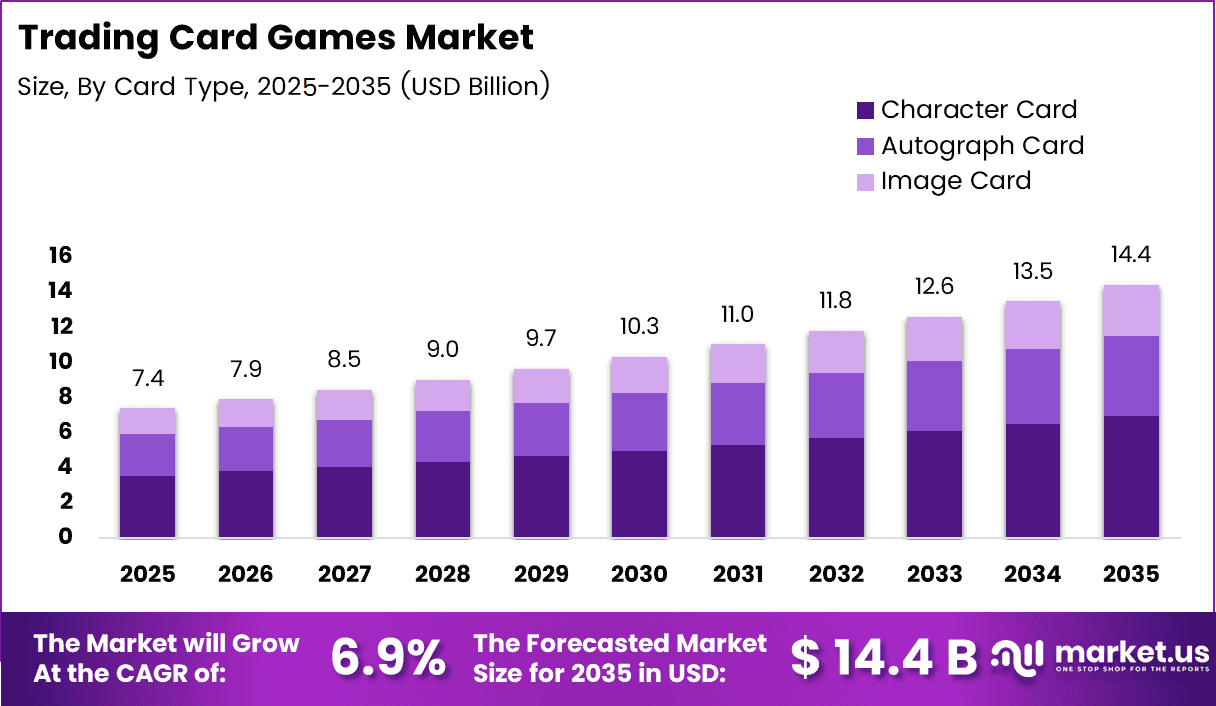
Global Trading Card Games Market size is expected to be worth around USD 14.4 Billion by 2035 from USD 7.4 Billion in 2025, growing at a CAGR of 6.9% during the forecast period 2026 to 2035.
The trading card games market encompasses both physical and digital collectible card formats where players build customized decks to compete strategically. These games combine collecting, trading, and competitive gameplay elements. Moreover, they span multiple entertainment genres including fantasy, anime, sports, and science fiction themes.
Trading card games have evolved from childhood pastimes into sophisticated competitive platforms. Consequently, they attract diverse age groups from kids to adults. The market benefits from strong intellectual property franchises and organized tournament ecosystems. Additionally, hybrid digital-physical models are expanding player engagement across platforms.
The industry demonstrates robust growth driven by e-sports integration and competitive gaming visibility. Therefore, major publishers invest heavily in organized play programs and global championships. Furthermore, adult collectors are driving premium card demand through nostalgia-based purchases. This trend significantly expands the traditional youth-focused demographic base.
Government regulations around digital payments and online gaming vary by region, impacting market accessibility. However, established franchises benefit from long-term player loyalty and brand recognition. Additionally, localization efforts help penetrate emerging markets with culturally adapted content and competitive pricing structures.
According to The Battle Bunnies, deck building typically involves 40 to 60 cards with strategic selection dramatically impacting gameplay. According to Gundam GCG, specific formats require exactly 50 cards with restrictions allowing up to 2 colors and 4 copies of identical cards. Moreover, competitive formats limit battlefield deployment to 6 units maximum.
Key Takeaways
- Global Trading Card Games Market projected to reach USD 14.4 Billion by 2035 from USD 7.4 Billion in 2025 at 6.9% CAGR
- Physical Card Games segment dominates with 69.2% market share in 2025
- Character Card type leads with 48.3% share across all card categories
- Fantasy genre holds 41.6% market share among gaming themes
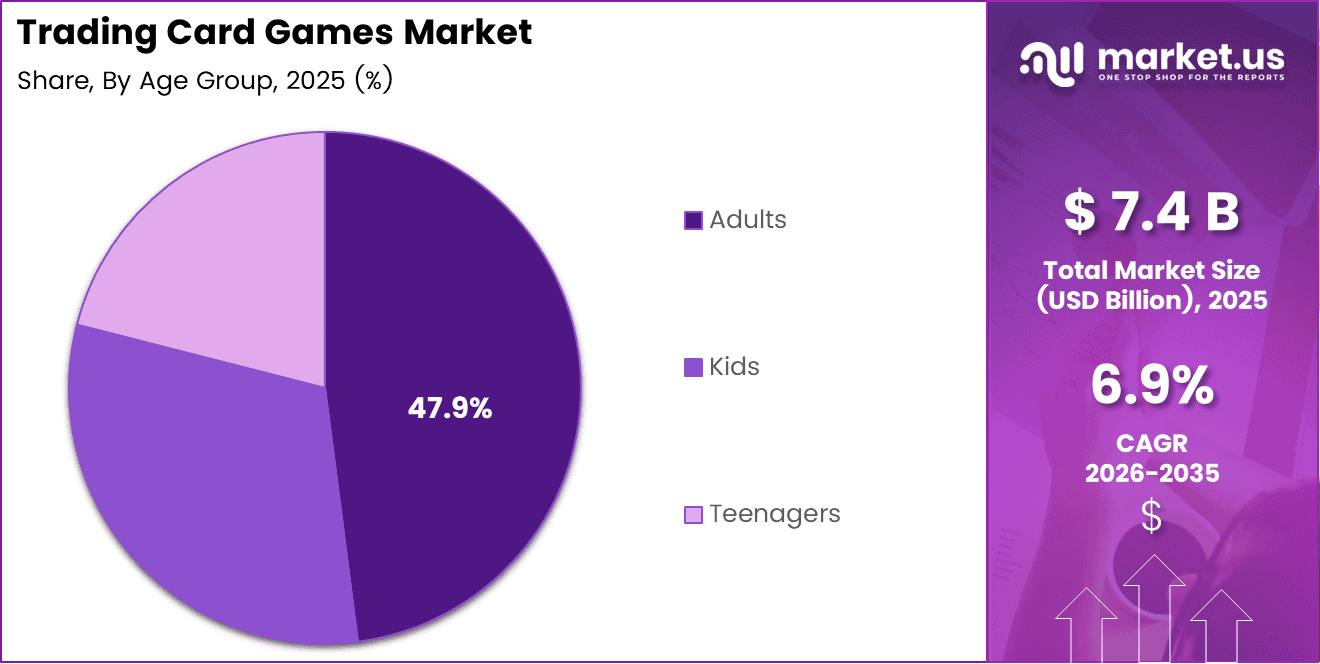
- Adults segment commands 47.9% share, surpassing traditional youth demographics
- North America dominates regionally with 46.90% share valued at USD 3.4 Billion
Type Analysis
Physical Card Games dominates with 69.2% due to tangible collectibility and established tournament infrastructure.
In 2025, ‘Physical Card Games’ held a dominant market position in the ‘Type’ segment of Trading Card Games Market, with a 69.2% share. Physical cards maintain strong appeal through tactile collecting experiences and competitive in-person tournaments. Moreover, graded card investments and secondary market trading sustain collector engagement. Premium packaging and limited editions further enhance physical product desirability.
Digital Card Games represent the growing technological evolution of traditional gameplay formats. Therefore, mobile platforms and online connectivity expand accessibility beyond geographic limitations. Additionally, digital formats eliminate physical storage constraints and enable instant global matchmaking. However, they capture smaller market share compared to established physical card traditions.
Card Type Analysis
Character Card dominates with 48.3% due to strategic gameplay importance and franchise recognition.
In 2025, ‘Character Card’ held a dominant market position in the ‘Card Type’ segment of Trading Card Games Market, with a 48.3% share. Character cards form the foundation of deck strategies and represent beloved franchise personalities. Consequently, they drive both gameplay mechanics and emotional collector connections. Furthermore, character rarity tiers create tiered collectibility and competitive advantages.
Autograph Card types appeal primarily to premium collectors seeking authenticated memorabilia value. These limited-edition releases command higher price points and investment potential. Additionally, autograph cards bridge sports memorabilia culture with trading card gaming traditions, attracting crossover audiences.
Image Card categories focus on artistic presentation and visual collectibility aspects. Therefore, they attract collectors prioritizing aesthetic value over competitive gameplay utility. Moreover, special illustration variants and artist collaborations create exclusive collectible releases.
Genre Analysis
Fantasy dominates with 41.6% due to established franchises and imaginative worldbuilding appeal.
In 2025, ‘Fantasy’ held a dominant market position in the ‘Genre’ segment of Trading Card Games Market, with a 41.6% share. Fantasy themes leverage dragons, magic systems, and mythological elements that resonate universally. Moreover, successful franchises like Magic The Gathering establish decades-long player communities. Therefore, fantasy settings enable creative card design and expansive narrative universes.
Sci-Fi genre attracts audiences preferring futuristic technology and space exploration themes. Consequently, franchises featuring robots, alien species, and advanced weaponry maintain dedicated followings. Additionally, sci-fi properties often cross-promote with popular media franchises and entertainment properties.
Anime genre capitalizes on Japanese animation popularity and established character franchises. Therefore, it drives significant collector demand in Asian markets and global anime communities. Sports genre serves niche audiences combining athletic competition with card collecting traditions. Historical themes attract educational-minded players and period-specific enthusiasts.
Others category encompasses hybrid genres and emerging thematic innovations. Consequently, it allows experimental game designs and niche community development. Moreover, this segment includes licensed properties from various entertainment media sources.
Age Group Analysis
Adults dominates with 47.9% due to nostalgia purchases and competitive esports participation.
In 2025, ‘Adults’ held a dominant market position in the ‘Age Group’ segment of Trading Card Games Market, with a 47.9% share. Adult players invest heavily in competitive deck building and premium collectibles. Moreover, nostalgia-driven purchases from childhood franchises sustain long-term engagement. Therefore, adults possess greater disposable income for tournament participation and rare card acquisitions.
Kids represent traditional entry-level players discovering trading card games through accessible starter products. Consequently, this segment drives volume sales through affordable booster packs and beginner-friendly formats. Additionally, kids benefit from parental purchases and gift-giving occasions throughout the year.
Teenagers bridge casual play and competitive gaming through organized school tournaments. Therefore, they develop strategic skills and social gaming communities during formative years. Moreover, teenagers engage actively with digital platforms and mobile companion applications for gameplay enhancement.
Key Market Segments
Type
- Physical Card Games
- Digital Card Games
Card Type
- Character Card
- Autograph Card
- Image Card
Genre
- Fantasy
- Sci-Fi
- Anime
- Sports
- Historical
- Others
Age Group
- Kids
- Teenagers
- Adults
Drivers
Competitive Esports Integration Elevating Trading Card Game Visibility and Participation
Esports tournaments transform trading card games into spectator entertainment with substantial prize pools. Consequently, professional player leagues attract mainstream media coverage and sponsorship investments. Moreover, streaming platforms broadcast competitive matches to global audiences, expanding market awareness. Therefore, organized play structures create career pathways for talented players.
Franchise-based intellectual properties sustain multi-generational player loyalty through recognizable characters and narratives. Additionally, established brands leverage decades of lore and community investment. Consequently, players maintain collections across multiple expansions and product cycles. This creates predictable revenue streams and sustained market demand.
Adult nostalgia purchases significantly expand beyond traditional youth demographics targeting childhood memories. Therefore, premium reprint editions and anniversary collections command higher price points. Moreover, adult collectors pursue graded vintage cards as investment assets. Tournament ecosystems provide structured competitive frameworks supporting local and international play communities.
Restraints
High Cost of Competitive Deck Building Limiting New Player Entry
Competitive deck construction requires purchasing multiple booster packs to acquire essential rare cards. Consequently, initial investment costs create significant barriers for budget-conscious newcomers. Moreover, meta-game shifts necessitate ongoing purchases to maintain competitive viability. Therefore, casual players face financial pressure competing against established collectors.
Secondary market prices for tournament-staple cards escalate beyond manufacturer suggested retail pricing. Additionally, speculative trading inflates rare card values disconnected from gameplay utility. Consequently, new players struggle accessing necessary cards for competitive participation. This economic barrier fragments the player base.
Counterfeit cards undermine consumer trust through fraudulent rare card reproductions flooding secondary markets. Therefore, authentication services become necessary expenses for high-value transactions. Moreover, market volatility from counterfeit proliferation destabilizes collector confidence. Inconsistent quality control and packaging security further exacerbate authentication challenges.
Growth Factors
Digital-to-Physical Hybrid Models Enabling Cross-Platform Player Engagement
Hybrid models integrate digital collection management with physical card ownership through companion applications. Consequently, players track inventory digitally while maintaining tangible card collections. Moreover, QR code authentication bridges physical products with online gameplay experiences. Therefore, manufacturers capture both traditional collectors and digital-native audiences simultaneously.
Emerging markets present untapped growth opportunities through localized game formats and culturally adapted pricing. Additionally, regional tournaments and community events establish grassroots player bases. Consequently, manufacturers customize card releases reflecting local entertainment preferences and folklore. This geographic expansion diversifies revenue streams.
Collaboration with entertainment media creates limited-edition card releases tied to movie premieres and series launches. Therefore, cross-promotional marketing amplifies brand visibility across multiple consumer touchpoints. Moreover, exclusive character cards drive collector demand among franchise enthusiasts. Subscription-based distribution models provide predictable monthly revenue through curated card deliveries and membership rewards.
Emerging Trends
Surge in Collector-Focused Premium and Graded Card Demand
Premium collector markets prioritize professionally graded cards authenticated through third-party certification services. Consequently, investment-grade cards appreciate as alternative assets within collectibles portfolios. Moreover, sealed vintage booster boxes command exponential value increases over time. Therefore, speculative collecting parallels traditional investment strategies.
Mobile companion apps enhance gameplay through digital deck management and real-time rule clarifications. Additionally, augmented reality features overlay digital animations onto physical cards during matches. Consequently, technology integration modernizes traditional gameplay without eliminating physical components. Tournament registration and matchmaking migrate toward mobile platforms.
Sustainability initiatives drive manufacturers toward eco-friendly card materials and recyclable packaging solutions. Therefore, biodegradable card stock and reduced plastic packaging appeal to environmentally conscious consumers. Moreover, carbon-neutral printing processes address corporate environmental responsibility commitments. Community-led content creation influences competitive meta-game strategies through social media analytics and deck optimization guides.
Regional Analysis
North America Dominates the Trading Card Games Market with a Market Share of 46.90%, Valued at USD 3.4 Billion
North America leads globally with a 46.90% market share valued at USD 3.4 Billion in 2025. The region benefits from established gaming culture and major publisher headquarters. Moreover, extensive retail distribution networks and organized tournament infrastructure support sustained growth. Consequently, North American consumers demonstrate high spending on premium collectibles and competitive play participation.
Europe Trading Card Games Market Trends
Europe demonstrates strong market presence through diverse language localizations and regional tournament circuits. Additionally, European collectors prioritize vintage card preservation and historical game editions. Consequently, secondary markets thrive through established trading communities and authentication services. Moreover, regulatory frameworks support consumer protection in digital transactions.
Asia Pacific Trading Card Games Market Trends
Asia Pacific experiences rapid growth driven by anime franchise popularity and mobile gaming adoption. Therefore, Japanese and Chinese publishers dominate regional content creation and distribution. Moreover, competitive esports viewership reaches unprecedented levels across digital platforms. Consequently, localized game formats cater to specific cultural preferences and gameplay styles.
Latin America Trading Card Games Market Trends
Latin America represents emerging growth markets with increasing disposable income and gaming culture adoption. Additionally, Spanish and Portuguese localizations expand accessibility across major population centers. Consequently, grassroots tournament organizations foster community development and competitive player bases. Moreover, affordability-focused product tiers accommodate regional pricing sensitivities.
Middle East & Africa Trading Card Games Market Trends
Middle East and Africa demonstrate nascent market development with growing youth demographics and digital connectivity. Therefore, mobile-first gaming platforms align with regional technology adoption patterns. Moreover, localized distribution partnerships establish retail presence in major urban centers. Consequently, cultural adaptations ensure content appropriateness for diverse regional audiences.
Key Regions and Countries
North America
- US
- Canada
Europe
- Germany
- France
- The UK
- Spain
- Italy
- Rest of Europe
Asia Pacific
- China
- Japan
- South Korea
- India
- Australia
- Rest of APAC
Latin America
- Brazil
- Mexico
- Rest of Latin America
Middle East & Africa
- GCC
- South Africa
- Rest of MEA
Key Company Insights
Z-Man Games maintains significant market presence through strategic board game and card game publishing portfolios. The company leverages innovative gameplay mechanics and distinctive artistic design philosophies. Moreover, Z-Man Games cultivates dedicated player communities through organized tournament support and expansion content releases. Consequently, their products maintain competitive relevance across multiple gaming demographics and skill levels.
TCGplayer dominates secondary market infrastructure providing digital marketplace platforms for card trading and pricing transparency. The company enables millions of transactions connecting buyers and sellers globally. Additionally, TCGplayer offers inventory management tools for retail stores and professional dealers. Therefore, their market data analytics influence pricing trends and collector investment strategies significantly.
Konami Holdings Corporation commands substantial market share through established franchise properties and competitive gaming ecosystems. The company benefits from decades of intellectual property development and global brand recognition. Moreover, Konami invests heavily in esports tournament infrastructure and professional player sponsorships. Consequently, their trading card games maintain multi-generational player loyalty and consistent revenue generation.
The Upper Deck Company specializes in premium sports and entertainment trading cards with authenticated memorabilia integration. The company pioneered hologram authentication technology preventing counterfeit card proliferation. Additionally, Upper Deck maintains exclusive licensing agreements with major sports leagues and entertainment franchises. Therefore, their premium product positioning commands higher price points among serious collectors and investors.
Key Players
- Z-Man Games
- TCGplayer
- Konami Holdings Corporation
- Steam Card Exchange
- The Upper Deck Company
- GameStop
- Hasbro Rio Grande Games
- Asmodee MyTradingCards
- Stonemaier Games
- Bushiroad
Recent Developments
- January 2026 – Games industry mergers and acquisitions reached a record $161 billion in 2025, with Electronic Arts’ $55 billion buyout and Netflix’s $82.7 billion acquisition of Warner Bros. dominating dealmaking activity during the year, demonstrating unprecedented consolidation trends.
- August 2025 – Pokémon TCG Pocket announced upcoming expansion introducing Mega Evolution cards including, Mega Gyarados ex, Mega Blaziken ex, and Mega Altaria ex during the Pokémon World Championships Closing Ceremony, scheduled for Fall release to enhance mobile gaming engagement.
Report Scope
Report Features Description Market Value (2025) USD 7.4 Billion Forecast Revenue (2035) USD 14.4 Billion CAGR (2026-2035) 6.9% Base Year for Estimation 2025 Historic Period 2020-2024 Forecast Period 2026-2035 Report Coverage Revenue Forecast, Market Dynamics, Competitive Landscape, Recent Developments Segments Covered Type (Physical Card Games, Digital Card Games), Card Type (Character Card, Autograph Card, Image Card), Genre (Fantasy, Sci-Fi, Anime, Sports, Historical, Others), Age Group (Kids, Teenagers, Adults) Regional Analysis North America (US and Canada), Europe (Germany, France, The UK, Spain, Italy, and Rest of Europe), Asia Pacific (China, Japan, South Korea, India, Australia, and Rest of APAC), Latin America (Brazil, Mexico, and Rest of Latin America), Middle East & Africa (GCC, South Africa, and Rest of MEA) Competitive Landscape Z-Man Games, TCGplayer, Konami Holdings Corporation, Steam Card Exchange, The Upper Deck Company, GameStop, Hasbro Rio Grande Games, Asmodee MyTradingCards, Stonemaier Games, Bushiroad Customization Scope Customization for segments, region/country-level will be provided. Moreover, additional customization can be done based on the requirements. Purchase Options We have three licenses to opt for: Single User License, Multi-User License (Up to 5 Users), Corporate Use License (Unlimited User and Printable PDF) 
-
-
- Z-Man Games
- TCGplayer
- Konami Holdings Corporation
- Steam Card Exchange
- The Upper Deck Company
- GameStop
- Hasbro Rio Grande Games
- Asmodee MyTradingCards
- Stonemaier Games
- Bushiroad
Our Clients

- 177965
- Feb 2026