


Report Overview
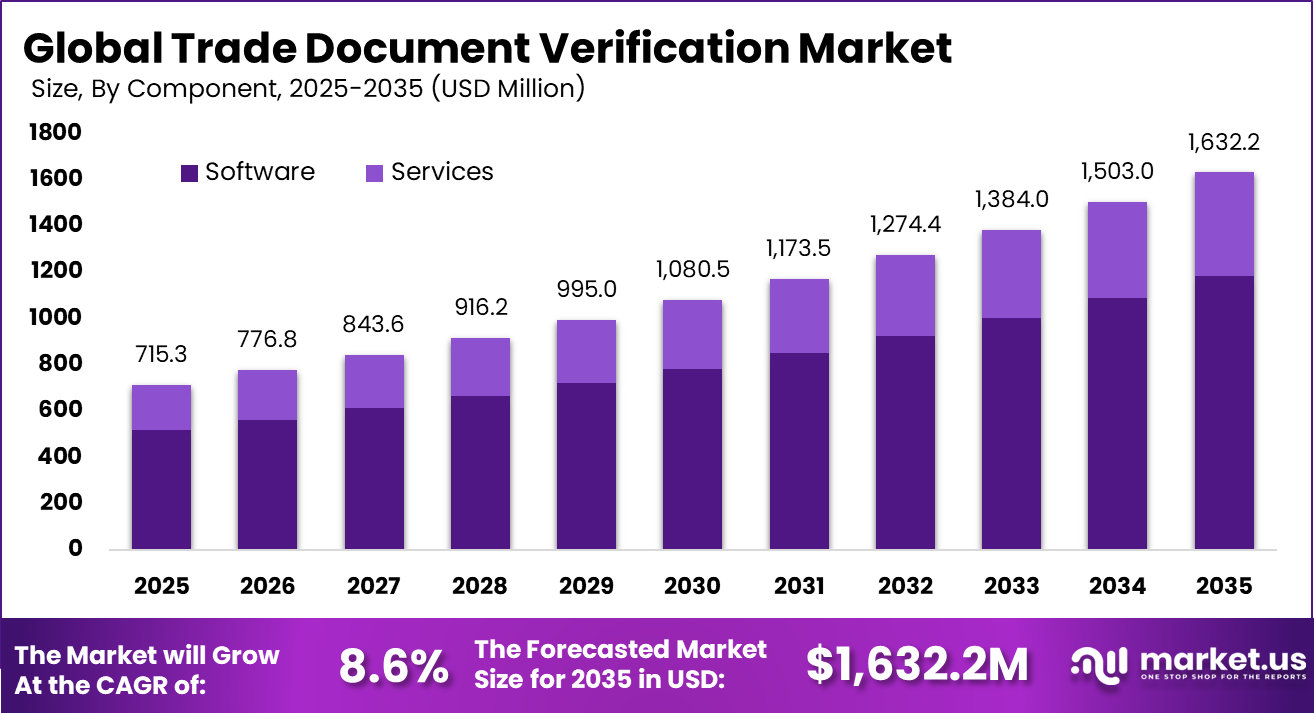
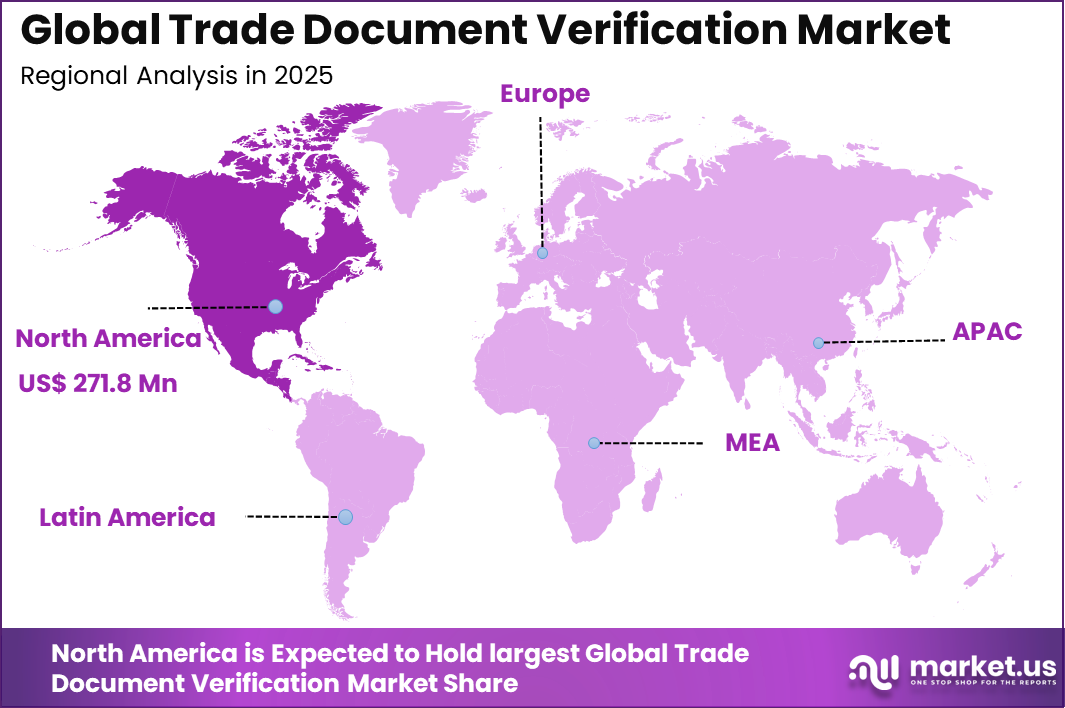
The Global Trade Document Verification Market size is expected to be worth around USD 1,632.2 million by 2035, from USD 715.3 million in 2025, growing at a CAGR of 8.6% during the forecast period from 2025 to 2035. North America held a dominant market position, capturing more than a 38% share, holding USD 271.8 million in revenue.
The Trade Document Verification Market refers to the ecosystem of digital solutions used to authenticate and validate trade related documents such as invoices, shipping records, and financial agreements across global trade operations. This market has evolved from manual, paper based verification toward automated and digital systems that improve accuracy, reduce delays, and strengthen compliance. The increasing complexity of international trade and the need for secure documentation have made verification processes a critical component of global supply chains.
Top driving factors for this market are strongly associated with the growing need to reduce inefficiencies and risks in trade documentation. Traditional paper based processes are often slow, error prone, and vulnerable to fraud. Industry assessments indicate that manual data handling in trade documentation creates inconsistencies and increases the risk of financial and compliance issues. The shift toward digital verification is helping to streamline workflows and improve reliability across trade transactions.
Demand continues to rise as supply chains expand across multiple countries, increasing the need for quick and reliable document validation. Around 70% of trade disputes are linked to mismatched or fraudulent documents, which drives companies to prioritize verification. Small businesses, in particular, depend on faster checks to avoid costly delays at ports and financial institutions.
For instance, in June 2025, TradeShift enhanced its Trade Finance module with AI‑assisted document‑validation workflows that auto‑check invoices, purchase orders, and shipping documents. The upgrade is being used by mid‑market manufacturers and distributors in North America to streamline early‑payment and receivables‑financing programs.
Key Takeaway
- In 2025, the software segment led the global trade document verification market with a share of 72.6%.
- Commercial invoices accounted for 38.2%, making them the dominant document type in verification processes.
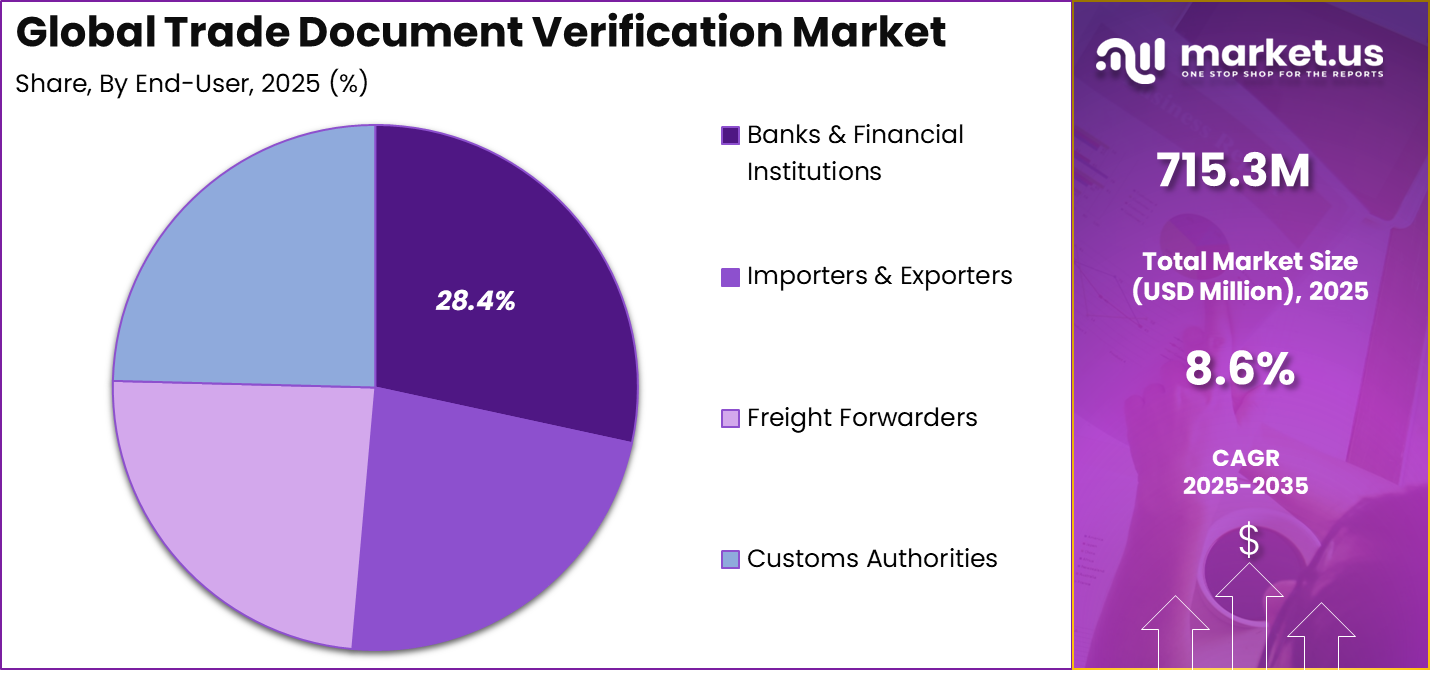
- Banks and financial institutions held 28.4%, reflecting their key role in trade finance and compliance checks.
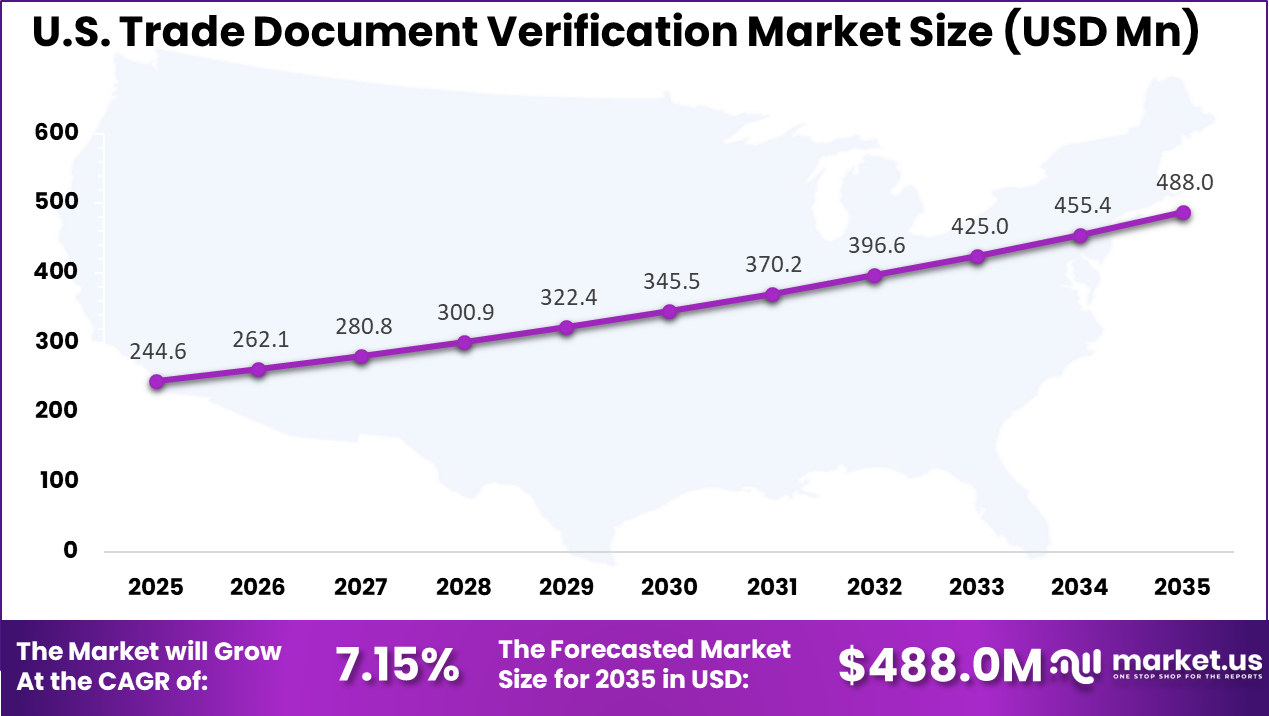
- The U.S. trade document verification market was valued at USD 244.6 million in 2025 and is projected to grow at a CAGR of 7.15%.
- North America captured more than 38% of the global market in 2025, supported by strong regulatory frameworks and digital adoption.
Key Insights Summary
- More than 3 billion digital transactions required identity proofing and document validation in 2023, reflecting rapid growth in digital onboarding.
- AI-enhanced verification solutions recorded a 49% increase in adoption across banking, healthcare, and e-commerce between early 2023 and 2024.
- Advanced AI systems can now detect over 500 types of identity documents from more than 180 countries, improving global verification coverage.
- AI-driven forgery detection has improved fraud identification rates by 244%, significantly reducing manual verification time.
- Around 78% of Know Your Customer processes now begin on smartphones, highlighting the shift toward mobile-first verification.
- Financial services remain the leading sector for identity verification, followed by growing demand in government, education, and healthcare.
- AI-powered tools can process complex trade and compliance documents within minutes, compared to traditional methods that often take days.
U.S. Market Size
The market for Trade Document Verification within the U.S. is growing tremendously and is currently valued at USD 244.6 million, the market has a projected CAGR of 7.15%. The market is growing due to increasing cross-border trade activity and rising compliance requirements across financial and logistics sectors. Businesses are focusing on reducing fraud risks and improving document accuracy, while digital transformation in trade operations is encouraging faster adoption of automated verification solutions across industries.
For instance, in March 2025, IBM strengthened U.S. dominance in Trade Document Verification by launching enhanced AI-powered blockchain solutions from Armonk, New York. Their new platform automates trade document authentication with real-time verification, reducing fraud by 40% for global supply chains. This innovation reinforces North America’s leadership in secure digital trade compliance.
In 2025, North America held a dominant market position in the Global Trade Document Verification Market, capturing more than a 38% share, holding USD 271.8 million in revenue. This dominance is due to strong digital trade infrastructure, strict compliance standards, and early adoption of automation across banking, logistics, and customs processes. The region also faces high scrutiny around fraud prevention, which increases demand for reliable verification tools that improve speed, accuracy, and trust in cross-border transactions.
For instance, in April 2025, Descartes, based in Waterloo, Ontario, launched Descartes Trade Document Suite across North America. The solution automates verification for cross-border shipments, serving 3,000+ logistics firms with 98% compliance rates. This Canadian innovation underscores North America’s dominance in integrated trade verification technology.
Component Analysis
In 2025, The Software segment held a dominant market position, capturing a 72.6% share of the Global Trade Document Verification Market. This dominance is due to the strong shift toward digital processing in trade operations. Companies prefer automated tools to manage large volumes of documents with better speed and accuracy, which supports smoother workflows and reduces manual intervention across verification processes.
Software solutions also improve consistency in compliance checks and reduce dependency on human review. They help businesses handle complex trade rules while maintaining accuracy. As digital trade expands, software platforms continue to play a key role in simplifying verification tasks and improving operational efficiency across global transactions and documentation handling.
For Instance, in March 2026, SAP pushed forward with automation features in its platforms, focusing on invoice processing through software layers. The new setup catches errors before they hit main systems, cutting down manual work. Businesses using SAP software gain speed in verifying trade docs, which boosts daily efficiency. This kind of update shows why software grows strong in this space, handling complex checks effortlessly.
Document Type Analysis
In 2025, the Commercial Invoices segment held a dominant market position, capturing a 38.2% share of the Global Trade Document Verification Market. This dominance is due to their central role in every trade transaction, where they define product details, pricing, and shipment value. These documents are essential for customs clearance and payment processing, making them the most frequently verified records.
Their high usage across import and export activities increases the need for accurate verification. Any mismatch in invoice data can lead to disputes or shipment delays. As a result, businesses focus heavily on verifying these documents to ensure smooth trade flow and maintain trust between trading partners and financial institutions.
For instance, in April 2026, IBM advanced its trade platform to better handle invoice details in digital flows. By linking fintech tools, it verifies commercial invoices against shipment records seamlessly. This helps traders avoid delays from mismatched data, a common pain point. Such developments keep invoices central as trade picks up pace globally.
End-User Analysis
In 2025, The Banks & Financial Institutions segment held a dominant market position, capturing a 28.4% share of the Global Trade Document Verification Market. This dominance is due to their responsibility in handling trade finance and ensuring compliance with regulatory requirements. They process large volumes of trade documents and must verify each one carefully to prevent fraud and maintain transaction integrity.
These institutions rely on verification systems to support secure payment flows and meet strict compliance standards. Document accuracy is critical for approving letters of credit and other financial instruments. As trade volumes grow, banks continue to invest in reliable verification processes to manage risks and ensure smooth cross-border transactions.
For Instance, in March 2026, Accenture named new leaders for services that aid banks in digital trade setups. Their focus on secure platforms helps financial teams verify docs before funding deals. Banks cut risks from fakes, speeding up trade finance approvals. This leadership shift promises tailored solutions for institutions handling high-stakes papers.
Emerging Trends Analysis
The trade document verification market is undergoing a structural shift from manual validation to AI-enabled automated verification systems. Traditionally, trade finance relied heavily on paper-based processes such as letters of credit and invoices, which created delays and increased operational risks. Recent developments show that artificial intelligence is being applied to automate document examination, detect discrepancies, and improve workflow efficiency across trade finance operations.
Another important trend is the integration of real-time data validation and cross-document intelligence. AI systems now compare shipment records, invoices, and transaction histories simultaneously to identify inconsistencies early in the process. This capability is reducing fraud risks and improving accuracy, while also enabling faster approvals in cross-border transactions. As global trade continues to digitize, document verification is increasingly becoming a real-time, system-driven process rather than a sequential manual activity.
Growth Factors
One of the key growth factors is the rapid increase in digital trade and cross-border transactions. The global expansion of e-commerce, digital banking, and supply chain digitization has significantly increased the volume of documents that require verification. At the same time, rising cybercrime levels, with over 859,000 reported cases and losses exceeding USD 16.6 billion, are pushing organizations to adopt more secure and automated verification systems.
Another major growth factor is the need to reduce operational inefficiencies in trade finance. Manual document checking processes are time-consuming and prone to human error, which can delay payments and increase transaction costs. AI-driven automation has demonstrated the ability to reduce processing time by nearly 60%, allowing financial institutions and enterprises to accelerate transaction cycles and improve working capital efficiency.
Key Market Segments
By Component
- Software
- Services
By Document Type
- Bills of Lading
- Certificates of Origin
- Commercial Invoices
- Insurance Documents
- Others
By End-User
- Banks & Financial Institutions
- Importers & Exporters
- Freight Forwarders
- Customs Authorities
Key Regions and Countries
North America
- US
- Canada
Europe
- Germany
- France
- The UK
- Spain
- Italy
- Russia
- Netherlands
- Rest of Europe
Asia Pacific
- China
- Japan
- South Korea
- India
- Australia
- Singapore
- Thailand
- Vietnam
- Rest of APAC
Latin America
- Brazil
- Mexico
- Rest of Latin America
Middle East & Africa
- South Africa
- Saudi Arabia
- UAE
- Rest of MEA
Drivers
Stronger Compliance Needs
Trade document verification is gaining importance as businesses face tighter checks across cross-border transactions. Companies must confirm that invoices, shipping papers, and supporting records are accurate and complete. This need is rising because trade operations now involve more scrutiny from financial institutions, customs authorities, and internal risk teams.
Clear verification practices help businesses reduce errors, improve document trust, and support smoother transaction approval. They also make it easier to maintain audit trails and respond to regulatory reviews. As trade compliance becomes more demanding, firms are giving more attention to systems that strengthen document control and review quality.
For instance, in December 2025, Thomson Reuters earned top marks in global trade management reports for its strong tools that help firms meet tough compliance rules. They rolled out updated content packs to handle rising checks on shipments, making sure businesses stay ahead of changing laws without missing a beat. This keeps trade flowing smoothly even under stricter eyes.
Restraint
High Setup Hurdles
One major restraint is the difficulty of setting up verification systems across existing trade operations. Many firms still use older processes and paper-based workflows, which makes integration slower and more costly. This can delay adoption, especially for organizations that lack strong technical support or clear digital transition plans.
Training staff and adjusting daily processes also adds to the challenge. Businesses often need time to align internal teams, update systems, and build confidence in new tools. For smaller firms, these early hurdles can feel heavy, even when the long-term value of document verification is clearly understood.
For instance, in November 2025, IBM launched a new platform for handling digital assets across blockchains, but early users noted the steep learning curve for linking it to old systems. Teams spent extra weeks training staff and tweaking connections, which slowed down full rollout. Smaller outfits found the initial tweaks too time-heavy to jump in right away.
Opportunities
Digital Trade Expansion
The shift toward digital trade is creating a strong opportunity for document verification solutions. As more transactions move online, businesses need faster ways to check invoices, shipping papers, and related records. This creates room for tools that improve speed, reduce manual effort, and support smoother movement across trade channels.
Digital trade also encourages better data visibility and more connected workflows between partners. Verification platforms can help businesses handle larger document volumes without losing control or accuracy. As paperless trade continues to spread, the market is well placed to benefit from rising demand for secure and efficient verification processes.
For instance, in April 2026, Thomson Reuters teamed up to feed validated trade data straight into Oracle setups, easing digital flows for online deals. This plug-in lets users check documents on the fly as trade goes electronic, opening doors for quicker border crossings. It fits right into growing e-trade platforms without extra hassle.
Challenges
System Fragmentation
One major challenge in this market is the fragmented nature of trade systems across regions and institutions. Different parties often use separate platforms, formats, and review methods. This makes document verification harder to manage because the same record may need to pass through several systems before a transaction is completed.
Fragmentation also creates delays when information cannot move smoothly between stakeholders. A document checked in one system may still require manual review in another. This weakens efficiency and adds complexity to cross border trade. For many firms, building a consistent verification process remains difficult in such a disconnected environment.
For instance, in December 2025, IBM’s blockchain push for trade finance ran into snags from mismatched formats across customs and banks in Dubai trials. Different data standards caused gaps in sharing shipment details, forcing manual fixes. It highlighted how varied regional setups still trip up unified verification efforts.
Key Players Analysis
The competitive landscape of the Trade Document Verification Market is led by established enterprise solution providers such as Thomson Reuters, SAP, and IBM. These firms offer advanced digital verification systems supported by AI and compliance tools. Their platforms help reduce document processing time by over 40%. Accenture and Oracle further strengthen the market through integrated trade finance and risk management solutions.
Logistics and trade technology providers such as Descartes and WiseTech Global play a key role in digitizing cross border documentation. These platforms enable automated validation and real time tracking of trade documents. Digital adoption in trade documentation has increased by nearly 35% due to rising global trade complexity. Bolero, essDOCS, and CargoX focus on secure electronic document exchange using blockchain and encryption technologies.
IT service and compliance focused firms such as TradeShift, Infosys, Wipro, Hexaware, and Exiger support implementation and regulatory compliance. These companies help enterprises modernize legacy trade systems and improve verification accuracy. Automation in document verification has improved accuracy levels to above 95% in controlled environments. Other emerging players continue to innovate with AI driven fraud detection and verification tools.
Top Key Players in the Market
- Thomson Reuters
- SAP
- IBM
- Accenture
- Oracle
- Descartes
- WiseTech Global
- Bolero
- essDOCS
- CargoX
- TradeShift
- Infosys
- Wipro
- Hexaware
- Exiger
- Others
Recent Developments
- In April 2026, Thomson Reuters enhanced its trade‑document verification capability by integrating real‑time AI‑driven sanctions and customs‑rule checks into its global trade content platform used by SAP and Oracle users. The upgrade cuts manual document reviews by 50-70% for large corporate clients and banks, reinforcing North America’s leadership in rule‑based documentary compliance.
- In March 2026, SAP expanded its SAP Trade Compliance add‑on with AI‑assisted trade‑document verification, enabling customers to auto‑check letters of credit, bills of lading, and certificates of origin against customs and regulatory rules. The module is now embedded in major SAP S/4HANA deployments, helping European and U.S. exporters reduce documentary errors and D/D delays.
Report Scope
| Report Features | Description |
|---|---|
| Market Value (2024) | USD 715.3 Mn |
| Forecast Revenue (2034) | USD 1,632.2 Mn |
| CAGR(2025-2034) | 8.6% |
| Base Year for Estimation | 2024 |
| Historic Period | 2020-2023 |
| Forecast Period | 2025-2034 |
| Report Coverage | Revenue forecast, AI impact on Market trends, Share Insights, Company ranking, competitive landscape, Recent Developments, Market Dynamics and Emerging Trends |
| Segments Covered | By Component (Software, Services), By Document Type (Bills of Lading, Certificates of Origin, Commercial Invoices, Insurance Documents, Others), By End-User (Banks & Financial Institutions, Importers & Exporters, Freight Forwarders, Customs Authorities) |
| Regional Analysis | North America – US, Canada; Europe – Germany, France, The UK, Spain, Italy, Russia, Netherlands, Rest of Europe; Asia Pacific – China, Japan, South Korea, India, New Zealand, Singapore, Thailand, Vietnam, Rest of Latin America; Latin America – Brazil, Mexico, Rest of Latin America; Middle East & Africa – South Africa, Saudi Arabia, UAE, Rest of MEA |
| Competitive Landscape | Thomson Reuters, SAP, IBM, Accenture, Oracle, Descartes, WiseTech Global, Bolero, essDOCS, CargoX, TradeShift, Infosys, Wipro, Hexaware, Exiger, Others |
| Customization Scope | Customization for segments, region/country-level will be provided. Moreover, additional customization can be done based on the requirements. |
| Purchase Options | We have three license to opt for: Single User License, Multi-User License (Up to 5 Users), Corporate Use License (Unlimited User and Printable PDF) |





































