


Global Toothpick Market Size, Share, Growth Analysis By Material (Wood, Bamboo, Plastic, Others), By Application (Residential, Commercial), By Distribution Channel (Supermarket/Hypermarket, Pharmacy, Online/E-Commerce, Others), By Region and Companies - Industry Segment Outlook, Market Assessment, Competition Scenario, Statistics, Trends and Forecast 2026-2035
- Published date: March 2026
- Report ID: 182452
- Number of Pages: 277
- Format:
-
keyboard_arrow_up
Quick Navigation
Report Overview
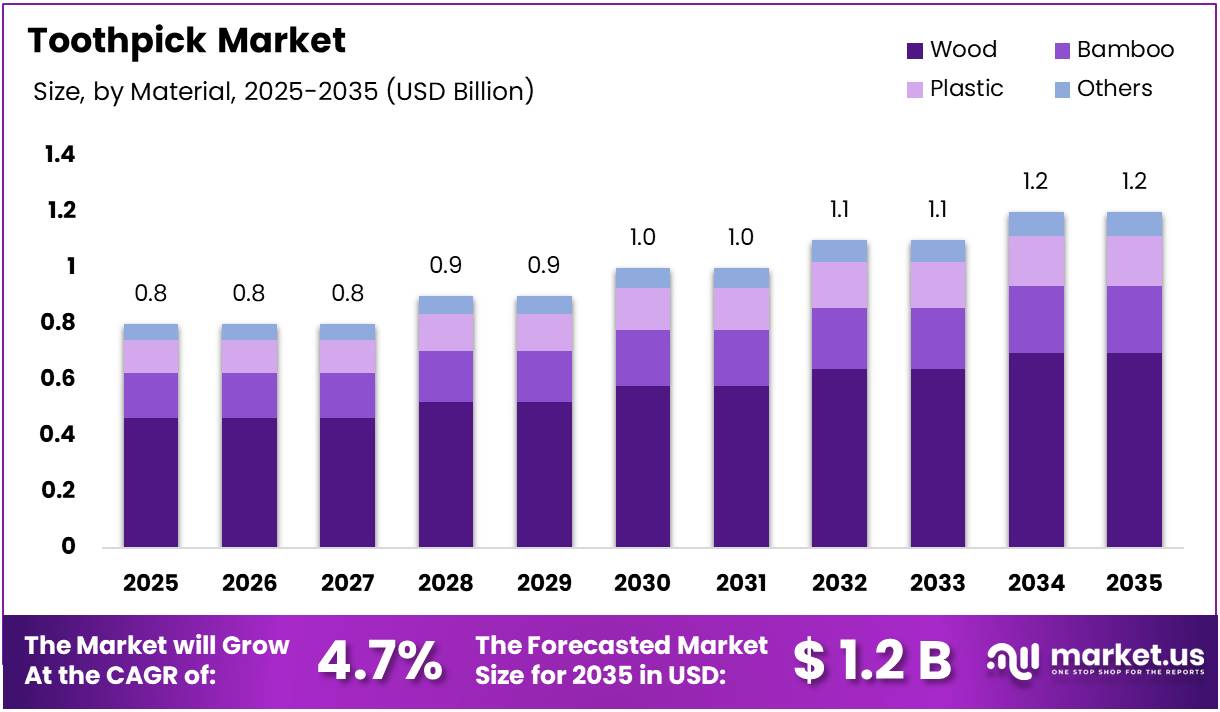
The Global Toothpick Market size is expected to be worth around USD 1.2 Billion by 2035 from USD 0.8 Billion in 2025, growing at a CAGR of 4.7% during the forecast period 2026 to 2035.
The toothpick market refers to the global industry involved in the production, distribution, and sale of toothpicks used for oral hygiene and food service purposes. These small tools are manufactured from wood, bamboo, plastic, and other materials. They serve both personal and commercial applications across households, restaurants, and hospitality businesses.
Toothpicks are among the oldest and most widely used oral care accessories in the world. They support basic interdental cleaning and remain a preferred option in many cultures. Moreover, their affordability and easy availability make them a consistent consumer staple. The market continues to evolve with innovations in materials, flavors, and packaging formats.
Market growth is driven by increasing awareness of oral hygiene, expanding foodservice industries, and rising urbanization in developing economies. Additionally, consumer preference for convenient and portable hygiene products supports steady demand. Manufacturers are responding with eco-friendly and premium product variants to capture a broader consumer base.
Government regulations on single-use plastics are shaping the direction of toothpick production globally. Many countries are enforcing restrictions on plastic waste, which is pushing manufacturers toward biodegradable and sustainable materials. Consequently, bamboo and wood-based toothpicks are witnessing increased investment and product development activity.
The growth opportunity is further supported by the expansion of packaged food consumption and ready-to-eat meal habits. According to a study published in the SRM Journal of Research in Dental Sciences, 58.6% of patients used toothpicks daily, highlighting consistent demand driven by everyday oral care habits.
Additionally, clinical research supports the functional value of toothpicks in oral care routines. According to a study published in PubMed (NCBI), toothpicks achieved a 74% plaque reduction in clinical testing. Furthermore, another PubMed-indexed study found that 40% of respondents used only the toothpick as their interdental oral hygiene device, reinforcing the product’s relevance in the market.
Key Takeaways
- The global toothpick market was valued at USD 0.8 Billion in 2025 and is projected to reach USD 1.2 Billion by 2035.
- The market is expected to grow at a CAGR of 4.7% during the forecast period 2026 to 2035.
- By Material, the Wood segment held the dominant share at 58.1% in 2025.
- By Application, the Residential segment led the market with a 67.7% share in 2025.
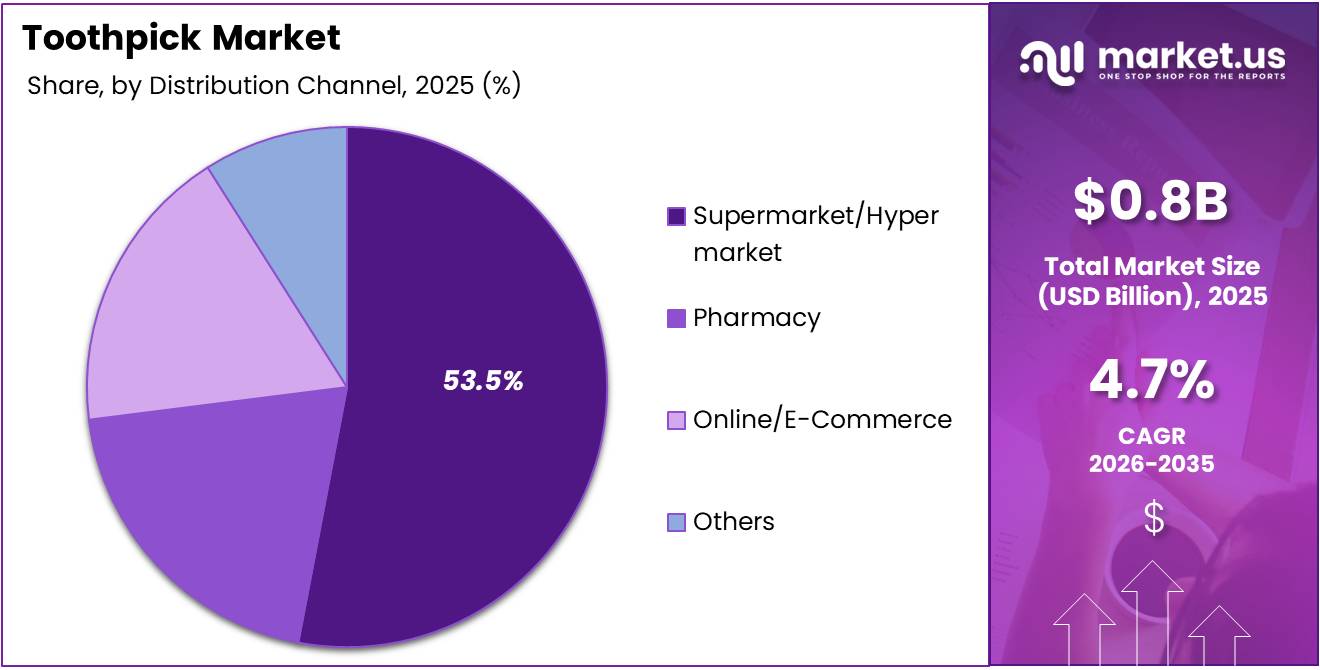
- By Distribution Channel, Supermarket/Hypermarket accounted for the largest share at 53.5% in 2025.
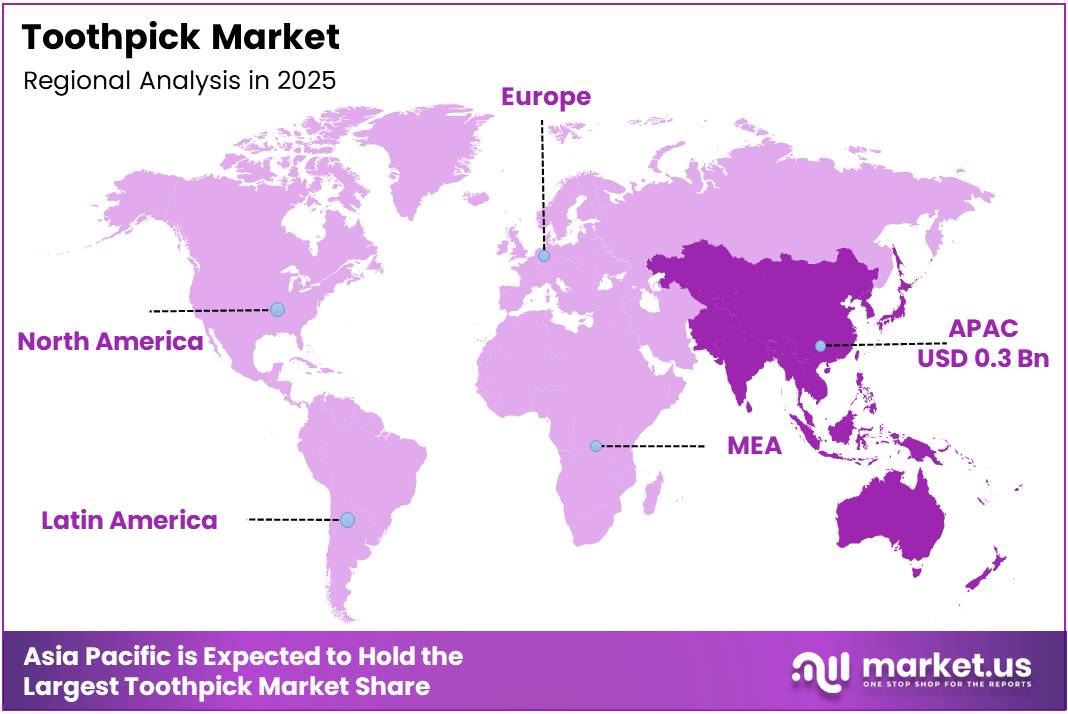
- Asia Pacific dominated the regional landscape with a market share of 45.70%, valued at approximately USD 0.3 Billion in 2025.
By Material Analysis
Wood dominates with 58.1% due to its wide availability, low cost, and long-standing consumer acceptance.
In 2025, Wood held a dominant market position in the By Material segment of the Toothpick Market, with a 58.1% share. Wood remains the most widely used raw material for toothpick production globally. Its natural properties, cost efficiency, and ease of manufacturing make it a preferred choice for both mass-market and private-label brands across regions.
Bamboo is gaining significant traction as a sustainable alternative to conventional wood toothpicks. Increasing environmental awareness and regulatory pressure on deforestation are driving consumers and manufacturers toward bamboo. It is stronger and faster-growing than most wood types, making it a highly viable eco-friendly option for future product development.
Plastic toothpicks continue to hold a notable share, particularly in commercial food service settings. However, growing restrictions on single-use plastics in many countries are limiting their long-term growth potential. Manufacturers are gradually transitioning away from plastic variants in response to both regulatory requirements and shifting consumer preferences.
Others include materials such as metal, starch-based composites, and novel biodegradable alternatives. These variants represent a smaller portion of the market but are attracting investment through innovation-driven segments. Additionally, functional and infused toothpick formats using alternative materials are emerging as niche but high-growth product categories.
By Application Analysis
Residential dominates with 67.7% due to high daily usage in household oral hygiene and meal routines.
In 2025, Residential held a dominant market position in the By Application segment of the Toothpick Market, with a 67.7% share. Household demand continues to account for the majority of toothpick consumption globally. Daily oral care habits, combined with use during meals at home, sustain consistent and high-volume residential purchases across all income groups.
Commercial applications cover usage across restaurants, hotels, catering businesses, and food courts. This segment is growing steadily alongside the global expansion of the foodservice and hospitality industries. Moreover, rising dining-out habits and the growth of fast-casual restaurant formats are supporting increased commercial procurement of toothpick products.
By Distribution Channel Analysis
Supermarket/Hypermarket dominates with 53.5% due to high consumer foot traffic and broad product availability.
In 2025, Supermarket/Hypermarket held a dominant market position in the By Distribution Channel segment of the Toothpick Market, with a 53.5% share. These retail formats offer consumers wide product variety and easy accessibility during routine grocery shopping. Their extensive reach across urban and semi-urban markets ensures consistent high sales volumes for toothpick brands.
Pharmacy distribution channels serve a specific consumer base focused on oral health and hygiene products. Toothpicks sold via pharmacies often carry a premium or medically endorsed positioning. Consequently, this channel supports higher unit value sales and is particularly relevant in markets where oral health awareness is growing steadily.
Online/E-Commerce is emerging as a rapidly growing distribution channel for toothpick products. Subscription-based models, bulk purchasing options, and access to premium or specialty toothpick brands are driving online demand. Additionally, growing digital commerce infrastructure in emerging economies is expanding the reach of this channel significantly.
Others include convenience stores, dollar stores, specialty retail outlets, and direct-to-business supply channels. While smaller in share, these outlets play an important role in last-mile distribution and impulse purchases. They also cater to specific regional buying behaviors, especially in markets where modern retail penetration remains limited.
Key Market Segments
By Material
- Wood
- Bamboo
- Plastic
- Others
By Application
- Residential
- Commercial
By Distribution Channel
- Supermarket/Hypermarket
- Pharmacy
- Online/E-Commerce
- Others
Drivers
Rising Demand for Convenient Oral Care and Foodservice Usage Drives Toothpick Market Growth
Growing consumer focus on personal hygiene is a primary driver of toothpick market growth. Toothpicks offer a simple, portable, and cost-effective solution for interdental cleaning after meals. Moreover, their ease of use and availability in both retail and foodservice settings support continuous and broad-based demand across global markets.
The foodservice and hospitality industry is a major growth contributor to toothpick consumption. Restaurants, hotels, and catering businesses rely on toothpick supplies as a standard service accessory. Additionally, the global expansion of fast food chains and casual dining formats is steadily increasing commercial procurement volumes across developed and emerging markets.
The growing consumption of packaged and ready-to-eat food products is also reinforcing market demand. Consumers who frequently eat on the go are more likely to use toothpicks for convenience-based oral hygiene. Consequently, the rise of convenience food culture, particularly in urban areas, directly supports higher and more consistent toothpick usage patterns globally.
Restraints
Environmental Concerns and Substitute Products Restrain Toothpick Market Expansion
Environmental concerns surrounding single-use wooden and plastic toothpick waste are becoming a significant market restraint. Growing awareness of deforestation and plastic pollution is leading consumers and regulators to question the sustainability of mass-use toothpick products. Moreover, several governments are actively introducing policies that limit single-use disposable items in consumer and commercial settings.
The availability of effective oral care substitutes is also limiting toothpick market growth. Products such as dental floss, interdental brushes, and water flossers offer clinically superior cleaning performance. Additionally, increasing dentist recommendations favoring these alternatives are gradually shifting consumer habits away from traditional toothpick use in hygiene-conscious demographics.
Together, these factors create a dual pressure on the toothpick market. Manufacturers must balance product sustainability with cost competitiveness while also differentiating from substitute categories. Consequently, brands that fail to innovate or reposition around eco-friendly and functional value propositions may face declining relevance in health-aware consumer segments.
Growth Factors
Eco-Friendly Innovation and Emerging Market Expansion Accelerate Toothpick Market Growth
The development of eco-friendly and biodegradable toothpick materials presents a major growth opportunity for market participants. Bamboo, cornstarch composites, and other sustainable inputs are replacing plastic and conventional wood variants. Moreover, growing consumer preference for green products is creating strong demand for certified sustainable toothpick brands across retail and e-commerce platforms.
Flavored and functional toothpick variants are gaining traction as a high-value product innovation segment. Products infused with mint, charcoal, or herbal extracts offer added benefits beyond basic oral care. Additionally, these premium variants command higher price points and attract health-conscious consumers who seek multifunctional hygiene and wellness products in their daily routines.
Increasing urbanization and rising disposable income in emerging markets are creating new demand pools for toothpick products. Countries across Asia, Africa, and Latin America are witnessing rapid growth in both organized retail and foodservice infrastructure. Consequently, these regions offer significant volume-driven opportunities for global and regional toothpick manufacturers seeking to expand their geographic presence.
Emerging Trends
Sustainability, Hygiene Packaging, and Functional Formats Reshape the Toothpick Market
The rising popularity of bamboo-based toothpicks is reshaping material preferences across the global market. Bamboo is increasingly recognized as a sustainable, fast-renewing, and durable alternative to wood. Moreover, eco-conscious consumers and retailers are prioritizing bamboo products in response to growing pressure on brands to reduce their environmental footprint.
Growing demand for individually wrapped and hygienically packaged toothpick formats is another notable trend. Consumers in foodservice and health-focused retail segments are seeking products that meet higher hygiene standards. Additionally, individually sealed packaging is becoming a differentiating factor for premium toothpick brands targeting restaurants, airlines, and hospitality businesses globally.
The increasing adoption of infused toothpicks with mint, herbal, or medicated extracts is creating a new functional product category. These innovations extend the perceived value of toothpicks beyond simple oral cleaning. Consequently, manufacturers offering flavor-infused or wellness-oriented variants are capturing premium shelf space and appealing to younger, health-aware consumer demographics worldwide.
Regional Analysis
Asia Pacific Dominates the Toothpick Market with a Market Share of 45.70%, Valued at USD 0.3 Billion
Asia Pacific is the leading regional market for toothpicks, holding a dominant share of 45.70% and valued at approximately USD 0.3 Billion in 2025. The region benefits from large populations, deeply rooted toothpick usage habits, and a rapidly growing foodservice industry. Moreover, the presence of major bamboo and wood raw material sources supports strong local manufacturing capacity across countries like China, India, and Japan.
North America Toothpick Market Trends
North America represents a mature but steadily growing toothpick market driven by retail innovation and premium product adoption. Consumer interest in flavored, infused, and hygienically packaged formats is particularly strong in the United States. Additionally, the well-established foodservice sector continues to generate consistent commercial demand across the region.
Europe Toothpick Market Trends
Europe is witnessing growing interest in sustainable and eco-certified toothpick products, driven by strict environmental regulations. The EU’s focus on reducing single-use plastic waste is accelerating the shift toward bamboo and biodegradable alternatives. Consequently, European manufacturers and retailers are actively reformulating their product offerings to meet evolving compliance and consumer standards.
Middle East and Africa Toothpick Market Trends
The Middle East and Africa region is an emerging market for toothpick products, supported by urbanization and expanding organized retail. Growing hospitality and food service sectors in Gulf countries are contributing to commercial demand. Furthermore, rising health awareness and disposable income in key African markets are gradually supporting consumer spending on oral hygiene accessories.
Latin America Toothpick Market Trends
Latin America presents a growing opportunity for toothpick market participants, particularly in Brazil and Mexico. Expanding food retail infrastructure and a young urban consumer base are supporting volume demand. Additionally, local manufacturers and regional distributors are increasing availability of affordable toothpick products across traditional trade and modern retail channels in the region.
Key Regions and Countries
North America
- US
- Canada
Europe
- Germany
- France
- The UK
- Spain
- Italy
- Rest of Europe
Asia Pacific
- China
- Japan
- South Korea
- India
- Australia
- Rest of APAC
Latin America
- Brazil
- Mexico
- Rest of Latin America
Middle East & Africa
- GCC
- South Africa
- Rest of MEA
Key Company Insights
TePe Oral Hygiene Products Ltd is a Swedish oral care company with a strong global presence in interdental and hygiene accessories, including toothpicks. The company focuses on evidence-based product development and professional dental recommendations. Its commitment to sustainable materials and clinical-grade oral care solutions positions it as a premium player in the global toothpick and oral hygiene accessories market.
Jordan is a well-established Norwegian brand recognized for its wide range of oral care products, including toothpicks and interdental tools. The company leverages decades of consumer trust and distribution partnerships across Europe and international markets. Jordan continues to innovate with eco-friendly and ergonomically designed toothpick products that align with growing sustainability and consumer convenience trends.
Panda Bambu specializes in bamboo-based oral care accessories, positioning itself as a sustainability-focused alternative in the toothpick segment. The brand caters to environmentally conscious consumers seeking biodegradable options. Its focus on bamboo sourcing, natural packaging, and a zero-waste product philosophy makes it well-suited to capitalize on the growing global demand for green oral hygiene products.
Daneson Ltd is a premium toothpick brand known for its single-malt Scotch and flavored toothpick offerings. The company targets upscale consumers and gift markets, differentiating through luxury positioning and unique product experiences. Daneson’s focus on infused and artisanal toothpick formats places it at the forefront of the functional and premium toothpick innovation trend globally.
Key players
- TePe Oral Hygiene Products Ltd
- Jordan
- Panda Bambu
- Daneson Ltd
- Bluem
- Astir IKE
- Paras Corporation
- Teepee Brush Manufacturers Ltd.
- The Humble Co.
- Curaprox
Recent Developments
- March 2025 – BiteMyWood, a premium USA-made birchwood toothpick brand based in Las Vegas, NV, and founded by David Miller, launched its new Oversized Birchwood Toothpick. This product targets consumers seeking a larger, more durable natural wood toothpick option in the premium oral care accessories segment.
- November 2025 – Pick’em launched its first-ever vitamin-infused toothpicks under the Powerline line in its biggest product drop yet. The launch represents a significant step into the functional oral care market, combining convenience with nutritional benefits for health-conscious consumers.
- December 2025 – The Flavour Smiths, via its sister brand, officially released Pixx Flavoured Toothpicks as a new precision-infused wooden toothpick brand. This development reflects the growing consumer interest in flavored toothpick formats that extend the product’s appeal beyond basic oral hygiene use.
- January 2026 – Perfekto24 introduced its new Wunder Toothpicks brand at ISM Cologne 2026, one of the world’s leading confectionery and snack trade exhibitions. The launch signals growing product innovation activity and cross-category positioning of premium toothpick brands in international retail and specialty trade channels.
Report Scope
Report Features Description Market Value (2025) USD 0.8 Billion Forecast Revenue (2035) USD 1.2 Billion CAGR (2026-2035) 4.7% Base Year for Estimation 2025 Historic Period 2020-2024 Forecast Period 2026-2035 Report Coverage Revenue Forecast, Market Dynamics, Competitive Landscape, Recent Developments Segments Covered By Material (Wood, Bamboo, Plastic, Others), By Application (Residential, Commercial), By Distribution Channel (Supermarket/Hypermarket, Pharmacy, Online/E-Commerce, Others) Regional Analysis North America (US and Canada), Europe (Germany, France, The UK, Spain, Italy, and Rest of Europe), Asia Pacific (China, Japan, South Korea, India, Australia, and Rest of APAC), Latin America (Brazil, Mexico, and Rest of Latin America), Middle East & Africa (GCC, South Africa, and Rest of MEA) Competitive Landscape TePe Oral Hygiene Products Ltd, Jordan, Panda Bambu, Daneson Ltd, Bluem, Astir IKE, Paras Corporation, Teepee Brush Manufacturers Ltd., The Humble Co., Curaprox Customization Scope Customization for segments, region/country-level will be provided. Moreover, additional customization can be done based on the requirements. Purchase Options We have three licenses to opt for: Single User License, Multi-User License (Up to 5 Users), Corporate Use License (Unlimited User and Printable PDF) 
-
-
- TePe Oral Hygiene Products Ltd
- Jordan
- Panda Bambu
- Daneson Ltd
- Bluem
- Astir IKE
- Paras Corporation
- Teepee Brush Manufacturers Ltd.
- The Humble Co.
- Curaprox
Our Clients

- 182452
- March 2026






