


Report Overview
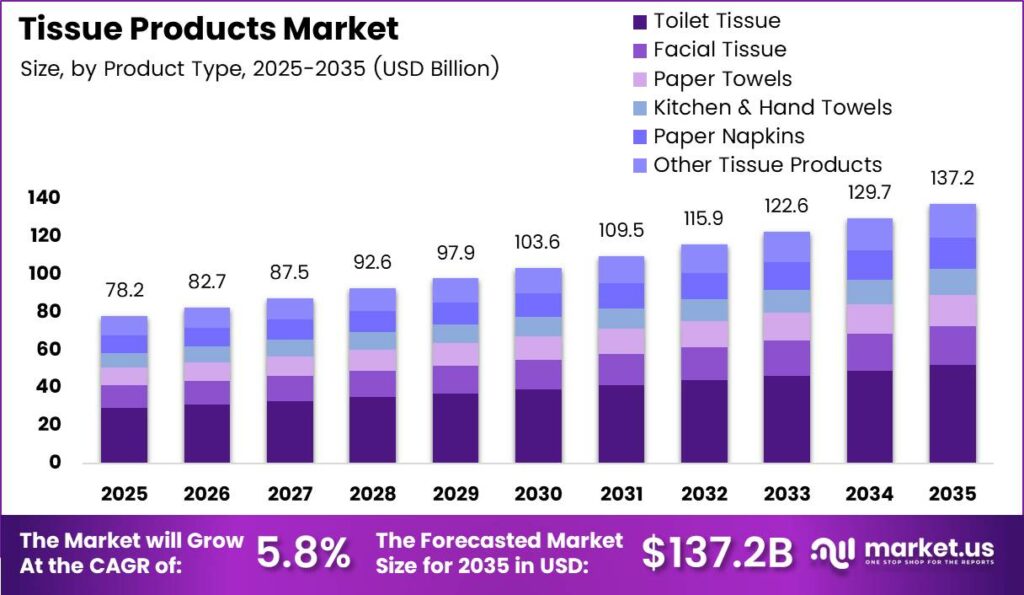
Global Tissue Products Market size is expected to be worth around USD 137.2 Billion by 2035 from USD 78.2 Billion in 2025, growing at a CAGR of 5.8% during the forecast period 2026 to 2035. This trajectory reflects tissue products’ position as a non-discretionary category that expands alongside rising household incomes, urbanization, and institutional hygiene standards across both developed and emerging economies.
The tissue products market covers a broad range of paper-based hygiene goods manufactured from virgin fiber, recycled fiber, or blended furnishes. Product lines span toilet tissue, facial tissue, paper towels, kitchen and hand towels, and paper napkins. Channels range from supermarkets and pharmacies to online retail. End users include residential households and commercial operators across hospitality, foodservice, healthcare, and office settings.
Key Takeaways
- The global Tissue Products Market was valued at USD 78.2 Billion in 2025 and is forecast to reach USD 137.2 Billion by 2035.
- The market is growing at a CAGR of 5.8% during the forecast period 2026 to 2035.
- By Product Type, Toilet Tissue dominates with a 38.00% share in 2025.
- By Raw Material, Virgin Fiber holds the leading position with a 51.00% share in 2025.
- By End User, Residential accounts for the largest share at 66.00% in 2025.
- By Commercial End User, Hotels and Hospitality leads with a 28.00% share in 2025.
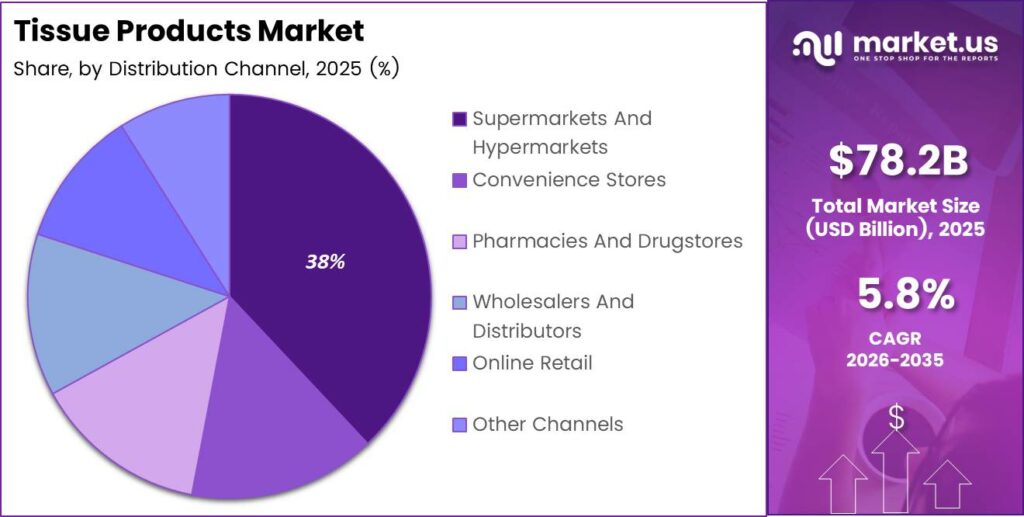
- By Distribution Channel, Supermarkets and Hypermarkets dominate with a 38.00% share in 2025.
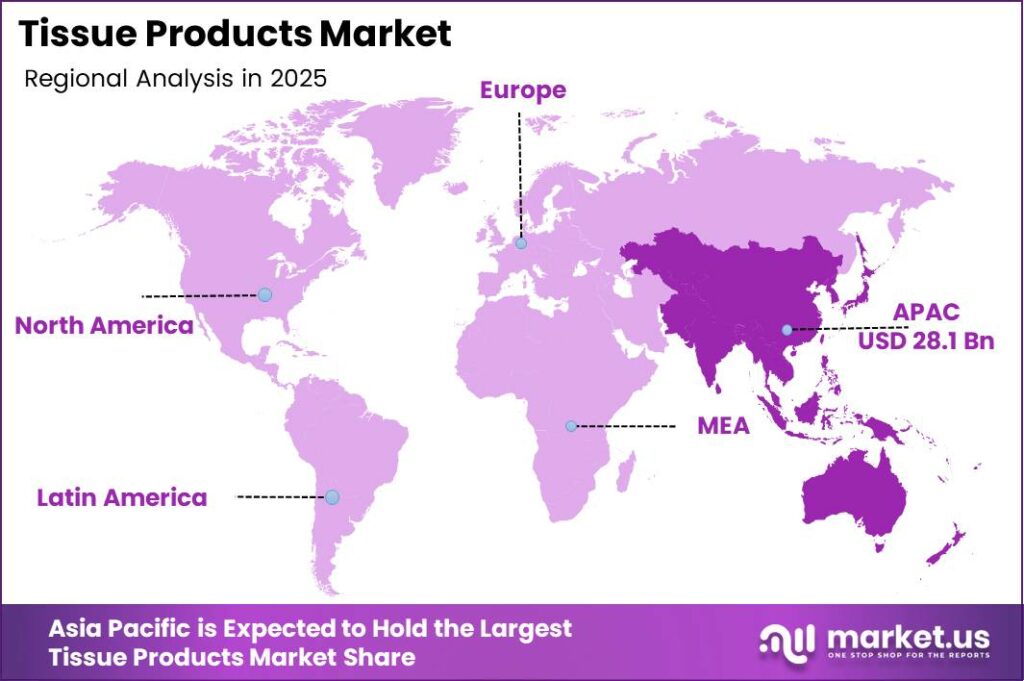
- Asia Pacific is the dominant region with a 36.00% market share, valued at USD 28.1 Billion in 2025.
Retail infrastructure plays a central role in tissue market access. As per our research, U.S. retail and foodservice sales reached $773.9 Billion in August 2026 on a seasonally adjusted basis, reflecting the scale of the consumer goods environment in which tissue products compete for shelf space and household spend. Organized retail expansion in emerging markets translates directly into new replenishment cycles for tissue brands.
Waste management considerations are reshaping producer priorities across the supply chain. The U.S. Environmental Protection Agency recorded that tissue paper and towels generated 3.79 million short tons of municipal solid waste in 2018, excluding bathroom tissue. This scale of post-consumer waste creates regulatory exposure for producers and accelerates investment in recycled-fiber capacity and reduced-packaging formats. Kimberly-Clark announced plans to invest more than $2 Billion over five years in its North American business, signaling sustained capital commitment to manufacturing scale and supply chain resilience across the region.
Product Type Analysis
Toilet Tissue dominates with 38.00% due to daily non-discretionary household use.
In 2025, Toilet Tissue held a dominant market position in the By Product Type segment of the Tissue Products Market, with a 38.00% share. Daily consumption driven by basic sanitation needs makes toilet tissue the most replenished item in the category. Brands compete on softness, ply count, and roll length. In May 2026, Kimberly-Clark launched Kleenex Snap & Go tissue packs at an announced single-pack price of $1.79, illustrating how portability and per-unit pricing are becoming active levers in product innovation.
Facial Tissue commands a structurally distinct buyer behavior compared with toilet tissue. Purchases skew toward branded formats emphasizing softness and multi-layer construction. Kleenex Ultra Soft facial tissues feature three layers, according to the brand’s official product specifications. This layering positions facial tissue as a premiumizable sub-segment where manufacturers can extract higher average selling prices without requiring volume increases.
Paper Towels serve dual residential and commercial demand, with commercial users typically purchasing through institutional supply channels. Absorbency, sheet count, and dispenser compatibility drive specification decisions in commercial settings. This segment benefits directly from foodservice and hospitality recovery cycles, where throughput per occupied seat or guest room drives repeat orders at scale.
Kitchen and Hand Towels, Paper Napkins, and Other Tissue Products together hold the remaining share of the product mix. These sub-segments serve defined use cases across dining, personal care, and light-duty wiping. Their collective contribution provides category breadth for distributors and retailers managing full-range tissue assortments across both residential and commercial accounts.
Raw Material Analysis
Virgin Fiber dominates with 51.00% due to superior softness and absorbency output.
In 2025, Virgin Fiber held a dominant market position in the By Raw Material segment of the Tissue Products Market, with a 51.00% share. Sofidel purchased 1,374,340 tonnes of virgin fiber in 2024, reflecting the continued scale of primary fiber dependency across premium tissue manufacturing. Virgin fiber’s consistent sheet quality and brightness make it the default input for branded consumer products where tactile performance commands shelf premium.
Recycled Fiber has built a credible manufacturing base among producers targeting sustainability commitments and cost diversification. Cascades PRO states that 87% of its papers are made from 100% recycled fibers, including refills for Tandem dispensers. This positions recycled-fiber producers as preferred suppliers for institutional buyers with environmental procurement mandates, creating a separate competitive lane from virgin-fiber brands.
Blended Fiber sits between the two primary input categories, enabling producers to manage input cost volatility while maintaining acceptable sheet quality thresholds. Blended formulations provide flexibility for manufacturers responding to pulp price cycles without committing fully to either virgin or recycled procurement strategies. This sub-segment is expected to attract converters seeking margin stability across variable fiber markets.
End User Analysis
Residential dominates with 66.00% due to universal household hygiene demand.
In 2025, Residential held a dominant market position in the By End User segment of the Tissue Products Market, with a 66.00% share. The U.S. Census Bureau reported a median household income of $87,460 in 2025, indicating purchasing power sufficient to sustain branded tissue purchases across the majority of American households. Rising incomes in comparable markets support the premiumization of residential tissue assortments over the forecast period.
Commercial end users account for the remaining share, supplying tissue to hotels, foodservice, healthcare, offices, educational institutions, and other facilities. Commercial procurement typically operates through institutional channels with contract pricing, volume commitments, and dispenser-compatibility requirements. This structural difference from residential purchasing gives suppliers with dedicated B2B distribution networks a structural entry barrier against generalist competitors.
Commercial End User Analysis
Hotels and Hospitality dominates with 28.00% due to high per-room tissue consumption rates.
In 2025, Hotels and Hospitality held a dominant market position in the By Commercial End User segment of the Tissue Products Market, with a 28.00% share. EU hotels and similar accommodation establishments recorded approximately 1.9 Billion tourist nights in 2025, according to Eurostat’s early estimates. Each occupied room night generates predictable toilet tissue, facial tissue, and hand towel consumption, making hospitality the most volume-consistent commercial sub-segment in the category.
Foodservice Establishments represent a structurally high-volume tissue channel driven by napkin and hand towel throughput at scale. The National Restaurant Association projected U.S. restaurant and foodservice industry sales of $1.55 Trillion in 2026. This revenue base reflects the frequency and density of tissue consumption events per service cover, supporting durable institutional supply contracts across chain and independent operators.
Hospitals and Healthcare Facilities operate under procurement standards that prioritize hygiene compliance over cost minimization. The WHO/UNICEF Joint Monitoring Programme estimated that 72% of healthcare facilities globally had basic hygiene services in 2025. The remaining 28% without basic hygiene coverage represents a latent institutional demand pool that public health investment programs are actively working to close.
Offices and Commercial Buildings, Educational Institutions, and Other Commercial Users together hold the remaining commercial share. These sub-segments purchase primarily through wholesale distributors and facilities management contracts. Their tissue requirements are less seasonal than hospitality and less hygiene-regulated than healthcare, making them cost-sensitive accounts that reward consistent supply and competitive pricing over product differentiation.
Distribution Channel Analysis
Supermarkets and Hypermarkets dominate with 38.00% due to high-frequency household replenishment traffic.
In 2025, Supermarkets and Hypermarkets held a dominant market position in the By Distribution Channel segment of the Tissue Products Market, with a 38.00% share. Walmart U.S. generated $462.4 Billion in net sales in FY2025, illustrating the purchasing scale concentrated in large-format retail. Tissue brands competing for placement in high-traffic supermarket formats gain disproportionate consumer reach relative to smaller channels, reinforcing the dominance of this distribution route.
Convenience Stores serve tissue demand in high-turnover, impulse-driven purchase occasions. Their smaller shelf footprint limits SKU range but supports premium single-pack formats with higher margin per unit. Walgreens Boots Alliance generated $147.7 Billion in consolidated sales in FY2024, reflecting the scale of pharmacy and convenience-adjacent retail through which tissue brands access consumers outside the traditional grocery aisle.
Online Retail has accelerated as a tissue distribution channel on the back of broader e-commerce adoption. Walmart reported global e-commerce growth of 20.8% in FY2025, demonstrating the pace at which large retail platforms are converting in-store tissue purchases to digital replenishment. Subscription-based models and bulk-format listings reinforce repeat purchase behavior in this channel and reduce brand switching at the point of reorder.
Pharmacies and Drugstores, Wholesalers and Distributors, and Other Channels collectively hold the remaining distribution share. Wholesalers and distributors play a critical intermediary role in servicing commercial accounts that cannot be reached efficiently through retail shelf formats. These channels are particularly relevant in emerging markets where organized retail penetration remains partial and institutional buyers depend on distributor-managed supply networks.
Key Market Segments
By Product Type
- Toilet Tissue
- Facial Tissue
- Paper Towels
- Kitchen And Hand Towels
- Paper Napkins
- Other Tissue Products
By Raw Material
- Virgin Fiber
- Recycled Fiber
- Blended Fiber
By End User
- Residential
- Commercial
- Hotels And Hospitality
- Foodservice Establishments
- Hospitals And Healthcare Facilities
- Offices And Commercial Buildings
- Educational Institutions
- Other Commercial Users
By Distribution Channel
- Supermarkets And Hypermarkets
- Convenience Stores
- Pharmacies And Drugstores
- Wholesalers And Distributors
- Online Retail
- Other Channels
Regional Analysis
Asia Pacific Dominates the Tissue Products Market with a Market Share of 36.00%, Valued at USD 28.1 Billion
Asia Pacific leads the global Tissue Products Market with a 36.00% share valued at USD 28.1 Billion in 2025. The World Bank estimated that 24 million people moved out of poverty in East Asia and Pacific during 2024 and 2025, expanding the base of households with discretionary income sufficient for packaged tissue purchases. This income transition is a structural demand driver that supports volume growth across toilet tissue and facial tissue formats throughout the region.
Europe represents the fastest-growing developed regional market, supported by institutional procurement activity and retail channel resilience. Eurostat reported that EU calendar-adjusted retail sales volume increased 0.9% in April 2026 compared with April 2025. WEPA announced an expansion at Bridgend, UK, comprising a paper machine with planned annual capacity of 70,000 tonnes and two converting lines, with implementation planned within two years. This capacity addition signals producer confidence in sustained European demand across both retail and commercial tissue segments.
North America sustains its position as a high-value tissue market driven by organized retail scale, premium product mix, and institutional supply depth. Latin America, the Middle East and Africa, and remaining Asia Pacific sub-markets contribute collectively to the global growth profile, with distributed retail build-out and rising urban household formation supporting incremental tissue volume outside the two leading regions.
Key Regions and Countries
North America
- US
- Canada
Europe
- Germany
- France
- The UK
- Spain
- Italy
- Rest of Europe
Asia Pacific
- China
- Japan
- South Korea
- India
- Australia
- Rest of APAC
Latin America
- Brazil
- Mexico
- Rest of Latin America
Middle East and Africa
- GCC
- South Africa
- Rest of MEA
Market Dynamics
Market Opportunity Analysis - Underserved commercial sub-segments and emerging regional channels offer the clearest entry points for new competitors
The Commercial end user segment holds structurally underexploited accounts despite its established presence in the market. The WHO/UNICEF Joint Monitoring Programme estimated that 28% of healthcare facilities globally lacked basic hygiene services in 2025. This unserved institutional base represents a procurement pipeline that public health funding and private-sector hygiene programs are actively building toward, giving specialized healthcare tissue suppliers a defined addressable market that has not yet reached full conversion.
The Foodservice Establishments sub-segment offers volume density that most tissue suppliers have not yet fully penetrated through dedicated channel programs. By contrast, the sub-segment’s link to a projected $1.55 Trillion U.S. foodservice revenue base in 2026 confirms the procurement scale available to suppliers who build foodservice-specific formats, portion-controlled napkin products, and operator-facing replenishment programs ahead of generalist competitors entering the channel.
Asia Pacific’s poverty reduction trajectory creates a time-limited first-mover window for mass-market tissue brands. With 24 million people transitioning out of poverty in East Asia and Pacific across 2024 and 2025, household tissue penetration in this cohort is in its earliest stage. Suppliers who establish distribution and brand presence in these newly formed consumer households before income levels rise further will benefit from the loyalty inertia that defines tissue replenishment behavior once habitual purchasing is established.
Online Retail remains an underutilized distribution route relative to its structural growth rate. Walmart’s 20.8% global e-commerce growth in FY2025 confirms that tissue consumers are shifting to digital replenishment faster than most brand investment levels currently reflect. Smaller regional brands and private-label operators that build subscription and bulk-bundle capabilities in online retail channels can compete directly against established supermarket brands without requiring comparable physical shelf investment.
Technology and Innovation Landscape - Packaging reduction, recycled-fiber integration, and freight cost management define the current innovation agenda for tissue producers
Packaging material reduction has emerged as a measurable sustainability output with direct cost implications. Sofidel reduced virgin plastic packaging per tonne of paper produced by 45% between 2013 and 2024, cutting from 26.8 kilograms to 14.7 kilograms per tonne. This reduction lowers input material costs per unit while satisfying retailer and institutional buyer environmental procurement requirements. Suppliers who cannot demonstrate comparable packaging intensity improvements face growing exclusion risk from sustainability-mandated tender processes.
Recycled-fiber processing capacity is expanding as a deliberate technology investment rather than a cost-saving measure alone. WEPA targets at least 60% recycled fibers and alternative virgin fibers in its sales-product portfolio by 2030. This target requires capital investment in deinking, cleaning, and fiber-quality management systems capable of producing consumer-grade sheet quality from secondary furnish. Producers who achieve this fiber transition at scale reduce their exposure to virgin pulp price cycles while accessing sustainability-premium pricing in institutional procurement.
Freight cost volatility has elevated supply chain design as a competitive differentiator in tissue logistics. UNCTAD reported that the Comprehensive Shanghai Export Containerized Freight Index fell 40% between early January and late March 2025. This rate compression benefited importers but also illustrated how rapidly ocean freight economics can shift, exposing suppliers with centralized manufacturing and long-haul distribution to margin volatility. Producers investing in regional converting hubs reduce their freight exposure and improve delivery speed to end markets.
Mill-scale capacity expansion is concentrating in the most capital-efficient formats available to modern tissue producers. Sofidel’s finalized $775 Million Inola, Oklahoma expansion includes a single tissue machine targeting 75,000 tonnes of annual capacity, paired with a 100,000-pallet-position finished-goods warehouse designed for integrated logistics efficiency. This co-location of production and warehousing reduces internal handling costs and accelerates order fulfilment cycles, setting a benchmark for how scale investments are now being structured across the industry.
Drivers
Travel recovery is translating directly into higher tissue consumption across hotel rooms, airport washrooms, and foodservice venues. UN Tourism recorded approximately 1.4 Billion international arrivals in 2024, up 11% from 2023, followed by reported growth of 4% in 2025. This arrival volume converts into predictable per-stay tissue throughput, making hospitality and travel-linked consumption the highest near-term CAGR contributor at an estimated +0.35 percentage points. Suppliers with institutional contracts and distributor-managed replenishment are best positioned to capture this demand efficiently.
Urban household formation and premiumization in South Asia, Southeast Asia, and Africa are building a durable long-term demand base. Rising household incomes expand both the number of tissue-purchasing households and average basket size as consumers shift from economy to mid-tier formats. Organized retail expansion in India, Southeast Asia, and Latin America provides the channel infrastructure needed to convert new consumers into repeat buyers, adding an estimated combined +0.50 percentage points to the forecast CAGR across urban formation, premium mix, and retail distribution drivers.
| Driver | (~) % Impact on CAGR Forecast | Geographic Relevance | Impact Timeline |
|---|---|---|---|
| Hospitality and travel-linked tissue consumption | +0.35% | Global; tourism-intensive economies | Short term (≤ 2 years) |
| Urban household formation | +0.25% | South Asia; Southeast Asia; Africa | Long term (≥ 4 years) |
| Premium household product mix | +0.20% | North America; Europe; affluent Asian markets | Medium term (2–4 years) |
| Organized retail distribution expansion | +0.15% | India; Southeast Asia; Latin America | Medium term (2–4 years) |
| Population-led essential replenishment | +0.10% | South Asia; sub-Saharan Africa | Long term (≥ 4 years) |
Restraints
Severely constrained household purchasing power limits tissue market conversion in sub-Saharan Africa and South Asia, where reusable alternatives and water-based practices already meet basic hygiene needs. The World Bank’s September 2025 update estimated that 839 million people lived in extreme poverty in 2024, with the global extreme-poverty rate at 10.3% projected to edge to 10.1% in 2025. This affordability ceiling applies an estimated -0.30 percentage point drag on the forecast CAGR. Smaller pack formats lower the checkout threshold but raise per-sheet packaging and handling costs, requiring suppliers to balance market access against contribution margin carefully.
Water-based cleansing substitution, public procurement budget freezes, import tariff barriers, and distributor credit rationing apply additional downward pressure totaling an estimated -0.55 percentage points across the remaining restraint categories. Short-term pressures from tariffs and credit tightening are most acute in cross-border and emerging-market wholesale channels. This means suppliers dependent on single-country sourcing or thin distributor credit terms face the most direct exposure and must diversify supply routes and payment structures to protect volume continuity.
| Restraint | (~) % Impact on CAGR Forecast | Geographic Relevance | Impact Timeline |
|---|---|---|---|
| Low-income household affordability ceiling | -0.30% | Sub-Saharan Africa; South Asia | Long term (≥ 4 years) |
| Water-based cleansing substitution | -0.20% | South Asia; Middle East; Southeast Asia | Long term (≥ 4 years) |
| Public procurement budget freezes | -0.15% | Fiscally constrained institutional markets | Short term (≤ 2 years) |
| Import tariff barriers | -0.10% | Tariff-exposed cross-border markets | Short term (≤ 2 years) |
| Distributor credit rationing | -0.10% | Emerging-market wholesale channels | Short term (≤ 2 years) |
Challenges
Non-integrated tissue producers face recurring margin compression when pulp prices move faster than contract reset cycles allow. Suzano’s manufacturer-issued results described pulp prices below historical averages during 2025, illustrating the cyclical nature of fiber procurement rather than a uniform cost trend. An illustrative converter model shows fiber representing 40–50% of manufacturing cost; a 10% pulp price increase raises total manufacturing cost by approximately 4–5%, and recovering only half through pricing during a 3–6-month reset leaves an unrecovered burden of 2–2.5% of manufacturing cost. This dynamic slows product launches and compresses working capital.
European tissue manufacturers face compounding thermal energy cost pressure. Russian piped gas deliveries to the European Union declined 45% year over year in the first half of 2025, according to the International Energy Agency. European hub gas prices averaged 40% above their first-half 2024 levels in the first half of 2025. This energy cost environment directly raises drying and converting costs at European tissue mills, creating a structural disadvantage relative to manufacturers in regions with stable or lower-cost energy supply. Bulky freight inefficiency, mill water resilience gaps, and converting quality consistency gaps apply an additional combined drag of -0.30 percentage points across the remaining challenge categories.
| Challenge | (~) % CAGR Friction Drag | Geographic Relevance | Mitigation Horizon |
|---|---|---|---|
| Fiber cost cycle exposure | -0.25% | Global; non-integrated tissue producers | Short term (≤ 2 years) |
| Thermal energy transition complexity | -0.20% | Europe; energy-importing manufacturing hubs | Long term (≥ 4 years) |
| Mill water resilience gaps | -0.15% | Water-stressed tissue manufacturing regions | Long term (≥ 4 years) |
| Bulky freight network inefficiency | -0.10% | Global; geographically dispersed markets | Medium term (2–4 years) |
| Converting quality consistency gaps | -0.05% | Global; rapidly scaling converters | Medium term (2–4 years) |
Opportunities
Managed washroom service contracts represent the highest-value near-term opportunity in commercial tissue, converting unserved accounts from commodity refill purchasing into contracted replenishment, dispenser maintenance, and usage-based service bundles. Tork states that a specified single-sheet system can reduce consumption by up to 40% compared with traditional jumbo-roll dispensers, a product-specific claim that provides a quantifiable value proposition for institutional buyers. An illustrative service model adding 15–20% in service revenue relative to the original refill-only invoice suggests an operating margin expansion of 1–2 percentage points under suitable contract pricing and route density.
Specialized industrial wiping applications, fragmented converter acquisitions in Latin America and Southeast Asia, and export-oriented regional converting hubs in the Gulf states and North Africa contribute a combined estimated +0.45 percentage points in potential CAGR upside. Early movers who build service capacity, acquire regional converters, or establish export-oriented hub infrastructure ahead of the competition will lock in structural cost and route-to-market advantages that commodity suppliers cannot replicate through pricing alone. The accessible dispenser product ecosystem opportunity adds a further long-term upside as aging societies direct procurement toward ease-of-use formats.
| Opportunity | (~) % Potential CAGR Upside | Geographic Relevance | Execution Window |
|---|---|---|---|
| Managed washroom service contracts | +0.30% | North America; Europe; developed Asian markets | Medium term (2–4 years) |
| Specialized industrial wiping applications | +0.20% | Manufacturing-intensive global markets | Medium term (2–4 years) |
| Fragmented converter acquisition platforms | +0.15% | Latin America; Southeast Asia; Eastern Europe | Medium term (2–4 years) |
| Export-oriented regional converting hubs | +0.10% | Gulf states; North Africa; regional trade corridors | Medium term (2–4 years) |
| Accessible dispenser product ecosystems | +0.05% | Aging societies; accessibility-led procurement markets | Long term (≥ 4 years) |
Key Company Insights
Kimberly-Clark Corporation operates across North America with a multi-brand portfolio that includes Kleenex, Scott, and Cottonelle. Procter & Gamble reported consolidated net sales of $87.0 Billion in FY2026 across its entire business, indicating the scale of competition Kimberly-Clark faces in the consumer goods aisle. Kimberly-Clark’s announced investment of more than $2 Billion over five years in North American manufacturing strengthens its supply chain depth against this competitive pressure. However, its concentration in mature North American and European markets exposes it to volume ceiling risk as emerging-market competitors build local capacity.
Essity AB differentiates through its Professional Hygiene business, which generated SEK 35,904 Million in net sales in 2025 across products and services beyond tissue alone. Sofidel reported annual production capacity of 1,860,000 tonnes at the end of 2024, illustrating the manufacturing scale competitors are building. Essity’s July 2024 agreement involved Clearwater Paper selling its tissue business to Sofidel America for $1.06 Billion, reshaping North American competitive dynamics. Essity’s service-bundled institutional model creates retention advantages that pure product suppliers cannot easily replicate in B2B tissue channels. Georgia-Pacific announced a $150 Million investment at its Wauna, Oregon mill for Angel Soft and private-label bath tissue, intensifying pressure across the mid-tier segment where Essity and others compete for commercial accounts.
Key Players
- Kimberly-Clark Corporation
- Essity AB
- The Procter & Gamble Company
- Georgia-Pacific LLC
- Sofidel S.p.A.
- Asia Pulp & Paper (APP) Sinar Mas
- Hengan International Group Company Limited
- WEPA Hygieneprodukte GmbH
- Metsä Tissue
- Cascades Inc.
- Empresas CMPC S.A.
- Vinda International Holdings Limited
- Kruger Products Inc.
- C&S Paper Co., Ltd.
- Industrie Cartarie Tronchetti S.p.A.
Recent Developments
- May 26, 2026 – Metsä Group inaugurated its expanded Mariestad tissue mill in Sweden following a €370 Million investment that doubled annual production capacity to approximately 145,000 tonnes. The expansion had started operations in autumn 2025.
- May 2026 – Essity reported the opening of its new recycled-fiber facility in Prudhoe, UK, following an investment exceeding £30 Million. The facility increased recycled-fiber processing capacity at the site to more than 105,000 tonnes annually.
- March 11, 2026 – Sofidel finalized a $775 Million expansion plan for its Inola, Oklahoma facility, including a tissue machine with annual capacity of 75,000 tonnes and a finished-goods warehouse with 100,000 pallet positions. Machine startup was scheduled for Q2 2028.
- December 9, 2024 – Georgia-Pacific announced a $90 Million investment at its Crossett, Arkansas mill to expand bath-tissue converting capacity and add 50 jobs, with initial production expected in 2026.
- January 2024 – Sofidel acquired ST Paper’s Duluth, Minnesota paper mill, which had annual production capacity of 65,000 tonnes.
Report Scope
| Report Features | Description |
|---|---|
| Market Value (2025) | USD 78.2 Billion |
| Forecast Revenue (2035) | USD 137.2 Billion |
| CAGR (2026-2035) | 5.8% |
| Base Year for Estimation | 2025 |
| Historic Period | 2020-2024 |
| Forecast Period | 2026-2035 |
| Report Coverage | Revenue Forecast, Market Dynamics, Market Opportunity Analysis, Technology and Innovation Landscape, Competitive Landscape, Recent Developments |
| Segments Covered | By Product Type (Toilet Tissue, Facial Tissue, Paper Towels, Kitchen And Hand Towels, Paper Napkins, Other Tissue Products), By Raw Material (Virgin Fiber, Recycled Fiber, Blended Fiber), By End User (Residential, Commercial), By Commercial End User (Hotels And Hospitality, Foodservice Establishments, Hospitals And Healthcare Facilities, Offices And Commercial Buildings, Educational Institutions, Other Commercial Users), By Distribution Channel (Supermarkets And Hypermarkets, Convenience Stores, Pharmacies And Drugstores, Wholesalers And Distributors, Online Retail, Other Channels) |
| Regional Analysis | North America (US and Canada), Europe (Germany, France, The UK, Spain, Italy, and Rest of Europe), Asia Pacific (China, Japan, South Korea, India, Australia, and Rest of APAC), Latin America (Brazil, Mexico, and Rest of Latin America), Middle East and Africa (GCC, South Africa, and Rest of MEA) |
| Competitive Landscape | Kimberly-Clark Corporation, Essity AB, The Procter & Gamble Company, Georgia-Pacific LLC, Sofidel S.p.A., Asia Pulp & Paper (APP) Sinar Mas, Hengan International Group Company Limited, WEPA Hygieneprodukte GmbH, Metsä Tissue, Cascades Inc., Empresas CMPC S.A., Vinda International Holdings Limited, Kruger Products Inc., C&S Paper Co., Ltd., Industrie Cartarie Tronchetti S.p.A. |
| Customization Scope | Customization for segments, region/country-level will be provided. Additional customization can be done based on requirements. |
| Purchase Options | We have three licenses to opt for: Single User License, Multi-User License (Up to 5 Users), Corporate Use License (Unlimited User and Printable PDF) |





































