


Global Tattoo Removal Market Size, Share, Growth Analysis By Procedures (Laser Procedure, Surgical Procedure, Creams, Others), By Facility Type (Dermatology Clinics, Artist Studios, Others), By End-User (Women, Men), By Region and Companies - Industry Segment Outlook, Market Assessment, Competition Scenario, Statistics, Trends and Forecast 2026-2035
- Published date: March 2026
- Report ID: 182401
- Number of Pages: 392
- Format:
-
keyboard_arrow_up
Quick Navigation
Report Overview
The Global Tattoo Removal Market size is expected to be worth around USD 3,359.2 Million by 2035 from USD 783.1 Million in 2025, growing at a CAGR of 15.7% during the forecast period 2026 to 2035.
The tattoo removal market refers to the range of procedures, technologies, and services used to eliminate or fade unwanted tattoos from the skin. These include laser-based treatments, surgical excision, and topical creams. The market has evolved significantly as advanced dermatological tools have replaced older, less effective methods.
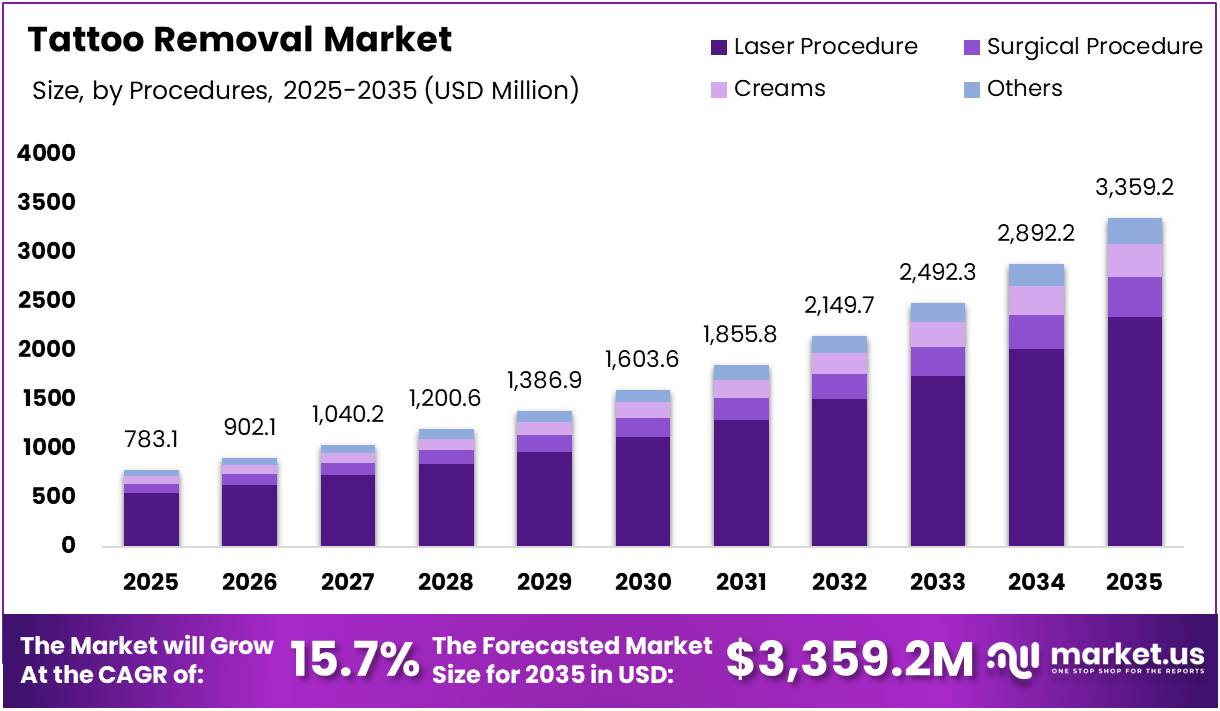
Laser tattoo removal remains the most widely adopted approach due to its precision and effectiveness. Modern laser systems target tattoo pigments without causing excessive damage to surrounding tissue. Consequently, demand for laser procedures continues to drive the overall market forward at a strong pace.
Growth in this market is closely linked to the rising popularity of body art and the subsequent desire for aesthetic corrections. Many individuals seek tattoo removal due to professional requirements, personal lifestyle changes, or cosmetic preferences. Moreover, the growing acceptance of dermatological procedures among younger demographics is expanding the market base considerably.
Government bodies and health regulators across several countries are setting clearer guidelines for tattoo removal procedures. These regulatory frameworks are improving patient safety standards and encouraging clinic accreditation. Therefore, structured oversight is helping build consumer confidence and supporting market growth in key regions.
Statistical data reinforces the strong demand in this space. According to PubMed (NCBI), 58% of tattooed individuals reported regretting their tattoo, and 42.5% attempted to remove it, with cultural reasons cited in 74% of cases. Additionally, side effects including local itching at 32%, pain at 22.7%, and infection at 10.5% further motivate patients to seek professional removal services.
According to Practical Dermatology, individuals aged 18 to 39 make up two-thirds of those seeking tattoo removal, with visible areas such as forearms and hands being the most frequently treated. According to NCBI (PMC), picosecond lasers improve clearance efficiency by approximately 30 to 50% compared to traditional nanosecond lasers, making them a preferred clinical choice globally.
According to NCBI, only 38% of patients achieved complete tattoo removal following laser treatment. Additionally, black tattoo ink demonstrated the highest removal success rate at greater than 90%, attributed to its superior absorption of laser energy compared to other ink colors.
Key Takeaways
- The global Tattoo Removal Market is valued at USD 783.1 Million in 2025 and is projected to reach USD 3,359.2 Million by 2035.
- The market is expected to grow at a CAGR of 15.7% during the forecast period 2026 to 2035.
- By Procedures, Laser Procedure dominates with a market share of 69.1% in 2025.
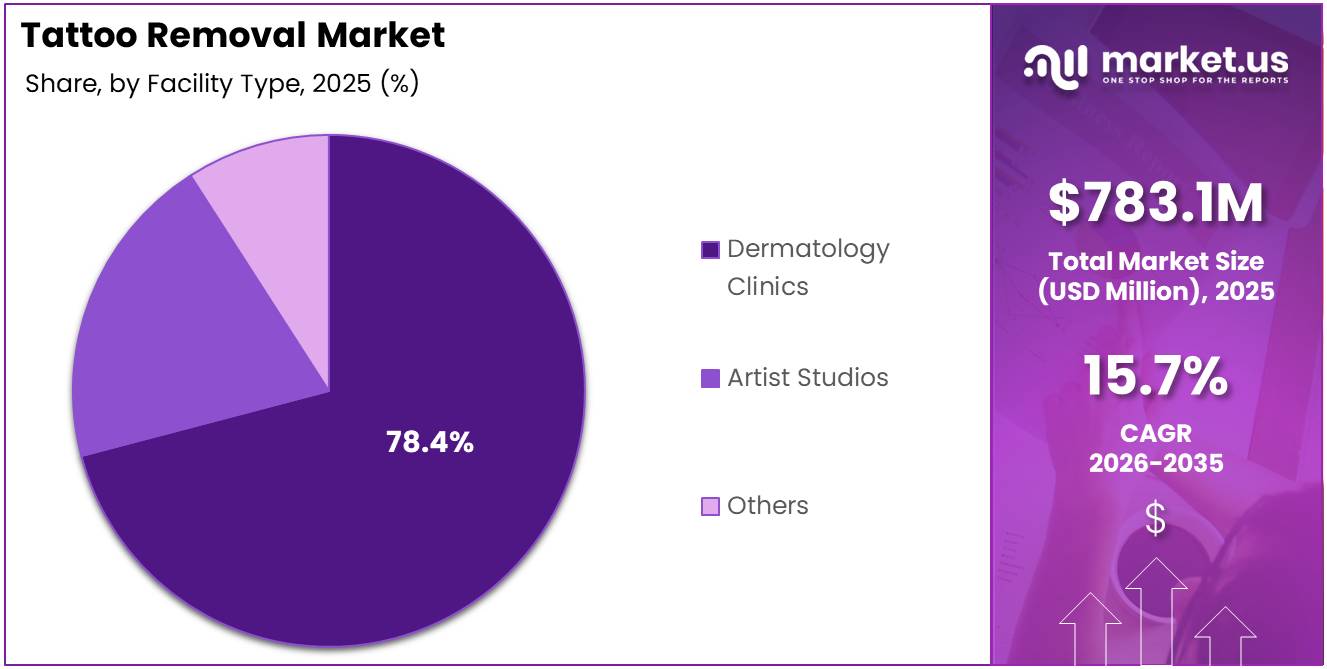
- By Facility Type, Dermatology Clinics hold the largest share at 78.4% in 2025.
- By End-User, Women account for the majority at 67.9% of the market in 2025.
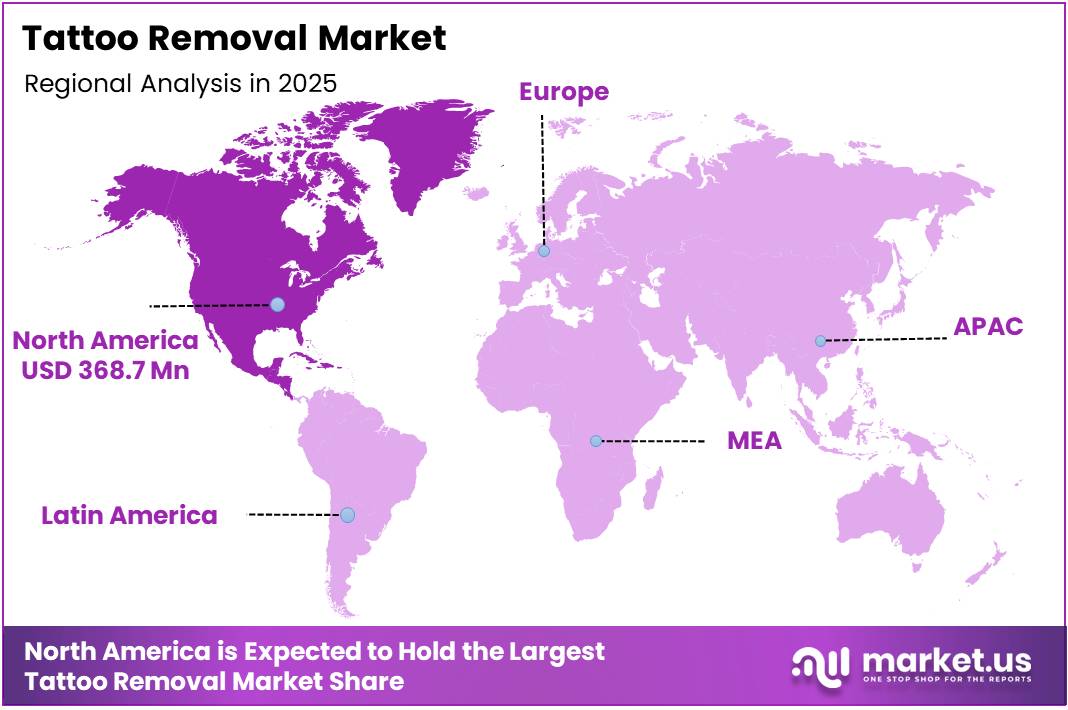
- North America dominates the regional market with a share of 47.10%, valued at USD 368.7 Million in 2025.
By Procedures Analysis
Laser Procedure dominates with 69.1% due to its high clinical efficacy and patient preference for non-invasive treatment.
In 2025, Laser Procedure held a dominant market position in the By Procedures segment of the Tattoo Removal Market, with a 69.1% share. Laser treatments are widely preferred due to their ability to break down tattoo pigments precisely with minimal skin damage. Moreover, continuous advancements in Q-switched and picosecond laser technologies have significantly improved treatment outcomes and patient satisfaction globally.
Surgical Procedure represents a smaller but relevant segment within the market. It is typically used when laser treatments are ineffective or when complete and immediate removal is required. However, due to higher recovery times and the risk of scarring,
surgical removal is generally reserved for specific clinical cases where other methods prove insufficient.
Creams occupy a niche position in the tattoo removal market. While they offer a non-invasive and cost-effective option, their effectiveness remains limited compared to laser or surgical approaches. Additionally, topical removal creams are more commonly used in early-stage fading or in regions with limited access to advanced clinical facilities.
Others include chemical peels, dermabrasion, and combination therapies. These are considered supplementary methods and are less commonly used in standalone tattoo removal. Nonetheless, they are occasionally integrated into multi-step treatment plans to support or accelerate results from primary removal procedures.
By Facility Type Analysis
Dermatology Clinics dominate with 78.4% due to their clinical credibility and access to advanced removal equipment.
In 2025, Dermatology Clinics held a dominant market position in the By Facility Type segment of the Tattoo Removal Market, with a 78.4% share. These clinics are equipped with certified professionals and high-grade laser systems, making them the first choice for patients. Furthermore, growing awareness of safe removal practices continues to increase footfall at dermatology facilities worldwide.
Artist Studios are increasingly offering tattoo removal or fading services, particularly for clients seeking partial removal before re-tattooing. While they lack medical-grade equipment, many studios partner with licensed practitioners. Consequently, artist studios are gaining relevance as a convenient access point, especially for clients in urban and semi-urban locations.
Others include medspas, wellness centers, and multi-specialty aesthetic clinics that offer tattoo removal as part of a broader cosmetic services menu. These facilities attract clients seeking combined treatment experiences. Additionally, the growing trend of holistic aesthetic care is encouraging more facilities beyond traditional clinics to add tattoo removal to their service offerings.
By End-User Analysis
Women dominate with 67.9% due to higher engagement with cosmetic and aesthetic correction procedures.
In 2025, Women held a dominant market position in the By End-User segment of the Tattoo Removal Market, with a 67.9% share. Women demonstrate a higher propensity for aesthetic procedures and are more likely to seek tattoo removal for professional or social reasons. Moreover, targeted marketing campaigns and social media influence have significantly shaped female consumer behavior in this segment.
Men represent a growing end-user base in the tattoo removal market. While historically less engaged with cosmetic procedures, male consumers are increasingly seeking removal services driven by career transitions and changing personal preferences. Additionally, the normalization of aesthetic care among men across multiple demographics is expected to gradually increase the male share over the forecast period.
Key Market Segments
By Procedures
- Laser Procedure
- Surgical Procedure
- Creams
- Others
By Facility Type
- Dermatology Clinics
- Artist Studios
- Others
By End-User
- Women
- Men
Drivers
Rising Demand for Aesthetic Procedures and Advanced Technologies Drives Tattoo Removal Market Growth
The growing demand for aesthetic and cosmetic procedures among young adults is a primary driver of the tattoo removal market. More individuals, particularly those aged 18 to 39, are seeking professional removal to align with changing personal or professional goals. Consequently, clinics are experiencing a consistent rise in appointment volumes and repeat treatments.
Advanced laser tattoo removal technologies are rapidly replacing older, less efficient methods, supported by innovations in tattoo removal devices. The adoption of picosecond and Q-switched laser systems has significantly improved clearance rates and reduced treatment sessions. Moreover, patients report higher satisfaction with newer technologies, which is encouraging more individuals to pursue professional removal rather than live with unwanted tattoos.
Growing awareness of safe, non-invasive dermatological treatments is also supporting market expansion. Educational campaigns, social media content, and endorsements by certified dermatologists are helping patients make informed decisions. Therefore, increased awareness is reducing hesitation around treatment and driving new patient acquisition across both established and emerging markets globally.
Restraints
Shortage of Skilled Professionals and Limited Regional Awareness Restrain Tattoo Removal Market Growth
A significant shortage of skilled professionals and certified laser technicians is limiting the scalability of tattoo removal services. Not all clinics can access adequately trained staff, which affects treatment quality and patient safety. Consequently, some regions face capacity constraints that prevent the market from meeting growing consumer demand effectively.
Limited awareness of safe tattoo removal techniques in certain emerging regions continues to restrain market penetration. Many potential patients in these areas are unaware of available clinical options or hold misconceptions about the safety of removal procedures. Therefore, the lack of consumer education creates barriers to adoption and slows market growth in underdeveloped geographies.
Additionally, the perception of high treatment costs discourages price-sensitive consumers from pursuing professional removal. Multiple sessions are often required to achieve satisfactory results, making the total expenditure significant. However, as more affordable clinics and payment options emerge, this restraint is expected to gradually ease over the forecast period.
Growth Factors
Technological Innovation and Personalized Treatment Solutions Accelerate Tattoo Removal Market Expansion
The development of faster, pain-free, and multi-pigment removal lasers is one of the most important growth factors in this market. New-generation devices can treat a wider range of ink colors in fewer sessions. Moreover, reduced discomfort and shorter recovery periods are making treatments more accessible and appealing to a broader patient demographic.
The integration of artificial intelligence and digital tools for personalized skin assessment is transforming the way tattoo removal is planned and delivered. AI-powered platforms can analyze skin type, ink depth, and pigment composition to recommend customized treatment protocols. Therefore, these innovations are improving clinical outcomes and increasing patient confidence in professional removal services.
Rising demand for tattoo lightening or partial removal before re-tattooing is also creating new growth avenues. Many clients seek fading rather than complete removal to prepare the skin for a new design. Consequently, this trend is expanding the addressable market beyond those seeking full removal and increasing the frequency of visits per patient at clinics.
Emerging Trends
Social Media Influence and Next-Generation Laser Adoption Reshape the Tattoo Removal Market
Social media is increasingly influencing aesthetic correction decisions, including the choice to undergo tattoo removal. Platforms such as Instagram and TikTok expose users to before-and-after content, professional recommendations, and trend-driven beauty standards. Consequently, social media serves as a powerful discovery and decision-making tool that is actively driving new demand in the tattoo removal market.
The adoption of Q-switched and pico laser technologies is a defining trend across dermatology clinics worldwide. These systems deliver high-energy pulses in ultra-short durations, maximizing pigment fragmentation while minimizing skin damage. Moreover, their ability to treat diverse ink colors and skin tones makes them the preferred clinical standard, accelerating technology upgrades in both private and institutional healthcare settings.
Increased interest in tattoo lightening before re-tattooing is reshaping how services are marketed and delivered. Clinics are now offering targeted lightening packages tailored to clients planning new tattoo designs. Additionally, collaboration between tattoo artists and removal clinics is emerging as a value-added service model that improves client experience and broadens the market’s overall commercial footprint.
Regional Analysis
North America Dominates the Tattoo Removal Market with a Market Share of 47.10%, Valued at USD 368.7 Million
North America leads the global tattoo removal market, accounting for 47.10% of the total share and valued at USD 368.7 Million in 2025. The region benefits from high consumer spending on aesthetic procedures, a dense network of certified dermatology clinics, and rapid adoption of advanced laser technologies. Moreover, strong awareness campaigns and favorable reimbursement environments continue to sustain demand across the US and Canada.
Europe Tattoo Removal Market Trends
Europe represents a mature and growing market for tattoo removal, driven by high aesthetic consciousness and well-developed healthcare infrastructure. Countries such as Germany, the UK, and France are key contributors, with strong demand from working professionals seeking removal for career-related reasons. Additionally, regulatory frameworks in Europe support safe clinical practices, building consumer trust in professional removal services.
Asia Pacific Tattoo Removal Market Trends
Asia Pacific is emerging as a high-growth region in the tattoo removal market, fueled by changing social attitudes toward body art and rising disposable incomes. Markets such as China, Japan, South Korea, and India are witnessing increasing clinic establishments and growing patient volumes. Furthermore, the influence of Western beauty trends and growing urban youth populations are accelerating market expansion across the region.
Middle East and Africa Tattoo Removal Market Trends
The Middle East and Africa region shows moderate market activity, with growth centered in the GCC nations where medical tourism and aesthetic spending are rising. Cultural and religious factors influence demand patterns, but urban centers are increasingly hosting dermatology clinics offering tattoo removal services. Consequently, awareness-building initiatives and improved access to certified professionals are gradually expanding the addressable market.
Latin America Tattoo Removal Market Trends
Latin America presents growing opportunities in the tattoo removal market, particularly in Brazil and Mexico where aesthetic procedures are gaining mainstream acceptance. Rising middle-class incomes and the influence of social media beauty culture are supporting demand. However, limited clinical infrastructure in smaller markets remains a challenge, and industry stakeholders are investing in training and facility development to address this gap.
Key Regions and Countries
North America
- US
- Canada
Europe
- Germany
- France
- The UK
- Spain
- Italy
- Rest of Europe
Asia Pacific
- China
- Japan
- South Korea
- India
- Australia
- Rest of APAC
Latin America
- Brazil
- Mexico
- Rest of Latin America
Middle East & Africa
- GCC
- South Africa
- Rest of MEA
Key Company Insights
Sisram Medical (Alma Lasers) is a globally recognized medical aesthetics company offering an extensive portfolio of energy-based devices for skin treatments, including tattoo removal. The company focuses on clinical innovation and has a strong presence across North America, Europe, and Asia Pacific. Its laser platforms are widely used in dermatology clinics, supported by robust clinical training and after-sales service programs.
Candela Corporation is a leading developer of laser and light-based aesthetic systems with a well-established footprint in the tattoo removal segment. The company’s devices are known for their precision targeting across multiple pigment types and skin tones. Candela continues to invest in product development and strategic partnerships with medical institutions, reinforcing its position as a trusted brand among dermatologists and aesthetic practitioners worldwide.
Lumenis Ltd. is one of the pioneering companies in energy-based medical technologies, with a comprehensive range of laser systems applicable to tattoo removal. The company emphasizes evidence-based innovation, ensuring its platforms meet rigorous clinical standards. Moreover, Lumenis maintains strong distribution networks across major markets, enabling healthcare providers to access reliable, high-performance removal equipment with dedicated technical support.
Cynosure specializes in light-based aesthetic treatment systems and holds a notable position in the tattoo removal market through its advanced laser portfolio. The company targets both medical and aesthetic clinic segments with scalable technology solutions. Additionally, Cynosure’s focus on user-friendly device design and comprehensive clinical training programs has helped it build a loyal customer base among practitioners seeking consistent treatment results.
Key Players
- Sisram Medical (Alma Lasers)
- Candela Corporation
- Lumenis Ltd.
- Cynosure
- Cipher Pharmaceuticals Inc.
- Fotona
Recent Developments
- February 2026 – Fotona launched its “Glow Up with Fotona” campaign aimed at redefining multi-dimensional skin rejuvenation for aesthetic clinics. The campaign highlights Fotona’s laser platforms and their versatility across multiple skin treatment categories, including tattoo removal.
- December 2025 – Ray Studios, a Paris-based tattoo removal specialist, successfully completed a fundraising round of €10 million. The capital is expected to support clinic expansion, technology upgrades, and scaling operations across key European markets.
- April 2025 – Fearless Tattoo Removal, in collaboration with J Mayhew Marketing, announced the launch of the Fearless Tattoo Removal Second Chances Program. The initiative is designed to provide accessible removal services to individuals seeking a fresh start, addressing both cosmetic and social rehabilitation needs.
Report Scope
Report Features Description Market Value (2025) USD 783.1 Million Forecast Revenue (2035) USD 3,359.2 Million CAGR (2026-2035) 15.7% Base Year for Estimation 2025 Historic Period 2020-2024 Forecast Period 2026-2035 Report Coverage Revenue Forecast, Market Dynamics, Competitive Landscape, Recent Developments Segments Covered By Procedures (Laser Procedure, Surgical Procedure, Creams, Others), By Facility Type (Dermatology Clinics, Artist Studios, Others), By End-User (Women, Men) Regional Analysis North America (US and Canada), Europe (Germany, France, The UK, Spain, Italy, and Rest of Europe), Asia Pacific (China, Japan, South Korea, India, Australia, and Rest of APAC), Latin America (Brazil, Mexico, and Rest of Latin America), Middle East & Africa (GCC, South Africa, and Rest of MEA) Competitive Landscape Sisram Medical (Alma Lasers), Candela Corporation, Lumenis Ltd., Cynosure, Cipher Pharmaceuticals Inc., Fotona Customization Scope Customization for segments, region/country-level will be provided. Moreover, additional customization can be done based on the requirements. Purchase Options We have three licenses to opt for: Single User License, Multi-User License (Up to 5 Users), Corporate Use License (Unlimited User and Printable PDF) 
-
-
- Sisram Medical (Alma Lasers)
- Candela Corporation
- Lumenis Ltd.
- Cynosure
- Cipher Pharmaceuticals Inc.
- Fotona
Our Clients

- 182401
- March 2026






