


Global Supply Chain Visibility Software Market Size, Share and Analysis Report By Component (Software, Services (Consulting, Implementation, Support & Maintenance)), By Deployment Mode (On-premises, Cloud-based), By Enterprise Size (Large Enterprises, Small & Medium-Sized Enterprises (SMEs)), By Application (Order Management, Asset Tracking, Inventory Management, Shipment Tracking, Supply Chain Planning, Others), By End-Use (Retail and Consumer Goods, Healthcare and Pharmaceuticals, Manufacturing, Transportation and Logistics, Automotive, Aerospace and Defense, Food and Beverages, Others), By Regional Analysis, Global Trends and Opportunity, Future Outlook By 2025-2035
- Published date: Feb. 2026
- Report ID: 179324
- Number of Pages: 362
- Format:
-
keyboard_arrow_up
Quick Navigation
Report Overview
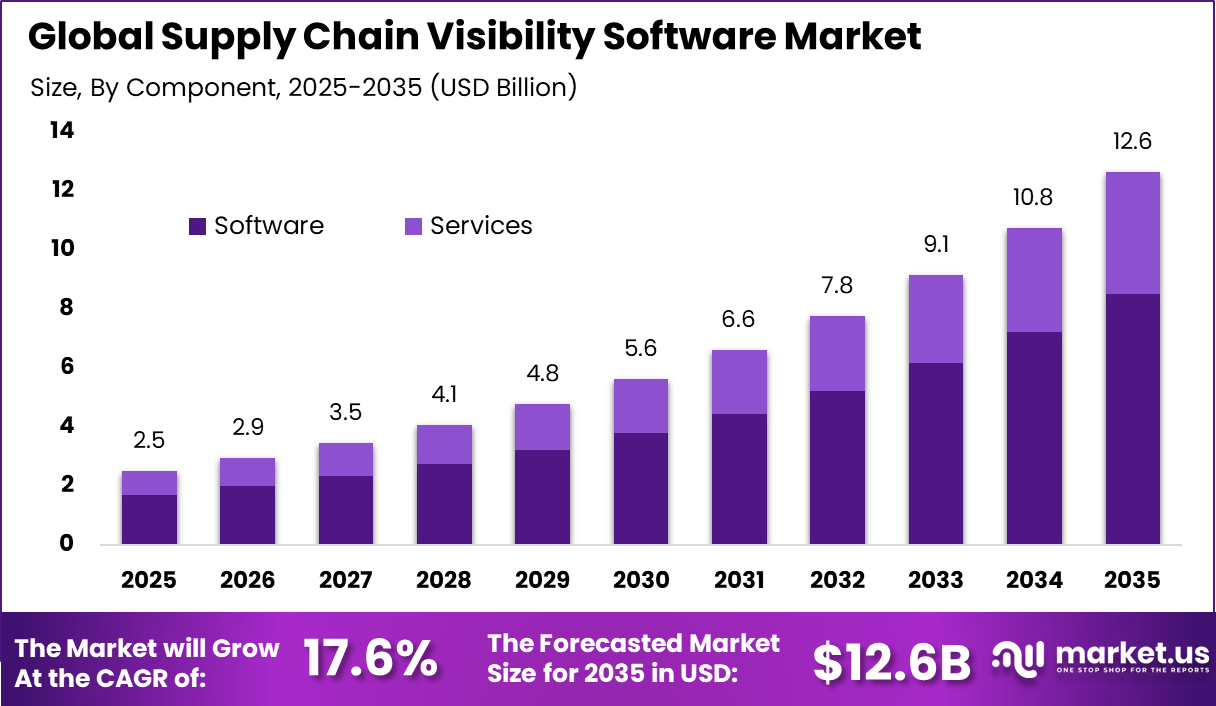
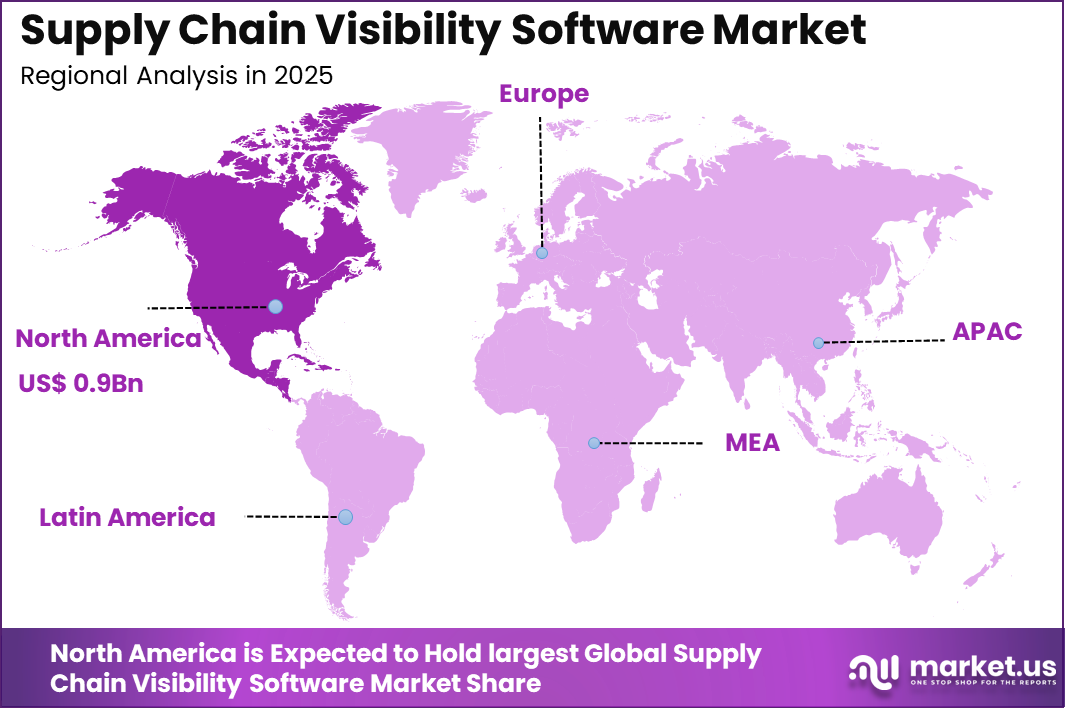
The Global Supply Chain Visibility Software Market size is expected to be worth around USD 12.6 Billion By 2035, from USD 2.5 billion in 2025, growing at a CAGR of 17.6% during the forecast period from 2026 to 2035. North America held a dominant Market position, capturing more than a 39.6% share, holding USD 0.9 Billion revenue.
The supply chain visibility software market is expanding as enterprises seek real time insight into inventory movement, shipment status, and supplier performance. Global trade complexity and frequent disruptions have increased the need for centralized monitoring systems. Organizations are investing in digital platforms that provide end to end tracking across procurement, warehousing, and last mile delivery. Visibility tools are becoming essential for risk mitigation and operational continuity.
Modern supply chains generate vast amounts of transactional and logistics data. Software platforms consolidate this data into unified dashboards that support faster decision making. Predictive analytics and alert systems allow companies to identify delays, bottlenecks, and compliance issues before they escalate. As supply networks become more interconnected, structured visibility solutions are strengthening resilience strategies.
AI-based supply chain visibility solutions have reduced forecasting errors by nearly 40%, improving planning accuracy during periods of rising disruption. Companies adopting AI-powered platforms report operational cost savings of 10% to 15%, supported by better demand forecasting and inventory control. These efficiencies allow organizations to allocate financial and operational resources more effectively.
Additional benefits include a 20% reduction in transportation expenses and a 30% improvement in warehouse efficiency, driven by enhanced coordination and automation. Furthermore, 67% of organizations have implemented digital dashboards to achieve end-to-end supply chain visibility, enabling real-time monitoring and informed decision-making across logistics networks.
One primary driver of the Supply Chain Visibility Software Market is the rise in global supply chain complexity and risk. Organisations today operate across multiple regions, carriers, and service providers, exposing operations to disruptions from geopolitical shifts, weather events, and logistics constraints. Visibility solutions provide real-time tracking and predictive notifications that support proactive risk management and operational continuity.
Top Market Takeaways
- Software accounted for 67.32% of the Supply Chain Visibility Software market, driven by demand for real-time analytics, dashboard integration, and predictive monitoring capabilities.
- Cloud-based deployment led with 61.25% share, reflecting preference for scalable platforms that enable multi-site coordination and remote access.
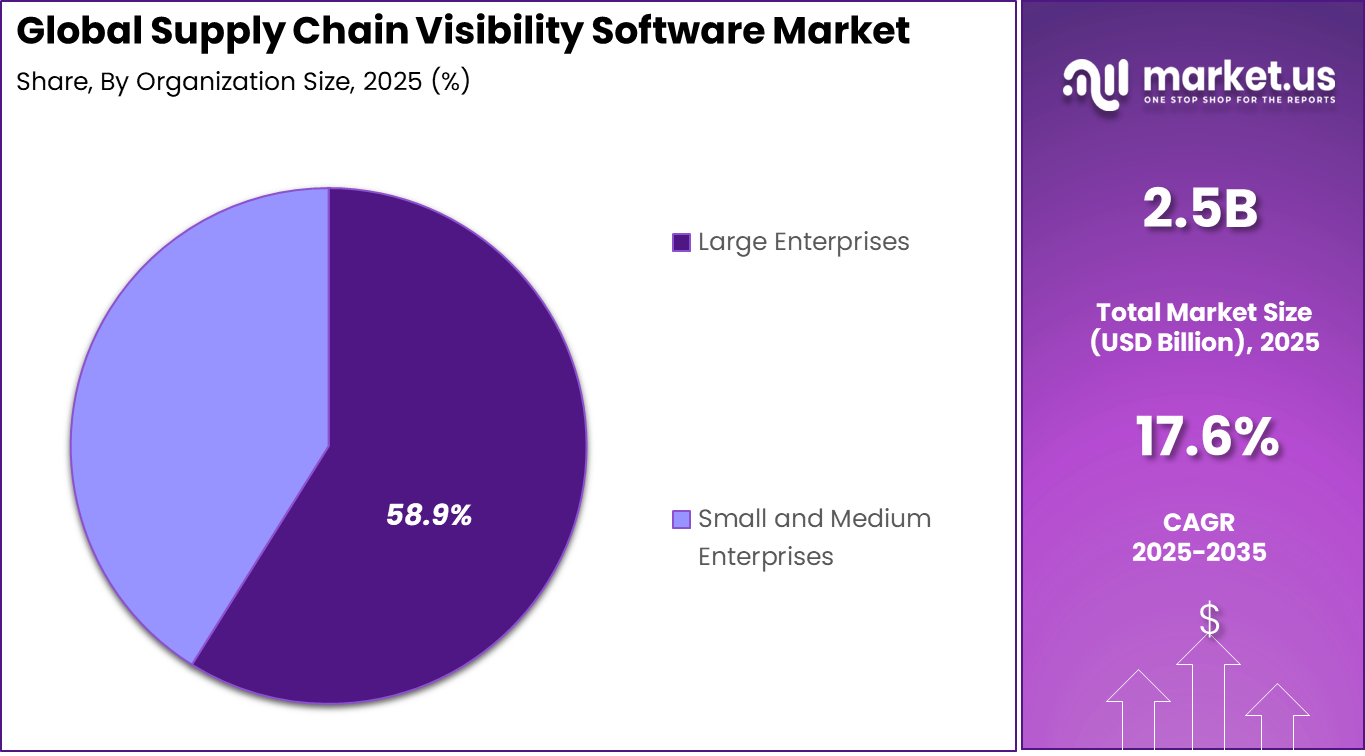
- Large enterprises represented 58.94% of total demand, supported by complex global supply chains and higher digital transformation budgets.
- Shipment tracking held 34.84% of application usage, as real-time cargo monitoring remains central to operational transparency and delivery accuracy.
- Manufacturing accounted for 31.32% of end-use share, driven by the need for inventory optimization and production continuity.
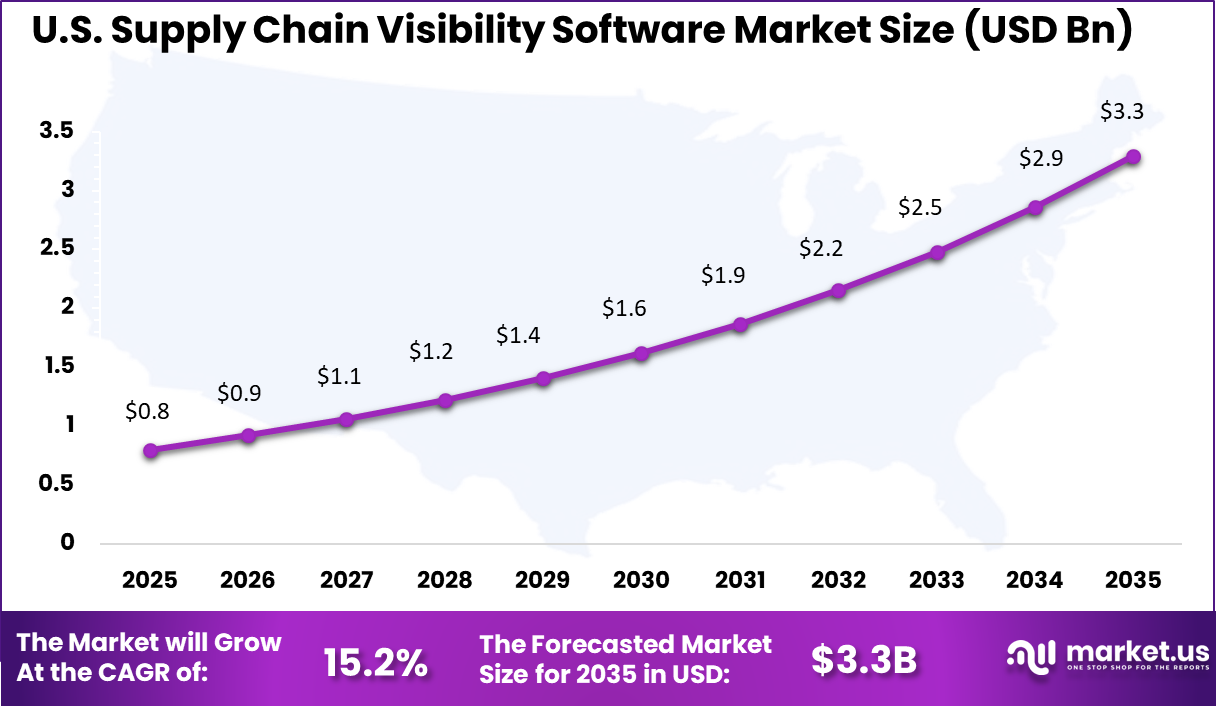
- North America captured 39.61% of the market, while the United States generated USD 0.89 billion in revenue and is expanding at a 15.2% CAGR, supported by increasing adoption of AI-enabled logistics platforms.
By Component
Software solutions account for 67.32% of the supply chain visibility software market, reflecting the growing reliance on digital platforms for end-to-end tracking. Enterprises are adopting centralized dashboards that consolidate data from transportation, warehousing, and distribution systems. These platforms enable real-time monitoring of inventory levels, shipment status, and supplier performance.
The dominance of software highlights the shift toward analytics-driven supply chain management. Advanced software tools integrate predictive analytics, artificial intelligence, and automated alerts to improve operational decision-making.
Organizations use these systems to identify disruptions, manage risks, and optimize logistics routes. Integration with enterprise resource planning and transportation management systems strengthens overall coordination. As supply chains become more complex, software-based visibility solutions remain critical.
By Deployment Mode
Cloud-based deployment holds 61.25% share, indicating strong preference for scalable and accessible solutions. Cloud platforms allow organizations to monitor global supply networks without heavy infrastructure investments. Real-time updates and remote accessibility enhance operational flexibility. This model supports collaboration among suppliers, logistics partners, and distributors across regions.
Cloud environments also enable faster integration with third-party data sources and IoT-enabled tracking devices. Companies benefit from automatic software updates and centralized data storage. The ability to scale operations based on seasonal demand strengthens adoption. As global trade networks expand, cloud deployment continues to gain momentum.
By Enterprise Size
Large enterprises represent 58.94% of total adoption, driven by their extensive and multi-layered supply networks. These organizations manage complex logistics operations across multiple countries and distribution centers. Visibility software helps coordinate suppliers, carriers, and inventory in real time. The scale of operations requires advanced analytics and structured monitoring tools.
Large corporations also prioritize compliance, risk management, and supplier transparency. Digital visibility systems provide actionable insights into delays, disruptions, and cost variations. Integration with procurement and finance systems enhances strategic planning. The segment’s strong share reflects the operational necessity of real-time supply chain intelligence.
By Application
Shipment tracking accounts for 34.84% of applications, emphasizing the importance of real-time logistics monitoring. Companies rely on tracking tools to monitor the movement of goods from origin to destination. This capability reduces uncertainty and improves customer communication. Real-time shipment updates support better planning and inventory management.
IoT sensors and GPS-enabled tracking devices strengthen data accuracy within this segment. Businesses use predictive alerts to anticipate delays and reroute shipments when necessary. Improved shipment transparency enhances customer satisfaction and service reliability. As delivery expectations rise, shipment tracking remains a core functionality.
By End-Use
Manufacturing represents 31.32% of end-use demand, reflecting the sector’s dependence on timely raw material and component delivery. Production schedules rely heavily on coordinated supplier networks and inventory flows. Visibility software enables manufacturers to anticipate shortages and manage supplier performance. This improves production continuity and reduces operational risk.
Manufacturers are increasingly adopting digital monitoring systems to support lean and just-in-time production models. Real-time data enhances decision-making related to procurement and logistics planning. Supply disruptions can directly affect output, making visibility tools strategically important. The sector continues to invest in digital solutions to improve resilience.
By Geography
North America commands 39.61% of the supply chain visibility software market due to advanced logistics infrastructure and digital maturity. Enterprises in the region actively invest in real time monitoring and predictive analytics. Regulatory compliance and trade complexity further encourage adoption. Strong technological ecosystems support continued innovation.
The United States market reached USD 0.89 billion and is growing at a CAGR of 15.2%. Expanding e commerce activity and complex distribution networks reinforce demand for visibility solutions. Companies prioritize transparency and risk mitigation in response to supply chain disruptions.
Emerging Trends Analysis
The Supply Chain Visibility Software market is increasingly shaped by the integration of real time tracking technologies and advanced analytics platforms. Organizations are deploying IoT sensors, RFID tags, and GPS enabled devices to monitor shipments, inventory levels, and asset movement across global networks. These data streams are consolidated within centralized dashboards to provide end to end transparency. As supply chains become more complex, demand for continuous monitoring solutions is strengthening.
Another emerging trend is the use of artificial intelligence and predictive analytics to anticipate disruptions. Visibility platforms are incorporating algorithms that analyze weather patterns, geopolitical events, and supplier performance data to identify potential risks. This proactive approach supports faster decision making and contingency planning. Cloud based architectures are further enhancing scalability and cross partner collaboration.
Key Market Segments
By Component
- Software
- Services
- Consulting
- Implementation
- Support & Maintenance
By Deployment Mode
- On-premises
- Cloud-based
By Enterprise Size
- Large Enterprises
- Small & Med-Sized Enterprises (SMEs)
By Application
- Order Management
- Asset Tracking
- Inventory Management
- Shipment Tracking
- Supply Chain Planning
- Others
By End-Use
- Retail and Consumer Goods
- Healthcare and Pharmaceuticals
- Manufacturing
- Transportation and Logistics
- Automotive
- Aerospace and Defense
- Food and Beverages
- Others
Regional Analysis and Coverage
- North America
- US
- Canada
- Europe
- Germany
- France
- The UK
- Spain
- Italy
- Russia
- Netherlands
- Rest of Europe
- Asia Pacific
- China
- Japan
- South Korea
- India
- Australia
- Singapore
- Thailand
- Vietnam
- Rest of Latin America
- Latin America
- Brazil
- Mexico
- Rest of Latin America
- Middle East & Africa
- South Africa
- Saudi Arabia
- UAE
- Rest of MEA
Driver Analysis
A primary driver of the Supply Chain Visibility Software market is the increasing need to manage supply chain disruptions effectively. Global events, transportation delays, and supplier inconsistencies have highlighted vulnerabilities in traditional supply networks. Enterprises are investing in visibility solutions to gain accurate and timely insights into operations. Improved transparency supports operational resilience and cost control.
Another key driver is the growth of e commerce and global trade activities. Higher transaction volumes and customer expectations for faster delivery require precise inventory and shipment tracking. Visibility software enables real time updates and performance monitoring. This capability enhances customer satisfaction and strengthens competitive positioning.
Restraint Analysis
One significant restraint in the market is the high cost of implementing comprehensive visibility solutions. Deployment often requires integration with enterprise resource planning, warehouse management, and transportation management systems. Customization and infrastructure upgrades can increase total implementation expenses. Smaller enterprises may delay adoption due to financial limitations.
Another restraint involves data standardization and interoperability challenges across supply chain partners. Different stakeholders may use varied systems and data formats. Achieving seamless data exchange requires coordination and technical alignment. Inconsistent data quality can limit the effectiveness of visibility tools.
Opportunity Analysis
A major opportunity lies in expanding adoption among small and medium enterprises seeking improved supply chain coordination. Cloud based subscription models lower entry barriers and reduce capital investment requirements. As SMEs expand into global markets, demand for scalable tracking and monitoring solutions is expected to grow. Vendors offering flexible pricing and simplified integration can capture this segment.
Another opportunity exists in incorporating sustainability and environmental reporting features within visibility platforms. Organizations are under pressure to monitor carbon emissions and ensure ethical sourcing practices. Visibility software can track environmental metrics alongside operational data. This integration supports regulatory compliance and corporate sustainability objectives.
Challenge Analysis
A primary challenge in the Supply Chain Visibility Software market is maintaining real time accuracy across highly distributed networks. Delays in data transmission or incomplete reporting from partners can affect system reliability. Continuous synchronization and validation mechanisms are necessary. Without accurate inputs, decision making may be compromised.
Another challenge involves ensuring cybersecurity across interconnected supply chain systems. Visibility platforms aggregate sensitive operational and commercial data. Cyber threats targeting supply chain networks can disrupt business continuity. Strong encryption, access controls, and continuous monitoring are essential to mitigate these risks.
Competitive Analysis
The Supply Chain Visibility Software market is led by major enterprise platform providers. SAP SE, Oracle Corporation, IBM Corporation, Infor, and Epicor Software Corporation offer integrated solutions that connect planning, logistics, and inventory data. Blue Yonder, Manhattan Associates, Inc., and Kinaxis strengthen control tower and real time analytics capabilities. These companies help enterprises improve forecasting accuracy and respond quickly to supply disruptions.
Specialized vendors focus on transportation and shipment level visibility. FourKites, Inc., Project44, and Descartes Systems Group Inc. provide real time tracking and predictive delivery insights. LogiNext, Shipwell, and Locus enhance route optimization and last mile transparency. E2open and Flexe support network coordination and flexible warehousing strategies across distributed supply chains.
Procurement and collaboration tools are also shaping market competition. Coupa integrates supplier risk management and spend visibility into broader supply chain workflows. Vendors are investing in cloud deployment and advanced analytics to strengthen operational resilience. Rising trade uncertainty and customer demand for faster fulfillment continue to support long term adoption.
Top Key Players in the Market
- SAP SE
- Blue Yonder
- Descartes Systems Group Inc.
- Epicor Software Corporation
- FourKites, Inc.
- IBM Corporation
- Infor
- Kinaxis
- Manhattan Associates, Inc.
- Oracle Corporation
- Project44
- LogiNext
- Shipwell
- Locus
- E2open
- Flexe
- Coupa
- Others
Recent Developments
- In October 2025, SAP introduced Joule AI agents for supply chain management. These agents were positioned to help automate production order workflows, support analysis of change requests, and simplify supplier onboarding. The rollout was intended to reduce operational errors and shorten cycle times across routine processes.
- In October 2025, Impilo partnered with Current Health to improve the speed, visibility, and reliability of medical supply deliveries. The collaboration was positioned to support advanced therapy logistics, including cell and gene treatments, CAR T, and bispecific immunotherapies. Better coordination across delivery steps was expected to strengthen planning and reduce delivery risk.
- In May 2025, Manhattan Associates made its Manhattan Active solutions available through Google Cloud Marketplace, expanding its partnership with Google Cloud. This approach was intended to simplify how customers evaluate and procure solutions. It also positioned customers to use Google Cloud AI capabilities to improve operational insights and automate selected workflows.
Report Scope
Report Features Description Market Value (2025) USD 2.5 Bn Forecast Revenue (2035) USD 12.6 Bn CAGR (2026-2035) 17.6% Base Year for Estimation 2025 Historic Period 2020-2024 Forecast Period 2026-2035 Report Coverage Revenue forecast, AI impact on Market trends, Share Insights, Company ranking, competitive landscape, Recent Developments, Market Dynamics and Emerging Trends Segments Covered By Component (Software, Services (Consulting, Implementation, Support & Maintenance)), By Deployment Mode (On-premises, Cloud-based), By Enterprise Size (Large Enterprises, Small & Medium-Sized Enterprises (SMEs)), By Application (Order Management, Asset Tracking, Inventory Management, Shipment Tracking, Supply Chain Planning, Others), By End-Use (Retail and Consumer Goods, Healthcare and Pharmaceuticals, Manufacturing, Transportation and Logistics, Automotive, Aerospace and Defense, Food and Beverages, Others) Regional Analysis North America – US, Canada; Europe – Germany, France, The UK, Spain, Italy, Russia, Netherlands, Rest of Europe; Asia Pacific – China, Japan, South Korea, India, New Zealand, Singapore, Thailand, Vietnam, Rest of Latin America; Latin America – Brazil, Mexico, Rest of Latin America; Middle East & Africa – South Africa, Saudi Arabia, UAE, Rest of MEA Competitive Landscape SAP SE, Blue Yonder, Descartes Systems Group Inc., Epicor Software Corporation, FourKites, Inc., IBM Corporation, Infor, Kinaxis, Manhattan Associates, Inc., Oracle Corporation, Project44, LogiNext, Shipwell, Locus, E2open, Flexe, Coupa, Others Customization Scope Customization for segments, region/country-level will be provided. Moreover, additional customization can be done based on the requirements. Purchase Options We have three license to opt for: Single User License, Multi-User License (Up to 5 Users), Corporate Use License (Unlimited User and Printable PDF)  Supply Chain Visibility Software MarketPublished date: Feb. 2026add_shopping_cartBuy Now get_appDownload Sample
 -
-
- SAP SE
- Blue Yonder
- Descartes Systems Group Inc.
- Epicor Software Corporation
- FourKites, Inc.
- IBM Corporation
- Infor
- Kinaxis
- Manhattan Associates, Inc.
- Oracle Corporation
- Project44
- LogiNext
- Shipwell
- Locus
- E2open
- Flexe
- Coupa
- Others
Our Clients

- 179324
- Feb. 2026









