


Market Overview
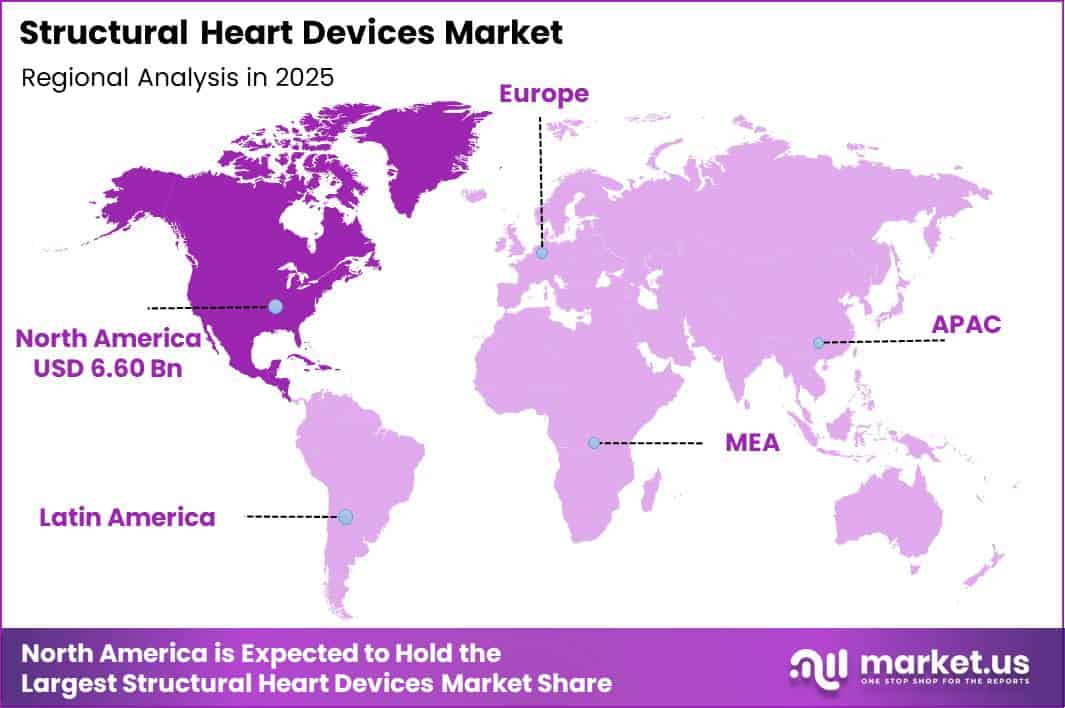
The Global Structural Heart Devices Market size is expected to be worth around US$ 46.77 Billion by 2035 from US$ 16.52 Billion in 2025, growing at a CAGR of 12.3% during the forecast period from 2026 to 2035. In 2025, North America led the market, achieving over 39.98% share with a revenue of US$ 6.60 Billion.
Structural heart devices are advanced medical technologies designed to diagnose, repair, or replace defects in the heart’s valves, chambers, septum, and associated structures without requiring extensive open-heart surgery in many cases. These devices include transcatheter heart valves, annuloplasty systems, left atrial appendage closure devices, septal occluders, and transcatheter repair systems.
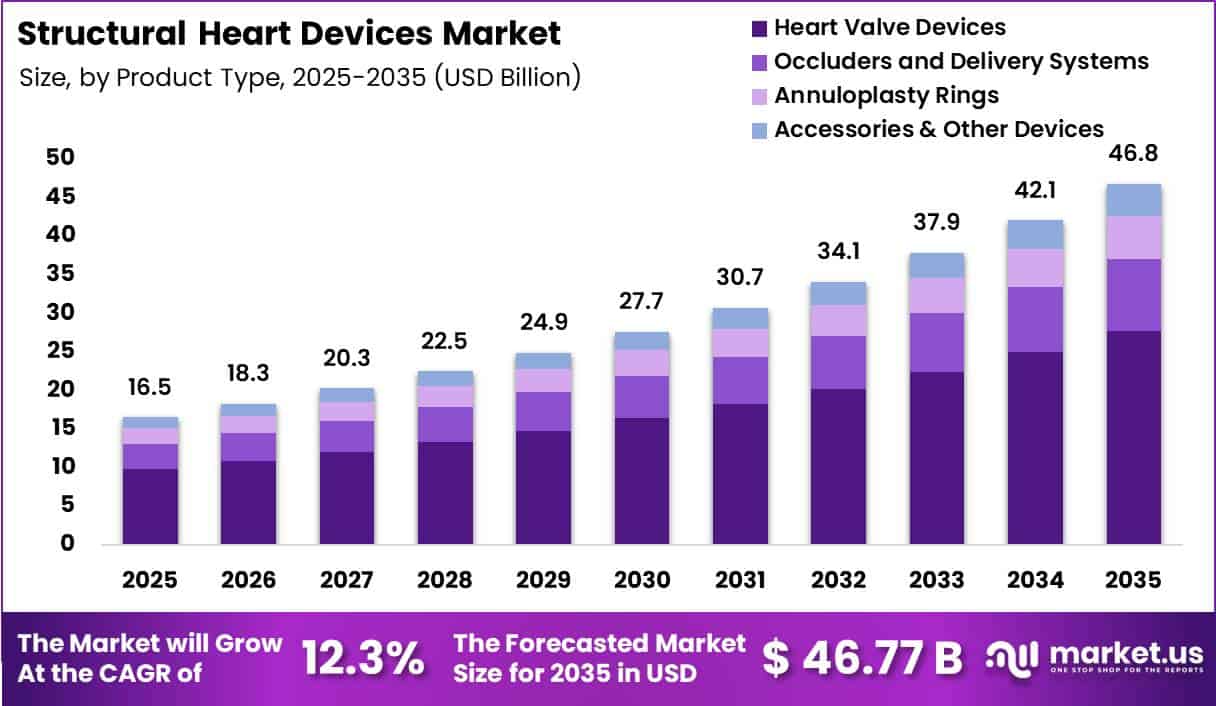
Growing adoption of minimally invasive cardiac procedures has transformed the treatment of structural heart disease by reducing hospital stays, improving recovery times, and lowering procedural risks for eligible patients. Continuous innovation in catheter-based interventions and imaging-guided procedures has further strengthened the role of these devices in modern cardiovascular care.
Structural heart disease represents a significant global healthcare burden. According to the U.S. National Institutes of Health (NIH), approximately 2.5% of the U.S. population is affected by heart valve disease, and more than 182,000 heart valve replacement procedures are performed annually in the United States.
The increasing prevalence of age-related valvular disorders, particularly aortic stenosis and mitral regurgitation, is driving demand for innovative structural heart interventions. In addition, cardiovascular disease remains one of the leading causes of morbidity worldwide, supporting continued investment in advanced treatment technologies.
Technological advancements have expanded the use of transcatheter procedures such as transcatheter aortic valve replacement (TAVR), left atrial appendage occlusion (LAAO), and transcatheter edge-to-edge repair (TEER).
A large U.S. analysis reported 434,630 structural heart intervention admissions between 2016 and 2020, demonstrating sustained clinical adoption despite temporary disruptions during the COVID-19 pandemic. Ongoing regulatory approvals, clinical research, and improvements in device durability and procedural outcomes continue to support the evolution of structural heart devices, making them an essential component of contemporary cardiovascular treatment strategies.
Key Takeaways
- Market Size: The Global Structural Heart Devices Market size was US$ 16.52 billion in 2025. The market is estimated to grow to US$ 46.77 billion by 2035.
- Market Share: The Compound Annual Growth Rate (CAGR) of the market from 2026 to 2035 will be 12.3%.
- Product Type: Heart Valve Devices has the largest market share, accounting for 59.35% of total sales.
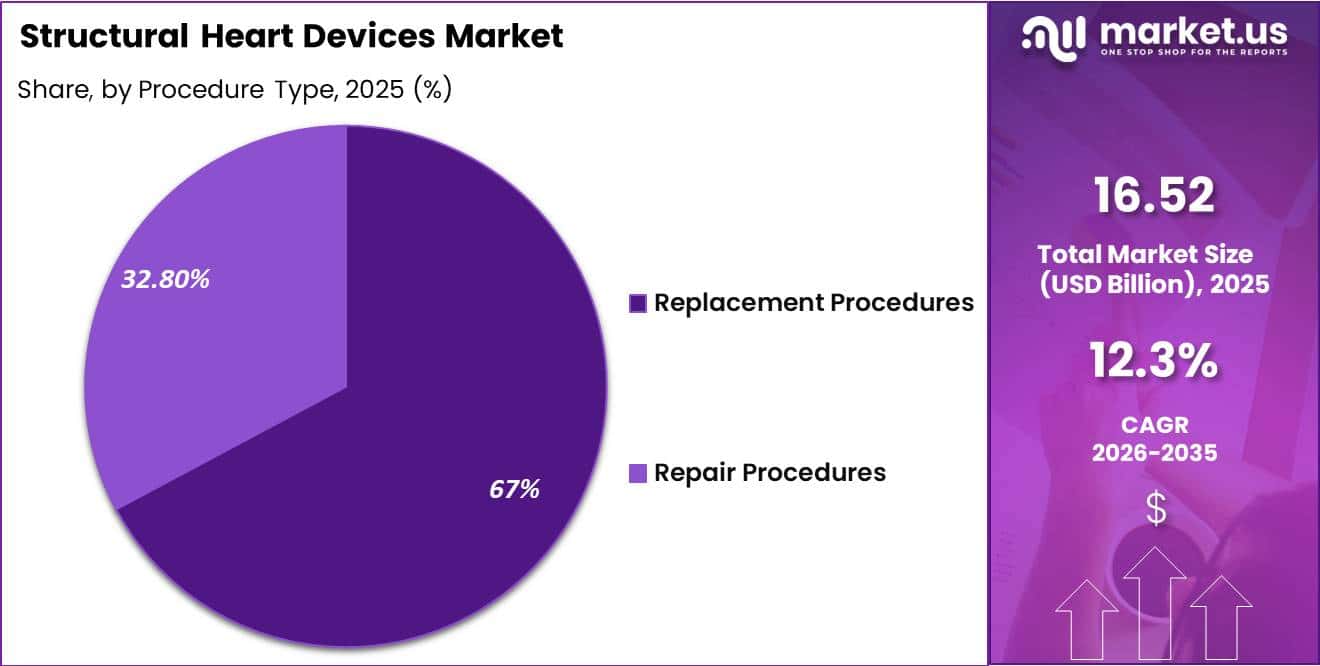
- Procedure Type: Replacement Procedures dominate the segment, accounting for 67.20% of total revenue.
- Indication: Aortic Valve Stenosis leads the segment, accounting for 56.50% of total revenue.
- End User: Hospitals dominate the segment, accounting for 82.25% of total revenue.
- Regional: North America is the dominant regional market, accounting for 39.98% of global sales, holding US$ 6.60 billion in revenue.
Product Type Analysis
The Heart Valve Devices segment dominated the Structural Heart Devices Market in 2025, accounting for 59.35% of the total market share. This leadership is attributed to the widespread adoption of transcatheter and surgical valve replacement technologies for treating aortic stenosis, mitral regurgitation, and other valvular heart diseases.
Increasing demand for minimally invasive procedures, coupled with technological advancements in transcatheter heart valves, has significantly expanded the use of these devices among elderly and high-risk patients.
Continuous improvements in valve durability, imaging guidance, and procedural success rates further reinforce the segment’s leading position. Rising awareness of early diagnosis and favourable clinical outcomes has also contributed to increased utilisation across major healthcare institutions worldwide.
The Occluders and Delivery Systems segment accounted for 20.0% of the market, supported by growing treatment volumes for atrial septal defects, ventricular septal defects, and left atrial appendage closure procedures. Annuloplasty Rings represented 12.0%, benefiting from increased adoption in mitral and tricuspid valve repair surgeries aimed at preserving native valve function.
Meanwhile, Accessories & Other Devices, holding 8.65%, continues to gain traction through innovations in delivery catheters, imaging accessories, and procedural support tools that improve procedural precision and expand the capabilities of structural heart interventions.
Procedure Type Analysis
The Replacement Procedures segment held the largest share of the Structural Heart Devices Market in 2025, capturing 67.2% of total revenue. The segment’s dominance is primarily driven by the growing preference for transcatheter aortic valve replacement (TAVR) and surgical valve replacement procedures in patients with severe valvular heart disease.
Expanding clinical indications, improved long-term outcomes, and increasing physician confidence have accelerated the adoption of replacement therapies across both developed and emerging healthcare markets.
The ageing global population and the rising prevalence of degenerative valve disorders further support the sustained demand for replacement procedures. Technological innovations in device design and procedural techniques have also enhanced procedural safety and reduced recovery times.
The Repair Procedures segment accounted for 32.8% of the market in 2025 and is projected to be the fastest-growing segment during the forecast period. Growing clinical preference for preserving native valve anatomy, particularly in mitral and tricuspid valve disease, is driving adoption of transcatheter edge-to-edge repair and annuloplasty procedures.
Continuous innovation in minimally invasive repair technologies, expanding regulatory approvals, and increasing evidence supporting improved patient outcomes are expected to accelerate market growth. Rising demand among younger patients and those unsuitable for valve replacement further strengthens the long-term growth outlook for repair procedures.
Indication Analysis
The Aortic Valve Stenosis segment dominated the Structural Heart Devices Market in 2025, accounting for 56.5% of the overall market share. The high prevalence of age-related calcific aortic stenosis, particularly among elderly populations, has significantly increased demand for transcatheter and surgical valve replacement procedures.
The widespread adoption of TAVR, supported by expanding clinical guidelines and favourable long-term outcomes, continues to strengthen the segment’s leadership. Earlier diagnosis through advanced cardiac imaging and broader patient eligibility for minimally invasive interventions have further contributed to sustained procedure volumes across hospitals worldwide. Increasing healthcare investments and improved reimbursement frameworks also support continued market expansion.
The Congenital Heart Defects segment represents an important portion of the market, driven by growing use of septal occluders and minimally invasive structural interventions in both pediatric and adult patients. Improvements in early diagnosis and long-term management have expanded treatment opportunities.
The Heart Failure segment is projected to be the fastest-growing during the forecast period, fueled by increasing adoption of structural heart therapies designed to address secondary mitral regurgitation and other heart failure-related structural abnormalities. Continuous innovation in transcatheter repair technologies and expanding clinical evidence are expected to accelerate growth in this segment over the coming years.
End-User Analysis
The Hospitals segment dominated the Structural Heart Devices Market in 2025, capturing 82.25% of the total market share. Hospitals remain the primary setting for structural heart interventions due to the complexity of these procedures, availability of hybrid operating rooms, advanced imaging technologies, and multidisciplinary heart teams.
High patient volumes, comprehensive cardiac care infrastructure, and access to specialised cardiovascular surgeons and interventional cardiologists contribute to the segment’s leading position. Hospitals also serve as major centres for clinical research, physician training, and adoption of newly approved structural heart technologies, supporting continued procedural growth. Increasing investments in cardiovascular centres and expansion of minimally invasive cardiac programs further reinforce hospital dominance.
The Ambulatory Surgical Centres (ASCs) accounted for 17.75% of the market in 2025 and continue to gain attention as healthcare systems seek cost-effective treatment settings for selected structural heart procedures. Improvements in minimally invasive technologies, shorter procedure durations, and enhanced post-procedural recovery have enabled a gradual shift of eligible interventions toward outpatient environments.
Growing emphasis on reducing healthcare costs, improving patient convenience, and expanding access to specialised cardiovascular care is expected to support the steady growth of ASCs as an important complementary end-user segment in the structural heart devices market.
Key Market Segments
By Product Type
- Heart Valve Devices
- Transcatheter Heart Valves (THVs)
- Surgical Heart Valves (Mechanical and Tissue/Bioprosthetic))
- Occluders and Delivery Systems
- Left Atrial Appendage Closure (LAAC) Devices
- Atrial/Ventricular Septal Defect (ASD/VSD) Occluders)
- Annuloplasty Rings
- Accessories & Other Devices
By Procedure Type
- Replacement Procedures
- Repair Procedures
- Mitral/Tricuspid Edge-to-Edge Repair (e.g., MitraClip)
- Valvuloplasty
By Indication
- Aortic Valve Stenosis
- Congenital Heart Defects
- Heart Failure
By End User
- Hospitals
- Ambulatory Surgical Centres (ASCs)
Driver
Tricuspid platform commercialisation after FDA approvals
The tricuspid intervention space is transitioning from investigational use to full commercial adoption following recent FDA approvals, creating a new structural heart growth segment rather than a narrow device upgrade cycle. In the U.S., Edwards’ EVOQUE became the first FDA-approved transcatheter tricuspid valve replacement in February 2024, while Abbott’s TriClip G4 received FDA approval in April 2024 for severe symptomatic tricuspid regurgitation in high-risk patients.
These approvals establish both repair and replacement pathways for a condition that was historically underdiagnosed and largely managed medically. This dual platform availability enables more systematic patient stratification based on anatomy and surgical risk, increasing procedural conversion rates and expanding treatment eligibility. As a result, hospitals can develop structured tricuspid programs rather than treating cases opportunistically, increasing structural heart service line utilisation.
The commercial impact extends beyond device volume, driving higher imaging utilisation, referral network activation, capital equipment deployment, and repeated procedural training across centres. This creates a compounding effect as programs mature and expand case throughput.
Overall, the emergence of a dual device tricuspid ecosystem supports an estimated 1.6 % point uplift to structural heart market CAGR, driven by category creation and sustained procedural adoption rather than one-time device penetration.
| Driver | (~) % Impact on CAGR Forecast | Geographic Relevance | Impact Timeline |
|---|---|---|---|
| Tricuspid platform commercialisation after FDA approvals | +1.6% | North America core, EU early-adopter centers, APAC tertiary hubs | Short term (≤ 2 years) |
| Reimbursement expansion through CMS evidence-based coverage | +1.3% | US core, EU reference effect, select APAC private systems | Short term (≤ 2 years) |
| Earlier intervention in severe valve disease | +1.1% | North America core, Western Europe, Japan, South Korea | Medium term (2-4 years) |
| Ageing-led valve disease burden and diagnosis expansion | +1.4% | North America, EU, Japan, China urban corridors, Latin America spill-over | Medium term (2-4 years) |
| Heart-team centralisation and procedural capacity build-out | +0.9% | US and EU centres of excellence, Gulf hubs, developed APAC metros | Medium term (2-4 years) |
| Digital screening and imaging workflow integration | +0.7% | US core, EU, Japan, advanced APAC hospital networks | Long-term (≥ 4 years) |
Challenge
Device and imaging supply chain volatility in structural heart markets
Structural heart therapies depend on highly complex supply chains spanning valves, occluders, delivery systems, catheters, bioprosthetic materials, and advanced imaging platforms. Volatility across these inputs continues to act as a structural drag on market expansion rather than causing outright shortages.
Lead times for key valve systems and imaging components can extend from a typical 2 to 3 weeks to 6 to 10 weeks during periods of supplier disruption, regulatory inspections, or logistics constraints. This forces hospitals to maintain inventory buffers 30 to 50 % above pre-pandemic levels, tying up significant working capital.
Imaging systems critical for case selection, such as transesophageal echocardiography probes, CT scanners, and cath lab fluoroscopy units, also face periodic parts shortages and maintenance delays. These disruptions can reduce imaging capacity by 5 to 15 % per quarter, slowing patient screening and downstream procedural throughput.
Freight variability, currency fluctuations, and regional supply imbalances contribute to 5 to 10 % year on year variability in landed device costs in some emerging markets, particularly across APAC and Latin America.
While manufacturers are responding with supplier diversification, regional assembly, and long-term contracting, these measures typically require 2 to 3 years to stabilise effectively, especially for smaller hospital systems with limited negotiating power.
Overall, supply chain and imaging volatility reduces procedural throughput and delays revenue realisation, trimming an estimated 1.1% points from structural heart market CAGR, with the greatest impact in import-dependent and resource-constrained healthcare systems.
| Challenge | (~) % CAGR Friction Drag | Geographic Relevance | Mitigation Horizon |
|---|---|---|---|
| Advanced operator talent gap | -1.4% | North America, EU, APAC metros | Long-term (≥ 4 years) |
| Cath lab & OR capacity bottlenecks | -1.2% | North America core, EU, East Asia | Medium term (2-4 years) |
| Complex multidisciplinary care coordination | -0.9% | High-income health systems | Medium term (2-4 years) |
| Device & imaging supply chain volatility | -1.1% | Global, APAC manufacturing hubs | Medium term (2-4 years) |
| Data, registry, and outcomes infrastructure gaps | -0.8% | Emerging markets, selected EU | Long-term (≥ 4 years) |
| Reimbursement complexity and value-based transition | -1.0% | US, EU, selected LATAM | Long-term (≥ 4 years) |
Restraints
Unequal access and reimbursement gaps in structural heart therapies
Despite cardiovascular diseases accounting for approximately 32% of global deaths and disproportionately affecting low- and middle-income countries, adoption of advanced structural heart interventions such as TAVR, TMVR, and percutaneous closures remains concentrated in high-income systems due to affordability constraints and reimbursement gaps.
Even within the same country, utilisation is lower among middle- and low-income groups despite comparable hospital outcomes, indicating that barriers arise earlier in the care pathway, particularly in referral patterns, insurance coverage, and out-of-pocket affordability.
In many emerging markets, these procedures are either absent from national reimbursement lists or only partially covered, leaving patients with costs equivalent to several years of income, compounded by limited device availability in public hospitals.
From a payer perspective, constrained healthcare budgets and competing priorities such as hypertension and diabetes management further restrict coverage for high-cost structural interventions. Consequently, although underlying clinical need in low- and middle-income countries could support double-digit growth, actual adoption remains in mid-single digits, resulting in an estimated 0.5 % point long-term drag on global structural heart device CAGR as market expansion lags epidemiological demand.
| Restraint | (~) % Impact on CAGR Forecast | Geographic Relevance | Impact Timeline |
|---|---|---|---|
| Premium device & procedure costs | -1.0% | North America core, Western EU, high-income APAC | Medium term (2–4 years) |
| Regulatory complexity & PMA burden | -0.8% | US, EU, Japan | Medium term (2–4 years) |
| Limited cath lab & SHD program capacity | -0.6% | North America, EU, urban APAC corridors | Short–medium term (≤ 4 years) |
| Unequal access & reimbursement gaps | -0.5% | Emerging APAC, LatAm, Eastern Europe, LMICs | Long-term (≥ 4 years) |
| High imaging & digital planning costs | -0.3% | North America core, EU centres of excellence | Short term (≤ 2 years) |
| Material, supply and post-approval study costs | -0.3% | Global, especially US & EU | Medium–long term (≥ 2 years) |
Opportunity
Mitral TMVR expansion driving structural heart growth opportunity
Mitral transcatheter valve replacement is an opportunity, not a baseline driver, because it expands the market into patients who remain poorly served by surgery or TEER and converts a technically narrower segment into a much larger procedural TAM as systems, imaging, and operator learning curves mature.
FDA approval of a transseptal TMVR pathway and coverage evolution around structural procedures create room for a meaningful category step-up, especially in high-volume centres that can absorb the higher implant economics and bundle follow-on imaging, planning, and post-procedure monitoring into a premium service line.
The upside is not just incremental procedure count: TMVR can lift average selling prices, protocolized workup revenue, and hospital economics, with a realistic 2.0 % point CAGR contribution if adoption broadens across the US, EU5, and Japan.
| Opportunity | (~) % Potential CAGR Upside | Geographic Relevance | Execution Window |
|---|---|---|---|
| Mitral TMVR scale-up | +2.0% | US, EU5, Japan | Short term (≤ 2 years) |
| Tricuspid first-mover capture | +1.7% | US, EU5, APAC core | Short term (≤ 2 years) |
| Asymptomatic TAVR expansion | +1.4% | US, Canada, Western EU | Short term (≤ 2 years) |
| AI planning + EHR monetisation | +1.1% | US core, EU regulated markets | Medium term (2-4 years) |
| Emerging-market access tiers | +1.3% | APAC emerging, Latin America, MENA | Medium term (2-4 years) |
| M&A roll-up of niche repair | +0.9% | North America, EU, select APAC | Long term (≥ 4 years) |
Regional Analysis
In 2025, North America led the market, achieving over 39.98% share with a revenue of US$ 6.60 billion. The region’s leadership is supported by a high prevalence of structural heart diseases, widespread adoption of minimally invasive transcatheter procedures, and advanced cardiovascular healthcare infrastructure. Strong reimbursement policies, favourable regulatory pathways, and the presence of leading medical device manufacturers further contribute to market growth.
Increasing utilisation of transcatheter aortic valve replacement (TAVR), transcatheter edge-to-edge repair (TEER), and left atrial appendage closure (LAAO) procedures continues to drive procedure volumes across the United States and Canada.
Europe represents the second-largest regional market, benefiting from an ageing population, well-established cardiac care networks, and broad clinical adoption of innovative structural heart technologies. Countries including Germany, France, Italy, and the United Kingdom continue to expand access to minimally invasive valve replacement and repair procedures through favourable healthcare systems and ongoing clinical research.
The Asia-Pacific region is expected to register the fastest growth during the forecast period. Rising cardiovascular disease prevalence, expanding healthcare infrastructure, growing healthcare expenditure, and increasing availability of advanced catheter-based interventions are accelerating market expansion across China, Japan, South Korea, and Australia. Government initiatives to strengthen cardiovascular care and improve access to advanced medical technologies further support regional growth.
Latin America and the Middle East & Africa are experiencing gradual market development, supported by improving healthcare infrastructure, increasing investments in specialised cardiac centres, greater physician training, and rising awareness of minimally invasive structural heart interventions. These factors are expected to create new growth opportunities as access to advanced cardiovascular treatments continues to improve across emerging economies.
Key Regions and Countries
North America
- The US
- Canada
Europe
- Germany
- France
- The U.K.
- Italy
- Spain
- Russia & CIS
- Rest of Europe
Asia Pacific
- China
- India
- Japan
- South Korea
- ASEAN
- Australia & New Zealand
- Rest of Asia Pacific
Middle East & Africa
- GCC
- South Africa
- Rest of Middle East & Africa
Latin America
- Brazil
- Mexico
- Rest of Latin America
Key Player Analysis
Competitive advantage in the global structural heart devices market is achieved through transcatheter heart valve technology leadership, comprehensive product portfolio coverage spanning replacement and repair procedure device categories, established relationships with hospital interventional cardiology and cardiac surgery departments, and continued investment in next-generation transcatheter valve and left atrial appendage closure device development.
Major strategic priorities for leading manufacturers include expansion of transcatheter aortic valve replacement (TAVR) product lines addressing the dominant aortic valve stenosis indication, development of transcatheter mitral and tricuspid valve repair and replacement technologies addressing the fastest-growing repair procedure segment, and growing investment in emerging Asia Pacific markets where structural heart disease burden and interventional cardiology infrastructure are expanding simultaneously.
Strong hospital cardiac catheterisation laboratory procurement relationships, combined with growing ambulatory surgical centre presence for lower-complexity structural heart procedures, represent a critical competitive differentiator for manufacturers serving the dominant heart valve device segment globally.
Top Key Players
- Medtronic plc
- Edwards Lifesciences Corporation
- Abbott Laboratories
- Boston Scientific Corporation
- LivaNova plc
- W. L. Gore & Associates, Inc.
- Cook Medical (Cook Group Inc.)
- CryoLife, Inc.
- Artivion, Inc. (formerly CryoLife)
- Terumo Corporation
- Lepu Medical Technology Co., Ltd.
- Venus Medtech, Inc.
- Meril Lifesciences Pvt. Ltd.
- JenaValve Technology, Inc.
- Corcym (formerly LivaNova Cardiac Surgery)
- Other Key Players
Recent Developments
- In January 2026, Edwards Lifesciences Corporation launched an expanded SAPIEN transcatheter heart valve portfolio with next-generation repositionable deployment technology, targeting hospital interventional cardiology departments seeking improved procedural outcomes in complex aortic valve stenosis cases.
- In February 2026, Abbott Laboratories received FDA approval for an expanded MitraClip indication covering tricuspid valve repair, targeting hospital structural heart programs seeking transcatheter repair solutions for patients with severe tricuspid regurgitation and high surgical risk profiles.
- In March 2026, Medtronic plc introduced a new left atrial appendage closure device with enhanced delivery system technology, targeting hospital electrophysiology and structural heart departments managing atrial fibrillation patients requiring stroke prevention through non-pharmacological LAAC procedures.
- In April 2026, Meril Lifesciences Pvt. Ltd. secured a multi-year distribution agreement with a leading Asian hospital network covering its transcatheter heart valve and occluder device portfolio, expanding its institutional presence across structural heart disease treatment procedures in the Asia Pacific region.
Report Scope
| Report Features | Description |
|---|---|
| Market Value (2025) | US$ 16.52 Billion |
| Forecast Revenue (2035) | US$ 46.77 Billion |
| CAGR (2026-2035) | 12.3% |
| Base Year for Estimation | 2025 |
| Historic Period | 2020-2024 |
| Forecast Period | 2026-2035 |
| Report Coverage | Revenue Forecast, Market Dynamics, Competitive Landscape, Recent Developments |
| Segments Covered | By Product Type (Heart Valve Devices, Occluders and Delivery Systems, Annuloplasty Rings, Accessories & Other Devices), By Procedure Type (Replacement Procedures, Repair Procedures), By Indication (Aortic Valve Stenosis, Congenital Heart Defects, Heart Failure), By End User (Hospitals, Ambulatory Surgical Centres (ASCs)) |
| Regional Analysis | North America – The US, Canada; Europe – Germany, France, U.K., Italy, Spain, Russia & CIS, Rest of Europe; Asia Pacific – China, India, Japan, South Korea, ASEAN, Australia & New Zealand, Rest of Asia Pacific; Middle East & Africa – GCC, South Africa, Rest of Middle East & Africa; Latin America – Brazil, Mexico, Rest of Latin America |
| Competitive Landscape | Medtronic plc, Edwards Lifesciences Corporation, Abbott Laboratories, Boston Scientific Corporation, LivaNova plc, W. L. Gore & Associates, Inc., Cook Medical (Cook Group Inc.), CryoLife, Inc., Artivion, Inc. (formerly CryoLife), Terumo Corporation, Lepu Medical Technology Co., Ltd., Venus Medtech, Inc., Meril Lifesciences Pvt. Ltd., JenaValve Technology, Inc., Corcym (formerly LivaNova Cardiac Surgery), Other Key Players |
| Customization Scope | Customization for segments, region/country-level will be provided. Moreover, additional customization can be done based on the requirements. |
| Purchase Options | We have three licenses to opt for: Single User License, Multi-User License (Up to 5 Users), Corporate Use License (Unlimited User and Printable PDF) |





































