


Global Smart Camera with NPU Market By NPU Integration (Integrated On-board NPU, External NPU Module/Accelerator), By Application (Consumer Smart Home Cameras, Enterprise & Industrial Surveillance, Automotive (In-cabin, ADAS), Robotics & Drones, Others), By End-User (Individual Consumers, Businesses & Commercial Entities, Government & Public Sector, Automotive Manufacturers),By Regional Analysis, Global Trends and Opportunity, Future Outlook By 2025-2035
- Published date: Mar. 2026
- Report ID: 181575
- Number of Pages: 362
- Format:
-
keyboard_arrow_up
Quick Navigation
- Report Overview
- Top Market Takeaways
- Drivers Impact Analysis
- Restraints Impact Analysis
- By NPU Integration Analysis
- By Application Analysis
- By End User Analysis
- Investor Type Impact Analysis
- Technology Enablement Analysis
- Key Challenges
- Emerging Trends
- Growth Factors
- Key Market Segments
- Regional Analysis
- Competitive Analysis
- Future Outlook
- Recent Developments
- Report Scope
Report Overview
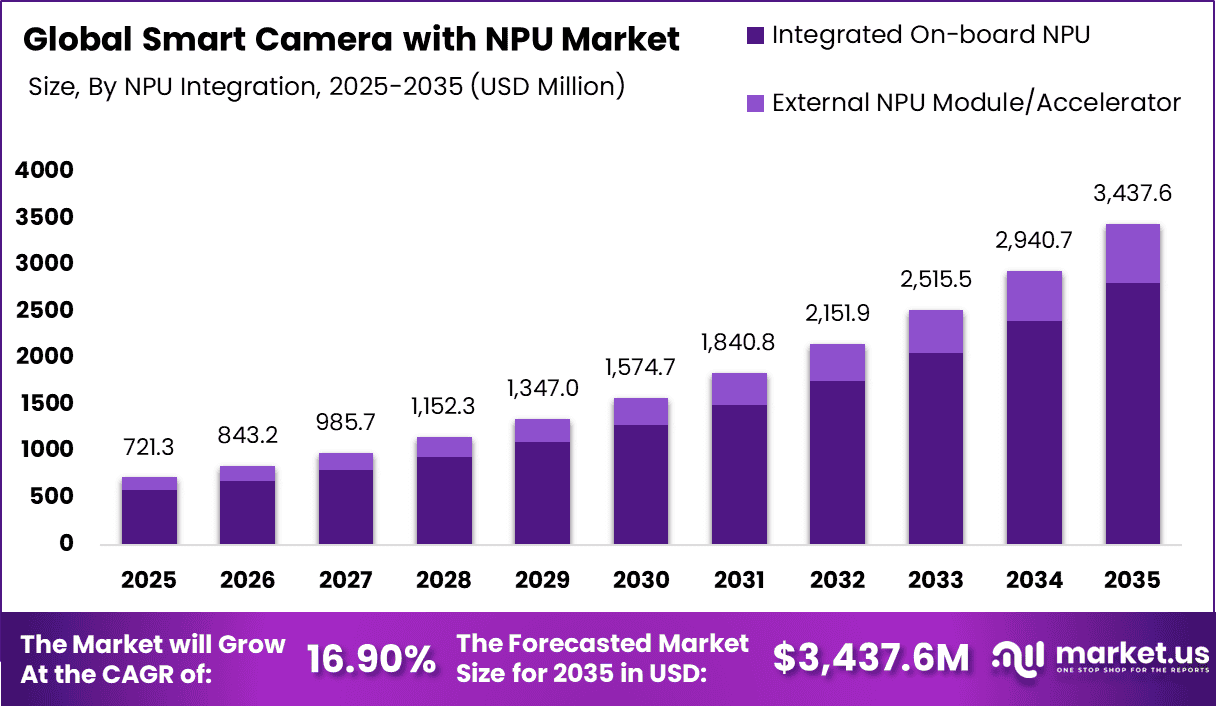
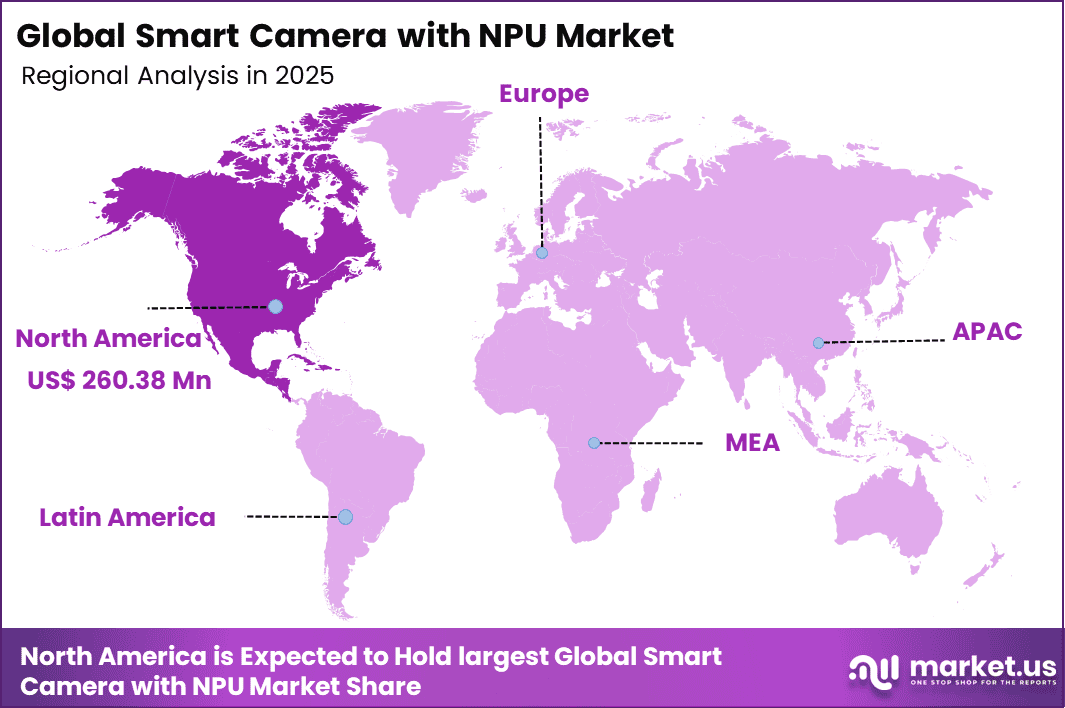
The Global Smart Camera with NPU Market generated USD 721.3 million in 2025 and is predicted to register growth from USD 843.2 million in 2026 to about USD 3,437.6 million by 2035, recording a CAGR of 16.90% throughout the forecast span. In 2025, North America held a dominan market position, capturing more than a 36.1% share, holding USD 260.38 Million revenue.
The smart camera with NPU market refers to intelligent imaging systems equipped with a Neural Processing Unit that enables on-device artificial intelligence processing. These cameras can analyze visual data locally without relying heavily on cloud infrastructure. NPUs are specialized processors designed to accelerate AI tasks such as object detection, facial recognition, motion tracking, and scene analysis directly within the camera hardware.
The adoption of smart cameras with NPUs is increasing as industries demand real-time analytics, low-latency processing, and enhanced data privacy. By processing data at the edge, these cameras reduce bandwidth usage, improve response times, and enable faster decision making. They are widely used in applications such as surveillance, retail analytics, industrial automation, healthcare monitoring, and smart city infrastructure.
One of the key growth factors driving the smart camera with NPU market is the rapid expansion of edge computing. Organizations are shifting from centralized cloud processing to edge-based systems where data is analyzed closer to the source. Smart cameras with NPUs enable this transition by performing AI inference directly on the device, reducing dependence on cloud connectivity.
Another growth factor is the increasing demand for real-time video analytics. Industries such as security, manufacturing, and retail require immediate insights from visual data to detect anomalies, monitor activities, and improve operational efficiency. NPUs enhance processing speed and enable continuous analysis without latency delays.
Top Market Takeaways
- By NPU Integration, integrated on-board NPU dominates with 81.7% share, enabling local facial recognition, object detection, and behavioral analysis without cloud dependency.
- By Application, consumer smart home cameras capture 48.6%, powering doorbell cams, indoor monitors, and pet cams with low-power continuous inference.
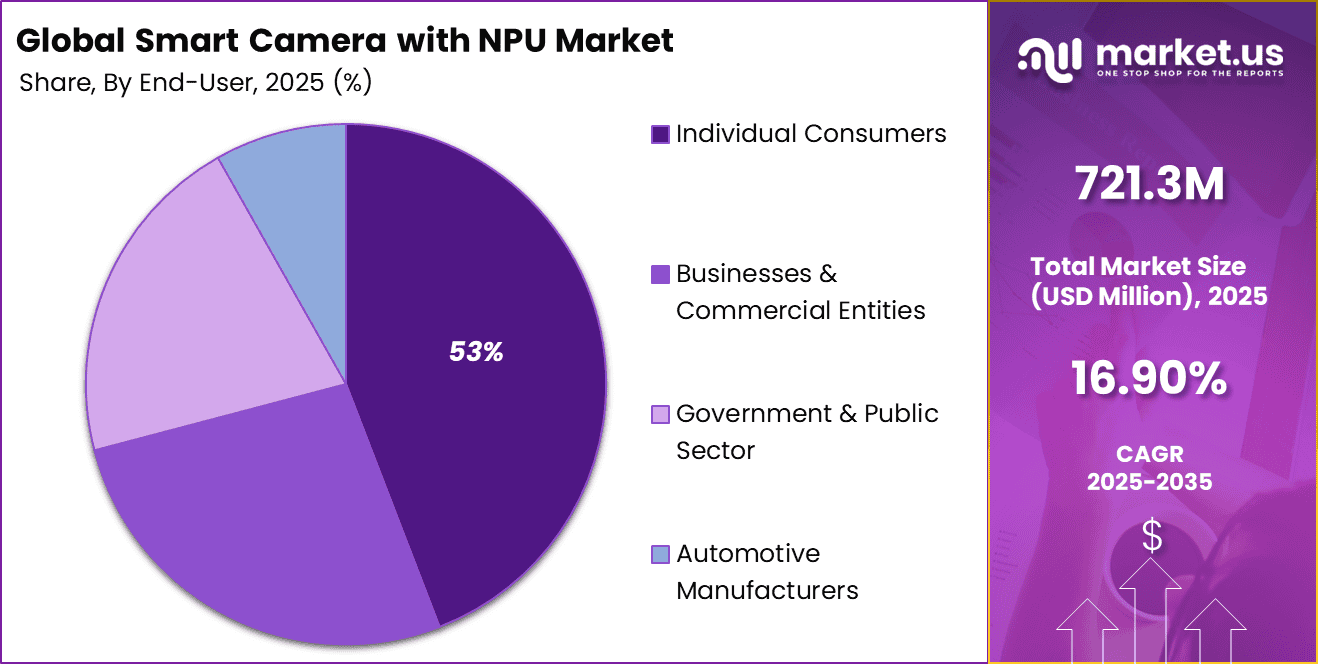
- By End-User, individual consumers claim 52.8%, driving mass adoption through affordable plug-and-play setup and smartphone integration.
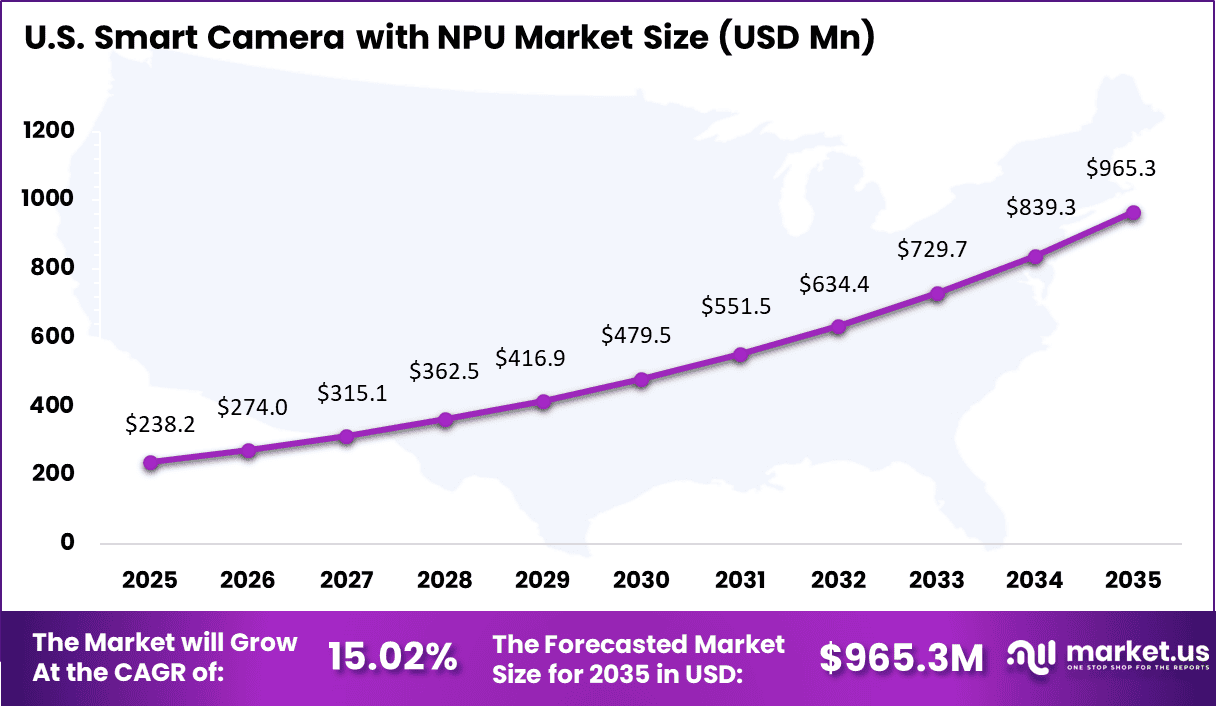
- Regionally, North America accounts for 36.1% global share, with the U.S. market valued at USD 238.2 million and a CAGR of 15.02%, fueled by Ring/Amazon ecosystem expansion and suburban security trends.
Drivers Impact Analysis
Key Driver Impact on CAGR Forecast (~%) Geographic Relevance Impact Timeline Strategic Effect Rising demand for edge AI and real time video analytics +3.1% North America, China, Europe Short to Mid Term (2025–2031) Enables faster on device decision making Increasing adoption in smart surveillance and security systems +2.8% Global Mid Term (2026–2032) Improves threat detection efficiency Growth of smart cities and intelligent infrastructure +2.6% Asia Pacific, Middle East, Europe Mid to Long Term (2026–2035) Expands deployment in public monitoring Rising use in automotive and advanced driver assistance systems +2.3% US, Germany, Japan, South Korea Mid to Long Term (2026–2035) Supports real time object detection Expansion of industrial automation and machine vision +2.1% Global Mid Term (2026–2032) Enhances production monitoring accuracy Restraints Impact Analysis
Key Restraint Impact on CAGR Forecast (~%) Geographic Relevance Impact Timeline Strategic Effect High cost of NPU enabled hardware components -2.2% Global Mid Term (2026–2032) Limits adoption in cost sensitive markets Power consumption and thermal management challenges -1.9% Global Mid Term (2026–2032) Affects device performance efficiency Integration complexity with existing systems -1.7% North America, Europe Mid Term (2026–2032) Slows deployment across industries Data privacy concerns in AI enabled cameras -1.6% Europe, North America Mid to Long Term (2026–2035) Creates regulatory challenges Limited availability of optimized AI models for edge devices -1.4% Global Mid Term (2026–2032) Restricts full performance potential By NPU Integration Analysis
Integrated on board NPU accounted for 81.7% of the Smart Camera with NPU Market. This segment leads because embedding processing capability directly within the camera allows real time image analysis without relying heavily on external servers. It enables faster object detection, facial recognition, and motion tracking while reducing latency.
The segment also benefits from increasing demand for edge computing in surveillance and smart devices. On board NPUs help reduce bandwidth usage and improve data privacy since processing happens locally. This makes integrated solutions more efficient and reliable for continuous monitoring applications.
By Application Analysis
Consumer smart home cameras represented 48.6% of the market. This segment dominates because households are rapidly adopting smart surveillance devices to monitor homes, entrances, and indoor spaces. Cameras with NPU capabilities provide intelligent alerts, activity recognition, and enhanced security features for everyday use.
The segment is supported by the expansion of connected home ecosystems. Consumers prefer cameras that can automatically detect unusual activity and provide real time notifications, which improves home safety and convenience while driving adoption of AI enabled camera systems.
By End User Analysis
Individual consumers held 53% of the Smart Camera with NPU Market. This segment leads because personal users are increasingly investing in smart security devices for home protection and remote monitoring. Easy installation and mobile connectivity make these products accessible to a wide range of users.
The segment is also driven by rising awareness of home security and the need for continuous surveillance. Individual consumers prefer solutions that offer intelligent features such as person detection and automated alerts, which enhances safety while keeping monitoring simple and efficient.
Investor Type Impact Analysis
Investor Type Growth Sensitivity Risk Exposure Geographic Focus Investment Outlook Venture Capital Firms Very High High US, China, Israel Strong edge AI innovation potential Private Equity Firms High Medium North America, Europe Expansion in AI hardware and vision systems Strategic Technology Investors Very High Medium US, Japan, South Korea Strengthens AI semiconductor ecosystem Corporate Venture Arms High Medium Global Supports smart device integration Government and Innovation Funds Medium Low to Medium Asia Pacific, Europe Supports AI and semiconductor development Technology Enablement Analysis
Technology Enabler Impact on CAGR Forecast (~%) Geographic Relevance Impact Timeline Implementation Significance Neural processing units for on device AI inference +3.2% Global Short to Mid Term (2025–2031) Enables real time processing Edge computing architectures for video analytics +2.9% North America, Europe, Asia Pacific Mid Term (2026–2032) Reduces latency and bandwidth use AI based image recognition and object detection +2.7% Global Mid Term (2026–2032) Improves detection accuracy Integration with IoT and connected device ecosystems +2.4% Global Mid to Long Term (2026–2035) Expands device interoperability Low power AI chip design advancements +2.1% US, China, South Korea Mid to Long Term (2026–2035) Improves energy efficiency Key Challenges
- High product cost remains a key challenge because smart fire safes with Wi Fi features, digital controls, and remote monitoring are more expensive than traditional safes.
- Internet and power dependence can affect reliability, as weak connectivity, app failure, or battery issues may limit access to smart functions when users need them most.
- Cybersecurity is a major concern because connected safes may face risks such as hacking, unauthorized access, or data privacy issues through mobile apps and cloud systems.
- Consumer awareness is still limited, as many buyers do not fully understand the benefits of smart fire safes or may prefer conventional products with simpler features.
- Product durability and maintenance also create challenges because manufacturers must ensure strong fire protection, secure locking performance, and long term software support in one system.
Emerging Trends
A key trend in the Smart Camera with NPU market is the shift toward edge based intelligence where cameras process data locally instead of sending everything to the cloud. Built in neural processing units allow these cameras to recognize objects, detect motion patterns, and filter relevant events in real time.
This reduces dependence on external systems and improves response speed in security and monitoring applications. Organizations increasingly prefer such solutions as they offer better privacy control and allow faster decision making directly at the device level.
Growth Factors
The growing demand for real time monitoring and intelligent surveillance is supporting the expansion of smart cameras with NPU capabilities. Businesses and public facilities require systems that can identify events quickly and reduce manual monitoring efforts.
These cameras help analyze video feeds efficiently and highlight important activities without constant human supervision. At the same time, the need for data privacy and reduced bandwidth usage encourages adoption, as local processing limits the amount of data transferred across networks while maintaining effective surveillance performance.
Key Market Segments
By NPU Integration
- Integrated On-board NPU
- External NPU Module/Accelerator
By Application
- Consumer Smart Home Cameras
- Enterprise & Industrial Surveillance
- Automotive (In-cabin, ADAS)
- Robotics & Drones
- Others
By End-User
- Individual Consumers
- Businesses & Commercial Entities
- Government & Public Sector
- Automotive Manufacturers
Regional Analysis
North America accounted for 36.1% of the Smart Camera with NPU Market, reflecting strong adoption of AI enabled imaging systems across consumer and enterprise applications. Organizations and households increasingly deploy smart cameras with built in neural processing units to enable real time image recognition, motion detection, and edge based analytics.
The growing demand for intelligent surveillance, smart home monitoring, and automated security systems continues to drive adoption. As connected devices expand across industries, the need for faster on device processing supports the growth of NPU integrated cameras in the region.
The U.S. generated about USD 238.2 Mn within the regional market and is projected to expand at a CAGR of 15.02%. Businesses and consumers across the country increasingly prefer cameras that can process data locally without relying heavily on cloud systems. Smart cameras with NPUs improve response time, reduce latency, and enhance privacy by limiting data transfer. As demand rises for efficient, real time video analytics in security, retail, and smart home applications, adoption of NPU enabled camera systems continues to grow steadily across the US market.
Key Regions and Countries
- North America
- US
- Canada
- Europe
- Germany
- France
- The UK
- Spain
- Italy
- Russia
- Netherlands
- Rest of Europe
- Asia Pacific
- China
- Japan
- South Korea
- India
- Australia
- Singapore
- Thailand
- Vietnam
- Rest of APAC
- Latin America
- Brazil
- Mexico
- Rest of Latin America
- Middle East & Africa
- South Africa
- Saudi Arabia
- UAE
- Rest of MEA
Competitive Analysis
The Smart Camera with NPU Market is driven by surveillance and imaging technology providers that integrate neural processing capabilities for real time analytics and edge AI processing. Hikvision Digital Technology Co., Ltd., Dahua Technology Co., Ltd., Axis Communications, and Bosch Security Systems deliver advanced smart cameras equipped with embedded AI chips. These solutions enable object detection, facial recognition, and behavior analysis directly on devices without relying on cloud processing.
Consumer technology companies are expanding smart camera adoption through connected home ecosystems. Google LLC through Nest, Amazon through Ring and Blink, and Arlo Technologies provide AI enabled cameras for home security and monitoring. Anker Innovations through Eufy and Reolink focus on affordable smart cameras with on device AI processing.
Semiconductor and AI chip providers form the technological backbone of NPU enabled smart cameras. Ambarella, Intel, Qualcomm, HiSilicon, and NVIDIA develop neural processing units and vision processing chips that enable edge AI capabilities. These technologies support low latency analytics, improved image processing, and energy efficient performance.
Top Key Players in the Market
- Hikvision Digital Technology Co., Ltd.
- Dahua Technology Co., Ltd.
- Axis Communications AB
- Bosch Security Systems, Inc.
- Hanwha Vision Co., Ltd.
- Google LLC (Nest)
- Amazon.com, Inc. (Ring, Blink)
- Arlo Technologies, Inc.
- Eufy (Anker Innovations)
- Reolink Digital Technology Co., Ltd.
- Ambarella, Inc. (NPU chip supplier)
- Intel Corporation (Movidius VPUs)
- Qualcomm Technologies, Inc.
- Hisilicon (Huawei)
- NVIDIA Corporation
- Others
Future Outlook
The future outlook for the Smart Camera with NPU Market appears strong as demand rises for cameras that can process images and video faster directly on the device. These cameras are expected to see wider use in homes, businesses, factories, and public security systems because they support quicker response, better privacy, and lower dependence on cloud processing. Growing adoption of edge AI, smart surveillance, and real time analytics is likely to support steady market growth in the coming years.
Recent Developments
- January, 2026 – Hanwha launched second-generation X series with Wisenet 9 dual-NPU SoC. One NPU handles video quality while the other runs analytics like people counting and queue management. Enterprises report 50% lower false alarms in retail deployments. Cameras cover harsh environments with AI noise reduction. Magnetic modular design simplifies installs. Hanwha equips 100,000 sites globally.
- February, 2026 – Hikvision rolled out ColorVu cameras with embedded Hisilicon NPUs. On-device vehicle detection processes 4K streams at 60fps. Perimeter security cut breach response to 3 seconds. AcuSense tech filters non-threats automatically. IP67 rating suits outdoors. Hikvision powers 40% of enterprise CCTV.
Report Scope
Report Features Description Market Value (2025) USD 721.3 Million Forecast Revenue (2035) USD 3,437.6 Million CAGR(2025-2035) 16.90% Base Year for Estimation 2024 Historic Period 2020-2024 Forecast Period 2025-2035 Report Coverage Revenue forecast, AI impact on Market trends, Share Insights, Company ranking, competitive landscape, Recent Developments, Market Dynamics and Emerging Trends Segments Covered By NPU Integration (Integrated On-board NPU, External NPU Module/Accelerator), By Application (Consumer Smart Home Cameras, Enterprise & Industrial Surveillance, Automotive (In-cabin, ADAS), Robotics & Drones, Others), By End-User (Individual Consumers, Businesses & Commercial Entities, Government & Public Sector, Automotive Manufacturers) Regional Analysis North America – US, Canada; Europe – Germany, France, The UK, Spain, Italy, Russia, Netherlands, Rest of Europe; Asia Pacific – China, Japan, South Korea, India, New Zealand, Singapore, Thailand, Vietnam, Rest of Latin America; Latin America – Brazil, Mexico, Rest of Latin America; Middle East & Africa – South Africa, Saudi Arabia, UAE, Rest of MEA Competitive Landscape Hikvision Digital Technology Co., Ltd., Dahua Technology Co., Ltd., Axis Communications AB, Bosch Security Systems, Inc., Hanwha Vision Co., Ltd., Google LLC (Nest), Amazon.com, Inc. (Ring, Blink), Arlo Technologies, Inc., Eufy (Anker Innovations), Reolink Digital Technology Co., Ltd., Ambarella, Inc. (NPU chip supplier), Intel Corporation (Movidius VPUs), Qualcomm Technologies, Inc., Hisilicon (Huawei), NVIDIA Corporation, Others Customization Scope Customization for segments, region/country-level will be provided. Moreover, additional customization can be done based on the requirements. Purchase Options We have three license to opt for: Single User License, Multi-User License (Up to 5 Users), Corporate Use License (Unlimited User and Printable PDF)  Smart Camera with NPU MarketPublished date: Mar. 2026add_shopping_cartBuy Now get_appDownload Sample
 -
-
- Hikvision Digital Technology Co., Ltd.
- Dahua Technology Co., Ltd.
- Axis Communications AB
- Bosch Security Systems, Inc.
- Hanwha Vision Co., Ltd.
- Google LLC (Nest)
- Amazon.com, Inc. (Ring, Blink)
- Arlo Technologies, Inc.
- Eufy (Anker Innovations)
- Reolink Digital Technology Co., Ltd.
- Ambarella, Inc. (NPU chip supplier)
- Intel Corporation (Movidius VPUs)
- Qualcomm Technologies, Inc.
- Hisilicon (Huawei)
- NVIDIA Corporation
- Others
Our Clients

- 181575
- Mar. 2026









