


Global Shredder Blades Market Size, Share, Growth Analysis By Blade Material (Alloy Tool Steel, Tungsten Carbide Alloy, Martensitic Stainless Steel, Ferritic Stainless Steel, Others), By Blade Design (Hook, Square), By Shaft Count (Double Shaft, Single Shaft, Others), By Application (Metals, Plastic, Rubber, Wood, E-waste, Paper & Cardboard, Others), By End-Use Industry (Waste Management & Recycling, Food, Pharmaceuticals, Others), By Region and Companies - Industry Segment Outlook, Market Assessment, Competition Scenario, Statistics, Trends and Forecast 2026-2035
- Published date: Feb 2026
- Report ID: 180590
- Number of Pages: 361
- Format:
-
keyboard_arrow_up
Quick Navigation
Report Overview
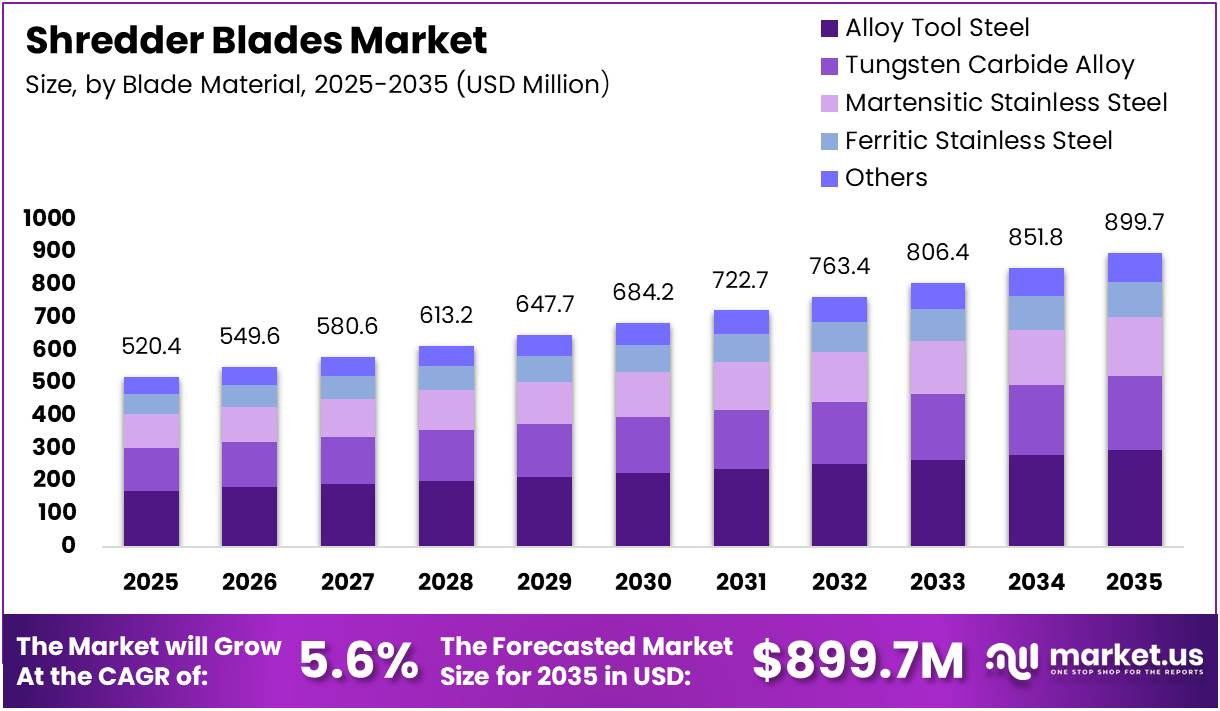
The Global Shredder Blades Market size is expected to be worth around USD 899.7 Million by 2035 from USD 520.4 Million in 2025, growing at a CAGR of 5.6% during the forecast period 2026 to 2035.
The shredder blades market covers the production, supply, and distribution of industrial cutting blades used in shredding machines. These blades are core components that process materials such as metals, plastics, rubber, wood, and electronic waste. They are widely used in waste management, recycling, manufacturing, and secondary material processing operations globally.
Shredder blades are manufactured using various materials including alloy tool steel, tungsten carbide alloy, and stainless steel grades. Moreover, blade design plays a critical role in shredding performance. Hook blades and square blades are among the most common configurations, each suited to specific material types and processing requirements across industrial applications.
Market growth is driven by the rapid expansion of recycling industries and increasing volumes of industrial and municipal waste. Additionally, the rising generation of e-waste and metal scrap is creating consistent demand for shredding solutions. Manufacturers are responding by developing longer-lasting and application-specific blade designs to serve a wide range of end-use sectors.
Government investment in waste processing infrastructure and circular economy programs is actively supporting adoption of advanced shredding technology. Consequently, environmental regulations in developed markets are pushing industrial operators to upgrade their equipment with higher-grade blade systems. Emerging economies are also expanding their recycling capacities, generating new growth opportunities for the global market.
According to MDPI, PET plastic shredding machines can achieve shredding efficiency between 64.8% and 69.5% depending on blade geometry and orientation. Additionally, according to JETIR, industrial shredder blades may require replacement after roughly 1.5 years due to wear, even though the shredding machine itself may last around 5 to 6 years.
According to Bladesg.com, wear-resistant shredder blades can typically be resharpened 5 to 8 times before full replacement, significantly extending total operational life. Therefore, the development of high-durability blade solutions has become a primary focus for manufacturers seeking to lower total cost of ownership and meet growing customer demands across global markets.
Key Takeaways
- The global Shredder Blades Market was valued at USD 520.4 Million in 2025 and is projected to reach USD 899.7 Million by 2035.
- The market is expected to grow at a CAGR of 5.6% during the forecast period 2026 to 2035.
- By Blade Material, Alloy Tool Steel holds the dominant position with a 32.2% market share in 2025.
- By Blade Design, the Hook segment leads the market with a 55.9% share.
- By Shaft Count, the Double Shaft segment dominates with a 60.7% share.
- By Application, the Metals segment holds the largest share at 27.8%.
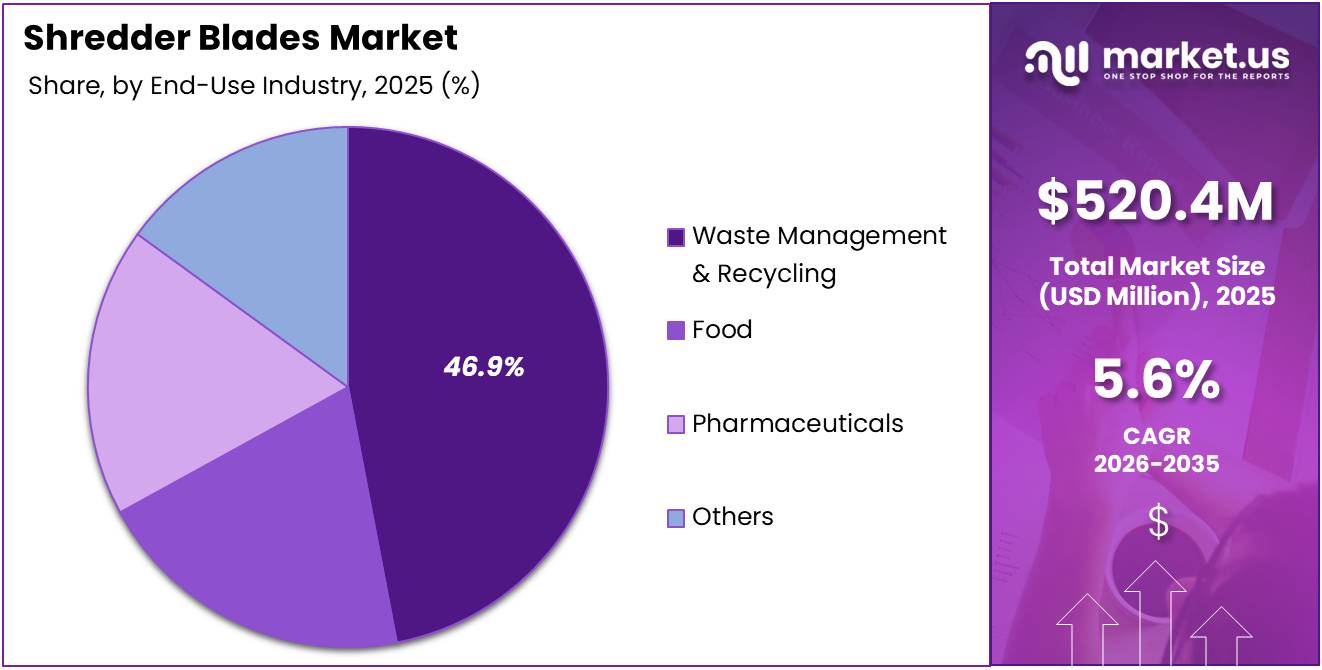
- By End-Use Industry, Waste Management and Recycling leads with a 46.9% share.
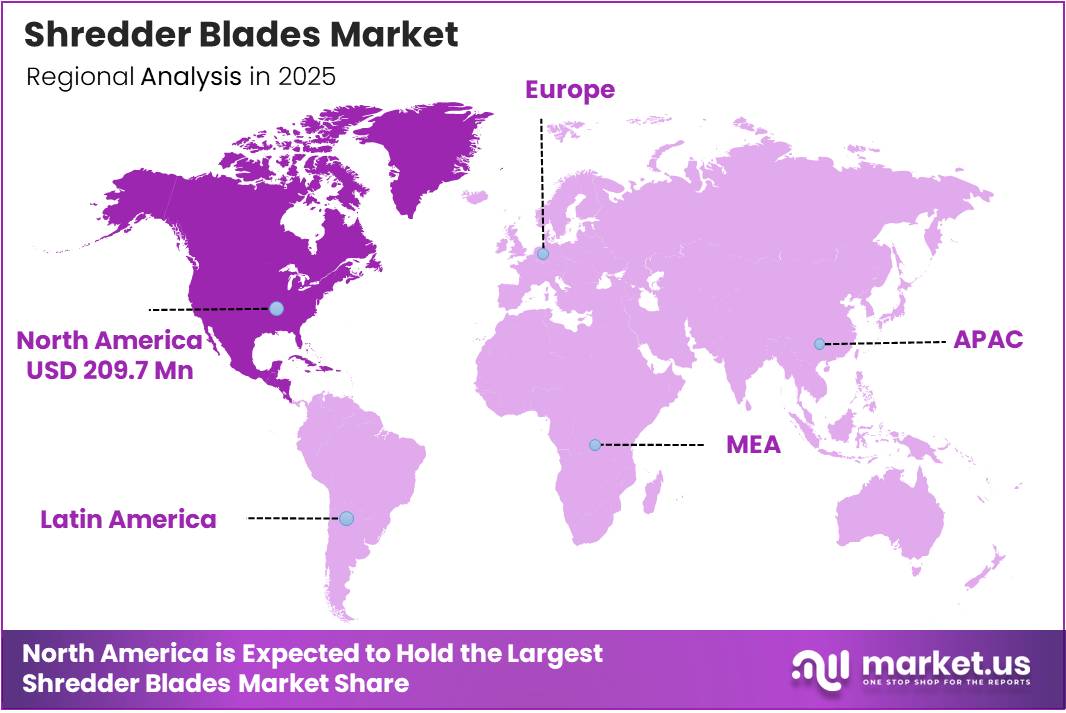
- North America dominates the regional landscape with a 40.3% share, valued at USD 209.7 Million.
Blade Material Analysis
Alloy Tool Steel dominates with 32.2% due to its superior hardness, cost-effectiveness, and broad suitability for demanding industrial shredding applications.
In 2025, Alloy Tool Steel held a dominant market position in the By Blade Material segment of the Shredder Blades Market, with a 32.2% share. This material is widely preferred due to its high hardness, wear resistance, and cost-effectiveness. It performs reliably in processing metals, plastics, and general industrial waste materials across high-volume operations.
Tungsten Carbide Alloy blades are increasingly adopted for applications requiring superior hardness and resistance to highly abrasive materials. Moreover, they offer extended operational life compared to standard tool steels. This makes them a preferred choice for processing hard metals, industrial scrap, and other demanding shredding applications where performance consistency is critical.
Martensitic Stainless Steel blades offer a balance of corrosion resistance and mechanical strength. Consequently, they are commonly selected for food processing, pharmaceutical, and hygiene-sensitive applications. These blades maintain sharpness under moderate operational loads and resist chemical exposure, making them well-suited for regulated industrial environments.
Ferritic Stainless Steel blades are used where moderate corrosion resistance is required at a lower cost than martensitic grades. Additionally, these blades perform reliably in light-duty applications involving paper, cardboard, and non-abrasive plastics. They offer good formability and consistent performance under standard industrial shredding conditions.
Others category includes specialty alloys and composite materials engineered for niche shredding applications. Therefore, manufacturers continue developing new blade materials to meet specific customer requirements. This segment is expected to grow as industries seek customized material solutions for handling unique waste streams and specialized processing environments.
Blade Design Analysis
Hook segment dominates with 55.9% due to superior material grip and high cutting efficiency across diverse shredding applications.
In 2025, Hook held a dominant market position in the By Blade Design segment of the Shredder Blades Market, with a 55.9% share. Hook blades are widely used because they provide excellent material grip and high cutting efficiency. They are particularly effective for processing bulky and hard materials such as metals and thick plastics in heavy-duty operations.
Square blades offer a flat, uniform cutting edge effective for processing softer materials such as paper, cardboard, and light plastics. Moreover, square blades are straightforward to resharpen and reconfigure, making them a cost-effective option for operators handling diverse material streams. They are commonly deployed in single-shaft shredders and light industrial processing environments.
Shaft Count Analysis
Double Shaft dominates with 60.7% due to its high torque output and reliable ability to handle tough, bulky materials efficiently.
In 2025, Double Shaft held a dominant market position in the By Shaft Count segment of the Shredder Blades Market, with a 60.7% share. Double shaft shredders use two counter-rotating shafts to deliver high torque and reliable processing of bulky and hard materials. They are widely used in metal, wood, and e-waste shredding operations globally.
Single Shaft shredders are valued for their precision and ability to produce uniform particle sizes. Moreover, they are widely adopted in plastic recycling and document destruction applications. Their simpler mechanical design compared to double shaft models makes them easier to maintain and operate, supporting their use in medium-scale processing facilities.
Others category includes four-shaft and specialized multi-shaft configurations used for highly demanding processing tasks. Consequently, these systems are deployed where ultra-fine output size or extreme material hardness requires additional cutting power. Demand for this segment is expected to grow in advanced recycling and specialized industrial processing environments.
Application Analysis
Metals segment dominates with 27.8% due to high volumes of metal scrap generated by global manufacturing and industrial operations.
In 2025, Metals held a dominant market position in the By Application segment of the Shredder Blades Market, with a 27.8% share. Metal shredding requires blades with extreme hardness and wear resistance. High volumes of scrap metal from automotive, construction, and heavy manufacturing industries drive consistent and strong demand for metal-grade shredder blades.
The Plastic segment represents significant market demand, driven by growing plastic waste volumes globally. Additionally, expanding plastic recycling programs require reliable shredding solutions capable of processing various plastic types. Blade design and material selection are critical in achieving consistent particle size and operational efficiency for plastic recycling facilities.
Rubber shredding is primarily driven by tire recycling and industrial rubber waste processing. Moreover, rubber applications require blades with high tensile strength to manage the elasticity and toughness of the material. Demand is growing steadily with the expansion of tire recycling initiatives and rubber reclamation facilities in multiple regions.
The Wood segment covers applications in timber processing, furniture manufacturing, and biomass fuel production. Consequently, wood shredding requires blades capable of efficiently handling both softwoods and hardwoods. Growing demand for biomass energy and wood waste recycling is contributing to steady growth in this application area within the shredder blades market.
E-waste shredding is among the fastest-growing application areas, reflecting the global surge in discarded electronics. Therefore, blades used in e-waste processing must withstand mixed material streams including metals, plastics, and circuit board components. Regulatory requirements for responsible electronic waste disposal are driving investment in dedicated shredding equipment and specialized blade solutions.
Paper and Cardboard shredding is widely used in document destruction, packaging recycling, and paper processing industries. Additionally, these applications typically require lighter-duty blades, making square and flat-edge designs most suitable. Growth in e-commerce packaging volumes and paper recycling programs continues to support steady demand within this application segment.
Others segment encompasses shredding applications for textiles, food waste, and composite materials requiring tailored blade solutions. Moreover, specialized processing needs are driving demand for customized blade designs and material compositions. As industries adopt new recycling methods and processing approaches, demand for niche and application-specific shredder blades is expected to grow progressively.
End-Use Industry Analysis
Waste Management and Recycling dominates with 46.9% due to growing global recycling mandates and increasing industrial and municipal waste volumes.
In 2025, Waste Management and Recycling held a dominant market position in the By End-Use Industry segment of the Shredder Blades Market, with a 46.9% share. This sector generates the highest demand for shredder blades globally. Growing volumes of municipal and industrial waste, combined with recycling mandates, sustain strong and consistent market demand.
The Food industry uses shredder blades for processing organic waste, food-grade materials, and production by-products. Moreover, food-grade shredding requires blades manufactured from corrosion-resistant materials that comply with hygiene standards. Increasing food processing capacities and waste reduction requirements are driving steady demand for specialized shredder blade solutions in this sector.
The Pharmaceuticals segment uses shredder blades for secure destruction of expired products, packaging, and production waste. Consequently, this application demands precise blade tolerances and materials resistant to chemical exposure. Compliance with pharmaceutical waste disposal regulations is a key factor driving blade replacement and equipment upgrade activity in this industry.
Others category includes industries such as textiles, construction, and automotive that use shredder blades for diverse material processing tasks. Additionally, these industries are expanding their shredding capabilities as sustainability requirements tighten. Therefore, this segment represents a growing opportunity for manufacturers offering specialized and customized shredder blade solutions.
Key Market Segments
By Blade Material
- Alloy Tool Steel
- Tungsten Carbide Alloy
- Martensitic Stainless Steel
- Ferritic Stainless Steel
- Others
By Blade Design
- Hook
- Square
By Shaft Count
- Double Shaft
- Single Shaft
- Others
By Application
- Metals
- Plastic
- Rubber
- Wood
- E-waste
- Paper & Cardboard
- Others
By End-Use Industry
- Waste Management & Recycling
- Food
- Pharmaceuticals
- Others
Drivers
Rising Global Demand for Waste Management and Recycling Infrastructure Drives Shredder Blades Market Growth
Rising global demand for efficient waste management and recycling infrastructure is a primary growth driver for the shredder blades market. Governments and private operators are investing heavily in recycling facilities to manage growing volumes of municipal and industrial waste. This directly increases the need for durable and high-performance shredder blades across processing operations.
The expansion of metal, plastic, and e-waste recycling industries is creating strong and consistent demand for high-performance shredding solutions. Moreover, rising environmental awareness and strict waste disposal regulations are compelling manufacturers and recyclers to adopt advanced shredding systems. Consequently, operators require reliable shredder blades capable of handling diverse and challenging material streams.
Increasing industrialization and manufacturing activity worldwide is generating large volumes of scrap and production waste. Therefore, industrial facilities require consistent access to replacement shredder blades to maintain efficient material processing operations. Growth in sectors such as automotive, construction, and electronics manufacturing continues to sustain strong demand for shredder blades globally.
Restraints
Rapid Blade Wear and Frequent Maintenance Requirements Restrain Operational Efficiency in the Shredder Blades Market
Rapid wear and performance degradation of shredder blades when processing abrasive and hard materials is a significant market restraint. Blades used in metal and e-waste shredding experience accelerated deterioration under heavy-duty conditions. Consequently, operators face increased costs related to frequent blade replacement and the procurement of specialized high-wear-resistant blade grades.
Operational disruptions caused by frequent blade replacement and scheduled maintenance requirements reduce overall equipment productivity. Moreover, unplanned downtime during blade servicing can be costly for industrial and recycling facilities operating under tight processing schedules. Therefore, the need for structured maintenance planning remains a persistent operational challenge for shredder blade end-users globally.
The combination of high replacement frequency and the cost of premium blade materials creates financial pressure for smaller operators. Additionally, sourcing correct blade specifications for specific applications can be a time-consuming procurement process. However, these challenges are motivating manufacturers to invest in longer-lasting blade technologies and more comprehensive aftermarket service and support solutions.
Growth Factors
Development of High-Durability Blade Technologies and Expanding Recycling Infrastructure Drive Key Market Opportunities
The development of advanced high-durability alloy and carbide shredder blades is a significant growth factor for the market. Manufacturers are investing in new blade compositions that deliver extended operational life and reduced wear under harsh processing conditions. Therefore, end-users benefit from lower total cost of ownership and fewer unplanned maintenance interruptions across operations.
Increasing demand for customized and application-specific shredder blade designs is opening new growth opportunities across diverse industries. Moreover, manufacturers are expanding their product portfolios to address the specific requirements of food, pharmaceutical, and specialized recycling applications. Consequently, the market is experiencing greater diversification in blade specifications, materials, and design configurations overall.
Expansion of recycling infrastructure in emerging economies is generating new demand for industrial shredding equipment and replacement blade components. Additionally, government-backed recycling programs in Asia Pacific, Latin America, and the Middle East are accelerating market development. These regions represent significant untapped opportunities for shredder blade manufacturers seeking to diversify and grow their customer base.
Emerging Trends
Precision Engineering and Circular Economy Practices Reshaping the Global Shredder Blades Market
The rising adoption of precision-engineered and CNC-manufactured shredder blades is a key trend shaping the market. Advanced manufacturing techniques allow for tighter tolerances and improved cutting performance. Consequently, operators benefit from more consistent output quality, reduced energy usage, and extended blade service life compared to conventionally manufactured blade alternatives.
Growing demand for modular and replaceable blade systems is reshaping how industrial shredding machines are designed and maintained. Moreover, modular configurations allow individual blade segments to be replaced without removing the entire cutting assembly. Therefore, operators can reduce downtime significantly and manage replacement costs more effectively across high-volume shredding environments.
The shift toward sustainable material processing and circular economy practices is driving innovation across shredding technology. Additionally, manufacturers are developing blades that support more efficient material recovery and lower energy consumption in recycling operations. This trend is expected to become a defining factor in product development and procurement strategies across the shredder blades industry.
Regional Analysis
North America Dominates the Shredder Blades Market with a Market Share of 40.3%, Valued at USD 209.7 Million
North America holds the leading position in the global shredder blades market, accounting for a 40.3% share and valued at USD 209.7 Million in 2025. The region benefits from a mature recycling industry, strong regulatory frameworks supporting waste processing, and high volumes of metal and industrial scrap. The United States drives consistent adoption of advanced shredding technology and premium blade solutions.
Europe Shredder Blades Market Trends
Europe represents a significant market driven by stringent environmental regulations and well-established recycling infrastructure. The region maintains a strong focus on circular economy goals, supporting demand for high-performance shredder blades in metal, plastic, and e-waste processing. Germany, France, and the UK are among the key contributors to regional market activity and growth.
Asia Pacific Shredder Blades Market Trends
Asia Pacific is the fastest-growing regional market, supported by rapid industrialization and expanding recycling infrastructure across major economies. Moreover, growing e-waste volumes and government initiatives to improve waste management are driving demand for shredding equipment. China and India are key markets, with increasing investments in recycling facilities and industrial processing infrastructure.
Middle East and Africa Shredder Blades Market Trends
The Middle East and Africa region is experiencing gradual growth in shredder blade adoption, driven by expanding industrial activity and ongoing infrastructure development. Additionally, growing awareness of waste management requirements and increased investment in recycling facilities are creating new market opportunities. GCC countries are emerging as key contributors to regional market expansion and growth.
Latin America Shredder Blades Market Trends
Latin America presents emerging growth potential for the shredder blades market, supported by expanding recycling programs and industrial development in countries such as Brazil and Mexico. Consequently, increasing volumes of industrial waste and metal scrap are driving investments in shredding equipment. Regional market development is expected to accelerate steadily through the forecast period.
Key Regions and Countries
North America
- US
- Canada
Europe
- Germany
- France
- The UK
- Spain
- Italy
- Rest of Europe
Asia Pacific
- China
- Japan
- South Korea
- India
- Australia
- Rest of APAC
Latin America
- Brazil
- Mexico
- Rest of Latin America
Middle East & Africa
- GCC
- South Africa
- Rest of MEA
Key Company Insights
Saturn Machine Knives Ltd is a well-established manufacturer of industrial cutting blades and shredder knives serving a wide range of end-use sectors globally. The company offers an extensive product portfolio covering multiple blade materials and design configurations. Its commitment to precision manufacturing and consistent product quality has positioned it as a trusted supplier in competitive shredding markets worldwide.
Miheu d.o.o. is a specialist manufacturer of high-quality industrial knives and shredder blades primarily serving recycling and manufacturing industries. The company is recognized for its technical expertise in blade geometry, material selection, and cutting performance optimization. Moreover, its ability to deliver customized blade solutions has supported its continued growth across European and international markets.
KAMADUR Industrial Knives B.V. is a Netherlands-based manufacturer offering a comprehensive range of industrial blades and cutting tools for shredding, granulating, and recycling applications. Its products are known for precision engineering and high wear resistance across demanding processing environments. Additionally, KAMADUR’s strong distribution network supports customers across diverse industries in multiple global markets.
Fordura China is a prominent manufacturer of shredder blades and industrial cutting components with strong export capabilities serving global markets. The company supports high-volume production while offering competitive pricing alongside a broad product range. Consequently, Fordura China has expanded its international market presence considerably, particularly in regions where cost-effective shredding solutions are in high demand.
Key Players
- Saturn Machine Knives Ltd
- Miheu d.o.o.
- KAMADUR Industrial Knives B.V.
- Fordura China
- WANROOE Machinery Co., Ltd.
- BKS Knives
- Povelato Srl
- Anhui Yafei Machine Tool Co., Ltd
- Fernite of Sheffield Ltd.
- Nanjing Huaxin Machinery Tool Mfg Co., Ltd
- Multech Machinery Corp.
- Shred Tools India
- American Cutting Edge
- Untha Shredding Technology
- Metso
- Other Key Players
Recent Developments
- March 2026 – Vecoplan announced the VEZ 3300 e-mobil mobile shredder, a new addition to its product line designed for flexible and mobile shredding operations. This launch reflects the growing industry demand for adaptable, high-performance shredding solutions across recycling and waste processing sectors.
- February 2026 – Alpha Recyclage acquired a new primary shredder from Recycla, strengthening its material processing capacity and operational capabilities. This investment supports the company’s efforts to scale recycling output and meet increasing demand for processed recycled materials in the market.
- September 2025 – Lindner Recyclingtech launched its new Urraco Evo series of mobile twin-shaft shredders, offering enhanced throughput and operational flexibility for waste processing applications. The series addresses growing industry demand for versatile, high-capacity mobile shredding platforms across recycling and industrial sectors.
- May 2025 – Pfingsten Partners acquired American Cutting Edge (ACE), expanding its industrial cutting and shredder blade portfolio significantly. This acquisition positions the group to strengthen its market presence and service capabilities across the North American shredder blades and industrial knives market.
Report Scope
Report Features Description Market Value (2025) USD 520.4 Million Forecast Revenue (2035) USD 899.7 Million CAGR (2026-2035) 5.6% Base Year for Estimation 2025 Historic Period 2020-2024 Forecast Period 2026-2035 Report Coverage Revenue Forecast, Market Dynamics, Competitive Landscape, Recent Developments Segments Covered By Blade Material (Alloy Tool Steel, Tungsten Carbide Alloy, Martensitic Stainless Steel, Ferritic Stainless Steel, Others), By Blade Design (Hook, Square), By Shaft Count (Double Shaft, Single Shaft, Others), By Application (Metals, Plastic, Rubber, Wood, E-waste, Paper & Cardboard, Others), By End-Use Industry (Waste Management & Recycling, Food, Pharmaceuticals, Others) Regional Analysis North America (US and Canada), Europe (Germany, France, The UK, Spain, Italy, and Rest of Europe), Asia Pacific (China, Japan, South Korea, India, Australia, and Rest of APAC), Latin America (Brazil, Mexico, and Rest of Latin America), Middle East & Africa (GCC, South Africa, and Rest of MEA) Competitive Landscape Saturn Machine Knives Ltd, Miheu d.o.o., KAMADUR Industrial Knives B.V., Fordura China, WANROOE Machinery Co., Ltd., BKS Knives, Povelato Srl, Anhui Yafei Machine Tool Co., Ltd, Fernite of Sheffield Ltd., Nanjing Huaxin Machinery Tool Mfg Co., Ltd, Multech Machinery Corp., Shred Tools India, American Cutting Edge, Untha Shredding Technology, Metso, Other Key Players Customization Scope Customization for segments, region/country-level will be provided. Moreover, additional customization can be done based on the requirements. Purchase Options We have three licenses to opt for: Single User License, Multi-User License (Up to 5 Users), Corporate Use License (Unlimited User and Printable PDF) 
-
-
- Saturn Machine Knives Ltd
- Miheu d.o.o.
- KAMADUR Industrial Knives B.V.
- Fordura China
- WANROOE Machinery Co., Ltd.
- BKS Knives
- Povelato Srl
- Anhui Yafei Machine Tool Co., Ltd
- Fernite of Sheffield Ltd.
- Nanjing Huaxin Machinery Tool Mfg Co., Ltd
- Multech Machinery Corp.
- Shred Tools India
- American Cutting Edge
- Untha Shredding Technology
- Metso
- Other Key Players
Our Clients

- 180590
- Feb 2026






