


Global Self-Reconfigurable Robots Market Size, Share Report Analysis By Module Type (Homogeneous Modular Robots, Heterogeneous Modular Robots), By Type (Chain-Based, Lattice-Based, Mobile-Based), By Level of Autonomy (Manual/Semi-Autonomous, Fully Autonomous), By Application (Education & Research, Defense & Security, Space Exploration, Industrial Automation & Manufacturing, Healthcare, Others), By Regional Analysis, Global Trends and Opportunity, Future Outlook By 2025-2034
- Published date: Dec. 2025
- Report ID: 169970
- Number of Pages: 299
- Format:
-
keyboard_arrow_up
Quick Navigation
- Report Overview
- Key Takeaway
- Quick Market Facts
- Investment and Business Benefits
- North America Market Size
- Module Type Analysis
- Type Analysis
- Level of Autonomy Analysis
- Application Analysis
- Emerging Trends
- Growth Factors
- Key Market Segments
- Drivers
- Restraint
- Opportunities
- Key Players Analysis
- Recent Developments
- Report Scope
Report Overview
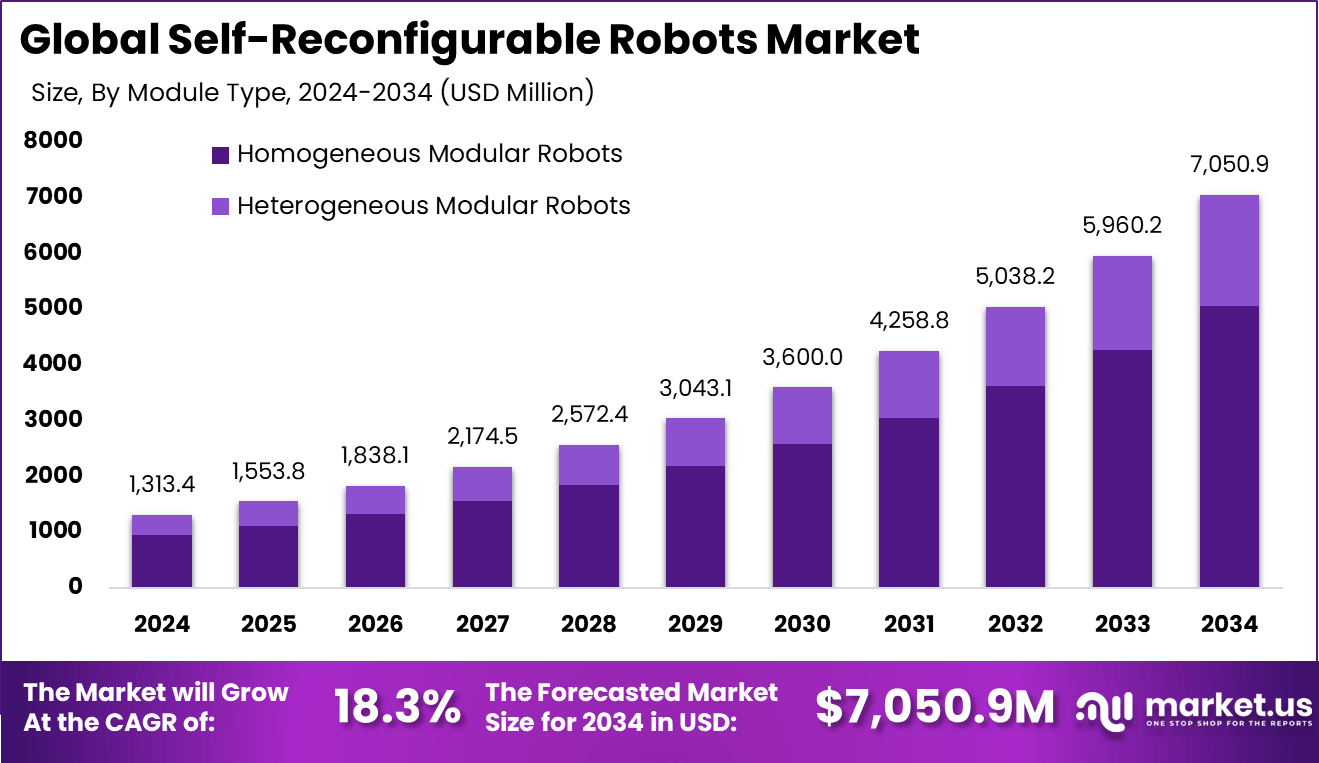
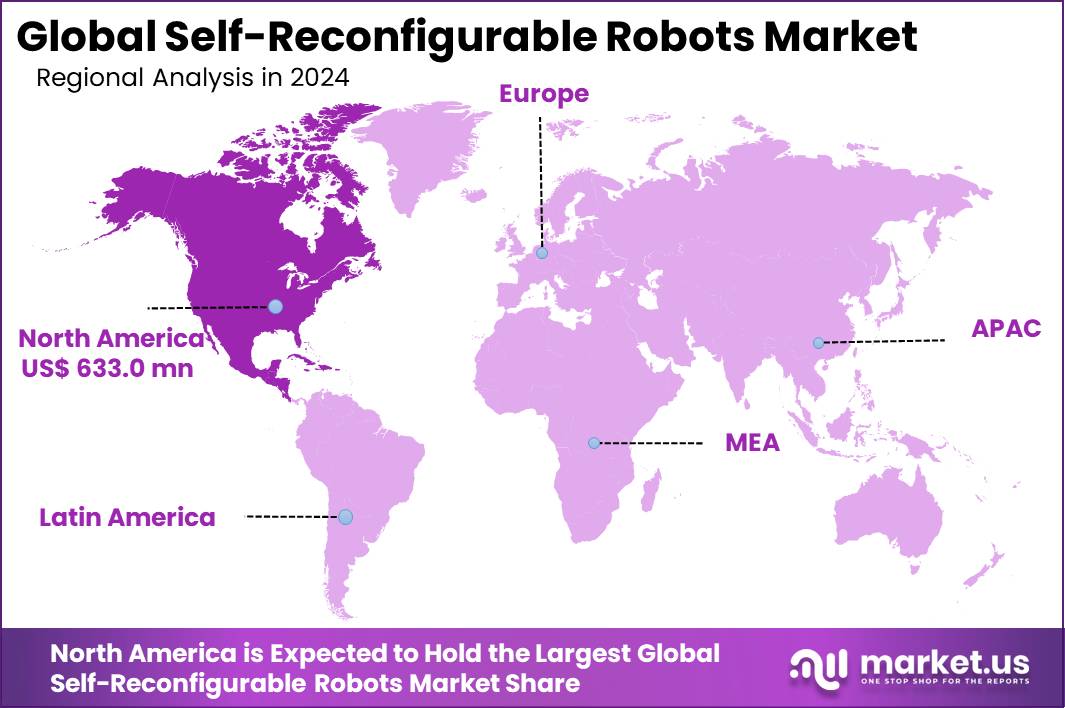
The Global Self-Reconfigurable Robots Market size is expected to be worth around USD 7,050.9 million by 2034, from USD 1,313.4 million in 2024, growing at a CAGR of 18.3% during the forecast period from 2025 to 2034. North America held a dominant market position, capturing more than a 48.2% share, holding USD 633.0 million in revenue.
The self-reconfigurable robots market refers to robotic systems built from multiple modules that can autonomously change their physical structure to perform different tasks. These robots are designed to adapt to changing environments, space constraints, or functional needs without human intervention. The concept is widely studied in robotics research, where modularity and adaptability are viewed as solutions to the limitations of fixed-structure robots.
The market growth is primarily driven by the rising need for flexible automation systems across industries facing frequent task changes. Manufacturing and logistics environments increasingly demand robots that can shift between assembly, transport, and inspection activities. Research data shows that modular robots improve system resilience, as damaged modules can be isolated and replaced without stopping the entire operation.
Demand for self-reconfigurable robots is strongest in environments where variability is high and downtime is costly. Studies indicate that production facilities with short product life cycles favor adaptable robotics over single-purpose machines. Academic and government research institutions also represent a major demand segment, as over 60% of experimental robotic platforms studied in modular robotics literature focus on self-reconfiguration capabilities.
For instance, in July 2025, KUKA AG hosted KUKA Connexions, unveiling the KR C5 controller for seamless modular robot integration with simulation tools that spot errors early. Their focus on flexible, resource-saving automation for e-mobility and electronics reinforces why reconfigurable designs are game-changers in high-volume production.
Key Takeaway
- Homogeneous modular robots dominated with 71.8%, reflecting strong demand for uniform module designs that simplify reconfiguration and control.
- Chain-based architectures held 45.3%, showing their suitability for flexible movement, shape-shifting, and adaptive structural tasks.
- Manual and semi-autonomous systems captured 84.9%, indicating that most deployments still rely on operator input while fully autonomous models remain in early development.
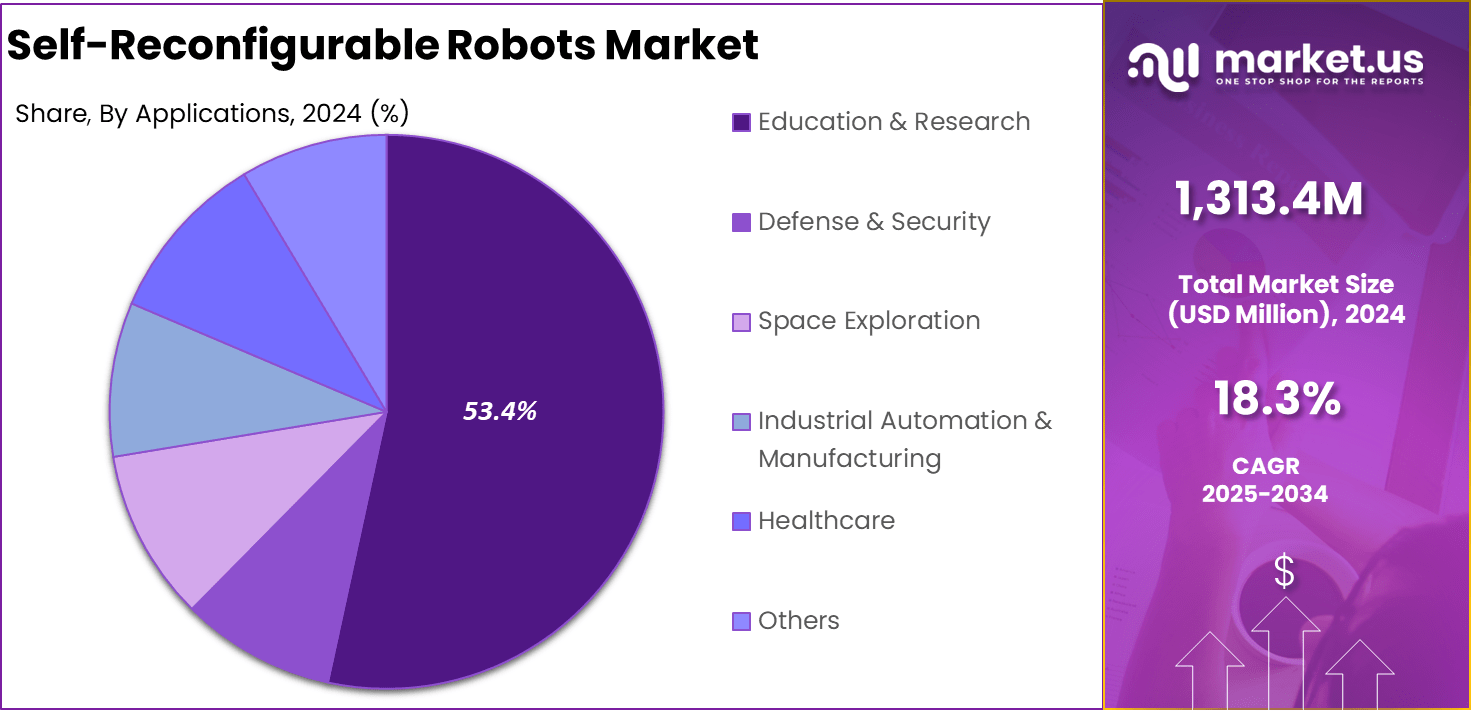
- Education and research accounted for 53.4%, supported by widespread use of modular robots in robotics labs, STEM programs, and experimental engineering environments.
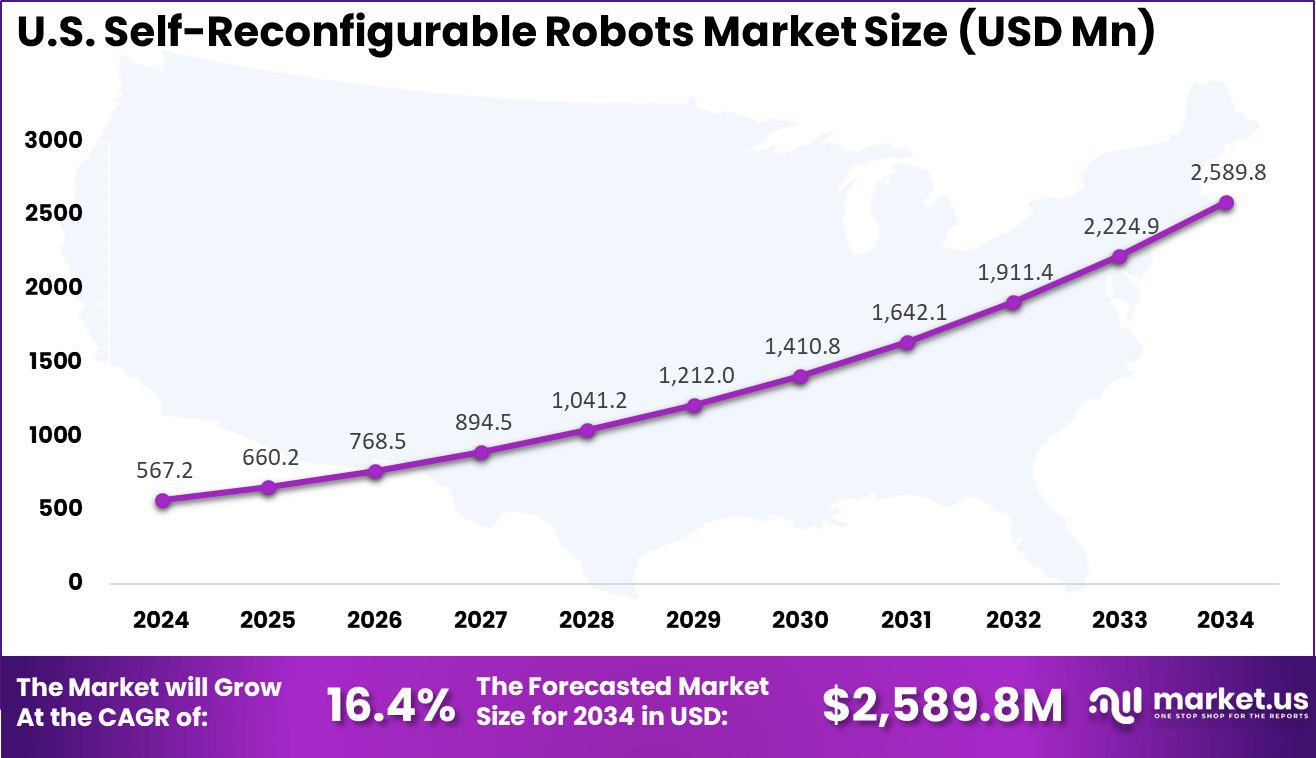
- The U.S. market reached USD 567.2 million in 2024 with a strong 16.4% CAGR, reflecting accelerating interest in advanced modular robotics.
- North America held more than 48.2% share, driven by high R&D spending, university research initiatives, and early industrial experimentation with reconfigurable systems.
Quick Market Facts
Adoption is supported by progress in distributed control algorithms, modular power management, and wireless communication protocols. Advances in magnetic and mechanical docking mechanisms have significantly improved connection reliability between modules.
Research publications highlight that modern self-reconfigurable robots achieve reconfiguration success rates above 90% in controlled environments, compared to less than 70% in early designs. Improvements in embedded processors and low-power sensors also enable faster coordination among modules, supporting real-time adaptation.
Organizations adopt self-reconfigurable robots mainly to reduce long-term system costs and improve operational resilience. A single modular platform can replace multiple specialized robots, lowering equipment procurement and maintenance expenses. Another key reason is fault tolerance. Studies confirm that modular robots can continue operating even after losing up to 25% of their modules by reorganizing remaining units.
Investment and Business Benefits
Investment opportunities exist across hardware development, control software, and system integration services. Public research funding for modular robotics has increased steadily, with several national science agencies prioritizing adaptive robotics programs. Private investment is also supported by the potential to commercialize modular platforms for factories, warehouses, and inspection tasks. The ability to reuse modules across different applications improves return on investment and reduces development risk for technology providers.
From a business perspective, self-reconfigurable robots support higher asset utilization rates. Equipment can be reconfigured rather than replaced when production requirements change. Operational data from pilot projects shows productivity improvements of 15% to 25% when modular robots are used in multi-task environments. Maintenance costs are also reduced, as individual modules can be serviced independently without shutting down the entire system.
The regulatory framework for self-reconfigurable robots is aligned with existing industrial robot safety standards. International guidelines such as ISO 10218 and ISO/TS 15066 define safety requirements related to robot design, human interaction, and risk assessment. Although these standards were originally developed for fixed robots, they are increasingly applied to modular systems. Compliance requires careful validation of all possible configurations to ensure consistent safety performance during operation.
North America Market Size
North America leads with a 48.2% share, supported by strong investment in robotics education, academic research, and advanced prototype development. Research universities and innovation centers across the region continue to focus on modular robotics as an emerging field.
For instance, in April 2025, HEBI Robotics earned a 2025 RBR50 Robotics Innovation Award for its inchworm-style robots, featuring segmented modular arms with magnetic or suction feet for climbing complex surfaces. This recognition highlights HEBI’s pioneering mobility solutions using self-reconfigurable modular designs, accelerating practical automation in challenging environments and underscoring North American dominance in innovative robotic actuation technologies.
The United States reached USD 567.2 Mn with a solid CAGR of 16.4%, showing active interest in flexible robotics for defense research, space exploration studies, and engineering training. Expanding robotics programs and increased funding for experimental platforms continue to push regional demand.
North America also benefits from collaboration between academic institutions and industry partners that explore new uses for shape shifting robots in inspection, emergency response, and autonomous exploration.
For instance, in August 2025, Boston Dynamics collaborated with Toyota Research Institute to demonstrate a Large Behavior Model (LBM) powering the Atlas humanoid robot, enabling complex, continuous tasks combining manipulation and locomotion without hand-programming. This AI-driven advancement allows rapid addition of new capabilities, marking a leap toward general-purpose, self-adapting robots and solidifying U.S. leadership in reconfigurable robotics intelligence.
Module Type Analysis
In 2024, Homogeneous modular robots hold a strong 71.8% share, showing their importance in flexible and adaptable robotic systems. These robots are built from identical modules that can rearrange themselves to form different shapes or perform different tasks. Their uniform structure reduces design complexity and supports easier maintenance and scaling.
Demand is driven by research labs, universities, and industrial testing facilities seeking cost effective and programmable robotic platforms. Homogeneous modules allow smoother reconfiguration, faster response time, and more predictable movement patterns, which strengthens their adoption.
Type Analysis
Chain based systems represent 45.3% of the market, reflecting their broad use in climbing, reaching, and navigating through narrow environments. These robots are built in a linked chain-like formation that allows flexible bending and shape shifting during movement.
Their design supports tasks such as inspection, terrain exploration, and manipulation in tight spaces. The ability to reconfigure the chain into different functional arrangements makes them suitable for complex academic experiments and robotic testing environments.
For instance, in March 2025, Robotis Co., Ltd. developed chain continuum prototypes. Modules link sequentially for loco-manipulation gaits. Tests showed rolling and crawling motions. Chain designs prove versatile for general-purpose adaptation.
Level of Autonomy Analysis
Manual and semi autonomous systems dominate with 84.9%, showing that most self reconfigurable robots still require some level of human guidance. These systems help researchers and engineers test new control methods, shape shifting algorithms, and modular interactions.
Semi autonomous models are commonly used because they allow a balance between automated behavior and supervised control. This is important for safety, accuracy, and experimentation, especially in research institutions and prototype development centers.
For Instance, in June 2025, ABB Ltd. previewed semi-autonomous features at Automatica. Robots switch tasks with human oversight via AI vision. Operators set goals while machines handle shapes. This hybrid mode builds trust in versatile operations.
Application Analysis
In 2024, Education and research account for 53.4%, making it the largest application segment. Universities and research labs use self reconfigurable robots to study locomotion, swarm behavior, mechanical design, and autonomous learning models.
These robots support hands-on learning and advanced experimentation in robotics engineering programs. Their modular nature helps students and researchers explore new robotic architectures and develop innovative shape-changing capabilities.
For Instance, in January 2022, Modular Robotics Inc. expanded Cubelets for classrooms. Students reconfigure homogeneous kits to learn modularity. Hands-on sessions drive research into swarm behaviors. This keeps education at the forefront of adoption.
Emerging Trends
A key trend in the self reconfigurable robots market is the growing interest in modular robotic systems that can change shape or function based on task requirements. These systems consist of independent robotic modules that attach or detach to form new structures.
Researchers and manufacturers are exploring designs that allow robots to shift from crawling to climbing or from acting as a single unit to forming cooperative assemblies. This trend is driven by demand for adaptable systems that can operate in environments where fixed form robots are less effective, such as disaster zones, remote research sites or space missions.
Another emerging trend is the increasing focus on autonomous decision making. Modern self reconfigurable robots are being developed with the ability to select configurations based on sensor inputs, environmental conditions and task priorities. Advances in motion planning and multi module coordination are helping these systems operate with minimal human intervention. This development improves versatility and supports use in inspection, search operations and maintenance tasks.
Growth Factors
A major growth factor is rising use of robotics in unpredictable or hazardous environments. Traditional robots are limited by their fixed structure, while self reconfigurable robots can adjust their form to navigate obstacles or carry out varied tasks. This makes them suitable for exploration, underground inspection, structural assessment and emergency response. The growing need for adaptable tools increases demand for such systems.
Another growth factor is increasing research and development investment by universities, aerospace agencies and industrial robotics groups. These investments support growth in modular hardware design, flexible actuation and robust communication between modules. As development improves reliability and lowers cost, interest from commercial sectors is expected to rise.
Key Market Segments
By Module Type
- Homogeneous Modular Robots
- Heterogeneous Modular Robots
By Type
- Chain-Based
- Lattice-Based
- Mobile-Based
By Level of Autonomy
- Manual/Semi-Autonomous
- Fully Autonomous
By Application
- Education & Research
- Defense & Security
- Space Exploration
- Industrial Automation & Manufacturing
- Healthcare
- Others
Key Regions and Countries
- North America
- US
- Canada
- Europe
- Germany
- France
- The UK
- Spain
- Italy
- Russia
- Netherlands
- Rest of Europe
- Asia Pacific
- China
- Japan
- South Korea
- India
- Australia
- Singapore
- Thailand
- Vietnam
- Rest of APAC
- Latin America
- Brazil
- Mexico
- Rest of Latin America
- Middle East & Africa
- South Africa
- Saudi Arabia
- UAE
- Rest of MEA
Drivers
A primary driver is the demand for robots that can perform multiple tasks without requiring separate machines. Self reconfigurable robots reduce the need for task specific devices by transforming their structure according to the job. This flexibility appeals to industries that operate in dynamic conditions or face frequent task changes, such as construction, environmental monitoring and industrial inspection.
Another driver is the potential to use these robots in space exploration. Space missions require equipment that can adapt to different environments and survive harsh conditions. Self reconfigurable systems can assemble into tools, transport units or support structures. As global interest in planetary exploration increases, this market receives additional support.
For instance, in September 2024, HEBI Robotics got a NASA grant to build space-rated modular blocks. These let teams design robots on Earth and shift to space versions fast. The tech speeds up custom setups for tough jobs like space missions. It shows how modular parts cut task switch times in real ops. Firms gain from quick changes without full rebuilds.
Restraint
A major restraint is the complexity of designing reliable modules that can connect, detach and coordinate consistently. Mechanical joints, communication links and power transfer systems must be durable, yet small and lightweight. These requirements increase production cost and slow down commercial readiness.
Another restraint comes from limited standardization. Different research groups use their own module designs, control frameworks and communication protocols. Without common standards, scaling production and enabling widespread commercial adoption becomes challenging.
For instance, in April 2025, Q-Bot raised funds to grow its underfloor insulation robots. The cash covers scaling robot-as-a-service for homes. Yet high build and partner costs slow small user uptake. Retrofit needs custom fits that hike initial spends. Many weigh long-term savings against front loads.
Opportunities
There is strong opportunity in industrial maintenance and inspection tasks. Factories, refineries and power plants often require robots that can enter confined spaces, climb structures or adjust shape to reach difficult areas. Self reconfigurable robots can meet these needs and reduce reliance on manual inspection in risky environments.
Another opportunity lies in education and research. Modular robots offer a flexible platform for teaching robotics, control theory and system design. Schools, universities and robotics labs continue to adopt these systems for experimentation, which broadens market potential and supports long term innovation.
For instance, in June 2025, ABB showed Autonomous Versatile Robotics at Automatica. AI lets mobile units switch tasks in real time without code tweaks. This opens doors in dynamic spots like health and logistics. Generative AI drives self-plans for complex jobs. It pulls new sectors into modular tech.
Key Players Analysis
Modular Robotics, Roombots, Q-Bot, HEBI Robotics, and PAL Robotics lead the self-reconfigurable robots market with modular platforms that can reshape themselves for different tasks. Their systems rely on interconnected units, adaptive motion control, and real-time sensing to support research, education, and early commercial automation. These companies focus on flexibility, simple configuration, and safe human interaction.
Festo, Yaskawa Electric, KUKA, ABB, Robotis, DOBOT, and Universal Robots strengthen the market with industrial-grade robotics adapted for modularity and collaborative functions. Their solutions combine precision actuators, intelligent controllers, and reconfigurable structures. These providers support manufacturing, warehousing, and assembly use cases that require quick adaptation.
Boston Dynamics, Neurala, Moley Robotics, Shadow Robot Company, Kawada Robotics, Mitsubishi Electric, Fanuc, and others broaden the landscape with advanced AI-driven control, dexterous manipulation, and autonomous reconfiguration. Their platforms target complex domains such as construction, disaster response, food automation, and medical robotics.
Top Key Players in the Market
- Modular Robotics Inc.
- Roombots (EPFL)
- Q-Bot Ltd.
- HEBI Robotics
- PAL Robotics
- Festo AG & Co. KG
- Yaskawa Electric Corporation
- KUKA AG
- ABB Ltd.
- Robotis Co., Ltd.
- Shenzhen Yuejiang Technology Co., Ltd. (DOBOT)
- Universal Robots A/S
- Boston Dynamics
- Neurala Inc.
- Moley Robotics
- Shadow Robot Company
- Kawada Robotics Corporation
- Mitsubishi Electric Corporation
- Fanuc Corporation
- Others
Recent Developments
- In July 2025, Roombots (EPFL) researchers rolled out major upgrades to their self-assembling swarm, now able to morph into furniture like chairs or shelves that even follow you around. By latching onto special hole-patterned surfaces on walls or floors, these cube bots climb and reconfigure on demand. It’s a smart step toward real-world use in tight living spaces where furniture needs to shift shapes daily.
- In December 2024, KUKA AG launched Robots as a Service (RaaS), letting factories subscribe to reconfigurable arms instead of buying outright. With plug-and-play setups and included maintenance, it cuts upfront costs by a ton. Small shops can now scale automation fast, swapping modules for welding one day and assembly the next.
Report Scope
Report Features Description Market Value (2024) USD 1,313.4 Mn Forecast Revenue (2034) USD 7,050.9 Mn CAGR(2025-2034) 18.3% Base Year for Estimation 2024 Historic Period 2020-2023 Forecast Period 2025-2034 Report Coverage Revenue forecast, AI impact on Market trends, Share Insights, Company ranking, competitive landscape, Recent Developments, Market Dynamics and Emerging Trends Segments Covered By Module Type (Homogeneous Modular Robots, Heterogeneous Modular Robots), By Type (Chain-Based, Lattice-Based, Mobile-Based), By Level of Autonomy (Manual/Semi-Autonomous, Fully Autonomous), By Application (Education & Research, Defense & Security, Space Exploration, Industrial Automation & Manufacturing, Healthcare, Others) Regional Analysis North America – US, Canada; Europe – Germany, France, The UK, Spain, Italy, Russia, Netherlands, Rest of Europe; Asia Pacific – China, Japan, South Korea, India, New Zealand, Singapore, Thailand, Vietnam, Rest of Latin America; Latin America – Brazil, Mexico, Rest of Latin America; Middle East & Africa – South Africa, Saudi Arabia, UAE, Rest of MEA Competitive Landscape Modular Robotics Inc., Roombots (EPFL), Q-Bot Ltd., HEBI Robotics, PAL Robotics, Festo AG & Co. KG, Yaskawa Electric Corporation, KUKA AG, ABB Ltd., Robotis Co., Ltd., Shenzhen Yuejiang Technology Co., Ltd. (DOBOT), Universal Robots A/S, Boston Dynamics, Neurala Inc., Moley Robotics, Shadow Robot Company, Kawada Robotics Corporation, Mitsubishi Electric Corporation, Fanuc Corporation, Others Customization Scope Customization for segments, region/country-level will be provided. Moreover, additional customization can be done based on the requirements. Purchase Options We have three license to opt for: Single User License, Multi-User License (Up to 5 Users), Corporate Use License (Unlimited User and Printable PDF)  Self-Reconfigurable Robots MarketPublished date: Dec. 2025add_shopping_cartBuy Now get_appDownload Sample
 -
-
- Modular Robotics Inc.
- Roombots (EPFL)
- Q-Bot Ltd.
- HEBI Robotics
- PAL Robotics
- Festo AG & Co. KG
- Yaskawa Electric Corporation
- KUKA AG
- ABB Ltd.
- Robotis Co., Ltd.
- Shenzhen Yuejiang Technology Co., Ltd. (DOBOT)
- Universal Robots A/S
- Boston Dynamics
- Neurala Inc.
- Moley Robotics
- Shadow Robot Company
- Kawada Robotics Corporation
- Mitsubishi Electric Corporation
- Fanuc Corporation
- Others
Our Clients

- 169970
- Dec. 2025









