


Report Overview
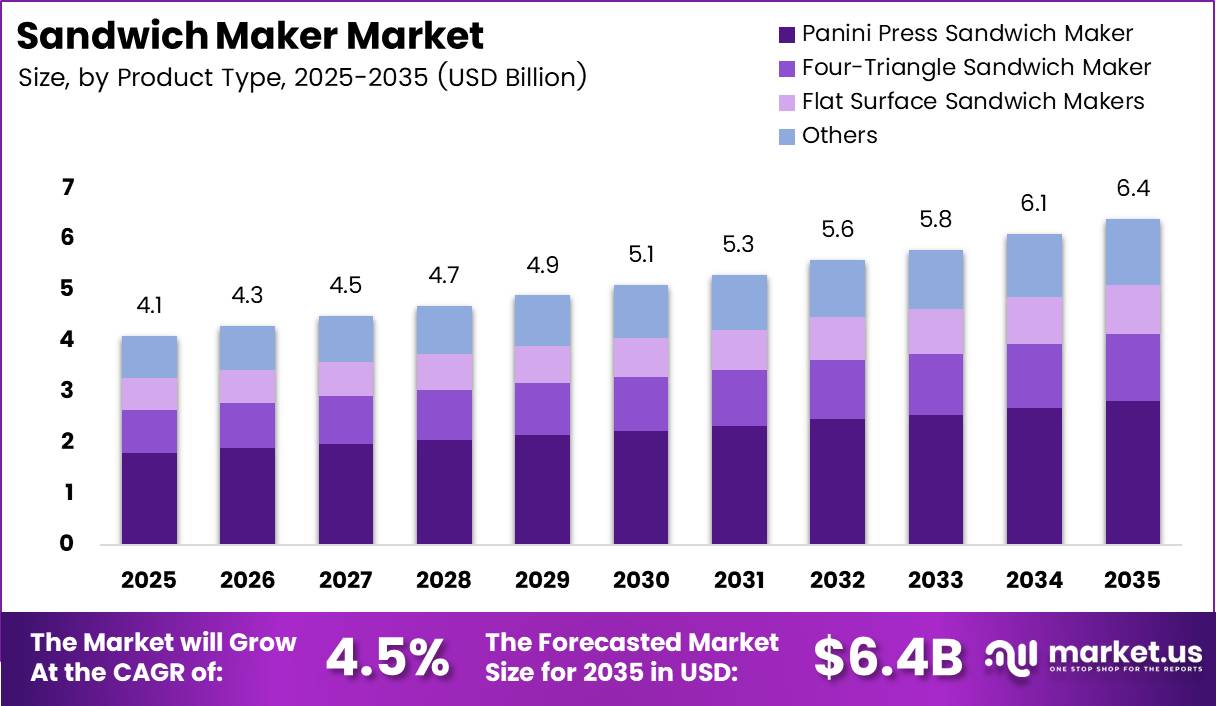
Global Sandwich Maker Market size is expected to be worth around USD 6.4 Billion by 2035 from USD 4.1 Billion in 2025, growing at a CAGR of 4.5% during the forecast period 2026 to 2035.
The sandwich maker market covers electric countertop appliances designed for grilling, pressing, and toasting sandwiches at home and in commercial foodservice settings. Products range from basic two-slice toast makers to multi-function panini presses with adjustable temperature control and interchangeable plates.
Urban households increasingly rely on compact kitchen appliances to reduce meal preparation time. This shift away from conventional oven cooking toward single-purpose countertop devices reflects a structural change in how consumers approach weekday meals — and it directly widens the addressable market for sandwich makers across price tiers.
E-commerce platforms now serve as the primary discovery and purchase channel for kitchen appliances in emerging markets. Affordable product listings, consumer reviews, and next-day delivery have lowered the barriers to first purchase — pulling first-time buyers into the category at a pace that physical retail alone cannot sustain.
Government compliance frameworks are reshaping manufacturer strategies in key growth markets. India’s BIS Quality Control Order mandates that all household electrical appliances, including sandwich makers, comply with IS 302 (Part 1): 2024 and carry the mandatory ISI Mark, with phased deadlines requiring large and medium enterprises to comply by 1 October 2026. This regulatory pressure eliminates non-compliant low-cost imports, consolidating market share toward certified brands.
Energy efficiency has become a measurable purchasing criterion rather than a marketing claim. According to trutrtl.com, a standard household sandwich maker operating between 700 W and 1,000 W consumes approximately 0.05 to 0.1 kWh per use — a fraction of a conventional electric oven’s draw. This cost advantage resonates with cost-conscious buyers in high-electricity-tariff markets, reinforcing adoption in South and Southeast Asia.
In February 2026, Reliance Consumer Products Limited acquired Tamil Nadu-based Southern Health Foods Private Limited, signaling that large FMCG conglomerates now view kitchen appliance-adjacent categories as core portfolio targets. This consolidation pressure means mid-tier sandwich maker brands face acquisition or displacement risk as distribution muscle concentrates among larger players.
The combination of regulatory clarity, energy efficiency advantages, and FMCG-led distribution expansion positions the sandwich maker market for sustained volume growth through 2035 — particularly in markets where household appliance penetration remains below developed-economy benchmarks.
Key Takeaways
- The global sandwich maker market is valued at USD 4.1 Billion in 2025 and is forecast to reach USD 6.4 Billion by 2035, at a CAGR of 4.5%.
- By Product Type, Panini Press Sandwich Makers dominate with a 41.7% share in 2025.
- By Material, Non-Stick Coating leads with a 45.9% share, reflecting strong consumer preference for easy-clean surfaces.
- By Mobility, Countertop models hold 73.4% of the market, driven by home-kitchen installation behavior.
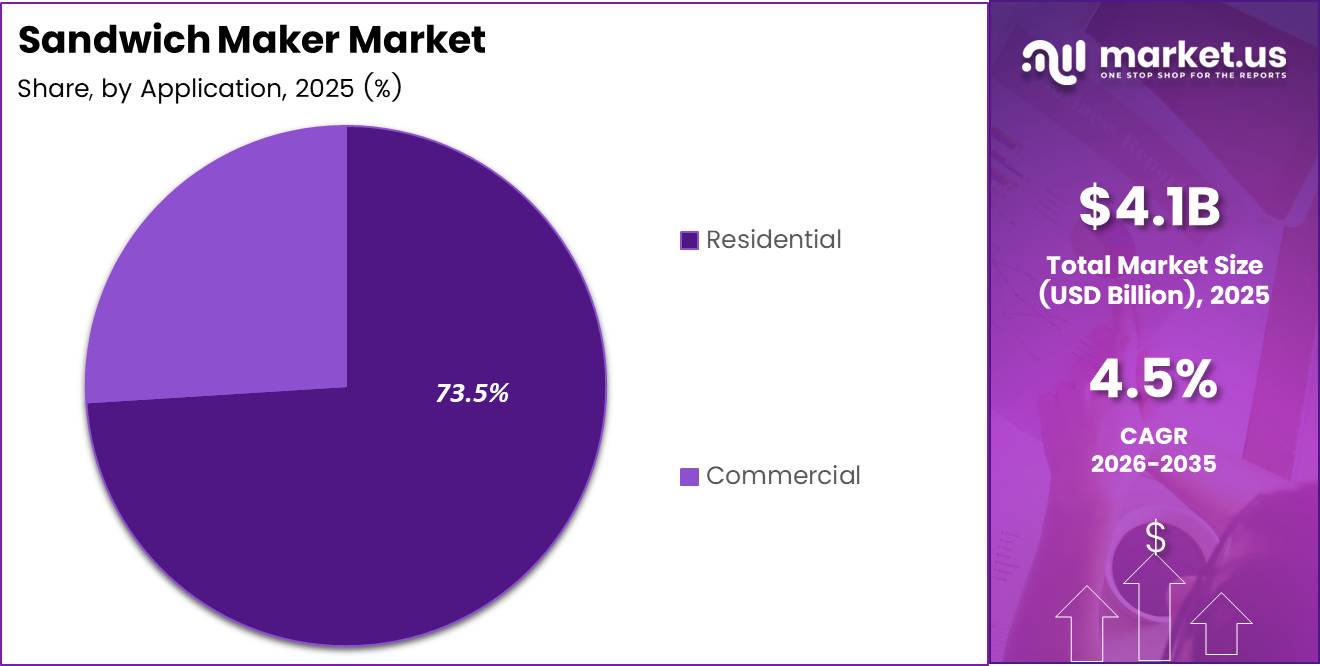
- By Application, Residential use accounts for 73.5% of total market demand.
- By Distribution Channel, Supermarkets lead with a 43.2% share, followed by Online and Kitchenware Stores.
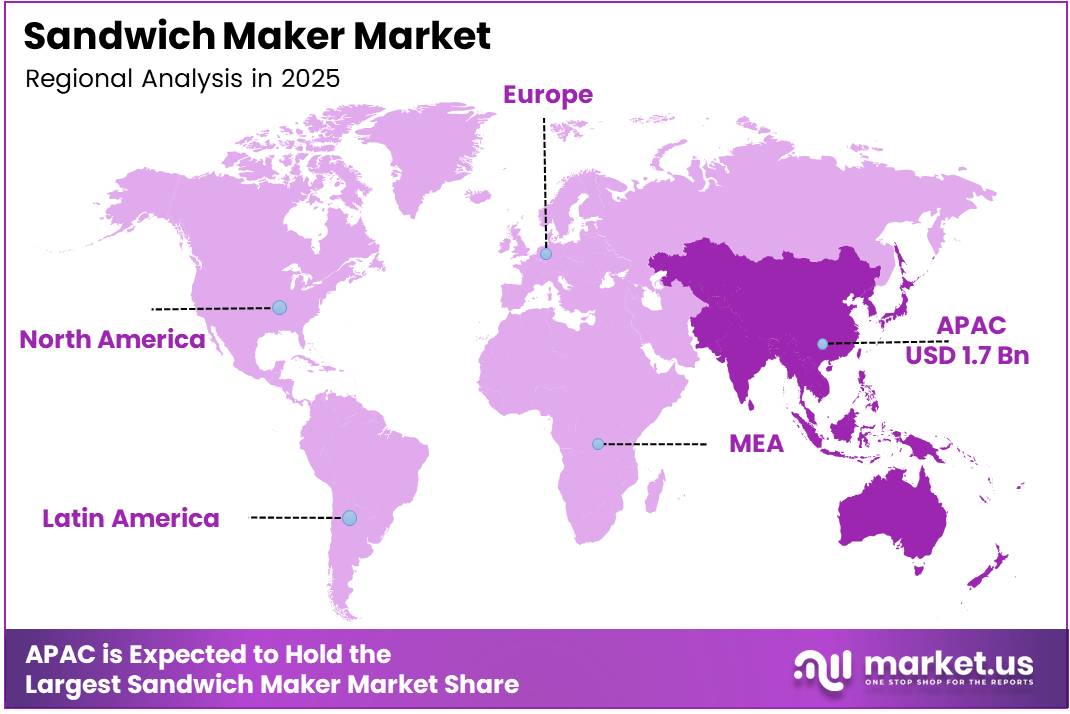
- Asia Pacific dominates regionally with a 43.60% share, valued at USD 1.7 Billion in 2025.
Product Analysis
Panini Press Sandwich Maker dominates with 41.7% due to multi-configuration grilling versatility.
In 2025, Panini Press Sandwich Maker held a dominant market position in the By Product Type segment of the Sandwich Maker Market, with a 41.7% share. Buyers choose panini presses because they handle open melts, pressed sandwiches, and grilled protein — functions no single-use toast maker can replicate. This versatility justifies a higher price point and supports category premiumization.
Four-Triangle Sandwich Maker serves as the entry-level volume driver in the residential segment. Its simple sealed-edge design produces portion-controlled triangular sandwiches with minimal cleanup, making it the default choice for first-time buyers and households with children. However, its single-function limitation makes it vulnerable to displacement as consumers trade up to multi-plate alternatives.
Flat Surface Sandwich Makers carry the widest commercial applicability within the product category. Their smooth, even heating surface suits quesadillas, flatbreads, and open-face sandwiches — giving foodservice operators flexibility beyond standard panini production. Consequently, flat-surface models see disproportionate adoption in café and fast-casual restaurant settings where menu variety matters.
Others within the product type segment capture niche configurations, including waffle-plate combinations and multi-tier stackable designs. These models target buyers seeking maximum function from a single appliance footprint. Moreover, this sub-segment is where the majority of new product launches — such as AFC’s 5-in-1 Electric Sandwich Maker/Waffle Maker launched in December 2023 — are concentrated.
Material Analysis
Non-Stick Coating dominates with 45.9% due to low-maintenance appeal across residential buyers.
In 2025, Non-Stick Coating held a dominant market position in the By Material segment of the Sandwich Maker Market, with a 45.9% share. Non-stick surfaces reduce cooking oil dependency and simplify post-use cleaning — two factors that align directly with the convenience-first behavior of urban residential buyers. This practical advantage makes non-stick the default specification across mid-range sandwich makers globally.
Stainless Steel differentiates through durability and professional-grade aesthetics that appeal to commercial foodservice buyers. Stainless construction resists corrosion, withstands repeated high-temperature cycles, and signals kitchen-grade quality in foodservice environments. Therefore, commercial operators sourcing grills for high-volume output — such as fast-casual restaurants processing 75 to 150 sandwiches per day — default to stainless steel units.
Ceramic Coating carries the highest perceived health credential within the material segment. Buyers seeking chemical-free cooking surfaces — particularly in markets where PTFE-based coatings face consumer scrutiny — actively seek ceramic-plate models. Additionally, ceramic coating aligns with the broader consumer trend toward cleaner cooking, creating a distinct positioning window for brands targeting health-aware households.
Others in the material segment include cast iron plates and composite coatings used primarily in professional-grade commercial panini grills. Cast iron retains heat longer but requires 90 to 180 seconds for heat recovery after each cold sandwich placement — a throughput constraint in high-volume operations. Consequently, cast iron material maintains a niche position in premium commercial equipment rather than mainstream residential appliances.
Mobility Analysis
Countertop dominates with 73.4% due to established home-kitchen installation behavior.
In 2025, Countertop held a dominant market position in the By Mobility segment of the Sandwich Maker Market, with a 73.4% share. Countertop models benefit from permanent kitchen placement — once installed, they become default cooking tools rather than occasional-use gadgets. This behavioral lock-in drives repeat category engagement and brand loyalty among residential buyers.
Portable sandwich makers address a structurally underserved segment: office workers, frequent travelers, and dormitory residents who need compact, lightweight cooking capability outside a fixed kitchen. The DASH MultiMaker Flex Press — at 6.8 lbs and dimensions of 10.9″ × 9.3″ × 3.9″ — demonstrates that competitive performance is achievable at portable form factors. Moreover, as remote and hybrid working patterns normalize, portable sandwich makers gain relevance beyond traditional travel use cases.
Application Analysis
Residential dominates with 73.5% due to widespread urban household appliance adoption.
In 2025, Residential held a dominant market position in the By Application segment of the Sandwich Maker Market, with a 73.5% share. The residential share reflects how deeply sandwich makers have embedded into daily breakfast and snack routines in urban households. Importantly, this concentration also means the market’s volume growth depends heavily on household formation rates and appliance penetration in emerging economies.
Commercial applications — spanning coffee shops, fast-casual restaurants, high-volume delis, and institutional catering — represent the higher-margin and faster-payback segment. Commercial sandwich press equipment typically delivers ROI within 1 to 3 months of foodservice deployment, based on the price premium panini service commands over standard sandwiches. Additionally, commercial buyers replace equipment more frequently than residential users, generating higher lifetime revenue per account for manufacturers and distributors.
Distribution Channel Analysis
Supermarkets dominate with 43.2% due to impulse-driven purchase behavior and product visibility.
In 2025, Supermarkets held a dominant market position in the By Distribution Channel segment of the Sandwich Maker Market, with a 43.2% share. Physical retail shelf placement allows consumers to evaluate product size, weight, and plate quality before purchase — critical decision factors for a tactile appliance category. Therefore, brands that secure prominent supermarket shelf positioning maintain a structural discovery advantage over online-only competitors.
Online channels serve as the fastest-growing distribution route for sandwich makers, particularly in markets where e-commerce infrastructure has outpaced physical retail expansion. Online platforms enable price comparison, user review access, and broader SKU availability — conditions that favor premium and niche brands that cannot secure large-format retail shelf space. Consequently, online distribution disproportionately benefits smaller brands and challenger products.
Kitchenware Stores provide a curated retail environment where higher-ASP sandwich makers — including premium panini presses priced between USD 500 and USD 900 — receive the product demonstration and expert selling context they require. Buyers entering a kitchenware store arrive with higher purchase intent than casual supermarket shoppers, making this channel critical for premium brand positioning.
Specialty Appliance Stores concentrate category depth in a format that allows full product range display — from entry-level toast makers to professional double grills with independent cooking zones. This channel serves the considered-purchase buyer who evaluates multiple models before committing. Moreover, specialty stores often provide post-purchase support and accessories, increasing per-customer lifetime value for appliance brands.
Others in the distribution segment include warehouse clubs, department stores, and direct-to-consumer brand channels. These outlets serve distinct buyer profiles — warehouse clubs attract volume buyers seeking low unit pricing, while direct channels allow brands to capture full margin and control the post-purchase experience. Additionally, regional FMCG distribution networks — particularly following acquisitions like RCPL’s expansion in India — increasingly carry small kitchen appliances alongside food products.
Key Market Segments
By Product Type
- Panini Press Sandwich Maker
- Four-Triangle Sandwich Maker
- Flat Surface Sandwich Makers
- Others
By Material
- Non-Stick Coating
- Stainless Steel
- Ceramic Coating
- Others
By Mobility
- Countertop
- Portable
By Application
- Residential
- Commercial
By Distribution Channel
- Supermarkets
- Online
- Kitchenware Stores
- Specialty Appliance Stores
- Others
Drivers
Urban Lifestyle Shifts and E-Commerce Expansion Accelerate Sandwich Maker Adoption Across Residential Markets
Urban households increasingly prioritize cooking speed without sacrificing food quality. Sandwich makers directly address this need — commercial-grade panini presses produce results in 3 to 5 minutes versus 8 to 10 minutes in a conventional oven, according to gofoodservice.com. This 50 to 60% time saving per sandwich makes the appliance a rational investment for time-pressured urban consumers, not just a convenience purchase.
E-commerce platforms now eliminate the geographic barrier that previously restricted kitchen appliance access to consumers near large retail outlets. Affordable entry-level sandwich makers — available in India from ₹1,000 to ₹2,500 — reach buyers in Tier 2 and Tier 3 cities through online channels. This price accessibility, combined with digital discovery, structurally expands the market beyond metro-concentrated demand.
The home café culture trend translates directly into appliance sales: consumers replicating café-style toasted sandwiches and paninis at home require equipment capable of consistent press and heat distribution. TTK Prestige responded by introducing four new sandwich maker variants in September 2023 — including the PSDP 02 and PGDP 03 SS — priced between ₹2,395 and ₹2,695, targeting the Indian household segment. This product expansion confirms that manufacturer investment follows consumer behavior shifts, not just price competition.
Restraints
Single-Function Positioning and Multi-Appliance Competition Compress Sandwich Maker Margins and Limit Upgrade Cycles
The core commercial challenge for sandwich maker brands is product differentiation in a category where basic function — pressing and heating bread — is identical across price tiers. This structural sameness pushes competition toward price rather than value, compressing margins for all but the most strongly branded players. Manufacturers without clear feature advantages face sustained price erosion as the category matures.
Commercial sandwich press hardware ranges from USD 300 to USD 2,500 depending on plate size and configuration, according to gofoodservice.com. This wide range reflects genuine performance differences — but residential buyers rarely evaluate sandwich makers with the same technical rigor as foodservice operators. Consequently, mid-range residential products face margin compression from both below (low-cost entrants) and above (premium multi-function grills).
The multi-function appliance segment directly cannibalizes dedicated sandwich maker sales. A consumer who owns an air fryer with grill function or a multi-cooker with a flat plate has less motivation to purchase a standalone sandwich maker. This substitution risk concentrates in the residential mid-tier, where the value proposition of a single-function device is weakest — and where volume is highest.
Growth Factors
Multi-Function Plate Innovation and Non-Stick Technology Create New Revenue Layers for Sandwich Maker Manufacturers
Multi-plate sandwich makers that support grilling, waffle production, and open-face cooking expand the appliance’s use case beyond breakfast — converting it from a single-meal tool into an all-day cooking device. This functional expansion increases purchase justification for budget-conscious buyers and supports a higher average selling price. Manufacturers that invest in interchangeable plate systems capture buyers who would otherwise select a dedicated waffle maker or grill separately.
Non-stick and ceramic coating technologies directly reduce the post-use friction that drives appliance abandonment. When cleaning requires minimal effort, daily usage rates increase — and higher usage frequency drives brand loyalty and word-of-mouth recommendation. In December 2023, Butterfly Gandhimathi Appliances launched the Matchless Sandwich Maker at 750 W with non-stick plates and multiple heat settings, demonstrating that Indian manufacturers now compete on surface technology, not just price.
Energy efficiency creates a durable sales argument in markets with high or rising electricity costs. According to trutrtl.com, a 750 W sandwich maker used 10 minutes daily consumes roughly 3 to 4 kWh per month — qualifying it as a low-energy daily-use appliance. This positions sandwich makers favorably against conventional cooking alternatives in markets where energy cost sensitivity influences appliance purchase decisions, particularly across South and Southeast Asia.
Emerging Trends
Smart Temperature Control, Ceramic Plates, and Space-Saving Design Redefine Consumer Expectations in the Sandwich Maker Category
Compact and foldable sandwich maker designs address a real constraint in urban kitchens where counter space is limited. Manufacturers now engineer models that fold flat for vertical storage — a design shift that moves the sandwich maker from occasional-use appliance to permanent countertop resident. This storage convenience removes a key objection in small-apartment markets across Asia Pacific and Europe.
Consumer preference for ceramic-coated cooking plates reflects a broader rejection of synthetic non-stick chemicals in daily cooking contact. Ceramic surfaces now occupy a distinct premium tier within the material segment, commanding a price premium over PTFE-coated equivalents. Moreover, smart temperature control features — such as the Cuisinart Griddler FIVE’s 25-degree increment control from 175°F to 450°F — shift buyer expectations toward precision cooking, not just fast heating.
Designer colorways and kitchen-aesthetic matching have emerged as purchase triggers among younger urban buyers furnishing first homes. Sandwich maker brands now release seasonal color ranges targeting kitchen décor coordination — a trend that shortens replacement cycles and creates repeat purchase behavior independent of functional wear. Additionally, a 750 W sandwich maker’s monthly energy draw of 3 to 4 kWh reinforces its positioning as a guilt-free daily appliance for energy-aware millennials, according to trutrtl.com.
Regional Analysis
Asia Pacific Dominates the Sandwich Maker Market with a Market Share of 43.60%, Valued at USD 1.7 Billion
Asia Pacific commands a 43.60% share of the global sandwich maker market, valued at USD 1.7 Billion in 2025. This dominance reflects the region’s large urban middle-class population, rising disposable incomes, and deep e-commerce penetration across India, China, and Southeast Asia. India’s BIS compliance mandates further consolidate the market toward certified domestic and international brands, raising the quality floor for all sellers.
North America Sandwich Maker Market Trends
North America maintains a mature but premium-oriented sandwich maker market, where buyer demand concentrates on high-wattage performance models such as the Breville Sear & Press Grill at 1,800 W and the All-Clad Indoor Grill with a temperature span of 250°F to 525°F. In March 2026, Breville refreshed its Panini Duo (BSG520) line in the US, signaling continued brand investment in the premium residential segment.
Europe Sandwich Maker Market Trends
Europe’s sandwich maker market operates under strict electrical safety and food-contact material regulations, which filter out low-quality imports and concentrate market share among established appliance brands. Energy efficiency certification requirements align well with the category’s inherently low energy draw — a structural marketing advantage that European brands actively communicate to sustainability-conscious consumers.
Latin America Sandwich Maker Market Trends
Latin America presents a developing market opportunity where expanding retail infrastructure and rising urban household formation drive appliance category penetration. Price sensitivity remains high, making entry-level countertop sandwich makers the primary volume driver. However, as e-commerce adoption accelerates in Brazil and Mexico, access to mid-range and premium models improves for urban buyers.
Middle East and Africa Sandwich Maker Market Trends
The Middle East and Africa region shows appliance adoption concentrated in GCC countries, where high urbanization rates and a large expatriate population sustain demand for international kitchen appliance brands. Africa’s market remains at early penetration stages, with growth tied to infrastructure development and expanding modern retail formats in South Africa and Nigeria.
Key Regions and Countries
North America
- US
- Canada
Europe
- Germany
- France
- The UK
- Spain
- Italy
- Rest of Europe
Asia Pacific
- China
- Japan
- South Korea
- India
- Australia
- Rest of APAC
Latin America
- Brazil
- Mexico
- Rest of Latin America
Middle East & Africa
- GCC
- South Africa
- Rest of MEA
Key Company Insights
Bajaj Electricals holds a structural advantage in the Indian residential sandwich maker market through its deep distribution network spanning modern trade, general trade, and e-commerce simultaneously. Its brand recognition in the electrical appliances category reduces the cost of customer acquisition significantly. This multi-channel presence positions Bajaj to benefit directly from India’s BIS compliance mandates, which eliminate non-certified competitors from the formal retail channel.
Black+Decker competes across the full price spectrum — from entry-level toast makers to mid-range panini presses — a breadth strategy that secures shelf space in supermarkets and online platforms simultaneously. This horizontal product coverage limits competitors’ ability to dominate any single sub-tier without confronting a Black+Decker SKU. However, broad coverage also dilutes premium brand positioning, creating risk as consumers trade up to more specialized alternatives.
Breville anchors its sandwich maker strategy at the premium performance tier, investing in high-wattage, multi-configuration equipment that commands a measurable price premium. The Breville Sear & Press Grill’s rated 1,800 W output and four cooking configurations justify its price position to buyers who evaluate technical specifications. Breville’s March 2026 US refresh of the Panini Duo (BSG520) confirms its commitment to defending premium shelf space against mid-range challengers.
Cuisinart differentiates through precision engineering, offering products like the Griddler FIVE with 25-degree temperature increment control and a dedicated sear function reaching 450°F in 2-minute increments. This level of cooking control targets the enthusiast home cook segment — a buyer who views the sandwich maker as a genuine cooking tool rather than a convenience appliance. Consequently, Cuisinart commands a loyalty premium that insulates it from price-based competition in the mid-to-high tier.
Key Players
- Bajaj Electricals
- Black+Decker
- Breville
- Cuisinart
- George Foreman
- Hamilton Beach
- Kenwood
- Morphy Richards
- Oster
- Panasonic
- Philips
- Prestige
- Russell Hobbs
- Sunbeam
- Tefal
Recent Developments
- March 2026 — Breville refreshed its Panini Duo (BSG520) electric sandwich maker line in the US market, repositioning the product as a versatile panini press for open-style melts and sandwiches, reinforcing its premium segment presence ahead of the peak spring appliance buying season.
- December 2024 — Prestige (TTK Prestige) marked its 75th anniversary by reinforcing its kitchen appliance leadership, receiving the “New Product Launch – Consumer Durables” award recognition, supported by its expanded sandwich maker and electric griller lineup launched the prior year.
- December 2023 — AFC launched a 5-in-1 Electric Sandwich Maker/Waffle Maker at 650 W with electronic time control through PG Mall, the Malaysian online retail platform, extending the brand’s Southeast Asian distribution footprint into 2024 and validating multi-function design as a viable commercial strategy in the region.
Report Scope
| Report Features | Description |
|---|---|
| Market Value (2025) | USD 4.1 Billion |
| Forecast Revenue (2035) | USD 6.4 Billion |
| CAGR (2026-2035) | 4.5% |
| Base Year for Estimation | 2025 |
| Historic Period | 2020-2024 |
| Forecast Period | 2026-2035 |
| Report Coverage | Revenue Forecast, Market Dynamics, Competitive Landscape, Recent Developments |
| Segments Covered | By Product Type (Panini Press Sandwich Maker, Four-Triangle Sandwich Maker, Flat Surface Sandwich Makers, Others), By Material (Non-Stick Coating, Stainless Steel, Ceramic Coating, Others), By Mobility (Countertop, Portable), By Application (Residential, Commercial), By Distribution Channel (Supermarkets, Online, Kitchenware Stores, Specialty Appliance Stores, Others) |
| Regional Analysis | North America (US and Canada), Europe (Germany, France, The UK, Spain, Italy, and Rest of Europe), Asia Pacific (China, Japan, South Korea, India, Australia, and Rest of APAC), Latin America (Brazil, Mexico, and Rest of Latin America), Middle East & Africa (GCC, South Africa, and Rest of MEA) |
| Competitive Landscape | Bajaj Electricals, Black+Decker, Breville, Cuisinart, George Foreman, Hamilton Beach, Kenwood, Morphy Richards, Oster, Panasonic, Philips, Prestige, Russell Hobbs, Sunbeam, Tefal |
| Customization Scope | Customization for segments, region/country-level will be provided. Moreover, additional customization can be done based on the requirements. |
| Purchase Options | We have three licenses to opt for: Single User License, Multi-User License (Up to 5 Users), Corporate Use License (Unlimited User and Printable PDF) |





































