


Global Returns Root Cause AI Market Size, Share, Industry Analysis Report By Deployment (Cloud-based, On-premise), By Function (Defect Detection, Customer Behavior Analysis, Return Pattern Identification, Others), By Application (E-commerce/Retail, Manufacturing, Logistics, Others), By Regional Analysis, Global Trends and Opportunity, Future Outlook By 2025-2034
- Published date: Dec. 2025
- Report ID: 168459
- Number of Pages: 390
- Format:
-
keyboard_arrow_up
Quick Navigation
Report Overview
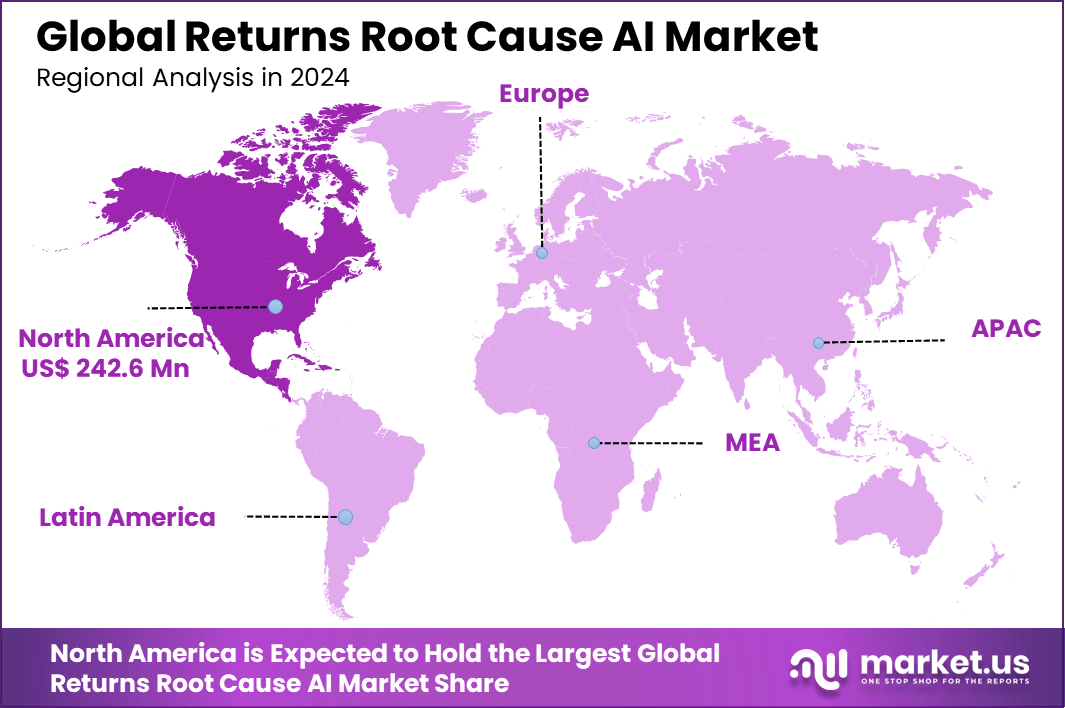
The Global Returns Root Cause AI Market size is expected to be worth around USD 7,716.6 million by 2034, from USD 638.5 million in 2024, growing at a CAGR of 28.3% during the forecast period from 2025 to 2034. In 2024, North America held a dominant market position, capturing more than a 38% share, holding USD 242.6 million in revenue.
The returns root cause AI market has expanded as retailers, manufacturers and logistics operators adopt intelligent systems to analyse why products are returned and how operational processes can be improved. Growth reflects rising return volumes in e commerce, increasing pressure to reduce reverse logistics costs and stronger expectations for accurate insights that support product and experience optimisation. AI driven tools now evaluate return reasons using behavioural patterns, product attributes and service interactions.
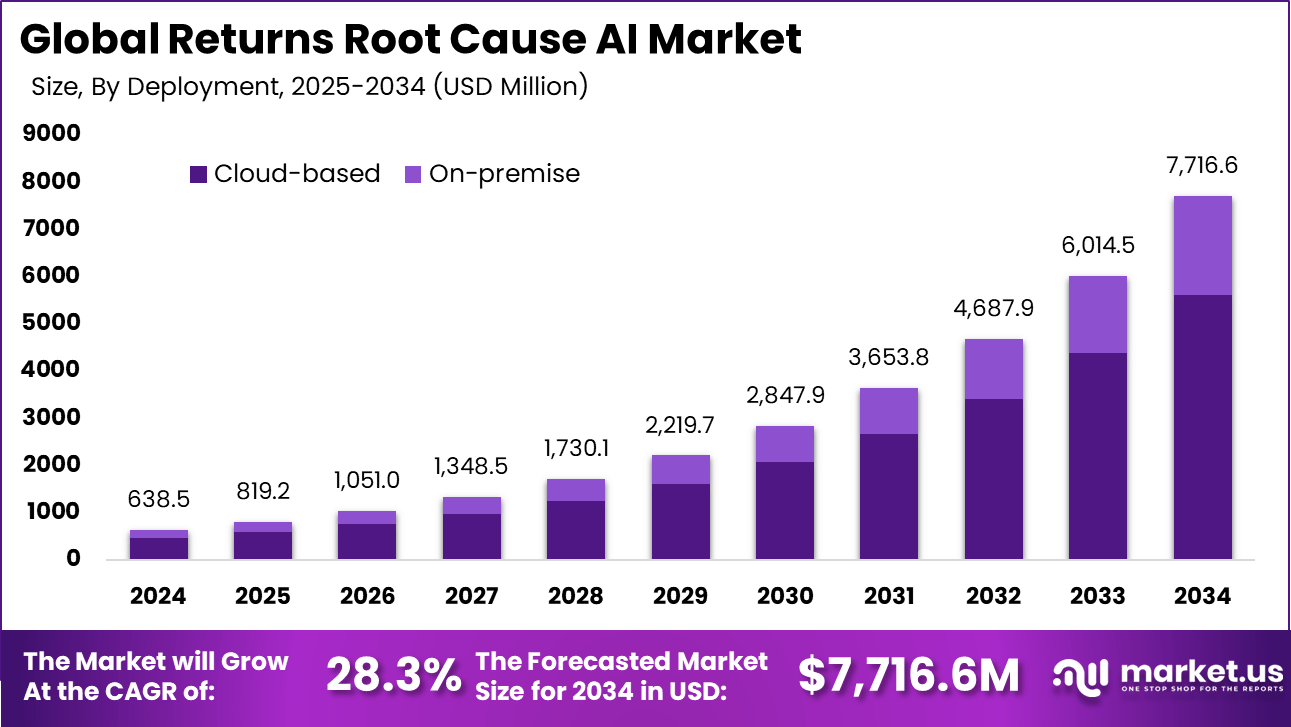
Top driving factors for Returns Root Cause AI include the increasing complexity of systems and operations that make manual problem-solving inefficient, the pressing need to reduce downtime and operational costs, and the growing adoption of automation in business processes. Organizations face tighter time constraints to resolve issues and require reliable, data-driven insights to speed decision-making while reducing human error.
For instance, in July 2025, Salesforce integrated AI-powered root cause diagnostics within its Service Cloud, leveraging Einstein AI for returns analysis to help customer service teams rapidly uncover and resolve root causes behind product returns. This helps reduce operational costs and improve customer satisfaction for North American clients.
AI-powered root cause analysis is delivering strong operational gains, with problem resolution becoming 75% faster and processing efficiency in returns management improving by 40% to 60%. These systems help identify issues quickly by analyzing patterns across large datasets, which reduces downtime and supports smoother business operations. Their ability to automate detection and streamline corrective actions strengthens overall process reliability.
Key technologies supporting adoption include natural language processing for analysing return notes, computer vision for product inspection, predictive models for identifying high risk items, anomaly detection, workflow automation tools and cloud based data platforms. AI systems analyse reviews, customer conversations, historical return data and product imagery to identify root causes. Automated tagging and pattern recognition accelerate analysis and support actionable insights.
Key Takeaway
- In 2024, the Cloud based segment accounted for 72.9% of the Global Returns Root Cause AI Market, reflecting strong reliance on remote AI infrastructure for return analysis.
- In 2024, the Defect Detection segment captured 39.6%, showing that identifying product issues remained the primary use case for AI driven root cause insights.
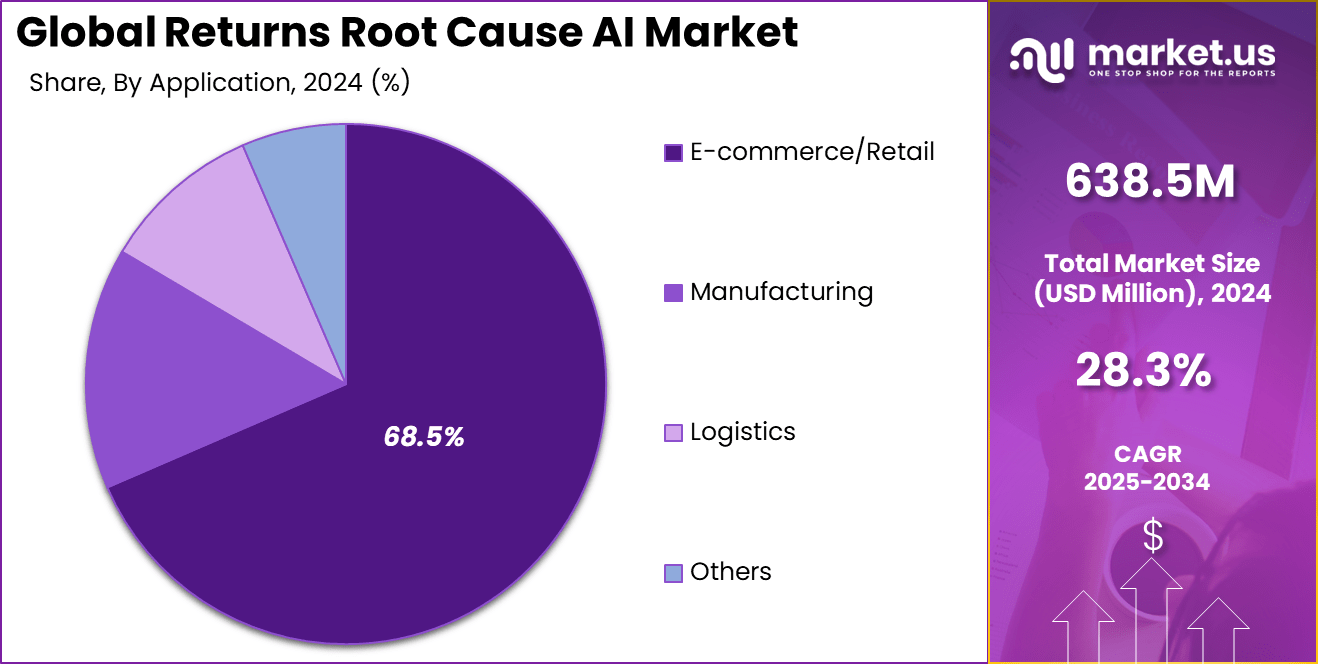
- In 2024, the E commerce and Retail segment reached 68.5%, highlighting heavy adoption of AI tools to reduce return volumes and improve product quality feedback loops.
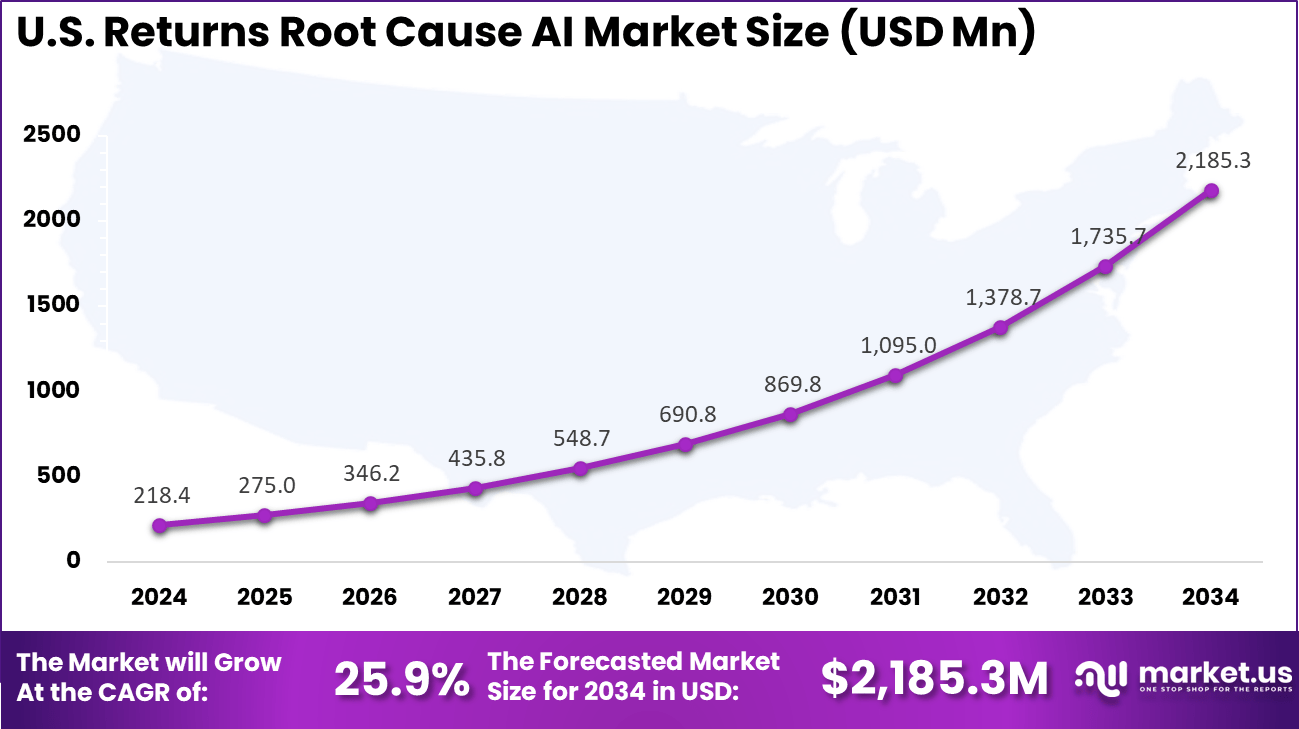
- The US market recorded USD 218.4 million in 2024 with a CAGR of 25.9%, indicating steady investment in AI systems designed to analyze return patterns.
- In 2024, North America held 38%, confirming the region’s strong position in deploying AI platforms that support return reduction strategies.
Role of Generative AI
Returns Root Cause AI is increasingly leveraging generative AI to enhance its capabilities in identifying and addressing root causes more efficiently. Generative AI models analyze complex data sets to generate explanations and forecasts that support faster decision-making in root cause analysis.
About 78% of companies are using generative AI in some business functions, yet only 15% report significant measurable returns within the first year, indicating early but growing adoption with room for optimization.
The key role of generative AI here lies in transforming raw data into actionable insights by automating pattern recognition in root cause investigations, allowing teams to focus on strategic problem-solving rather than manual data processing.
Investment and Business Benefits
Investors target infrastructure supporting root cause AI, such as data processing and analytics platforms. Opportunities lie in scalable solutions for emerging digital ecosystems without heavy reliance on mega-caps. Cross-sector synergies with IoT and cloud amplify potential.
Focus areas include automation for quality control and process optimization. Funding supports tools enhancing productivity in high-data environments. Growth in smart manufacturing and IT operations creates entry points for specialized tech.
Root cause AI cuts resolution time by automating pattern recognition and causal inference. It reduces downtime and defects through proactive measures, improving efficiency. Decisions become data-driven with deeper insights into failure modes.
Benefits extend to cost savings via optimized maintenance and resource allocation. Enhanced accuracy minimizes human error and bias in analysis. Overall, it fosters continuous improvement and resilience in operations.
U.S. Market Size
The market for Returns Root Cause AI within the U.S. is growing tremendously and is currently valued at USD 218.4 million, the market has a projected CAGR of 25.9%. Increasing adoption of AI technologies across industries drives improvements in operational efficiencies and cost reductions related to product returns. Businesses are leveraging AI to analyze large volumes of return data, enabling faster identification of root causes and proactive correction of defects.
Additionally, high investment in AI infrastructure and cloud platforms supports advanced analytics capabilities. The growing demand for better customer experience and supply chain optimization fuels further expansion.
For instance, in August 2025, IBM launched advanced AI software, augmenting its Watson AI to provide enhanced returns, root cause analysis, and integrating AI-powered causal graphs and explainability features. These innovations improve transparency and actionable insights to corporate clients, helping reduce product return rates and streamline operational workflows in sectors such as manufacturing and retail.
In 2024, North America held a dominant market position in the Global Returns Root Cause AI Market, capturing more than a 38% share, holding USD 242.6 million in revenue. This lead stems from the region’s advanced technological infrastructure and early adoption of AI solutions by major enterprises.
Strong investments in cloud computing and data analytics enable precise analysis of return patterns, cutting costs in retail and manufacturing. The presence of leading tech hubs and research institutions accelerates innovation in root cause tools. High demand across sectors like e-commerce drives deployment, supported by favorable policies and venture funding that boost AI integration for operational gains.
For instance, In April 2025, Microsoft upgraded its Return Root Cause AI within Azure AI by adding stronger anomaly detection and causal inference models. These enhancements improved the speed and accuracy of diagnosing issues in returns and supply chain operations, supporting more reliable decision intelligence. The update strengthened Microsoft’s position in helping North American enterprises reduce losses and improve returns management efficiency.
Deployment Analysis
In 2024, The Cloud-based segment held a dominant market position, capturing a 72.9% share of the Global Returns Root Cause AI Market. Cloud deployment offers businesses the advantage of scalability, allowing them to easily manage the growing volume of return data without the need for costly infrastructure investments. It also provides flexibility to update and integrate AI tools quickly and remotely, which helps companies maintain smooth and efficient operations.
Cloud-based AI also greatly reduces the time and resources needed for root cause analysis. The use of AI in cloud platforms can cut investigation times from days to minutes by automating data collection and analysis. This leads to faster problem-solving and less downtime for businesses, allowing teams to focus more on strategic priorities instead of routine troubleshooting. Cloud deployment’s accessibility and cost-effectiveness have made it the preferred choice for many organizations.
For Instance, in November 2025, AWS announced top cloud operations updates with generative AI for automated root cause analysis. The ‘5 Whys’ workflow mirrors internal AWS methods to pinpoint systemic issues in cloud setups. It streamlines returns processing by handling vast operational data efficiently.
Function Analysis
In 2024, the Defect Detection segment held a dominant market position, capturing a 39.6% share of the Global Returns Root Cause AI Market. The AI systems help businesses detect defects accurately and promptly by analyzing patterns and anomalies in return data. This early detection helps companies address quality issues before they escalate, reducing costs and customer dissatisfaction.
Using AI for defect detection also eliminates human error and bias, increasing the consistency and thoroughness of inspections. Automated systems analyze extensive data quickly, ensuring no critical signals are missed. By providing accurate root causes for defects, these AI solutions help organizations improve product reliability and customer trust.
For instance, in October 2025, Microsoft Marketplace featured Straive’s AI defect detection proof-of-concept for manufacturing. It boosts efficiency and accuracy in spotting product flaws that lead to returns. Cloud integration makes it scalable for high-volume defect analysis.
Application Analysis
In 2024, The E-commerce/Retail segment held a dominant market position, capturing a 68.5% share of the Global Returns Root Cause AI Market. This dominance is driven by the high volume of returns typical in these industries, which creates a strong need for a better understanding and management of return causes.
AI root cause analysis supports retailers by uncovering patterns behind returns, such as sizing issues, product defects, or inaccurate descriptions. This insight helps retailers optimize inventory decisions, reduce reverse logistics costs, and tailor customer service improvements.
Being able to analyze return data at scale also enables targeted solutions that improve product offerings and customer satisfaction. AI in this application drives profitability by minimizing return-related losses and enhancing operational efficiency.
For Instance, in August 2025, SAP partnered with Henkel on AI-assisted returns and exchanges management. It streamlines processing in retail by automating root cause checks on return reasons. This boosts efficiency in e-commerce reverse logistics.
Emerging Trends
One main trend in Returns Root Cause AI is blending AI with machine learning to handle data on its own. Tools now pull in info from different sources and link odd events to find causes fast. About 34% of groups using these see better results in catching flaws and lowering risks. This setup works well in busy systems like IT or supply chains where things break often.
Another shift comes with AI that fits specific fields, like power grids or factories. These handle unique data sets and spot hidden links between things like weather and machine wear. Generative AI even creates normal data profiles to flag small changes early. The result is fewer surprises and quicker fixes across complex setups.
Growth Factors
Key growth factors for Root Cause AI include the rapid digital transformation of industries and increasing complexity in IT and operational environments. As systems become more interconnected, the need for AI-powered analytics to manage anomalies and maintain business continuity grows significantly.
Increasing investments in smart manufacturing, IT infrastructure, and critical asset monitoring create a higher demand for root cause analytics that can enhance productivity and reduce costly downtime. Sectors such as manufacturing, healthcare, and financial services are leading adopters, motivated by the benefits of predictive maintenance and operational optimization.
Key Market Segments
By Deployment
- Cloud-based
- On-premise
By Function
- Defect Detection
- Customer Behavior Analysis
- Return Pattern Identification
- Others
By Application
- E-commerce/Retail
- Manufacturing
- Logistics
- Others
Regional Analysis and Coverage
- North America
- US
- Canada
- Europe
- Germany
- France
- The UK
- Spain
- Italy
- Russia
- Netherlands
- Rest of Europe
- Asia Pacific
- China
- Japan
- South Korea
- India
- Australia
- Singapore
- Thailand
- Vietnam
- Rest of Latin America
- Latin America
- Brazil
- Mexico
- Rest of Latin America
- Middle East & Africa
- South Africa
- Saudi Arabia
- UAE
- Rest of MEA
Drivers
Rising E-commerce and Retail Demand
One of the key drivers for the Returns Root Cause AI market is the rapid growth of e-commerce and omnichannel retailing. As online shopping expands, businesses face increasing pressure to effectively manage return processes and identify root causes of returns to reduce costs and improve customer satisfaction.
AI solutions that analyze return data, detect patterns, and uncover root causes help retailers optimize inventory, improve product quality, and streamline reverse logistics. This growing demand from the retail and e-commerce sectors creates a strong market pull for root cause AI solutions. Companies are incentivized to invest in these AI technologies to handle increasing return volumes intelligently and efficiently, which supports overall market expansion and adoption.
For instance, in November 2025, Google rolled out new Vertex AI Search features for commerce, helping retailers analyze shopping patterns and cut down returns through smarter product matches. This ties right into e-commerce growth by using AI to spot why items get sent back and fix issues upfront. Retailers gain from fewer surprises in customer behavior.
Restraint
Data Quality and Fragmentation
A significant restraint for the Returns Root Cause AI market is the heavy dependence on high-quality, unbiased, and well-integrated data. AI models for root cause analysis require large, clean, and consistent datasets to accurately infer causes of returns. Fragmented or poor-quality data originating from multiple disconnected systems or sources can weaken AI performance, leading to incorrect insights or reduced reliability.
This challenge is compounded in industries and companies where data infrastructure is still developing or siloed. Overcoming these data issues demands robust data governance and integration efforts, which can delay AI deployment and increase costs. The reliance on data quality restrains market growth since not all organizations possess the maturity or resources to address these foundational needs effectively.
For instance, in November 2025, Collibra launched AI Governance for SAP to tackle fragmented data in business clouds, ensuring clean inputs for root cause models. Poor data from mixed sources often stalls AI accuracy in returns analysis. This addresses the core issue of unreliable datasets slowing deployments.
Opportunities
Industry-Specific Custom Solutions
The market presents notable opportunities for developing industry-specific root cause AI solutions tailored to unique operational needs. Different industries, such as healthcare, energy, logistics, and manufacturing, have distinct return patterns, regulations, and process complexities. Custom AI models designed for these specific contexts can significantly improve the accuracy and relevance of root cause findings.
This opens the door for vendors to innovate scalable, industry-focused platforms that combine AI with IoT and big data analytics for proactive maintenance and continuous optimization beyond basic cause analysis. As organizations accelerate digital transformation, they seek solutions that address their particular challenges, creating a growing demand for specialized AI offerings in this space.
For instance, in February 2025, SAP teamed with Databricks on Business Data Cloud for industry-tuned AI in supply chains, including root causes. Custom setups link ERP data to predict issues in manufacturing returns. It opens paths for specialized solutions in heavy industries.
Challenges
Talent Shortage and Adoption Barriers
A major challenge in the Returns Root Cause AI market is the shortage of skilled AI talent and slow adoption in traditional sectors. Many companies struggle to find personnel with expertise in AI technologies, data science, and domain knowledge necessary for effective implementation and ongoing management of root cause AI systems. This limits the speed and scale at which AI solutions can be integrated.
Also, conservative industries or smaller businesses may hesitate to adopt advanced AI due to perceived complexity, change resistance, or budget constraints. Overcoming these barriers requires investments in workforce reskilling, user education, and change management to build confidence and competence in leveraging AI for root cause analysis. Without addressing talent and cultural challenges, market growth may be constrained despite technological advances.
For instance, in August 2025, AWS reported a $195 billion backlog of customer demand exceeding its capacity to deliver AI and cloud services, slowing growth despite high interest. This signals industry-wide challenges with supply constraints and highlights the difficulty in scaling AI deployments quickly due to infrastructure limits and talent shortages necessary to meet booming demand.
Key Players Analysis
Google, Microsoft, IBM, and Amazon lead the returns root cause AI market with advanced analytics engines and cloud platforms that help retailers identify patterns behind product returns. Their systems analyze customer behavior, product attributes, logistics data, and quality signals to pinpoint recurring issues. These companies focus on scalable AI models, real-time insights, and automated recommendations.
Salesforce, Oracle, SAP, Accenture, and Capgemini strengthen the market with integrated AI solutions designed for end-to-end returns management. Their platforms combine CRM data, supply-chain information, and predictive analytics to identify operational bottlenecks and product-specific problems. These providers support retailers in optimizing product design, refining merchandising decisions, and improving fulfillment accuracy.
Deloitte, PwC, EY, KPMG, Cognizant, Infosys, and other participants broaden the landscape with consulting-led AI implementations, tailored data models, and industry-specific root cause analysis frameworks. Their solutions help enterprises reduce avoidable returns, streamline reverse logistics, and strengthen product lifecycle management. These companies focus on actionable insights, compliance alignment, and cross-functional visibility.
Top Key Players in the Market
- Microsoft
- IBM
- Amazon
- Salesforce
- Oracle
- SAP
- Accenture
- Capgemini
- Deloitte
- PwC
- EY
- KPMG
- Cognizant
- Infosys
- Others
Recent Developments
- In November 2025, RELEX Solutions launched AI-Assisted Diagnostics, a new capability that automatically identifies root causes of supply chain issues like stockouts, spoilage, and excess inventory. This tool uses AI agents and GenAI to analyze operational data, deliver actionable insights, and recommend fixes such as adjusting orders or sourcing strategies for retailers and distributors.
- In November 2025, Chronosphere launched AI-Guided Troubleshooting, combining AI insights with a Temporal Knowledge Graph for accurate root-cause analysis in production incidents. This addresses manual troubleshooting amid rising code velocity from generative AI, offering suggestions, investigation notebooks, and natural language assistance to speed resolutions.
Report Scope
Report Features Description Market Value (2024) USD 638.5 Mn Forecast Revenue (2034) USD 7,716.6 Mn CAGR(2025-2034) 28.3% Base Year for Estimation 2024 Historic Period 2020-2023 Forecast Period 2025-2034 Report Coverage Revenue forecast, AI impact on Market trends, Share Insights, Company ranking, competitive landscape, Recent Developments, Market Dynamics and Emerging Trends Segments Covered By Deployment (Cloud-based, On-premise), By Function (Defect Detection, Customer Behavior Analysis, Return Pattern Identification, Others), By Application (E-commerce/Retail, Manufacturing, Logistics, Others) Regional Analysis North America – US, Canada; Europe – Germany, France, The UK, Spain, Italy, Russia, Netherlands, Rest of Europe; Asia Pacific – China, Japan, South Korea, India, New Zealand, Singapore, Thailand, Vietnam, Rest of Latin America; Latin America – Brazil, Mexico, Rest of Latin America; Middle East & Africa – South Africa, Saudi Arabia, UAE, Rest of MEA Competitive Landscape Google, Microsoft, IBM, Amazon, Salesforce, Oracle, SAP, Accenture, Capgemini, Deloitte, PwC, EY, KPMG, Cognizant, Infosys, Others Customization Scope Customization for segments, region/country-level will be provided. Moreover, additional customization can be done based on the requirements. Purchase Options We have three license to opt for: Single User License, Multi-User License (Up to 5 Users), Corporate Use License (Unlimited User and Printable PDF)  Returns Root Cause AI MarketPublished date: Dec. 2025add_shopping_cartBuy Now get_appDownload Sample
 -
-
- Microsoft
- IBM
- Amazon
- Salesforce
- Oracle
- SAP
- Accenture
- Capgemini
- Deloitte
- PwC
- EY
- KPMG
- Cognizant
- Infosys
- Others
Our Clients

- 168459
- Dec. 2025









