


Market Overview
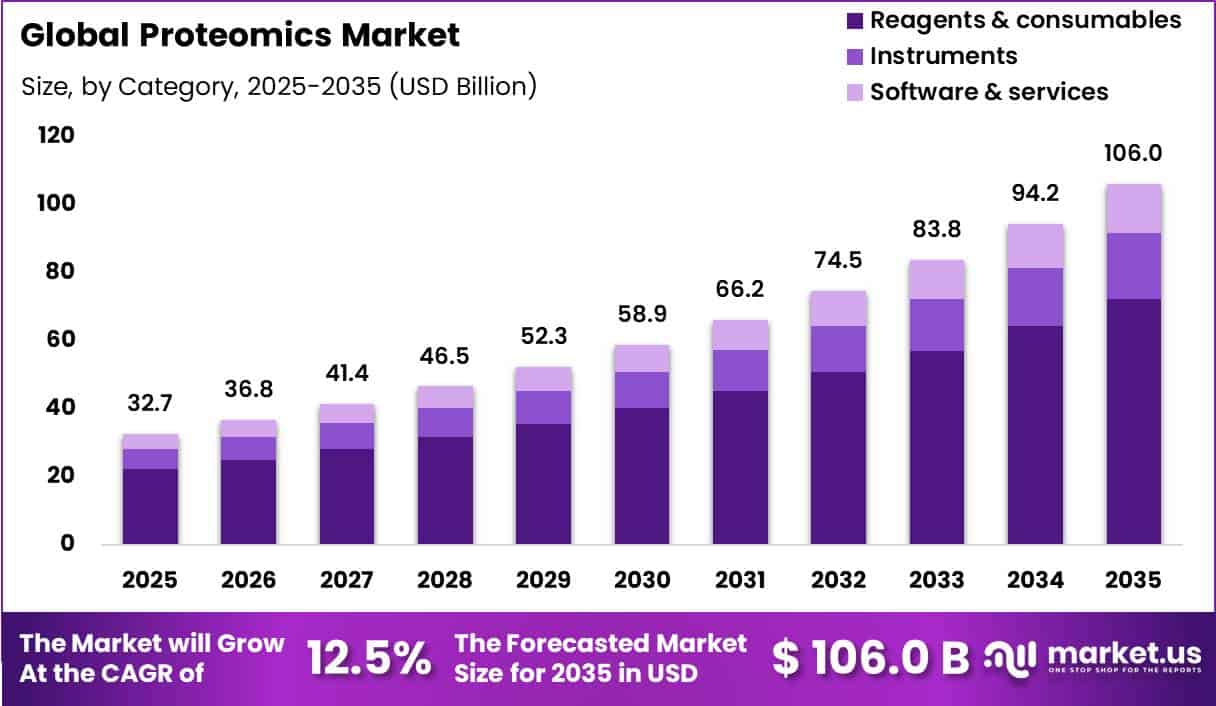
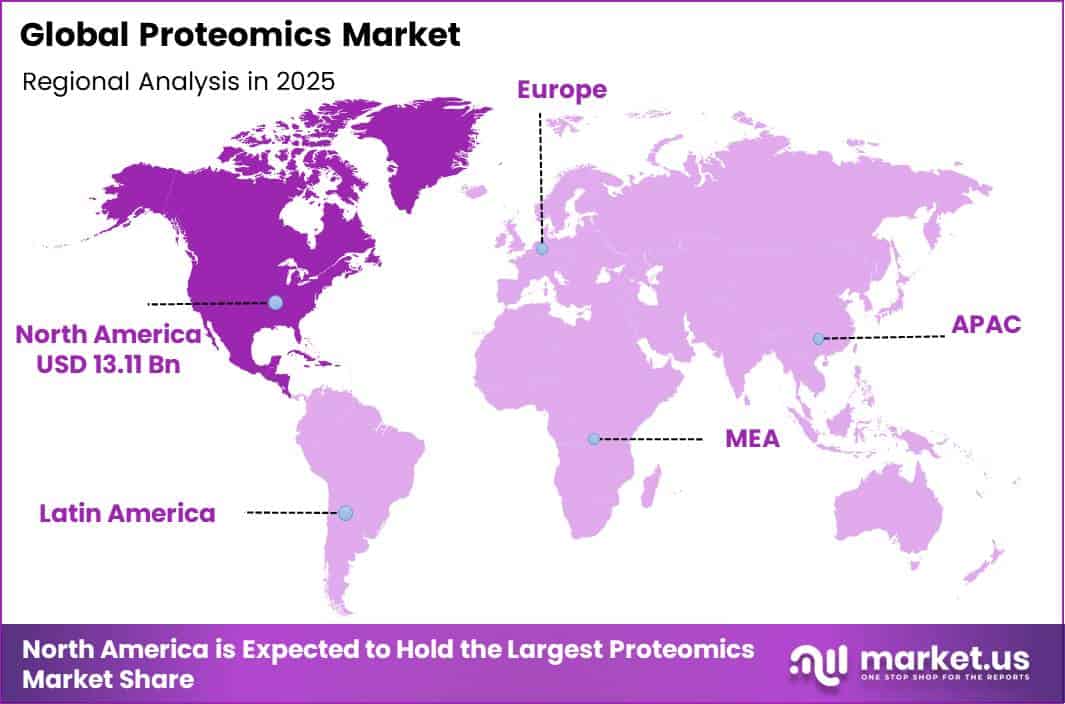
The Global Proteomics Market size is expected to be worth around US$ 106.0 Billion by 2035 from US$ 32.7 Billion in 2025, growing at a CAGR of 12.5% during the forecast period from 2026 to 2035. In 2025, North America led the market, achieving over 40.1% share with a revenue of US$ 13.11 Billion.
Proteomics is the large-scale study of proteins, including their structure, function, interactions, and expression within biological systems. As proteins are the primary functional molecules in cells, proteomics provides direct insights into disease mechanisms, therapeutic targets, and biological pathways that cannot be fully understood through genomics alone.
According to the U.S. National Centre for Advancing Translational Sciences (NCATS), proteomics plays a vital role in biomarker discovery, cancer research, precision medicine, and drug development by analyzing how proteins change under different physiological and pathological conditions.
Advancements in high-resolution mass spectrometry, artificial intelligence, bioinformatics, and next-generation protein sequencing are accelerating the adoption of proteomics across pharmaceutical research, clinical diagnostics, and academic institutions.
The National Institutes of Health (NIH) reported that scientists have identified proteins encoded by more than 17,000 human genes, representing approximately 84% of known protein-coding genes, significantly expanding understanding of the human proteome.
Furthermore, the NIH’s National Institute of General Medical Sciences estimates that each human cell contains nearly 10 trillion protein molecules, while proteins constitute approximately 42% of the body’s dry weight, underscoring their central role in human biology. The global Protein Data Bank had also archived 229,378 experimentally determined biomolecular structures by the end of 2024, providing an extensive foundation for biomedical and pharmaceutical research.
Growing investments by government agencies, research institutions, and biotechnology companies continue to strengthen proteomics capabilities worldwide. The integration of proteomics with genomics, transcriptomics, and metabolomics is enabling more comprehensive disease profiling, supporting earlier diagnosis, personalized therapies, and accelerated drug discovery.
These technological and scientific advances are expected to drive continued expansion of proteomics applications across oncology, infectious diseases, neuroscience, cardiovascular disorders, and precision healthcare.
Key Takeaways
- Market Size: The Global Proteomics Market size was US$ 32.7 billion in 2025. The market is estimated to grow to US$ 106.0 billion by 2035.
- Market Share: The Compound Annual Growth Rate (CAGR) of the market from 2026 to 2035 will be 12.5%.
- Category: Reagents & Consumables has the largest market share, accounting for 68.1% of total sales.
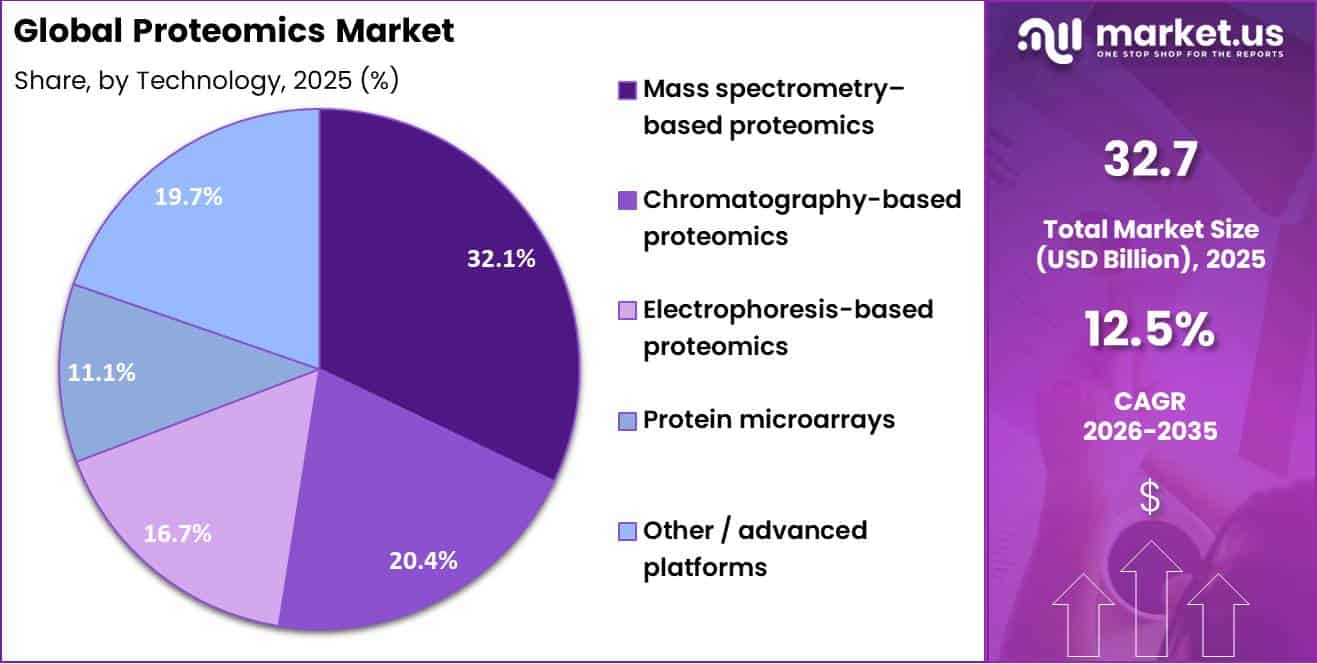
- Technology: Mass Spectrometry-Based Proteomics leads the segment, accounting for 32.1% of total revenue.
- Application: Drug Discovery & Development dominates the segment, accounting for 35.2% of total revenue.
- End User: Biopharma & Biotechnology Companies dominate the segment, accounting for 70.1% of total revenue.
- Regional: North America is the dominant regional market, accounting for 40.1% of global sales, holding US$ 13.11 billion in revenue.
Category Analysis
In 2025, Reagents & Consumables dominated the proteomics market, accounting for 68.1% of the total market share. The segment’s leadership is driven by the recurring demand for sample preparation kits, antibodies, labelling reagents, chromatography columns, assay kits, buffers, enzymes, and other laboratory consumables that are required for every stage of proteomics workflows.
Growing research activities in biomarker discovery, precision medicine, drug development, and clinical proteomics continue to increase the frequency of laboratory testing, resulting in sustained purchases of consumables. Continuous product innovations that improve sensitivity, reproducibility, and workflow efficiency further strengthen this segment’s position.
Instruments represented 18.3% of the market in 2025, supported by increasing installations of advanced mass spectrometers, chromatography systems, electrophoresis platforms, and automated sample preparation equipment across research laboratories and pharmaceutical companies.
Although instrument purchases involve significant capital investment, technological upgrades and expanding laboratory infrastructure continue to support steady demand.
Meanwhile, Software & Services accounted for 13.6% of the market, reflecting the growing need for bioinformatics platforms, cloud-based data analysis, laboratory information management systems, workflow optimization, instrument maintenance, and technical support. Increasing complexity of proteomic datasets is encouraging wider adoption of specialized analytical software and outsourced proteomics services.
Technology Analysis
In 2025, Mass Spectrometry-Based Proteomics held the largest market share of 32.1%, establishing itself as the leading technology for comprehensive protein identification, quantification, and characterization.
Its superior sensitivity, accuracy, and ability to analyze complex biological samples have made it the preferred platform in pharmaceutical research, biomarker discovery, clinical proteomics, and precision medicine. Continuous advancements in high-resolution instruments, automation, and data analysis software have further accelerated adoption across research institutions and biopharmaceutical companies.
Chromatography-Based Proteomics captured 20.4% of the market, benefiting from its critical role in protein separation, purification, and sample preparation before downstream analysis. Electrophoresis-Based Proteomics accounted for 16.7%, remaining widely utilized for protein separation, comparative expression studies, and routine laboratory workflows because of its cost-effectiveness and established protocols.
Protein Microarrays represented 11.1% of the market, supported by increasing applications in high-throughput protein interaction studies, antibody screening, and biomarker validation. The Other/Advanced Platforms segment contributed 19.7%, encompassing emerging technologies such as next-generation protein sequencing, single-cell proteomics, imaging-based proteomics, and advanced affinity-based methods.
These innovative platforms are expanding analytical capabilities and enabling a deeper understanding of complex biological systems.
Application Analysis
In 2025, Drug Discovery & Development emerged as the leading application segment, accounting for 35.2% of the global proteomics market. The dominance of this segment is driven by increasing pharmaceutical and biotechnology investments in identifying novel therapeutic targets, validating drug candidates, understanding disease pathways, and optimizing clinical development programs.
Proteomics technologies enable comprehensive protein profiling, helping researchers improve drug efficacy while reducing development timelines and failure rates. Rising adoption of precision medicine and targeted therapies continues to strengthen demand for proteomics throughout the drug development pipeline.
Clinical Diagnostics & Biomarker Discovery represented the second-largest application area, supported by growing efforts to identify disease-specific biomarkers for early diagnosis, patient stratification, and personalized treatment selection across oncology, cardiovascular, neurological, and infectious diseases.
Protein Expression Profiling also accounted for a significant market share, as researchers increasingly utilize protein expression analysis to investigate cellular functions, signaling pathways, disease mechanisms, and therapeutic responses.
The Other Research & Applied Uses segment includes agricultural biotechnology, food science, environmental research, forensic science, veterinary diagnostics, and academic research applications. Continuous technological advancements and expanding interdisciplinary research are broadening the scope of proteomics across multiple scientific and industrial sectors, supporting long-term market growth.
End-User Analysis
In 2025, Biopharma & Biotechnology Companies dominated the proteomics market, accounting for 70.1% of the total market share. This leadership reflects substantial investments by pharmaceutical and biotechnology companies in drug discovery, target identification, biomarker validation, biologics development, and precision medicine research.
Proteomics has become an essential component of modern therapeutic development, enabling deeper understanding of disease biology, accelerating candidate selection, and improving clinical trial outcomes.
Increasing research collaborations, expanding biologics pipelines, and greater adoption of high-throughput proteomics platforms continue to reinforce the segment’s leading position.
Academic & Research Institutes represented the second-largest end-user segment, supported by government funding, university-based life science research, and growing interest in systems biology, genomics, and translational medicine. These institutions play a vital role in advancing proteomics technologies and generating foundational scientific discoveries.
The Clinical segment is also expanding steadily as hospitals, diagnostic laboratories, and healthcare organizations increasingly integrate proteomics into disease diagnosis, biomarker testing, and personalized treatment strategies.
Other End Users, including contract research organizations (CROs), forensic laboratories, agricultural research centers, and food testing facilities, further contribute to market demand through specialized research services and applied proteomics applications across diverse industries.
Key Market Segments
By Category
- Reagents & Consumables
- Instruments
- Software & Services
By Technology
- Mass Spectrometry-Based Proteomics
- Chromatography-Based Proteomics
- Electrophoresis-Based Proteomics
- Protein Microarrays
- Other/Advanced Platforms
By Application
- Drug Discovery & Development
- Clinical Diagnostics & Biomarker Discovery
- Protein Expression Profiling
- Other Research & Applied Uses
By End User
- Biopharma & Biotechnology Companies
- Academic & Research Institutes
- Clinical
- Other End Users
Driver
Expansion of Precision Medicine and Oncology Biomarker Programs
Precision medicine programs in oncology are increasingly positioning proteomics as a core analytical layer alongside genomics and transcriptomics. Mass spectrometry-based protein profiling is being used for biomarker discovery, tumour classification, and treatment response prediction, moving beyond exploratory research into clinically relevant decision support.
Large oncology trials and biobank initiatives now routinely integrate proteomic endpoints, increasing both the number of samples analyzed and the frequency of testing per patient over the disease course. This shift is expanding recurring demand for mass spectrometry workflows, as longitudinal patient monitoring requires repeated sampling across treatment cycles rather than a one-time analysis.
As a result, proteomics is evolving into a structured component of translational and clinical pipelines rather than a purely research-driven tool. Technological advances in next-generation MS platforms and AI-driven data interpretation are accelerating the identification of protein signatures linked to cancer subtypes and therapy response.
These capabilities are directly supporting companion diagnostic development for targeted therapies, which operate on multi-year development timelines but require continuous proteomic validation.
From a commercial standpoint, hybrid MS systems already account for a significant share of biomarker-related revenues, and this proportion is rising as oncology programs scale. Vendors are increasingly bundling hardware with cloud analytics, assay development, and validation services, shifting the industry toward recurring, multi-year contracts rather than one-time capital sales.
Overall, expanding precision medicine and oncology biomarker programs are expected to contribute approximately 2 % points of incremental CAGR to the global proteomics market, with the strongest adoption in North America, Europe, and advanced APAC research ecosystems.
| Driver | (~) % Impact on CAGR Forecast | Geographic Relevance | Impact Timeline |
|---|---|---|---|
| AI-enhanced mass spectrometry & single-cell proteomics | +2.3% | North America core, EU, APAC innovation hubs | Medium term (2-4 years) |
| Expansion of precision medicine & oncology biomarker programs | +2.0% | North America core, EU, APAC corridors | Medium term (2-4 years) |
| Public research funding and multi-omics infrastructure build-out | +1.6% | North America core, EU, selected APAC | Long-term (≥ 4 years) |
| Increasing clinical and diagnostic validation of proteomic assays | +1.9% | North America core, EU, APAC urban clusters | Medium term (2-4 years) |
| Cost and throughput gains in hybrid MS platforms & automation | +1.7% | North America core, EU manufacturing, APAC production bases | Short to medium term (≤ 4 years) |
| Regulatory and data-sharing frameworks enabling real-world proteomics | +1.2% | North America core, EU, selected APAC & UK | Long-term (≥ 4 years) |
Challenge
High Throughput Instrument Capital Expenditure Constraints
High-throughput proteomics is fundamentally constrained by the high capital expenditure required for advanced LC MS platforms, which typically cost between USD 750,000 and 1.5 million per system. These costs are further amplified by annual service contracts of USD 80,000 to 150,000, as well as infrastructure investments in vibration-controlled, temperature-stable laboratories with reliable power supply.
Combined, the total cost of ownership can increase by 20 to 30 % over the full instrument lifecycle. In real-world deployment, utilization inefficiencies further worsen unit economics. Many hospitals and research institutes operate only 1 to 2 high-end systems despite handling large sample volumes, with practical throughput often limited to 1,100 to 1,700 samples per month versus a theoretical capacity of 2,000 to 3,000.
Downtime, maintenance cycles, and conservative scheduling practices reduce productivity and increase per-sample amortisation costs, often raising them from USD 60 to 80 to USD 120 to 160 over a 7 to 10 year depreciation horizon.
Although government and NIH-backed funding initiatives are increasingly supporting omics infrastructure, procurement and grant-to-deployment timelines of 12 to 24 months slow rapid scale-up. This creates uneven access across institutions and regions, limiting the pace of adoption in mid-tier laboratories.
To improve efficiency, the market is shifting toward shared instrumentation cores, regional consortia, and cloud-based analysis platforms that aim to increase utilisation to 80 to 85 %. These models can reduce per-sample costs by 25 to 35 % and enable pay-per-use or subscription access structures.
Despite these improvements, high upfront capital intensity continues to suppress expansion velocity and is estimated to reduce global proteomics market CAGR by approximately 1.2 % points until broader financing and shared access models mature over the next several years.
| Challenge | (~) % CAGR Friction Drag | Geographic Relevance | Mitigation Horizon |
|---|---|---|---|
| Skilled proteomics talent gap | -1.4% | North America, EU, APAC research hubs | Medium term (2-4 years) |
| High-throughput instrument capex | -1.2% | North America core, EU, East Asia | Medium term (2-4 years) |
| Workflow reproducibility & QC | -1.0% | Global clinical & translational labs | Long-term (≥ 4 years) |
| Data integration & bioinformatics load | -1.3% | Global multi-omics programs | Long-term (≥ 4 years) |
| Regulatory biomarker validation burden | -0.9% | US, EU, and Japan regulatory markets | Long-term (≥ 4 years) |
| Sample access & biobank fragmentation | -0.8% | Global, especially emerging markets | Medium term (2-4 years) |
Restraints
Skilled Proteomics Workforce Shortage and Capability Constraints
The proteomics industry faces a growing structural constraint in the form of a skilled workforce shortage, where demand for advanced mass spectrometry scientists, proteomics specialists, and bioinformatics engineers is expanding faster than talent supply.
Modern proteomics workflows require expertise not only in LC MS operation but also in experimental design, multi-omics integration, and high-dimensional data interpretation, creating a narrow and highly specialised labour pool.
In typical high complexity laboratories, 3 to 6 senior scientists and 4 to 10 data analysts are needed to maintain efficient 24/5 operations at 70 to 80 % instrument utilisation. However, vacancy rates of 10 to 20 % are increasingly common in leading research hubs, driving annual salary inflation of 8 to 12 % for critical roles since 2023. This shortage directly reduces operational efficiency, with many labs running at only 50 to 60 % of theoretical capacity, effectively doubling per-sample costs relative to planned assumptions.
Recruitment timelines for qualified personnel often extend 6 to 12 months, delaying deployment of new instruments and slowing the ramp-up of recently installed systems.
On the analytical side, the lack of experienced bioinformaticians capable of processing terabyte-scale datasets, including post-translational modification mapping and network analysis, further elongates data-to-insight cycles from 2 to 3 weeks to 6 to 8 weeks in complex studies. This reduces perceived value for pharmaceutical sponsors and delays contract renewals.
Strategically, organisations are forced to prioritise high-margin projects while deferring routine applications, limiting expansion into clinical proteomics. Overall, this talent bottleneck is estimated to reduce potential market CAGR by approximately 1.5 % points, while also reinforcing industry consolidation as only large players can sustain continuous training and global recruitment pipelines.
| Restraint | (~) % Impact on CAGR Forecast | Geographic Relevance | Impact Timeline |
|---|---|---|---|
| High-cost instrumentation & CapEx drag | -2.0% | North America core, EU, East Asia hubs | Long-term (≥ 4 years) |
| Skilled proteomics workforce shortage | -1.5% | North America, EU, APAC corridors | Medium term (2–4 years) |
| Reagent & consumables supply volatility | -1.2% | Global labs, APAC sourcing-heavy | Short to medium (≤ 4 years) |
| Data infrastructure, interoperability gaps | -0.9% | US, EU, advanced APAC labs | Long-term (≥ 4 years) |
| Regulatory validation and compliance burden | -0.8% | US, EU, Japan, UK | Medium to long (2–6 years) |
| Payer and budget constraints in healthcare | -0.7% | US, EU public systems, emerging markets | Short to medium (≤ 4 years) |
Opportunity
Integrated Proteomics-Based Companion Diagnostics and Drug Diagnostic Convergence
The key opportunity in integrated proteomics-based companion diagnostics lies in shifting proteomics from a discovery-focused biomarker tool into fully regulated, reimbursed clinical diagnostics co-developed alongside targeted therapies.
This is particularly relevant in oncology, immunology, and complex cardiovascular diseases, where protein activity and post-translational modifications often provide more direct insight into therapeutic response than genomics alone.
Today’s precision medicine ecosystem remains predominantly DNA- and RNA-centric, with most approved companion diagnostics relying on genomic markers. As a result, proteomic signatures that better reflect functional pathway activation, drug sensitivity, and toxicity risk remain underutilised despite strong clinical relevance.
Between 2026 and 2032, expansion of proteomics CDx partnerships potentially involving 15 to 25 pharma programs could enable the development of multi-analyte protein panels (50 to 200 biomarkers per indication) tied directly to targeted therapies.
If successfully commercialised across major regulatory regions such as the U.S., EU, and China, this could generate an additional USD 3 to 5 billion in annual testing revenue, assuming 400 to 800 USD per test and 500,000 to 1,000,000 annual patients across multiple indications.
This model also shifts the industry structure from instrument-centric sales to recurring, outcome-linked revenue streams through drug diagnostic bundling and revenue-sharing agreements.
Standardised high-throughput workflows support gross margins of 55 to 65 % for assay kits and 45 to 55 % for centralised testing services.
Overall, this transition could add approximately 2.5 % points to long-term proteomics market CAGR, driven by regulatory approvals, label integration into targeted therapies, and broader adoption of protein-level decision tools in clinical practice from around 2028 onward.
| Opportunity | (~) % Potential CAGR Upside | Geographic Relevance | Execution Window |
|---|---|---|---|
| Population-scale clinical proteomics platforms | +3.0% | North America, EU, East Asia | Medium term (2-4 years) |
| Integrated proteomics-based companion diagnostics | +2.5% | North America core, EU, China | Medium term (2-4 years) |
| Proteomics for chronic metabolic disease management | +2.0% | North America, EU, GCC, India | Short term (≤ 2 years) |
| Low-cost proteomics workflows for emerging markets | +1.8% | APAC emerging, LatAm, Africa | Long-term (≥ 4 years) |
| Proteomics-driven drug discovery platforms (platform-as-a-service) | +3.5% | North America, EU, Japan | Medium term (2-4 years) |
| Cross-industry proteomics applications beyond healthcare | +1.5% | Global selected industrial hubs | Long-term (≥ 4 years) |
Regional Analysis
In 2025, North America led the market, achieving over 40.1% share with a revenue of US$ 13.11 billion. North America dominated the global proteomics market in 2025, driven by its well-established life sciences ecosystem, strong pharmaceutical and biotechnology industry presence, and substantial investments in biomedical research.
The region benefits from widespread adoption of advanced proteomics technologies, including mass spectrometry and high-throughput protein analysis platforms, supported by leading research institutions, favorable funding programs, and increasing demand for precision medicine.
Growing collaborations between academic organizations, biotechnology firms, and healthcare providers continue to accelerate innovation in protein biomarker discovery and therapeutic development.
Europe held the second-largest market share, supported by extensive government-backed research initiatives, expanding clinical proteomics applications, and a mature biotechnology sector.
Countries including Germany, the United Kingdom, France, Switzerland, and the Netherlands are investing heavily in translational research, personalized healthcare, and advanced analytical technologies. Increasing cross-border scientific collaborations and regulatory support for innovative diagnostics further strengthen regional market growth.
Asia-Pacific is projected to register the fastest growth during the forecast period due to expanding pharmaceutical manufacturing, rising healthcare expenditure, and increasing investments in biotechnology research across China, Japan, South Korea, India, and Australia.
Growing genomic and proteomic research programs, improving laboratory infrastructure, and supportive government initiatives are accelerating technology adoption throughout the region.
Latin America and the Middle East & Africa are experiencing gradual market expansion as healthcare infrastructure improves, research funding increases, and awareness of precision medicine grows.
Expanding collaborations with global pharmaceutical companies and rising investments in clinical research are expected to create new opportunities for proteomics adoption across these emerging regions.
Key Regions and Countries
North America
- The US
- Canada
Europe
- Germany
- France
- The U.K.
- Italy
- Spain
- Russia & CIS
- Rest of Europe
Asia Pacific
- China
- India
- Japan
- South Korea
- ASEAN
- Australia & New Zealand
- Rest of Asia Pacific
Middle East & Africa
- GCC
- South Africa
- Rest of Middle East & Africa
Latin America
- Brazil
- Mexico
- Rest of Latin America
Key Player Analysis
The competitive landscape of the global proteomics market is shaped by comprehensive product portfolios covering reagents and consumables, analytical instruments, software, and data analysis solutions.
Established procurement relationships with biopharmaceutical and biotechnology companies provide a significant advantage, particularly as these organizations represent the leading end-user segment. Continuous investment in mass spectrometry and advanced proteomics technologies is also supporting improvements in protein identification, analytical sensitivity, accuracy, and throughput.
Key strategic priorities among leading manufacturers include expanding reagent and consumable offerings to generate recurring revenues alongside capital equipment sales, while developing integrated software and artificial intelligence-enabled data analysis platforms to establish subscription-based revenue models.
Increased investment in clinical diagnostics, biomarker discovery, and precision medicine is further supporting market expansion beyond conventional pharmaceutical research. In addition, strong relationships with biopharmaceutical companies and biotechnology firms, supported by broader distribution networks across academic and research institutions, remain important competitive differentiators for manufacturers targeting the dominant drug discovery and development application segment worldwide.
Top Key Players
- Thermo Fisher Scientific Inc.
- Agilent Technologies Inc.
- Danaher Corporation
- Merck KGaA (MilliporeSigma)
- Bruker Corporation
- Waters Corporation
- Bio-Rad Laboratories Inc.
- Illumina Inc.
- QIAGEN N.V.
- Shimadzu Corporation
- Promega Corporation
- Olink Proteomics AB
- SomaLogic Inc.
- Seer Inc.
- Biognosys AG
- Other Key Players
Recent Developments
- In January 2026, Thermo Fisher Scientific Inc. launched its next-generation Orbitrap Astral mass spectrometry platform with enhanced single-cell proteomics throughput, targeting biopharma drug discovery and clinical biomarker research for institutional buyers seeking improved protein identification sensitivity.
- In February 2026, Bruker Corporation introduced a new timsTOF Ultra mass spectrometry system optimized for spatial proteomics applications, targeting academic research institutes and biopharma companies advancing spatial biology and tissue-level protein profiling programs.
- In March 2026, Olink Proteomics AB expanded its proximity extension assay reagent portfolio with new cardiovascular and oncology biomarker panels, targeting clinical diagnostics and biopharma biomarker discovery institutional buyers across North American and European research markets.
- In April 2026, Waters Corporation secured a multi-year supply agreement with a leading Asian biopharma research network covering its chromatography-based proteomics instrument and consumable portfolio, expanding its institutional presence across drug discovery and protein expression profiling research programs in the region.
Report Scope
| Report Features | Description |
|---|---|
| Market Value (2025) | US$ 32.7 Billion |
| Forecast Revenue (2035) | US$ 106.0 Billion |
| CAGR (2026-2035) | 12.5% |
| Base Year for Estimation | 2025 |
| Historic Period | 2020-2024 |
| Forecast Period | 2026-2035 |
| Report Coverage | Revenue Forecast, Market Dynamics, Competitive Landscape, Recent Developments |
| Segments Covered | By Category (Reagents & Consumables, Instruments, Software & Services), By Technology (Mass Spectrometry-Based Proteomics, Chromatography-Based Proteomics, Electrophoresis-Based Proteomics, Protein Microarrays, Other/Advanced Platforms), By Application (Drug Discovery & Development, Clinical Diagnostics & Biomarker Discovery, Protein Expression Profiling, Other Research & Applied Uses), By End User (Biopharma & Biotechnology Companies, Academic & Research Institutes, Clinical, Other End Users) |
| Regional Analysis | North America – The US, Canada; Europe – Germany, France, U.K., Italy, Spain, Russia & CIS, Rest of Europe; Asia Pacific – China, India, Japan, South Korea, ASEAN, Australia & New Zealand, Rest of Asia Pacific; Middle East & Africa – GCC, South Africa, Rest of Middle East & Africa; Latin America – Brazil, Mexico, Rest of Latin America |
| Competitive Landscape | Thermo Fisher Scientific Inc., Agilent Technologies Inc., Danaher Corporation, Merck KGaA (MilliporeSigma), Bruker Corporation, Waters Corporation, Bio-Rad Laboratories Inc., Illumina Inc., QIAGEN N.V., Shimadzu Corporation, Promega Corporation, Olink Proteomics AB, SomaLogic Inc., Seer Inc., Biognosys AG, Other Key Players |
| Customization Scope | Customization for segments, region/country-level will be provided. Moreover, additional customization can be done based on the requirements. |
| Purchase Options | We have three licenses to opt for: Single User License, Multi-User License (Up to 5 Users), Corporate Use License (Unlimited User and Printable PDF) |





































