


Global Probiotic Ingredients Market Size, Share, And Enhanced Productivity By Form (Dry/Powder, Liquid),By Ingredients (Bacteria (Lactobacilli, Bifidobacterium, Streptococcus, Others),Yeast, Spore Formers), By Application (Food and Beverages (Dairy, Cereals, Baked Food, Others), Dietary Supplements ((Chewable and Gummies, Capsules, Powders, Tablets, Soft Gels, Others), Animal Feed, Others)), By Region and Companies - Industry Segment Outlook, Market Assessment, Competition Scenario, Trends, and Forecast 2026-2035
- Published date: March 2026
- Report ID: 183030
- Number of Pages: 342
- Format:
-
keyboard_arrow_up
Quick Navigation
Report Overview
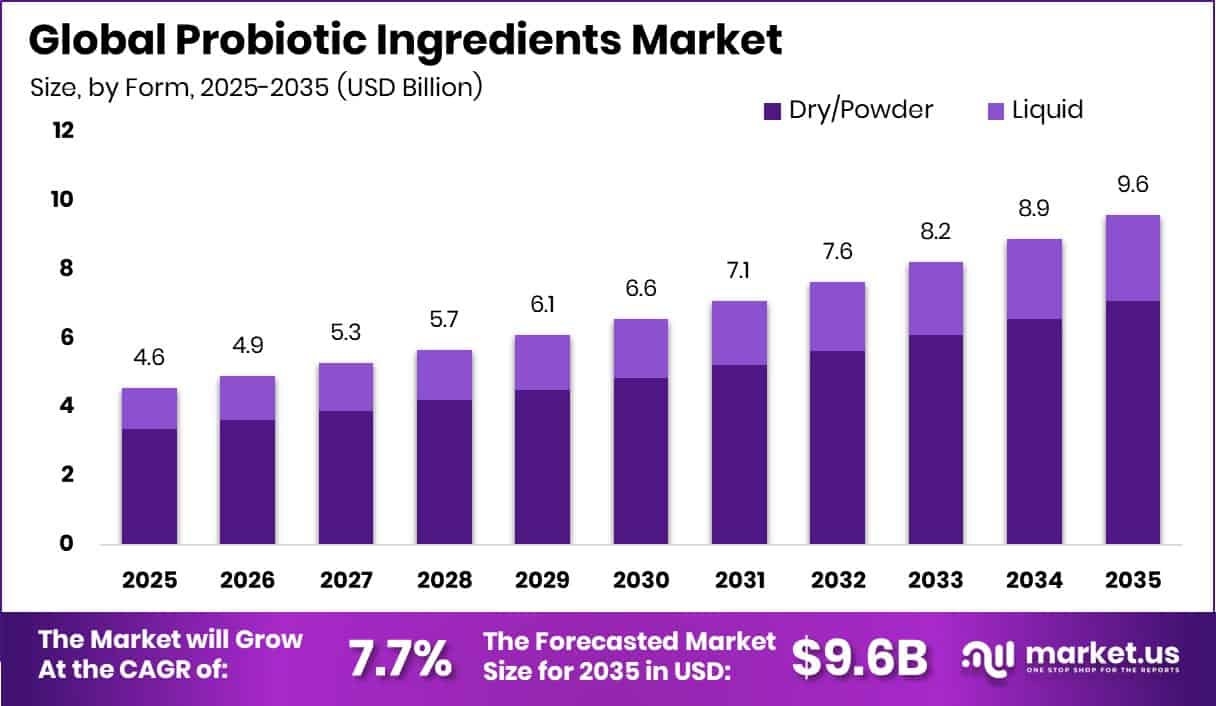
The Global Probiotic Ingredients Market is expected to be worth around USD 9.6 billion by 2035, up from USD 4.6 billion in 2025. It is projected to grow at a CAGR of 7.7% from 2026 to 2035. Regionally, the Asia Pacific held 34.70%, equivalent to USD 1.5 Bn during 2025 globally.
Probiotic ingredients are live beneficial microorganisms and functional compounds used to support gut balance, digestion, immunity, and overall wellness. These ingredients are commonly available in dry/powder and liquid forms, helping manufacturers improve stability, delivery, and usage across multiple product formats.
The Probiotic Ingredients Market refers to the global industry built around probiotic-based raw materials used in food and beverages, dietary supplements, animal feed, and other applications. By ingredient type, the market includes bacteria, yeast, and spore formers, each selected for specific formulation, stability, and health-support roles.
A major growth factor is rising concern over product purity and label transparency. The finding that 70% of 36 popular protein supplements sold in India were mislabeled and 14% contained toxins is pushing consumers toward trusted wellness ingredients, increasing preference for scientifically positioned probiotic formulations in supplements and functional foods.
From a demand perspective, consumers increasingly prefer convenient daily nutrition solutions. This is reflected in trends such as a stick-on supplement brand receiving 50 lakhs on Shark Tank India, showing how easy-to-use wellness delivery formats are expanding probiotic ingredient demand in modern nutrition systems.
A strong opportunity lies in future food-system shifts and functional innovation. With projections that by 2034 only 40% of cereal production will be consumed directly by humans, while 27% moves to biofuel and industrial uses, probiotics offer value in feed efficiency, food fortification, and sustainable nutrition. Community-driven wellness funding, such as Yellow food and drink bringing in $24,000 to Finding Our Voices, also reflects broader support for health-led nutrition initiatives.
- In 2025, Kerry Inc further strengthened its probiotic ingredients work in maternal and infant nutrition, focusing on human milk probiotics. The company works on advanced nutrition and life science ingredients, and this development highlights its expansion into next-generation probiotic solutions for infant gut and immune health applications. This reflects Kerry’s focus on science-based probiotic strains for specialized nutrition uses.
Key Takeaways
- The Global Probiotic Ingredients Market is expected to be worth around USD 9.6 billion by 2035, up from USD 4.6 billion in 2025. It is projected to grow at a CAGR of 7.7% from 2026 to 2035.
- In the probiotic ingredients market, dry/powder forms dominate with a 73.9% share due to stability benefits.
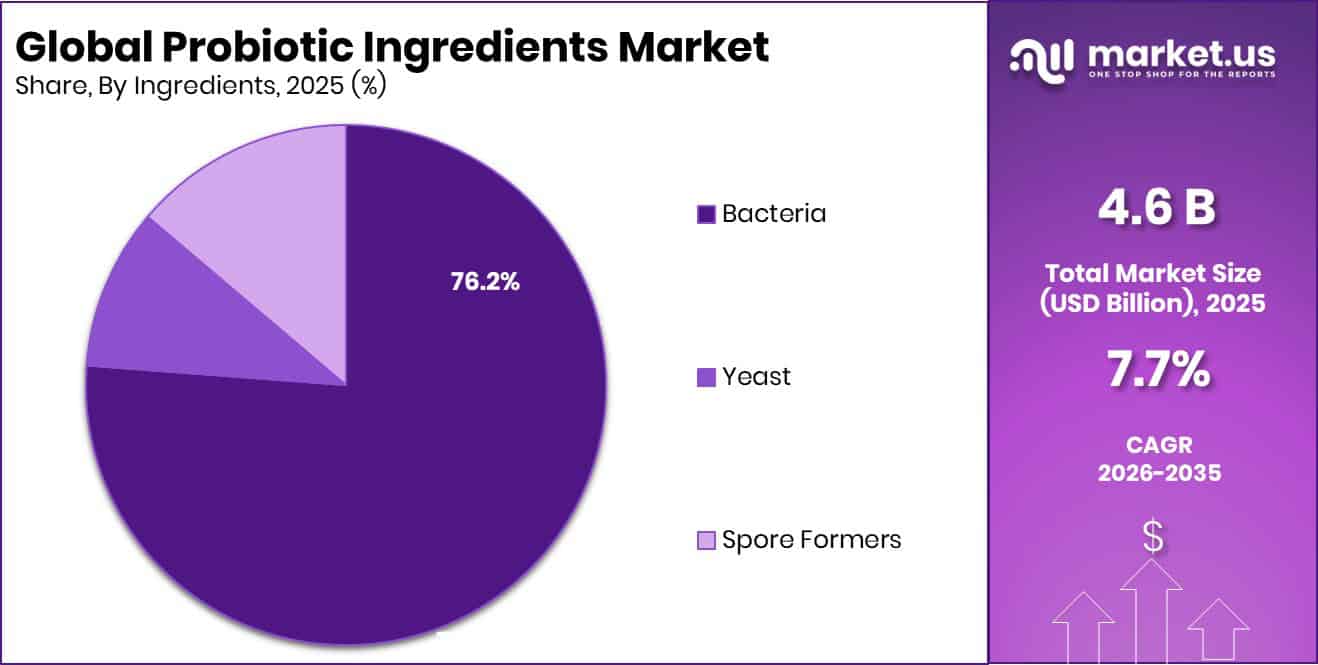
- Within the probiotic ingredients market, bacteria-based ingredients lead at 76.2%, driven by proven gut-health efficacy.
- In the probiotic ingredients market, dietary supplements account for 45.1%, reflecting strong preventive health consumer demand.
- Asia Pacific accounted for 34.70%, totaling USD 1.5 Bn in market value overall.
By Form Analysis
In the probiotic ingredients market, dry/powder form held a 73.9% share globally overall.
In 2025, the Probiotic Ingredients Market showed a clear preference for dry or powder formulations, which accounted for 73.9% of the total market share, reflecting strong manufacturer and consumer demand for formats that offer superior shelf stability, easier transportation, longer storage life, and seamless integration into capsules, sachets, tablets, powdered beverages, and functional food blends, while also supporting cost-efficient large-scale production and preserving microbial viability during processing and distribution, making this form especially attractive for nutraceutical brands and food companies aiming to deliver convenience, potency, and consistent performance across diverse product categories, as the dry format continued to outperform liquid alternatives due to its adaptability in modern health-focused product development and its strong alignment with global preferences for convenient wellness solutions.
By Ingredients Analysis
Within the probiotic ingredients market, bacterial ingredients account for a 76.2% share worldwide today.
In 2025, bacteria-based probiotic ingredients dominated the Probiotic Ingredients Market with a 76.2% share, underscoring the widespread commercial and scientific reliance on bacterial strains such as Lactobacillus, Bifidobacterium, and Bacillus for their proven digestive, immune, and gut microbiome benefits, as these strains remain highly favored across functional foods, pharmaceutical formulations, infant nutrition, and dietary supplements due to their extensive clinical validation, formulation flexibility, and compatibility with multiple delivery systems, while growing consumer awareness around gut health, immunity support, and preventive wellness further accelerated the demand for bacteria-derived probiotic solutions, enabling ingredient suppliers to expand strain-specific offerings and targeted health applications, thereby reinforcing bacteria as the leading ingredient segment driving innovation, investment, and long-term growth momentum across the global probiotic ingredients industry.
By Application Analysis
Across the probiotic ingredients market, dietary supplement applications captured a 45.1% demand share globally.
In 2025, dietary supplements emerged as the leading application segment in the Probiotic Ingredients Market with a 45.1% share, driven by rising global demand for preventive healthcare products, digestive wellness solutions, immunity boosters, and daily gut health maintenance formulas, as consumers increasingly turned toward capsules, tablets, gummies, powders, and stick packs containing probiotic ingredients for convenient everyday use, supported by expanding retail access through pharmacies, e-commerce, wellness stores, and direct-to-consumer brands, while supplement manufacturers continued to innovate with targeted formulations for women’s health, pediatric care, senior nutrition, sports recovery, and stress-related digestive support, making dietary supplements the most commercially dynamic application area and a key revenue contributor, supported by strong repeat purchase behavior, brand loyalty, and growing acceptance of probiotics as an essential part of daily nutrition routines.
Key Market Segments
By Form
- Dry/Powder
- Liquid
By Ingredients
- Bacteria
- Lactobacilli
- Bifidobacterium
- Streptococcus
- Others
- Yeast
- Spore Formers
By Application
- Food and Beverages
- Dairy
- Cereals
- Baked Food
- Others
- Dietary Supplements
- Chewable and Gummies
- Capsules
- Powders
- Tablets
- Soft Gels
- Others
- Animal Feed
- Others
Driving Factors
Rising gut health awareness boosts demand
In the Probiotic Ingredients Market, rising gut health awareness continues to strengthen product demand across food, beverage, and dietary supplement applications. Consumers are increasingly linking digestive balance with immunity, metabolism, and daily wellness, which is encouraging stronger adoption of probiotic-based formulations in convenient delivery formats. This shift is supporting wider use of bacteria, yeast, and spore-forming ingredients in preventive nutrition products.
As third-party health education, clean-label preferences, and wellness-focused consumption patterns expand, manufacturers are seeing stronger interest in clinically positioned probiotic ingredients. The growing acceptance of routine gut-friendly nutrition across adult, pediatric, and senior populations is therefore acting as a core market driver, helping probiotic ingredients gain deeper penetration in both mainstream and specialized health-oriented product categories globally.
Restraining Factors
Stability challenges affect probiotic viability rates
In the Probiotic Ingredients Market, stability challenges remain a major restraint because probiotic viability is highly sensitive to moisture, heat, oxygen, and processing conditions. Maintaining live microorganism effectiveness throughout manufacturing, transportation, shelf storage, and end consumption requires advanced encapsulation, controlled environments, and specialized packaging systems. These technical demands increase formulation complexity and create performance consistency concerns, especially in liquid and functional food applications.
Even minor degradation in microbial count can affect product efficacy claims and consumer trust, making shelf-life reliability a critical issue. As a result, brands and ingredient suppliers must continuously invest in protective technologies and quality assurance systems, which can slow commercialization timelines and limit faster expansion into cost-sensitive and emerging application areas.
Growth Opportunity
Animal feed nutrition creates new demand
The Probiotic Ingredients Market holds strong growth opportunities in animal feed nutrition, where demand is rising for sustainable alternatives that improve gut health, digestion efficiency, and overall livestock productivity. Probiotic ingredients are increasingly being integrated into feed formulations for poultry, cattle, aquaculture, and companion animals to support nutrient absorption and reduce digestive disorders. This creates meaningful expansion potential beyond human wellness applications, especially as feed producers seek natural performance-enhancing solutions.
Bacteria-based and spore-forming strains are particularly well-suited for feed due to their higher survivability in harsh processing environments. As the livestock sector continues to prioritize productivity, immunity, and feed conversion efficiency, probiotic ingredients are gaining relevance as functional feed additives, opening new long-term revenue channels and diversified application scope for ingredient manufacturers.
Latest Trends
Dry powder formats gain preference
A leading trend in the Probiotic Ingredients Market is the growing preference for dry powder formats, driven by their superior shelf stability, longer viability retention, and ease of use across multiple product categories. Dry and powdered probiotic ingredients are increasingly favored in dietary supplements, sachets, stick packs, capsules, tablets, and fortified nutrition blends because they simplify storage, transportation, and large-scale manufacturing.
Compared with liquid forms, powder formats better protect microbial activity during distribution and provide greater formulation flexibility for brand owners. This trend is also aligned with consumer demand for portable, convenient, and easy-to-dose wellness products. As innovation continues in encapsulation and moisture-protection technologies, dry powder probiotics are becoming the preferred commercial format across both mass-market and premium health nutrition applications.
Regional Analysis
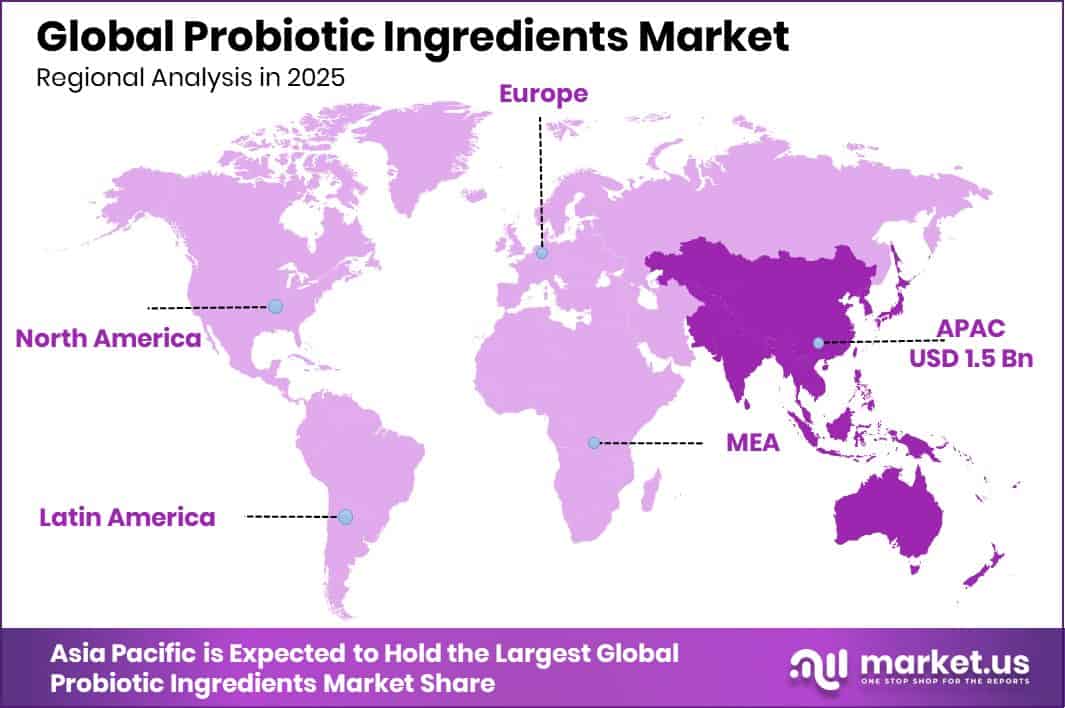
In 2025, Asia Pacific led with 34.70%, reaching USD 1.5 Bn in revenue.
In 2025, the Probiotic Ingredients Market demonstrated broad regional participation across North America, Europe, Asia Pacific, the Middle East & Africa, and Latin America, with demand patterns shaped by evolving consumer awareness around digestive wellness, functional nutrition, and preventive health products. Among these regions, Asia Pacific emerged as the dominating region, accounting for 34.70% of the global market and reaching a value of USD 1.5 Bn, supported by strong consumption of probiotic-enriched dietary supplements, fortified foods, and functional beverages across major economies in the region.
North America maintained a well-established market presence, driven by mature supplement usage trends and a strong preference for gut health solutions, while Europe continued to show steady demand through functional food and clean-label nutrition applications. The Middle East & Africa represented an emerging regional landscape, supported by increasing health awareness and the gradual expansion of nutritional product accessibility.
Latin America also contributed to overall market development, benefiting from rising consumer interest in daily wellness products. However, Asia Pacific remained the clear regional leader, with 34.70% share and USD 1.5 Bn, reinforcing its dominant position in the global probiotic ingredients market.
Key Regions and Countries
- North America
- US
- Canada
- Europe
- Germany
- France
- The UK
- Spain
- Italy
- Rest of Europe
- Asia Pacific
- China
- Japan
- South Korea
- India
- Australia
- Rest of APAC
- Latin America
- Brazil
- Mexico
- Rest of Latin America
- Middle East & Africa
- GCC
- South Africa
- Rest of MEA
Key Players Analysis
In 2025, Kerry Inc is viewed as a strategically important participant in the global probiotic ingredients market due to its strong capability in ingredient innovation, application-focused development, and broad alignment with evolving health and nutrition demands. From an analyst’s perspective, the company’s strength lies in its ability to position probiotic ingredients across diverse end-use formats while maintaining consistency in quality, formulation support, and commercial scalability. Its role is especially notable in enabling brands to build differentiated digestive wellness and functional nutrition solutions.
DSM continues to represent a high-value competitive force in 2025, supported by its scientific expertise, formulation precision, and strong focus on advanced health ingredient solutions. Analyst evaluation suggests that the company’s probiotic ingredient presence benefits from a disciplined innovation approach, allowing it to remain well aligned with premium nutrition, supplement, and wellness product development requirements. Its structured portfolio strategy strengthens confidence in long-term relevance within probiotic ingredient applications.
From an analyst viewpoint, DuPont de Nemours Inc. holds a credible and influential position in 2025 through its established expertise in specialized ingredient technologies and application-driven solutions. The company is recognized for supporting product developers with reliable probiotic ingredient integration, technical depth, and strong commercial adaptability, making it a consistently relevant name among leading global probiotic ingredient companies.
Top Key Players in the Market
- Kerry Inc
- DSM
- DuPont de Nemours Inc
- Associated British Foods plc
- Lallemand Inc
- Archer Daniels Midland
- Advanced Enzyme Technologies
- Probi AB
- Adisseo
Recent Developments
- In May 2024, DuPont de Nemours Inc announced its three-company separation plan, a major corporate restructuring move. The company works in advanced solutions across healthcare and industrial materials, and this development sharpened its focus on high-value health-related innovation platforms relevant to specialty probiotic ingredient technologies.
- In April 2024, DSM worked with Lallemand Health Solutions to launch new synbiotic probiotic solutions for early-life nutrition, supporting infant gut and immune health with science-based strains. This development strengthened DSM’s work in advanced probiotic ingredients for specialized nutrition in 2024.
Report Scope
Report Features Description Market Value (2025) USD 4.6 Billion Forecast Revenue (2035) USD 9.6 Billion CAGR (2026-2035) 7.7% Base Year for Estimation 2025 Historic Period 2020-2024 Forecast Period 2026-2035 Report Coverage Revenue Forecast, Market Dynamics, Competitive Landscape, Recent Developments Segments Covered By Form (Dry/Powder, Liquid), By Ingredients (Bacteria (Lactobacilli, Bifidobacterium, Streptococcus, Others), Yeast, Spore Formers), By Application (Food and Beverages (Dairy, Cereals, Baked Food, Others), Dietary Supplements ((Chewable and Gummies, Capsules, Powders, Tablets, Soft Gels, Others), Animal Feed, Others)) Regional Analysis North America – US, Canada; Europe – Germany, France, The UK, Spain, Italy, Rest of Europe; Asia Pacific – China, Japan, South Korea, India, Australia, Singapore, Rest of APAC; Latin America – Brazil, Mexico, Rest of Latin America; Middle East & Africa – GCC, South Africa, Rest of MEA Competitive Landscape Kerry Inc, DSM, DuPont de Nemours Inc, Associated British Foods plc, Lallemand Inc, Archer Daniels Midland, Advanced Enzyme Technologies, Probi AB, Adisseo Customization Scope Customization for segments, region/country-level will be provided. Moreover, additional customization can be done based on the requirements. Purchase Options We have three licenses to opt for: Single User License, Multi-User License (Up to 5 Users), Corporate Use License (Unlimited User and Printable PDF)  Probiotic Ingredients MarketPublished date: March 2026add_shopping_cartBuy Now get_appDownload Sample
 -
-
- Kerry Inc
- DSM
- DuPont de Nemours Inc
- Associated British Foods plc
- Lallemand Inc
- Archer Daniels Midland
- Advanced Enzyme Technologies
- Probi AB
- Adisseo
Our Clients

- 183030
- March 2026






