


Global Prebiotic Ingredient Market Size, Share, And Enhanced Productivity By Type (Inulin, Fructo-oligosaccharides (FOS), Galacto-oligosaccharides (GOS), Mannan-oligosaccharides (MOS), Others), By Source (Plant-Based Source, Dairy-Based Source, Others), By Form (Powder, Liquid), By Application (Functional Food and Beverage, Infant Formula and Baby Food, Dietary Supplements, Animal Feed, Others), By Region and Companies - Industry Segment Outlook, Market Assessment, Competition Scenario, Trends, and Forecast 2026-2035
- Published date: March 2026
- Report ID: 183147
- Number of Pages: 217
- Format:
-
keyboard_arrow_up
Quick Navigation
Report Overview
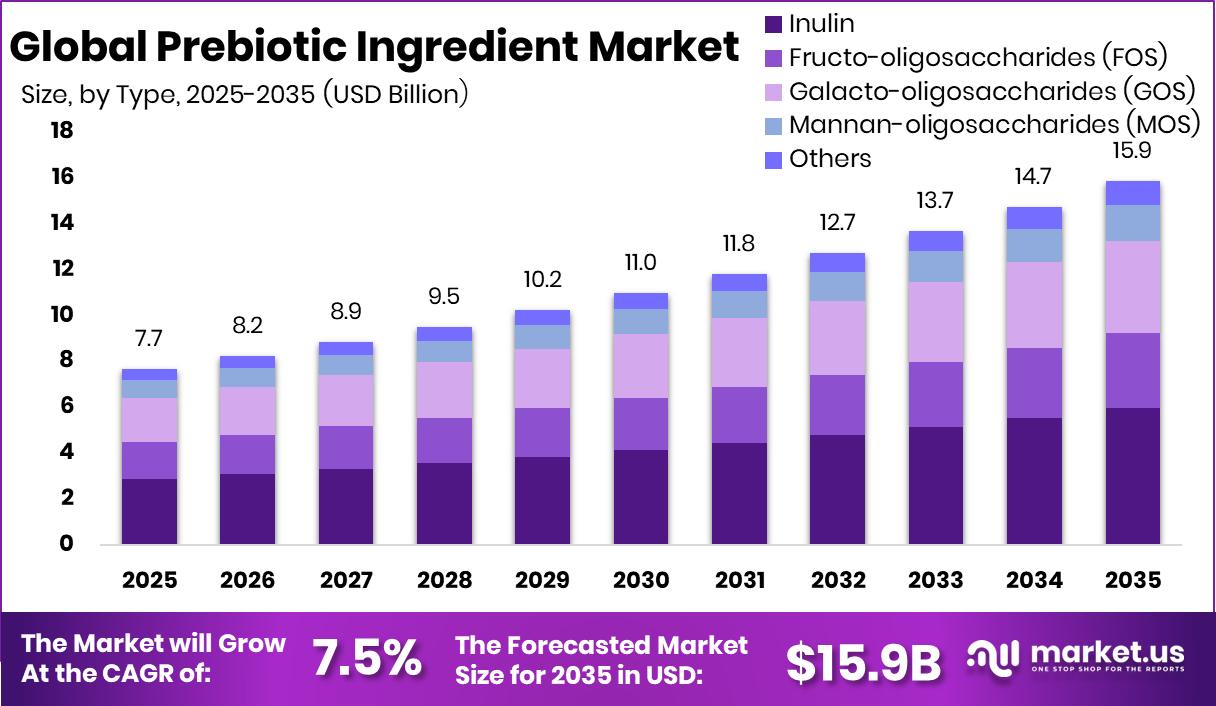
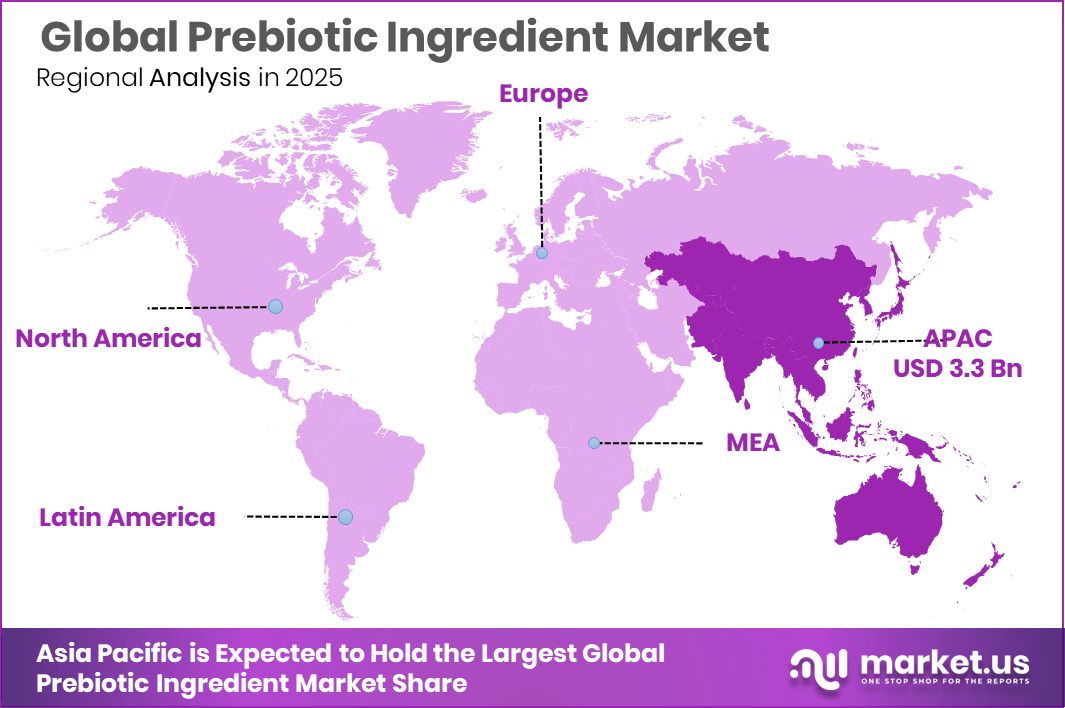
The Global Prebiotic Ingredient Market is expected to be worth around USD 15.9 billion by 2035, up from USD 7.7 billion in 2025. It is projected to grow at a CAGR of 7.5% from 2026 to 2035. Asia Pacific led globally at 43.6%, valued at USD 3.3 Bn during 2025 growth.
Prebiotic ingredients are specialized non-digestible food compounds that help stimulate the growth and activity of beneficial gut bacteria, supporting digestive balance and overall wellness. Commonly used forms include inulin, fructo-oligosaccharides (FOS), galacto-oligosaccharides (GOS), mannan-oligosaccharides (MOS), and other specialty fibers derived from plant-based, dairy-based, and alternative sources. These ingredients are widely incorporated in powder and liquid formats across functional food and beverage products, infant formula, dietary supplements, animal feed, and other nutrition-focused applications. The prebiotic ingredient market refers to the global commercial ecosystem involving the development, processing, formulation, and use of these ingredients across end-use industries.
A major growth factor for the market is the rising focus on digestive wellness, immunity, and preventive nutrition among consumers. Increasing use of gut-health solutions in daily diets, infant nutrition, and supplement routines is accelerating ingredient demand. Strong financial momentum in the wider nutrition sector further supports this trend, reflected by developments such as ARTAH Nutrition securing £2.85m investment, Evidose raising €455k for supplement validation, and Cristiano Ronaldo-backed Bioniq reaching a €75.7 million valuation, reinforcing confidence in health-oriented nutrition innovation.
Demand continues to strengthen through expanding use in functional beverages, fortified foods, and plant-based wellness drinks. Consumer preference for easy-to-consume powder supplements, digestive beverages, and performance nutrition products is widening the application scope. This is further supported by Revere’s $2M funding launch for plant-based workout drinks, showing stronger market pull for nutrition products that combine hydration, energy, and digestive support benefits in convenient formats.
The market also presents strong opportunities through regulatory and public health support, especially in food safety and advanced nutrition science. The FDA’s proposed $7.2 billion funding to enhance food safety, nutrition, and medical product safety creates a favorable environment for innovation, validation, and wider use of scientifically supported prebiotic formulations. Opportunities are particularly strong in infant nutrition, dietary supplements, and next-generation functional food systems.
From a segmental perspective, plant-based sources, powder formats, and functional food and beverage applications are expected to remain the most commercially attractive areas within the taxonomy. Their flexibility across multiple product categories, strong consumer acceptance, and alignment with preventive health lifestyles continue to create long-term expansion opportunities across the global prebiotic ingredient market.
- In March 2025, Samyang further advanced its prebiotic-related ingredient business by showcasing Fiberest resistant dextrin and sugar-reduction solutions at Natural Products Expo West 2025. This highlights continued commercial development in prebiotic fiber solutions for beverages, snacks, and reduced-sugar foods.
Key Takeaways
- The Global Prebiotic Ingredient Market is expected to be worth around USD 15.9 billion by 2035, up from USD 7.7 billion in 2025. It is projected to grow at a CAGR of 7.5% from 2026 to 2035.
- In the Prebiotic Ingredient Market, inulin leads by type, capturing 37.5% share through diverse applications.
- Within the Prebiotic Ingredient Market, plant-based sources dominate supply with 65.3% share across global demand.
- For the Prebiotic Ingredient Market, powder form prevails at 66.2%, favored for versatility and stability.
- In Prebiotic Ingredient Market applications, functional food and beverages hold 37.9% due to wellness trends.
- Asia Pacific region reached USD 3.3 Bn with 43.6% share in 2025 overall.
By Type Analysis
Prebiotic Ingredient Market sees inulin leading the type segment with 37.5% global share.
In 2025, the prebiotic ingredient market showed strong product concentration, with inulin accounting for 37.5% of total type-based demand. This leadership reflects its broad acceptance across digestive wellness, immunity support, and sugar-reduction formulations. Food manufacturers increasingly prefer inulin because it offers both functional and nutritional benefits, including fiber enrichment, texture improvement, and fat replacement in processed foods.
Its compatibility with dairy, bakery, cereals, and nutritional supplements continues to support wider commercial adoption. Rising consumer awareness around gut microbiome health has further strengthened demand, especially in premium health-focused product lines. As clean-label preferences expand globally, inulin remains the most commercially attractive prebiotic type, helping brands position products around wellness, digestive balance, and everyday preventive nutrition with strong market scalability and worldwide growth.
By Source Analysis
Plant-based sources dominate the Prebiotic Ingredient Market, accounting for 65.3% overall demand globally.
In 2025, plant-based sources represented 65.3% of the prebiotic ingredient market by source, highlighting the sector’s clear shift toward natural and sustainable raw materials. Chicory root, Jerusalem artichoke, garlic, onions, bananas, and whole grains remain the leading botanical origins supporting this dominance.
Manufacturers are increasingly leveraging plant-derived fibers to meet rising consumer expectations for vegan, non-GMO, and label-friendly nutrition solutions. This trend is especially visible in Europe and the Asia-Pacific, where natural wellness products continue to outperform synthetic alternatives.
Plant-based sourcing also strengthens supply chain storytelling, enabling brands to market traceability, sustainability, and minimal processing as key value propositions. As consumers connect digestive health with holistic nutrition, plant-origin prebiotics are expected to remain the preferred sourcing segment across global product categories.
By Form Analysis
Powder form leads the Prebiotic Ingredient Market formats, capturing 66.2% share worldwide today.
In 2025, powder formats held 66.2% of the prebiotic ingredient market by form, underlining their strong advantage in processing efficiency, shelf stability, and formulation versatility. Powdered prebiotics are widely used because they blend easily into beverages, sachets, capsules, bakery mixes, dairy products, and sports nutrition applications without significantly affecting taste or texture. Their longer storage life and ease of transport make them especially attractive for large-scale food and nutraceutical manufacturers. The format also supports precise dosage control, which is critical in clinical nutrition and fortified food development.
Growing demand for instant wellness drinks, stick packs, and supplement powders continues to reinforce this segment’s dominance. As convenience-led health consumption rises worldwide, powder remains the preferred delivery form for scalable, cost-effective market expansion.
By Application Analysis
Functional food and beverages drive the Prebiotic Ingredient Market applications with 37.9% share.
In 2025, functional food and beverage applications captured 37.9% of the prebiotic ingredient market, making this the leading application segment. Strong momentum comes from rising demand for gut-health yogurts, fiber drinks, fortified cereals, nutrition bars, infant formula, and wellness-focused dairy alternatives.
Brands are actively incorporating prebiotic ingredients into everyday consumables to align digestive support with routine eating habits rather than capsule-based supplementation alone. This application area benefits from high repeat purchase rates, easier consumer adoption, and strong retail visibility across supermarkets and online channels.
Innovation in synbiotic beverages, reduced-sugar foods, and protein-enriched snacks is further accelerating usage. As preventive nutrition becomes central to consumer lifestyles, functional foods and beverages will continue to serve as the most influential commercialization pathway globally.
Key Market Segments
By Type
- Inulin
- Fructo-oligosaccharides (FOS)
- Galacto-oligosaccharides (GOS)
- Mannan-oligosaccharides (MOS)
- Others
By Source
- Plant-Based Source
- Dairy-Based Source
- Others
By Form
- Powder
- Liquid
By Application
- Functional Food and Beverage
- Infant Formula and Baby Food
- Dietary Supplements
- Animal Feed
- Others
Driving Factors
Rising gut health awareness boosts demand
Growing consumer understanding of digestive balance, immunity, and microbiome health continues to strongly support the Prebiotic Ingredient Market. As more consumers connect gut wellness with overall health, demand for inulin, FOS, GOS, and related fibers is increasing across foods, supplements, and infant nutrition. This demand momentum is further reinforced by ecosystem-level funding activity, including French animal nutrition firm Aviwell raising EUR 11 million in investment funds for microbiota innovation, which highlights stronger confidence in microbiome-led ingredient science.
Such developments support wider commercial acceptance of prebiotic ingredients across human and animal nutrition platforms. Rising preventive healthcare preferences, coupled with better awareness of long-term digestive wellness benefits, continue to make gut-health positioning one of the strongest demand-side drivers for sustained category expansion globally.
Functional foods increase prebiotic ingredient adoption
The rapid growth of functional foods and beverages is creating a strong foundation for wider prebiotic ingredient usage across mainstream diets. Consumers increasingly prefer daily-consumption formats such as yogurts, nutrition bars, cereals, fiber drinks, and fortified snacks that offer digestive benefits without requiring separate supplementation. This shift is improving product penetration across retail shelves and wellness brands.
Supporting this broader ingredient ecosystem, the Ensus bioethanol plant reopening with a £100m funding deal reflects stronger infrastructure and processing investment across bio-based value chains, indirectly strengthening ingredient manufacturing confidence. As food producers continue to integrate health-supportive fibers into convenient products, the Prebiotic Ingredient Market benefits from higher repeat consumption, broader application diversity, and stronger acceptance among preventive nutrition consumers seeking simple everyday wellness solutions.
Restraining Factors
High production costs limit affordability
High production and extraction costs remain a key challenge for the Prebiotic Ingredient Market, especially for specialty fibers requiring controlled processing, purification, and formulation consistency. Plant-derived and dairy-based prebiotic ingredients often involve complex sourcing, advanced manufacturing, and stable quality requirements, which can raise end-product costs. This creates affordability pressure for mass-market applications and price-sensitive regions.
The issue becomes more visible in wider agricultural supply systems, as shown by drought-hit WA pastoralists seeking funds to move hay stored 1,000 km away, reflecting how logistics and environmental disruptions can sharply increase feedstock and transport expenses. Similar cost pressures can affect raw inputs used in prebiotic extraction, reducing pricing flexibility for manufacturers and limiting faster penetration into low-cost food, supplement, and feed product categories.
Raw material price volatility impacts margins
Fluctuating prices of plant roots, grains, dairy derivatives, and other feedstocks continue to pressure profitability in the Prebiotic Ingredient Market. Volatility in agricultural commodities can directly influence sourcing costs for inulin, resistant dextrins, and oligosaccharides, making long-term pricing strategies more difficult for ingredient suppliers and product formulators. Margin sensitivity becomes especially important in large-volume food and beverage contracts where pricing stability is critical.
Broader agricultural investment activity, such as MDARD surpassing $250 million in grants awarded during the Whitmer Administration, highlights how governments are increasingly supporting agricultural resilience and supply continuity. While such support helps long-term sector stability, near-term fluctuations in crop yield, transportation, and input availability still remain a major restraint affecting consistent profitability and expansion planning.
Growth Opportunity
Infant nutrition applications create new demand
Infant formula and baby food represent a major growth opportunity for the Prebiotic Ingredient Market as parents increasingly seek digestive and immune-supportive nutrition from early life stages. Prebiotic ingredients such as GOS and FOS are widely suited for infant gut microbiota development, making this segment highly attractive for premium nutrition innovation. Demand is expected to expand further as pediatric wellness and science-backed formulations gain wider consumer trust.
Public support for sustainable agricultural systems, including MDARD awarding nearly $300,000 for regenerative agriculture education and outreach, can also strengthen the long-term supply ecosystem for high-quality plant-based raw materials used in infant-safe ingredients. This creates favorable conditions for expanding specialized formulations that align with safety, purity, and digestive wellness requirements in early-life nutrition.
Plant-based supplements expand global opportunities
Plant-based supplements are creating strong global opportunities for prebiotic ingredients as consumers increasingly shift toward vegan, clean-label, and naturally derived wellness products. Inulin, resistant dextrin, and other plant fibers fit well into this trend, especially in powder-based digestive blends, daily sachets, and performance nutrition products. Their compatibility with holistic wellness positioning improves market reach across multiple age groups.
Supporting this innovation environment, the Michigan Craft Beverage Council is awarding nearly $450,000 in research and education grants, reflecting a stronger ecosystem interest in plant-based formulation science and ingredient experimentation. As more brands launch naturally positioned supplement products with digestive and immunity claims, plant-based prebiotics are expected to unlock significant expansion opportunities in both developed and emerging nutrition markets.
Latest Trends
Synbiotic beverages gain strong consumer traction
Synbiotic beverages combining probiotics and prebiotic fibers are emerging as one of the most visible trends in the Prebiotic Ingredient Market. Consumers increasingly prefer ready-to-drink wellness products that support digestion, immunity, and energy in a single convenient format. This trend is accelerating innovation in dairy alternatives, sparkling gut-health drinks, and fortified wellness tonics.
Industry-wide infrastructure support, such as MDARD awarding over $3.1 million through the Resilient Food System Infrastructure Program, further strengthens the production environment for advanced beverage systems and ingredient integration. As lifestyle nutrition moves toward multifunctional beverages, synbiotic formulations are becoming a key trend shaping product innovation pipelines and premium retail growth.
Clean-label fibers trend across formulations
Clean-label ingredient positioning is becoming a defining trend across the Prebiotic Ingredient Market, with consumers actively preferring recognizable, naturally sourced fibers in foods and supplements. Plant-based inulin, chicory fibers, and resistant dextrins are increasingly used in products marketed around transparency, minimal processing, and simple ingredient lists. This trend is especially strong in baby food, snack bars, powdered supplements, and functional beverages.
Institutional support, such as the NJEDA Board approving the second round of FEED NJ grants worth $9.3M to 23 organizations, highlights broader food-system investment momentum that can support transparent and locally resilient ingredient ecosystems. Clean-label fibers are therefore becoming central to next-generation product positioning and brand differentiation strategies.
Regional Analysis
Asia Pacific captured 43.6% share, generating USD 3.3 Bn in 2025 alone regionally.
In 2025, the Prebiotic Ingredient Market demonstrated broad regional participation across North America, Europe, Asia Pacific, the Middle East & Africa, and Latin America, with demand patterns shaped by expanding digestive health awareness and functional nutrition adoption.
Among all regions, Asia Pacific emerged as the dominating region, accounting for 43.6% of the global market and reaching a value of USD 3.3 Bn, establishing it as the leading revenue contributor in the overall regional landscape. The region’s leadership reflects stronger market penetration of prebiotic-enriched food, beverage, and supplement products, positioning it ahead of other established markets such as North America and Europe.
Meanwhile, North America and Europe continued to represent significant mature regional markets supported by established health-focused consumer bases, while Latin America and the Middle East & Africa showed growing participation within the broader global framework.
From a segmental perspective, Asia Pacific’s 43.6% share and USD 3.3 Bn valuation clearly define the center of regional market dominance, making it the primary benchmark region for competitive positioning, regional comparison, and long-term opportunity assessment across the global prebiotic ingredient industry.
Key Regions and Countries
- North America
- US
- Canada
- Europe
- Germany
- France
- The UK
- Spain
- Italy
- Rest of Europe
- Asia Pacific
- China
- Japan
- South Korea
- India
- Australia
- Rest of APAC
- Latin America
- Brazil
- Mexico
- Rest of Latin America
- Middle East & Africa
- GCC
- South Africa
- Rest of MEA
Key Players Analysis
In 2025, Tereos S.A. stands out in the global Prebiotic Ingredient Market from an analyst’s perspective as a company well-positioned for value creation through ingredient specialization and portfolio relevance. Its presence among key companies indicates strong strategic importance in supplying prebiotic solutions aligned with evolving food and nutrition applications. The company’s role is likely to remain significant where formulation consistency, scalable ingredient processing, and long-term customer relationships are central to competitive advantage. From a market viewpoint, Tereos S.A. contributes to category depth by supporting innovation-oriented ingredient demand.
Ingredion Incorporated reflects a strong competitive position through its established ingredient-focused business orientation, making it an influential participant in 2025. Analyst assessment suggests that its strength lies in addressing application-specific requirements across food and beverage manufacturers seeking functional and digestive wellness ingredients. Its inclusion among leading companies highlights its ability to support diversified formulation needs, particularly where texture, stability, and nutritional enhancement intersect. This positions the company as a strategically relevant player in expanding commercial use cases for prebiotic ingredients globally.
Archer Daniels Midland Company remains one of the most influential names among key companies in 2025 due to its scale-driven industry presence and broad ingredient ecosystem alignment. Its strategic relevance in the prebiotic ingredient space likely comes from strong integration capabilities across sourcing, processing, and downstream application support. This allows the company to remain highly competitive in serving large-volume industrial demand while strengthening its position in the global value chain.
Top Key Players in the Market
- Tereos S.A.
- Ingredion Incorporated
- Archer Daniels Midland Company
- Cargill Incorporated
- International Flavors & Fragrances Inc.
- Cosun Beet Company (Sensus B.V.)
- Kerry Group plc
- Cosucra Groupe Warcoing S.A.
- Roquette Frères S.A.
- Samyang Corporation
- Clasado Biosciences Ltd.
- AIDP Inc.
- DSM-firmenich
- Südzucker Group
Recent Developments
- In April 2025, Tereos S.A. announced a business divestment development, selling its natural products trading activities through its subsidiary Loiret & Haëntjens to Millenis. The company mainly works in sugar, starch, sweeteners, fibers, and specialty food ingredients, and this move shows a clearer focus on its core ingredient businesses, including health and nutrition-linked solutions. The sold activities covered coconut, castor oil, and molasses trading, while Tereos retained a stronger concentration on strategic ingredient platforms that align better with specialty food and prebiotic applications.
- In September 2024, Cargill Incorporated made a notable new product and solution development relevant to prebiotic and digestive health nutrition through the introduction of its Specialized Nutrition solutions at Vitafoods Asia. Cargill mainly works in food ingredients, agricultural solutions, fibers, proteins, and nutrition systems. In this development, the company showcased plant-based high-protein and fiber bars, performance powders, and functional gummies designed to support gut and digestive health, making it directly relevant to prebiotic ingredient applications.
Report Scope
Report Features Description Market Value (2025) USD 7.7 Billion Forecast Revenue (2035) USD 15.9 Billion CAGR (2026-2035) 7.5% Base Year for Estimation 2025 Historic Period 2020-2024 Forecast Period 2026-2035 Report Coverage Revenue Forecast, Market Dynamics, Competitive Landscape, Recent Developments Segments Covered By Type (Inulin, Fructo-oligosaccharides (FOS), Galacto-oligosaccharides (GOS), Mannan-oligosaccharides (MOS), Others), By Source (Plant-Based Source, Dairy-Based Source, Others), By Form (Powder, Liquid), By Application (Functional Food and Beverage, Infant Formula and Baby Food, Dietary Supplements, Animal Feed, Others) Regional Analysis North America – US, Canada; Europe – Germany, France, The UK, Spain, Italy, Rest of Europe; Asia Pacific – China, Japan, South Korea, India, Australia, Singapore, Rest of APAC; Latin America – Brazil, Mexico, Rest of Latin America; Middle East & Africa – GCC, South Africa, Rest of MEA Competitive Landscape Tereos S.A., Ingredion Incorporated, Archer Daniels Midland Company, Cargill Incorporated, International Flavors & Fragrances Inc., Cosun Beet Company (Sensus B.V.), Kerry Group plc, Cosucra Groupe Warcoing S.A., Roquette Frères S.A., Samyang Corporation, Clasado Biosciences Ltd., AIDP Inc., DSM-Firmenich, Südzucker Group Customization Scope Customization for segments, region/country-level will be provided. Moreover, additional customization can be done based on the requirements. Purchase Options We have three licenses to opt for: Single User License, Multi-User License (Up to 5 Users), Corporate Use License (Unlimited User and Printable PDF)  Prebiotic Ingredient MarketPublished date: March 2026add_shopping_cartBuy Now get_appDownload Sample
 -
-
- Tereos S.A.
- Ingredion Incorporated
- Archer Daniels Midland Company
- Cargill Incorporated
- International Flavors & Fragrances Inc.
- Cosun Beet Company (Sensus B.V.)
- Kerry Group plc
- Cosucra Groupe Warcoing S.A.
- Roquette Frères S.A.
- Samyang Corporation
- Clasado Biosciences Ltd.
- AIDP Inc.
- DSM-firmenich
- Südzucker Group
Our Clients

- 183147
- March 2026






