


Report Overview
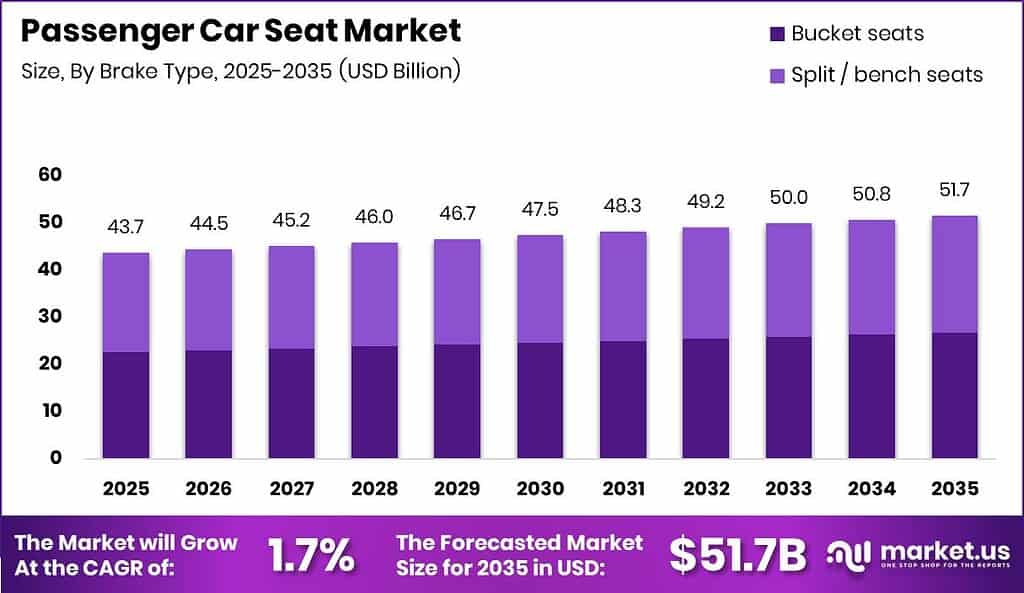
Global Passenger Car Seat Market size is expected to be worth around USD 51.7 Billion by 2035 from USD 43.7 Billion in 2025, growing at a CAGR of 1.7% during the forecast period 2026 to 2035. This steady upward trajectory reflects a market driven by rising seat content value per vehicle rather than pure unit volume growth. OEMs are embedding comfort and safety technologies into broader trim configurations, lifting per-vehicle revenue without requiring proportional increases in production output.
The passenger car seat market encompasses the design, engineering, and supply of complete seat systems installed in passenger vehicles. This includes front and rear seating assemblies across all trim levels, from standard manual configurations to fully powered, heated, ventilated, and sensor-equipped platforms. The supply chain operates through a tiered structure, with Tier-1 seat integrators sourcing frames, foam, textiles, electronics, and mechanical components from specialized sub-suppliers before delivering finished seat systems directly to OEM assembly lines.
Key Takeaways
- Market Value (2025): USD 43.7 Billion
- Forecast Value (2035): USD 51.7 Billion
- CAGR (2026 to 2035): 1.7%
- Dominant Seat Type: Bucket seats with 51.9% share
- Dominant Material: Synthetic leather with 45.8% share
- Dominant Technology: Powered seats with 26.8% share
- Dominant Position: Front seats with 55.6% share
- Dominant Region: Asia Pacific with 43.3% share, valued at USD 18.94 Billion
In April 2026, Adient acquired an automotive seating foam manufacturing facility in Romulus, Michigan, expanding its vertically integrated production capacity for passenger vehicle seating systems across North America. This move signals a broader industry shift toward supply chain internalization as tariff pressures on imported components intensify. Suppliers who control more of their input chain will carry a structural cost advantage over those relying on cross-border component sourcing.
Euro NCAP completed 108 new-car safety assessments across more than 50 brands during 2025, with seating and restraint performance included in adult and child occupant protection testing. Of those assessments, 98% of vehicles achieved at least a four-star safety rating. This near-universal compliance threshold raises the effective floor for seat engineering standards, signaling that suppliers who cannot meet four-star seating and restraint performance will be excluded from mainstream OEM programs.
Brake Type Analysis
Bucket seats dominate with 51.9% due to ergonomic fit and driver control preference.
In 2025, Bucket Seats held a dominant market position in the By Brake Type segment of the Passenger Car Seat Market, with a 51.9% share. Bucket seats deliver individualized lateral support and a driver-focused cockpit geometry that consumers consistently rank above bench configurations in perceived driving quality. According to the International Organization of Motor Vehicle Manufacturers (OICA), global passenger car production exceeded 70 million units in 2024, with crossover and SUV body styles, which standardize bucket seating, accounting for the fastest-growing share of that output. Suppliers prioritizing bucket-seat programs gain access to the highest-volume and highest-value platforms in current OEM production cycles.
Split and bench seats hold a 48.1% share, retaining a structurally significant position driven by their dominance in rear-seat configurations across sedans, MPVs, and entry-level vehicles. The International Trade Administration reports that fleet and commercial vehicle procurement, which heavily favors bench-style rear configurations for passenger capacity, represents a consistent volume segment across Latin American and Southeast Asian markets. Rear bench seating is unlikely to be displaced by bucket configurations in these applications, making it a stable but lower-growth revenue line for Tier-1 suppliers. In 2025, Adient launched the ModuGo modular seating platform, enabling automakers to configure seat structures, trim, heating, ventilation, and massage functions from a common architecture while reducing engineering complexity, which broadens applicability across both bucket and bench configurations.
Material Analysis
Synthetic leather dominates with 45.8% due to durability, cost, and cleaning advantages.
In 2025, Synthetic Leather held a dominant market position in the By Material segment of the Passenger Car Seat Market, with a 45.8% share. Synthetic leather offers OEMs a cost-effective premium appearance with measurable functional advantages over fabric, including resistance to staining, lower maintenance requirements, and compatibility with heated seat elements. According to UNIDO industrial production statistics, global output of synthetic leather materials for automotive applications exceeded 1.2 billion square meters annually by 2024, reflecting deep upstream manufacturing capacity that keeps material costs competitive. Suppliers specifying synthetic leather across mid-trim programs can capture margin without the input cost volatility associated with genuine leather sourcing.
Fabric and foam combinations retain a substantial share of the market, anchoring economy and entry-level trim configurations across high-volume production markets in Asia and Latin America. The World Bank’s manufacturing indicators show that vehicle ownership penetration in lower-income segments across South and Southeast Asia is expanding, which structurally sustains demand for fabric-seat configurations where price sensitivity outweighs premium material preferences. Fabric seat programs carry lower per-unit revenue but benefit from higher volume throughput and simpler manufacturing processes, which supports supplier margins through scale.
Genuine leather holds the smallest share across the three material categories, concentrated in premium and luxury vehicle segments where brand differentiation and occupant experience justify the higher input cost. Corporate annual reports from luxury OEMs including BMW and Mercedes-Benz confirm that genuine leather seating remains a near-universal fitment for flagship and upper-trim configurations in their global lineups. The addressable volume is structurally limited by luxury segment production scale, but per-seat revenue is the highest across all material categories, making genuine leather a margin-accretive niche for specialized seat suppliers with validated luxury program credentials.
Technology Analysis
Powered seats dominate with 26.8% due to OEM mid-trim content expansion strategy.
In 2025, Powered Seats held a dominant market position in the By Technology segment of the Passenger Car Seat Market, with a 26.8% share. Power-adjustable seating modules are now migrating from premium-only into standard mid-trim fitment across crossover and SUV platforms in North America and Europe, directly expanding the addressable volume for electronic seat components. According to OICA production data, crossover and SUV output represented more than 55% of global passenger vehicle production in 2024, and these body styles carry a structurally higher rate of power-seat fitment than sedans or hatchbacks. This content-mix shift is lifting per-vehicle seat revenue without requiring new vehicle sales growth.
Standard and manual seats retain the largest installed base by unit count, anchoring economy-segment vehicles across Asia Pacific, Latin America, and Africa where total cost of ownership determines purchasing decisions. Trade data from ITC Trade Map shows that manually adjusted seat frames remain the dominant export category for seat components shipped from lower-cost manufacturing hubs in China, India, and Thailand to assemblers across developing markets. Manual seat programs generate lower per-unit revenue but sustain high-volume throughput for suppliers with cost-competitive manufacturing footprints in these regions.
Heated seats represent the fastest-growing technology sub-segment, driven by regulatory and consumer-comfort pressures across Northern European and North American markets where cold-climate vehicle usage creates direct demand for thermal comfort. The European Automobile Manufacturers Association has documented consistent growth in optional and standard heated-seat fitment rates across its member OEM production programs since 2022. Heated seat systems add a relatively low-cost electronic module to existing seat structures, allowing suppliers to capture incremental content value on programs where full power-adjustment architecture is not yet specified.
Position Analysis
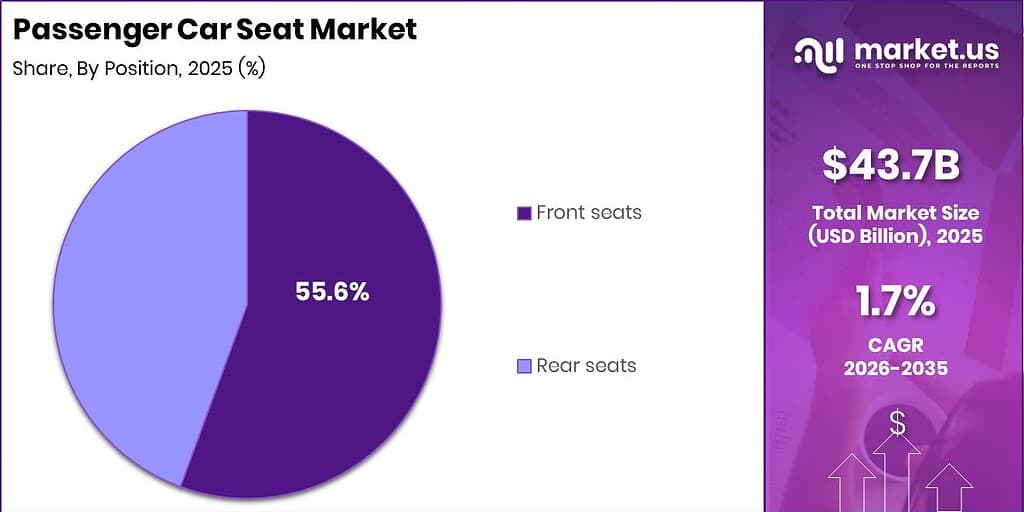
Front seats dominate with 55.6% due to direct driver-safety and comfort specification.
In 2025, Front Seats held a dominant market position in the By Position segment of the Passenger Car Seat Market, with a 55.6% share. Front seats carry the highest per-unit engineering content of any seating position, integrating power adjustment, heating, ventilation, lumbar support, side airbag housings, and increasingly, occupant-sensing electronics into a single assembly. According to IIHS regulatory filings, front-seat crashworthiness remains the primary structural test criterion governing seat homologation in North American and European markets, which requires continuous engineering investment from Tier-1 suppliers to maintain program qualification. This regulatory baseline ensures front-seat programs carry both higher engineering cost and higher contractual value than rear alternatives.
Rear seats hold a 44.4% share and represent the fastest-growing position segment, driven by OEM investment in second-row passenger comfort as automakers respond to rising ride-sharing use cases and consumer demand for rear-cabin amenities. Customs database records from major automotive producing countries show rear-seat component import and export volumes increasing at a rate exceeding front-seat components since 2023, reflecting OEM program spending shifting toward rear-seat differentiation. Suppliers who establish rear-seat comfort and safety credentials early will capture program awards before this segment attracts full competitive attention from all major Tier-1 players.
Key Market Segments
By Brake Type
- Bucket Seats
- Split / Bench Seats
By Material
- Fabric and Foam
- Synthetic Leather
- Genuine Leather
By Technology
- Standard / Manual Seats
- Powered Seats
- Heated Seats
By Position
- Front Seats
- Rear Seats
Regional Analysis
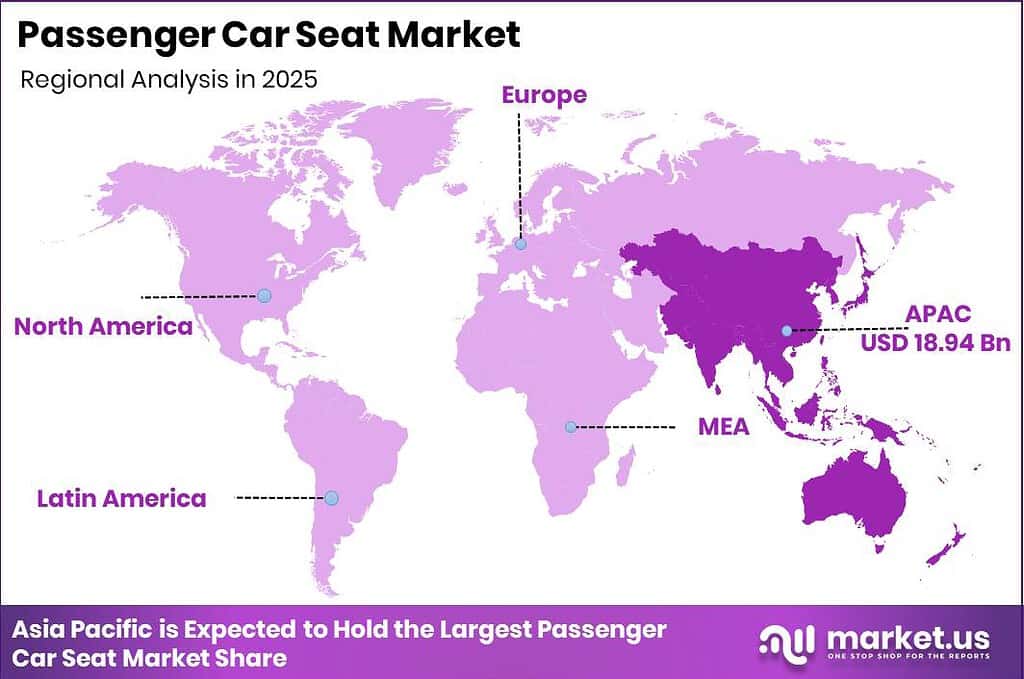
Asia Pacific Dominates the Passenger Car Seat Market with a Market Share of 43.3%, Valued at USD 18.94 Billion
Asia Pacific accounts for 43.3% of the global passenger car seat market, valued at USD 18.94 Billion in 2025. This position reflects the region’s role as the world’s largest vehicle production hub, with China, Japan, South Korea, and India collectively contributing the majority of global passenger vehicle output. As per our research, the concentration of OEM assembly plants and Tier-1 seat supplier facilities within the same regional geography compresses logistics costs and accelerates program delivery timelines. Suppliers with established manufacturing presence in Asia Pacific hold a structural sourcing cost advantage that is difficult for new entrants to replicate quickly.
In December 2025, Adient completed the acquisition of a 49% stake in SCI (Zhangjiakou) Co., Ltd., expanding its automotive seating manufacturing footprint and strengthening supply capabilities for Chinese passenger vehicle OEMs. This signals how critical regional production capacity has become for maintaining OEM program eligibility in China, where local manufacturing presence is increasingly a prerequisite for Tier-1 supplier selection. Competitors without a comparable China-based footprint face growing barriers to accessing the world’s largest single-country passenger vehicle market.
North America and Europe represent mature but structurally important regions where premium seat content and regulatory compliance requirements sustain per-vehicle seat revenue above global averages. As per our research, both regions carry higher proportions of powered, heated, and sensor-equipped seat programs relative to Asia Pacific, lifting average selling prices per seat system. Latin America, the Middle East, and Africa collectively hold a smaller share of global market value but represent the geographies where volume-driven, cost-competitive seating programs will see the most unit growth over the forecast period as vehicle ownership rates expand.
Key Regions and Countries
North America
- US
- Canada
Europe
- Germany
- France
- The UK
- Spain
- Italy
- Rest of Europe
Asia Pacific
- China
- Japan
- South Korea
- India
- Australia
- Rest of APAC
Latin America
- Brazil
- Mexico
- Rest of Latin America
Middle East and Africa
- GCC
- South Africa
- Rest of MEA
Market Dynamics
Market Opportunity Analysis - Underexploited seat positions, materials, and emerging regions signal where capital should move next.
Rear seating represents the fastest-growing position segment yet receives proportionally less engineering investment than front-seat programs. As established in the regional and segmentation analysis, rear-seat component import and export volumes have outpaced front-seat equivalents since 2023 across major automotive producing markets. New entrants who focus program development on rear-seat comfort, safety, and ventilation systems can compete for OEM awards in a sub-segment where the incumbent Tier-1 supplier base is less entrenched than in front-seat procurement.
Genuine leather seating remains confined to premium and luxury trim configurations, leaving a gap between fabric-seat economy programs and full luxury fitment. Synthetic leather’s 45.8% dominant share across mid-range vehicles reflects consumer willingness to pay for a premium material aesthetic at a lower price point. Suppliers who develop high-quality synthetic leather seat programs with validated durability and sustainability credentials can capture trade-up spending from fabric-seat buyers before genuine leather OEM programs become accessible price points in emerging markets.
South and Southeast Asia, alongside Latin America, hold structurally lower average seat content value per vehicle compared to North America and Europe. Adient’s Q1 2026 disclosure that its Pure Ergonomics architecture contains 46% recycled material, combined with its reported target that recycled components could account for up to 50% of components in newer programs compared with 0% in programs entering production during the 2020s, signals that cost-competitive sustainable seat systems are approaching feasibility for volume markets. Investors who fund localized seat manufacturing in these regions before full-scale regulatory sustainability mandates arrive will gain first-mover cost and compliance advantages.
Heated seats represent the fastest-growing technology sub-segment but remain concentrated in cold-climate markets across Northern Europe and North America. This geographic concentration means the technology is underexploited across temperate and warm-climate markets where heated-seat demand is seasonal rather than year-round. Suppliers who engineer cost-optimized heated-seat modules priced for mid-tier adoption in markets outside Northern Europe and North America can open a new volume tier without competing directly on the premium specification programs where incumbent suppliers are strongest.
Technology and Innovation Landscape - Manufacturing precision, material circularity, and assembly automation are redefining competitive cost structures
Lear Corporation’s ComfortMax automotive-seat technology achieved up to 40% faster time-to-sensation for both seat heating and ventilation when announced in February 2025. As reported by Lear Corporation, the ComfortMax modular seat design simultaneously reduced the number of parts required by up to 50%, simplifying automotive-seat assembly processes. These two gains combined mean OEMs receive a seat system with faster occupant comfort response and lower assembly complexity, directly compressing both manufacturing cost and quality-control risk on programs where ComfortMax is specified.
A 2025 peer-reviewed automotive-seat manufacturing study demonstrated that redesigning the listing fleece in rear-seat cushions reduced wrinkling defects by 60%, cutting defective pieces from 312 to 187. The same study recorded an overall seat-cushion defect rate improvement from 4.05% to 1.61% over six months, finishing below the project target of 2.0%. The redesigned fleece incorporated 15 × 5 mm rectangular slots positioned 80 mm apart to prevent deformation in curved seat cushion sections. Suppliers who adopt precision fleece geometry as a standard process control tool can reduce rework costs and improve OEM delivery quality scores simultaneously.
The same seat-manufacturing improvement program cut production cycle time by 20% and produced estimated savings of THB 852,500 through lower rework and material waste, alongside a 20% improvement in customer satisfaction. These figures confirm that process-level seat manufacturing interventions generate both financial returns and commercial relationship benefits. Manufacturers who systematically apply structured defect-reduction methods across multiple seat programs can compound these gains into a durable operational cost advantage over competitors who rely on traditional quality control approaches.
A 2026 peer-reviewed passenger-car assembly study found that Lean Six Sigma increased process-cycle efficiency from 19.9% to 66.7%, a gain of 46.8 percentage points, while cobot integration increased overall equipment effectiveness from 80% to 87.74%. Scrap generation in the same process decreased from 0.06% to 0.02%, a 66.7% relative reduction, and workstation modifications increased productivity from 40.1 to 44.0 pieces per person-hour. Suppliers who deploy collaborative robotics alongside structured process improvement frameworks will outperform on cost per unit and quality consistency across high-volume seat programs, creating barriers to competitive displacement on incumbent programs.
Drivers
The mainstreaming of powered, heated, and ventilated seating into standard mid-trim configurations is the single largest active contributor to current baseline growth, adding an estimated +0.5% to the 1.7% CAGR. Per Lear Corporation’s fiscal 2025 investor disclosures, seat-content value per vehicle rose across compact and crossover platforms as power-adjustment and thermal-comfort modules shifted from premium-only into base and mid-level trims. This content-mix shift allows Tier-1 suppliers to expand blended gross margins by an estimated 100 to 150 basis points on comfort-equipped programs without requiring new vehicle volume growth.
Stringent occupant safety regulations add an estimated +0.4% to the CAGR by requiring continuous seat engineering upgrades across all vehicle classes. IIHS reported in March 2026 that more than 70% of 85 model-year 2025 vehicles evaluated earned an acceptable or good rating in its updated moderate-overlap test, demonstrating that OEMs are investing to meet tighter second-row protection criteria. Suppliers who can deliver crashworthiness-compliant seat systems faster and at lower certification cost will capture a larger share of program awards as homologation timelines compress competitive selection windows.
| Driver | (~) % Impact on CAGR Forecast | Geographic Relevance | Impact Timeline |
|---|---|---|---|
| Mainstreaming of powered, heated & ventilated seating in mid-trims | +0.5% | Global | Short term (2 years or less) |
| Rising SUV and crossover production mix lifting seat content per vehicle | +0.4% | Asia Pacific & North America | Short term (2 years or less) |
| Stringent occupant safety and crashworthiness regulations | +0.4% | Global | Medium term (2 to 4 years) |
| EV platform expansion requiring lightweight, flat-floor seat architectures | +0.3% | Europe & China | Medium term (2 to 4 years) |
| OEM deployment of smart occupant-sensing seats in premium trims | +0.3% | North America & Europe | Short term (2 years or less) |
| Nearshoring of seat component production in North America & Europe | +0.2% | North America & Europe | Short term (2 years or less) |
Restraints
Import tariffs on seat frames, electronic control modules, and upholstery textiles are the most severe current brake on realized market growth, carrying an estimated -0.5% drag against the 1.7% baseline CAGR. Section 301 and Section 232 tariff schedules on Chinese-origin steel, aluminum, and automotive electronics, alongside reciprocal EU customs duties, have raised landed input costs for seat-frame steel and occupant-sensor modules by double-digit percentages since 2024. U.S. Census Bureau foreign trade data show imported automotive seating component values rising even as unit shipment volumes softened, indicating pure cost pass-through rather than demand expansion.
Tariff-driven cost inflation is compressing seating-segment operating margins by an estimated 150 to 250 basis points, per 2025 investor communications from Lear Corporation and Adient. Both suppliers have flagged a pause on new frame-stamping capital expenditure commitments in favor of near-term supply reallocation toward USMCA-compliant sourcing. This freeze directly limits incremental capacity expansion that would otherwise support baseline volume growth, creating a structural gap between demand potential and available supply investment across the forecast period.
| Restraint | (~) % Impact on CAGR Forecast | Geographic Relevance | Impact Timeline |
|---|---|---|---|
| Import tariffs on seat frames, electronics & upholstery | -0.5% | Global (US-China-EU) | Short term (2 years or less) |
| Elevated interest rates suppressing new vehicle sales | -0.4% | Global | Short term (2 years or less) |
| Semiconductor & electronic component shortages halting production lines | -0.3% | Asia Pacific & Europe | Short term (2 years or less) |
| High cost of advanced modular seats pricing out economy segment | -0.3% | Emerging Markets (India, LatAm, SE Asia) | Medium term (2 to 4 years) |
| Lengthy crash-test & homologation certification delaying launches | -0.2% | Global | Medium term (2 to 4 years) |
Challenges
Raw material price volatility across steel, aluminum, foam, and resin inputs generates an estimated -0.3% drag on the market’s growth ceiling. World Bank commodity price indices tracking steel and aluminum benchmarks through 2025, alongside OECD industrial input price data for polyurethane foam feedstock, confirm that seating manufacturers face structural input cost exposure tied to energy-price cycles. Seat-frame steel and foam input costs have exhibited swings of 8% to 15% within single fiscal years since 2023, per cost-of-goods disclosures from Adient and Magna International, complicating multi-year fixed-price OEM supply contracts.
Suppliers must renegotiate index-linked pricing clauses, expand hedging programs for aluminum and resin exposure, and accelerate qualification of alternative bio-based foam chemistries to mitigate ongoing margin erosion. This adjustment path stretches across the medium term as contract renewal cycles gradually absorb volatility-sharing mechanisms. Suppliers who resolve input cost exposure fastest through contract restructuring and material diversification will gain a durable margin advantage over competitors still absorbing commodity swings within fixed-price programs.
| Challenge | (~) % CAGR Friction Drag | Geographic Relevance | Mitigation Horizon |
|---|---|---|---|
| Raw material price volatility | -0.3% | Global | Medium term (2 to 4 years) |
| Mechatronics & software talent shortage | -0.2% | North America & Europe | Medium term (2 to 4 years) |
| Multi-tier textile & trim supply chain complexity | -0.2% | Asia Pacific | Medium term (2 to 4 years) |
| Lightweighting-cost-safety engineering trade-off | -0.2% | Global | Long term (4 years or more) |
| Emerging ELV circularity compliance for foam & textiles | -0.1% | Europe | Long term (4 years or more) |
Opportunities
Converting powered, heated, and massage seating functions into software-unlockable, subscription-based features represents the highest-upside untapped opportunity, with an estimated additional +0.5% upside above the 1.7% baseline if broadly executed. Hardware-only seat programs typically carry gross margins of 18% to 22% per Tier-1 supplier disclosures, whereas software-unlockable feature revenue, once the underlying actuator and sensor hardware is amortized, can carry incremental margins exceeding 60%. Suppliers and OEMs who jointly standardize actuator-to-telematics integration will capture this margin premium before right-to-repair and consumer-acceptance questions close the commercial window.
Bio-based and recycled material seating programs offer an estimated +0.3% CAGR upside, particularly in Europe where End-of-Life Vehicle circularity regulations are tightening material traceability requirements. A pilot led by Adient, JLR, and Dow incorporated 20% end-of-life polyurethane foam into newly produced automotive-seat foam, demonstrating that circular feedstock integration is technically viable at program scale. Suppliers who build validated recycled-content seat programs ahead of regulatory mandates will qualify for OEM sustainability sourcing requirements before competitors with conventional material supply chains can pivot.
| Opportunity | (~) % Potential CAGR Upside | Geographic Relevance | Execution Window |
|---|---|---|---|
| Subscription-based, OTA-unlockable seat feature monetization | +0.5% | Global | Medium term (2 to 4 years) |
| Autonomous vehicle reconfigurable lounge seating architectures | +0.4% | North America, Europe & China | Long term (4 years or more) |
| Bio-based & recycled material eco-tier premium seating | +0.3% | Europe | Medium term (2 to 4 years) |
| Biometric health-monitoring seat data monetization | +0.3% | North America & Europe | Long term (4 years or more) |
| Localized seat manufacturing roll-up in South/Southeast Asia & LatAm | +0.3% | South/Southeast Asia & Latin America | Medium term (2 to 4 years) |
Key Company Insights
Adient plc holds a commanding position in the global passenger car seat market through its accelerating investment in lightweight ergonomic seat architecture. Its Pure Ergonomics concept reduced total seat weight by 5% to 10% through optimized use of metal, foam, and trim materials, while delivering up to 60 mm of additional rear-seat legroom. In September 2025, Adient introduced the Pure Ergonomics seating concept, directly addressing OEM demand for interior space efficiency without increasing vehicle wheelbase. Competitors without a comparable lightweight redesign program face growing OEM pressure to match these space and weight benchmarks.
Lear Corporation defends its market position through operational discipline and a focus on content-value expansion within existing programs. Lear’s Seating segment recorded an operating margin of 6.2% and an adjusted operating margin of 6.7% in Q2 2026, closely matching Q2 2025 figures of 6.4% and 6.7% respectively, demonstrating margin stability in a cost-pressured environment. This resilience reflects Lear’s ability to manage input cost volatility through contract structuring rather than volume dependency. Suppliers who cannot maintain margin stability through tariff and commodity cycles will lose program credibility with cost-sensitive OEM procurement teams.
Key Players
- Adient plc
- Lear Corporation
- Forvia SE
- Toyota Boshoku Corporation
- Magna International Inc.
- Aisin Corporation
- TS Tech Co., Ltd.
- Johnson Controls International plc
- NHK Spring Co., Ltd.
- Tachi-S Co., Ltd.
- Grupo Antolin
- Grammer AG
- RECARO Automotive
- Hyundai Transys
- Sitech Sitztechnik GmbH
Recent Developments
- July 2025: Adient commercialized its 3D Mechanical Massage Seat System on the GAC Trumpchi M8 PHEV, marking the first production application of its mechanical massage seating technology for passenger vehicles.
- October 2025: Adient and Autoliv jointly unveiled a production-ready zero-gravity seating safety solution integrating Adient’s Z-Guard seat concept with Autoliv’s restraint technologies for future passenger vehicles.
- 2025: Among the 48 IIHS award recipients under 2025 criteria, 36 earned the Top Safety Pick+ designation and 12 earned Top Safety Pick, reflecting the tightened second-row seat protection requirements that reduced total qualifying models from 71 in the prior year.
Geopolitical Impact Analysis
Trade policy escalation between the United States, China, and the European Union is directly raising the cost base for passenger car seat manufacturing. According to WTO trade monitoring reports, Section 301 tariffs on Chinese-origin automotive components and reciprocal EU customs schedules have added double-digit percentage cost increases to seat-frame steel and electronic occupant-sensor module imports since 2024. The World Bank’s commodity price tracker confirms steel benchmark prices remained elevated through 2025, compounding tariff-driven landed cost increases for seat-frame steel sourced outside USMCA-compliant supply chains. Suppliers without near-shored or USMCA-compliant component sourcing face compounding cost pressure from both trade policy and raw material pricing simultaneously.
Supply chain rerouting in response to geopolitical risk is adding measurable lead-time and logistics cost to seat component delivery. According to the World Shipping Council, port congestion and rerouting away from Red Sea transit lanes added an estimated 14 to 21 days to Asia-to-Europe container shipment times through 2024 and into 2025, directly disrupting just-in-time seat component delivery schedules. UNCTAD trade and development data confirm that freight rate volatility across major automotive supply corridors increased by more than 200% at peak disruption points during this period. Seat manufacturers with geographically diversified supplier bases and regional buffer inventory strategies are absorbing these disruptions at lower cost than those dependent on single-corridor component flows.
Report Scope
| Report Features | Description |
|---|---|
| Market Value (2025) | USD 43.7 Billion |
| Forecast Revenue (2035) | USD 51.7 Billion |
| CAGR (2026-2035) | 1.7% |
| Base Year for Estimation | 2025 |
| Historic Period | 2020-2024 |
| Forecast Period | 2026-2035 |
| Report Coverage | Revenue Forecast, Market Dynamics, Market Opportunity Analysis, Technology and Innovation Landscape, Competitive Landscape, Recent Developments |
| Segments Covered | By Brake Type (Bucket Seats, Split / Bench Seats), By Material (Fabric and Foam, Synthetic Leather, Genuine Leather), By Technology (Standard / Manual Seats, Powered Seats, Heated Seats), By Position (Front Seats, Rear Seats) |
| Regional Analysis | North America (US and Canada), Europe (Germany, France, The UK, Spain, Italy, and Rest of Europe), Asia Pacific (China, Japan, South Korea, India, Australia, and Rest of APAC), Latin America (Brazil, Mexico, and Rest of Latin America), Middle East and Africa (GCC, South Africa, and Rest of MEA) |
| Competitive Landscape | Adient plc, Lear Corporation, Forvia SE, Toyota Boshoku Corporation, Magna International Inc., Aisin Corporation, TS Tech Co., Ltd., Johnson Controls International plc, NHK Spring Co., Ltd., Tachi-S Co., Ltd., Grupo Antolin, Grammer AG, RECARO Automotive, Hyundai Transys, Sitech Sitztechnik GmbH |
| Customization Scope | Customization for segments, region / country-level will be provided. Additional customization can be done based on requirements. |
| Purchase Options | We have three licenses to opt for: Single User License | Multi-User License (Up to 5 Users) | Corporate Use License (Unlimited User and Printable PDF) |





































