Market Overview
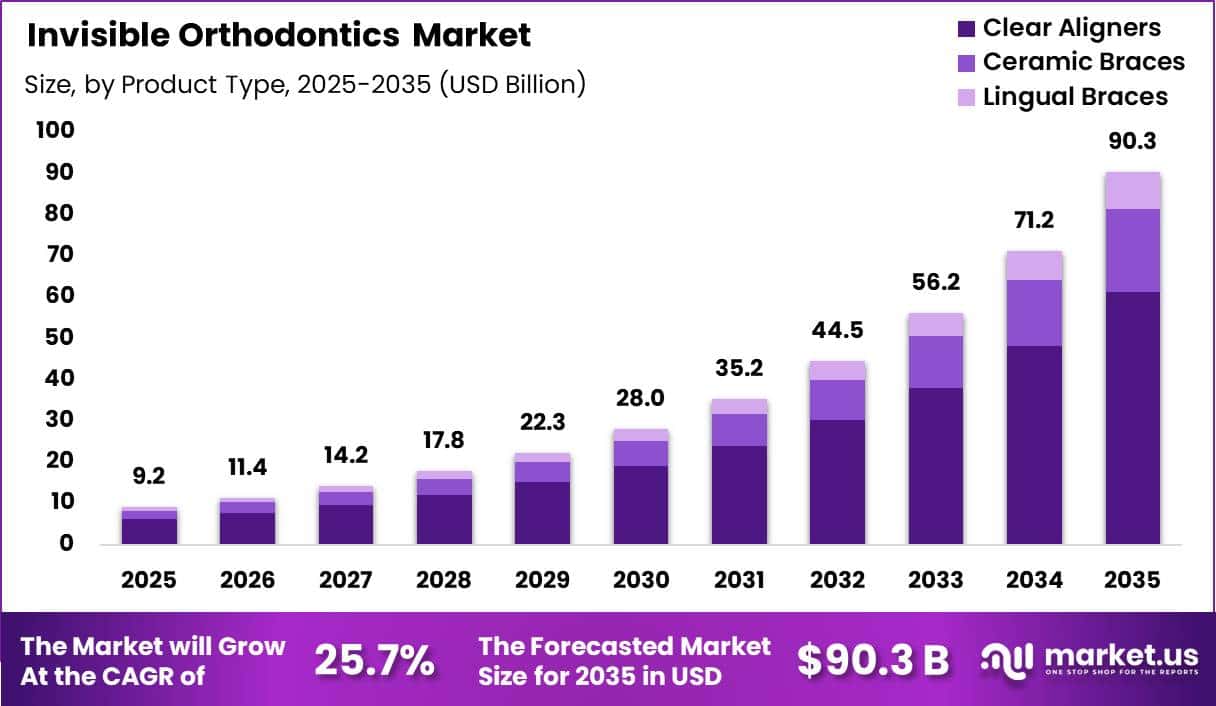
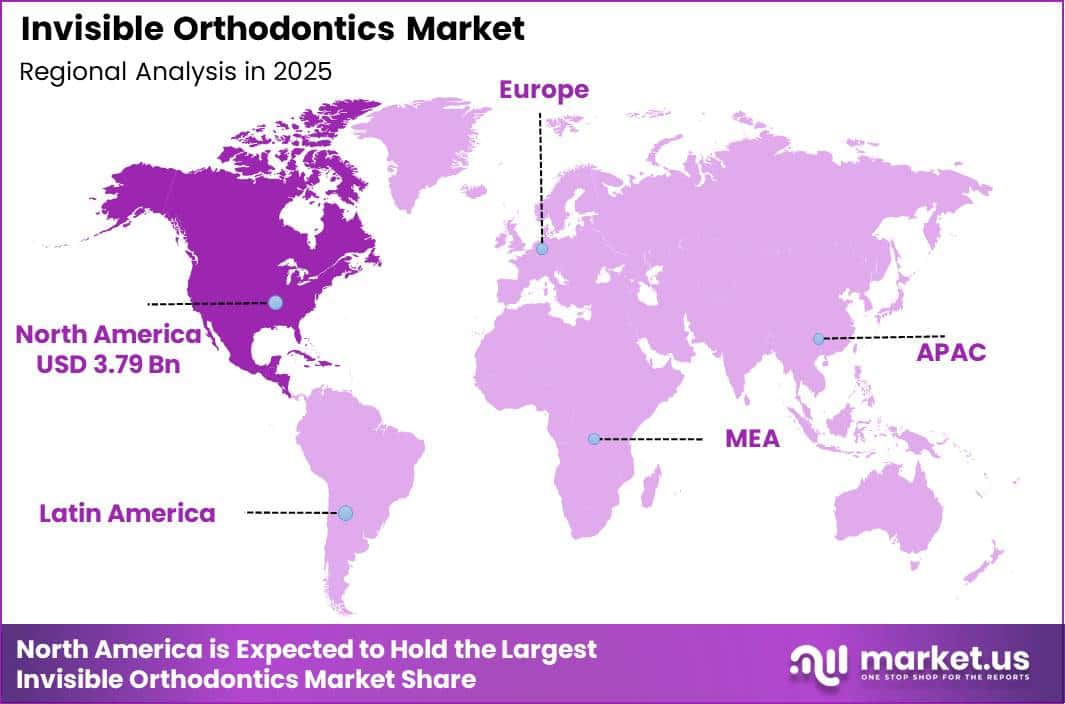
Global Invisible Orthodontics Market size is expected to be worth around US$ 90.3 Billion by 2035 from US$ 9.2 Billion in 2025, growing at a CAGR of 25.7% during the forecast period from 2026 to 2035. In 2025, North America led the market, achieving over 41.2% share with a revenue of US$ 3.8 Billion.
Invisible orthodontics is emerging as a transformative segment within global dental care, reshaping how malocclusion and dental alignment disorders are treated. The field primarily includes clear aligners and lingual orthodontic systems that offer improved aesthetics, comfort, and removability compared to traditional fixed metal braces.
Increasing preference for minimally visible dental treatments among adolescents and adults, combined with advancements in digital imaging, 3D printing, and computer-aided treatment planning, is accelerating adoption worldwide.
The demand outlook is strongly supported by the high prevalence of oral and dental conditions. The World Health Organization states that oral diseases affect approximately 3.5 billion people globally, with malocclusion ranking among the most common non-communicable oral health conditions.
In the United States, the Centers for Disease Control and Prevention reports that a significant proportion of children and adolescents experience developmental dental alignment issues that may benefit from orthodontic intervention.
Regulatory and clinical endorsement further underpins market expansion. The U.S. Food and Drug Administration has cleared multiple clear aligner systems as Class II dental devices, ensuring adherence to safety and performance standards.
Additionally, research supported by the National Institutes of Health highlights that timely orthodontic correction can lower risks of periodontal disease, tooth wear, and jaw disorders later in life.
With rising oral health awareness, supportive clinical evidence, and expanding access to digital dentistry, invisible orthodontics is positioned as a high-growth, patient-centric solution within modern preventive and corrective dental care.
Key Takeaways
- The global Invisible Orthodontics Market was valued at US$ 9.2 Billion in 2025.
- The global Invisible Orthodontics Market is projected to grow at a CAGR of 25.7% and is estimated to reach US$ 90.3 Billion by 2035.
- By Product Type, Clear Aligners dominated the market, accounting for 67.8% of the total market share in 2025.
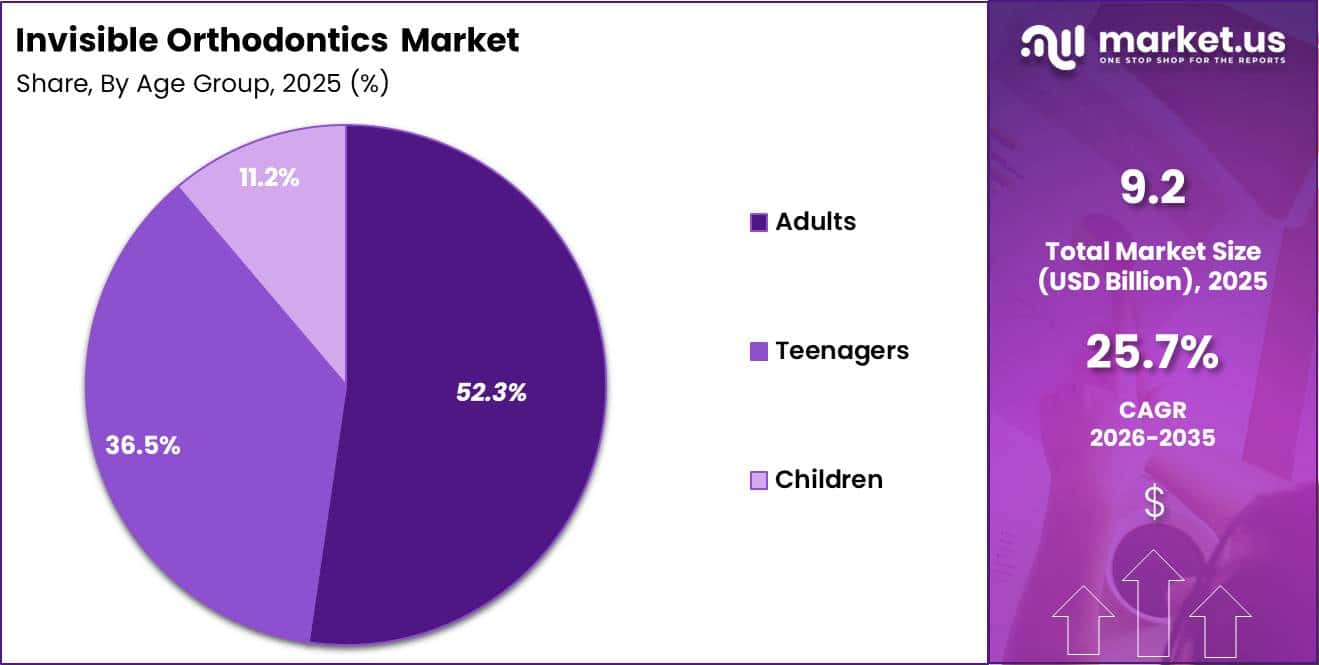
- Based on Age Group type,the Adults dominated the market, constituting 52.3% of the total market share..
- By Treatment Complexity type, Moderate Malocclusion dominated the market, constituting 45.5% of the total market share
- Among end users, Dental Clinics dominated the market, accounting for 58.7% of the total market share.
- Among regions, North America emerged as the leading regional market, contributing 41.2% of the global Invisible Orthodontics Market
revenue in 2025.
Product Type Analysis
The Invisible Orthodontics Market is segmented by product type into clear aligners, ceramic braces, and lingual braces, each addressing distinct clinical and patient-preference needs. Clear aligners dominate the market, accounting for 67.8% share in 2025, driven by their near-invisible appearance, removability, and enhanced comfort compared to traditional orthodontic solutions.
Their growing adoption is supported by advancements in digital scanning, 3D printing, and AI-driven treatment planning, which improve accuracy and reduce treatment time. Rising adult demand for aesthetic dental solutions and increased availability through orthodontic clinics further strengthen this segment’s leadership.
Ceramic braces represent 22.3% of the market, offering a balance between discretion and effectiveness. These braces appeal to patients who require fixed orthodontic correction but prefer tooth-colored materials over metal alternatives.
Meanwhile, lingual braces account for 9.9%, catering to patients seeking completely hidden treatment options. Although clinically effective, their higher cost, technical complexity, and longer adjustment periods limit widespread adoption.
Overall, product type segmentation reflects a strong shift toward patient-centric, aesthetically driven solutions, with clear aligners continuing to set the pace for innovation and market growth.
Age Group Analysis
By age group, the Invisible Orthodontics Market is segmented into adults, teenagers, and children, reflecting varying treatment objectives and compliance levels. Adults lead the market with a 52.3% share in 2025, primarily due to heightened aesthetic awareness, professional lifestyle considerations, and increasing willingness to invest in premium dental care.
Invisible orthodontic solutions, particularly clear aligners, are highly favored among adults for their discreet appearance, flexibility, and minimal disruption to daily routines. Growing prevalence of late orthodontic correction and cosmetic dentistry trends further reinforce adult dominance.
Teenagers account for 36.5% of the market, supported by rising parental awareness of dental alignment, improved affordability of invisible options, and better treatment compliance enabled by digital monitoring tools.
Teen-focused aligner solutions with durability features are expanding adoption in this segment. Children represent 11.2%, reflecting more limited use of invisible orthodontics due to mixed dentition stages and a greater reliance on early interceptive treatments.
However, technological improvements and early diagnosis are gradually increasing acceptance. Overall, age group segmentation highlights adults as the primary growth engine, while teenagers provide steady volume-driven expansion.
Treatment Complexity Analysis
Based on treatment complexity, the Invisible Orthodontics Market is segmented into mild, moderate, and severe malocclusion. Mild malocclusion accounts for 37.8% of the market in 2025, driven by strong demand for cosmetic alignment and minor corrective treatments.
Patients with mild spacing or crowding issues increasingly opt for invisible solutions due to shorter treatment durations, predictable outcomes, and lower overall costs. This segment benefits significantly from direct-to-clinic digital workflows and growing consumer awareness.
Moderate malocclusion represents the largest functional segment at 45.5%, reflecting expanded clinical capabilities of invisible orthodontic systems. Advances in material science, attachment designs, and treatment planning software have enabled aligners and discreet braces to effectively address more complex tooth movements, broadening their clinical applicability.
Severe malocclusion accounts for 16.7%, where invisible orthodontics are often used in combination with auxiliary appliances or hybrid treatment approaches. Although adoption is lower due to complexity and cost, continuous innovation is improving outcomes in this segment.
Overall, segmentation by treatment complexity underscores the expanding role of invisible orthodontics beyond purely cosmetic correction.
End User Analysis
The Invisible Orthodontics Market is segmented by end users into dental clinics, hospitals, and academic or specialty centers. Dental clinics dominate the market with a 58.7% share in 2025, owing to their specialized orthodontic expertise, high patient footfall, and rapid adoption of advanced digital technologies.
Clinics serve as the primary access point for invisible orthodontic treatments, offering personalized consultations, in-house scanning, and streamlined follow-up care. Their flexibility in pricing and treatment customization further strengthens patient preference for clinic-based services.
Hospitals account for a smaller share, primarily focusing on complex cases, multidisciplinary dental care, and patients requiring comprehensive medical oversight.
While hospitals benefit from strong infrastructure, longer treatment cycles and higher operational costs limit volume growth in invisible orthodontics. Academic and specialty centers contribute modestly, driven by training programs, clinical research, and early adoption of innovative techniques.
Overall, end user segmentation highlights dental clinics as the core growth channel, supported by rising cosmetic dentistry demand, expanding orthodontic networks, and increased consumer emphasis on convenience and specialized care.
Market Segmentations
By Product Type
- Clear Aligners
- Ceramic Braces
- Lingual Braces
By Age Group
- Adults
- Teenagers
- Children
By Treatment Complexity
- Mild Malocclusion
- Moderate Malocclusion
- Severe Malocclusion
By End User
- Dental clinics
- Hospitals
- Orthodontic Speciality Centers
- Academic and Research Institutes
Opportunity
GP-led tier-2 access model
This is an opportunity rather than a current driver because baseline growth already reflects existing orthodontist- and premium urban-clinic demand, whereas the larger uncaptured upside sits in underpenetrated secondary cities and general-practitioner conversion, where treatment access is constrained more by provider density and chair-time economics than by consumer awareness.
World Health Organization notes that oral diseases affect nearly 3.7 billion people and that most low- and middle-income countries still lack sufficient oral-health services, which implies a structurally underserved funnel for esthetic orthodontics once delivery is simplified and localized.
Align Technology ended 2025 with about 295,000 active Invisalign-trained doctors, 121,000 active iTero units, and a stated 600 million consumer opportunity, yet only 2.61 million clear-aligner cases shipped in 2025, indicating current annual penetration of well below 1% of the addressable base and a large monetizable gap if companies deploy lighter-capex GP onboarding models, scanner-sharing hubs, and lab-supported treatment planning into tier-2 networks.
A scaled GP-led model can reduce patient acquisition cost by an estimated 15% to 25% through local referral capture, lower provider onboarding cost per clinic by 20% to 30% via shared digital infrastructure, and raise regional case density enough to add roughly 2.4% points to market CAGR1
Especially in APAC emerging markets and Latin America where Straumann already reported 18.3% organic growth in Latin America and 7.3% in APAC, signaling that the geographic demand base exists even if invisible-orthodontic service coverage remains incomplete.
| Opportunity | (~) % Potential CAGR Upside | Geographic Relevance | Execution Window |
|---|---|---|---|
| GP-led tier-2 access model | +2.4% | APAC emerging, LATAM, MEA | Short term (≤ 2 years) |
| Teen interceptive expansion | +1.9% | North America, EU, APAC urban | Short term (≤ 2 years) |
| Remote monitoring subscription | +1.6% | North America core, EU, Australia | Medium term (2-4 years) |
| Hybrid ortho-restorative bundles | +1.4% | North America, EU, Japan, South Korea | Medium term (2-4 years) |
| Value-segment platform M&A | +2.1% | LATAM, Southeast Asia, CEE | Medium term (2-4 years) |
| Public-private affordability rails | +1.3% | India, Brazil, GCC, select EU | Long term (≥ 4 years) |
Driver
Adult esthetic demand and case acceptance expansion
Invisible orthodontics continues to benefit from the structural preference for low-visibility treatment among working adults and image-conscious teens, but in 2026 the more important commercial factor is not vanity alone.
It is conversion efficiency in clinics where clear aligners now sit closer to mainstream orthodontic case presentation. Expert clinical consensus published in 2025 shows clear aligner therapy has matured into a protocolized treatment pathway with explicit case grading, selection logic, and procedural guidance, reducing earlier uncertainty around who can be treated predictably.
At the same time, Align Technology stated its 2025 Invisalign DSP Touch Up cases shipped exceeded 136,000, up 35.7% versus 2024, which signals continued utilization of refinement and continuation pathways rather than one-off simple cosmetic cases.
| Driver | (~) % Impact on CAGR Forecast | Geographic Relevance | Impact Timeline |
|---|---|---|---|
| Adult esthetic demand and case acceptance expansion | +2.4% | North America core, Western Europe, Japan, South Korea, tier-1 China metros, ANZ | Short term |
| Practice digitalization and aligner workflow efficiency | +1.9% | North America core, EU, China, India private urban clinics, Southeast Asia corridors | Short term |
| Doctor-directed channel shift after DTC scrutiny | +1.6% | North America core, EU, developed APAC | Medium term |
| Adolescent and hybrid-complex case penetration | +1.7% | North America, EU, Brazil, Middle East private care, APAC urban corridors | Medium term |
| Aging population and restorative-preprosthetic orthodontics | +1.2% | Japan, Western Europe, U.S., South Korea, affluent urban APAC | Long term |
| AI-enabled diagnostics and treatment-planning productivity | +1.5% | U.S., EU, China, South Korea, digitally advanced APAC clinics | Medium term |
Challenge
Digital Workflow Fragmentation
The category depends on a multi-step digital chain, scan acquisition, cloud transfer, treatment simulation, approval loops, file conversion, manufacturing, shipment tracking, and monitoring, but many clinics and labs still run partially disconnected systems, which turns technology adoption into an operational coordination problem rather than a pure capability upgrade.
This friction is material because invisible orthodontics scales best when scanner hardware, imaging software, case-planning engines, and lab/manufacturer portals are interoperable.
Where they are not, practices absorb rework through duplicate uploads, rescans, incompatible file standards, and slower approval cycles, which can add 1 to 3 days per case at each handoff and raise remake or refinement incidence by several percentage points in high-volume settings.
The result is an estimated 1.0 percentage-point drag on attainable market CAGR, especially in fast-scaling DSO and multi-clinic environments, and the durable fix is enterprise workflow standardization, fewer software vendors, common STL/portal protocols, centralized QA dashboards, and KPI-led scanner utilization, because market expansion increasingly depends less on awareness generation and more on process reliability at scale.
| Challenge | (~) % CAGR Friction Drag | Geographic Relevance | Mitigation Horizon |
|---|---|---|---|
| Chairside Talent Bottleneck | -1.4% | North America core, EU urban clinics, APAC metro chains | Medium term (2-4 years) |
| Reimbursement-Cost Squeeze | -1.2% | U.S. PPO-heavy channels, Western Europe insured markets, LatAm private-pay middle tier | Medium term (2-4 years) |
| Digital Workflow Fragmentation | -1.0% | North America DSO networks, EU digital labs, India and Southeast Asia scaling clinics | Medium term (2-4 years) |
| Regulatory Software Revalidation | -0.8% | EU regulatory hubs, U.K. compliance channels, global exporters to Europe | Long term (≥ 4 years) |
| Lab Capacity Variability | -0.9% | APAC manufacturing corridors, North America cross-border supply lanes, EU premium cases | Short term (≤ 2 years) |
| Consumer Case Completion Risk | -1.1% | U.S. adult segment, Europe elective aesthetics, affluent APAC urban demand | Medium term (2-4 years) |
Restraints
High out-of-pocket burden
Invisible orthodontics remains heavily exposed to self-pay economics because oral healthcare is still financed predominantly through private spending in many countries, with World Health Organization explicitly noting out-of-pocket cost as a major access barrier and recent global oral-health coverage literature describing dental care as inadequately covered and largely privately financed.
That financing structure is especially restrictive for aligner therapy because it sits in the discretionary-to-elective zone rather than the urgent-care bucket, so even modest household budget stress causes treatment deferral rates to rise faster than in general dentistry.
In practical terms, when treatment tickets run into several thousand dollars and installment plans reprice upward under tighter consumer-credit conditions, clinics face lower consultation-to-case conversion, more mid-funnel drop-off, and slower uptake outside affluent urban cohorts, which justifies an estimated -2.4 percentage-point drag on 2026 baseline CAGR across North America, India, Latin America, and price-sensitive APAC demand pools.
| Restraint | (~) % Impact on CAGR Forecast | Geographic Relevance | Impact Timeline |
|---|---|---|---|
| High out-of-pocket burden | -2.4% | North America core, India, LATAM, urban APAC | Short term (≤ 2 years) |
| Orthodontist capacity bottleneck | -1.7% | U.S., Canada, EU5, ANZ, tier-1 APAC cities | Medium term (2-4 years) |
| EU MDR / regulatory overhead | -1.3% | EU, UK-linked supply chains | Medium term (2-4 years) |
| Clinical scope limitations | -1.5% | Global, strongest in emerging markets | Long term (≥ 4 years) |
| Resin, freight, and tariff volatility | -1.2% | U.S. imports, EU, APAC corridors | Short term (≤ 2 years) |
| Weak insurance reimbursement | -1.0% | U.S., India, Southeast Asia, LATAM | Long term (≥ 4 years) |
Regional Analysis
In 2025, North America led the market, achieving over 41.2% share with a revenue of US$ 3.8 Billion.
North America emerged as the leading region in the Invisible Orthodontics Market in 2025, This dominance is supported by high awareness of aesthetic dental treatments, widespread adoption of advanced orthodontic technologies, and strong purchasing power.
The region benefits from a well-established dental care infrastructure, high orthodontist density, and early acceptance of clear aligner systems among adult patients seeking discreet treatment options. Favorable reimbursement structures for dental procedures and continuous product innovation further reinforce regional growth.
Europe represents the second-largest regional market, driven by rising cosmetic dentistry demand, increasing prevalence of malocclusion, and expanding access to private dental clinics.
Countries in Western Europe show strong uptake of invisible orthodontic solutions, particularly among working professionals and older adolescents, supported by growing investments in digital dentistry.
The Asia–Pacific region is witnessing the fastest growth, fueled by a large untreated patient pool, improving dental healthcare access, and increasing disposable incomes in emerging economies. Rapid urbanization, growing aesthetic consciousness, and expansion of dental service chains are accelerating adoption rates.
Meanwhile, Latin America and the Middle East & Africa remain developing markets, with growth constrained by cost sensitivity and limited specialist availability, though gradual improvements in dental infrastructure and awareness are creating long-term opportunities for invisible orthodontics adoption.
Key Regions and Countries
North America
- The US
- Canada
Europe
- Germany
- France
- The U.K.
- Italy
- Spain
- Russia & CIS
- Rest of Europe
Asia Pacific
- China
- India
- Japan
- South Korea
- ASEAN
- Australia & New Zealand
- Rest of Asia Pacific
Middle East & Africa
- GCC
- South Africa
- Rest of Middle East & Africa
Latin America
- Brazil
- Mexico
- Rest of Latin America
Key Player Analysis
The invisible orthodontics market is moderately consolidated, with competition shaped by a mix of global dental technology leaders and specialized, innovation-focused aligner manufacturers.
The market is transitioning from high-growth to early maturity, supported by rising acceptance of clear aligners, expanding adult patient demand, and deeper integration of digital orthodontic workflows. Competitive differentiation increasingly centers on treatment predictability, software-driven planning, materials innovation, and scalable manufacturing rather than pricing alone.
From a structural standpoint, players operate across three strategic tiers. Large multinational dental innovators such as Dentsply Sirona, 3M, and Henry Schein, Inc. anchor the market with broad portfolios, global distribution, and strong clinician relationships.
Specialty orthodontic manufacturers—including Align Technology, Inc., Institut Straumann AG, Ormco Corporation, TP Orthodontics, Inc., SCHEU DENTAL GmbH, G&H Orthodontics, DB Orthodontics, Inc., and K Line Europe GmBH—play a critical role in advancing clinical performance and practitioner-focused solutions.
Innovation-driven and digitally native players, such as Angel Aligner, SmarTee, SmileDirectClub, ClearPath Healthcare Services Pvt Ltd, and Orthodontics SDC, compete through software-enabled treatment planning, streamlined workflows, and scalable service models.
Across all tiers, competitive strategies emphasize sustained R&D investment, partnerships with clinics and labs, product pipeline expansion, and ecosystem-based competition that integrates diagnostics, digital planning, and precision orthodontics.
Top Key Players
- Angel Aligner
- SmarTee
- Dentsply Sirona
- Institut Straumann AG
- SCHEU DENTAL GmbH
- Ormco Corporation (Envista)
- Henry Schein, Inc.
- SmileDirectClub
- Align Technology, Inc.
- TP Orthodontics, Inc.
- K Line Europe GmBH
- 3M
- ClearPath Healthcare Services Pvt Ltd
- DB Orthodontics, Inc.
- G&H Orthodontics
- Orthodontics SDC
Recent Developments
- In July 2025, Align Technology launched Invisalign® System with Mandibular Advancement featuring occlusal blocks for Class II skeletal correction, expanding clear aligner indications for growing patients.
- In October 2025, Straumann Group announced strategic partnerships with Smartee and Dental Monitoring to strengthen ClearCorrect digital orthodontic ecosystem.
- In February 2026, Dentsply Sirona and Dreve advanced evaluation of Primeprint Direct Aligner resin for potential integration into 3D-printed aligner workflows.
Report Scope
| Report Features | Description |
|---|---|
| Market Value (2025) | US$ 9.2 Billion |
| Forecast Revenue (2035) | US$ 90.3 Billion |
| CAGR (2026-2035) | 25.7% |
| Base Year for Estimation | 2025 |
| Historic Period | 2020-2024 |
| Forecast Period | 2026-2035 |
| Report Coverage | Revenue Forecast, Market Dynamics, Competitive Landscape, Recent Developments |
| Segments Covered | By Product Type(Clear Aligners ,Ceramic Braces ,Lingual Braces) By Age Group(Adults ,Teenagers ,Children) By Treatment Complexity(Mild Malocclusion ,Moderate Malocclusion ,Severe Malocclusion) By End User(Dental Clinics ,Hospitals ,Orthodontic Specialty Centers ,Academic & Research Institutes ,Others) |
| Regional Analysis | North America – The US, Canada; Europe – Germany, France, U.K., Italy, Spain, Russia & CIS, Rest of Europe; Asia Pacific – China, India, Japan, South Korea, ASEAN, Australia & New Zealand, Rest of Asia Pacific; Middle East & Africa – GCC, South Africa, Rest of Middle East & Africa; Latin America – Brazil, Mexico, Rest of Latin America |
| Competitive Landscape | Angel Aligner ,SmarTee ,Dentsply Sirona ,Institut Straumann AG ,SCHEU DENTAL GmbH ,Ormco Corporation (Envista) ,Henry Schein, Inc. ,SmileDirectClub ,Align Technology, Inc. ,TP Orthodontics, Inc. ,K Line Europe GmBH ,3M ,ClearPath Healthcare Services Pvt Ltd ,DB Orthodontics, Inc. ,G&H Orthodontics ,Orthodontics SDC |
| Customization Scope | Customization for segments, region/country-level will be provided. Moreover, additional customization can be done based on the requirements. |
| Purchase Options | We have three licenses to opt for: Single User License, Multi-User License (Up to 5 Users), Corporate Use License (Unlimited User and Printable PDF) |