


Global Organ Transport Devices Market By Product (Transport Devices, Disposables, Cold Storage Solutions, Perfusion Solutions and Slush Preparation Solutions), By Organ Type (Kidney, Liver, Heart, Lung, Pancreas and Other organs), By End-User (Hospitals, Transplant Centers, and Organ Procurement Organizations (OPOs)), Region and Companies – Industry Segment Outlook, Market Assessment, Competition Scenario, Trends and Forecast 2025-2034
- Published date: Dec 2025
- Report ID: 170461
- Number of Pages: 226
- Format:
-
keyboard_arrow_up
Quick Navigation
Report Overview
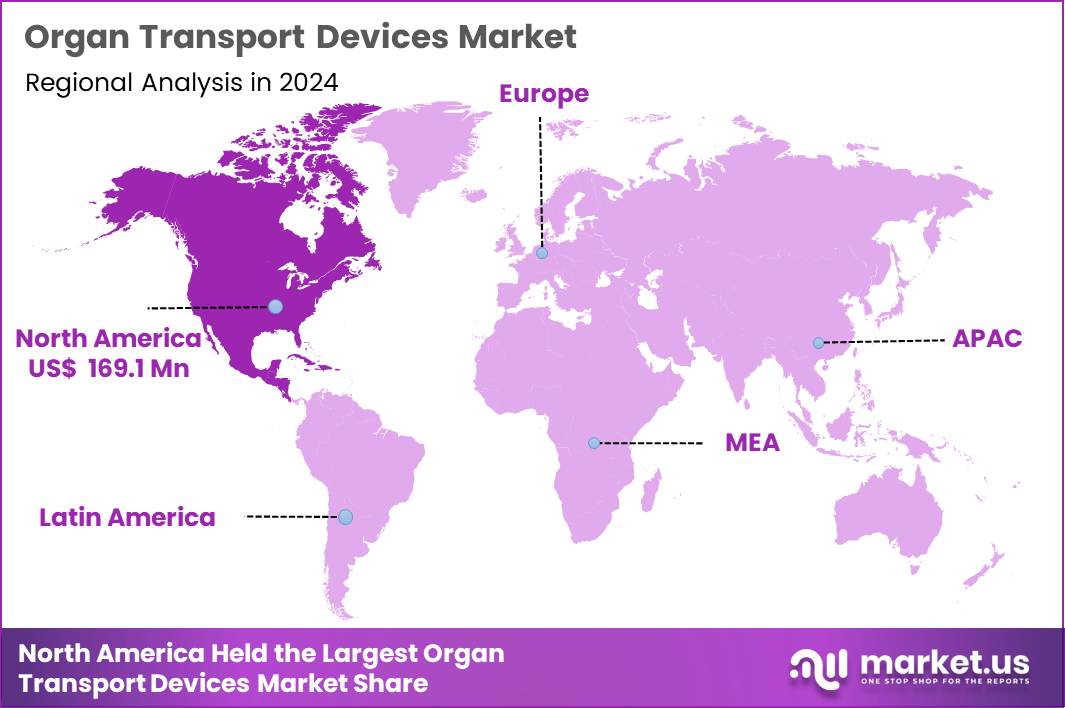
The Global Organ Transport Devices Market size is expected to be worth around US$ 717.2 Million by 2034 from US$ 440.3 Million in 2024, growing at a CAGR of 5.0% during the forecast period 2025 to 2034. In 2024, North America led the market, achieving over 38.4% share with a revenue of US$ 169.1 Million.
Organ transport devices are specialized medical systems designed to preserve donor organs during transit from donor to recipient, extending viability beyond traditional ice-based cold storage methods. They maintain optimal conditions like temperature, oxygenation, and perfusion with nutrient-rich fluids to minimize cellular damage and improve transplant success rates.
These devices fall into warm perfusion (normothermic) and advanced cold storage categories. Warm systems perfuse organs with oxygenated blood at body temperature, allowing continuous monitoring and function during transport. Cold devices use controlled cooling and preservation solutions in insulated containers to reduce metabolic activity.
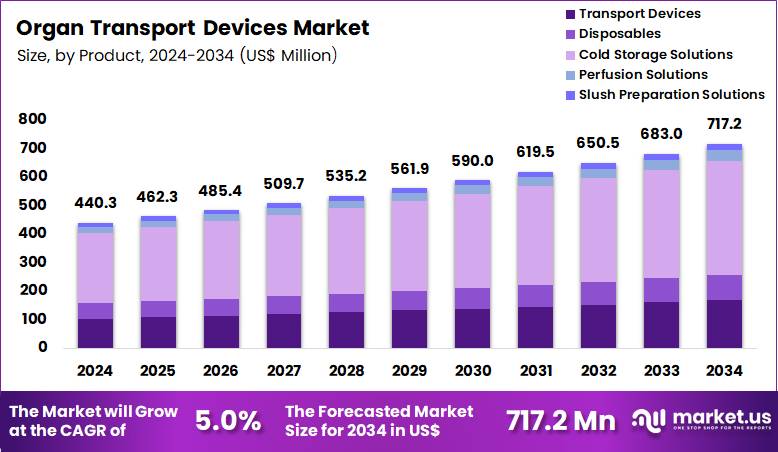
The Organ Transport Devices Market represents a critical component of global transplant medicine, supporting safe, temperature-controlled, and physiologically stable movement of donor organs from retrieval sites to transplant centers. As countries report rising transplantation volumes such as more than 144,000 solid-organ transplants globally each year demand for reliable transport systems continues to strengthen.
Advanced technologies such as portable preservation devices, ice-cold storage units, and machine-perfusion systems enhance graft quality by reducing ischemic injury and extending viable transport windows. Transport solutions now routinely integrate real-time temperature logging, sterile chamber design, and shock-resistant insulation to maintain organ integrity across long distances, including air-ambulance and ground-logistics operations. Major device manufacturers have introduced organ-specific carriers for heart, lung, liver, and kidney transport, reflecting the complexity and precision required to maintain organ viability during transit.
Growing transplant infrastructure in North America, Europe, and Asia Pacific fuels adoption of modern transport devices. For example, the US consistently performs over 25,000 kidney transplants annually, creating strong utilization of kidney-specific carriers. Meanwhile, machine-perfusion systems are increasingly used in liver and heart transports to maintain continuous oxygenation and nutrient supply.
Innovations such as hypothermic and normothermic perfusion broaden preservation windows and enable marginal organs to be evaluated before transplant. Manufacturers such as Paragonix Technologies and XVIVO have accelerated device enhancements, launching organ-specific transport systems that improve preservation consistency and reduce variability across transplant networks.
In June 2023, OrganOx expanded its clinical partnerships for its normothermic liver perfusion device, enabling extended preservation times that support longer transport distances and improved organ evaluation.
Key Takeaways
- In 2024, the market generated a revenue of US$ 440.3 Million, with a CAGR of 5.0%, and is expected to reach US$ 717.2 Million by the year 2034.
- The Product segment is divided into Transport Devices, Disposables, Cold Storage Solutions, Perfusion Solutions, and Slush Preparation Solutions, with Quantitative taking the lead in 2024 with a market share of 64.7%
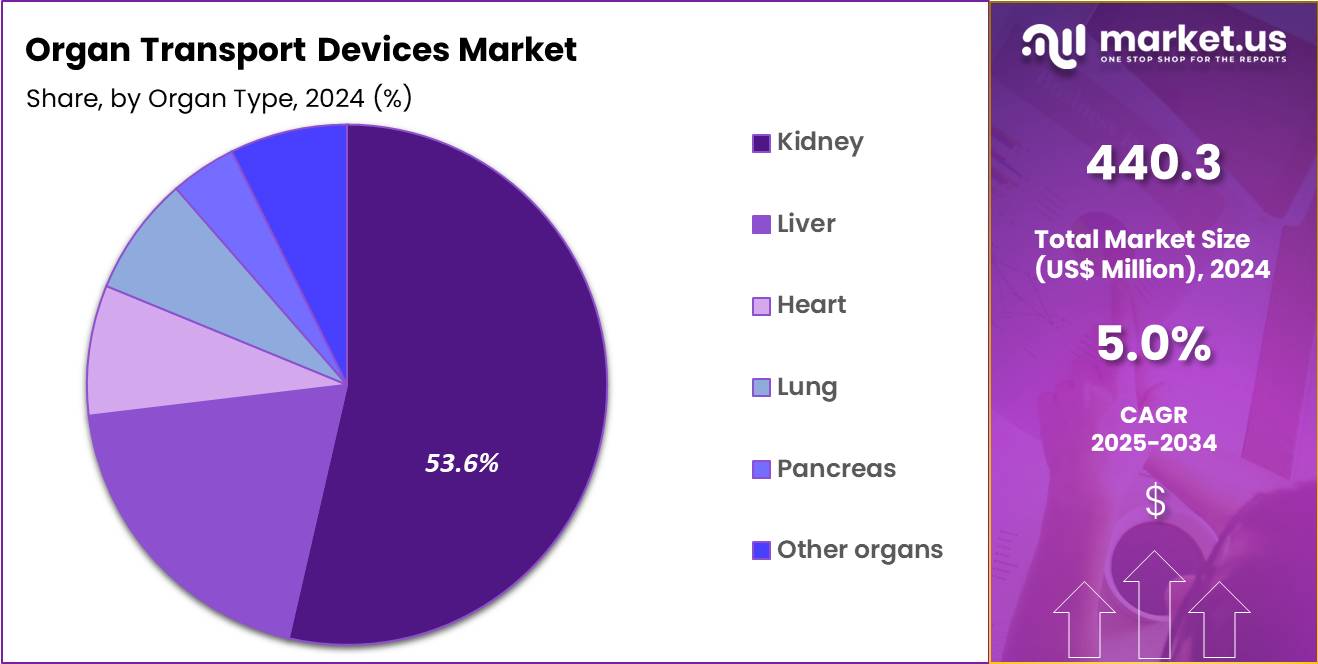
- The Organ Type segment is divided into Kidney, Liver, Heart, Lung, Pancreas, and Other organs, with Kidney taking the lead in 2024 with a market share of 53.6%
- The End-User segment is divided into Hospitals, Transplant Centers, and Organ Procurement Organizations (OPOs), with Transplant Centers taking the lead in 2024 with a market share of 58.3%
- North America led the market by securing a market share of 38.4% in 2024.
Product Analysis
Cold Storage Solutions remain heavily used dominating the market with 55.9% market share, especially in kidney and liver transports. Standardized cold-storage containers filled with preservation solutions continue to support a majority of global transplants due to their reliability and ease of use. Static cold storage is routinely applied to kidney retrievals that travel between regions, sometimes exceeding 18–24 hours of preservation time.
Their broad compatibility across organ types sustains their usage. In January 2023, Organ Recovery Systems implemented software upgrades across its LifePort Kidney Transporter fleet to improve temperature stability reporting and compliance tracking during procurement operations. In March 2023, Bridge to Life introduced next-generation cold-storage carriers designed for kidney and liver transport, incorporating durability improvements and enhanced insulation for inter-regional transfers.
Transport Devices due to their universal requirement across all organ types and their essential role in maintaining hypothermic conditions during long-distance transfer. These devices employ multi-layer insulation, sterile inner chambers, and temperature-monitoring capabilities. For example, heart and lung transports often require secure stabilization to protect against vibration and pressure fluctuations during air transit. Portable devices with rigid exteriors and gel-based cooling systems are widely used in national donor-sharing networks. As transplant volumes rise, hospitals purchase multiple device units for parallel transport coordination.
Disposables such as sterile bags, tubing sets, cannulas, and temperature-stable wraps support routine transport workflows. Transplant teams rely on single-use consumables to maintain sterility and reduce contamination risk. These items are frequently replenished due to procurement-center protocols that mandate one-time use to mitigate infection risks.
Perfusion Solutions support machine-perfusion devices increasingly used for heart, lung, and liver preservation. Solutions enriched with oxygen carriers, electrolytes, and metabolic substrates help maintain organ viability during normothermic or hypothermic perfusion. Clinical studies show that perfusion-preserved livers demonstrate improved graft survival compared to traditional cold storage.
Organ Type Analysis
Kidney leads the market owing to the highest transplant frequency worldwide with accountancy of 53.6% market share. Many countries report kidney transplant volumes exceeding all other organs combined. Transport devices tailored for kidneys offer prolonged cooling stability and ease of use during long-distance transfers. Cold-storage carriers maintain low metabolic rates and protect renal tissue integrity.
Liver transport requires stringent preservation due to high sensitivity to warm ischemia. Specialized carriers with reinforced insulation and perfusion-compatible chambers are used increasingly. Machine-perfusion devices for livers help maintain continuous oxygenation, enabling evaluation of marginal organs before transplantation.
In March 2023, Bridge to Life introduced next-generation cold-storage carriers designed for kidney and liver transport, incorporating durability improvements and enhanced insulation for inter-regional transfers.
Heart transport demands the most precise conditions due to extremely short acceptable transport times. Transport devices for hearts are engineered with rigid exteriors, anti-rotation mounts, and gel-cooling systems to minimize mechanical stress during helicopter or aircraft transfer. Emerging perfusion systems allow continuous beating-heart preservation. In 2024, Waters Medical Systems introduced improved insulated transport systems targeted for heart and kidney transfers, optimizing cooling uniformity during long-distance logistics.
Lung transport utilizes insulated carriers with controlled cooling, often accompanied by ventilation and perfusion technologies. Lung grafts are highly susceptible to edema, so dedicated devices ensure stable temperature and positioning.
Pancreas transport relies on cold-storage systems with compartmentalized chambers to prevent accidental compression and ensure uniform cooling. Pancreas transplants remain less frequent but require specialized handling.
Other organs, such as intestines, require strict preservation discipline due to high metabolic rates. Transport systems with enhanced cooling chambers and sterile handling accessories support these procedures.
End-User Analysis
Transplant Centers dominated the market with 58.3% market share in 2024 as these perform high-complexity organ surgeries and maintain specialized procurement teams. These centers frequently adopt advanced technologies, including perfusion devices and organ-specific transport systems, to support multi-organ transplant programs. Their high specialization leads to fast adoption of innovative transport solutions.
Hospitals also remain the major segment, as transplant surgeries are concentrated in tertiary care facilities equipped with dedicated transplant units. Large hospitals maintain multiple device inventories to coordinate simultaneous organ arrivals. Retrieval teams use hospital-supplied carriers during donor-site procurement.
Organ Procurement Organizations (OPOs) manage donor identification, organ retrieval, and transport logistics. They coordinate multi-state transfers and frequently utilize high-performance transport devices to ensure organ safety. OPOs rely on standardized, regulatory-approved carriers to comply with national transplant protocols.
Key Market Segments
By Product
- Transport Devices
- Disposables
- Cold Storage Solutions
- Perfusion Solutions
- Slush Preparation Solutions
By Organ Type
- Kidney
- Liver
- Heart
- Lung
- Pancreas
- Other organs
By End-User
- Hospitals
- Transplant Centers
- Organ Procurement Organizations (OPOs)
Drivers
Rise in global solid-organ transplant volumes
The primary driver of the Organ Transport Devices Market is the continuous rise in global solid-organ transplant volumes, which exceeded more than 144,000 procedures annually in recent international registry reports. Kidney transplants remain the most frequent, performing several times higher than liver, heart, and lung transplants combined, creating persistent demand for reliable transport devices.
Increasing cross-border and inter-regional sharing of organs under national allocation systems also elevates the need for temperature-stable carriers capable of maintaining safe cold-ischemia times. For example, the United States frequently conducts multi-state transports each week, with organs sometimes traveling hundreds of miles under strict time constraints.
Clinical findings show that every additional hour of ischemia significantly increases the risk of early graft dysfunction in livers and hearts, prompting hospitals to adopt more advanced insulated containers and perfusion-capable transport systems. Moreover, the emergence of marginal donors and expanded-criteria donor programs requires superior preservation quality to minimize deterioration during transport.
Machine perfusion both hypothermic and normothermic has gained traction, with studies demonstrating improved post-transplant outcomes when continuous perfusion is used. Government investments in transplant infrastructure in countries such as India, China, and Brazil further amplify demand by increasing both retrieval and transplant activity across public hospitals and procurement organizations.
Restraints
High device costs, complex operational requirements and infrastructure disparities
A major restraint in this market stems from high device costs, complex operational requirements, and infrastructure disparities between developed and emerging regions. Advanced perfusion-based systems despite their clinical advantages require specialized training, high-quality consumables, and stable power sources, making adoption challenging for many transplant centers. In low- and middle-income regions where transplant activity is growing but budgets remain constrained, hospitals often continue to rely solely on traditional cold-storage methods due to affordability limitations.
Another challenge is preservation variability: clinical studies show that extended cold ischemia correlates strongly with delayed graft function, particularly in kidney and liver transplants, placing pressure on transport teams to minimize transit time. Regions with limited air-ambulance services or slow cross-border clearance procedures risk exceeding recommended ischemic thresholds.
Additionally, donor-organ logistics are vulnerable to unpredictable factors such as weather disruptions, aircraft unavailability, and ground-transport delays. These risks have been highlighted in reports where heart and lung transports occasionally encountered unforeseen delays, resulting in graft discard. The lack of standardized temperature-monitoring protocols across some procurement networks also contributes to inconsistent outcomes.
Opportunities
Rapid advancement and adoption of machine-perfusion technologies
The largest opportunity in the Organ Transport Devices Market lies in the rapid advancement and adoption of machine-perfusion technologies, which are transforming preservation standards for liver, heart, and lung transplants. Normothermic perfusion systems, for example, allow organs to function at near-physiological temperatures during transport, enabling clinicians to assess viability and reduce discard rates.
Studies have reported significant improvements in graft survival when perfusion platforms are used, especially for marginal organs. This creates substantial commercial potential for manufacturers developing organ-specific perfusion devices and associated consumables. Another major opportunity arises from the expansion of national deceased-donor programs in Asia Pacific, Latin America, and the Middle East.
Countries such as China and India have reported strong growth in transplant procedures following government-led donation reforms, increasing demand for high-quality transport carriers. Partnerships between medical-device companies and Organ Procurement Organizations (OPOs) present additional growth avenues, as OPOs manage thousands of retrievals annually and require standardized, large-scale procurement of transport systems. Digital innovation also presents opportunities, with growing interest in transport devices equipped with GPS, real-time temperature tracking, and shock-monitoring sensors.
Impact of Macroeconomic / Geopolitical Factors
Macroeconomic and geopolitical conditions exert significant influence on the Organ Transport Devices Market by shaping procurement budgets, logistics reliability, and the availability of essential preservation materials. Economic slowdowns often constrain hospital capital spending, delaying the adoption of advanced transport devices such as perfusion-based platforms, which require higher upfront investment.
Inflation and rising global energy costs can increase the price of cooling agents, sterile packaging materials, and insulated polymers used in transport carriers. For example, fluctuations in petroleum-derived raw materials have periodically raised manufacturing costs for medical-grade plastics and insulation foams.
Geopolitical tensions, especially those affecting major air routes, can disrupt organ transport schedules, as organs frequently rely on commercial and chartered flights for rapid interstate or international transfer. During global aviation disruptions, some regions reported delays in heart and lung shipments, where even short setbacks can lead to graft discard. Supply-chain fragmentation also impacts availability of perfusion fluids and specialized sterile disposables, as many components are manufactured across multiple countries.
Regulatory shifts arising from geopolitical events can complicate cross-border organ transport protocols, requiring additional approvals or documentation. Conversely, heightened global focus on healthcare resilience—such as government-funded transplant infrastructure programs—helps offset some volatility by prioritizing uninterrupted organ transportation capacity.
Latest Trends
Transition from traditional static cold storage toward technology-driven preservation methods
A defining trend in the Organ Transport Devices Market is the transition from traditional static cold storage toward dynamic, technology-driven preservation methods. Machine perfusion hypothermic, subnormothermic, and normothermic is rapidly gaining mainstream adoption as clinical evidence increasingly shows reduced organ injury and improved post-transplant outcomes. For instance, normothermic liver perfusion trials have demonstrated extended preservation times beyond conventional limits, allowing organs to be transported across longer distances.
Another trend is the development of organ-specific transport systems, such as heart stabilization chambers, lung carriers with integrated positioning supports, and kidney cold-storage devices designed for extended ischemia tolerance. These specialized devices address the unique requirements of each organ type.
Digitalization is also reshaping the market: transport containers now incorporate embedded sensors that record temperature, humidity, vibration, and orientation throughout transit, providing full traceability and compliance documentation. Transplant teams increasingly rely on mobile dashboards to monitor transport conditions in real time. Lightweight composite materials and reusable container designs are trending as hospitals seek long-term cost efficiency.
Regional Analysis
North America is leading the Organ Transport Devices Market
North America remains the leading region in the Organ Transport Devices Market due to its advanced transplant infrastructure, high donation rates, and strong coordination across Organ Procurement Organizations (OPOs). The US alone performs tens of thousands of kidney, liver, heart, and lung transplants annually, generating continuous demand for high-performance transport carriers.
OPOs operate structured retrieval networks that frequently manage multi-state organ transfers using air ambulances, commercial flights, and specialized logistics teams. Regulatory guidance from organizations such as UNOS and Health Canada supports standardized transport protocols, driving consistent adoption of insulated containers and real-time temperature-monitoring systems.
Research hospitals across the region are early adopters of perfusion technologies, using machine-perfusion platforms to enhance viability of marginal organs and extend transport times. North America also benefits from strong manufacturer presence, enabling rapid device innovation and reliable supply chains.
The Asia Pacific region is expected to experience the highest CAGR during the forecast period
Asia Pacific is the fastest-growing region in the Organ Transport Devices Market due to rapid expansion of transplant programs, rising incidence of organ failure, and significant government investment in healthcare infrastructure. Countries such as China, India, South Korea, and Japan have strengthened deceased-donor systems and broadened transplant eligibility, increasing retrieval and transport activity. Major hospitals are upgrading procurement workflows with advanced insulated carriers and adopting perfusion systems for liver and heart preservation.
Growing intercity and interprovincial transport of organs often across long distances heightens the need for reliable temperature-controlled devices. Public health initiatives promoting organ donation have resulted in steady year-over-year increases in transplant volumes, particularly for kidneys and livers. Domestic manufacturers are emerging in China and India, improving access to high-quality transport solutions at competitive prices.
Key Regions and Countries
North America
- US
- Canada
Europe
- Germany
- France
- The UK
- Spain
- Italy
- Russia
- Netherland
- Rest of Europe
Asia Pacific
- China
- Japan
- South Korea
- India
- Australia
- New Zealand
- Singapore
- Thailand
- Vietnam
- Rest of APAC
Latin America
- Brazil
- Mexico
- Rest of Latin America
Middle East & Africa
- South Africa
- Saudi Arabia
- UAE
- Rest of MEA
Key Players Analysis
Key players in the market include XVIVO Perfusion AB, Paragonix Technologies, Dr. Franz Köhler Chemie GmbH, Bridge to Life Ltd, OrganOx Ltd, TransMedics, Terumo Corporation, Medtronic, BioLife Solutions, Organ Recovery Systems, Preservation Solutions Inc, Transplant Biomedicals, CryoLife, and Others
XVIVO Perfusion AB is a Sweden-based leader in machine-perfusion technologies for kidneys, livers, and lungs. Their platforms such as portable perfusion devices enable oxygenated ex-vivo preservation, extending viability beyond static cold storage. XVIVO’s lung perfusion solution is widely regarded as a gold standard globally. Paragonix Technologies is a U.S.-based firm offering a broad portfolio of preservation and transport devices covering thoracic and abdominal organs.
Their systems (e.g., SherpaPak for hearts) provide controlled-temperature transport, and they integrate digital tracking tools and logistics support used by hundreds of transplant centers worldwide. Dr. Franz Köhler Chemie GmbH is a German company with long-standing roots (since 1959) in organ preservation solutions. Their custodial-type preservation fluids are widely used for static cold storage across organ types, and remain key to many cold-chain transport workflows globally.
Top Key Players
- XVIVO Perfusion AB
- Paragonix Technologies
- Franz Köhler Chemie GmbH
- Bridge to Life Ltd
- OrganOx Ltd
- TransMedics
- Terumo Corporation
- Medtronic
- BioLife Solutions
- Organ Recovery Systems
- Preservation Solutions Inc
- Transplant Biomedicals
- CryoLife
- Others
Recent Developments
- In April 2024, TransMedics announced expanded deployment of its Organ Care System across major transplant centers in the US, enabling more long-distance heart, lung, and liver transports with real-time perfusion and monitoring capabilities.
- In February 2024, Paragonix Technologies reported new clinical outcome data showing improved graft condition for heart and lung recipients using its SherpaPak and LUNGguard transport systems, leading to wider adoption in European and US programs.
- In October 2023, XVIVO Perfusion received regulatory clearance in additional countries for its perfusion-based preservation platform, supporting increased clinical use in liver and lung transportation.
Report Scope
Report Features Description Market Value (2024) US$ 440.3 Million Forecast Revenue (2034) US$ 717.2 Million CAGR (2025-2034) 5.0% Base Year for Estimation 2024 Historic Period 2020-2023 Forecast Period 2025-2034 Report Coverage Revenue Forecast, Market Dynamics, COVID-19 Impact, Competitive Landscape, Recent Developments Segments Covered By Product (Transport Devices, Disposables, Cold Storage Solutions, Perfusion Solutions and Slush Preparation Solutions), By Organ Type (Kidney, Liver, Heart, Lung, Pancreas and Other organs), By End-User (Hospitals, Transplant Centers, and Organ Procurement Organizations (OPOs)) Regional Analysis North America – US, Canada; Europe – Germany, France, The UK, Spain, Italy, Russia, Netherlands, Rest of Europe; Asia Pacific – China, Japan, South Korea, India, Australia, New Zealand, Singapore, Thailand, Vietnam, Rest of APAC; Latin America – Brazil, Mexico, Rest of Latin America; Middle East & Africa – South Africa, Saudi Arabia, UAE, Rest of MEA Competitive Landscape XVIVO Perfusion AB, Paragonix Technologies, Dr. Franz Köhler Chemie GmbH, Bridge to Life Ltd, OrganOx Ltd, TransMedics, Terumo Corporation, Medtronic, BioLife Solutions, Organ Recovery Systems, Preservation Solutions Inc, Transplant Biomedicals, CryoLife, and Others Customization Scope Customization for segments, region/country-level will be provided. Moreover, additional customization can be done based on the requirements. Purchase Options We have three licenses to opt for: Single User License, Multi-User License (Up to 5 Users), Corporate Use License (Unlimited User and Printable PDF)  Organ Transport Devices MarketPublished date: Dec 2025add_shopping_cartBuy Now get_appDownload Sample
 -
-
- XVIVO Perfusion AB
- Paragonix Technologies
- Franz Köhler Chemie GmbH
- Bridge to Life Ltd
- OrganOx Ltd
- TransMedics
- Terumo Corporation
- Medtronic
- BioLife Solutions
- Organ Recovery Systems
- Preservation Solutions Inc
- Transplant Biomedicals
- CryoLife
- Others
Our Clients

- 170461
- Dec 2025






