


Global Oral Health Probiotics Market Size, Share Analysis Report By Form (Capsules and Tablets, Gummies and Chews, Powders, Sachets), By End Use (Children, Adults, Seniors), By Distribution Channel (Retail Pharmacies, Online Stores, Direct-to-Consumer) , By Region and Companies - Industry Segment Outlook, Market Assessment, Competition Scenario, Trends and Forecast 2026-2035
- Published date: Mar 2026
- Report ID: 182347
- Number of Pages: 334
- Format:
-
keyboard_arrow_up
Quick Navigation
Report Overview
The Global Oral Health Probiotics Market size is expected to be worth around USD 329.3 Million by 2035, from USD 107.0 Million in 2025, growing at a CAGR of 11.9% during the forecast period from 2026 to 2035. In 2025, North America held a dominant market position, capturing more than a 41.3% share, holding USD 44.1 Million revenue.
Oral health probiotics are emerging as a specialized functional-biotics category positioned between preventive oral care, dietary supplements, and microbiome-based wellness. The industrial rationale is strengthening because oral diseases remain a very large addressable burden: the World Health Organization states that oral diseases affected 3.5 billion people globally in 2019, untreated dental caries affected 2.5 billion, severe periodontal disease affected 1 billion, and global spending on the main oral diseases exceeded US$380 billion.

This burden supports demand for adjunctive, non-invasive formats such as lozenges, chewing gums, tablets, sachets, and probiotic dairy or nutraceutical products targeted at plaque control, halitosis, gum health, and enamel protection.
Demand-side conditions are also supportive. In the Council for Responsible Nutrition’s 2024 consumer survey, 75% of Americans reported using dietary supplements, while prebiotic use rose to 7% of supplement users from 5% a year earlier, indicating broader consumer acceptance of microbiome-positioned products. For oral health probiotics, this matters because buyers are increasingly receptive to natural, preventive, daily-use solutions that can complement conventional oral care.
Government and institutional initiatives also improve the long-term outlook. Under the WHO Global Oral Health Action Plan 2023–2030, the overarching target is for 80% of the global population to be entitled to essential oral health services by 2030, while 90% of countries are expected to implement measures to phase down or phase out dental amalgam.
In May 2025, its EXPERT’Biome CDMO unit and Ostia Sciences announced successful production of a new oral-care probiotic and scale-up to 150L, with clinical trials planned and preliminary results expected by year-end; later, in September 2025, Lallemand highlighted that its Oralis SB oral-health platform was supported by 13 clinical studies, involving more than 700 participants.
Key Takeaways
- Oral Health Probiotics Market size is expected to be worth around USD 329.3 Million by 2035, from USD 107.0 Million in 2025, growing at a CAGR of 11.9%.
- Capsules and Tablets held a dominant market position, capturing more than a 45.7% share.
- Adults held a dominant market position, capturing more than a 56.2% share.
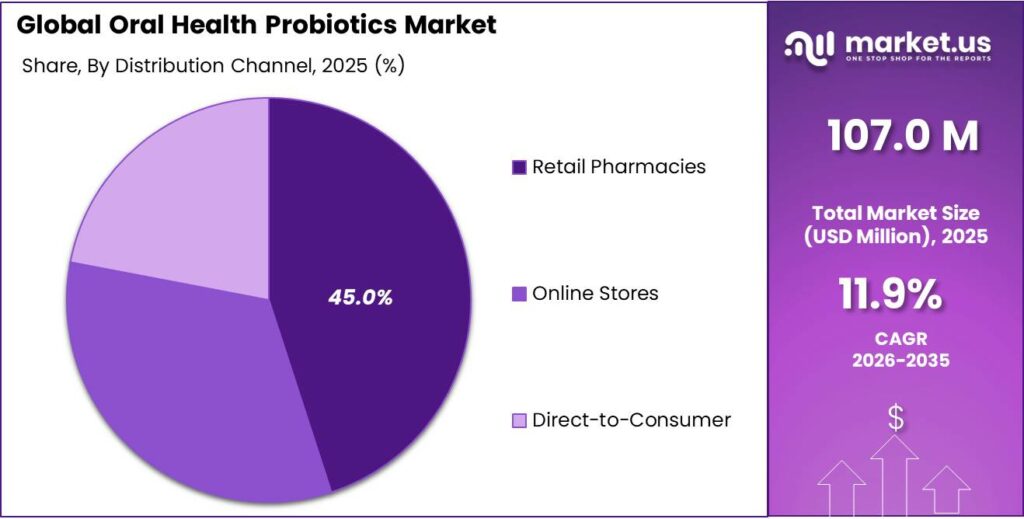
- Retail Pharmacies held a dominant market position, capturing more than a 45.9% share.
- North America emerged as the leading region in the oral health probiotics market, accounting for 41.3% share, valued at around USD 44.1 Mn.
By Form Analysis
Capsules and Tablets dominate with 45.7% driven by convenience and precise dosing
In 2025, Capsules and Tablets held a dominant market position, capturing more than a 45.7% share. This strong position was mainly supported by their ease of use and familiar format, as most consumers are already comfortable taking supplements in capsule or tablet form. These formats offer accurate dosage, longer shelf life, and better portability, making them a preferred choice for daily oral health routines.
By End Use Analysis
Adults lead with 56.2% as awareness around preventive oral care continues to grow
In 2025, Adults held a dominant market position, capturing more than a 56.2% share. This was largely driven by increasing awareness about oral hygiene and the growing need to manage issues like gum disease, bad breath, and plaque buildup. Adults are more likely to adopt probiotic solutions as part of their daily health routine, especially as they look for natural alternatives to traditional oral care products.
By Distribution Channel Analysis
Retail Pharmacies lead with 45.9% as consumers rely on trusted in-store guidance
In 2025, Retail Pharmacies held a dominant market position, capturing more than a 45.9% share. This was mainly because consumers prefer buying oral health probiotics from places they trust, where they can also get basic advice from pharmacists. These stores are easily accessible and offer a wide range of products, making them a convenient choice for regular purchases. Many buyers feel more confident picking up health-related products from pharmacies compared to other channels.
Key Market Segments
By Form
- Capsules and Tablets
- Gummies and Chews
- Powders
- Sachets
By End Use
- Children
- Adults
- Seniors
By Distribution Channel
- Retail Pharmacies
- Online Stores
- Direct-to-Consumer
Emerging Trends
Shift toward functional foods and everyday probiotic consumption
One of the most noticeable trends in oral health probiotics is how they are slowly becoming part of daily food habits instead of being seen only as supplements. People are now consuming probiotics through yogurt, drinks, and fortified snacks, and this shift is creating a strong base for oral probiotics as well. In 2025, probiotic food products reached around USD 114.18 billion, and continued growing further in 2026 as more consumers preferred natural health options over chemical-based solutions
What’s interesting is that probiotic-based foods already make up a large portion of the functional food category, contributing nearly 60% of all functional foods globally. This shows how deeply probiotics are entering everyday diets. Organizations like the FAO and WHO also define probiotics as beneficial live microorganisms that support health when consumed regularly, which adds credibility and trust among consumers
Growing innovation in delivery formats and microbiome-based products
Another key trend is the rapid innovation in how probiotics are delivered to consumers. Earlier, probiotics were mostly limited to dairy products, but now they are available in plant-based foods, beverages, and advanced supplement forms. Research shows that probiotic products are moving beyond traditional dairy into snacks, drinks, and even oral care-specific formats, making them more accessible to a wider audience
At the same time, the overall probiotics market reached about USD 76.5 billion in 2025, showing strong demand for microbiome-based health solutions. This demand is pushing companies to develop targeted products, including oral probiotics designed specifically for gum health, bad breath, and bacterial balance in the mouth. Governments and health organizations are also encouraging research into microbiome health, recognizing its role in immunity and disease prevention
Drivers
Rising burden of oral diseases pushing demand for probiotic solutions
One of the biggest drivers for oral health probiotics is the growing number of people dealing with dental issues worldwide. According to global health data, oral diseases affect billions of people and remain one of the most common health problems. This rising burden is pushing both individuals and healthcare systems to look for preventive solutions rather than just treatments.
At the same time, scientific research highlights that probiotics can directly reduce oral pathogens and slow down the formation of dental caries, which makes them useful for long-term prevention. Governments and public health bodies are also focusing more on preventive dental care through awareness programs and early intervention strategies. This shift is naturally supporting the use of probiotics as an easy daily solution.
Growing awareness of microbiome health and functional foods
Another key factor driving the market is the increasing awareness of the role of good bacteria in maintaining health. Over the past few years, probiotics have moved beyond gut health and are now widely recognized for their benefits in oral care. Consumers are becoming more conscious about what they consume, and many are shifting toward functional foods and supplements that offer additional health benefits.
There is also growing interest in probiotic-rich foods like yogurt and fermented products, which are now among the most commonly consumed dietary supplements after vitamins and minerals. This trend is being supported by health organizations promoting balanced diets and preventive care. In addition, clinical findings suggest that probiotics can reduce bad breath compounds in up to 85% of users within a short time frame, showing clear real-world benefits
Restraints
High cost of awareness gap and limited consumer understanding
One of the key challenges holding back the oral health probiotics market is the lack of proper awareness among consumers. Even though oral diseases affect a massive population, many people still rely on traditional products like toothpaste and mouthwash, without fully understanding how probiotics can help.
According to the World Health Organization, oral diseases impact nearly 3.5 to 3.7 billion people globally, making them one of the most common health conditions.
Governments and health bodies have started promoting oral health through programs like the WHO Global Oral Health Action Plan 2030, which focuses on prevention and awareness. However, changing consumer behavior takes time.
Many people still associate oral care only with brushing and dental visits, not with microbiome balance. This gap slows down product adoption, as consumers are hesitant to try new solutions they are unfamiliar with. Until awareness improves at a grassroots level, especially through public health campaigns, the growth of oral probiotics will continue to face resistance.
High treatment focus over prevention limits probiotic adoption
Another major restraint is the strong focus on treatment rather than prevention in oral healthcare systems. Even today, most dental care spending goes toward treating issues like cavities and gum disease instead of preventing them early. Data shows that global spending on oral diseases exceeds USD 380 billion, highlighting how much is spent on treatment rather than preventive care.
Even though probiotics are designed to prevent problems by balancing oral bacteria, they are often seen as optional rather than essential. In many regions, dental visits happen only when pain or visible issues appear, not for routine prevention. WHO has been encouraging countries to shift toward preventive care models, but adoption is still uneven across regions
Opportunity
Expansion of functional food and probiotic-rich diets creating new growth paths
One of the biggest growth opportunities for oral health probiotics is the rapid expansion of functional foods and probiotic-rich diets. People are no longer looking at probiotics only for gut health; they are slowly connecting them with overall wellness, including oral care. According to food industry insights, functional food and beverage products already account for over 74.5% of probiotic consumption, showing how deeply probiotics are entering daily diets.
Organizations like the FAO and WHO have also recognized probiotics as beneficial live microorganisms that support health when consumed regularly. Governments in many countries are encouraging better nutrition and preventive health habits, which indirectly supports probiotic adoption. As consumers become more comfortable consuming probiotics through food, it becomes easier for oral-specific probiotic products to gain acceptance.
Rising demand for preventive healthcare and microbiome-based solutions
Another strong opportunity comes from the growing focus on preventive healthcare and microbiome science. People are now trying to avoid health problems instead of treating them later, and probiotics fit perfectly into this mindset. Data shows that the global probiotics industry reached around USD 76.5 billion in 2025, reflecting strong demand for preventive health solutions. This trend is not limited to gut health anymore, as research increasingly shows that microbial balance plays a role in oral health as well.
Health organizations are actively promoting prevention-based care models, especially after recognizing the long-term cost burden of diseases. Probiotics are being studied for their ability to control harmful bacteria, reduce inflammation, and support immune function in the body. This creates a clear opportunity for oral probiotics to grow as part of daily preventive routines.
Regional Insights
North America dominates with 41.3% share, supported by strong awareness and advanced healthcare systems
North America emerged as the leading region in the oral health probiotics market, accounting for 41.3% share, valued at around USD 44.1 Mn. This dominance is mainly driven by high awareness of oral hygiene, strong healthcare infrastructure, and early adoption of preventive health products. The United States plays a major role in this growth, where oral health concerns remain highly prevalent.
In addition, nearly 90% of adults in the U.S. have experienced dental caries, reflecting a widespread need for long-term oral care management. Consumers in North America are more inclined toward functional and probiotic-based products due to higher health awareness and disposable income. The region also benefits from strong distribution networks, including pharmacies and e-commerce platforms, which make these products easily accessible.

Key Regions and Countries Insights
- North America
- US
- Canada
- Europe
- Germany
- France
- The UK
- Spain
- Italy
- Rest of Europe
- Asia Pacific
- China
- Japan
- South Korea
- India
- Australia
- Rest of APAC
- Latin America
- Brazil
- Mexico
- Rest of Latin America
- Middle East & Africa
- GCC
- South Africa
- Rest of MEA
Key Players Analysis
Lallemand Inc. is one of the most established players in the probiotics space, operating with a strong global presence and diversified portfolio. The company generates an estimated USD 1–10 billion in annual revenue, supported by multiple business units across health, food, and biotechnology sectors. Its Health Solutions division focuses on probiotic strains used in human health, including oral care. With over 100+ years of research expertise and thousands of microbial strains, Lallemand continues to invest in innovation and large-scale production capabilities.
BioGaia is a well-known Swedish probiotic company with strong financial performance and scientific backing. In 2025, the company reported net sales of around SEK 1,538 million, showing consistent growth in probiotic demand. Its oral health segment alone contributed over SEK 372 million, reflecting rising adoption of oral probiotic solutions. BioGaia’s patented strains, especially L. reuteri, are widely used in products targeting gum health and oral bacteria balance. The company’s global presence and focus on clinically proven products make it a strong competitor in this space.
Blis Technologies, headquartered in New Zealand, is a specialized oral probiotic company focusing on throat and dental health. Founded in 2000, the company has developed patented strains like BLIS K12 and BLIS M18, which are widely used in oral care products. These strains are designed to target harmful bacteria responsible for bad breath, plaque, and gum disease. Blis products are sold in multiple formats such as lozenges and powders, across global markets. Its strong focus on oral-specific probiotics gives it a niche advantage in the industry.
Top Key Players Outlook
- Lallemand Inc.
- AB-BIOTICS, SA
- BioGaia
- Blis Technologies
- Orasana
- Stratum Nutrition
- SUNSTAR Suisse S.A.
- Align Technology, Inc
- DESERT ESSENCE
- BURST Oral Care
Recent Industry Developments
By 2026, BioGaia’s oral-health portfolio on its U.S. store included 5 oral health products, with listed prices such as USD 19.99 for Prodentis® lozenges, USD 21.99 for Prodentis® Fresh Breath, and USD 22.99 for Prodentis® drops, showing that the company is covering multiple price points and formats in the oral probiotics segment.
30 September 2025, Blis posted revenue of NZD 7.7 million, up 28% year over year, and said growth in Europe was supported by rising adoption of BLIS K12® and BLIS M18® in oral health.
Report Scope
Report Features Description Market Value (2025) USD 107.0 Mn Forecast Revenue (2035) USD 329.3 Mn CAGR (2026-2035) 11.9% Base Year for Estimation 2025 Historic Period 2020-2024 Forecast Period 2026-2035 Report Coverage Revenue Forecast, Market Dynamics, Competitive Landscape, Recent Developments Segments Covered By Form (Capsules and Tablets, Gummies and Chews, Powders, Sachets), By End Use (Children, Adults, Seniors), By Distribution Channel (Retail Pharmacies, Online Stores, Direct-to-Consumer) Regional Analysis North America – US, Canada; Europe – Germany, France, The UK, Spain, Italy, Rest of Europe; Asia Pacific – China, Japan, South Korea, India, Australia, Singapore, Rest of APAC; Latin America – Brazil, Mexico, Rest of Latin America; Middle East & Africa – GCC, South Africa, Rest of MEA Competitive Landscape Lallemand Inc., AB-BIOTICS, SA, BioGaia, Blis Technologies, Orasana, Stratum Nutrition, SUNSTAR Suisse S.A., Align Technology, Inc, DESERT ESSENCE, BURST Oral Care Customization Scope Customization for segments, region/country-level will be provided. Moreover, additional customization can be done based on the requirements. Purchase Options We have three licenses to opt for: Single User License, Multi-User License (Up to 5 Users), Corporate Use License (Unlimited User and Printable PDF)  Oral Health Probiotics MarketPublished date: Mar 2026add_shopping_cartBuy Now get_appDownload Sample
 -
-
- Lallemand Inc.
- AB-BIOTICS, SA
- BioGaia
- Blis Technologies
- Orasana
- Stratum Nutrition
- SUNSTAR Suisse S.A.
- Align Technology, Inc
- DESERT ESSENCE
- BURST Oral Care
Our Clients

- 182347
- Mar 2026






