


Global Optical Fiber Connector Market Size, Share and Analysis By Connector Type (Standard Connector (SC), Ferrule Core Connector (FC), ST Connector, Lucent Connector (LC), Plastic FOC Connector, Fiber Distributed Data Interface Connector (FDDI), LX-5 Connector, Others), By Fiber Mode (Multi-mode Fiber Optic Connectors, Single-mode Fiber Optic Connectors), By Distribution Channel (Direct Sales, Channel Sales), By End Use Industry (Telecom, Oil & Gas, Utilities/Energy, Transportation, Aerospace & Aviation, Others), By Regional Analysis, Global Trends and Opportunity, Future Outlook By 2025-2035
- Published date: March 2026
- Report ID: 180572
- Number of Pages: 234
- Format:
-
keyboard_arrow_up
Quick Navigation
- Report Overview
- Key Takeaway
- Role of Generative AI
- Investment and Business Benefits
- By Connector Type Analysis
- By Fiber Mode Analysis
- By Distribution Channel Analysis
- By End Use Industry Analysis
- U.S. Optical Fiber Connector Market Size
- Emerging Trends
- Growth Factors
- Key Market Segments
- Drivers
- Restraint
- Opportunities
- Challenges
- Key Players Analysis
- Recent Developments
- Report Scope
Report Overview
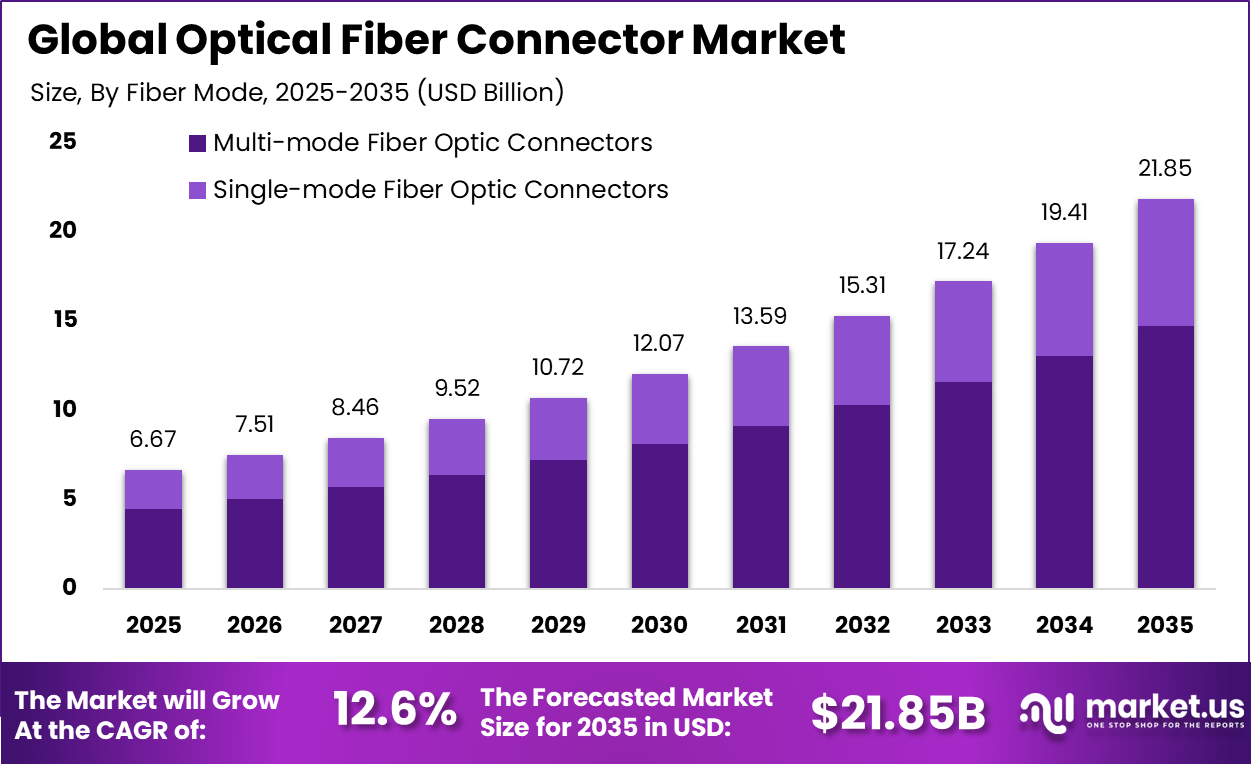
The Global Optical Fiber Connector Market size is expected to be worth around USD 21.85 billion by 2035, from USD 6.67 billion in 2025, growing at a CAGR of 12.6% during the forecast period from 2025 to 2035. North America held a dominant market position, capturing more than a 39.3% share, holding USD 2.62 billion in revenue.
The optical fiber connector market refers to the global industry that designs and manufactures connectors used to join optical fibers and enable high-speed data transmission across communication networks. Optical fiber connectors provide a removable interface that allows fiber cables to be connected, disconnected, or reconfigured while maintaining minimal signal loss. These connectors are essential components in telecommunications infrastructure, data centers, enterprise networks, and industrial communication systems.
The demand for optical fiber connectors is rising as digital connectivity becomes a core requirement across industries. The rapid expansion of cloud computing, 5G networks, and large-scale data centers has significantly increased the need for high-bandwidth communication infrastructure. Fiber connectors enable reliable and scalable connections in these environments, supporting faster data transfer and improved network efficiency.
For instance, in December 2025, Panduit launched NetKey fiber optic connectors with tool-less field termination, cutting installation time by 60%. Targeting enterprise data centers, the system supports 400GBASE-SR8 transceivers. Panduit’s focus on user-friendly solutions drives adoption among systems integrators handling complex cabling projects.
One of the major growth factors driving the optical fiber connector market is the rapid deployment of 5G telecommunications networks. 5G infrastructure requires high-density fiber connectivity to support large volumes of data transmission with minimal latency. Optical fiber connectors play a critical role in enabling these high-speed connections between base stations, network equipment, and fiber backbone systems.
Key Takeaway
- In 2025, the Standard Connector segment led the Global Optical Fiber Connector Market, accounting for 34.7% of total share.
- In 2025, Multi mode fiber optic connectors dominated the product category with a 67.4% market share.
- In 2025, Direct Sales remained the primary distribution channel, capturing 58.5% of overall revenue.
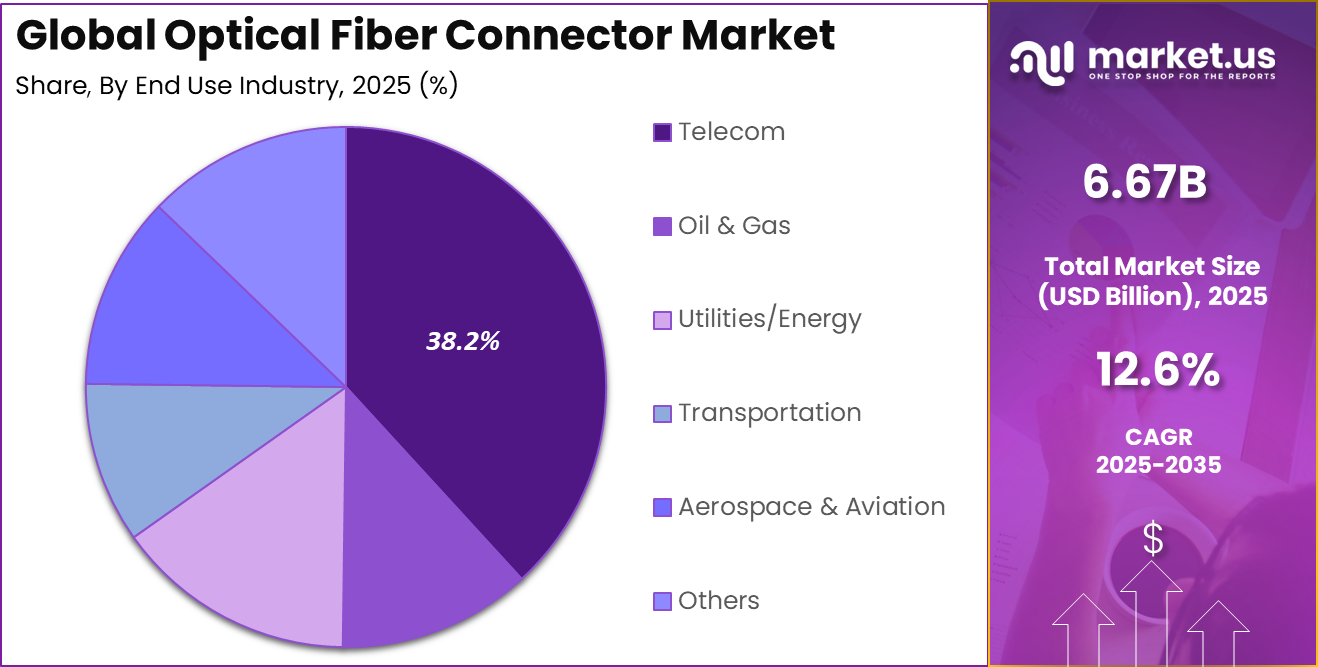
- In 2025, the Telecom sector emerged as the leading application segment, contributing 38.2% of market demand.
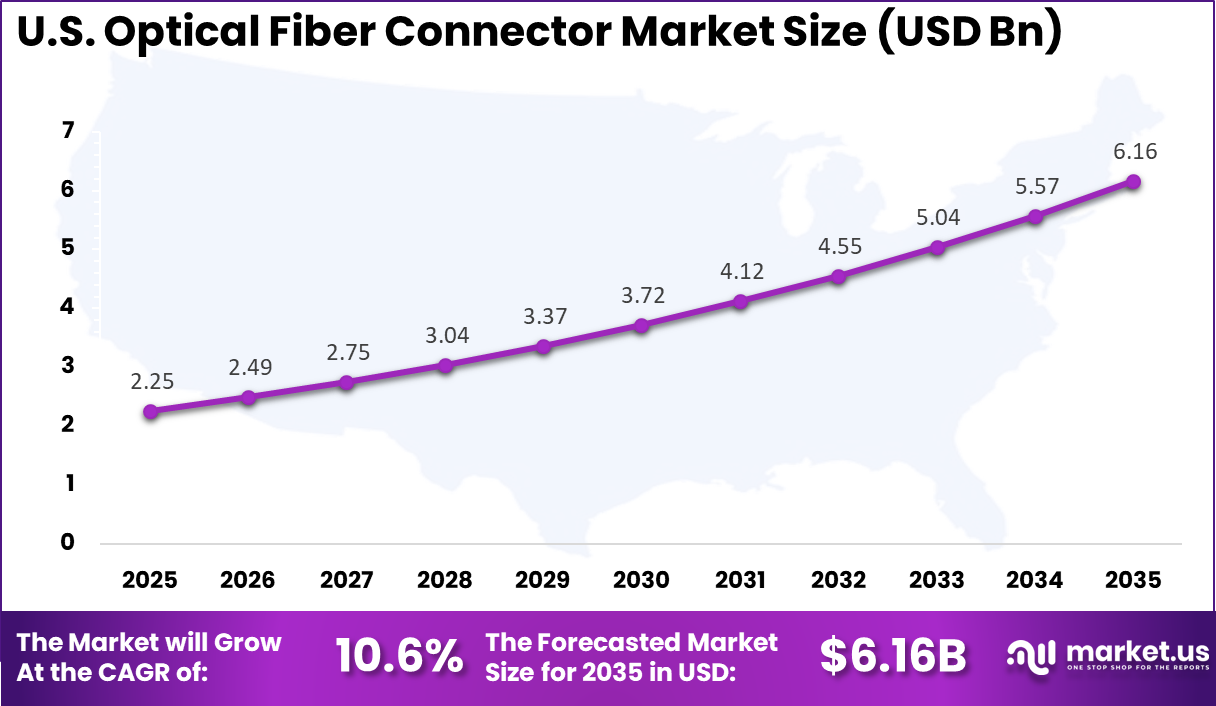
- In 2025, the U.S. Optical Fiber Connector Market reached USD 2.25 billion and recorded a growth rate of 10.6%.
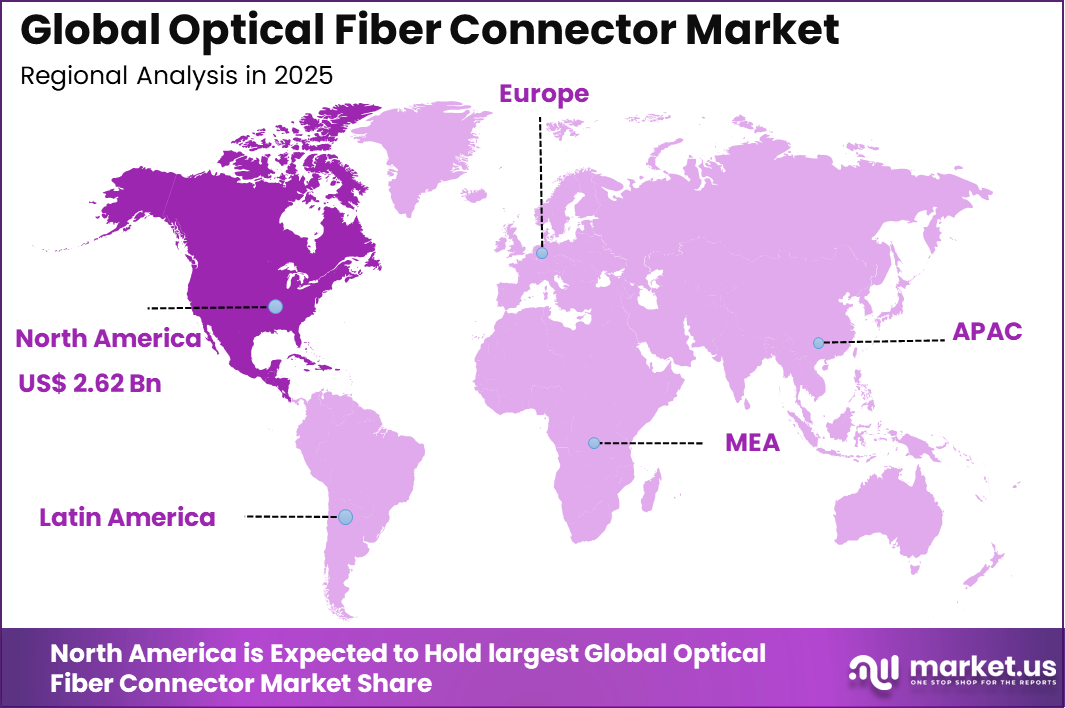
- In 2025, North America held a leading regional position, securing more than 39.3% of the Global Optical Fiber Connector Market.
Role of Generative AI
Generative AI is transforming the way engineers design optical fiber connectors. Advanced AI tools allow designers to simulate thousands of connector structures and materials within a short time. Industry observations show 65% of fiber optic companies now use AI-driven modeling, which has reduced overall connector design cycles by nearly 40%.
Generative AI also supports smarter maintenance planning. AI systems study wear patterns from connector performance data and identify early warning signs of damage. Industry surveys highlight a 72% improvement in predicting connector lifespan, allowing network operators to prevent failures and maintain a stable communication infrastructure.
Investment and Business Benefits
Investors increasingly look toward regions expanding national broadband infrastructure, where fiber networks are growing quickly. Countries building strong digital economies require durable connectors to support cloud platforms and remote data centers. Environmental considerations also influence purchasing decisions. Reports suggest more than 60% of buyers prefer recyclable materials, creating opportunities for companies producing sustainable connector designs.
Optical fiber connectors offer practical advantages for businesses operating large digital networks. They help maintain stable connections while reducing disruptions and service downtime. Companies also benefit from scalable infrastructure that can expand without major rewiring costs. Studies show fiber based systems can deliver up to 30% better energy efficiency compared with older copper based network technologies.
By Connector Type Analysis
In 2025, Standard connector types, particularly SC connectors, account for 34.7% of the market due to their reliability and ease of installation. SC connectors are widely used in telecommunications networks because they provide stable fiber connections with minimal signal loss. Their push pull locking mechanism ensures secure connectivity in network environments that require consistent performance.
The widespread use of SC connectors is also supported by their compatibility with various fiber optic systems and network configurations. Telecommunications providers rely on these connectors to maintain efficient signal transmission across long distance communication infrastructure. As broadband networks continue to expand, SC connectors remain an important component in fiber connectivity solutions.
For Instance, in August 2025, Fibertronics rolled out upgraded SC models for better dust resistance in outdoor links. These tweaks make SC connectors tougher for real-world telecom jobs, cutting downtime from environmental wear. Growth here feels steady as firms like Fibertronics meet calls for durable parts that snap in without tools.
By Fiber Mode Analysis
In 2025, the multi mode fiber optic connectors represent 67.4% of the market, reflecting their extensive use in short distance data transmission environments. These connectors are commonly deployed in local area networks, enterprise communication systems, and data center infrastructure. Multi mode fiber supports high bandwidth transmission over shorter distances, making it suitable for internal networking applications.
Organizations increasingly deploy multi mode fiber connectors in data centers and enterprise networks to support large volumes of data traffic. Their ability to transmit multiple light signals simultaneously enhances network performance. As digital infrastructure expands, multi mode connectors continue to dominate fiber optic connectivity solutions.
For instance, in June 2025, Panduit introduced rugged multi-mode cables for industrial floors, built to withstand vibration and pulls. Such steps drive the segment as factories and offices add fiber for faster internal links, valuing multi-mode’s balance of price and bandwidth over fancy long-range gear.
By Distribution Channel Analysis
In 2025, The Direct sales account for 58.5% of the market, indicating the importance of direct engagement between manufacturers and enterprise customers. Telecommunications providers, data center operators, and network infrastructure companies often purchase fiber optic connectors directly from manufacturers to ensure product reliability and compatibility.
Direct sales channels also allow manufacturers to provide technical support, customization, and installation guidance for complex networking environments. This approach helps organizations deploy fiber connectivity solutions more efficiently. As network infrastructure projects become larger and more specialized, direct sales channels continue to play a major role in distribution.
For Instance, in April 2025, TE Connectivity expanded direct sales teams for custom fiber kits, speeding orders for big projects. This channel grows because clients get exact matches and hands-on support, skipping reseller delays on specialized runs. TE’s push builds trust for repeat bulk buys.
By End Use Industry Analysis
In 2025, The telecommunications sector represents 38.2% of the market due to the increasing deployment of fiber optic networks for high speed communication services. Telecom providers rely heavily on fiber connectors to link transmission equipment, switching systems, and network infrastructure. Reliable connectors are essential to maintain signal integrity across extensive communication networks.
The expansion of broadband connectivity, mobile network upgrades, and fiber to the home deployments has significantly increased demand for optical fiber connectors. Telecommunications companies continue to invest in fiber infrastructure to support growing data consumption. As global communication networks expand, the telecom sector remains the leading end user.
For Instance, in February 2026, Japan Aviation Electronics debuted telecom-grade connectors for 5G towers, locking in signal under storms. Telecom booms with these as networks stretch to remote spots, needing parts that endure weather and load. Their reliable hookups keep data flowing non-stop.
U.S. Optical Fiber Connector Market Size
The market for Optical Fiber Connectors within the U.S. is growing tremendously and is currently valued at USD 2.25 billion, the market has a projected CAGR of 10.6%. The market is growing due to the rapid expansion of fiber broadband infrastructure across cities and rural regions.
Telecom providers are upgrading networks to support rising internet traffic from streaming, cloud services, and connected devices. Growth of data centers and increasing deployment of 5G networks are also strengthening demand for reliable fiber connectivity solutions.
For instance, in February 2026, Fibertronics expanded its U.S. manufacturing with a new facility focused on precision MPO connectors for 800G networks. This investment boosts domestic production capacity, reinforcing its position as the hub for reliable, high-performance fiber optic solutions.
In 2025, North America held a dominant market position in the Global Optical Fiber Connector Market, capturing more than a 39.3% share, holding USD 2.62 billion in revenue. This dominance is due to the region’s strong telecommunications infrastructure and early adoption of high speed fiber networks.
Large scale broadband expansion, rapid growth of cloud data centers, and continuous investments in 5G connectivity have increased the need for reliable fiber components. Strong digital demand from enterprises and households further supports connector deployment across the region.
For instance, in February 2026, Broadcom solidified U.S. leadership in optical fiber connectors by launching next-gen high-density modules for AI data centers. These connectors support 800G Ethernet speeds, meeting exploding bandwidth demands from hyperscale operators. The innovation reinforces North America’s dominance in cutting-edge telecom infrastructure.
Emerging Trends
A major trend in the optical connector field is the development of compact and durable designs suited for dense network environments. Multi fiber push on connectors are becoming more common because they save space while supporting higher data capacity. Around 58% of new deployments now favor this type for modern networks.
Sustainability is also shaping new connector designs. Manufacturers increasingly explore biodegradable polymers and environmentally responsible materials. Industry data indicates a 45% rise in the use of low carbon connectors during the past two years, reflecting growing pressure to balance performance with greener production methods.
Growth Factors
Growing internet usage from streaming platforms, cloud computing, and digital services is driving the need for advanced fiber connectors. Network operators must support faster speeds and larger data volumes. Reports show bandwidth demand has doubled within three years, prompting nearly 70% of operators to upgrade existing fiber infrastructure.
Manufacturing improvements are another factor supporting market expansion. Modern polishing technologies and automated assembly processes improve connector quality and durability. Industry statistics indicate defect rates have dropped by about 35%, enabling companies to scale network installations more efficiently while maintaining reliable fiber connectivity.
Key Market Segments
By Connector Type
- Standard Connector (SC)
- Ferrule Core Connector (FC)
- ST Connector
- Lucent Connector (LC)
- Plastic FOC Connector
- Fiber Distributed Data Interface Connector (FDDI)
- LX-5 Connector
- Others
By Fiber Mode
- Multi-mode Fiber Optic Connectors
- Single-mode Fiber Optic Connectors
By Distribution Channel
- Direct Sales
- Channel Sales
By End Use Industry
- Telecom
- Oil & Gas
- Utilities/Energy
- Transportation
- Aerospace & Aviation
- Others
Key Regions and Countries
North America
- US
- Canada
Europe
- Germany
- France
- The UK
- Spain
- Italy
- Russia
- Netherlands
- Rest of Europe
Asia Pacific
- China
- Japan
- South Korea
- India
- Australia
- Singapore
- Thailand
- Vietnam
- Rest of APAC
Latin America
- Brazil
- Mexico
- Rest of Latin America
Middle East & Africa
- South Africa
- Saudi Arabia
- UAE
- Rest of MEA
Drivers
Rising Global Demand for High Speed Connectivity
Growing demand for high speed internet connectivity is a major factor supporting the optical fiber connector market. Digital activities such as video streaming, cloud computing, and online collaboration require strong and reliable data transmission networks. As internet traffic continues to increase globally, telecom providers are expanding fiber infrastructure to deliver faster and more stable communication services.
Many governments are also promoting national broadband programs to improve digital access in urban and rural regions. These initiatives focus on expanding fiber networks that support advanced communication technologies. Optical fiber connectors play an essential role in linking fiber cables across these networks, which strengthens their demand in modern communication infrastructure.
For instance, in November 2025, Amphenol launched a new line of high-density fiber connectors suited for telecom upgrades worldwide. These parts support quicker data transfer in urban broadband rollouts, addressing the growing need for remote workers and video calls. Their design ensures stable performance as networks expand to serve more users without slowdowns.
Restraint
High Installation and Infrastructure Costs
One major limitation in the optical fiber connector market involves the high cost associated with fiber network deployment. Installing fiber infrastructure requires specialized equipment, skilled technicians, and careful planning. For many regions, especially developing areas, the cost of laying fiber cables and connecting systems can slow infrastructure expansion.
Maintenance and upgrades also add to operational expenses. Fiber networks require periodic inspection and replacement of damaged components to maintain performance. Organizations must allocate budgets for technical training and specialized tools. These financial requirements can delay fiber adoption in areas where communication infrastructure investment remains limited.
For instance, in August 2025, TE Connectivity highlighted cost-saving tweaks in their connector assembly process during an industry update, aiming to ease the burden of pricey fiber setups. They focused on simpler mounting options that cut labor time in tricky urban digs, yet noted how steep upfront costs still slow smaller projects. This reflects ongoing efforts to make infrastructure more affordable amid rising expenses.
Opportunities
Expansion of Data Centers and Cloud Services
The rapid growth of cloud computing and digital storage facilities creates strong opportunities for optical fiber connectors. Data centers rely on high capacity fiber connections to transfer large volumes of information between servers, storage systems, and network equipment. Reliable connectors help maintain stable communication across these complex environments.
As more organizations move their operations to cloud platforms, the need for efficient data transfer infrastructure continues to grow. Fiber connectors support fast internal connections within these facilities. Increasing investments in digital infrastructure, therefore, open new opportunities for connector manufacturers and network equipment suppliers.
For instance, in October 2025, CommScope announced tailored fiber solutions for hyperscale cloud hubs, easing integration in sprawling server farms. These connectors boost internal wiring for heavier data flows, opening doors as providers rush to expand capacity. It’s a clear play on the steady rise of cloud-dependent operations.
Challenges
Maintaining Signal Integrity in Complex Networks
Maintaining signal integrity across complex fiber networks remains a significant challenge for network operators. Optical connectors must be precisely aligned to ensure that light signals travel smoothly without interference or loss. Even small alignment issues or surface contamination can affect communication performance.
Large communication systems often include thousands of fiber connections across multiple locations. Dust, physical stress, and environmental conditions can impact connector quality over time. Network teams must regularly inspect and maintain these connections to keep data transmission stable across high speed communication infrastructure.
For instance, in July 2025, Corning detailed upgrades to its polishing tech for connectors, fighting signal loss in bend-heavy networks. They tackled dust and alignment issues in lab tests for multi-point systems, but stressed that vibrations still pose risks in real-world bends. This work underscores the tough balance in keeping signals clean amid complexity.
Key Players Analysis
The Optical Fiber Connector Market is supported by global electronics and connectivity solution providers that supply high performance fiber interconnect components. Broadcom, Amphenol, TE Connectivity, and Molex are widely recognized for their advanced optical connectivity products used in telecommunications, data centers, and enterprise networking infrastructure.
Industrial connectivity and network infrastructure providers also play a significant role in the market. 3M, Belden, Panduit, and Japan Aviation Electronics Industry, Ltd. supply fiber connectors and cable management solutions for enterprise networks and industrial automation systems. These companies emphasize durability, signal stability, and compatibility with high speed fiber optic networks.
Specialized manufacturers contribute additional innovation in precision connector design and niche industrial applications. Stäubli, Neutrik, WAGO Corp., Bulgin, along with providers such as Fibertronics, Multicom, and Sun Telecom, focus on compact fiber connectors and customized interconnection systems. Their offerings support telecommunications expansion, fiber to the home deployments, and high density network infrastructure projects.
Top Key Players in the Market
- Broadcom
- Fibertronics
- Stäubli
- Molex
- Multicom, Inc.
- Panduit
- Japan Aviation Electronics Industry, Ltd.
- Amphenol
- TE Connectivity
- Neutrik
- 3M
- Belden
- Sun Telecom
- WAGO Corp.
- Bulgin
- Others
Recent Developments
- In October 2025, TE Connectivity expanded its MX-POL family of fiber optic connectors with a ruggedized version for harsh industrial environments. The new connectors handle 100Gbps transmission in oil & gas applications, boosting reliability by 40% over standard models. Their strategic plant expansion in Asia serves the growing 5G backhaul demand effectively.
- In March 2026, Japan Aviation Electronics (JAE) partnered with NTT for 1.6Tbps optical connectors in IOWN networks. Their ultra-low loss LC connectors achieved 99.99% reliability in field trials. JAE’s precision manufacturing expertise gives Japan a strong competitive edge in next-generation telecom infrastructure deployment.
Report Scope
Report Features Description Market Value (2025) USD 6.6 Bn Forecast Revenue (2035) USD 21.8 Bn CAGR (2025-2035) 12.6% Base Year for Estimation 2025 Historic Period 2020-2024 Forecast Period 2025-2035 Report Coverage Revenue forecast, AI impact on Market trends, Share Insights, Company ranking, competitive landscape, Recent Developments, Market Dynamics and Emerging Trends Segments Covered By Connector Type (Standard Connector (SC), Ferrule Core Connector (FC), ST Connector, Lucent Connector (LC), Plastic FOC Connector, Fiber Distributed Data Interface Connector (FDDI), LX-5 Connector, Others), By Fiber Mode (Multi-mode Fiber Optic Connectors, Single-mode Fiber Optic Connectors), By Distribution Channel (Direct Sales, Channel Sales), By End Use Industry (Telecom, Oil & Gas, Utilities/Energy, Transportation, Aerospace & Aviation, Others) Regional Analysis North America – US, Canada; Europe – Germany, France, The UK, Spain, Italy, Russia, Netherlands, Rest of Europe; Asia Pacific – China, Japan, South Korea, India, New Zealand, Singapore, Thailand, Vietnam, Rest of Latin America; Latin America – Brazil, Mexico, Rest of Latin America; Middle East & Africa – South Africa, Saudi Arabia, UAE, Rest of MEA Competitive Landscape Broadcom, Fibertronics, Stäubli, Molex, Multicom, Inc., Panduit, Japan Aviation Electronics Industry, Ltd., Amphenol, TE Connectivity, Neutrik, 3M, Belden, Sun Telecom, WAGO Corp., Bulgin, Others Customization Scope Customization for segments, region/country-level will be provided. Moreover, additional customization can be done based on the requirements. Purchase Options We have three license to opt for: Single User License, Multi-User License (Up to 5 Users), Corporate Use License (Unlimited User and Printable PDF)  Optical Fiber Connector MarketPublished date: March 2026add_shopping_cartBuy Now get_appDownload Sample
 -
-
- Broadcom
- Fibertronics
- Stäubli
- Molex
- Multicom, Inc.
- Panduit
- Japan Aviation Electronics Industry, Ltd.
- Amphenol
- TE Connectivity
- Neutrik
- 3M
- Belden
- Sun Telecom
- WAGO Corp.
- Bulgin
- Others
Our Clients

- 180572
- March 2026









