


Report Overview
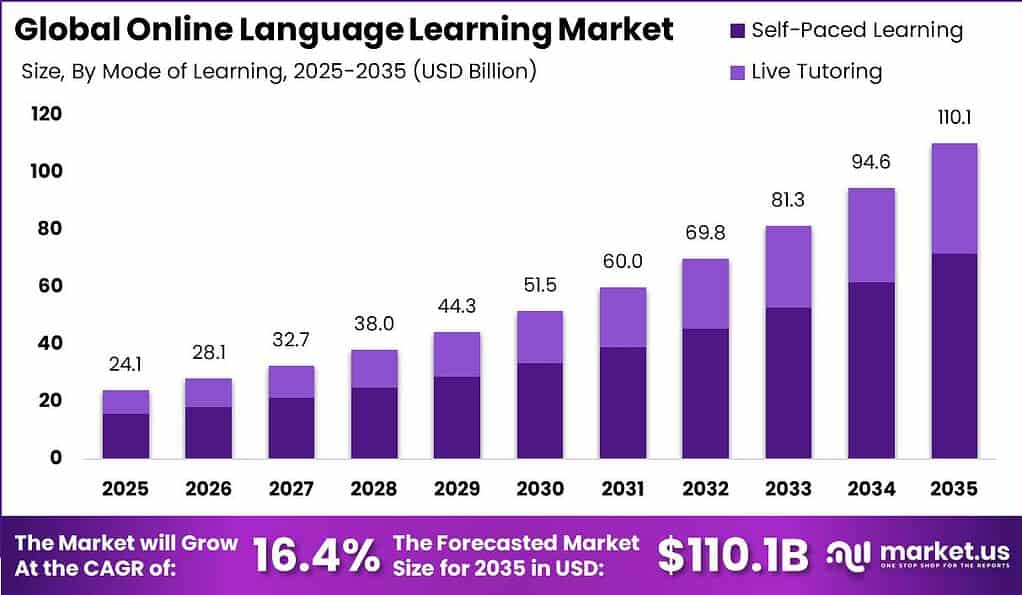
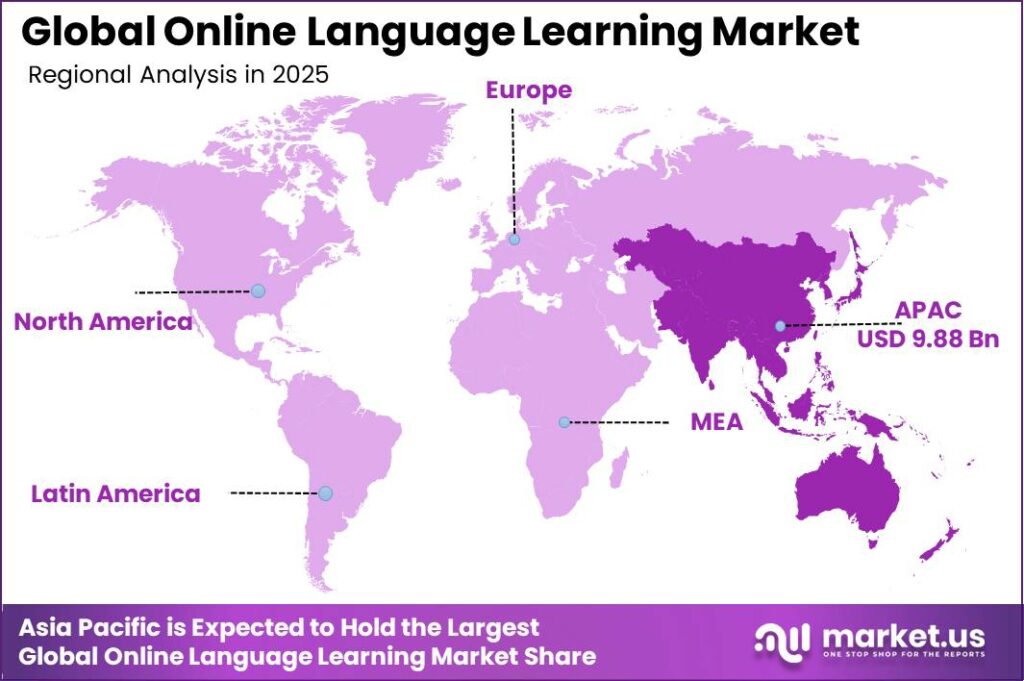
In 2025, the Online Language Learning Market was valued at USD 24.1 billion. The market is projected to grow at a CAGR of 16.4% during 2026–2035, reaching approximately USD 110.1 billion by 2035. Asia Pacific dominated the global market in 2025, accounting for more than 41.1% of the total market share and generating approximately USD 9.88 billion in revenue.
The strong growth in the online language learning market is supported by rapid digital adoption, rising cross-border mobility, and growing demand for lifelong learning. According to the International Telecommunication Union (ITU), about 5.5 billion people were using the internet globally in 2024, representing 68% of the world’s population. This large connected population creates a broad base of potential users for language learning apps, online courses, and virtual tutoring.
The World Bank also reports that internet usage exceeds 90% in many high-income economies, while adoption continues to increase across emerging markets. This expansion of internet access makes digital language education more affordable and accessible, allowing learners to study from smartphones and computers without depending on physical classrooms.
Asia Pacific’s more than 41.1% market share is supported by its large online population, strong education demand, and growing international economic activity. Statista data indicate that Asia Pacific has more than 2.6 billion online users, with China and India accounting for roughly half of this base, creating a significant addressable market for digital language learning among students, professionals, and migrants.
The OECD reports that about 40% of adults in member countries participate in learning each year, with non-formal and job-related learning representing an important part of this activity. Language training directly benefits from this trend because workers increasingly need communication skills for international employment and business.
Key Takeaway
- The global online language learning market is projected to grow from $24.1 billion in 2025 to $110.1 billion by 2035, reflecting strong long-term expansion.
- The market is expected to register a 16.4% CAGR from 2025 to 2035, driven by rising demand for flexible and accessible language education.
- Self-paced learning dominates by mode, holding a 65.1% market share due to flexibility, convenience, and personalized learning.
- Individual learners lead by target audience, accounting for 70.3% of the market, supported by growing demand for personal and professional language skills.
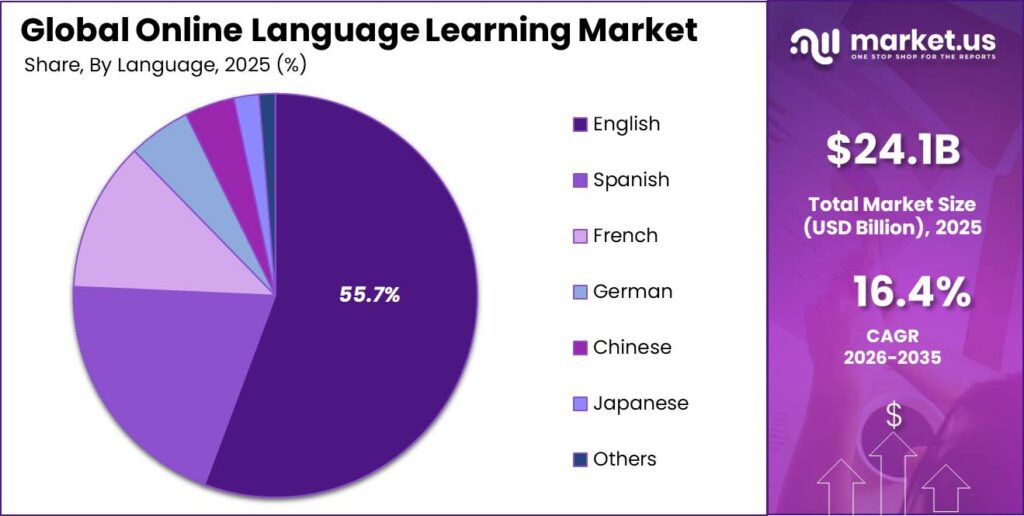
- English is the leading language segment, representing 55.7% of the market, reflecting its importance in global education and business communication.
- Asia Pacific accounts for 41.1% of the global market, representing approximately $9.8 billion in 2025.
By Mode of Learning
In 2025, Self-Paced Learning held a dominant market position, capturing more than a 65.1% share. Surveys across corporate and academic e-learning show that around 70% of learners say self-paced online courses are their preferred way to study, mainly because they can fit learning around work and family responsibilities. Studies also report that self-paced and online formats can improve knowledge retention by 25% to 60% compared with traditional classroom teaching, reinforcing sustained use rather than one-off experimentation.
In 2025, many platforms saw completion rates jump from roughly 35% to 85% when they linked self-paced modules with micro-quizzes and short video lessons, highlighting the appeal of bite-sized practice. These changes were rolled out progressively from March to June 2025, in time for university exams and corporate mid-year reviews.
By Target Audience
Individual Learners held a significant share of the market in 2025, mirroring broader shifts in e-learning where budgets and decisions are moving from institutions to end users. In workplace surveys, about 70% of employees say online self-paced courses are their preferred way to gain new skills, and a growing share apply this habit to language learning for career mobility and remote work opportunities.
Microlearning statistics show that short modules can achieve completion rates of around 80%, compared with roughly 20% for longer courses, which encourages individuals to subscribe to language apps rather than wait for classroom programs.
By Language
In 2025, English held a dominant market position, capturing more than a 55.7% share, supported by its status as the primary working and study language across global digital industries. Usage data for digital learning tools show that English courses attract a large share of mobile learners, with one study noting that 94% of Generation Z students use phones for study and often choose English for international communication and content access.
Corporate training statistics indicate that e-learning can reduce course completion time by 40% to 60%, and many firms apply this to English upskilling for distributed teams. Demand tends to spike between May and July 2025 as learners prepare for admissions cycles, visa applications, and standardized tests requiring proof of English proficiency.
Key Market Segments
By Mode of Learning
- Self-Paced Learning
- Live Tutoring
By Target Audience
- Individual Learners
- Institutional Institutions
By Language
- English
- Spanish
- French
- German
- Chinese
- Japanese
- Others
Market Dynamics
Drivers
| Driver | (~) % Impact on CAGR Forecast | Geographic Relevance | Impact Timeline |
|---|---|---|---|
| Globalization & cross-border mobility | +3.0% | Global | Short term (≤ 2 years) |
| Smartphone & broadband penetration | +2.4% | Asia-Pacific, Latin America, Africa | Short term (≤ 2 years) |
| Institutional adoption of online language programs | +2.1% | Europe, North America, Asia-Pacific | Medium term (2–4 years) |
| AI-powered adaptive and conversational learning | +1.9% | Global urban centers | Medium term (2–4 years) |
| Corporate demand for multilingual workforce | +1.6% | Global trade-intensive sectors | Medium term (2–4 years) |
| Expansion of live online tutoring platforms | +1.4% | Asia-Pacific, Middle East | Short term (≤ 2 years) |
Globalization & cross-border mobility
The root driver is the continued expansion of international student flows, cross-border work migration, and global trade links, which together push tens of millions of learners each year to acquire new languages for admission, visa, or employment requirements, as documented by rising international student numbers and mobility statistics through 2025.
Operationally, this shows up as higher conversion into paid online language courses for test preparation and professional certifications, with platforms reporting mid-teens to high-teens enrollment growth in markets where international students grew at roughly 5–7% annually and where cross-border mobility has rebounded to or exceeded pre-pandemic levels.
Commercially, this driver accelerates a shift from one-time licensing or offline classroom fees into subscription-based SaaS language learning models, increasing average revenue per user by roughly 20–30% when learners move from short intensive courses to year-round access bundles, while keeping gross margins in the 60–70% band through digital delivery and centralized content production.
Restraints
| Restraint | (~) % Impact on CAGR Forecast | Geographic Relevance | Impact Timeline |
|---|---|---|---|
| Macroeconomic pressure on discretionary edtech spend | -2.8% | Europe, Latin America, parts of Asia | Short term (≤ 2 years) |
| Regulatory constraints on data privacy & minors | -2.1% | EU, North America | Medium term (2–4 years) |
| Unequal digital infrastructure in low-income regions | -1.9% | Sub-Saharan Africa, rural Asia | Long term (≥ 4 years) |
| Intense price competition & freemium saturation | -1.7% | Global app stores | Short term (≤ 2 years) |
| Institutional budget rigidities & procurement cycles | -1.5% | Public education systems | Medium term (2–4 years) |
| Payment friction in emerging markets | -1.3% | Cash-heavy economies | Short term (≤ 2 years) |
Macroeconomic pressure on discretionary edtech spend
The primary restraint is the squeeze on household and institutional discretionary budgets arising from elevated inflation and higher interest rates in several regions through 2024–2025, which directly reduces the share of income available for non-mandatory online learning purchases.
Quantitatively, consumer surveys and education software spending data indicate that households facing real income contractions of around 3–5% year-on-year often cut optional subscription services by 10–20%, while ministries and universities delay or scale down digital learning rollouts when capital budgets are tightened and borrowing costs increase by 200–300 basis points.
Strategically, this results in margin compression for online language providers that must absorb higher customer acquisition costs yet face resistance to price increases, with some operators discounting headline prices by 10–15% and extending promotional free periods, which in turn pushes out payback periods on content and platform CapEx from about 18 months toward roughly 24–30 months in more stressed geographies.
Challenges
| Challenge | (~) % CAGR Friction Drag | Geographic Relevance | Mitigation Horizon |
|---|---|---|---|
| Persistent engagement & retention gap | -2.5% | Global | Medium term (2–4 years) |
| Shortage of qualified online language tutors | -2.0% | High-demand language pairs | Medium term (2–4 years) |
| Content localization and cultural nuance complexity | -1.8% | Multilingual emerging markets | Long term (≥ 4 years) |
| Data and learning analytics integration gaps | -1.6% | Smaller providers | Medium term (2–4 years) |
| Platform scalability and uptime expectations | -1.4% | Global | Short term (≤ 2 years) |
| Fragmented distribution and channel partnerships | -1.2% | Institutional & corporate segments | Long term (≥ 4 years) |
Persistent engagement & retention gap
A structural vulnerability is the consistently low completion and retention rates observed in online language learning, where many platforms report that fewer than 30–40% of users complete even half of a multi-month course and monthly active user cohorts can decay by 10–15% over every 90 days without strong engagement hooks.
This creates quantitative friction because high churn inflates effective customer acquisition cost per sustained learner; for instance, if marketing and referral programs drive initial sign-ups at an apparent cost of US$10 per registrant but only 25% remain active after 6 months, the true CAC for enduring users can rise toward the equivalent of US$40, eroding the upside of mid-teens revenue growth.
Over the long term, providers must redesign product roadmaps around adaptive pathways, behavioral nudges, and more intensive live support, which may shift operating cost structures by adding 5–10% more in instructional or support labor per active user but is necessary to sustain the baseline CAGR and avoid cumulative drag that could otherwise shave several percentage points off the market’s maximum growth potential.
Opportunities
| Opportunity | (~) % Potential CAGR Upside | Geographic Relevance | Execution Window |
|---|---|---|---|
| AI-first, personalized language coaching subscriptions | +2.6% | Global | Medium term (2–4 years) |
| Integration with workforce upskilling and HR platforms | +2.2% | North America, Europe, Asia-Pacific | Medium term (2–4 years) |
| Specialized industry and domain-specific language tracks | +2.0% | Export-oriented sectors | Long term (≥ 4 years) |
| Gamified micro-learning for emerging market youth | +1.8% | Asia-Pacific, Africa, Latin America | Medium term (2–4 years) |
| Deep partnerships with universities and test bodies | +1.7% | Global higher education | Long term (≥ 4 years) |
| Cross-product monetization with broader edtech ecosystems | +1.5% | Global digital learning platforms | Long term (≥ 4 years) |
AI-first, personalized language coaching subscriptions
This opportunity is future-oriented rather than a current baseline driver because fully AI-first, highly personalized language coaching combining real-time speech evaluation, conversational agents, and adaptive curricula tied to individual proficiency gaps is only in early deployment stages across the online language segment as of 2026, with most offerings still augmenting, not replacing, traditional course structures.
Quantitatively, moving to deeply personalized coaching can improve learner completion and proficiency attainment rates by an estimated 15–25%, which in turn supports premium subscription tiers priced perhaps 20–30% above standard plans while maintaining or even expanding gross margins by 5–10 percentage points, as incremental AI compute and data costs per user often scale more slowly than equivalent human tutoring hours.
Strategically, this white space allows providers to re-architect unit economics from low-price, high-churn consumer apps into higher-value, longer-duration subscriptions, potentially doubling revenue per engaged learner over a 24–36-month period and shortening the payback on AI and data platform investments to roughly 18–24 months, thereby adding several percentage points of upside to the market CAGR if executed at scale above the current baseline.
Geopolitical Impact Analysis
Escalating geopolitical tensions are exerting measurable cost and timing pressures across the online language learning value chain, particularly for cloud infrastructure, end-user devices, and cross-border digital distribution. Bilateral US–China tariffs climbed to an average of 17% in 2019 before easing slightly to 16%, materially raising the landed cost of ICT hardware such as servers, networking equipment, and consumer electronics that underpin online language platforms, as documented by the World Trade Organization (WTO).
More recently, new US tariffs of 10–12.5% on imports from major trading partners further elevate component costs for tablets, laptops, and headsets used in B2B and institutional deployments, forcing vendors either to compress margins or pass through price increases into subscription tiers and SaaS licensing models.
Concurrently, UNCTAD analysis shows that container freight rates at their post-pandemic peak drove global import prices up by an estimated 11% and consumer prices by 1.5%, with some Asia–South America routes experiencing freight hikes of 443% above median levels, directly impacting the distribution of branded hardware bundles and printed course materials in hybrid online programs.
Energy and data-infrastructure volatility are amplifying operating cost inflation for large language-learning platforms that rely on high-availability data centers and AI-driven content engines. The International Energy Agency (IEA) estimates data-center electricity consumption at about 415 TWh in 2024, representing roughly 1.5% of global demand, having grown 12% annually over the prior five years, and projects a near-doubling to 945 TWh by 2030, implying around 15% yearly growth in electricity use.
This trajectory increases power-purchase costs for hosting providers, translating into higher cloud compute and storage pricing for video streaming, real-time tutoring, and generative AI features embedded in language apps. In parallel, energy-driven input costs for manufacturing rose to 4.7 times their long-run average during the 2022 PMI peak, more than doubling typical pressure, which cascades into higher OEM prices for PCs, smartphones, microphones, and routers that constitute the hardware stack of institutional e-learning deployments.
For online language learning vendors, these combined shocks manifest as 5–15% uplifts in total cost of ownership for hardware-plus-software bundles, extended deployment lead times, and greater pricing dispersion across regions depending on tariff exposure and route-specific freight surcharges, necessitating more localized sourcing, multi-cloud strategies, and regionally differentiated pricing architectures.
Regional Analysis
Asia Pacific is the dominant region in the global online language learning market, accounting for around 41.1% of total revenues and an estimated market value of approximately USD 9.88 billion in the latest assessment period.
The region’s leadership is underpinned by its large digitally active population, rapid expansion of broadband and 4G/5G networks, and very high smartphone penetration across major economies such as China, India, Japan, South Korea, and key ASEAN countries.
Corporate and institutional buyers are also scaling up investments in online language training to support multilingual operations in IT services, tourism, manufacturing, and shared service centers, adding recurring subscription revenues.
The product mix in Asia Pacific is skewed toward app‑based self‑learning modules, micro‑learning content, and hybrid models that combine asynchronous lessons with live virtual tutoring sessions. Price‑sensitive users increasingly adopt freemium or low‑cost offerings, while urban professionals and students gravitate toward premium platforms with structured curricula, certification pathways, and integrated testing.
Key Regions and Countries
North America
- US
- Canada
Europe
- Germany
- France
- The UK
- Spain
- Italy
- Rest of Europe
Asia Pacific
- China
- Japan
- South Korea
- India
- Australia
- Rest of APAC
Latin America
- Brazil
- Mexico
- Rest of Latin America
Middle East & Africa
- GCC
- South Africa
- Rest of MEA
Key Players Analysis
Tier‑1 leaders in online language learning are dominated by Duolingo, which reported 2025 revenue of approximately USD 1.04 billion on bookings of USD 1.16 billion, supported by 50 million daily active users and Adjusted EBITDA of USD 84.3 million at a 29.8% margin, implying a high‑scale, profitable platform with global reach.
Assuming a 2025 online language learning market size of USD 24.56 billion, Duolingo’s disclosed revenue suggests a roughly 4–6% share of the total market, positioning it as the largest pure‑play online language app by monetized user base rather than by total learners.
Duolingo’s growth profile 35% year‑over‑year revenue increase and 24% booking growth in 2025 combined with more than USD 40 million in net income signals a Tier‑1 financial structure capable of sustained reinvestment in AI‑driven personalization and gamified product features, even though specific R&D line items are not broken out in the public extracts.
Tier‑2 challengers such as Rosetta Stone operate at smaller scale but still command meaningful positions in segments such as corporate training and legacy consumer licensing. Rosetta Stone’s 2024 revenue of GBP 275.3 million (down slightly from GBP 277.1 million in 2023) with gross profit of GBP 122.5 million indicates a gross margin in the low‑to‑mid 40% range, underpinning its ability to fund platform modernization despite modest top‑line contraction.
With cash and equivalents decreasing from USD 22.7 million in 2023 to USD 8 million in 2024, and total debt rising to USD 237 million (net debt USD 229 million), Rosetta Stone’s balance sheet is more leveraged than Duolingo’s, suggesting a strategic focus on disciplined free‑cash‑flow generation USD 42.8 million in 2024 and operating cash flow at a six‑year high of USD 58.5 million to sustain digital product investments and targeted acquisitions.
Top Key Players in the Market
- Babble
- Busuu
- OpenLanguage
- Pimsleur
- Memrise
- Duolingo Inc.
- Rosetta Stone
- italki
- Verbling
- Coursera, Inc.
- Berlitz
- EF Education First
Recent Developments
- In April 2026, Coursera approved the acquisition worth USD 2.5 billion, creating one of the largest global online learning platforms with expanded consumer and enterprise course offerings. The combined platform was expected to integrate over USD 190 million in quarterly consumer revenue streams, strengthening its position across digital skills and language-learning segments.
- In April 2026, Babbel launched its global Group Plan subscription, allowing up to six users to share one plan while maintaining individual learning paths. The model increased account-level user capacity by up to 500%, targeting families, roommates, and small groups while creating new consumer monetization opportunities.
Report Scope
| Report Features | Description |
|---|---|
| Market Value (2025) | USD 24.1 Billion |
| Forecast Revenue (2035) | USD 110.1 Billion |
| CAGR (2026-2035) | 16.4% |
| Base Year for Estimation | 2025 |
| Historic Period | 2020-2024 |
| Forecast Period | 2026-2035 |
| Report Coverage | Revenue Forecast, Market Dynamics, Competitive Landscape, Recent Developments |
| Segments Covered | By Mode of Learning (Self-Paced Learning, Live Tutoring), By Target Audience (Individual Learners, Institutional Institutions), By Language (English, Spanish, French, German, Chinese, Japanese, Others) |
| Regional Analysis | North America – US, Canada; Europe – Germany, France, The UK, Spain, Italy, Rest of Europe; Asia Pacific – China, Japan, South Korea, India, Australia, Singapore, Rest of APAC; Latin America – Brazil, Mexico, Rest of Latin America; Middle East & Africa – GCC, South Africa, Rest of MEA |
| Competitive Landscape | Babbel, Busuu, OpenLanguage, Pimsleur, Memrise, Duolingo Inc., Rosetta Stone, italki, Verbling, Coursera, Inc., Berlitz, EF Education First |
| Customization Scope | We will provide customization for segments and region/country levels. Moreover, additional customization can be done based on the requirements. |
| Purchase Options | We have three licenses to opt for: Single User License, Multi-User License (Up to 5 Users), Corporate Use License (Unlimited Users and Printable PDF) |





























