Report Overview
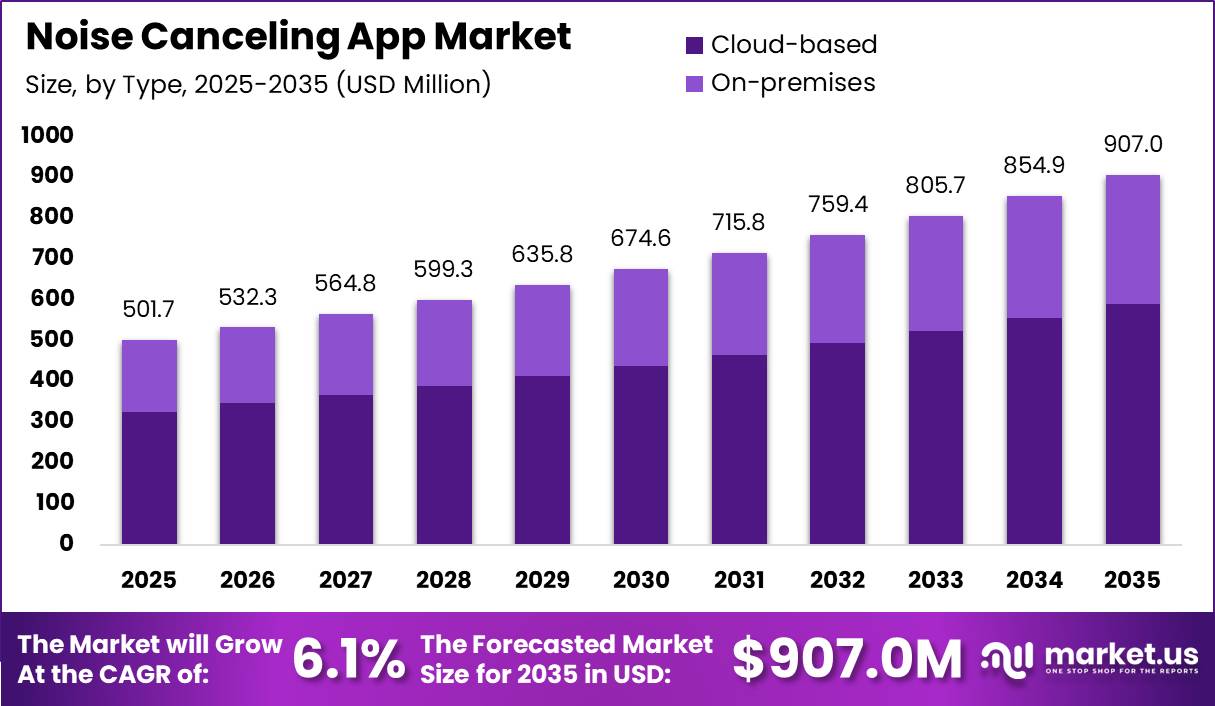
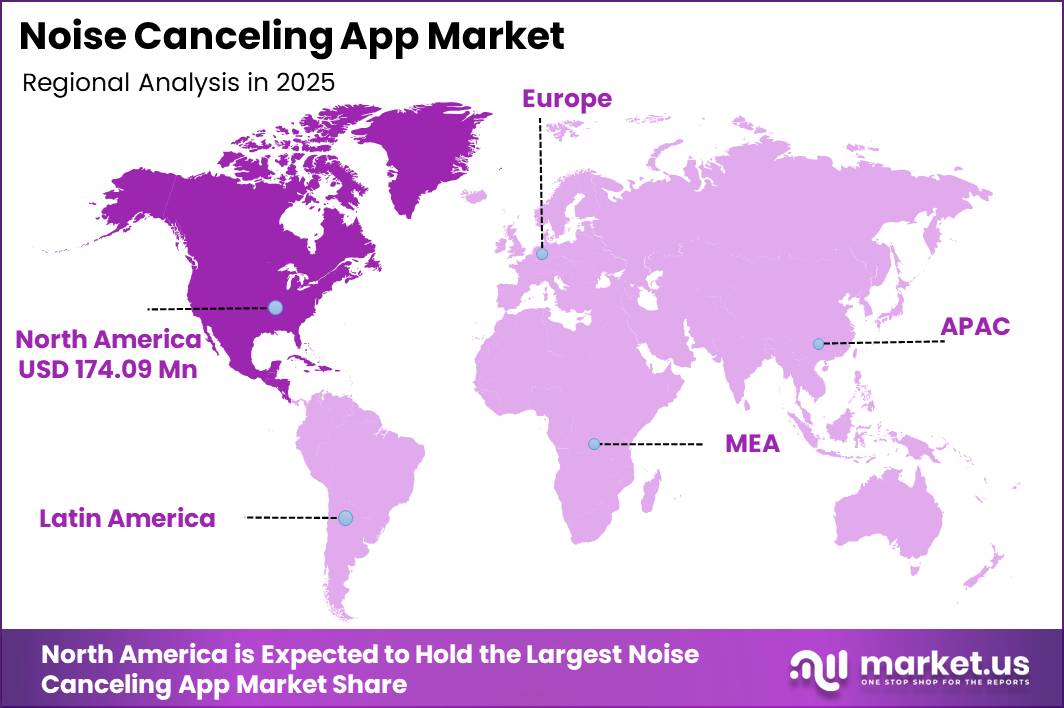
In 2025, the Global Noise Canceling App Market was valued at USD 501.7 million. The market is projected to grow at a CAGR of 6.1% during 2026–2035, reaching approximately USD 907.0 million by 2035. North America dominated the global market in 2025, accounting for more than 34.7% of the total market share and generating approximately USD 174.09 million in revenue.
Remote and hybrid working has created strong demand for affordable tools that improve call quality and concentration. According to the U.S. Bureau of Labor Statistics, 35.5 million Americans teleworked or worked from home during Q1 2024. The national telework rate reached 22.9%, compared with 19.6% one year earlier. Noise-cancelling applications offer a lower-cost alternative to premium headphones for professionals working in homes, shared offices, cafés, and co-working locations.
The expanding connected-device base also strengthens market opportunities. The International Telecommunication Union reported approximately 9.1 billion mobile-cellular subscriptions worldwide in 2024, while around 5.5 billion people were using the internet. This large digital population provides app developers with a broad distribution base across both developed and emerging economies.
Health concerns are another important growth factor. The World Health Organization estimates that more than 1.5 billion people experience some degree of hearing loss. It also warns that over 1 billion people aged 12–35 years may be at risk from unsafe listening practices. Noise-cancelling apps can help users hear audio clearly without significantly increasing volume levels.
Key Takeaway
- The Noise-Cancelling App Market is valued at USD 501.7 Million in 2025, projected to reach USD 907.0 Million by 2035 at a 6.1% CAGR.
- Cloud-based solutions held a 65% share of the Type segment, driven by rising enterprise cloud adoption.
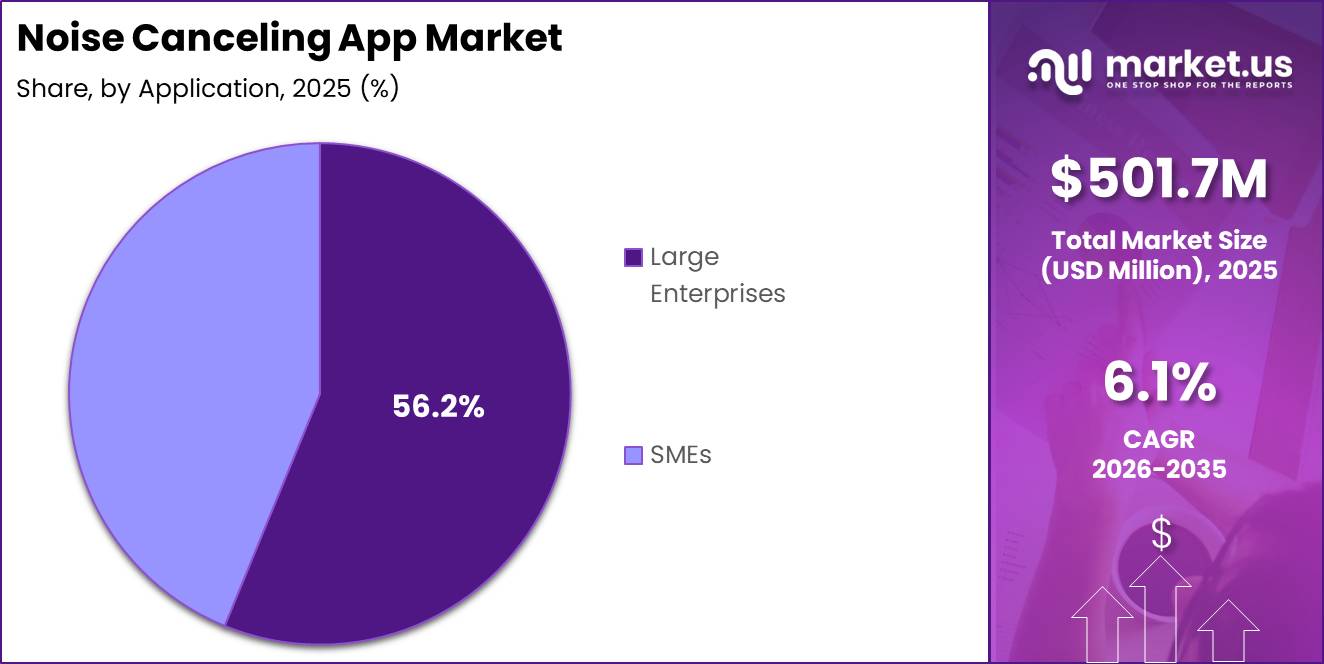
- Large enterprises accounted for a 56.2% share of the Application segment due to higher call volumes and centralized IT budgets.
- North America led the market with a 34.7% share, worth approximately USD 174.09 million in 2025.
Market Statistics and Data Insights
- In Q1 2024, 35.5 million people in the United States teleworked or worked from home, representing 22.9% of employed people at work, compared with 19.6% one year earlier. A Microsoft survey of 31,000 workers across 31 countries found that 68% lacked uninterrupted focus time, while employees spent 57% of their Microsoft 365 activity communicating through meetings, emails, and chats.
- ITU estimated that 6 billion people, equal to around 74% of the global population, used the internet in 2025. The world also had 9.2 billion mobile-cellular subscriptions, or 112 subscriptions per 100 inhabitants, while mobile broadband represented 89% of all mobile subscriptions.
- WHO reports that more than 1 billion people aged 12–35 are at risk of hearing loss from unsafe recreational listening. Around 20% of the global population currently experiences some degree of hearing loss, and unaddressed hearing loss creates an estimated annual economic cost of almost USD 1 trillion.
- WHO recommends keeping device volume at no more than 60% of maximum and maintaining an average sound exposure below 80 dB. Listening at 80 dB is considered safe for up to 40 hours per week, while at 90 dB the recommended period falls to 4 hours. WHO specifically recommends noise-cancelling headphones and sound-monitoring apps to reduce the need for higher volume.
- In 2025, 5G covered 84% of people in high-income economies but only 4% in low-income economies. Low-income-market 4G coverage stood at 56%, and active mobile-broadband penetration was 49 subscriptions per 100 people, compared with 99.4 globally. ITU states that 3G remains important for internet access in these markets, supporting opportunities for compressed, offline, or on-device noise reduction.
- In 2025, 85% of large EU enterprises purchased cloud services, compared with 52% of small and medium-sized enterprises. Among cloud users, 85% used the cloud for email, while 72% used it for office software and 72% for file storage. These centralized cloud environments are suitable for workforce-wide noise-cancellation licensing and administration.
- Microsoft Teams creates a voice profile using a recording lasting approximately 30 seconds. Zoom’s enhanced personalized isolation requires desktop version 6.0.0 or later and recommends at least 30 seconds of recorded speech, while storing the automatic voiceprint locally until deletion. This shows a movement toward speaker-specific filtering rather than general background-noise removal.
- In May 2026, Krisp reported that Turn Prediction v3 identified 47% more genuine turn shifts within the first 200 milliseconds than v2, without increasing false positives.
- In July 2025, Krisp reported that deployments using its VIVA voice-isolation SDK achieved 3.5 times better turn-taking accuracy, 50% fewer dropped calls, and 30% higher customer-satisfaction scores.
- In 2025, an independent TestDevLab evaluation found that Microsoft Teams achieved the highest overall noise-suppression Mean Opinion Score of 3.40 out of 5, compared with 3.25, 3.20, and 3.14 for three competing communication applications.
By Type
The Cloud-based segment held a dominant market position, accounting for a 65% share of the Noise Cancelling App Market. This leadership reflects the wider shift among enterprises and individual users from locally installed software toward flexible cloud services.
According to Eurostat, 52.7% of European Union enterprises purchased cloud computing services in 2025, representing an increase of 7.4 percentage points compared with 2023. Adoption was particularly high among large enterprises, reaching 77.6%.
Cloud infrastructure allows noise-cancelling applications to process audio through advanced artificial intelligence models without relying entirely on the user’s device. Developers can introduce algorithm improvements, security updates, and new features remotely, reducing the need for manual installation.
By Application
Large Enterprises held a dominant position in the Noise Cancelling App Market, accounting for a 56.2% share. Their leadership is supported by their significant contribution to global employment and their larger digital communication requirements.
According to the World Bank Enterprise Surveys, companies with 100 or more employees represent 41.2% of total employment worldwide. This share rises above 45% in high-income countries, showing the strong economic role of large organizations.
These organizations also have centralized information technology budgets and structured purchasing processes. This allows them to purchase bulk software licences and deploy applications across entire departments or workforces rather than relying on separate individual purchases. Enterprise-wide contracts increase both deployment speed and subscription value.
Key Market Segments
By Type
- Cloud-based
- On-premises
By Application
- SMEs
- Large Enterprises
Geopolitical Impact Analysis
Escalating trade tensions between the United States and China are reshaping the cost structure of the hardware and digital infrastructure supporting the Noise Cancelling App Market. Although noise-cancelling applications are software products, their performance depends heavily on semiconductor-based smartphones, batteries, electronic components, and cloud servers.
In 2025, Section 301 measures increased U.S. tariffs on certain Chinese semiconductors, batteries, and electronic components to as much as 145%. These duties were later partly reduced to a 10% baseline under the U.S.-China agreement announced in November 2025.
China’s retaliatory controls on exports of gallium, germanium, and rare-earth magnets also created supply concerns for smartphone and semiconductor manufacturers. Although some restrictions were suspended following the agreement, the earlier controls exposed the industry to component shortages, higher sourcing costs, and production delays.
Cloud infrastructure presents another geopolitical and operating challenge. The International Energy Agency reported that global data-centre electricity consumption reached 415 TWh in 2024, increasing by approximately 12% annually. The United States, Europe, and China together accounted for around 85% of this electricity demand. Energy-price volatility, grid congestion, and regional supply risks in these major markets can increase cloud-hosting expenses and affect service reliability.
During 2025, tariff rates ranged from a 10% baseline to peaks of 245% on selected Chinese electronic products. Supply-chain movement toward Vietnam, India, and Mexico has improved sourcing diversity but also added logistics expenses and longer lead times, potentially affecting device affordability and app adoption.
Regional Analysis
North America held a dominant position in the Noise Cancelling App Market, capturing a 34.7% share and generating approximately USD 174.09 million in 2025. The region benefits from advanced enterprise technology, high smartphone adoption, strong cloud infrastructure, and widespread remote working practices.
According to Ericsson, mobile data traffic in North America reached 8.7 exabytes per month in 2024, supporting real-time audio processing and cloud-based noise reduction. Large businesses also continue to invest in communication and productivity software, creating steady demand for enterprise noise-cancelling applications.
Asia Pacific is emerging as the fastest-growing regional market due to its rapidly expanding digital population. According to GSMA, the mobile industry contributed USD 950 billion to the region’s economy in 2024. The number of mobile internet users is expected to rise from nearly 1.4 billion in 2023 to around 1.8 billion by 2030.
The International Telecommunication Union reported that internet penetration in Asia Pacific reached 66% in 2024. Regional connectivity expanded at approximately 7.8% annually during the previous decade, compared with the global rate of 6.1%. In addition, mobile broadband subscriptions reached 97 per 100 inhabitants, while 5G coverage expanded significantly from its 3% level in 2020 through 2024.
Key Regions and Countries
North America
- US
- Canada
Europe
- Germany
- France
- The UK
- Spain
- Italy
- Rest of Europe
Asia Pacific
- China
- Japan
- South Korea
- India
- Australia
- Rest of APAC
Latin America
- Brazil
- Mexico
- Rest of Latin America
Middle East & Africa
- GCC
- South Africa
- Rest of MEA
Market Dynamics
Drivers
| Driver | (~) % CAGR | Geographic Relevance | Impact Timeline |
|---|---|---|---|
| Enterprise SaaS licensing shift | +1.6% | North America, Western Europe | Short term (2 years or less) |
| Hybrid work call-quality demand | +1.4% | Global | Short term (2 years or less) |
| Smartphone AI chipset diffusion | +1.1% | Asia Pacific | Short term (2 years or less) |
| Cloud-based real-time DSP adoption | +0.9% | Global | Medium term (2 to 4 years) |
| Rising unsafe-listening health awareness | +0.7% | North America, Europe | Medium term (2 to 4 years) |
Enterprise SaaS Licensing Shift
The migration of enterprise voice-communication tools from perpetual on-premises licences to per-seat SaaS subscriptions is strengthening the 2026 market baseline. Eurostat reported that paid cloud-service adoption among EU enterprises increased to 52.7% in 2025 from 45.2% in 2023, showing that more businesses are becoming comfortable with subscription-based digital platforms.
This shift toward SaaS could shorten customer-acquisition-cost payback periods by an estimated 15–20% compared with traditional licensing models, based on broader OECD enterprise software adoption patterns. Demand is also supported by remote and hybrid working, with U.S. Bureau of Labor Statistics data showing a telework rate of 23.4% in the fourth quarter of 2024.
A larger remote workforce gives vendors more potential seats to monetize through enterprise contracts. Together, recurring subscriptions, bulk licensing, higher revenue per customer, and lower customer churn are supporting the market’s 6.1% baseline CAGR through 2026.
Restraints
| Restraint | (~) % CAGR | Geographic Relevance | Impact Timeline |
|---|---|---|---|
| Voice-data privacy litigation exposure | -1.3% | North America, EU | Short term (2 years or less) |
| Venture capital funding scarcity | -0.9% | Global | Short term (2 years or less) |
| EU AI Act compliance burden | -0.7% | European Union | Short term (2 years or less) |
| Free native OS noise suppression | -0.6% | Global | Short term (2 years or less) |
Voice-Data Privacy Litigation Exposure
Active wiretap and biometric-privacy lawsuits against AI transcription and voice-processing providers are creating uncertainty in enterprise purchasing. Plaintiffs have alleged that some vendors intercepted voiceprint information without proper authorization under state wiretapping laws.
This compliance burden is particularly important for regulated large enterprises, which account for more than 41.2% of global formal employment according to the World Bank Enterprise Surveys. Procurement teams may delay multi-seat software approvals until legal, privacy, and security reviews are completed.
Based on the FTC’s enforcement approach toward AI-enabled consumer services, these additional reviews could extend vendor sales cycles by an estimated 3 to 6 months. Such delays can directly reduce near-term software bookings and slow enterprise adoption, rather than only limiting the market’s long-term growth potential.
Challenges
| Challenge | (~) % CAGR | Geographic Relevance | Mitigation Horizon |
|---|---|---|---|
| SME AI literacy gap | -0.8% | Global, OECD member states | Medium term (2 to 4 years) |
| Fragmented developer talent pool | -0.6% | North America, Asia Pacific | Medium term (2 to 4 years) |
| Data-center energy cost volatility | -0.5% | United States, Europe, China | Long term (4 years or more) |
| Cross-border tariff-driven device costs | -0.4% | North America, China | Medium term (2 to 4 years) |
SME AI Literacy Gap
Small and medium-sized enterprises remain an underpenetrated customer segment for noise-cancelling applications. According to the OECD ICT Access and Usage Database, only 11.9% of SMEs adopted artificial intelligence in 2024, compared with 40% of companies employing 250 or more workers. The OECD’s 2025 D4SME Survey also found that approximately 50% of surveyed SMEs across 4 G7 countries believed their employees lacked the skills needed to use generative-AI-related tools effectively.
Although this challenge does not prevent sales to large enterprises, it can slow the conversion of smaller businesses into paying users. SME use of AI applications increased from 26% to 39% between 2024 and 2025, showing improving interest. However, limited technical expertise and training resources may cause SME adoption to develop gradually over several years.
Opportunities
| Opportunity | (~) % CAGR | Geographic Relevance | Execution Window |
|---|---|---|---|
| API-based embedded developer monetization | +1.8% | Global | Medium term (2 to 4 years) |
| Emerging-market SME AI conversion | +1.2% | Asia Pacific, Latin America | Long term (4 years or more) |
| Voice-cloning adjacent monetization | +0.9% | North America, Europe | Medium term (2 to 4 years) |
| Healthcare hearing-safety partnerships | +0.6% | Global | Long term (4 years or more) |
API-Based Embedded Developer Monetization
Opening core audio-separation and noise-isolation engines to third-party developers through APIs represents genuine market white space rather than an established growth driver. OECD enterprise digitalization data shows that cloud-service penetration among enterprises exceeded 52% in advanced economies, creating a strong potential customer base for usage-based audio-processing APIs.
A usage-based API pricing model could improve blended gross margins by an estimated 8 to 12 percentage points compared with direct-to-consumer subscription sales. This approach allows high-volume enterprise integrators to absorb infrastructure costs on a per-call basis. Unit economics could improve further as per-minute processing costs decline through better data-centre computing efficiency.
Key Players Analysis
The Noise Cancelling App Market has a fragmented competitive structure, with a well-funded Tier-1 company operating alongside many smaller Tier-2 providers. Krisp represents the Tier-1 category, having raised approximately USD 25.5 million through its Series A and Series B funding rounds. The company received backing from Shasta Ventures and Sierra Ventures, making it one of the best-funded pure-play noise cancellation software providers.
Tier-2 companies operate with smaller teams, lower revenue, and limited external funding. LALAL.AI recorded an estimated annual recurring revenue of USD 2.6 million in 2025 and an estimated valuation of USD 7.9 million, while operating without disclosed external investment. SoliCall, a telephony-focused noise reduction provider founded in 2006, generated approximately USD 330,000 in revenue during 2025 with a team of 3 employees. The company has remained self-funded since its establishment.
Similar providers, including myNoise and Denoiser, generally follow lean, product-led growth strategies rather than relying on major acquisitions or capital-intensive expansion. Krisp’s stronger funding position allows it to develop broader enterprise capabilities and compete across multiple communication platforms.
In comparison, products such as Noise Killer and UrbanDenoiser remain focused on narrower functions and have no widely disclosed institutional funding. The market therefore includes many participants, but funding, revenue, and technology capabilities remain concentrated among a limited number of leading providers.
Top Key Players in the Market
- LALAL.AI
- Krisp
- Neutralizer
- Noise Killer
- Safe Headphones
- myNoise
- UrbanDenoiser
- Noise Wall
- Denoise
- Noise Blocker
- Noise Gator
- Samson Sound Deck
- Sleep Pillow
- DSP Soundware
- SoliCall
- Ams Active Noise Cancellation Software
- Denoiser
Recent Developments
- In 2025, LALAL.AI launched the Andromeda neural network as its most advanced audio-processing model. Trained using 4 times more data than its Perseus model, Andromeda delivered processing speeds up to 40% faster and improved Signal-to-Distortion Ratio performance by approximately 10%.
- In 2025, Krisp launched its VIVA voice-isolation model and software development kit on July 16. The technology was designed for voice-based artificial intelligence agents, providing real-time background-noise cancellation and voice isolation. At the time of launch, Krisp reported processing more than 1 billion minutes of voice audio per month across its global deployments.
Report Scope
| Report Features | Description |
|---|---|
| Market Value (2025) | USD 501.7 Million |
| Forecast Revenue (2035) | USD 907.0 Million |
| CAGR (2026-2035) | 6.1% |
| Base Year for Estimation | 2025 |
| Historic Period | 2020-2024 |
| Forecast Period | 2026-2035 |
| Report Coverage | Revenue Forecast, Market Dynamics, Competitive Landscape, Recent Developments |
| Segments Covered | By Type (Cloud-based, On-premises); By Application (SMEs, Large Enterprises) |
| Regional Analysis | North America – US, Canada; Europe – Germany, France, The UK, Spain, Italy, Rest of Europe; Asia Pacific – China, Japan, South Korea, India, Australia, Singapore, Rest of APAC; Latin America – Brazil, Mexico, Rest of Latin America; Middle East & Africa – GCC, South Africa, Rest of MEA |
| Competitive Landscape | LALAL.AI, Krisp, Neutralizer, Noise Killer, Safe Headphones, myNoise, UrbanDenoiser, Noise Wall, Denoise, Noise Blocker, Noise Gator, Samson Sound Deck, Sleep Pillow, DSP Soundware, SoliCall, Ams Active Noise Cancellation Software, Denoiser |
| Customization Scope | Customization for segments, region/country-level will be provided. Moreover, additional customization can be done based on the requirements. |
| Purchase Options | We have three licenses to opt for: Single User License, Multi-User License (Up to 5 Users), Corporate Use License (Unlimited Users and Printable PDF) |