


Report Overview
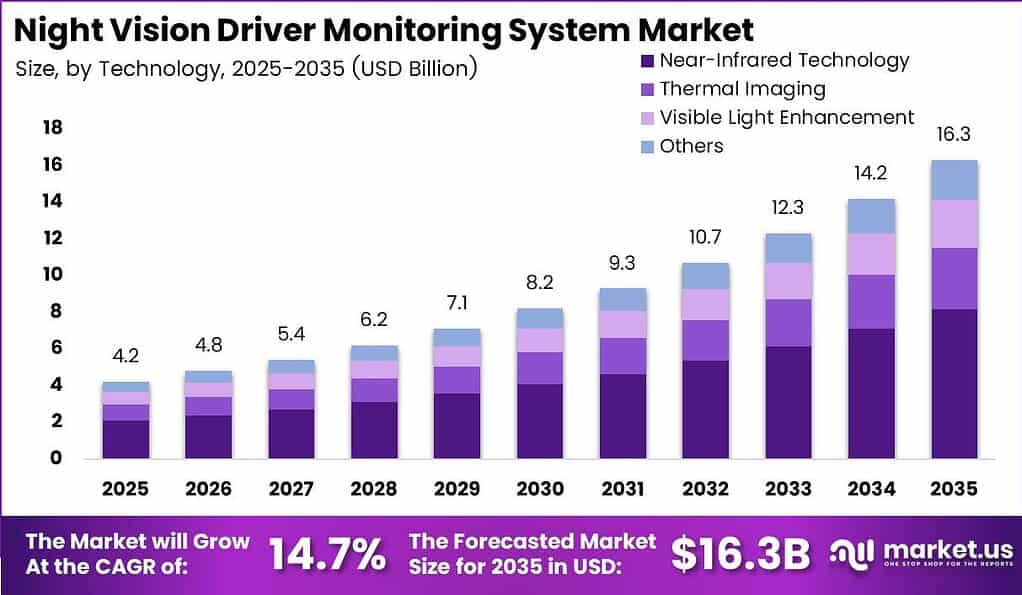
Global Night Vision Driver Monitoring System Market size is expected to be worth around USD 16.3 Billion by 2035 from USD 4.2 Billion in 2025, growing at a CAGR of 14.7% during the forecast period 2026 to 2035.
The night vision driver monitoring system market encompasses hardware and software technologies that track driver attention, drowsiness, and head position in low-light or zero-light conditions. Systems combine near-infrared cameras, thermal sensors, processors, and alert software into integrated cabin safety platforms. Passenger cars and commercial vehicles both drive demand across this market.
Key Takeaways
- The global Night Vision Driver Monitoring System Market was valued at USD 4.2 Billion in 2025 and is forecast to reach USD 16.3 Billion by 2035.
- The market is growing at a CAGR of 14.7% during the forecast period 2026 to 2035.
- By Technology, Near-Infrared Technology dominates with a 41.23% share in 2025.
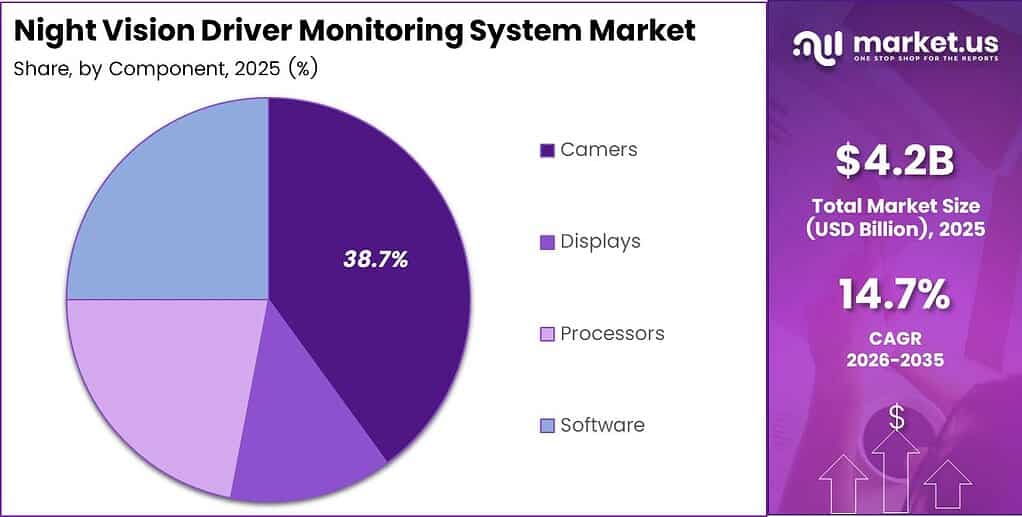
- By Component, Cameras hold the largest share at 38.78% and are the fastest-growing component.
- By Vehicle, Passenger Cars dominate with a 63.45% share and are the fastest-growing vehicle segment.
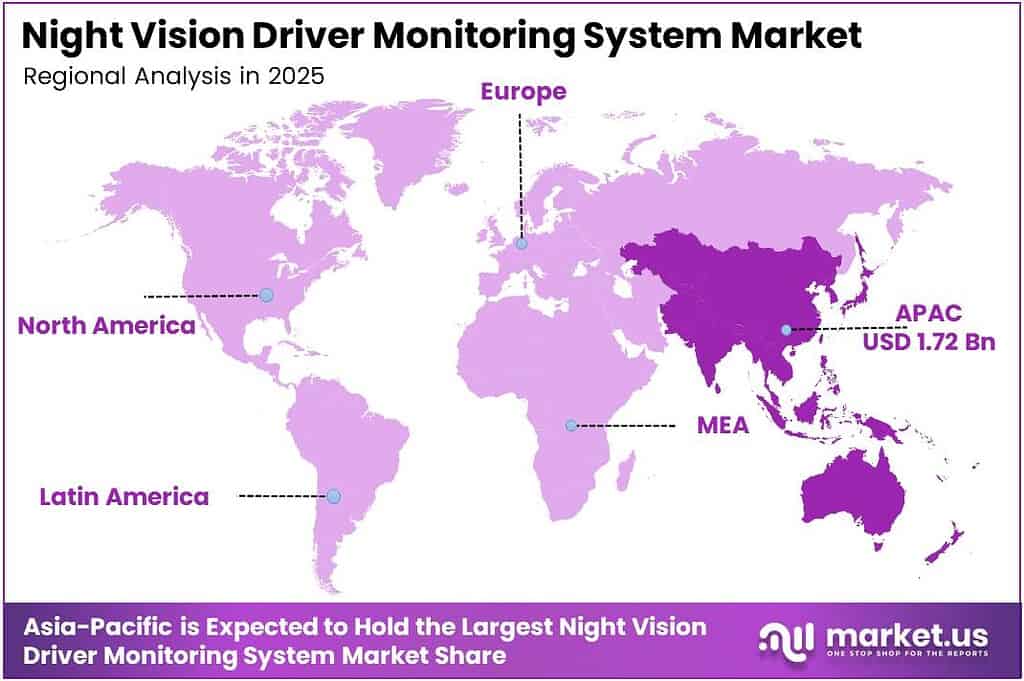
- Asia-Pacific leads all regions with a 40.65% share, valued at USD 1.72 Billion in 2025.
Government investment and regulatory enforcement are reshaping demand timelines across major markets. Continental allocated €400 million in annual administrative cost savings from 2025 to strengthen automotive competitiveness. These savings directly fund continued investment in driver-assistance development, ensuring that hardware and software content per vehicle rises rather than contracts in a cost-constrained environment.
According to the International Organization of Motor Vehicle Manufacturers, global motor-vehicle production increased from 92.7 million units in 2024 to 96.4 million units in 2025, a year-over-year rise of 3.9%. This expansion directly enlarges the addressable vehicle population for fitment. Global vehicle sales also rose from 95.3 million to 99.8 million units, a gain of 4.7%. Higher sales volumes accelerate the replacement cycle through which mandated safety systems enter the active fleet.
Data from the World Trade Organization shows world merchandise-trade volume grew 4.6% in 2025, outpacing its prior forecast of 2.4%. This trade acceleration supports cross-border component sourcing and finished-vehicle export flows that underpin supplier scale. However, the World Bank projects global goods-and-services trade growth to slow from 3.4% in 2025 to 2.2% in 2026. Suppliers must build supply-chain resilience now rather than assume continued volume tailwinds. The World Bank also projected global GDP growth of 2.5% in 2026 before firming in 2027 to 2028, signaling a brief consolidation window before a stronger demand cycle resumes.
Technology Analysis
Near-Infrared Technology dominates with 41.23% due to proven reliability in low-light cabin sensing.
In 2025, Near-Infrared Technology held a dominant market position in the By Technology segment of the Night Vision Driver Monitoring System Market, with a 41.23% share. Near-infrared systems deliver consistent facial and eye-tracking performance across a wide range of lighting conditions without emitting visible light. This makes them the preferred architecture for OEM fitment programs tied to regulatory mandates in Europe and advancing safety ratings globally.
Thermal Imaging is the fastest-growing technology sub-segment in this market. Thermal sensors detect body-heat signatures independent of ambient light, enabling driver-state inference even when infrared illumination fails or is obstructed. As reported by the International Organization of Motor Vehicle Manufacturers, China’s new-energy-vehicle production reached 16.626 million units in 2025, up 29% year over year. New-energy vehicles require more sophisticated cabin-sensing architectures, creating direct design-win opportunities for thermal suppliers on premium EV platforms in China and export markets.
Visible Light Enhancement technology addresses daytime and urban driving conditions where ambient light is sufficient but driver-state classification still requires optical analysis. This sub-segment serves vehicle programs that need cost-effective compliance with indirect attention-warning standards. Other technologies, including multi-spectral and hybrid sensor fusion approaches, hold the remaining share and support niche defense, luxury, and prototype applications where unit economics allow higher sensor costs per vehicle.
Component Analysis
Cameras dominate with 38.78% due to their central role in all cabin-sensing architectures.
In 2025, Cameras held a dominant market position in the By Component segment of the Night Vision Driver Monitoring System Market, with a 38.78% share, and are also the fastest-growing component sub-segment. Cameras form the primary data-capture layer in every night-vision driver monitoring architecture, and their unit count scales directly with vehicle production volume. Valeo estimated the global driver-monitoring-system market grew from about 1 million units in 2020 to 22 million units in 2025, a trajectory that compresses camera supplier lead times and raises production tooling requirements across the supply chain.
Displays serve as the human-machine interface layer that translates driver-state alerts into actionable warnings for the vehicle occupant. Display content, brightness calibration, and alert sequencing directly affect user acceptance rates, which in turn determine whether OEMs retain or remove monitoring features after initial deployment. Suppliers that can integrate display output with seat, steering, and powertrain response signals hold a differentiation advantage in platform bids.
Processors handle the real-time inference load for driver-state classification, translating raw camera data into latency-compliant alert decisions. Processor selection defines the boundary between on-device and cloud-dependent architectures, a critical distinction for programs requiring functional-safety certification. Software rounds out the component structure by providing the algorithm layers, validation frameworks, and over-the-air update pathways that determine system accuracy across driver populations, lighting conditions, and geographic markets.
Vehicle Analysis
Passenger Cars dominate with 63.45% due to higher production volumes and earlier regulatory exposure.
In 2025, Passenger Cars held a dominant market position in the By Vehicle segment of the Night Vision Driver Monitoring System Market, with a 63.45% share, and are also the fastest-growing vehicle sub-segment. India’s passenger-vehicle sales reached a record 4.3 million units in FY 2024 to 2025, rising 2% from the prior year according to the Society of Indian Automobile Manufacturers. Utility vehicles accounted for 65% of that total, indicating that higher-spec vehicle types within the passenger segment are gaining share and pulling premium safety content with them.
India’s passenger-vehicle sales further reached a record 4.643 million units in FY 2025 to 2026, an increase of 7.9%, as reported by the Society of Indian Automobile Manufacturers. Passenger-vehicle exports also reached a record 905,000 units in FY 2025 to 2026, rising 17.5% versus the prior fiscal year. Export growth signals that Indian-manufactured vehicles are entering markets where safety mandates are stricter, creating indirect pull for monitoring system fitment on export-oriented platforms.
Passenger-vehicle sales in India were 1.012 million units in Q1 FY 2025 to 2026, down 1.4%, and 1.039 million units in Q2, down 1.5%, both compared with the prior year periods per the Society of Indian Automobile Manufacturers. This quarterly softness contrasts with the full-year record, indicating that volume recovered sharply in the second half of the fiscal year. Suppliers must align production and inventory planning with back-half demand concentration to avoid margin pressure from underutilized capacity in early quarters.
Commercial Vehicles represent the second vehicle segment and encompass trucks, buses, and vans where driver fatigue carries the highest consequence per incident. The European Automobile Manufacturers’ Association reported approximately 30.1 million vans in the EU in 2023, up 1.7% year over year, with 1.3% electrically chargeable. The EU also had about 6 million trucks averaging 14.1 years in age and approximately 680,000 buses, with 3% electrically chargeable.
Aisin formulated its 2025 medium-term management plan, allocating an additional ¥500 billion of strategic investments toward BEV and intelligence initiatives, directly supporting next-generation monitoring system integration on electrified commercial platforms. The EU’s extensive and aging commercial fleet presents a long-term replacement-driven fitment opportunity as emission and safety retrofit cycles force fleet renewal. The European Automobile Manufacturers’ Association also reported the EU had 249 million cars on its roads in 2023, up 1.4%, reinforcing the scale of the total addressable vehicle parc across both passenger and commercial categories.
Key Market Segments
By Technology
- Near-Infrared Technology
- Thermal Imaging
- Visible Light Enhancement
- Others
By Component
- Cameras
- Displays
- Processors
- Software
By Vehicle
- Passenger Cars
- Commercial Vehicles
Regional Analysis
Asia-Pacific Dominates the Night Vision Driver Monitoring System Market with a Market Share of 40.65%, Valued at USD 1.72 Billion
Asia-Pacific commands the largest regional share at 40.65%, underpinned by the scale of its vehicle production base. Data from the International Organization of Motor Vehicle Manufacturers shows Asia-Pacific vehicle production increased 7.6% to approximately 59.2 million units in 2025, representing more than 61% of global output. China alone produced 34.53 million motor vehicles in 2025. This concentration of production volume creates a structurally large and captive fitment opportunity for night-vision monitoring suppliers embedded in East Asian supply chains.
Europe is the fastest-growing regional market, driven by its mandatory Driver Drowsiness and Attention Warning regulatory framework. Europe’s total vehicle production declined 0.8% to 17.2 million units in 2025, while regional sales fell 0.4% to 18.63 million units per the International Organization of Motor Vehicle Manufacturers. ZF disclosed plans to transfer its ADAS business, including smart cameras, radar technology, and driver-assistance software, to an acquirer in the second half of 2026. This structural consolidation signals that European ADAS supply chains are reorganizing, creating design-win openings for suppliers able to step into gaps left by divested business units.
North America recorded a production decline of 2.1% to 18.74 million units in 2025, while sales increased 2.9% to 24.86 million units according to the International Organization of Motor Vehicle Manufacturers. The positive sales-to-production gap confirms that North American demand draws on imports and inventory rather than purely domestic output. India’s full-year passenger-vehicle sales reached 4.643 million units in FY 2025 to 2026, a 7.9% increase, while exports hit a record 905,000 units. These figures confirm India’s dual role as both a consumption market and a growing export base feeding regions where safety content mandates are already in force.
Key Regions and Countries
North America
- US
- Canada
Europe
- Germany
- France
- The UK
- Spain
- Italy
- Rest of Europe
Asia Pacific
- China
- Japan
- South Korea
- India
- Australia
- Rest of APAC
Latin America
- Brazil
- Mexico
- Rest of Latin America
Middle East and Africa
- GCC
- South Africa
- Rest of MEA
Market Dynamics
Market Opportunity Analysis - Passenger car growth, fleet electrification, and emerging market demand create distinct entry points for focused suppliers
Passenger Cars hold a 63.45% share but remain unevenly penetrated by night-vision monitoring within that base. Mid-range passenger vehicles in Asia-Pacific are the largest underexploited sub-segment because platform economics have historically prioritized powertrain and connectivity content over cabin sensing. As India’s passenger-vehicle exports grow and enter regulated markets, safety content requirements on those export-oriented platforms will pull fitment upstream into the domestic manufacturing base.
Commercial Vehicles carry the highest fatigue-incident consequence per event yet remain below passenger-car penetration rates for in-cabin monitoring systems. Trucks averaging 14.1 years in age across the EU fleet signal a fleet-renewal cycle that will reset safety system content standards. This renewal cycle creates a bounded, predictable demand window for suppliers who position monitoring systems as fleet-risk-management tools rather than standalone safety features.
Thermal Imaging is the fastest-growing technology sub-segment but remains a minor share of total deployments today. New-energy vehicles, which reached 16.626 million production units in China in 2025, require cabin architectures built from scratch rather than adapted from internal-combustion platforms. This creates a design-in window for thermal suppliers to establish positions on EV platforms before incumbent near-infrared vendors lock in long-term supply agreements.
Software as a component sub-segment is undervalued relative to its margin potential. Hardware suppliers that control the algorithm layer, validation framework, and over-the-air update pathway can charge recurring license fees per vehicle per year. By contrast, suppliers that deliver only hardware cede the highest-margin revenue stream to software-defined vehicle platform vendors who enter later with lower capital requirements.
Technology and Innovation Landscape - Near-infrared dominance, thermal growth, and software-defined architectures define the next competitive divide
Near-infrared technology holds a 41.23% share and anchors the current technology baseline. Its dominance reflects the accumulated investment in camera optics, illumination engineering, and algorithm training that suppliers have built over multiple regulatory cycles. This installed knowledge base creates a switching cost for OEMs that have already validated near-infrared systems and embedded them into platform type-approval documentation.
Thermal Imaging is the fastest-growing technology because it operates independent of illumination, resolving the core nighttime limitation of camera-based approaches. New-energy vehicle platforms offer the clearest adoption pathway because their cabin architectures are designed without legacy near-infrared constraints. Suppliers who build thermal sensor calibration and algorithm expertise now will be better positioned to win design slots on EV platforms before the segment matures.
DENSO’s Global Safety Package 3 achieved 37% coverage of fatal-accident scenarios in fiscal 2025, with a stated target of 80% by fiscal 2031 and 100% by fiscal 2036. This scenario-coverage roadmap illustrates that leading ADAS suppliers treat algorithm completeness as a long-horizon engineering objective rather than a product feature. Suppliers that cannot demonstrate measurable progress on scenario coverage will face declining design-win relevance as OEM procurement teams benchmark against DENSO’s published targets.
Software-defined vehicle platforms shift value from sensor hardware toward algorithm licensing, over-the-air model updates, and functional-safety certification services. Valeo’s €24.6 billion order intake in 2025, rising 38% over the year, reflects how quickly content-per-vehicle is expanding as OEMs consolidate cabin-sensing functions onto fewer, more capable software platforms. Suppliers without a credible software revenue model will find hardware margins under pressure as platform consolidation concentrates purchasing power among a smaller number of large OEM programs.
Drivers
The European Union’s compulsory Driver Drowsiness and Attention Warning requirement applied to new vehicle types from 6 July 2022 and to all newly registered passenger and commercial vehicles from 7 July 2024. This mandate converts in-cabin monitoring from an optional feature into a type-approval requirement. Every affected platform now requires validated sensing, warning logic, and software support, lifting camera, infrared, and processor content per vehicle.
Suppliers delivering night-capable infrared systems with low false-alert rates can capture higher software and validation revenue per unit. Evolving safety-assessment protocols reward continuous eye and head tracking rather than indirect steering inference. Vendors dependent on lower-cost indirect sensing face shrinking design-win relevance as OEMs align platform architectures with the 2024 registration deadline and beyond.
| Driver | (~) % Impact on CAGR Forecast | Geographic Relevance | Impact Timeline |
|---|---|---|---|
| EU DDAW fitment mandate | +2.6% | European Union and UNECE-aligned markets | Short term (≤ 2 years) |
| Level 2 ADAS engagement demand | +1.8% | Europe, North America, China, Japan and South Korea | Short term (≤ 2 years) |
| Premium-vehicle safety differentiation | +1.3% | North America, Europe, China and Gulf markets | Medium term (2–4 years) |
| Infrared sensor cost reduction | +1.1% | Global, led by East Asian supply chains | Medium term (2–4 years) |
| Fleet fatigue-risk management | +0.9% | North America, Europe, Australia, India and Gulf markets | Medium term (2–4 years) |
| Direct eye-tracking safety ratings | +0.8% | Europe, China and export-oriented vehicle platforms | Short term (≤ 2 years) |
Restraints
Night-vision driver monitoring architectures require a near-infrared camera, illumination, optical stack, processor capacity, thermal design, software integration, and vehicle-level validation. In entry-level vehicle programs, even a low-single-digit content increase within the electronics bill can trigger substitution with indirect drowsiness logic. This suppresses penetration in price-sensitive segments across India, Southeast Asia, Latin America, and Africa.
Suppliers carry non-recurring engineering, functional-safety, and validation costs across vehicle variants, creating a volume threshold below which program economics deteriorate. Competitive bidding on high-volume programs can compress supplier pricing by an estimated 3% to 6%. This delays capital allocation for dedicated in-cabin architectures and slows revenue contribution from lower-priced market tiers.
| Restraint | (~) % Impact on CAGR Forecast | Geographic Relevance | Impact Timeline |
|---|---|---|---|
| Entry-vehicle bill-of-material pressure | -2.2% | India, Southeast Asia, Latin America, Africa and price-sensitive China segments | Short term (≤ 2 years) |
| Weak regulatory pull outside Europe | -1.6% | India, Southeast Asia, Latin America, Middle East and Africa | Medium term (2–4 years) |
| Vehicle-production cyclicality | -1.2% | Global | Short term (≤ 2 years) |
| Privacy-driven feature limitations | -1.0% | Europe, North America, China and South Korea | Medium term (2–4 years) |
| Aftermarket retrofit infeasibility | -0.8% | Global, especially ageing vehicle fleets | Long term (≥ 4 years) |
| OEM sourcing concentration | -0.7% | Global | Medium term (2–4 years) |
Challenges
Driver-state inference must remain reliable through darkness, sunlight transitions, spectacles, sunglasses, masks, facial-hair variation, head rotation, road vibration, and cabin reflections, all at automotive-grade latency. Systems that generate false warnings during real-world driving prompt users to disable alerts. This erodes safety benefit and weakens OEM platform confidence in the supplier’s technology stack.
Teams must collect and label large multi-condition datasets, retrain models continuously, and sustain sub-second detection-to-warning workflows on constrained processors. Euro NCAP’s 2026 framework increases the performance bar by rewarding continuous eye and head tracking and driver-state integration into assistance sensitivity. This raises development and revalidation expenditure even as it improves long-term system value for suppliers who meet the standard.
| Challenge | (~) % CAGR Friction Drag | Geographic Relevance | Mitigation Horizon |
|---|---|---|---|
| Nighttime algorithm robustness | -1.9% | Global | Long term (≥ 4 years) |
| Edge-compute thermal constraints | -1.4% | Global, especially hot-climate markets | Medium term (2–4 years) |
| Driver-demographic dataset gaps | -1.3% | Global | Long term (≥ 4 years) |
| Cybersecurity lifecycle compliance | -1.1% | Europe, Japan, South Korea and UNECE markets | Medium term (2–4 years) |
| False-alert user acceptance | -1.0% | Global | Medium term (2–4 years) |
| Multi-tier component traceability | -0.8% | Global | Medium term (2–4 years) |
Opportunities
Commercial-fleet safety subscriptions remain underexploited because current deployments monetize hardware rather than recurring risk-management services. The white space lies in combining night-capable driver-state sensing with fleet dashboards, fatigue-risk scoring, and insurer-compatible safety reporting. A subscription model can shift supplier economics toward recurring software revenue with gross-margin potential roughly 15% to 25% percentage points above hardware-only content after platform scale is reached.
Reducing preventable fatigue events, manual video-review time, and unscheduled vehicle downtime improves fleet unit economics. This supports higher system attachment rates without requiring equivalent increases in sensor cost per vehicle. Early movers who build data-aggregation and coaching workflow capabilities now will establish switching-cost advantages before larger software-defined vehicle platform vendors enter the fleet analytics space.
| Opportunity | (~) % Potential CAGR Upside | Geographic Relevance | Execution Window |
|---|---|---|---|
| Commercial-fleet safety subscriptions | +2.1% | North America, Europe, India, Australia, Gulf markets and Latin America | Medium term (2–4 years) |
| Impairment-detection sensor fusion | +1.8% | North America, Europe, Japan, South Korea and Australia | Long term (≥ 4 years) |
| Occupant-monitoring platform expansion | +1.6% | Europe, China, North America and Japan | Medium term (2–4 years) |
| Cabin-sensing software licensing | +1.4% | Global software-defined vehicle platforms | Medium term (2–4 years) |
| Low-cost emerging-market architectures | +1.2% | India, ASEAN, Latin America, Africa and Middle East | Long term (≥ 4 years) |
| Insurance-linked risk analytics | +0.9% | North America, Europe, Australia and select Asian markets | Long term (≥ 4 years) |
Key Company Insights
AISIN SEIKI Co., Ltd. positions itself at the intersection of electrification and intelligent cabin systems through its 2025 medium-term management plan, which allocates an additional ¥500 billion of strategic investment toward BEV and intelligence initiatives over three years. This capital commitment signals that Aisin is building the platform architecture required to integrate driver-monitoring functions into next-generation electrified vehicles rather than treating them as add-on sensors.
Valeo reported €20.9 billion in sales and €24.6 billion in order intake in 2025, with order intake rising 38% over the year. This order-to-sales ratio above 1.0 confirms that future revenue is being booked ahead of delivery. Valeo also completed modernization at its Angers automotive-lighting site, representing more than €45 million in investment during 2023 to 2026, and announced a $450 million non-dilutive convertible bond offering in January 2026 to fund continued capacity and technology deployment.
DENSO Corporation reported ¥503.0 billion in ADAS-domain sales in fiscal 2025, targeting ¥520.0 billion under its medium-term plan, and achieved 37% coverage of fatal-accident scenarios with targets of 80% by fiscal 2031 and 100% by fiscal 2036. DENSO also announced a five-year plan to invest ¥3.7 trillion in R&D across electrification and intelligence domains in April 2026.
DENSO further expanded its ADAS development effort as part of a consolidated revenue base of ¥7,540.0 billion and operating profit of ¥552.5 billion for the fiscal year ended March 31, 2026. Magna International reported full-year 2025 sales of $42.0 billion, adjusted EBIT of $2.4 billion, and free cash flow of $1.9 billion, and subsequently entered agreements to divest its Lighting and Rooftop Systems businesses, which generated approximately $1.1 billion in combined global sales, signaling a strategic focus shift toward higher-margin technology content.
Key Players
- AISIN SEIKI Co., Ltd.
- Valeo
- Veoneer Inc.
- OMRON Corporation
- Magna International Inc.
- DENSO CORPORATION
- ZF Friedrichshafen AG
- Aptiv
- Robert Bosch GmbH
- Continental AG
- Autoliv Inc.
- Visteon Corporation
Recent Developments
- March 2025 – Continental AG announced an investment of almost €75 million over three years in two German locations for driver-assistance-system development, with around €25 million allocated to new office and workshop space.
- January 2025 – Aptiv PLC announced plans to execute a tax-free spin-off of its Electrical Distribution Systems business, with 2025 full-year net-sales guidance of $19.6 billion to $20.4 billion for the company at the time of announcement.
- January 2026 – Valeo completed a $450 million offering of non-dilutive cash-settled convertible bonds to fund continued capacity and technology deployment.
- September 2024 – DENSO Corporation announced a new plant through expansion of its Zenmyo Plant in Nishio, Aichi, with a total investment of approximately ¥69 billion; construction is scheduled to begin in the first half of FY2025 and production in the first half of FY2028.
- July 2026 – Continental AG signed an agreement to sell its ContiTech group sector to Lone Star Funds at an enterprise value of €4.0 billion, plus potential performance-based components of up to €250 million, with expected cash proceeds of approximately €3.1 billion at closing.
- April 2026 – Valeo contracted to repurchase a maximum of 3.325 million shares for up to €45 million between April 7 and May 20, 2026.
- March 2026 – Continental AG’s ContiTech Surface Solutions business commissioned a new gravure-printing machine at its Weissbach, Germany, site, requiring investment in the mid-single-digit-million-euro range.
- May 2026 – Magna International reported 3% sales growth to $10.38 billion in Q1 2026, with new program launches among the contributing factors and $520 million of reported-sales uplift from currency strengthening identified.
Report Scope
| Report Features | Description |
|---|---|
| Market Value (2025) | USD 4.2 Billion |
| Forecast Revenue (2035) | USD 16.3 Billion |
| CAGR (2026-2035) | 14.7% |
| Base Year for Estimation | 2025 |
| Historic Period | 2020-2024 |
| Forecast Period | 2026-2035 |
| Report Coverage | Revenue Forecast, Market Dynamics, Market Opportunity Analysis, Technology and Innovation Landscape, Competitive Landscape, Recent Developments |
| Segments Covered | By Technology (Near-Infrared Technology, Thermal Imaging, Visible Light Enhancement, Others), By Component (Cameras, Displays, Processors, Software), By Vehicle (Passenger Cars, Commercial Vehicles) |
| Regional Analysis | North America (US and Canada), Europe (Germany, France, The UK, Spain, Italy, and Rest of Europe), Asia Pacific (China, Japan, South Korea, India, Australia, and Rest of APAC), Latin America (Brazil, Mexico, and Rest of Latin America), Middle East and Africa (GCC, South Africa, and Rest of MEA) |
| Competitive Landscape | AISIN SEIKI Co., Ltd., Valeo, Veoneer Inc., OMRON Corporation, Magna International Inc., DENSO CORPORATION, ZF Friedrichshafen AG, Aptiv, Robert Bosch GmbH, Continental AG, Autoliv Inc., Visteon Corporation |
| Customization Scope | Customization for segments, region/country-level will be provided. Additional customization can be done based on requirements. |
| Purchase Options | We have three licenses to opt for: Single User License, Multi-User License (Up to 5 Users), Corporate Use License (Unlimited User and Printable PDF) |





































