


Global Multi-Modal AI Platform Market Size, Share and Analysis Report By Offering (Solutions, Services), By Data Modality (Image Data, Text Data, Speech & Voice Data, Video Data, Audio Data, Others), By Technology (Machine Learning, Natural Language Processing, Computer Vision, Context Awareness, Internet of Things), By Type (Generative Multimodal AI, Translative Multimodal AI, Explanatory Multimodal AI, Interactive Multimodal AI), By Industry (Media & Entertainment, BFSI, IT & Telecommunication, Healthcare, Automotive & Transportation, Gaming, Others), By Regional Analysis, Global Trends and Opportunity, Future Outlook By 2025-2035
- Published date: Jan. 2026
- Report ID: 174502
- Number of Pages: 214
- Format:
-
keyboard_arrow_up
Quick Navigation
- Report Overview
- Top Market Takeaways
- Quick Market Facts
- Drivers Impact Analysis
- Risk Impact Analysis
- Restraint Impact Analysis
- By Offering
- By Data Modality
- By Technology
- By Type
- By Industry
- By Region
- Investor Type Impact Matrix
- Technology Enablement Analysis
- Opportunity Analysis
- Challenge Analysis
- Emerging Trends
- Growth Factors
- Key Market Segments
- Competitive Analysis
- Recent Developments
- Report Scope
Report Overview
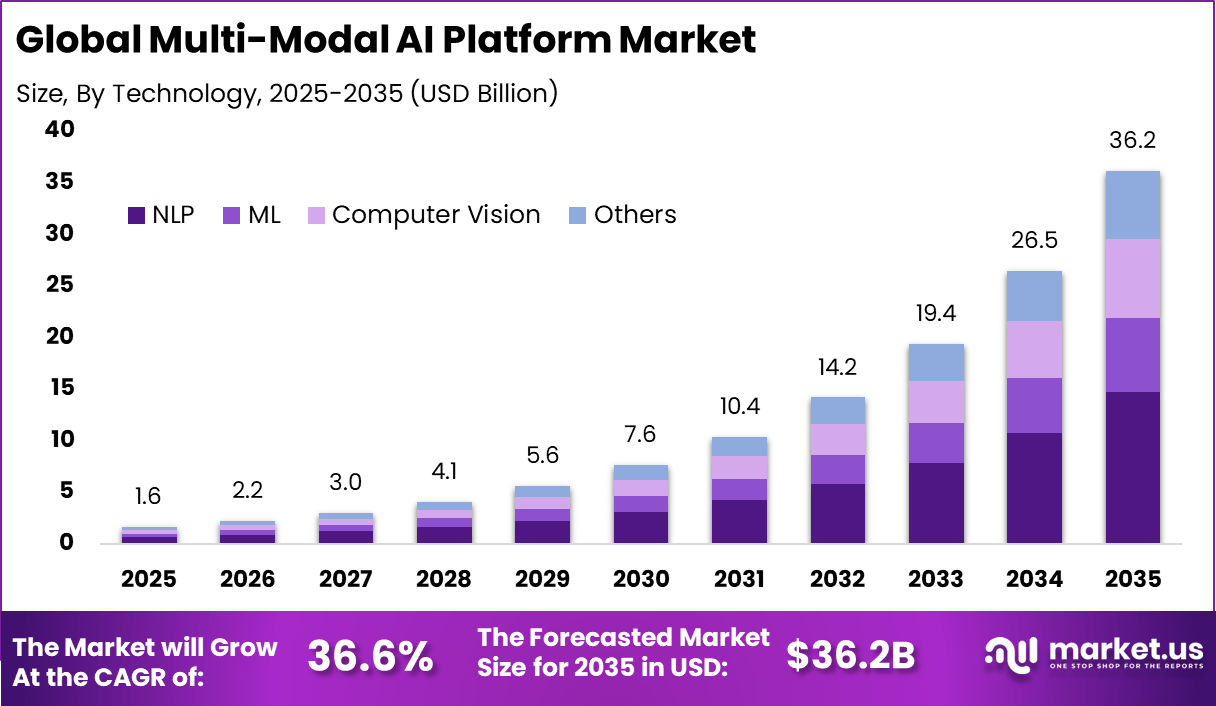
The Global Multi-Modal AI Platform Market size is expected to be worth around USD 36.2 Billion By 2035, from USD 1.6 billion in 2025, growing at a CAGR of 36.6% during the forecast period from 2026 to 2035. North America held a dominan Market position, capturing more than a 43.6% share, holding USD 0.6 Billion revenue.
The multi modal AI platform market refers to systems that can process and understand multiple types of data such as text, images, audio, video, and structured data within a single platform. These platforms combine different AI models to deliver more comprehensive analysis and decision support. Multi modal AI platforms are used across enterprise applications, healthcare, retail, media, and industrial operations. They support use cases that require context across different data formats.
Adoption is increasing as organizations seek more holistic intelligence from their data. Market development has been influenced by limitations of single-data-type AI systems. Many real-world problems involve information from multiple sources and formats. Multi modal platforms address this challenge by integrating insights across data types. This leads to more accurate understanding and response generation. As data ecosystems become more complex, demand for unified AI platforms grows.
One major driving factor of the multi modal AI platform market is the growing volume of diverse data generated by digital systems. Organizations collect information from documents, sensors, videos, customer interactions, and voice channels. Managing these data streams separately reduces insight quality. Multi modal platforms unify analysis across formats. This improves decision accuracy.
Demand for multi modal AI platforms is influenced by enterprise digital transformation initiatives. Organizations seek platforms that reduce complexity by consolidating AI capabilities. Unified systems simplify deployment and management. Multi modal platforms reduce dependency on multiple tools. This operational efficiency increases demand.
Top Market Takeaways
- Solutions dominated the market with an 85.4% share, as enterprises favored end to end platforms that combine data ingestion, model orchestration, and deployment across multiple modalities.
- Text data remained the most widely used modality with a 42.3% share, reflecting its central role in enterprise knowledge management, customer interaction, and content driven AI applications.
- Natural language processing led technology adoption with a 40.6% share, supported by strong demand for conversational AI, document understanding, and language based analytics.
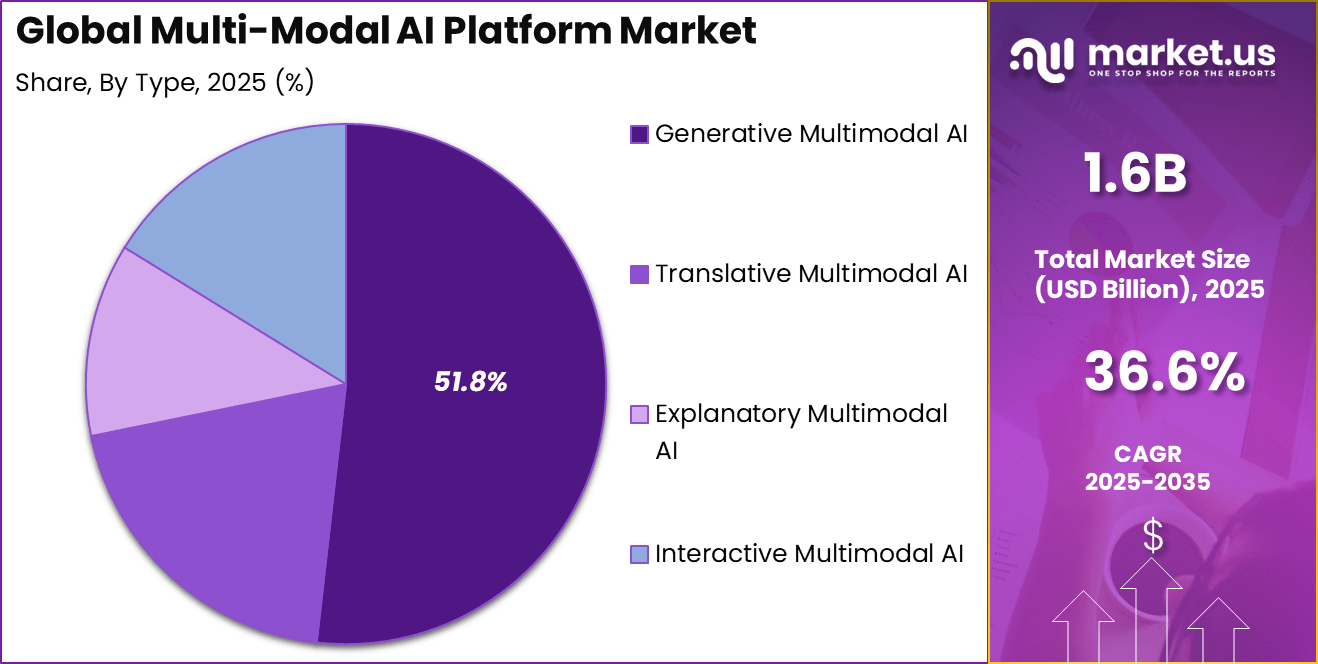
- Generative multimodal AI accounted for a 51.8% share, highlighting rapid adoption of models capable of producing and reasoning across text, images, audio, and video within unified workflows.
- The IT and telecommunications sector represented 28.1% of industry demand, driven by use cases such as network intelligence, customer support automation, and large scale data analysis.
- North America held a leading 43.6% share, supported by advanced AI ecosystems, strong cloud infrastructure, and early enterprise adoption of multimodal platforms.
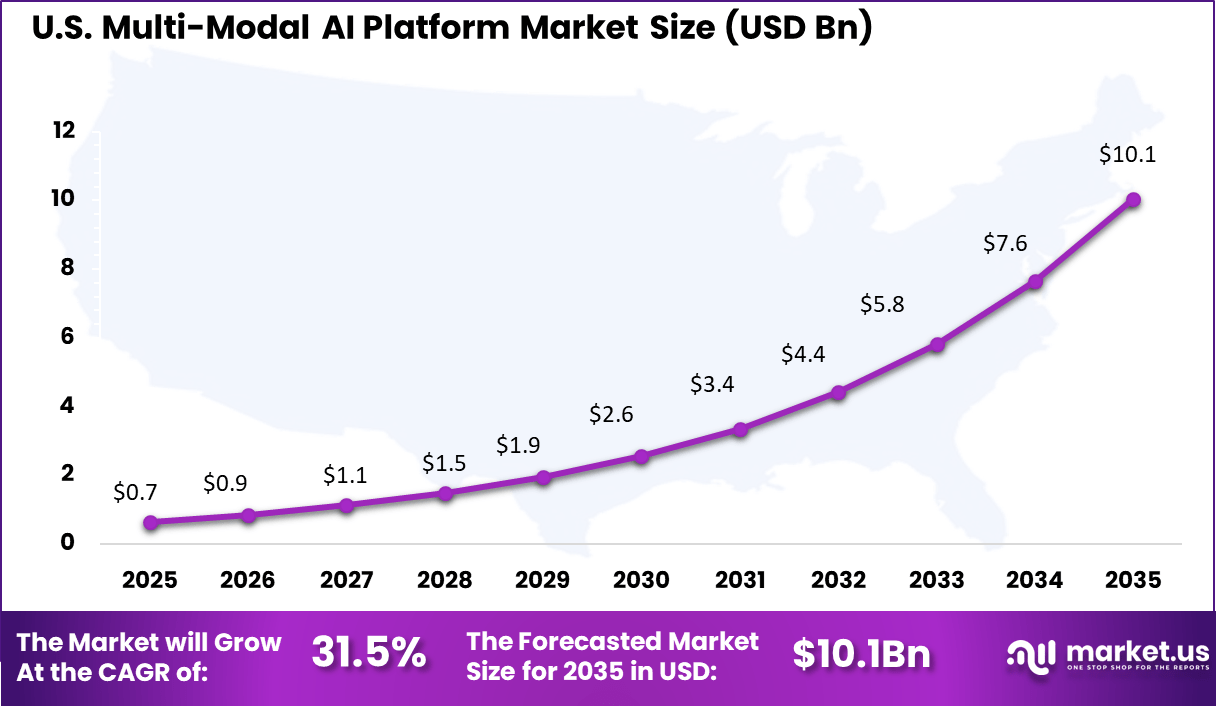
- The U.S. market reached USD 0.65 billion, expanding at a strong 31.5% growth rate, driven by accelerated AI investment, generative model innovation, and broad enterprise deployment.
Quick Market Facts
Adoption and Usage Insights
- Enterprise adoption reached a broad base by 2026, as nearly 60% of enterprise applications were built using models that combine two or more data modalities such as text, images, audio, or video. This shift reflected growing demand for richer context and higher accuracy in AI driven decision making.
- Operational integration advanced rapidly in the United States, with about 47% of enterprises fully embedding multi modal AI into daily workflows to improve efficiency, automation, and user experience.
- Generative AI expansion accelerated across the software ecosystem. By 2026, around 80% of software vendors were expected to embed generative and increasingly multi modal AI capabilities into their products, up sharply from less than 1% in 2023.
Usage Patterns by Industry
- Healthcare emerged as the leading sector with a 34% to 39% share, using multi modal AI to combine medical imaging, clinical notes, and patient records for diagnostics. Hospital deployments recorded accuracy improvements of about 46% in clinical trials.
- Retail and e commerce accounted for roughly 22% of usage and represented the fastest growing sector, expanding at a 29% pace. In the Asia Pacific region, more than 68% of e commerce platforms adopted multi modal search and recommendation tools.
- Financial services showed about 18% adoption, focusing on secure authentication through facial and voice recognition and advanced analysis of complex financial documents.
- Automotive applications held an estimated 14% to 18% share, centered on advanced driver assistance systems that integrate camera feeds, sensor inputs, and voice based controls.
Drivers Impact Analysis
Driver Category Key Driver Description Estimated Impact on CAGR (%) Geographic Relevance Impact Timeline Enterprise demand for unified AI models Need to process text, image, audio, and video together ~8.4% North America, Europe Short Term Rapid adoption of generative AI Expansion beyond single-modal AI systems ~7.2% Global Short Term Growth of digital customer engagement Multi-channel interaction analysis ~6.1% Global Mid Term Advancements in AI infrastructure Improved training efficiency for large models ~5.3% Global Mid Term Expansion of real-time analytics use Context-aware decision making ~4.2% Global Long Term Risk Impact Analysis
Risk Category Risk Description Estimated Negative Impact on CAGR (%) Geographic Exposure Risk Timeline High computational cost Resource intensive model training ~6.8% Global Short Term Data privacy and governance Multi-source data handling risks ~5.6% North America, Europe Short Term Model integration complexity Alignment of different data modalities ~4.7% Global Mid Term Talent shortages Limited expertise in multi-modal AI ~3.9% Global Mid Term Regulatory uncertainty Evolving AI compliance frameworks ~3.1% Europe, North America Long Term Restraint Impact Analysis
Restraint Factor Restraint Description Impact on Market Expansion (%) Most Affected Regions Duration of Impact High deployment costs Infrastructure and compute expenses ~6.2% Emerging Markets Short to Mid Term Limited standardization Lack of common multi-modal benchmarks ~4.9% Global Mid Term Integration with legacy systems Complex enterprise environments ~4.1% Global Mid Term ROI measurement challenges Difficulty quantifying early value ~3.3% Global Long Term Security concerns Increased attack surface ~2.6% Global Long Term By Offering
Solutions account for 85.4%, showing their dominant role in multi-modal AI platforms. These solutions integrate multiple data types into a single analytical framework. Enterprises use solution platforms to manage model training, deployment, and monitoring. Centralized systems improve operational efficiency and control. Scalability remains a key requirement.
The dominance of solutions is driven by enterprise adoption needs. Organizations prefer end-to-end platforms rather than fragmented tools. Integrated solutions simplify data processing workflows. They also reduce system complexity. This sustains strong demand for solution-based offerings.
By Data Modality
Text data represents 42.3%, making it the most widely used data modality. Text remains a primary source of enterprise information. Documents, emails, and reports generate large volumes of data. Multi-modal platforms process text alongside other data types. Text analysis supports knowledge extraction.
Growth in text data usage is driven by digital documentation. Organizations rely on textual data for decision-making. Multi-modal platforms improve contextual understanding. Text data integrates easily with other modalities. This keeps text data central to adoption.
By Technology
Natural language processing holds 40.6%, making it a key enabling technology. NLP allows systems to interpret human language effectively. This supports interaction between users and AI platforms. NLP improves understanding of intent and context. Accuracy in language processing is essential.
The dominance of NLP is driven by demand for conversational interfaces. Enterprises seek intuitive AI systems. NLP supports automation of text-based workflows. Continuous learning improves performance over time. This sustains strong NLP adoption.
By Type
Generative multimodal AI accounts for 51.8%, making it the leading platform type. These systems generate content across multiple data formats. They combine text, images, and other modalities. Generative capabilities support creative and analytical tasks. Flexibility improves application scope.
Adoption of generative multimodal AI is driven by automation needs. Organizations use generation for content and insights. Multi-format output improves productivity. Generative systems reduce manual effort. This keeps generative AI dominant.
By Industry
IT and telecommunications account for 28.1%, making them the leading industry users. These sectors manage complex and diverse data environments. Multi-modal AI supports network monitoring and analytics. Automation improves operational efficiency. Data integration remains critical.
Adoption in IT and telecom is driven by service scale. Organizations require real-time insights from multiple data sources. Multi-modal platforms improve system intelligence. Integration with existing infrastructure supports deployment. This sustains strong industry participation.
By Region
North America accounts for 43.6%, supported by strong AI platform adoption. Enterprises in the region invest in advanced analytics technologies. Cloud infrastructure maturity supports deployment. Skilled talent accelerates implementation. The region remains influential.
Region Primary Growth Driver Regional Share (%) Regional Value (USD Bn) Adoption Maturity North America Early enterprise AI adoption 43.6% USD 0.71 Bn Advanced Europe Regulation driven AI modernization 26.9% USD 0.44 Bn Advanced Asia Pacific Rapid digital transformation 21.8% USD 0.36 Bn Developing to Advanced Latin America Enterprise AI modernization 4.5% USD 0.07 Bn Developing Middle East and Africa Smart infrastructure initiatives 3.2% USD 0.05 Bn Early 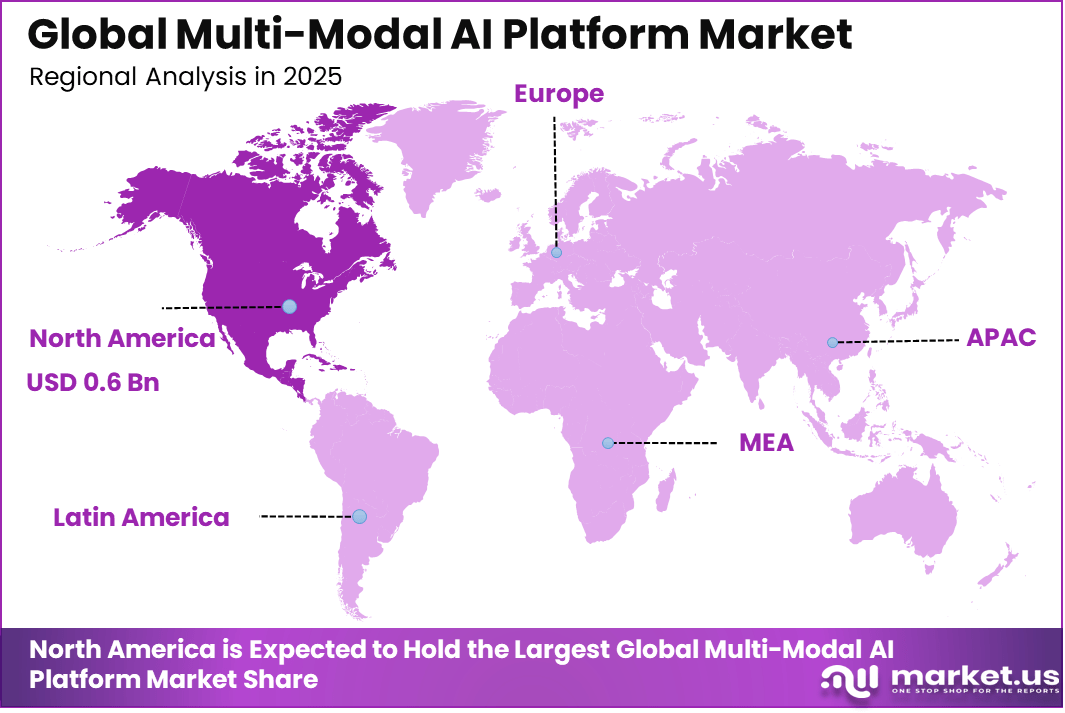
The United States reached USD 0.65 Billion with a CAGR of 31.5%, reflecting rapid market expansion. Growth is driven by enterprise AI investments. Demand for multi-modal intelligence continues to rise. Innovation supports adoption. Market momentum remains strong.
Investor Type Impact Matrix
Investor Type Adoption Level Contribution to Market Growth (%) Key Motivation Investment Behavior IT and telecom enterprises Very High ~28.1% Network intelligence and automation Platform wide deployment Large enterprises High ~31% Cross-channel AI insights Phased rollout Cloud service providers High ~19% AI infrastructure monetization Capital intensive Government organizations Moderate ~13% Smart public systems Program based SMEs Low to Moderate ~9% Cost sensitive automation Selective adoption Technology Enablement Analysis
Technology Layer Enablement Role Impact on Market Growth (%) Adoption Status Foundation multi-modal models Unified understanding across data types ~9.1% Growing Cross-modal transformers Feature fusion and reasoning ~7.3% Growing Cloud AI platforms Scalable training and inference ~6.0% Mature Data orchestration pipelines Synchronization of multi-format data ~4.5% Developing AI governance frameworks Responsible AI deployment ~3.2% Developing Opportunity Analysis
Emerging opportunities in the multi-modal AI platform market are linked to its expanding applicability across sectors that benefit from enriched contextual understanding and decision support. In healthcare, for example, platforms that analyse combined imaging, clinical text, and sensor data can improve diagnostic accuracy and patient-centric care.
In retail and customer engagement, multi-modal systems enhance interaction quality by interpreting visual, verbal, and behavioural signals to personalise recommendations and support real-time assistance. The integration of multi-modal AI with edge devices and cloud services further extends opportunities for scalable deployment in smart environments, autonomous systems, and immersive digital experiences.
Challenge Analysis
A central challenge confronting the multi-modal AI platform market relates to model interpretability and alignment with user trust and regulatory expectations. As systems synthesise heterogeneous data, understanding how decisions are derived across modalities becomes more complex, raising concerns about transparency, bias, and accountability.
Ensuring that multi-modal AI outputs are explainable to stakeholders and compliant with ethical and regulatory frameworks requires advanced techniques for model auditing and governance. Additionally, maintaining consistent performance across diverse deployment scenarios and balancing latency, privacy, and data security constraints add operational and technical complexity that must be managed carefully.
Emerging Trends
Emerging trends within the multi-modal AI platform landscape include the rise of unified representation learning techniques that enable shared understanding across data types, improving efficiency and reducing redundancy in model architectures.
Another trend is the integration of natural language processing with visual and auditory comprehension to support more intuitive human-computer interaction, such as conversational AI that can analyse images and text simultaneously. There is also growing interest in modular and composable multi-modal frameworks that allow developers to customise capabilities for specific use cases without retraining entire systems.
Growth Factors
Growth in the multi-modal AI platform market is driven by the accelerated adoption of artificial intelligence across enterprises seeking more powerful analytical capabilities and richer user experiences. Rapid advancements in compute infrastructure and algorithms continue to expand the feasibility of deploying multi-modal systems at scale.
The increasing volume and diversity of data generated across digital channels, IoT devices, and interactive platforms underscores the need for AI that can synthesise varied inputs into coherent insights. As organisations prioritise digital innovation and competitive differentiation, multi-modal AI platforms are being recognised as strategic assets for supporting complex, real-world applications that extend beyond single-modality analytics.
Key Market Segments
By Offering
- Solutions
- Services
- Professional Services
- Managed Services
By Data Modality
- Image Data
- Image Recognition
- Object Detection
- Image Captioning
- Image Generation
- Others
- Text Data
- Natural Language Understanding
- Sentiment Analysis
- Text Generation
- Language Translation
- Others
- Speech & Voice Data
- Speech & Voice Recognition
- Voice Assistants
- Voice Biometrics
- Speech Synthesis
- Others
- Video Data
- Video Analysis
- Video Captioning
- Video Generation
- Others
- Audio Data
- Audio Processing
- Music Analysis
- Sound Classification
- Others
- Others
By Technology
- Natural Language Processing
- Machine Learning
- Computer Vision
- Others
By Type
- Generative Multimodal AI
- Translative Multimodal AI
- Explanatory Multimodal AI
- Interactive Multimodal AI
By Industry
- Media & Entertainment
- BFSI
- IT & Telecommunication
- Healthcare
- Automotive & Transportation
- Gaming
- Others
Regional Analysis and Coverage
- North America
- US
- Canada
- Europe
- Germany
- France
- The UK
- Spain
- Italy
- Russia
- Netherlands
- Rest of Europe
- Asia Pacific
- China
- Japan
- South Korea
- India
- Australia
- Singapore
- Thailand
- Vietnam
- Rest of Latin America
- Latin America
- Brazil
- Mexico
- Rest of Latin America
- Middle East & Africa
- South Africa
- Saudi Arabia
- UAE
- Rest of MEA
Competitive Analysis
Amazon Web Services, Google Inc., Microsoft Corporation, IBM Corporation, and OpenAI Inc. lead the multi modal AI platform market by providing large scale models that process text, image, audio, and video within unified architectures. Their platforms support enterprise analytics, generative AI, and real time decision systems. These companies focus on scalability, model performance, and cloud native deployment. Growing enterprise adoption of cross modality intelligence continues to reinforce their leadership.
Stability AI Ltd., Runway AI Inc., Inworld AI Inc., Archetype AI Inc., and Jina AI GmbH strengthen the market with developer focused multi modal models and creative AI platforms. Their solutions enable content generation, search, and interactive experiences across multiple data types. These providers emphasize flexibility, API driven access, and rapid experimentation. Rising demand from media, gaming, and marketing sectors supports wider adoption.
Habana Labs Inc., Reka AI Inc., Mobius Labs Inc., Modality.AI Inc., and other players expand the landscape with specialized multi modal reasoning, edge deployment, and industry specific AI solutions. Their offerings target use cases in healthcare, surveillance, and enterprise automation. These companies focus on efficiency and accuracy across modalities. Increasing need for holistic AI understanding continues to drive steady growth in the multi modal AI platform market.
Top Key Players in the Market
- Aiberry Inc.
- Aimesoft Inc.
- Amazon Web Services
- Archetype AI Inc.
- Beewant SAS
- Google Inc.
- Habana Labs Inc.
- Hoppr Inc.
- Inworld AI Inc.
- IBM Corporation
- Jina AI GmbH
- Microsoft Corporation
- Mobius Labs Inc.
- Modality.AI Inc.
- Multimodal Inc.
- Neuraptic AI S.L.
- Newsbridge SAS
- OpenAI Inc.
- Owlbot.AI Inc.
- Perceiv AI Inc.
- Reka AI Inc.
- Runway AI Inc.
- Stability AI Ltd.
- Others
Recent Developments
- August, 2025: Aimesoft Inc. showcased its multi-modal AI solutions at the Vietnam International Innovation Expo and earned a spot in the top 10 AI platforms.
- August, 2025: OpenAI launched GPT-5, a powerhouse model excelling in visual, video, spatial, and scientific reasoning across multi-modal benchmarks.
Report Scope
Report Features Description Market Value (2025) USD 1.6 Bn Forecast Revenue (2035) USD 36.2 Bn CAGR(2026-2035) 36.6% Base Year for Estimation 2025 Historic Period 2020-2024 Forecast Period 2026-2035 Report Coverage Revenue forecast, AI impact on Market trends, Share Insights, Company ranking, competitive landscape, Recent Developments, Market Dynamics and Emerging Trends Segments Covered By Offering (Solutions, Services), By Data Modality (Image Data, Text Data, Speech & Voice Data, Video Data, Audio Data, Others), By Technology (Machine Learning, Natural Language Processing, Computer Vision, Context Awareness, Internet of Things), By Type (Generative Multimodal AI, Translative Multimodal AI, Explanatory Multimodal AI, Interactive Multimodal AI), By Industry: Media & Entertainment, BFSI, IT & Telecommunication, Healthcare, Automotive & Transportation, Gaming, Others) Regional Analysis North America – US, Canada; Europe – Germany, France, The UK, Spain, Italy, Russia, Netherlands, Rest of Europe; Asia Pacific – China, Japan, South Korea, India, New Zealand, Singapore, Thailand, Vietnam, Rest of Latin America; Latin America – Brazil, Mexico, Rest of Latin America; Middle East & Africa – South Africa, Saudi Arabia, UAE, Rest of MEA Competitive Landscape Aiberry Inc., Aimesoft Inc., Amazon Web Services, Archetype AI Inc., Beewant SAS, Google Inc., Habana Labs Inc., Hoppr Inc., Inworld AI Inc., IBM Corporation, Jina AI GmbH, Microsoft Corporation, Mobius Labs Inc., Modality.AI Inc., Multimodal Inc., Neuraptic AI S.L., Newsbridge SAS, OpenAI Inc., Owlbot.AI Inc., Perceiv AI Inc., Reka AI Inc., Runway AI Inc., Stability AI Ltd., Others Customization Scope Customization for segments, region/country-level will be provided. Moreover, additional customization can be done based on the requirements. Purchase Options We have three license to opt for: Single User License, Multi-User License (Up to 5 Users), Corporate Use License (Unlimited User and Printable PDF)  Multi-Modal AI Platform MarketPublished date: Jan. 2026add_shopping_cartBuy Now get_appDownload Sample
 -
-
- Aiberry Inc.
- Aimesoft Inc.
- Amazon Web Services
- Archetype AI Inc.
- Beewant SAS
- Google Inc.
- Habana Labs Inc.
- Hoppr Inc.
- Inworld AI Inc.
- IBM Corporation
- Jina AI GmbH
- Microsoft Corporation
- Mobius Labs Inc.
- Modality.AI Inc.
- Multimodal Inc.
- Neuraptic AI S.L.
- Newsbridge SAS
- OpenAI Inc.
- Owlbot.AI Inc.
- Perceiv AI Inc.
- Reka AI Inc.
- Runway AI Inc.
- Stability AI Ltd.
- Others
Our Clients

- 174502
- Jan. 2026









