


Market Overview
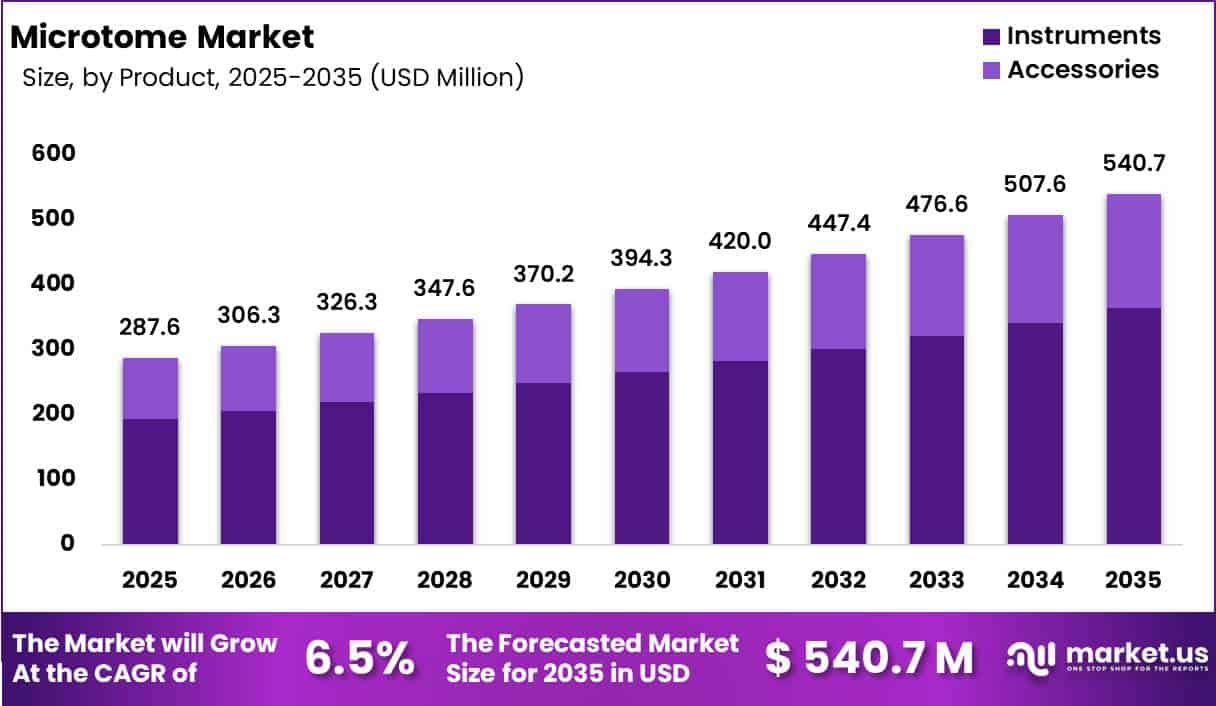
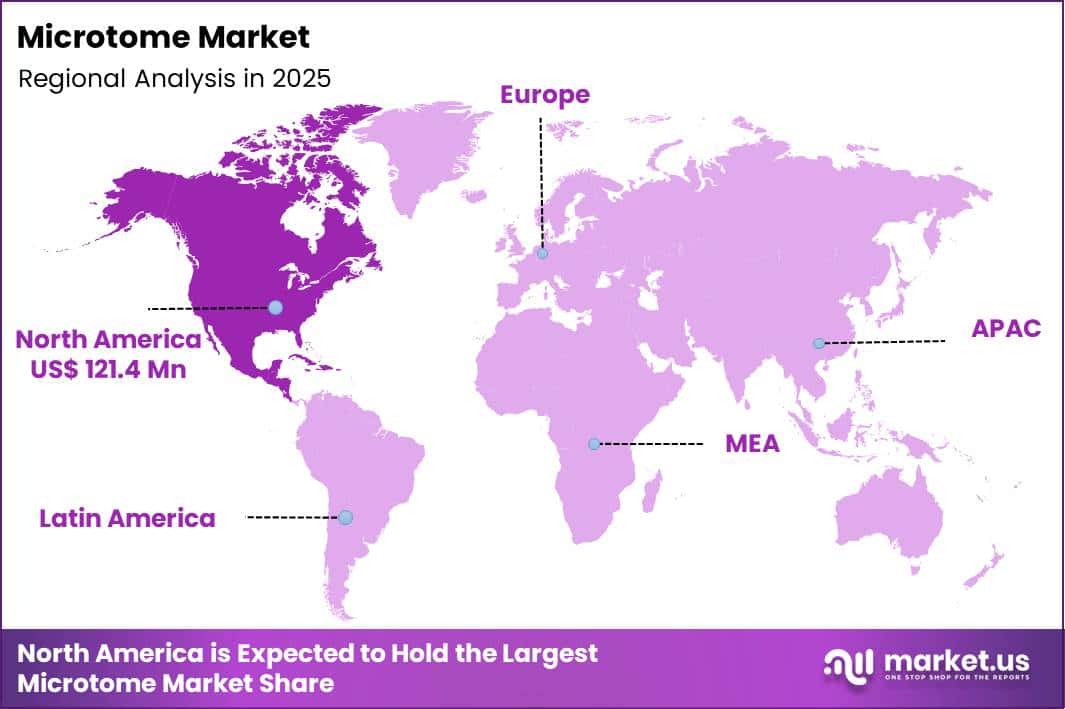
Global Microtome Market size is expected to be worth around US$ 540.7 Million by 2035 from US$ 287.6 Million in 2025, growing at a CAGR of 6.5% during the forecast period from 2026 to 2035. In 2025, North America led the market, achieving over 42.2% share with a revenue of US$ 121.4 Million.
The global microtome market is driven by the increasing demand for accurate tissue sectioning in pathology, histology, biomedical research, and diagnostic laboratories. A microtome is a precision laboratory instrument used to cut thin or ultrathin sections of embedded tissue samples using steel, glass, or diamond knives, enabling microscopic examination for disease diagnosis and research applications.
Microtomes are widely used in surgical pathology workflows, cancer diagnosis, immunohistochemistry, and research institutions. The National Institutes of Health (NIH) utilizes multiple sectioning technologies, including sliding microtomes and cryostats, for preparing tissue samples, with cryostat systems capable of producing frozen tissue sections ranging from approximately 5 to 100 micrometers depending on application requirements.
Technological advancements are improving microtome performance through automated sectioning, enhanced precision control, ergonomic designs, and integration with digital pathology workflows.
Conventional histology commonly requires tissue sections in the range of approximately 2 to 50 micrometers, while routine diagnostic paraffin sections are generally prepared around 4 to 10 micrometers thick. Cryosectioning techniques can accelerate diagnostic workflows, with frozen section preparation supporting rapid pathological evaluation compared with conventional processing methods.
Growing investments in cancer research, molecular diagnostics, and advanced microscopy are expected to support demand for rotary microtomes, cryostats, and specialized microtomy equipment. Increasing adoption of digital pathology and automated laboratory systems is further encouraging laboratories to upgrade precision tissue preparation capabilities for faster and more reliable diagnostic outcomes.
Key Takeaways
- Market Size: Global Microtome Market size is expected to be worth around US$ 540.7 Million by 2035 from US$ 287.6 Million in 2025.
- Market Share: The market is growing at a CAGR of 6.5% during the forecast period from 2026 to 2035.
- Product: Instruments segments dominate with 67.4% market share in 2025.
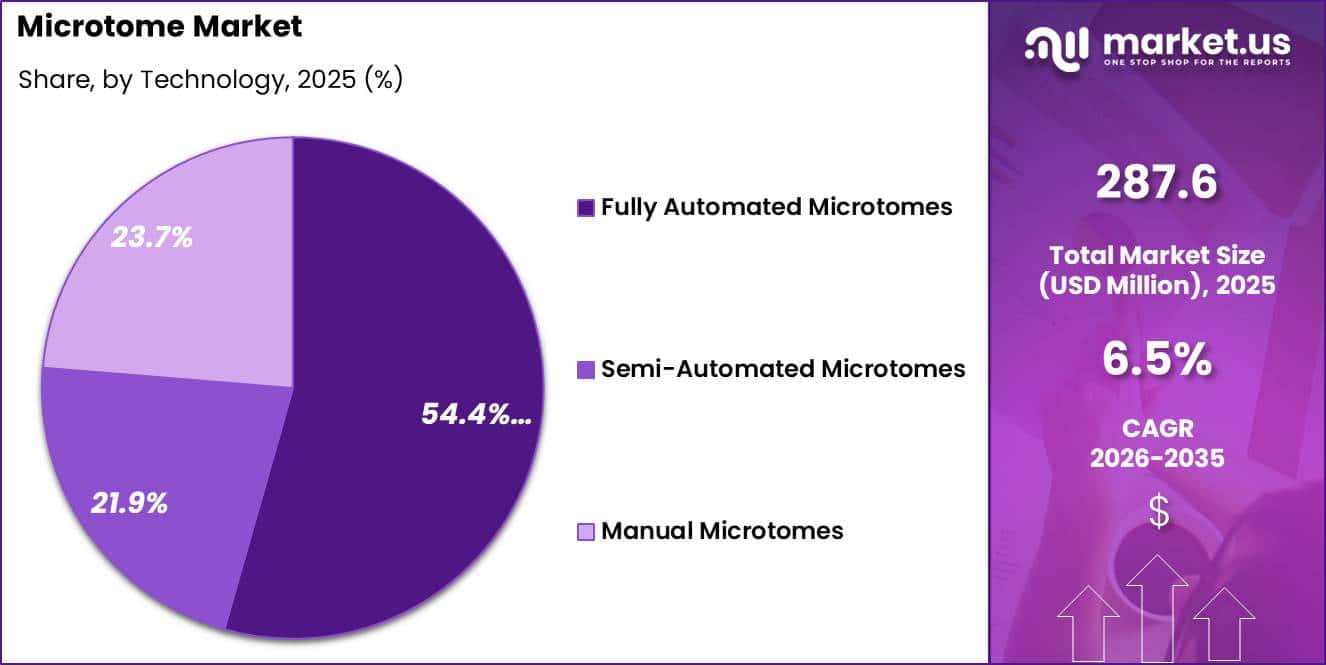
- Technology: Fully Automated Microtomes segments dominate with 54.4% market share in 2025.
- Application: Disease Diagnostics segments dominate with 64.2% market share in 2025.
- End User: Hospital Laboratories segments dominate with 50.8% market share in 2025.
- Regional Analysis: In 2025, North America led the market, achieving over 42.2% share with a revenue of US$ 121.4 Million.
Product Analysis
Instruments segments dominates the Microtome market share in 2025.
By product type into segmented Instruments and Accessories. Instruments segments dominate with 67.4% market share in 2025, driven by increasing demand for advanced tissue sectioning equipment in pathology laboratories, hospitals, and research facilities.
Microtome instruments are essential for producing precise tissue sections used in histopathology, disease diagnosis, and biomedical research. Technological advancements such as automated operation, improved cutting accuracy, and enhanced workflow efficiency are supporting the adoption of modern microtome systems.
Accessories account for 32.6% of the market, supported by recurring demand for blades, specimen holders, clamps, and other consumable components required for continuous laboratory operations. Growing diagnostic procedures, rising tissue analysis requirements, and increasing replacement cycles of consumable parts are contributing to accessory segment growth.
While instruments remain the primary revenue contributor due to equipment upgrades and automation trends, accessories provide consistent growth opportunities through routine usage across diagnostic and research applications.
Technology Analysis
Fully Automated Microtomes segments dominates the Microtome market share in 2025.
By technology segmented into Fully Automated Microtomes, Semi-Automated Microtomes, and Manual Microtomes. Fully Automated Microtomes segments dominate with 54.4% market share in 2025, supported by growing demand for precision, reproducibility, and high-throughput tissue preparation.
Automated systems reduce manual errors, improve sectioning consistency, and enhance laboratory productivity, making them increasingly preferred by advanced pathology laboratories. Semi-Automated Microtomes account for 21.9% of the market, offering controlled operation with improved efficiency compared with conventional systems.
These systems are widely adopted by laboratories seeking cost-effective automation solutions. Manual Microtomes represent 23.7% of the market, continuing to maintain demand due to their affordability, simplicity, and suitability for educational institutions and smaller laboratories.
Increasing adoption of digital pathology, rising diagnostic workloads, and the need for standardized tissue preparation are driving the transition toward automated microtome technologies.
Application Analysis
Disease Diagnostics segments dominates the Microtome market share in 2025.
The Microtome Market is segmented by application into Disease Diagnostics, Medical Research, and Industrial Applications. Disease Diagnostics segments dominate with 64.2% market share in 2025, due to increasing utilization of tissue sectioning in pathology testing, cancer diagnosis, and clinical examinations.
Microtomes play a critical role in preparing tissue samples for microscopic evaluation, enabling accurate disease identification and treatment planning. Growing biopsy procedures and increasing demand for precision diagnostics are supporting segment expansion.
Medical Research applications are driven by rising biomedical studies, drug development activities, and tissue-based research requiring accurate sample preparation. Industrial Applications utilize microtome technology for specialized material analysis and microscopic evaluations.
Expanding healthcare infrastructure, research activities, and advancements in laboratory technologies continue to support the adoption of microtomes across diverse application areas.
End User Analysis
Hospital Laboratories segments dominates the Microtome market share in 2025.
The Microtome Market is segmented by end user into Hospital Laboratories, Clinical & Diagnostic Laboratories, Pharmaceutical & Biotechnology Companies, Academic & Research Institutes, and Others. Hospital Laboratories segments dominate with 50.8% market share in 2025, driven by increasing demand for histopathological examinations, biopsy analysis, and routine diagnostic procedures.
Hospitals rely on microtomes for accurate tissue preparation in oncology, pathology, and disease diagnosis workflows. Clinical & Diagnostic Laboratories are expanding adoption due to increasing sample volumes and centralized diagnostic services.
Pharmaceutical & Biotechnology Companies use microtomes in drug discovery, preclinical research, and tissue analysis studies. Academic & Research Institutes contribute through applications in biomedical research, pathology education, and experimental studies.
Others include specialized laboratories and additional users requiring precision tissue sectioning solutions. Growing diagnostic requirements, research investments, and laboratory modernization initiatives are supporting market growth across all end-user segments.
Key Market Segments
By Product
- Instruments
- Accessories
By Technology
- Fully Automated Microtomes
- Semi-Automated Microtomes
- Manual Microtomes
By Application
- Disease Diagnostics
- Medical Research
- Industrial Applications
By End User
- Hospital Laboratories
- Clinical & Diagnostic Laboratories
- Pharmaceutical & Biotechnology Companies
- Academic & Research Institutes
- Others
Driver
Screening and early diagnosis programs increasing paraffin section workload.
Organized screening expands pathology intake by shifting more asymptomatic patients into biopsy and tissue confirmation pathways.
CDC supports screening for breast, cervical, colorectal, and lung cancers based on USPSTF aligned recommendations, while WHO’s cervical cancer strategy targets 70% screening coverage by ages 35 and 45, particularly in low and middle income countries.
This increase in screening raises routine laboratory caseloads, especially small biopsies and follow up confirmations, which increases the number of paraffin blocks processed per pathologist.
As a result, demand rises for histology tools such as rotary microtomes, disposable blades, and cryostat systems used in intraoperative diagnostics.The impact is gradual, but once screening programs scale, it creates sustained equipment and consumables demand driven by higher throughput requirements and recurring laboratory workflows.
| Driver | (~) % Impact on CAGR Forecast | Geographic Relevance | Impact Timeline |
|---|---|---|---|
| Oncology biopsy volume expansion driving routine histology throughput | +1.6% | North America core, EU, East Asia, urban APAC hospitals | Short term |
| Screening and early-diagnosis programs increasing paraffin section workload | +1.2% | North America, EU, South-East Asia, Latin America public systems | Medium term |
| Digital pathology rollout requiring higher section consistency and repeatability | +1.0% | North America core, Western Europe, Japan, South Korea, Gulf reference labs | Medium term |
| Translational research and spatial biology programs lifting premium microtome demand | +0.9% | U.S. academic clusters, EU research hubs, China, Japan | Medium term |
| Regulatory and quality-accreditation tightening supporting equipment refresh cycles | +0.8% | U.S., EU, export-oriented APAC manufacturers, private hospital chains | Short term |
| Reimbursement pressure favoring automation, labor savings, and cryostat replacement | +0.7% | U.S. independent labs, EU consolidated pathology networks, developed APAC | Short term |
Challenge
Structural input cost volatility in global microtome manufacturing.
Microtome manufacturers remain exposed to volatile input costs and geopolitical trade dynamics, as precision components such as steel blades, bearings, optical encoders, motors, and control electronics are sourced through multi tier global supply chains.
A significant share of the bill of materials is imported and sensitive to tariffs, logistics costs, and currency fluctuations.Recent tariff changes and elevated freight rates have increased landed costs for laboratory instruments and consumables, while also extending lead times for critical components.
Items that previously shipped in a few weeks can now take significantly longer, forcing manufacturers to hold higher safety stock to avoid production delays.This volatility contributes to higher equipment prices, longer procurement cycles, and delayed replacement decisions in hospitals and laboratories.
Overall, it creates a moderate friction on market growth by increasing costs and slowing purchasing decisions, even though underlying demand remains intact.
| Challenge | (~) % CAGR Friction Drag | Geographic Relevance | Mitigation Horizon |
|---|---|---|---|
| Volatile lab equipment inputs | -1.0% | North America, EU, East Asia | Medium term (2-4 years) |
| Diagnostic lab supply fragility | -0.8% | Global hospital hubs, reference labs | Medium term (2-4 years) |
| Pathology workforce bottlenecks | -0.7% | US, EU, Japan, GCC | Long term (≥ 4 years) |
| Capital budget cyclicality | -0.6% | Public health systems, EM hospitals | Medium term (2-4 years) |
| Workflow–digitization mismatch | -0.5% | High-income digital pathology hubs | Long term (≥ 4 years) |
| Quality, uptime, and compliance drag | -0.4% | Global accredited labs | Short term (≤ 2 years) |
Restraints
Structural pathology workforce shortages limiting microtome utilization globally.
A key constraint on microtome demand is the growing mismatch between rising histopathology workload and limited specialist workforce capacity. With global cancer cases reaching about 20 million in 2022 and projected to rise toward 35 million by 2050, biopsy volumes and tissue processing requirements are increasing steadily.
However, pathology and histotechnology workforces in the US and Europe are under pressure due to aging staff, limited training pipeline capacity, and rising burnout. Many hospital labs already operate with noticeable vacancy rates, which forces them to cap daily processing volumes and prioritize urgent cases.
As a result, existing microtome fleets are often run near capacity, but additional equipment purchases are delayed because there is insufficient trained staff to operate new units effectively. This leads to slower replacement cycles and restrained unit growth despite rising clinical demand.
Overall, workforce shortages reduce effective utilization expansion and modestly limit market growth, as laboratories increasingly focus on workflow efficiency, automation, and digital pathology rather than expanding mechanical sectioning capacity.
| Restraint | (~) % Impact on CAGR Forecast | Geographic Relevance | Impact Timeline |
|---|---|---|---|
| 1. Pathology workforce shortages & underutilization | -1.6% | North America, Western Europe, high-income APAC | Long term (≥ 4 years) |
| 2. Capital budget pressure in hospitals & labs | -1.4% | North America core, EU, LatAm tier-2, MEA public | Medium term (2–4 years) |
| 3. Supply chain & precision component volatility | -1.2% | EU, North America, APAC corridors | Short–Medium term (≤ 4 years) |
| 4. Regulatory compliance & quality systems drag | -0.9% | U.S., EU, Japan, China | Medium–Long term (≥ 2 years) |
| 5. Slow digital pathology & automation adoption | -1.0% | North America core, EU, advanced APAC | Long term (≥ 4 years) |
| 6. Competitive commoditization & price erosion | -0.8% | APAC volume markets, LatAm, MEA | Medium term (2–4 years) |
Opportunity
Automation led microtomy platforms for labor constrained pathology.
This is a major upside opportunity driven by the shift from manual microtomy toward semi and fully automated sectioning systems that reduce operator dependence and improve workflow efficiency in high volume pathology labs.
Unlike baseline demand, which is driven by routine replacement, this opportunity comes from upgrading installed base systems to automation enabled platforms.These systems can improve section consistency, reduce trimming waste, and lower labor intensity by around 20 to 35 percent in workforce constrained settings, while increasing throughput per shift and standardizing output across multi site laboratory networks.
This makes them particularly relevant in regions facing persistent pathology staffing shortages and rising quality requirements.Commercially, automation shifts capital spending toward higher value systems with stronger ROI justification, supporting faster adoption in North America, Europe, and Japan.
Overall, this transition could add meaningful upside to growth by accelerating replacement cycles and increasing equipment value per installation.
| Opportunity | (~) % Potential CAGR Upside | Geographic Relevance | Execution Window |
|---|---|---|---|
| Automated microtomy | +1.8% | North America, EU, Japan | Short term (≤ 2 years) |
| Digital-pathology bundles | +1.2% | North America, EU, APAC advanced | Short term (≤ 2 years) |
| Premium blades | +0.9% | Global, especially EU and APAC | Medium term (2-4 years) |
| Specialty sectioning | +0.8% | North America, EU, China | Medium term (2-4 years) |
| Service and uptime | +0.7% | North America, EU | Short term (≤ 2 years) |
| Emerging lab buildouts | +1.4% | APAC emerging, Middle East, Latin America | Long term (≥ 4 years) |
Regional Analysis
North America dominated the Microtome Market.
North America dominated the Microtome Market in 2025, accounting for over 42.2% of the global market share with revenue reaching approximately US$ 121.4 Million. The region’s leadership is supported by the presence of advanced healthcare infrastructure, a strong pathology and histopathology research ecosystem, and increasing adoption of precision diagnostic technologies.
The growing volume of cancer screening, tissue-based diagnostics, and biomedical research activities has increased demand for high-performance microtomes across hospitals, diagnostic laboratories, academic institutions, and research centers. The expansion of personalized medicine and molecular pathology applications has further encouraged laboratories to upgrade from manual systems to automated and semi-automated microtome solutions.
Europe represents another significant market, driven by well-established pathology networks, strong investments in healthcare modernization, and increasing focus on early disease detection. Countries such as Germany, the United Kingdom, and France are adopting advanced laboratory automation technologies to improve workflow efficiency and diagnostic accuracy.
The Asia-Pacific region is expected to witness substantial growth due to rising healthcare expenditure, expanding diagnostic infrastructure, and increasing demand for pathology services in emerging economies. Growing investments in medical research facilities and laboratory modernization are supporting microtome adoption across hospitals and academic centers.
Latin America and the Middle East & Africa are also experiencing gradual market expansion, supported by improving healthcare access, increasing diagnostic awareness, and government initiatives aimed at strengthening laboratory capabilities. Overall, regional growth is driven by advancements in pathology workflows, increasing disease diagnosis requirements, and technological improvements in microtome systems.
Key Regions and Countries
North America
- The US
- Canada
Europe
- Germany
- France
- The U.K.
- Italy
- Spain
- Russia & CIS
- Rest of Europe
Asia Pacific
- China
- India
- Japan
- South Korea
- ASEAN
- Australia & New Zealand
- Rest of Asia Pacific
Middle East & Africa
- GCC
- South Africa
- Rest of Middle East & Africa
Latin America
- Brazil
- Mexico
- Rest of Latin America
Key Player Analysis
The Microtome Market demonstrates a moderately consolidated competitive structure, with leading global medical technology companies competing alongside specialized pathology equipment manufacturers. Market competition is driven by technological advancements, product reliability, automation capabilities, and integration with broader histopathology workflows.
Major players are focusing on developing advanced microtome solutions that enhance sectioning precision, improve laboratory efficiency, and support increasing diagnostic workloads. Innovation strategies include automated systems, ergonomic designs, improved safety features, and compatibility with digital pathology ecosystems.
Key companies such as Danaher Corporation (Leica Biosystems), Epredia (a PHC Group company), and Thermo Fisher Scientific Inc. are strengthening their market positions through continuous R&D investments, workflow automation solutions, and integration of instruments with complete pathology platforms.
Sakura Finetek Japan Co., Ltd. emphasizes ecosystem-based competition by combining specimen processing, embedding, and sectioning solutions to support laboratory efficiency. Specialized manufacturers including SLEE medical GmbH, Histo-Line Laboratories S.r.l., MEDITE GmbH, Nanolytik, Alltion (Wuzhou) Co., Ltd., and Amos Scientific Pty Ltd. compete through product customization, precision engineering, and cost-effective solutions for research and diagnostic applications.
Companies such as Auxilab S.L., Bio-Optica Milano S.p.A., Boeckeler Instruments Inc. (RMC Products), CellPath Ltd., and Diapath S.p.A. are focusing on specialized pathology workflows, product innovation, and customer-specific solutions. Strategic partnerships, portfolio expansion, and integration with digital laboratory systems remain key approaches among market participants.
Overall, competition is shaped by advancements in automation, diagnostic workflow integration, and the ability to provide comprehensive histopathology solutions.
Top Key Players
- Danaher Corporation (Leica Biosystems)
- Epredia (a PHC Group company)
- Thermo Fisher Scientific Inc.
- Sakura Finetek Japan Co., Ltd.
- SLEE medical GmbH
- Histo-Line Laboratories S.r.l.
- MEDITE GmbH
- Nanolytik
- Alltion (Wuzhou) Co., Ltd.
- Amos Scientific Pty Ltd.
- Auxilab S.L.
- Bio-Optica Milano S.p.A.
- Boeckeler Instruments Inc. (RMC Products)
- CellPath Ltd.
- Diapath S.p.A.
- Others
Recent Developments
- In February 2026, Danaher Corporation (Leica Biosystems): Leica Biosystems launched the Leica CM1950 Cryostat with DualEcoTec Cooling System, strengthening its position in advanced histology workflows. The new cryostat focuses on faster specimen preparation, improved technician comfort, and sustainability through next-generation refrigerant technology with near-zero global warming potential. The system delivers up to 3× faster specimen cooling and up to 2× faster chamber cooling, helping laboratories reduce preparation time and improve operational efficiency.
- In March 2026, Sakura Finetek Japan Co., Ltd.: Sakura Finetek announced a global alliance with Hamamatsu Photonics K.K. to support consistent scan-ready slides and improved digital image quality for clinical decision-making. The partnership highlights the growing convergence of histology preparation equipment and digital pathology technologies.
Report Scope
| Report Features | Description |
|---|---|
| Market Value (2025) | US$ 287.6 Million |
| Forecast Revenue (2035) | US$ 540.7 Million |
| CAGR (2026-2035) | 6.5% |
| Base Year for Estimation | 2025 |
| Historic Period | 2020-2024 |
| Forecast Period | 2026-2035 |
| Report Coverage | Revenue Forecast, Market Dynamics, Competitive Landscape, Recent Developments |
| Segments Covered | By Product (Instruments, Accessories), By Technology (Fully Automated Microtomes, Semi-Automated Microtomes, Manual Microtomes), By Application (Disease Diagnostics, Medical Research, Industrial Applications), By End User (Hospital Laboratories, Clinical & Diagnostic Laboratories, Pharmaceutical & Biotechnology Companies, Academic & Research Institutes, Others) |
| Regional Analysis | North America – The US, Canada; Europe – Germany, France, U.K., Italy, Spain, Russia & CIS, Rest of Europe; Asia Pacific – China, India, Japan, South Korea, ASEAN, Australia & New Zealand, Rest of Asia Pacific; Middle East & Africa – GCC, South Africa, Rest of Middle East & Africa; Latin America – Brazil, Mexico, Rest of Latin America |
| Competitive Landscape | Danaher Corporation (Leica Biosystems), Epredia (a PHC Group company), Thermo Fisher Scientific Inc., Sakura Finetek Japan Co., Ltd., SLEE medical GmbH, Histo-Line Laboratories S.r.l., MEDITE GmbH, Nanolytik, Alltion (Wuzhou) Co., Ltd., Amos Scientific Pty Ltd., Auxilab S.L., Bio-Optica Milano S.p.A., Boeckeler Instruments Inc. (RMC Products), CellPath Ltd., Diapath S.p.A., Others |
| Customization Scope | Customization for segments, region/country-level will be provided. Moreover, additional customization can be done based on the requirements. |
| Purchase Options | We have three licenses to opt for: Single User License, Multi-User License (Up to 5 Users), Corporate Use License (Unlimited User and Printable PDF) |





































