


Global Micronutrient Fertilizer Market Size, Share, And Enhanced Productivity By Product (Boron, Copper, Iron, Manganese, Molybdenum, Zinc, Others), By Application Mode (Fertigation, Foliar, Soil), By Crop Type (Field Crops, Horticultural Crops, Turf and Ornamental), By Region and Companies - Industry Segment Outlook, Market Assessment, Competition Scenario, Trends, and Forecast 2026-2035
- Published date: March 2026
- Report ID: 181016
- Number of Pages: 235
- Format:
-
keyboard_arrow_up
Quick Navigation
Report Overview
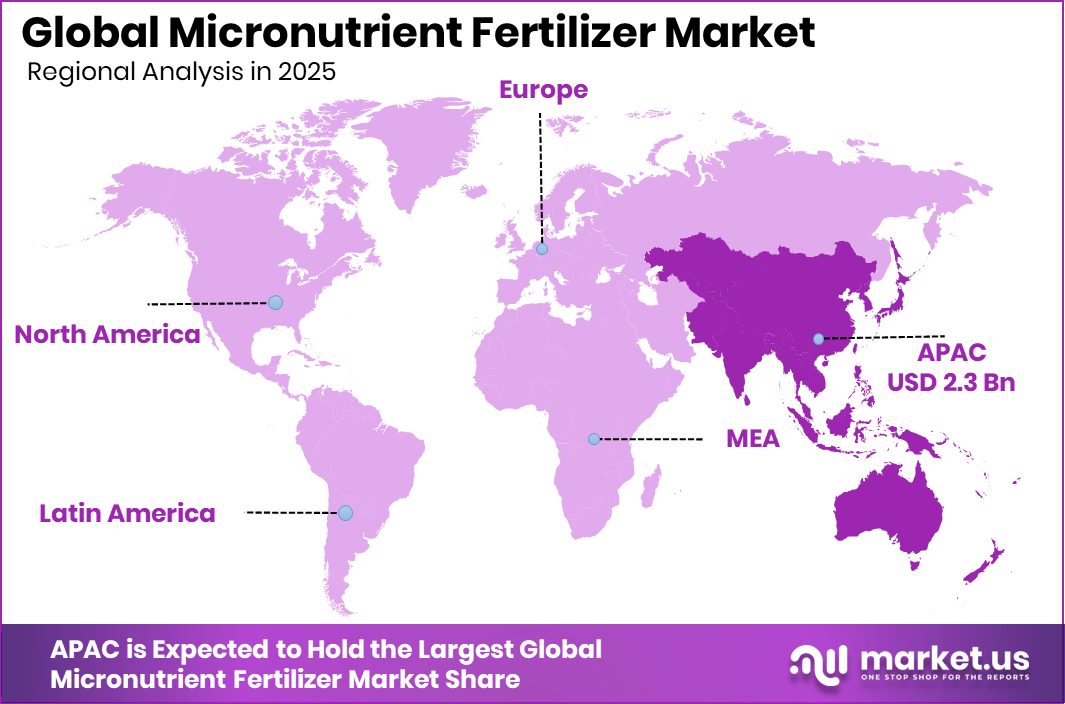
The Global Micronutrient Fertilizer Market is expected to be worth around USD 12.3 billion by 2035, up from USD 5.9 billion in 2025, and is projected to grow at a CAGR of 7.6% from 2026 to 2035. Asia Pacific dominated the Micronutrient Fertilizer Market with 39.1% share, totaling USD 2.3 Bn.
Micronutrient fertilizer refers to agricultural inputs that supply essential trace elements required in small quantities for proper plant growth and development. These nutrients include boron, copper, iron, manganese, molybdenum, zinc, and other minor elements that support key physiological processes in crops. Even though plants require them in limited amounts, deficiencies can significantly reduce crop yield, quality, and resistance to environmental stress. Micronutrient fertilizers are applied through different methods such as fertigation, foliar spraying, and soil application, depending on crop requirements and soil conditions. They are widely used in the cultivation of field crops, horticultural crops, and turf and ornamental plants to maintain balanced nutrition and improve agricultural productivity.
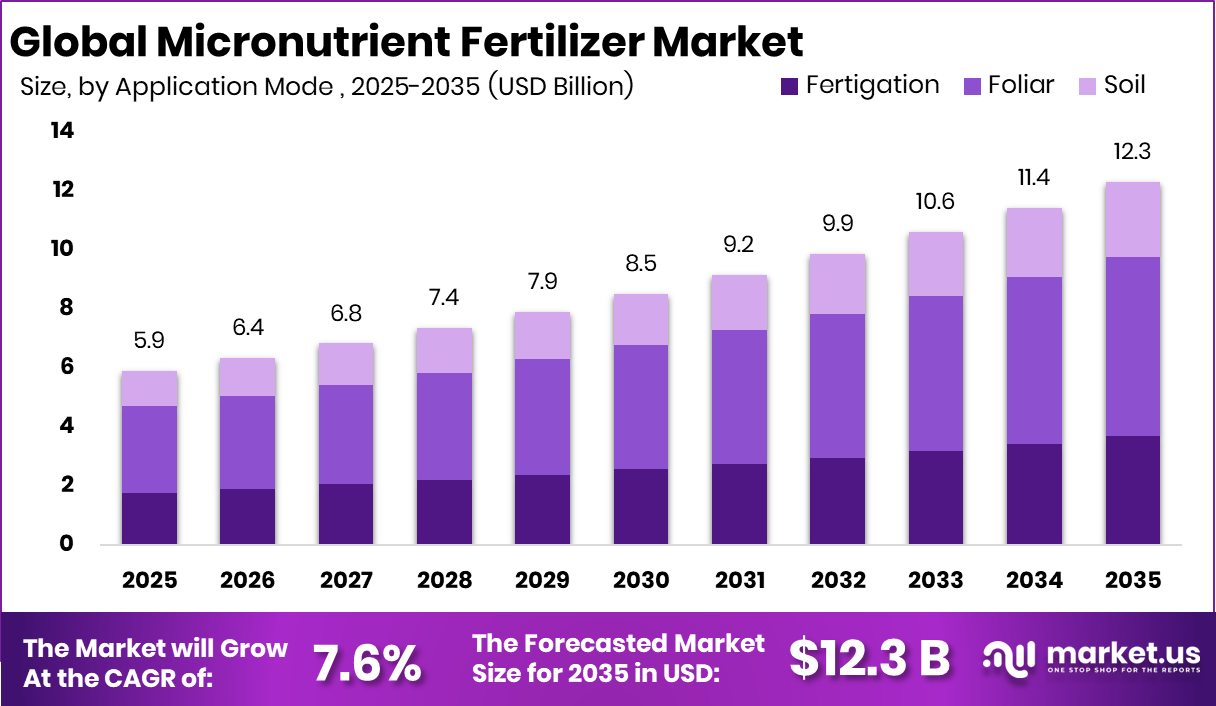
The Micronutrient Fertilizer Market represents the global trade, production, and use of fertilizers designed to supply essential micronutrients to crops. The market includes various product types such as boron, copper, iron, manganese, molybdenum, zinc, and other trace nutrients. These products are applied through different application modes, including fertigation, foliar, and soil treatments across multiple crop types, such as field crops, horticultural crops, and turf and ornamental plants. The market reflects the increasing attention given to soil nutrient balance and crop health in modern agriculture, where farmers adopt targeted nutrient solutions to maintain productivity and crop quality.
One of the major growth factors influencing the micronutrient fertilizer market is the rising awareness of soil nutrient deficiencies caused by continuous cropping and intensive agricultural practices. Over time, repeated cultivation without balanced nutrient replenishment reduces the availability of essential trace elements in soil. Farmers and agricultural professionals are increasingly recognizing the importance of micronutrients in improving plant metabolism, strengthening root development, and enhancing crop resilience. This awareness is encouraging the wider adoption of micronutrient fertilizers across different agricultural systems and crop types.
Demand for micronutrient fertilizers continues to grow as farmers focus on improving crop yield, nutritional value, and overall farm productivity. Modern farming practices emphasize balanced fertilization rather than relying only on traditional macronutrients such as nitrogen, phosphorus, and potassium. Crops such as cereals, fruits, vegetables, and ornamental plants require trace elements for healthy growth, which has increased the use of micronutrient fertilizers through soil, foliar, and fertigation methods. As agricultural systems become more intensive and productivity-driven, the role of micronutrient inputs is becoming increasingly important.
The market also presents strong opportunities as innovation and financial support continue to encourage the development of advanced fertilizer technologies. Several companies and agricultural technology initiatives are receiving investment to explore alternative and sustainable fertilizer solutions. For example, Nitricity raised $10 million to develop an organic fertilizer plant in California while focusing on new technology. Lucent Bio secured over $3.6 million in funding, and Lucent BioSciences raised $2.4 million to reinvent fertilizer solutions. Additionally, ten companies shared a $2 million grant to explore alternative fertilizers, highlighting growing interest in improving nutrient management and advancing fertilizer innovation.
Key Takeaways
- The Global Micronutrient Fertilizer Market is expected to be worth around USD 12.3 billion by 2035, up from USD 5.9 billion in 2025, and is projected to grow at a CAGR of 7.6% from 2026 to 2035.
- Zinc dominated the Micronutrient Fertilizer Market with 38.4% share due to widespread soil deficiency globally.
- Foliar application held 49.5% share in the Micronutrient Fertilizer Market due to efficient nutrient absorption.
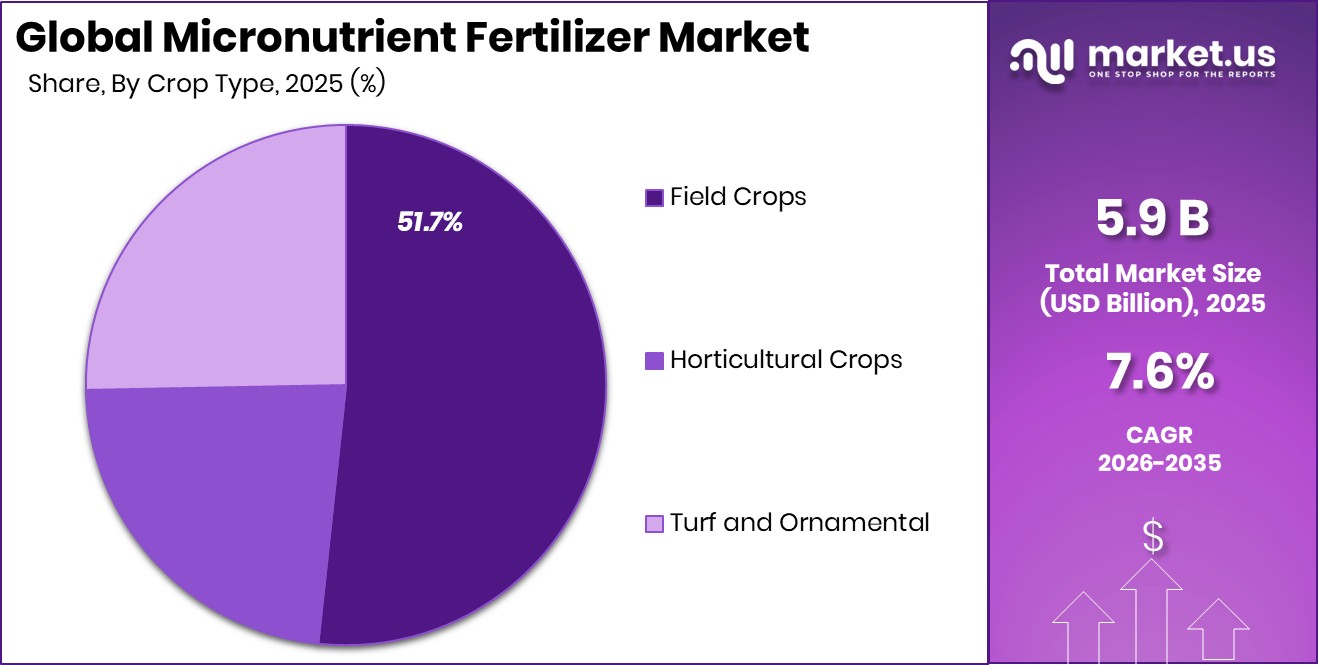
- Field crops accounted for 51.7% of the Micronutrient Fertilizer Market, driven by large cultivation areas.
- In the Asia Pacific, the Micronutrient Fertilizer Market reached USD 2.3 Bn, accounting for 39.1%.
By Product Analysis
In 2025, zinc accounted for a significant 38.4% share of the Micronutrient Fertilizer Market by product type, reflecting its essential role in improving plant growth and crop productivity. Zinc is widely used in agriculture because it supports enzyme activity, protein synthesis, and overall plant metabolism. Farmers increasingly apply zinc-based micronutrients to correct soil deficiencies, particularly in regions where intensive farming has depleted natural nutrient levels. The rising cultivation of cereals, grains, and oilseeds has further strengthened the demand for zinc fertilizers, as these crops are highly responsive to zinc supplementation.
Additionally, growing awareness among farmers about balanced nutrient management and sustainable agricultural practices has encouraged the use of zinc micronutrients. Government initiatives promoting soil health and improved fertilizer efficiency have also contributed to the steady adoption of zinc-based fertilizers across major agricultural markets worldwide.
By Application Mode Analysis
In 2025, foliar application held a dominant 49.5% share of the Micronutrient Fertilizer Market by application mode, driven by its efficiency in delivering nutrients directly to plant leaves. Foliar feeding allows crops to absorb micronutrients quickly, making it an effective solution for correcting nutrient deficiencies during critical growth stages. Farmers prefer foliar application because it requires smaller quantities of fertilizers while providing faster results compared to soil application. This method is particularly beneficial in regions where soil conditions limit nutrient availability or where rapid nutrient uptake is required to support crop development.
The growing adoption of precision farming and advanced spraying technologies has further encouraged the use of foliar micronutrient fertilizers. As agricultural practices continue to focus on improving yield quality and nutrient efficiency, foliar application remains a preferred technique for modern crop management.
By Crop Type Analysis
In 2025, field crops represented the largest segment of the Micronutrient Fertilizer Market by crop type, accounting for 51.7% of the total share. Crops such as wheat, rice, maize, and barley require a balanced micronutrient supply to maintain optimal growth and maximize yields. Continuous cultivation and intensive farming have reduced the natural nutrient content in soils, making micronutrient fertilizers essential for sustaining productivity.
Field crops are cultivated on a large scale across major agricultural regions, which significantly contributes to the high demand for micronutrient fertilizers in this segment. Farmers are increasingly adopting nutrient management strategies that include micronutrients to improve crop health and resistance to environmental stress. The need to enhance food production for a growing global population continues to drive the application of micronutrient fertilizers in large-scale field crop cultivation.
Key Market Segments
By Product
- Boron
- Copper
- Iron
- Manganese
- Molybdenum
- Zinc
- Others
By Application Mode
- Fertigation
- Foliar
- Soil
By Crop Type
- Field Crops
- Horticultural Crops
- Turf and Ornamental
Driving Factors
Rising soil micronutrient deficiency globally
Rising soil micronutrient deficiency globally is one of the key driving factors supporting the growth of the Micronutrient Fertilizer Market. Continuous cultivation, intensive farming practices, and imbalanced fertilizer use have gradually reduced the availability of essential trace nutrients in agricultural soils. Farmers are increasingly adopting micronutrient fertilizers to restore soil fertility and maintain stable crop yields. Technological and financial initiatives are also strengthening modern agricultural practices.
For instance, Kubota led a €6.5 million funding round in ultra-precise spot-spraying robot developer Kilter, supporting advanced agricultural technology. In addition, about $17M in funding has been made available to promote efficient irrigation use, helping farmers manage water and nutrient delivery more effectively. These developments collectively encourage better nutrient management and support the broader adoption of micronutrient fertilizers in agriculture.
Restraining Factors
High cost of micronutrient fertilizers
High cost of micronutrient fertilizers remains a key restraining factor affecting the expansion of the Micronutrient Fertilizer Market, particularly for small and medium-scale farmers. Compared with conventional fertilizers, micronutrient products can involve higher production, formulation, and application costs, which sometimes limit their widespread adoption in cost-sensitive agricultural regions.
Farmers may hesitate to adopt these fertilizers when immediate economic returns are uncertain. However, research and innovation efforts continue to support improvements in crop protection and productivity. Fermata raised $10 million to strengthen technologies aimed at protecting crops from climate and pest challenges. Additionally, a $2M gift was provided to support field crops research and teaching at the University of Guelph’s Ridgetown Campus. Such research initiatives may contribute to better nutrient management strategies in the long term.
Growth Opportunity
Growing adoption of precision farming
Growing adoption of precision farming presents a strong growth opportunity for the Micronutrient Fertilizer Market. Precision agriculture technologies allow farmers to apply nutrients more accurately based on soil conditions, crop needs, and field variability. This targeted approach helps improve fertilizer efficiency while reducing nutrient waste and environmental impact. Micronutrient fertilizers play an important role in these systems because they provide specific nutrients exactly where crops require them.
Increasing technological integration in agriculture is further strengthening this opportunity. For example, a $25M grant has supported Cornell University’s initiatives to improve global crop resilience through advanced agricultural research and innovation. Such investments encourage the development of smarter farming solutions that combine digital agriculture, soil analysis, and nutrient management, creating favorable conditions for the expanded use of micronutrient fertilizers.
Latest Trends
Rising use of foliar micronutrient fertilizers
Rising use of foliar micronutrient fertilizers represents an important trend shaping the Micronutrient Fertilizer Market. Foliar application allows nutrients to be absorbed directly through plant leaves, providing quicker correction of nutrient deficiencies during critical crop growth stages. Farmers increasingly prefer this method because it improves nutrient efficiency and supports crop health when soil conditions limit nutrient availability.
Alongside this trend, technological innovation and investment in agricultural infrastructure are expanding. The Department of Energy announced $29 million to support feedstock innovation for energy production, encouraging advancements in agricultural resource use. Additionally, Irrigreen secured $19M in Series A financing to advance irrigation technologies for future agricultural development. Such investments in technology and resource management continue to influence modern farming practices and encourage more efficient nutrient delivery methods.
Regional Analysis
Asia Pacific held 39.1% share of the Micronutrient Fertilizer Market, valued at USD 2.3 Bn.
The Micronutrient Fertilizer Market demonstrates varied growth patterns across key regions, including North America, Europe, Asia Pacific, the Middle East & Africa, and Latin America, driven by differences in agricultural practices, soil nutrient conditions, and crop cultivation intensity.
Asia Pacific emerged as the dominant region in the market, accounting for 39.1% of the global share and reaching a value of USD 2.3 Bn. Extensive agricultural activities, large-scale cultivation of staple crops, and growing awareness of balanced nutrient management among farmers support the region’s leadership. Countries across the Asia-Pacific region are increasingly adopting micronutrient fertilizers to address soil deficiencies and enhance crop productivity.
In North America and Europe, the market is characterized by the steady adoption of advanced agricultural practices and the integration of micronutrient solutions to improve crop yield and soil health. Meanwhile, the Middle East & Africa region is witnessing gradual growth due to expanding agricultural development and the need to improve soil fertility in nutrient-deficient lands.
Latin America also represents a developing market, supported by increasing cultivation of commercial crops and the growing use of micronutrient fertilizers to maintain soil productivity and support agricultural output.
Key Regions and Countries
- North America
- US
- Canada
- Europe
- Germany
- France
- The UK
- Spain
- Italy
- Rest of Europe
- Asia Pacific
- China
- Japan
- South Korea
- India
- Australia
- Rest of APAC
- Latin America
- Brazil
- Mexico
- Rest of Latin America
- Middle East & Africa
- GCC
- South Africa
- Rest of MEA
Key Players Analysis
In 2025, Yara International ASA continues to maintain a strong presence in the global micronutrient fertilizer industry through its extensive expertise in crop nutrition and integrated fertilizer solutions. The company focuses on delivering balanced nutrient products designed to improve crop productivity and nutrient efficiency. Its global agricultural network, agronomic advisory services, and strong distribution capabilities enable the company to support farmers across multiple crop systems. Yara’s emphasis on nutrient management solutions and product innovation strengthens its position in micronutrient fertilizers, particularly in addressing soil nutrient deficiencies and improving crop performance in intensive farming regions.
The Mosaic Company plays a significant role in the micronutrient fertilizer landscape through its broad fertilizer portfolio and strong agricultural supply chain. The company’s operations focus on providing nutrient solutions that support crop health and productivity across diverse agricultural environments. With established production capabilities and global distribution channels, Mosaic serves key agricultural markets where micronutrient supplementation is essential for maintaining soil fertility. Its focus on supporting large-scale crop cultivation and delivering reliable nutrient products positions the company as an important participant in the evolving micronutrient fertilizer segment.
ICL Group Ltd contributes to the global micronutrient fertilizer sector through its specialty plant nutrition products and mineral-based agricultural solutions. The company’s approach emphasizes advanced nutrient formulations that support efficient nutrient uptake and crop development. With operations spanning multiple regions, ICL leverages its expertise in specialty fertilizers to provide targeted micronutrient products for modern agriculture. Its focus on innovation, specialized formulations, and crop nutrition solutions supports the growing need for improved nutrient management in global farming systems.
Top Key Players in the Market
- Yara International ASA
- The Mosaic Company
- ICL Group Ltd
- K+S Aktiengesellschaft
- Coromandel International Ltd
- Koch Agronomic Services (Koch Industries)
- BASF SE
- FMC Corporation
- SQM S.A.
- Haifa Group
Recent Developments
- In July 2025, The Mosaic Company produces phosphate and potash crop nutrients used in fertilizers and micronutrient blends for agriculture. In July 2025, the company opened a new fertilizer blending facility in Palmeirante, Brazil, increasing its capacity to process about 1 million tonnes of fertilizer annually and expanding supply to farmers in the region.
- In March 2025, Yara International ASA develops crop nutrition and micronutrient fertilizer solutions for agriculture. In March 2025, the company expanded fertilizer production through a USD 100 million investment in low-carbon fertilizer facilities in Colombia to support sustainable crop nutrition and improve environmentally friendly fertilizer supply. This initiative helps farmers access advanced fertilizer products and supports sustainable agriculture practices.
Report Scope
Report Features Description Market Value (2025) USD 5.9 Billion Forecast Revenue (2035) USD 12.3 Billion CAGR (2026-2035) 7.6% Base Year for Estimation 2025 Historic Period 2020-2024 Forecast Period 2026-2035 Report Coverage Revenue Forecast, Market Dynamics, Competitive Landscape, Recent Developments Segments Covered By Product (Boron, Copper, Iron, Manganese, Molybdenum, Zinc, Others), By Application Mode (Fertigation, Foliar, Soil), By Crop Type (Field Crops, Horticultural Crops, Turf and Ornamental) Regional Analysis North America – US, Canada; Europe – Germany, France, The UK, Spain, Italy, Rest of Europe; Asia Pacific – China, Japan, South Korea, India, Australia, Singapore, Rest of APAC; Latin America – Brazil, Mexico, Rest of Latin America; Middle East & Africa – GCC, South Africa, Rest of MEA Competitive Landscape Yara International ASA, The Mosaic Company, ICL Group Ltd, K+S Aktiengesellschaft, Coromandel International Ltd, Koch Agronomic Services (Koch Industries), BASF SE, FMC Corporation, SQM S.A., Haifa Group Customization Scope Customization for segments, region/country-level will be provided. Moreover, additional customization can be done based on the requirements. Purchase Options We have three licenses to opt for: Single User License, Multi-User License (Up to 5 Users), Corporate Use License (Unlimited User and Printable PDF)  Micronutrient Fertilizer MarketPublished date: March 2026add_shopping_cartBuy Now get_appDownload Sample
 -
-
- Yara International ASA
- The Mosaic Company
- ICL Group Ltd
- K+S Aktiengesellschaft
- Coromandel International Ltd
- Koch Agronomic Services (Koch Industries)
- BASF SE
- FMC Corporation
- SQM S.A.
- Haifa Group
Our Clients

- 181016
- March 2026






