


Global Men's Grooming Products Market Market Size, Share, Growth Analysis By Type (Mass, Premium), By Product (Skin Care, Hair Styling, Shave/Beard Care, Accessories, Color Cosmetics, Others), By Distribution Channel (Offline, Online), By Region and Companies - Industry Segment Outlook, Market Assessment, Competition Scenario, Statistics, Trends and Forecast 2025-2034
- Published date: Nov 2025
- Report ID: 168308
- Number of Pages: 392
- Format:
-
keyboard_arrow_up
Quick Navigation
Report Overview
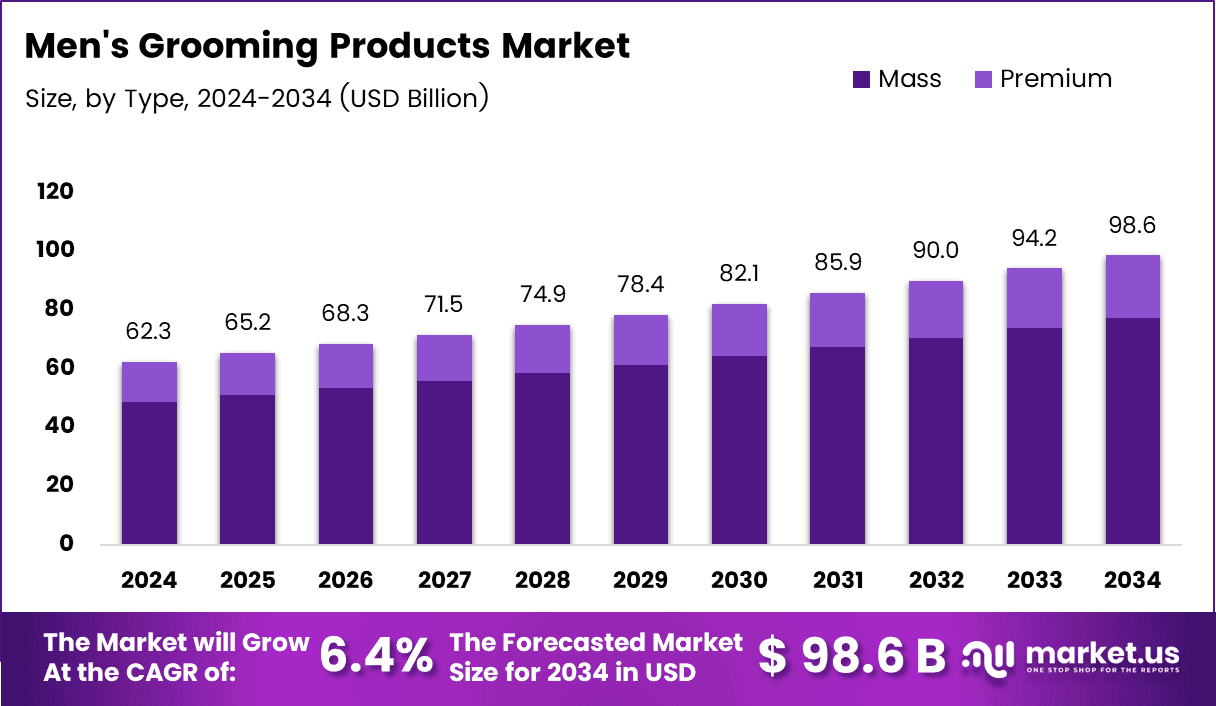
The Global Men’s Grooming Products Market size is expected to be worth around USD 98.6 billion by 2034, from USD 62.3 billion in 2024, growing at a CAGR of 6.4% during the forecast period from 2025 to 2034.
The Men’s Grooming Products Market refers to a fast-evolving consumer sector driven by rising personal-care awareness, premiumization, and expanding distribution channels. The market includes skincare, shaving, haircare, fragrances, and body-care essentials that align with modern lifestyles, higher hygiene awareness, and digital influence across male consumers. It continues gaining traction as men adopt structured grooming routines influenced by wellness trends and social media culture.
The market grows steadily as younger consumers adopt multi-step grooming habits and shift toward upgraded formulations. Increasing spending on skincare, sun protection, and beard-care essentials strengthens the segment further. Moreover, clean-label preferences and dermatology-tested solutions accelerate product diversification, encouraging brands to adopt science-backed claims, natural actives, and functional benefits to attract value-driven buyers.
Additionally, the category experiences strong opportunity expansion through e-commerce penetration, influencer-led awareness, and rising acceptance of self-care among millennial and Gen Z men. Governments in several regions promote hygienic living standards through public-health campaigns, indirectly supporting personal-care product adoption. Regulatory bodies also tighten ingredient-safety frameworks, pushing manufacturers toward compliant, transparent, and sustainable formulations across grooming lines.
According to Walmart retail distribution insights, the Shop product line now appears in 1,600 stores across the US, strengthening mass-market presence and normalizing grooming adoption. Additionally, the company donates 2% of its profits to men’s mental-health causes, according to brand communications, aligning the market with purpose-driven consumer expectations and socially responsible brand positioning.
Global expansion also contributes significantly. According to brand reports, the grooming line maintains distribution across 93 countries, showcasing a strong international reach. Furthermore, according to Mintel consumer behavior insights, 35% of men aged 18–34 buy premium body lotions, while 33% of Gen Z men upgrade to premium facial skincare products—confirming a clear premiumization shift strengthening the Men’s Grooming Products Market overall.
Key Takeaways
- The Global Men’s Grooming Products Market is projected to reach USD 98.6 billion by 2034 from USD 62.3 billion in 2024.
- The market expands at a CAGR of 6.4% during the forecast period from 2025 to 2034.
- Mass dominates the By Type segment with a leading share of 78.3% in 2024.
- Skin Care leads the By Product segment with a significant 37.9% share in 2024.
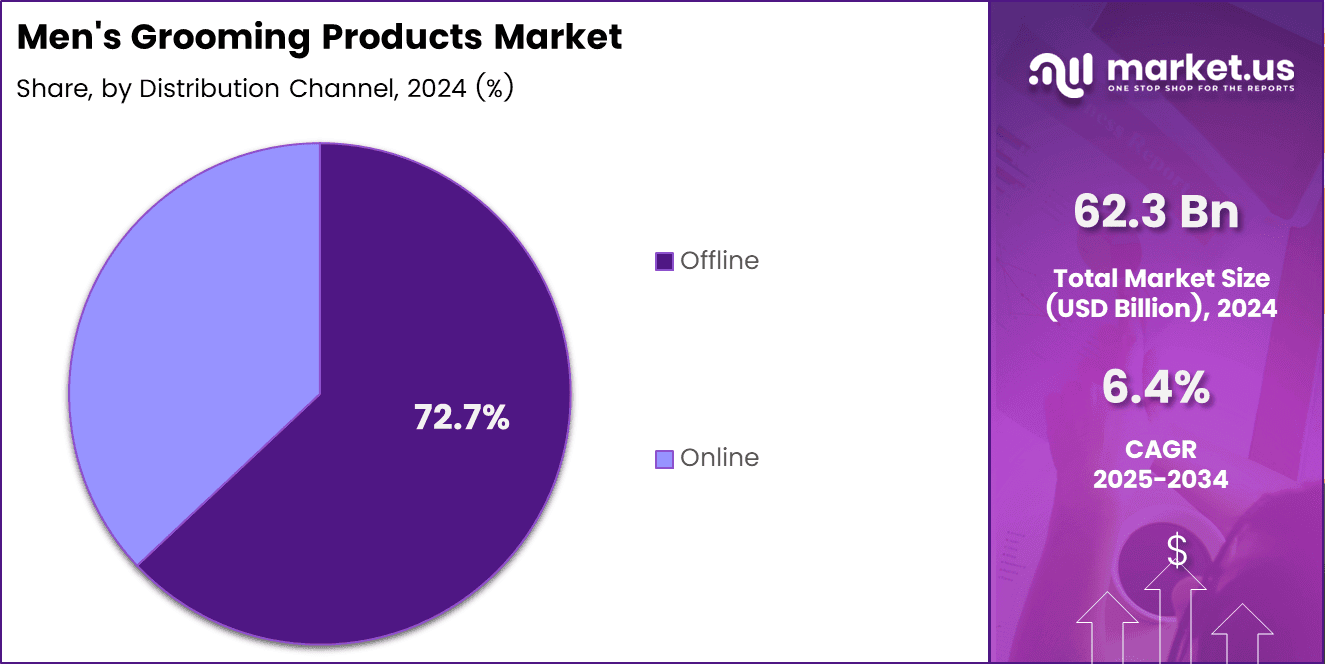
- Offline holds the largest By Distribution Channel share at a strong 72.7% in 2024.
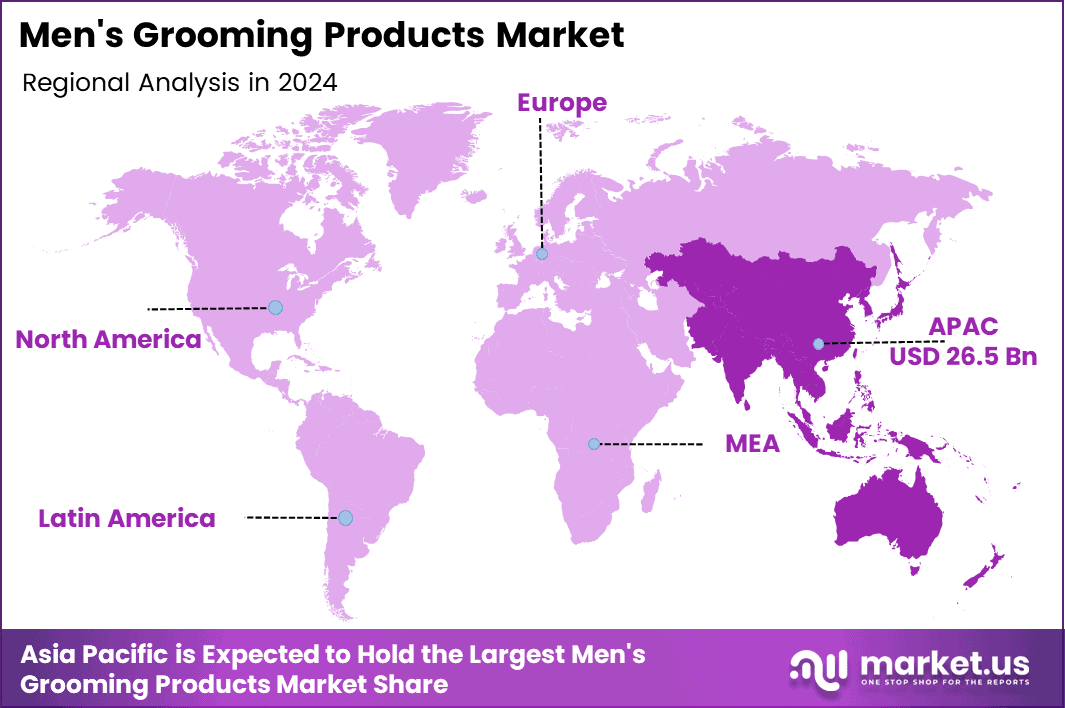
- Asia Pacific dominates the regional landscape with a market share of 42.6%, valued at USD 26.5 billion in 2024.
By Type Analysis
Mass dominates with 78.3% due to its affordability and broad consumer adoption.
In 2024, Mass held a dominant market position in the By Type Analysis segment of the Men’s Grooming Products Market, with a 78.3% share. This segment continues expanding as budget-friendly grooming essentials remain widely accessible across retail chains. Moreover, rising middle-income consumption strengthens demand for economical skincare, shave care, and hair-styling solutions.
In 2024, Premium maintained a secondary position in the By Type Analysis segment, benefiting from rising interest in high-quality grooming formulations. This segment grows as consumers explore advanced skincare, upgraded beard oils, and dermatology-tested textures. Additionally, increased awareness regarding ingredient quality encourages men to shift selectively toward premium grooming choices.
By Product Analysis
Skin Care dominates with 37.9% as men increasingly adopt structured skincare routines.
In 2024, Skin Care held a dominant market position in the By Product Analysis segment of the Men’s Grooming Products Market, with a 37.9% share. This segment strengthens as men adopt moisturizers, sunscreens, and facial cleansers as part of everyday grooming. Moreover, rising awareness of skin health accelerates category expansion.
Hair Styling contributed significantly to segment growth by appealing to consumers prioritizing appearance enhancement. Demand rises as men incorporate gels, clays, sprays, and pomades into daily grooming. Furthermore, evolving hairstyle trends encourage broader product diversity and consistent category engagement.
Shave/Beard Care played an essential role within the By-Product segment due to the continued adoption of beards and precision grooming routines. Consumers prefer oils, balms, and trimmers that support healthy beard maintenance. Consequently, rising interest in personal appearance sustains steady demand.
Accessories expanded gradually through the growing need for grooming tools supporting daily routines. Combs, razors, travel kits, and hygiene accessories improve convenience and routine consistency. Additionally, rising travel frequency and workplace grooming standards support further adoption.
Color Cosmetics gained momentum as more men explored subtle complexion-enhancing solutions. Tinted moisturizers, concealers, and grooming-friendly cosmetic items encouraged greater category acceptance. This shift reflects the rising influence of social media and professional appearance standards.
Others contributed to segment diversification by covering emerging hygiene and wellness essentials. Fragrances, body washes, and niche grooming formulations attracted consumers seeking all-in-one personal-care solutions. Consequently, increasing health consciousness supports the continued expansion of this category.
By Distribution Channel Analysis
Offline dominates with 72.7% driven by strong retail presence and consumer trust.
Offline held a dominant market position in the By Distribution Channel Analysis segment of the Men’s Grooming Products Market, with a 72.7% share. Supermarkets, hypermarkets, and pharmacy chains continue attracting shoppers who prefer in-person product evaluation. Additionally, strong retail visibility reinforces brand familiarity and purchase confidence.
Online contributed substantially as digital adoption expanded among grooming buyers. E-commerce platforms provide convenience and broader product discovery across skincare, beard care, and styling categories. Furthermore, rising mobile shopping penetration accelerates online grooming sales as consumers increasingly rely on reviews and doorstep delivery.
Key Market Segments
By Type
- Mass
- Premium
By Product
- Skin Care
- Hair Styling
- Shave/Beard Care
- Accessories
- Color Cosmetics
- Others
By Distribution Channel
- Offline
- Online
Drivers
Rising Adoption of Premium Beard-Care and Skincare Routines Among Millennial and Gen Z Men Drives Market Growth
Growing interest in self-care among younger men is expected to push the demand for premium beard oils, serums, and facial moisturizers. These consumers actively experiment with grooming routines, creating strong traction for high-performance, clean-label, and dermatologically tested products across online and offline retail formats. Their willingness to try new formats supports ongoing category expansion.
The shift from basic grooming to advanced routines is anticipated to strengthen product premiumization. Men increasingly use multi-step skincare such as exfoliators, toners, and anti-aging creams. This behavior encourages brands to innovate in textures, fragrances, and active ingredients to match changing skin concerns. Urban lifestyles and higher disposable incomes among millennial and Gen Z users are projected to accelerate the adoption of professional grooming services.
Restraints
High Price Sensitivity Affecting Premium Grooming Product Adoption in Emerging Markets Restrains Growth
Price consciousness in emerging economies is expected to limit the shift toward premium male grooming products. Many consumers still prefer mass-market creams, razors, and oils because premium items feel expensive for daily use. Brands face the challenge of balancing affordability and quality without compromising performance. Limited product knowledge in rural regions is anticipated to hinder category progression.
Many men remain unaware of ingredient safety, correct product usage, and long-term skin benefits. This gap reduces the demand for specialized grooming items such as serums, anti-pollution creams, and beard conditioners. Accessibility challenges continue to restrict market reach across non-urban areas. Retail shelves often lack advanced grooming lines, and supply chains remain dominated by low-cost local products. This slows premium penetration and reduces brand visibility.
Growth Factors
Growing Shift Toward Dermatologist-Tested Men’s Skincare Fuels Market Opportunities
The men’s grooming products market is experiencing strong growth as more consumers show interest in dermatologist-tested and clinically supported skincare solutions. This shift reflects a wider awareness among men about the importance of skin health, ingredient safety, and long-term skin benefits. Brands that offer science-backed products now attract higher trust and visibility in both online and offline channels.
At the same time, multi-functional grooming items are creating major opportunities for companies aiming to serve busy consumers. Products that combine cleansing, moisturizing, and anti-aging benefits into a single step are becoming popular because they save time and simplify daily routines. This trend encourages innovation in hybrid formulations and advanced textures suitable for all skin types.
Emerging Trends
Surge in Demand for Natural, Organic, and Chemical-Free Grooming Formulations Creates Strong Opportunities
The rising preference for natural and organic grooming formulations among men is projected to open new growth avenues. Consumers increasingly avoid harsh chemicals and prefer products enriched with plant-based oils, vitamins, and herbal extracts, especially for beard, skin, and hair care. This trend encourages brands to expand clean-label portfolios.
Demand for customized grooming solutions is expected to accelerate with the growth of AI-based skin assessment tools and subscription services. Personalized kits tailored to beard texture, skin type, or hair concerns offer greater convenience and a stronger sense of value. These models help brands improve retention and recurring revenue. Quick-commerce and D2C channels are anticipated to strengthen product accessibility. Faster delivery for razors, serums, aftershaves, and grooming essentials increases consumer purchase frequency.
Regional Analysis
Asia Pacific Dominates the Men’s Grooming Products Market with a Market Share of 42.60%, Valued at USD 26.5 Billion
Asia Pacific emerges as the leading regional market due to rising urbanization, strong demand for skincare, and increasing grooming awareness among younger male consumers. The region’s large population and shifting lifestyle patterns significantly enhance product uptake. With a dominant 42.60% share valued at USD 26.5 billion, growth remains supported by expanding retail networks, digital platforms, and evolving grooming trends across China, India, Japan, and Southeast Asia.
North America Men’s Grooming Products Market Trends
North America shows strong market expansion driven by higher spending on premium grooming, beard care, and advanced skincare products. The region benefits from widespread brand awareness and an established retail ecosystem. Increasing focus on appearance, self-care routines, and natural formulations continues to strengthen consumer adoption across the US and Canada.
Europe Men’s Grooming Products Market Trends
Europe remains a key market supported by high grooming consciousness, strong product innovation, and a mature beauty and personal care industry. Demand rises as consumers shift toward specialty skincare, organic grooming solutions, and multifunctional grooming formats. Well-developed regulatory frameworks and growing online beauty commerce further enhance regional market performance.
Middle East & Africa Men’s Grooming Products Market Trends
The Middle East & Africa region experiences accelerating demand due to rising disposable income, growth of modern retail outlets, and increasing adoption of male grooming routines. Urban centers such as the UAE, Saudi Arabia, and South Africa drive product penetration. Cultural shifts toward personal care and premium grooming categories support steady market expansion.
Latin America Men’s Grooming Products Market Trends
Latin America shows consistent growth fueled by increasing awareness of grooming practices, expanding middle-income groups, and rising demand for affordable grooming solutions. Countries such as Brazil and Mexico lead product consumption as men increasingly adopt skincare and styling routines. Digital retail growth and localized product offerings contribute to improving market accessibility and engagement.
United States Men’s Grooming Products Market Trends
The US market continues advancing due to strong consumer inclination toward skincare, hair styling, and beard-care products. High acceptance of premium and natural grooming formulations drives value growth. Evolving fashion trends, media influence, and the rise of male-focused grooming content strengthen consumer engagement across retail and e-commerce channels.
Key Regions and Countries
North America
- US
- Canada
Europe
- Germany
- France
- The UK
- Spain
- Italy
- Rest of Europe
Asia Pacific
- China
- Japan
- South Korea
- India
- Australia
- Rest of APAC
Latin America
- Brazil
- Mexico
- Rest of Latin America
Middle East & Africa
- GCC
- South Africa
- Rest of MEA
Key Men’s Grooming Products Market Company Insights
- In 2024, Beiersdorf AG continued to leverage its strong heritage in skin-care science to deepen its penetration in men’s grooming, enhancing product formulations with advanced dermatological ingredients and expanding retail presence across Europe and Asia. This strategic emphasis on quality and skincare competence helped maintain brand loyalty among premium male consumers.
- In 2024, the Procter & Gamble Co. strengthened its global men’s grooming portfolio by accelerating innovation cycles and launching new variants in shaving, deodorants, and skincare, supported by aggressive marketing. The company’s distribution scale and economies of scale enabled competitive pricing, allowing it to capture value-conscious male customers across diverse markets.
- In 2024 the L’Oréal SA built on its global brand equity to broaden its men’s grooming offerings beyond haircare to include skincare and beard grooming under aspirational branding, appealing to younger and style-conscious demographics. Leveraging its R&D capabilities and brand image, L’Oréal elevated the perception of men’s grooming from functional to lifestyle-driven routines.
- In 2024, the Shiseido Co., Ltd. focused on premiumization in men’s grooming, targeting affluent and urban male consumers with high-end skincare and fragrance lines rooted in Japanese beauty heritage. Emphasizing product quality, minimalist design, and refined scent profiles helped Shiseido carve out a niche in the luxury grooming segment and differentiate itself from mass-market competitors.
Top Key Players in the Market
- Beiersdorf AG
- Procter & Gamble Co.
- L’Oréal SA
- Shiseido Co., Ltd.
- Vi-john Group
- Colgate-Palmolive Company
- Kao Corporation
- Estee Lauder Companies, Inc.
- Coty, Inc.
Recent Developments
- In November 2025, Godrej Consumer Products (GCPL) acquired the men’s grooming brand Muuchstac for Rs 450 crore to enhance its premium personal care portfolio.This acquisition supports GCPL’s strategy to expand its presence in the premium face wash and skincare segment within the men’s grooming market.
- In December 2025, Honasa Consumer Ltd acquired Reginald Men (BTM Ventures) for ₹195 crore, signaling its formal entry into men’s-focused personal care.The move strengthens Honasa’s position in the specialized men’s grooming category beyond its existing mass-market brands.
- In February 2024, Planity raised $50 million in Series C funding to scale its digital booking and management platform.The funding is aimed at expanding services for men’s salons and grooming establishments across key European markets.
Report Scope
Report Features Description Market Value (2024) USD 62.3 Billion Forecast Revenue (2034) USD 98.6 billion CAGR (2025-2034) 6.4% Base Year for Estimation 2024 Historic Period 2020-2023 Forecast Period 2025-2034 Report Coverage Revenue Forecast, Market Dynamics, Competitive Landscape, Recent Developments Segments Covered By Type (Mass, Premium), By Product (Skin Care, Hair Styling, Shave/Beard Care, Accessories, Color Cosmetics, Others), By Distribution Channel (Offline, Online) Regional Analysis North America (US and Canada), Europe (Germany, France, The UK, Spain, Italy, and Rest of Europe), Asia Pacific (China, Japan, South Korea, India, Australia, and Rest of APAC), Latin America (Brazil, Mexico, and Rest of Latin America), Middle East & Africa (GCC, South Africa, and Rest of MEA) Competitive Landscape Beiersdorf AG, Procter & Gamble Co., L’Oréal SA, Shiseido Co., Ltd., Vi-John Group, Colgate-Palmolive Company, Kao Corporation, Estée Lauder Companies, Inc., Coty, Inc. Customization Scope Customization for segments, region/country-level will be provided. Moreover, additional customization can be done based on the requirements. Purchase Options We have three licenses to opt for: Single User License, Multi-User License (Up to 5 Users), Corporate Use License (Unlimited Users and Printable PDF)  Men’s Grooming Products MarketPublished date: Nov 2025add_shopping_cartBuy Now get_appDownload Sample
 -
-
- Beiersdorf AG
- Procter & Gamble Co.
- L'Oréal SA
- Shiseido Co., Ltd.
- Vi-john Group
- Colgate-Palmolive Company
- Kao Corporation
- Estee Lauder Companies, Inc.
- Coty, Inc.
Our Clients

- 168308
- Nov 2025






