


Market Overview
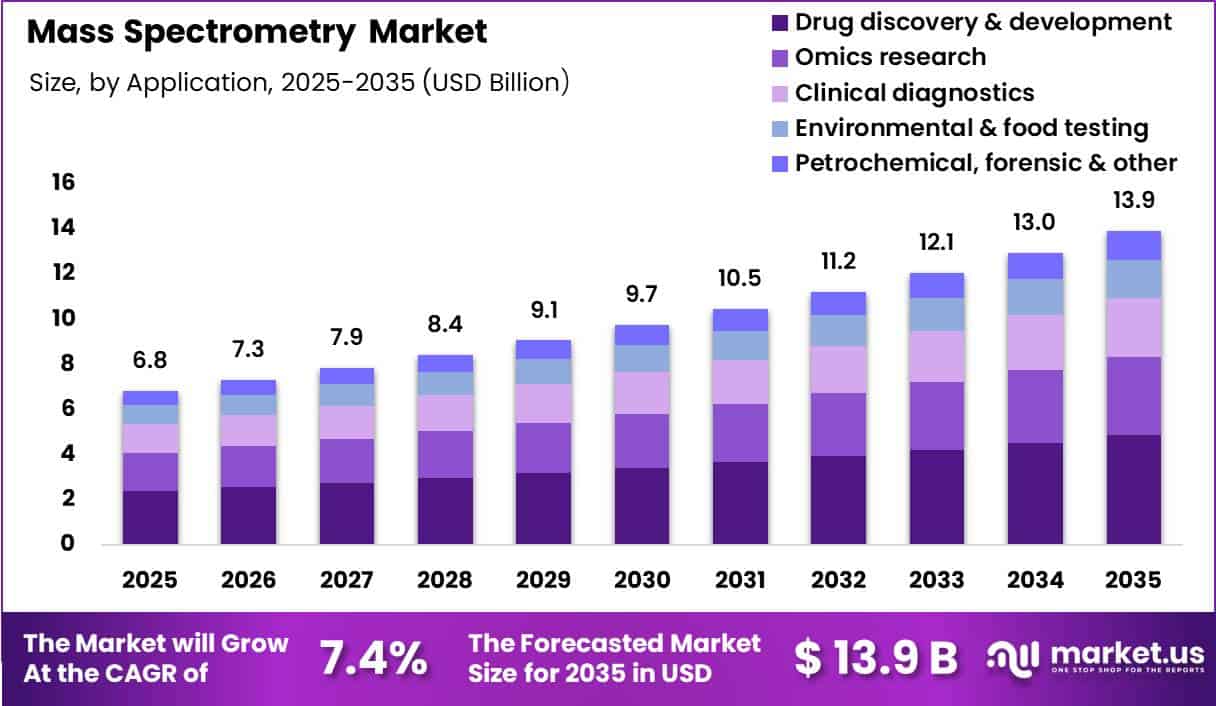
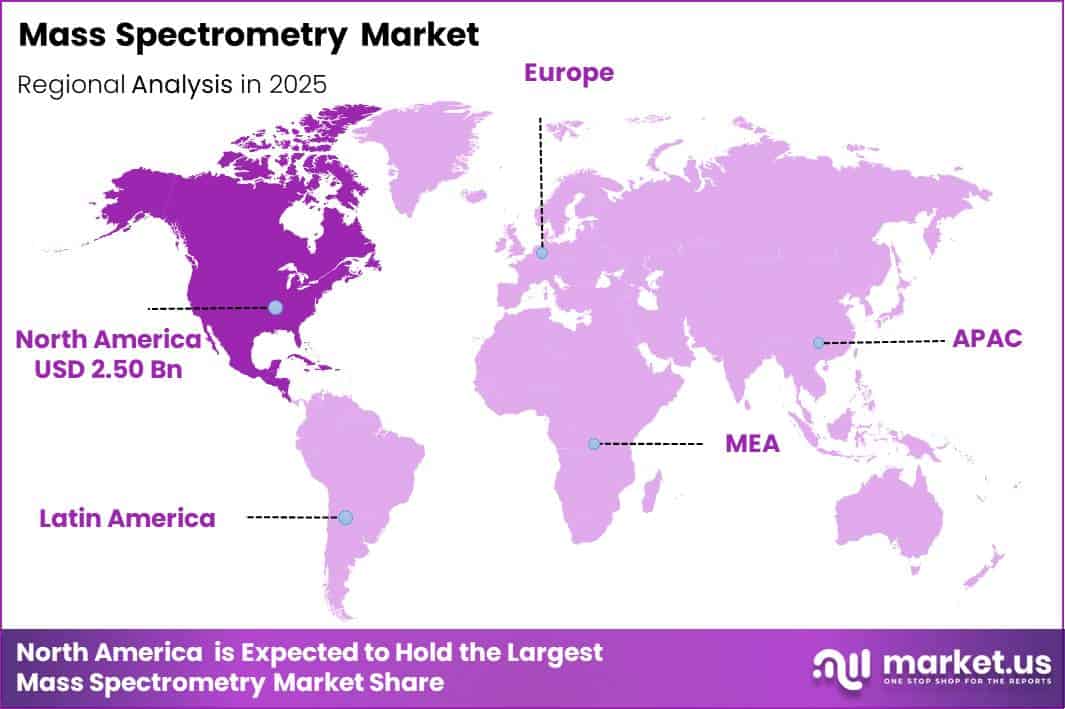
The Global Mass Spectrometry Market size is expected to reach around US$ 13.9 Billion by 2035, up from US$ 6.8 Billion in 2025, growing at a CAGR of 7.4% during the forecast period from 2026 to 2035. In 2025, North America led the market, achieving over 36.7% market share with revenue of US$ 2.5 Billion.
Mass spectrometry is an advanced analytical technology used to identify, quantify, and characterise molecules based on their mass-to-charge ratio. The technique plays a critical role in healthcare, pharmaceutical development, biotechnology, environmental testing, food safety, and clinical diagnostics. Growing demand for precision medicine, biomarker discovery, and rapid disease detection is increasing the adoption of mass spectrometry platforms in laboratories and research institutions.
In healthcare, mass spectrometry is widely used for clinical diagnostics, including newborn screening, therapeutic drug monitoring, toxicology testing, and infectious disease analysis. According to the U.S.
Centres for Disease Control and Prevention (CDC), newborn screening programs test millions of infants annually in the United States, with tandem mass spectrometry being an important technology for detecting inherited metabolic disorders. The CDC reports that more than 4 million newborns are screened each year in the U.S., helping identify serious conditions at an early stage.
The U.S. Food and Drug Administration (FDA) recognises mass spectrometry as an important analytical tool for pharmaceutical quality control, bioanalysis, and laboratory testing. The National Institutes of Health (NIH) highlights the increasing role of high-resolution mass spectrometry in proteomics, metabolomics, and biomedical research.
Technological advancements such as liquid chromatography–mass spectrometry (LC-MS), gas chromatography mass spectrometry (GC-MS), and high-resolution mass analysers are improving sensitivity, accuracy, and automation.
Rising investments in life sciences research, expanding personalised healthcare initiatives, and increasing clinical laboratory applications are expected to support continued growth of the global mass spectrometry market. Key applications include drug discovery, cancer research, biomarker identification, and precision diagnostics.
Key Takeaways
- Market Size: The Global Mass Spectrometry Market size was US$ 6.8 billion in 2025. The market is estimated to grow to US$ 13.9 billion by 2035.
- Market Share: The Compound Annual Growth Rate (CAGR) of the market from 2026 to 2035 will be 7.4%.
- Application: Drug Discovery & Development leads the segment, accounting for 34.9% of total application revenue.
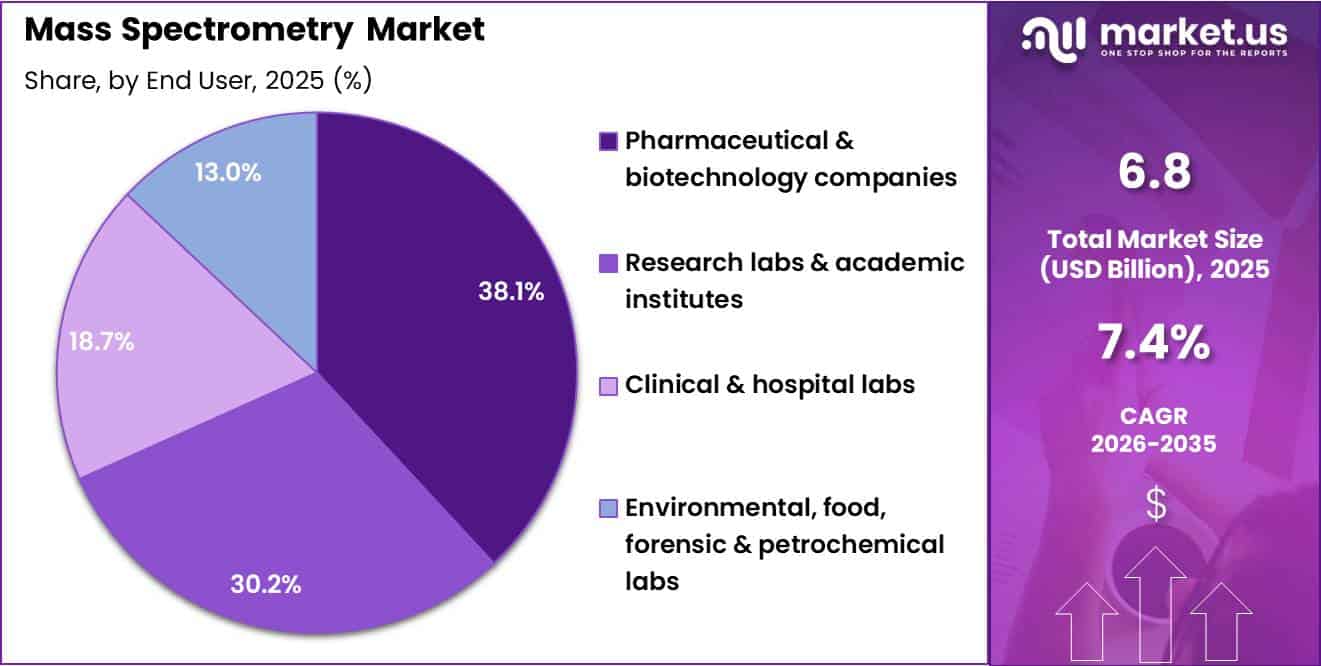
- End User: Pharmaceutical & Biotechnology Companies leads the segment, accounting for 38.1% of total end-user revenue.
- Technology: Hybrid Mass Spectrometry leads the segment, accounting for 49.9% of total technology segment revenue.
- Regional: North America is the dominant regional market, accounting for 36.7% of global revenue.
Application Analysis
The application segment of the Mass Spectrometry Market highlights the extensive use of analytical technologies across pharmaceutical research, healthcare diagnostics, environmental monitoring, and industrial testing.
Drug Discovery & Development segments dominate the market with a 34.9% share in 2025, supported by the increasing adoption of mass spectrometry for compound identification, molecular characterisation, pharmacokinetics studies, and biomarker validation. Pharmaceutical and biotechnology organisations utilise advanced mass spectrometry workflows to accelerate therapeutic development and improve drug safety assessment.
Omics Research accounts for 24.9% of the market share, driven by expanding applications in proteomics, metabolomics, and genomics research. Mass spectrometry enables large-scale molecular analysis, supporting disease mechanism studies and precision medicine initiatives. Clinical Diagnostics holds an 18.8% share, with growing usage in newborn screening, infectious disease testing, therapeutic drug monitoring, and clinical biomarker analysis.
Environmental & Food Testing contributes a 12.3% share, supported by regulatory requirements for detecting contaminants, pesticides, toxins, and chemical residues. Meanwhile, Petrochemical, Forensic & Other Applied Industries represent a 9.1% share, using mass spectrometry for material analysis, chemical identification, and forensic investigations. Increasing demand for accurate, sensitive, and high-throughput analytical solutions continues to expand mass spectrometry adoption across diverse applications.
End-User Analysis
The end-user segment of the Mass Spectrometry Market reflects strong adoption across pharmaceutical, academic, clinical, and industrial laboratories.
Pharmaceutical & Biotechnology Companies dominate the market with a 38.1% share in 2025, driven by extensive use of mass spectrometry in drug discovery, biologics development, quality control, and molecular research. These companies rely on advanced analytical platforms to improve research efficiency, validate therapeutic candidates, and support regulatory submissions.
Research Labs & Academic Institutes account for 30.2% of the market share, supported by increasing investments in biomedical research, proteomics, metabolomics, and life science studies. Universities and research centres use mass spectrometry systems for understanding complex biological processes and discovering new disease biomarkers.
Clinical & Hospital Labs hold 18.7% share, with expanding applications in clinical chemistry, metabolic disorder screening, infectious disease testing, and personalised medicine. Growing demand for faster and more precise diagnostic testing is encouraging healthcare laboratories to adopt advanced mass spectrometry solutions.
Environmental, Food, Forensic & Petrochemical Labs contribute 13.0% share, utilising these technologies for contamination analysis, quality testing, chemical identification, and regulatory compliance. The increasing need for reliable analytical testing across healthcare and industrial sectors continues to strengthen market adoption.
Technology Analysis
The technology segment of the Mass Spectrometry Market demonstrates the importance of advanced analytical platforms in research, diagnostics, and industrial applications.
Hybrid Mass Spectrometry segments dominate the market with a 49.9% share in 2025, owing to their superior sensitivity, high-resolution capabilities, and ability to combine multiple mass analysis techniques. Hybrid systems such as tandem mass spectrometry platforms are widely used in pharmaceutical research, proteomics, clinical diagnostics, and complex molecular analysis.
Single / Simple Mass Spectrometry platforms represent a significant portion of the market, supported by their cost-effectiveness, operational simplicity, and broad utilisation in routine laboratory testing. These systems are commonly used for basic compound identification, quality control procedures, and targeted analytical applications.
Other MS Platforms continue to gain attention due to technological advancements and specialised applications, including high-resolution mass spectrometry, imaging mass spectrometry, and emerging automated solutions. These platforms support advanced research areas such as spatial biology, biomarker discovery, and precision diagnostics.
Increasing demand for accurate molecular characterisation, automation, and high-throughput analysis is encouraging laboratories and research organisations to upgrade from conventional systems toward advanced mass spectrometry technologies.
Continued innovation in instrumentation, software integration, and data analysis capabilities is expected to support technology expansion across healthcare and scientific applications.
Key Market Segments
By Application
- Drug Discovery & Development
- Omics Research
- Clinical Diagnostics
- Environmental & Food Testing
- Petrochemical, Forensic & Other Applied Industries
By End User
- Pharmaceutical & Biotechnology Companies
- Research Labs & Academic Institutes
- Clinical & Hospital Labs
- Environmental, Food, Forensic & Petrochemical Labs
By Technology
- Hybrid Mass Spectrometry
- Single/Simple Mass Spectrometry
- Other MS Platforms
Drivers
Precision Proteomics in Oncology and Neurology Workflows
Precision proteomics is transitioning from a discovery-focused research tool into a clinically relevant platform in oncology and neurology, reshaping how mass spectrometry is deployed in translational medicine. This shift is important because it moves spending away from one-time research instruments toward recurring clinical applications such as biomarker validation, companion diagnostics, and longitudinal disease monitoring.
Recent developments highlight accelerating adoption. NIH-linked initiatives and Nature Medicine-associated consortium programs are building standardised proteomic datasets for neurodegeneration, while improving reproducibility and clinical-grade analytical workflows. These efforts are making protein-level signatures more usable in regulated clinical and near-clinical environments rather than purely academic settings.
Technological capability is also expanding rapidly. Spatial proteomics workflows reported in 2025 have demonstrated quantification of roughly 900 proteins at near single-cell resolution and up to 4,600 proteins in larger tissue regions, significantly improving sensitivity and scalability for translational applications in oncology and neurodegenerative diseases. Commercially, this evolution increases system value per lab.
High-end mass spectrometry platforms are increasingly paired with standardised sample prep kits, cloud or on-premises analytics software, and long-term service contracts. This shifts revenue toward recurring streams from reagents, consumables, and data analytics subscriptions rather than only capital equipment sales.
Overall, precision proteomics is becoming more embedded in multi-year clinical research programs, especially in oncology and neurology centres. This supports higher utilisation, faster instrument replacement cycles, and stronger recurring revenue intensity, contributing an estimated 2.2 % point uplift to market CAGR through expanded clinical integration and consumable-driven business models.
| Driver | (~) % Impact on CAGR Forecast | Geographic Relevance | Impact Timeline |
|---|---|---|---|
| Precision proteomics in oncology and neurology workflows | +2.2% | North America core, EU translational hubs, East Asia advanced labs | Medium term (2-4 years) |
| MALDI-TOF adoption in clinical microbiology and AMR surveillance | +1.8% | North America core, EU, APAC hospital corridors, selective LMIC reference labs | Short term (≤ 2 years) |
| Biologics, CGT, and advanced QC characterisation demand | +1.6% | US biopharma core, Western Europe, China, South Korea, Singapore | Medium term (2-4 years) |
| Lab regulation, coding, and reimbursement formalisation | +1.1% | United States core, EU regulated diagnostics markets, spill-over to developed APAC | Short term (≤ 2 years) |
| Spatial and single-cell omics workflow commercialization | +1.4% | US academic-medical clusters, EU research networks, Japan, South Korea | Long-term (≥ 4 years) |
Challenges
Clinical MS Talent Shortfall in Precision Diagnostics
The global expansion of clinical and research mass spectrometry MS capacity has outpaced the availability of trained specialists, creating a structural talent bottleneck in diagnostic and translational laboratories. In many large academic hospitals in the U.S. and EU, facilities operate 3 to 8 LC-MS systems but rely on only 2 to 4 senior MS scientists and 6 to 10 cross-trained technologists.
Resulting in an approximate ratio of 1 advanced instrument per 1 to 1.5 qualified FTE, compared with more balanced staffing levels in automated chemistry platforms. This mismatch limits throughput in high-demand clinical applications such as therapeutic drug monitoring, steroid profiling, vitamin D testing, and emerging proteomic biomarker panels.
With conditions like diabetes alone affecting 38.4 million people in the U.S. and 830 million globally, demand for high-specificity MS-based assays continues to grow, yet an estimated 15 to 25 % of potential testing demand is either outsourced or unmet due to constrained in-house expertise. The talent pipeline is slow to scale.
Developing a fully competent clinical MS scientist typically requires 3 to 5 years of specialised training, while annual turnover rates of 10 to 15 % in academic and hospital laboratories further strain continuity. This leads to longer assay validation timelines (often delayed by 6 to 12 months) and conservative instrument utilisation to minimise analytical risk.
Overall, this persistent workforce gap is estimated to impose a 1.1 % point drag on achievable CAGR, limiting the speed of new assay deployment and system scaling.
Mitigation depends on long-term structural interventions, including formal fellowship programs, vendor-led training ecosystems, accreditation-linked staffing benchmarks, and AI-assisted spectral interpretation tools that could reduce expert review time by 20 to 30 %, though meaningful balance between demand and talent supply is likely a 4-plus-year horizon outcome.
| Challenge | (~) % CAGR Friction Drag | Geographic Relevance | Mitigation Horizon |
|---|---|---|---|
| High-complexity workflow burden | -1.3% | North American hospitals, EU labs, APAC tertiary centres | Medium term (2-4 years) |
| Clinical MS talent shortfall | -1.1% | North America core, EU academic hubs, APAC metros | Long-term (≥ 4 years) |
| Regulatory validation overhead | -0.9% | US FDA, EU EMA hubs, Japan PMDA | Medium term (2-4 years) |
| Capital-intensive lab retrofits | -1.0% | Hospitals & reference labs, global urban clusters | Long-term (≥ 4 years) |
| Data management & IT bottlenecks | -0.8% | North America, EU, advanced APAC corridors | Medium term (2-4 years) |
| Consumables & uptime fragility | -0.7% | Global installed base, high-throughput labs | Short term (≤ 2 years) |
Restraints
Semiconductor and Precision Parts Bottlenecks in Mass Spectrometry Markets
Semiconductor and precision component bottlenecks are becoming a meaningful constraint on mass spectrometry MS system production, upgrades, and deployment cycles.
Critical subsystems such as ADCs, RF electronics, vacuum pumps, and motion controllers are increasingly affected by semiconductor shortages, export controls, and tariff-related supply chain fragmentation, all of which extend procurement timelines for high-end instruments.
In 2025 to 2026, tighter trade restrictions and capacity limits in advanced electronics manufacturing have pushed lead times for key components from 8 to 10 weeks to 20 to 30 weeks in many cases.
Specialised vacuum assemblies and precision machined parts sourced from East Asia also face 20 to 40 % higher logistics costs than pre-pandemic levels. These pressures collectively result in 3- to 6-month delays in instrument delivery, especially for complex platforms such as Orbitrap and time-of-flight systems.
At the installed base level, delayed upgrades force laboratories to continue using older systems with 10 to 20 % lower throughput and higher downtime, reducing analytical efficiency and slowing modernisation cycles. On the cost side, bill of materials inflation of 7 to 12 % has driven 5 to 8 % price increases for selected MS configurations since 2024.
Given long replacement cycles of 10 to 12 years, even moderate cost inflation and delivery delays reduce replacement urgency, particularly in academic and mid-tier clinical labs. This suppresses adoption in price-sensitive segments and contributes to an estimated 1.5 % point drag on CAGR through 2028.
To respond, OEMs are diversifying suppliers, redesigning instrument architectures to reduce semiconductor intensity, and selectively reshoring critical subcomponents, though these strategies require multi-year execution to fully stabilise supply chains.
| Restraint | (~) % Impact on CAGR Forecast | Geographic Relevance | Impact Timeline |
|---|---|---|---|
| High system CapEx & OpEx | -2.0% | North America, EU, APAC core | Medium term (2-4 years) |
| Semiconductor & precision parts bottlenecks | -1.5% | North America, EU, East Asia | Short to medium term (≤ 4 years) |
| Escalating regulatory & validation burden | -1.2% | North America, EU | Medium to long term (≥ 3-5 years) |
| Shortage of advanced MS talent | -1.0% | North America, EU, China, India | Medium term (2-4 years) |
| Constrained healthcare & public research budgets | -1.8% | North America, EU, selected EMs | Short to medium term (≤ 4 years) |
| Slow NAM/alternative methods adoption is shifting spend | -0.8% | North America, EU | Long-term (≥ 4 years) |
Opportunity
Portable Clinical Mass Spectrometry MS Opportunity
Portable and ambient mass spectrometry remains a largely untapped segment, as most current market growth is still concentrated in centralized laboratory based instruments. Decentralised or near-patient MS applications are constrained by challenges in sensitivity, reproducibility, workflow standardisation, and reimbursement frameworks, which limit broad clinical adoption today.
The key opportunity lies in shifting MS from a reference lab-only technology to a point-of-care or near-patient diagnostic tool. Potential use cases include emergency departments, mobile clinics, and high-acuity hospital settings, where rapid decision-making is critical.
Applications such as therapeutic drug monitoring, infectious disease triage, and oncology tissue assessment could benefit significantly from faster turnaround times. Even a 10 to 15 % reduction in diagnostic turnaround time can meaningfully improve clinical decision speed and workflow efficiency.
Despite its promise, this remains a non-baseline driver because adoption is still largely experimental and confined to select pilot sites. However, by 2028, advances in miniaturisation, automated sample preparation, and improved analytical robustness could enable broader deployment in controlled clinical environments.
If these constraints are gradually resolved, portable MS could unlock an additional 5 to 8 % expansion of the addressable end market, particularly in high acuity care settings. This would translate into an estimated 1.2 % point upside to overall market CAGR, driven by new decentralised use cases rather than replacement of existing lab infrastructure.
Overall, portable MS represents a structural long-term shift toward distributed diagnostics, but its impact depends on overcoming core barriers in standardisation, regulatory acceptance, and reimbursement integration.
| Opportunity | (~) % Potential CAGR Upside | Geographic Relevance | Execution Window |
|---|---|---|---|
| Portable clinical MS | +1.2% | North America, EU, APAC urban hospitals | Short term (≤ 2 years) |
| Reimbursed liquid biopsy | +1.8% | North America core, EU tier-1 markets | Medium term (2-4 years) |
| Metabolomics panels | +1.4% | North America, EU, Japan, South Korea | Medium term (2-4 years) |
| Public health surveillance | +1.0% | U.S., EU, select APAC public systems | Medium term (2-4 years) |
| AI software monetisation | +1.5% | Global installed base, especially NA/EU | Short term (≤ 2 years) |
| Lab network roll-ups | +1.1% | U.S., EU fragmented regional labs | Long-term (≥ 4 years) |
Regional Analysis
In 2025, North America led the market, achieving over 36.7% market share with revenue of US$2.50 billion. The regional landscape of the Mass Spectrometry Market is shaped by increasing investments in life sciences research, pharmaceutical innovation, clinical diagnostics, and advanced analytical testing.
North America represents a leading market region, supported by strong biotechnology and pharmaceutical industries, extensive research infrastructure, and high adoption of advanced laboratory technologies. The presence of major academic research centres, government-funded biomedical programs, and increasing demand for precision medicine applications continues to drive mass spectrometry adoption across drug discovery and clinical diagnostics.
Europe is witnessing significant growth due to rising investments in proteomics, metabolomics, and healthcare research initiatives. Countries across the region are expanding laboratory capabilities for pharmaceutical development, environmental monitoring, and food safety testing. Regulatory emphasis on accurate analytical testing and quality control is further supporting the adoption of advanced mass spectrometry systems.
Asia-Pacific is emerging as a rapidly expanding region, driven by growing pharmaceutical manufacturing, biotechnology research, healthcare infrastructure development, and increasing laboratory automation. Countries such as Japan, China, and South Korea are strengthening research capabilities in molecular biology, personalised medicine, and drug development.
Latin America, the Middle East & Africa are gradually adopting mass spectrometry technologies due to improving healthcare systems, increasing diagnostic capabilities, and growing investments in scientific research.
Expanding applications in clinical testing, environmental analysis, and pharmaceutical quality control are expected to support regional market development. Overall, rising demand for high-precision molecular analysis is accelerating global adoption of mass spectrometry solutions.
Key Regions and Countries
North America
- The US
- Canada
Europe
- Germany
- France
- The U.K.
- Italy
- Spain
- Russia & CIS
- Rest of Europe
Asia Pacific
- China
- India
- Japan
- South Korea
- ASEAN
- Australia & New Zealand
- Rest of Asia Pacific
Middle East & Africa
- GCC
- South Africa
- Rest of the Middle East & Africa
Latin America
- Brazil
- Mexico
- Rest of Latin America
Key Player Analysis
Suppliers in the global mass spectrometry market are strengthening competitive positions through hybrid platform innovation that integrates quadrupole, time-of-flight, Orbitrap, and ion trap technologies within advanced tandem MS configurations.
These systems are being developed to provide higher sensitivity, resolution, mass accuracy, and structural characterization for complex biological samples across drug discovery, proteomics, and clinical diagnostics. Strategic priorities include enhancing Orbitrap and time-of-flight performance for sub-ppm mass accuracy and high-resolution proteomics and metabolomics workflows.
Clinical mass spectrometry platforms are also being expanded to support laboratory-developed tests and FDA-cleared diagnostic applications. Investments in software, spectral libraries, automated interpretation, and quantitative data analytics are reducing analytical workload and improving accessibility.
In parallel, companies are developing application-specific ion sources, integrated LC-MS and GC-MS workflows, and global technical support networks. Rising pharmaceutical and academic investment in proteomics, metabolomics, spatial omics, biomarker discovery, precision medicine, and multi-omics research is expected to sustain high-value mass spectrometry procurement through 2035.
Top Key Players
- Thermo Fisher Scientific Inc.
- Agilent Technologies Inc.
- SCIEX (Danaher Corporation)
- Waters Corporation
- Bruker Corporation
- Shimadzu Corporation
- PerkinElmer Inc.
- JEOL Ltd.
- LECO Corporation
- MKS Instruments Inc.
- Ametek Inc. (incl. Mass-Spec Brands)
- Rigaku Corporation
- Bio-Rad Laboratories Inc.
- Analytik Jena GmbH
- Hitachi High-Tech Corporation
- Other Key Players
Recent Developments
- In February 2026, Waters Corporation expanded its tandem quadrupole mass spectrometry portfolio with an enhanced clinical diagnostic platform targeting hospital and reference laboratory institutional buyers seeking high-throughput quantitative LC-MS/MS newborn screening and therapeutic drug monitoring test menu expansion.
- In March 2026, Agilent Technologies secured a multi-year mass spectrometry instrument and consumable supply agreement with a leading European pharmaceutical research consortium covering LC-MS and GC-MS platform procurement across its member organisation’s drug discovery and analytical chemistry institutional laboratory network.
- In May 2026, Bruker Corporation launched its next-generation timsTOF Ultra trapped ion mobility mass spectrometry platform targeting academic proteomics and pharmaceutical single-cell multi-omics research institutional buyers seeking the highest sensitivity four-dimensional proteomics data acquisition capability.
Report Scope
| Report Features | Description |
|---|---|
| Market Value (2025) | US$ 6.8 Billion |
| Forecast Revenue (2035) | US$ 13.9 Billion |
| CAGR (2026-2035) | 7.4% |
| Base Year for Estimation | 2025 |
| Historic Period | 2020-2024 |
| Forecast Period | 2026-2035 |
| Report Coverage | Revenue Forecast, Market Dynamics, Competitive Landscape, Recent Developments |
| Segments Covered | By Application (Drug Discovery & Development, Omics Research, Clinical Diagnostics, Environmental & Food Testing, Petrochemical, Forensic & Other Applied Industries), By End User (Pharmaceutical & Biotechnology Companies, Research Labs & Academic Institutes, Clinical & Hospital Labs, Environmental/Food/Forensic & Petrochemical Labs), By Technology (Hybrid Mass Spectrometry, Single/Simple Mass Spectrometry, Other MS Platforms) |
| Regional Analysis | North America – The US, Canada; Europe – Germany, France, U.K., Italy, Spain, Russia & CIS, Rest of Europe; Asia Pacific – China, India, Japan, South Korea, ASEAN, Australia & New Zealand, Rest of Asia Pacific; Middle East & Africa – GCC, South Africa, Rest of Middle East & Africa; Latin America – Brazil, Mexico, Rest of Latin America |
| Competitive Landscape | Thermo Fisher Scientific Inc., Agilent Technologies Inc., SCIEX (Danaher Corporation), Waters Corporation, Bruker Corporation, Shimadzu Corporation, PerkinElmer Inc., JEOL Ltd., LECO Corporation, MKS Instruments Inc., Ametek Inc. (incl. Mass-Spec Brands), Rigaku Corporation, Bio-Rad Laboratories Inc., Analytik Jena GmbH, Hitachi High-Tech Corporation, Other Key Players |
| Customization Scope | Customization for segments, region/country-level will be provided. Moreover, additional customization can be done based on the requirements. |
| Purchase Options | We have three licenses to opt for: Single User License, Multi-User License (Up to 5 Users), Corporate Use License (Unlimited User and Printable PDF) |





































