Report Overview
The Global LLM Cost Optimization Market size is expected to be worth around USD 9,207.2 million by 2035, from USD 863.7 million in 2025, growing at a CAGR of 26.7% during the forecast period from 2025 to 2035. North America held a dominant market position, capturing more than a 44.1% share, holding USD 380.8 million in revenue.
LLM cost optimization refers to the process of reducing the operational expense of large language models while maintaining useful performance. It includes better control of compute usage, prompt efficiency, model routing, caching, and resource planning. The goal is to make AI deployment more affordable, reliable, and practical for long term business use.
Rising compute needs remain a primary driver, as larger AI models consume heavy processing resources, with nearly 70-80% of total costs linked to compute usage. Inefficient token usage further increases spending, often accounting for 40-50% of expenses. Real-time demand adds pressure, where peak loads can raise infrastructure costs by 30% or more without proper scaling.
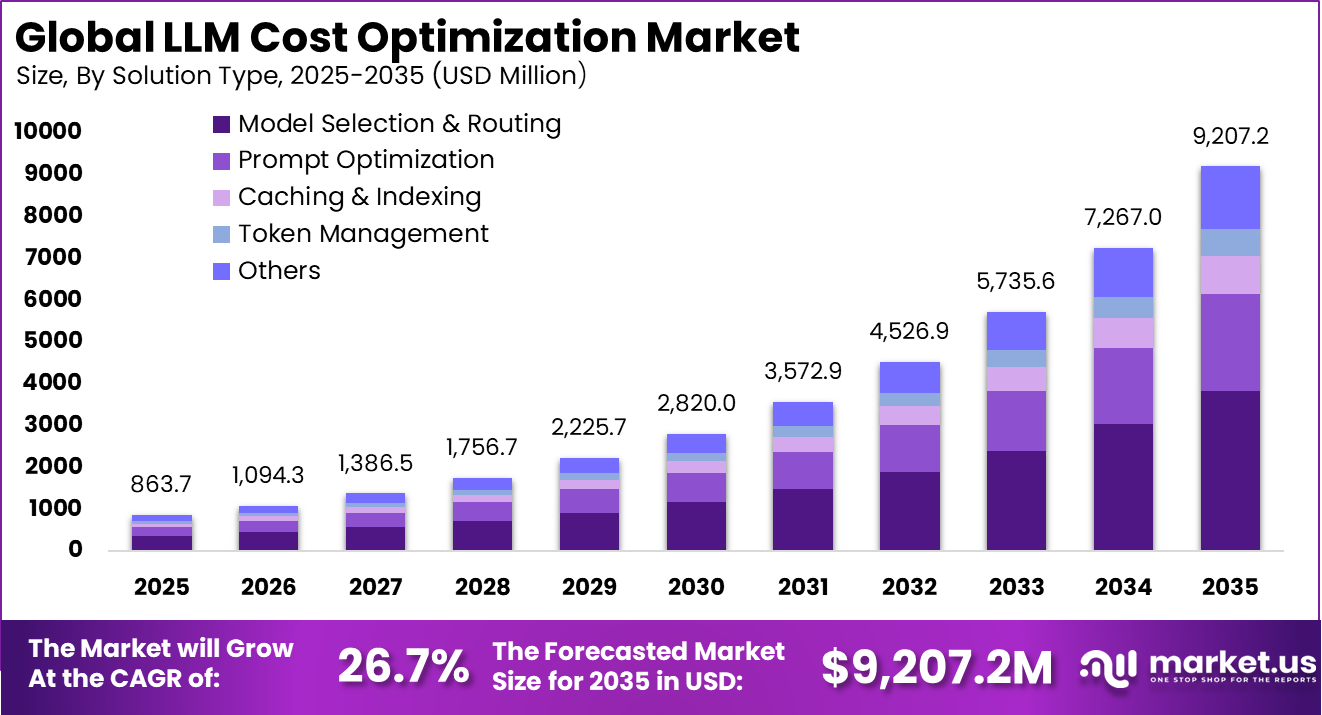
The market for LLM cost optimization is driven by the rapid rise in enterprise AI usage and the need to manage growing operational expenses. As organizations deploy language models across multiple functions, controlling compute usage and improving efficiency becomes essential. Businesses are focusing on better resource allocation, prompt design, and system monitoring to ensure sustainable adoption without affecting performance or service quality.
Demand continues to expand as enterprises increasingly rely on AI systems for complex tasks such as data analysis and continuous customer interaction. Enterprise query volumes are rising by around 60% each year, reflecting strong adoption. However, this growing usage places pressure on budgets, encouraging companies to prioritize efficiency before scaling further deployments.
For instance, in January 2026, AWS debuted Bedrock’s Inference Yield Manager from Seattle, achieving 40% lower TCO through predictive workload balancing. Financial firms using Llama models saw immediate savings without accuracy loss, reinforcing Amazon’s dominance in enterprise LLM deployment efficiency.
Key Takeaway
- In 2025, the model selection and routing segment led the global LLM cost optimization market with a share of 41.8%.
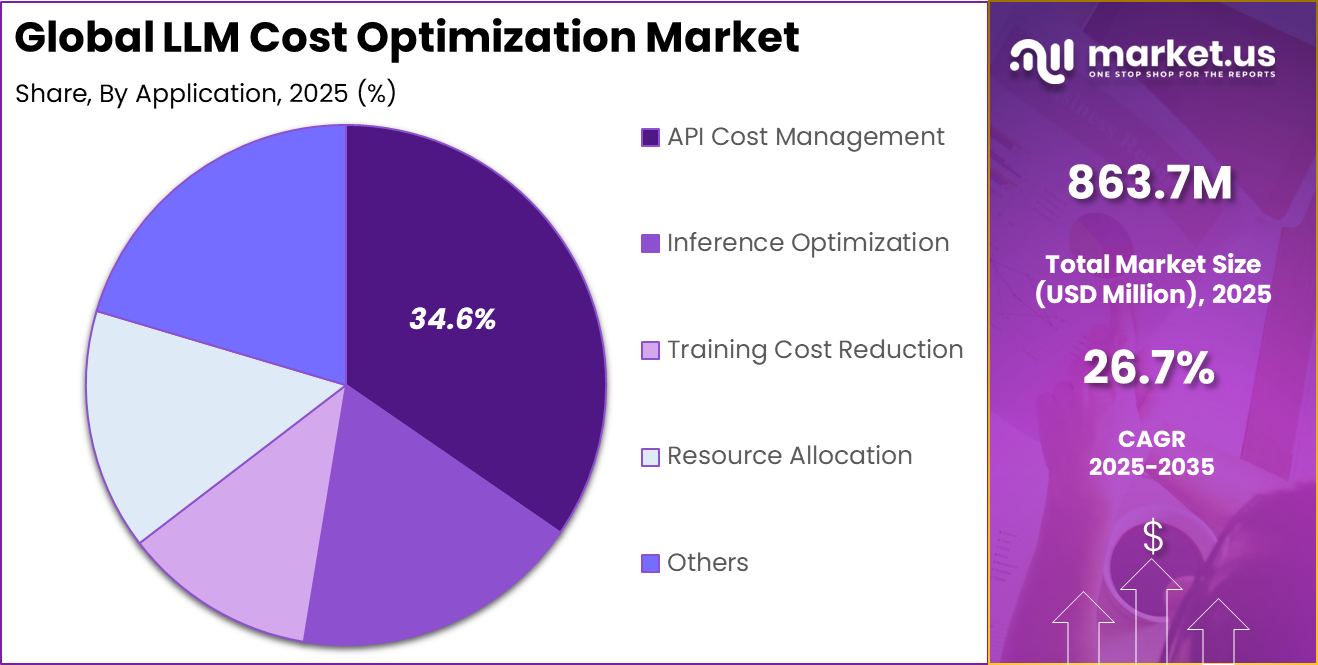
- The API cost management segment accounted for 34.6%, reflecting strong demand for optimizing API usage and associated costs.
- The enterprises segment held a dominant 58.3% share, indicating that large organizations are the primary users of LLM cost optimization solutions.
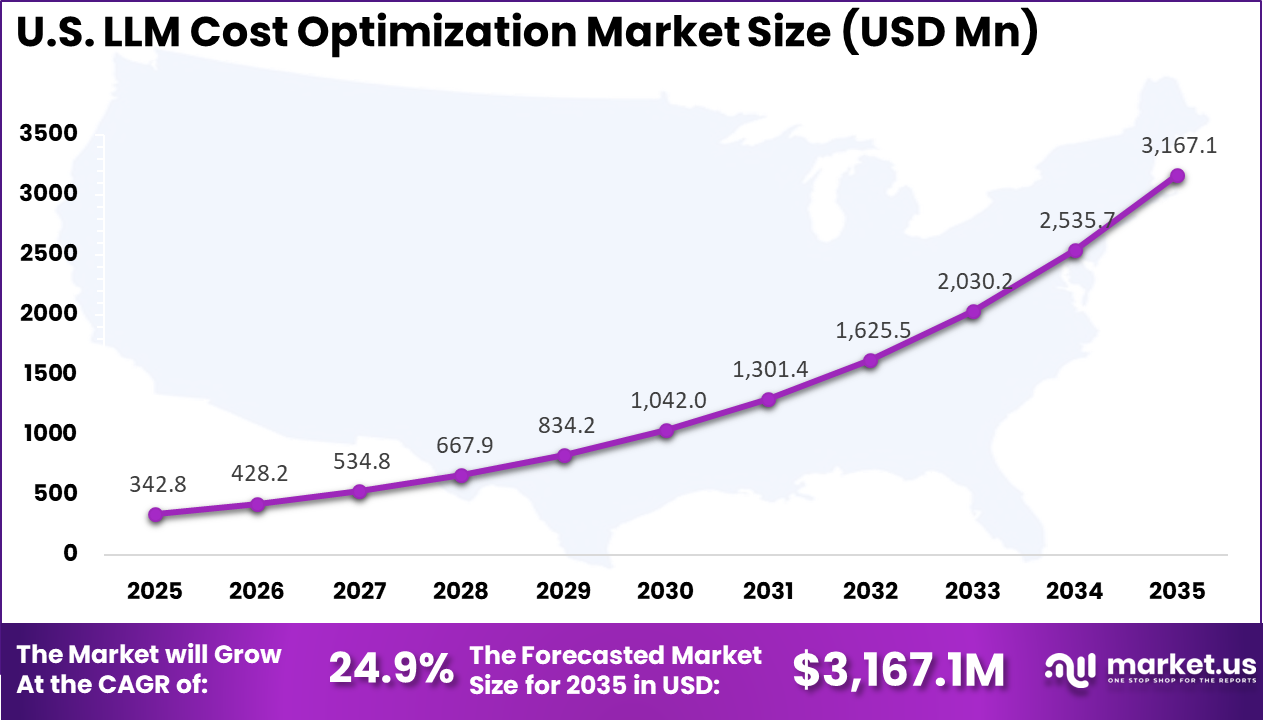
- The U.S. LLM cost optimization market was valued at USD 342.8 million in 2025, with a robust CAGR of 24.9%.
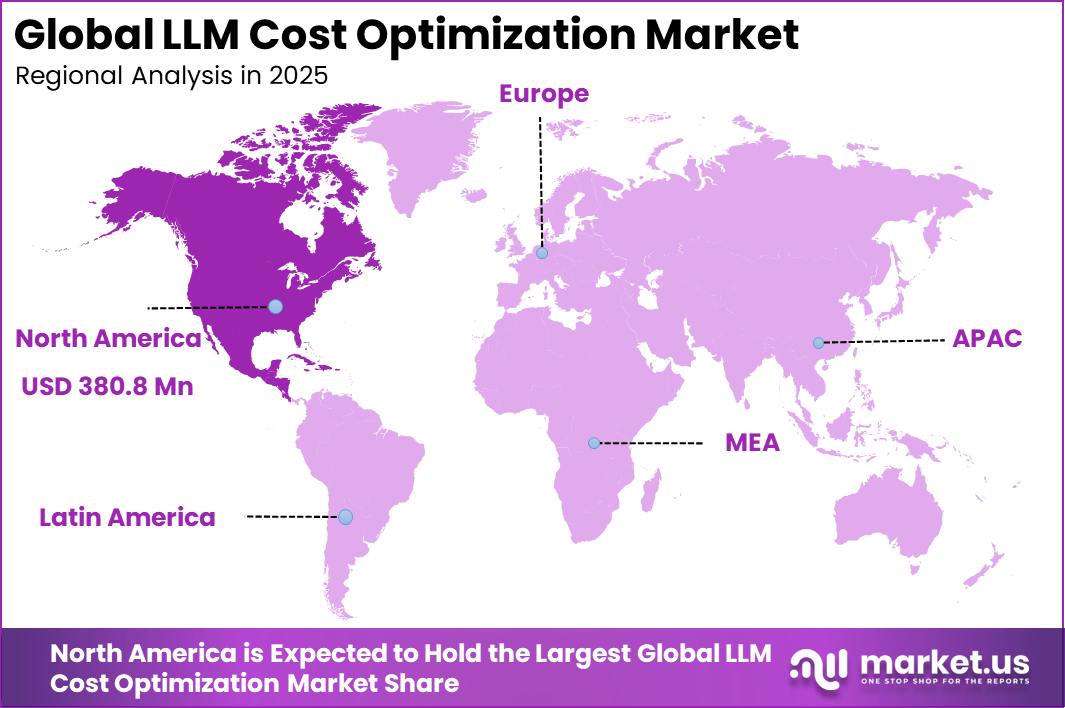
- North America held more than 44.1% of the global market in 2025, driven by technological advancements and a high concentration of enterprises adopting LLM optimization strategies.
Solution Type Analysis
In 2025, The Model Selection & Routing segment held a dominant market position, capturing a 41.8% share of the Global LLM Cost Optimization Market. This dominance is due to the growing need to assign the right model for each task instead of using a single high-cost model for all queries. Organizations are focusing on balancing performance and cost by routing simple requests to lighter models while reserving advanced models for complex tasks, improving efficiency across workloads.
This approach also supports better control over response time and system load, especially in high-volume environments. As AI usage expands across departments, businesses prefer flexible routing systems that can adapt to different use cases. This helps maintain quality while reducing unnecessary resource consumption in daily operations.
For Instance, in April 2026, Microsoft rolled out new tools to help teams pick and switch between LLMs based on task needs. This makes it easier to match models to jobs like analysis or generation, cutting waste in real-world setups. Developers now route queries smarter, saving time and resources as demands grow.
Application Analysis
In 2025, the API Cost Management segment held a dominant market position, capturing a 34.6% share of the Global LLM Cost Optimization Market. This dominance is due to the rising use of API-based AI services across enterprise applications. As more systems depend on external AI models, managing request flow and usage becomes critical. Organizations focus on controlling how data is sent and processed to prevent unnecessary cost increases.
Companies are also adopting better monitoring and optimization practices to manage usage more effectively. Techniques such as reducing redundant queries and improving prompt structure are helping control expenses. This ensures stable operations while supporting growing demand for AI-driven services across business functions.
For instance, in February 2026, AWS launched features to track and trim API calls for LLMs in cloud environments. It flags high-use patterns and suggests tweaks to keep bills steady during spikes. Users in large deployments now handle scaling without constant cost worries.
End-User Analysis
In 2025, The Enterprises segment held a dominant market position, capturing a 58.3% share of the Global LLM Cost Optimization Market. This dominance is due to the large-scale adoption of AI solutions across enterprise environments. These organizations handle higher workloads and require strong cost control to maintain efficiency. Managing AI expenses becomes essential as usage spreads across departments and business processes.
Enterprises also invest more in structured optimization strategies to improve long-term performance. They focus on reliability, governance, and consistent output quality. This leads to wider adoption of cost management tools that support continuous operations while maintaining control over complex AI deployments.
For Instance, in March 2026, IBM released enterprise-grade dashboards for LLM tracking in business systems. These tools break down costs by department, making it simple to adjust for heavy users like sales or support. Adoption is picking up fast in corporate settings.
U.S. LLM Cost Optimization Market Size
The market for LLM Cost Optimization within the U.S. is growing tremendously and is currently valued at USD 342.8 million; the market has a projected CAGR of 24.9%. The market is growing due to the rapid adoption of large language models across businesses that need better control over rising compute, storage, and inference expenses.
Companies are investing in optimization tools to improve model efficiency, reduce token waste, and manage infrastructure loads more effectively. Strong enterprise AI adoption, rising cloud spending, and the need for scalable deployment are also supporting steady market growth across the country.
For instance, in April 2025, Google introduced Gemini 2.5 Flash’s “thinking budget” feature from Mountain View, California, letting developers control reasoning depth to balance performance and costs. This flexible optimization tool helps enterprises achieve high-quality AI outputs at significantly lower token rates, solidifying U.S. leadership in cost-effective LLM scaling.
In 2025, North America held a dominant market position in the Global LLM Cost Optimization Market, capturing more than a 44.1% share, holding USD 380.8 million in revenue. This dominance is due to strong enterprise adoption of AI across industries, where cost control becomes essential at scale.
The region benefits from advanced cloud infrastructure, early deployment of large models, and higher spending on AI tools. Organizations actively invest in optimization to manage growing usage and maintain operational efficiency.
For instance, in March 2025, Microsoft enhanced LLM cost optimization with Azure AI Studio’s new auto-scaling inference endpoints that dynamically adjust compute resources based on real-time demand. This innovation reduced inference costs by up to 40% for enterprise customers while maintaining low latency. From Redmond, Washington, Microsoft’s cloud leadership continues to drive North America’s dominance in efficient LLM deployment.
Emerging Trends
Workflow integration is becoming more common, where generative AI tools are embedded into everyday business processes. These systems handle repetitive tasks efficiently, reducing errors and operational friction. Many organizations report cost reductions of nearly 50% for non-urgent workloads through batch processing, improving overall efficiency across multiple functions.
Multi-modal capabilities are expanding rapidly, combining text, images, and voice into unified outputs. These systems enhance customer interactions and creative workflows, delivering more engaging experiences. Early implementations show engagement improvements of 30-50%, as businesses benefit from better personalization without significantly increasing complexity or resource requirements.
Growth Factors
Robust data infrastructure plays a central role in enabling efficient AI deployment and scalability. Organizations with strong data foundations report up to 70% smoother implementation processes. Clean and well-structured data reduces errors and rework, allowing systems to operate efficiently while minimizing unnecessary computational and operational waste.
Employee trust and adoption are equally important for sustained growth. Clear usage guidelines and early success in simple applications encourage wider acceptance. Adoption rates can increase by 40% or more when users understand the benefits. Without internal confidence, even advanced systems remain underutilized and fail to deliver expected outcomes.
Key Market Segments
By Solution Type
- Model Selection & Routing
- Prompt Optimization
- Caching & Indexing
- Token Management
- Others
By Application
- API Cost Management
- Inference Optimization
- Training Cost Reduction
- Resource Allocation
- Others
By End-User
- Enterprises
- Developers
- Cloud Providers
Key Regions and Countries
North America
- US
- Canada
Europe
- Germany
- France
- The UK
- Spain
- Italy
- Russia
- Netherlands
- Rest of Europe
Asia Pacific
- China
- Japan
- South Korea
- India
- Australia
- Singapore
- Thailand
- Vietnam
- Rest of APAC
Latin America
- Brazil
- Mexico
- Rest of Latin America
Middle East & Africa
- South Africa
- Saudi Arabia
- UAE
- Rest of MEA
Drivers
Rising Enterprise AI Usage
Enterprise AI usage is growing as more businesses bring language models into customer support, content work, search, analytics, and internal operations. As usage expands across teams, the cost of running these systems becomes a serious concern. This is pushing organizations to look for better ways to manage resources and improve overall efficiency.
The need for optimization is becoming stronger because enterprise deployments are no longer limited to small experiments. Many companies now depend on AI tools in routine workflows, where high usage can quickly affect budgets. This steady expansion is creating strong demand for solutions that help reduce waste while keeping systems responsive and useful.
For instance, in February 2026, Google expanded its Gemini for Workspace and Vertex AI integrations, enabling more enterprises to run AI‑assisted search, drafting, and analytics at scale. As more organizations route internal knowledge workflows and customer‑facing functions through these tools, Google has had to introduce tighter budgeting, model‑tier selection, and token‑tracking features so businesses can keep AI usage predictable and aligned with their operational cost structures.
Restraint
Governance Complexity
Governance complexity remains a key restraint in this market because AI systems must be managed with clear rules, oversight, and accountability. Many organizations struggle to align cost control with compliance, risk management, and internal approval processes. This often slows adoption and makes optimization harder to apply across departments.
The challenge becomes greater when multiple teams use different tools, models, and workflows at the same time. In such cases, decision making becomes fragmented, and visibility is reduced. Companies may know they need optimization, but governance hurdles can delay action and limit how effectively these solutions are implemented.
For instance, in April 2026, IBM launched an updated AI governance suite that forces stricter model‑version controls whenever teams attempt to swap or downgrade LLMs for cost reasons. In regulated environments, even small changes such as using a smaller model or adjusting context length must pass through data‑privacy, security, and compliance gates, which can delay or block cost‑optimization experiments that would otherwise be technically straightforward.
Opportunities
Smarter Inference Control
Smarter inference control presents a major opportunity because it helps businesses run AI tasks more efficiently. Instead of using the same model for every request, organizations can match tasks with the most suitable resource. This improves performance while helping control unnecessary processing and operational waste.
There is also strong potential for tools that simply automate these choices. Many businesses want systems that can manage routing, caching, and workload balancing without manual effort. Solutions that make inference control easier to use can support broader adoption and improve cost discipline across AI deployments.
For instance, in April 2026, Cohere introduced smarter routing logic that automatically assigns incoming requests to different model tiers based on content complexity and historical performance data. This lets customers keep premium models for high‑value tasks such as contract analysis or legal drafting while steering everyday summarization and classification jobs to lighter, cheaper variants, all without changing their application code.
Challenges
Balancing Cost with Quality
Balancing cost with quality remains one of the biggest challenges in this market. Businesses want lower AI operating expenses, but they also need reliable outputs, fast responses, and a consistent user experience. Cutting costs too aggressively can weaken performance and reduce trust in the system.
This creates a difficult tradeoff for organizations trying to scale AI responsibly. Every change made to reduce cost must also be checked for its effect on output quality and business value. The challenge is not only about spending less, but about doing so without reducing the usefulness of AI applications.
For instance, in January 2026, Graphcore began encouraging customers to experiment with lower‑precision inference modes that can halve compute requirements for certain text‑generation workloads. However, early tests showed that aggressive precision‑cutting sometimes introduced subtle artifacts in outputs, forcing teams to carefully define acceptable quality thresholds and fall back to higher‑quality modes for customer‑facing responses.
Key Players Analysis
The competitive landscape of the LLM Cost Optimization Market is led by major cloud and technology providers such as Microsoft, Google, and AWS. These organizations focus on delivering scalable infrastructure and tools to reduce large language model (LLM) training and inference costs. Their offerings include optimized hardware and resource management platforms. Enterprises using these solutions report significant improvements in cost efficiency and resource utilization during model deployment.
Key AI and model innovation firms such as OpenAI, Anthropic, and IBM contribute through optimized training pipelines and algorithmic efficiency enhancements. Their platforms support automated tuning and model compression techniques to lower overall expenditure. Providers such as Databricks and Hugging Face integrate cost management features within collaborative AI workflows, enabling effective scaling of LLM workloads across teams.
Specialized AI infrastructure and research driven entities such as Cohere, Aleph Alpha, Cerebras, SambaNova, Graphcore, MosaicML, and Together AI are advancing LLM cost optimization through efficient model architectures and hardware acceleration. These players support cost reduction by enhancing throughput and lowering energy consumption in large model operations. Other competitors continue to introduce niche cost management tools and performance optimization solutions.
Top Key Players in the Market
- Microsoft
- AWS
- OpenAI
- Anthropic
- IBM
- Databricks
- Hugging Face
- Cohere
- Aleph Alpha
- Cerebras
- SambaNova
- Graphcore
- MosaicML
- Together AI
- Others
Recent Developments
- In January 2026, Microsoft rolled out Azure AI Studio’s new auto-scaling inference engine that cuts LLM hosting costs by 40% for enterprise workloads. Built on their OpenAI partnership, it dynamically routes traffic between GPT and lighter Phi models based on query complexity. Early adopters like financial firms saw immediate savings on high-volume customer service deployments. This keeps Microsoft ahead in making production LLMs affordable at scale.
- In February 2026, Google launched Vertex AI’s Gemini Cost Optimizer, reducing inference expenses by 35% through intelligent model distillation and memory compression tech. The tool automatically compresses context windows by 6x without losing accuracy, perfect for long-document RAG apps. Enterprises running Workspace integrations reported 50% lower token bills, solidifying Google’s cloud-native cost leadership.
Report Scope
| Report Features | Description |
|---|---|
| Market Value (2024) | USD 863.7 Mn |
| Forecast Revenue (2034) | USD 9,207.2 Mn |
| CAGR(2025-2034) | 26.7% |
| Base Year for Estimation | 2024 |
| Historic Period | 2020-2023 |
| Forecast Period | 2025-2034 |
| Report Coverage | Revenue forecast, AI impact on Market trends, Share Insights, Company ranking, competitive landscape, Recent Developments, Market Dynamics and Emerging Trends |
| Segments Covered | By Solution Type (Model Selection & Routing, Prompt Optimization, Caching & Indexing, Token Management, Others), By Application (API Cost Management, Inference Optimization, Training Cost Reduction, Resource Allocation, Others), By End-User (Enterprises, Developers, Cloud Providers) |
| Regional Analysis | North America – US, Canada; Europe – Germany, France, The UK, Spain, Italy, Russia, Netherlands, Rest of Europe; Asia Pacific – China, Japan, South Korea, India, New Zealand, Singapore, Thailand, Vietnam, Rest of Latin America; Latin America – Brazil, Mexico, Rest of Latin America; Middle East & Africa – South Africa, Saudi Arabia, UAE, Rest of MEA |
| Competitive Landscape | Microsoft, Google, AWS, OpenAI, Anthropic, IBM, Databricks, Hugging Face, Cohere, Aleph Alpha, Cerebras, SambaNova, Graphcore, MosaicML, Together AI, Others |
| Customization Scope | Customization for segments, region/country-level will be provided. Moreover, additional customization can be done based on the requirements. |
| Purchase Options | We have three license to opt for: Single User License, Multi-User License (Up to 5 Users), Corporate Use License (Unlimited User and Printable PDF) |