


Global LED Light Face Mask Market Size, Share, Growth Analysis By Type (Red and Blue LED, Near Infrared LED, Amber LED, Others), By Application (Anti-aging, Acne Treatment, Hospitals, Beauty Salons, Rehabilitation Center, Pigmentation Treatment, Others), By Therapy (RE, E-Light, Laser, IPL), By End User (At Home, Dermatologists, Beauty Centers, Others), By Distribution Channel (Online and Offline, Beauty Salons, Hospitals and Clinics, Hypermarkets and Supermarkets, Pharmacy and Drugstores, Others), By Region and Companies - Industry Segment Outlook, Market Assessment, Competition Scenario, Statistics, Trends and Forecast 2026-2035
- Published date: Feb 2026
- Report ID: 179567
- Number of Pages: 322
- Format:
-
keyboard_arrow_up
Quick Navigation
Report Overview
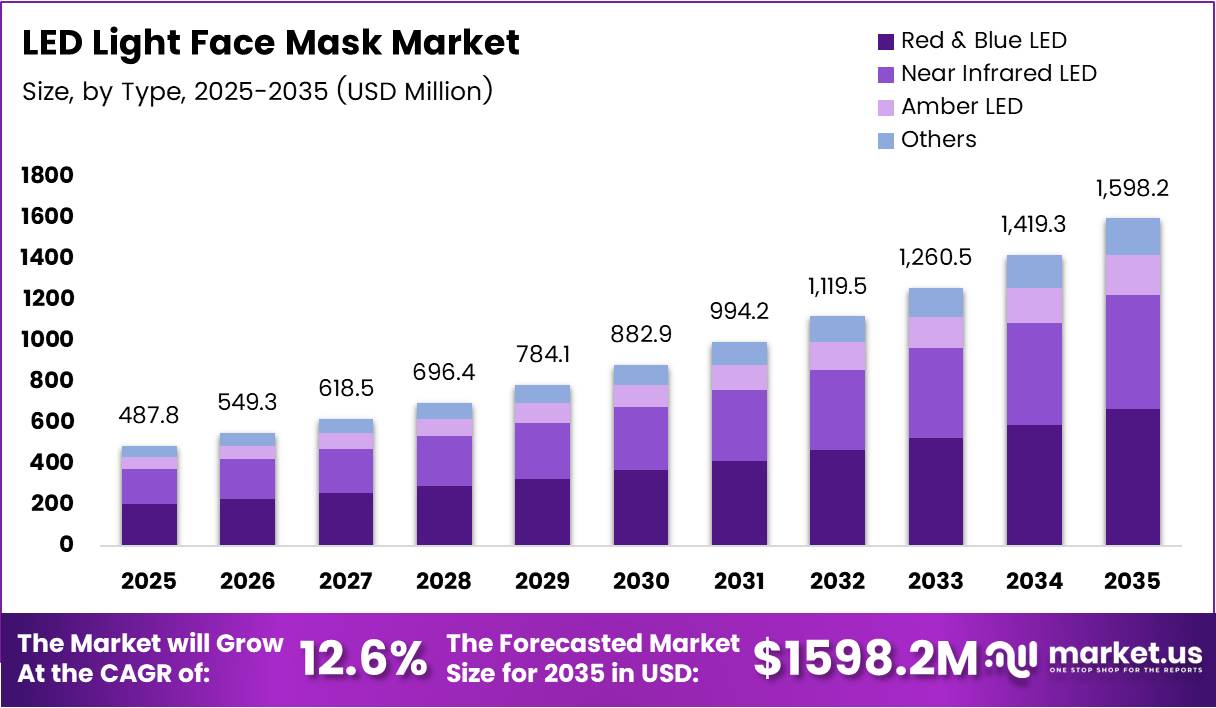
Global LED Light Face Mask Market size is expected to be worth around USD 1598.2 Million by 2035 from USD 487.8 Million in 2025, growing at a CAGR of 12.6% during the forecast period 2026 to 2035.
LED light face masks deliver targeted phototherapy using specific light wavelengths — red, blue, near-infrared, and amber — to stimulate skin cells and address conditions from acne to wrinkles. Unlike topical skincare, these devices work at a cellular level. This mechanism differentiates LED phototherapy from conventional beauty products and positions it as a clinical-grade solution accessible to everyday consumers.
The shift toward at-home dermatological care is reshaping consumer spending priorities. Urban professionals with limited time for clinic visits now invest in professional-grade devices for home use. This behavioral shift has moved LED face masks from a niche clinical tool into a mainstream personal care category, opening new retail and distribution pathways that did not exist five years ago.
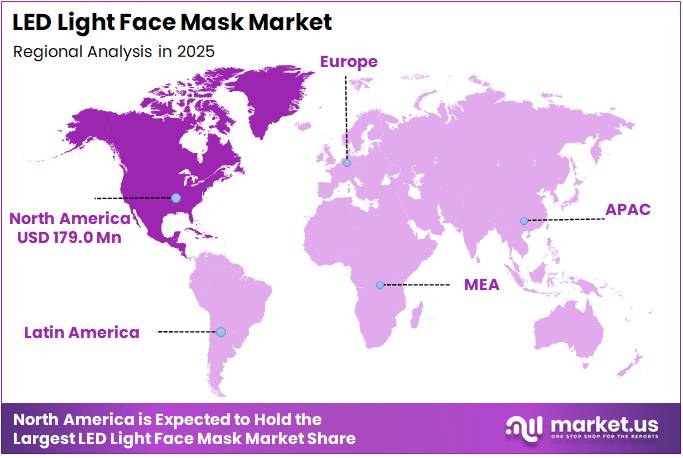
North America leads the global market with a 36.70% share, valued at USD 179.0 Million. Early consumer education, high dermatologist endorsement rates, and strong e-commerce infrastructure give North American brands a structural advantage. These same conditions are now emerging across Western Europe, signaling the next major growth geography for device manufacturers.
Government and regulatory agencies continue to shape the competitive boundary. FDA clearance has become a critical differentiator in the US market. In January 2025, Nanoleaf unveiled its FDA-cleared LED Light Therapy Face Mask at CES 2025, featuring seven treatment modes priced at $149.99 — a signal that cleared devices can compete on both clinical credibility and consumer price accessibility. This raises the bar for all entrants.
Meanwhile, Shark Beauty unveiled the CryoGlow Cooling LED Face Mask at CES 2025, combining red, blue, and infrared light with cooling technology. Clinical results showed 34% more radiant skin and 20% firmer skin after eight weeks. Product launches of this complexity demonstrate that the market rewards brands that combine multiple modalities into a single device.
According to Therabody’s manufacturer clinical study report (October 2025), 84% of participants showed clinical improvement in radiance and luminosity after 12 weeks with the TheraFace Mask Glo. This figure matters because it documents measurable, reproducible outcomes — exactly the kind of clinical evidence that converts skeptical buyers and earns continued dermatologist endorsements, reinforcing the premium pricing tier.
According to a peer-reviewed study published in the Medicine journal (2025), 89.3% of participants in the per-protocol set showed improvement in periorbital wrinkles at 12 weeks using a home-use LED and IRED face mask. Published clinical validation of this magnitude shifts buyer confidence from trial purchases to repeat investment in higher-end devices, directly supporting average selling price growth across the category.
Key Takeaways
- The global LED Light Face Mask Market was valued at USD 487.8 Million in 2025 and is forecast to reach USD 1,598.2 Million by 2035.
- The market advances at a CAGR of 12.6% from 2026 to 2035.
- By Type, Red and Blue LED holds the dominant share at 58.9% in the LED face mask market.
- By Application, Anti-aging leads all application segments with a 36.8% share.
- By Therapy, RE (Red and E-Light) therapy commands the highest share at 51.7%.
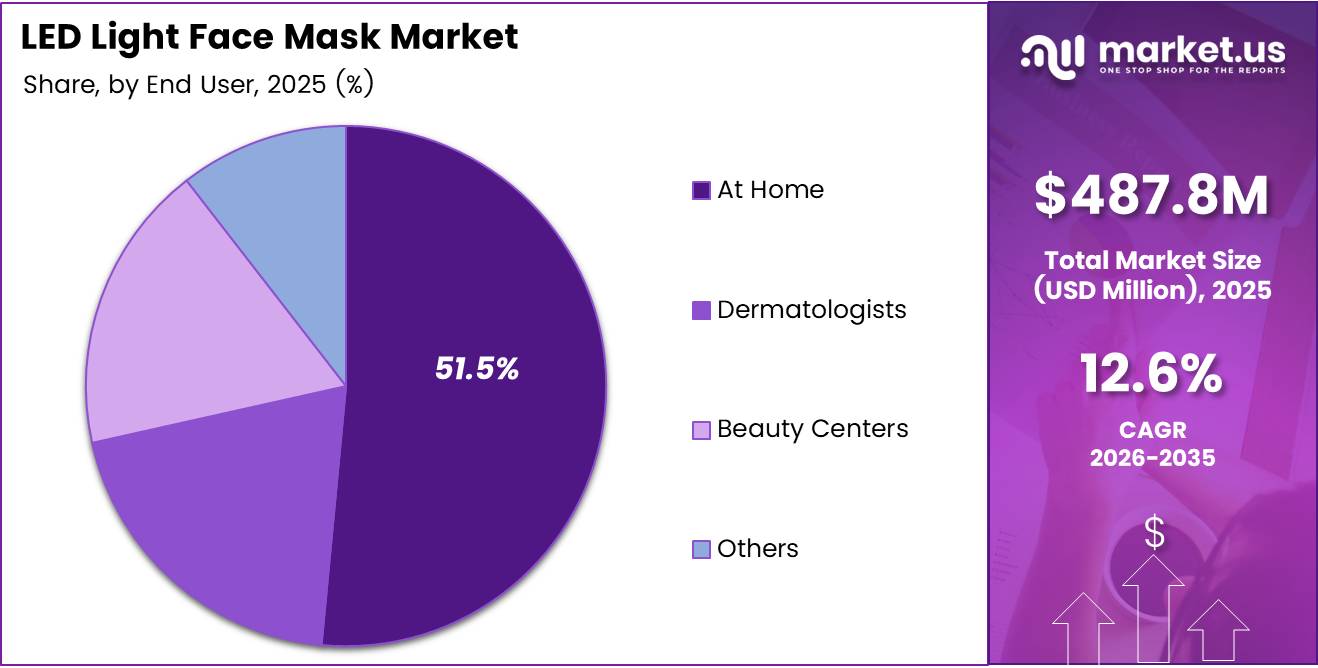
- By End User, At-Home users represent the largest segment with a 51.5% share.
- By Distribution Channel, Online and Offline channels together hold the leading share at 41.4%.
- North America dominates the regional landscape with a 36.70% share, valued at USD 179.0 Million.
Type Analysis
Red and Blue LED dominates with 58.9% due to dual-action acne and anti-aging efficacy.
In 2025, Red and Blue LED held a dominant market position in the By Type segment of the LED Light Face Mask Market, with a 58.9% share. This combination addresses the two highest-priority skin concerns — active acne and visible aging — in a single device. Buyers who might otherwise purchase two separate tools choose this format, which concentrates demand and supports higher device price points.
Near Infrared LED targets deeper tissue layers that visible red light cannot reach. This wavelength stimulates collagen production and accelerates cellular repair, making it the preferred modality for post-procedure recovery and anti-aging protocols. In January 2025, Nanoleaf’s FDA-cleared mask featuring near-infrared light at CES 2025 validated consumer appetite for this wavelength at the mass-market price point of $149.99.
Amber LED differentiates through its targeted action on redness, rosacea, and lymphatic stimulation — conditions underserved by red or blue wavelengths. Its specificity attracts a smaller but high-intent buyer segment willing to pay a premium for targeted treatment. However, limited standalone device options and lower brand awareness constrain its current market penetration relative to other wavelength categories.
Others in the type segment include green, yellow, and multi-wavelength combinations beyond the primary trio. These formats appeal to professional-use buyers in beauty salons and dermatology clinics who require versatile devices across diverse patient presentations. Multi-wavelength devices in this category carry the highest average selling price, making them attractive to premium-positioned brands entering the professional channel.
Application Analysis
Anti-aging dominates with 36.8% due to high consumer priority for visible wrinkle reduction.
In 2025, Anti-aging held a dominant market position in the By Application segment of the LED Light Face Mask Market, with a 36.8% share. The concentration of clinical evidence around wrinkle reduction — including peer-reviewed studies showing 89.3% improvement in periorbital wrinkles — directly converts hesitant buyers by reducing purchase risk. Anti-aging claims carry the highest commercial value in personal care, giving LED masks a compelling market entry point.
Acne Treatment serves as the entry point for younger demographic buyers, particularly those aged 18–34 seeking alternatives to topical medications with side effects. Blue LED’s proven antibacterial action against P. acnes bacteria provides the clinical rationale that supports first-time device purchases. This segment feeds long-term customer lifetime value, as acne-treatment buyers frequently graduate to anti-aging devices.
Hospitals adopt LED phototherapy for post-procedure skin recovery and wound healing applications where clinical-grade irradiance is required. This channel demands FDA or CE-marked devices and favors established brands with published safety data. The hospital channel commands lower unit volumes but provides institutional validation that strengthens consumer-facing brand credibility across other channels.
Beauty Salons drive repeat revenue through session-based LED treatment packages, allowing salons to monetize device investment over hundreds of client visits. This recurring revenue model makes premium multi-wavelength devices financially viable for salon operators and sustains a steady commercial replacement cycle as device technology advances.
Rehabilitation Centers use LED phototherapy primarily for tissue repair and inflammation reduction in post-injury recovery protocols. The clinical setting demands high safety standards and documented treatment outcomes. This application segment remains small in volume but grows as physical rehabilitation practitioners integrate non-invasive phototherapy into standard care protocols.
Pigmentation Treatment addresses melasma, sunspots, and post-inflammatory hyperpigmentation — conditions with strong consumer demand but historically limited non-invasive solutions. Clinical validation supports this application, with the Déesse PRO LED Phototherapy Mask demonstrating a 14% reduction in hyperpigmentation within six weeks. As this evidence base grows, pigmentation treatment will attract buyers currently relying on chemical peels or laser sessions.
Others within application include rosacea management, eczema support, and general skin barrier reinforcement. These indications are growing as dermatologists expand LED prescription protocols beyond primary anti-aging and acne use cases, gradually broadening the addressable patient and consumer population for face mask devices.
Therapy Analysis
RE Therapy dominates with 51.7% due to broad clinical evidence supporting red light protocols.
In 2025, RE Therapy held a dominant market position in the By Therapy segment of the LED Light Face Mask Market, with a 51.7% share. Red light therapy carries the deepest body of peer-reviewed clinical evidence across anti-aging, acne, and wound healing. This evidence foundation accelerates physician recommendation rates and lowers buyer acquisition costs for brands competing on clinical credibility.
E-Light therapy combines intense pulsed light with radio frequency, delivering a dual-energy treatment that addresses both skin surface and dermal tissue. E-Light devices occupy the premium professional tier, where salon and clinic operators justify higher capital investment through superior outcome differentiation. However, regulatory requirements for professional-use high-energy devices limit this therapy’s accessibility in the direct-to-consumer channel.
Laser therapy within the face mask category applies low-level laser light for photobiomodulation, distinct from ablative clinical lasers. This modality attracts medically-oriented buyers seeking clinical precision and measurable photon dosing. The laser therapy segment carries higher device costs and requires careful regulatory navigation, concentrating competition among a smaller set of specialized manufacturers.
IPL (Intense Pulsed Light) therapy delivers broad-spectrum light across multiple skin concerns simultaneously. IPL devices face the most complex regulatory pathway among all therapy types due to energy intensity, limiting at-home adoption. Professional beauty centers remain the dominant buyers of IPL-based face mask devices, sustaining this segment’s revenue without significant at-home market penetration.
End User Analysis
At-Home users dominate with 51.5% due to convenience preference and device price accessibility.
In 2025, At-Home users held a dominant market position in the By End User segment of the LED Light Face Mask Market, with a 51.5% share. The combination of falling device prices, increasing clinical evidence, and social media education has created a buyer segment that no longer depends on clinic access to achieve professional skincare outcomes. This structural shift permanently expands the addressable market beyond professional-use channels.
Dermatologists represent the highest-influence buyer category despite lower purchase volume. A single dermatologist recommendation can drive dozens of patient purchases, making this segment disproportionately important for brand positioning and clinical trial investment. Brands that secure dermatologist endorsement gain a credibility multiplier that no advertising spend can replicate.
Beauty Centers function as volume adoption hubs, purchasing mid-tier multi-wavelength devices for client treatment packages. Their adoption decisions respond to client demand trends, meaning beauty centers follow consumer interest rather than lead it. However, the professional-use context allows beauty centers to trial higher irradiance devices not yet cleared for home use, creating a test market for manufacturers before consumer launches.
Others in the end user category include sports medicine clinics, med-spas, and wellness retreat centers integrating LED phototherapy into broader treatment programs. This segment adopts devices primarily based on clinical differentiation and treatment versatility. As wellness tourism expands, this buyer group represents an incremental revenue channel for premium device brands targeting institutional clients.
Distribution Channel Analysis
Online and Offline channels dominate with 41.4% due to combined omnichannel reach and purchase convenience.
In 2025, Online and Offline channels held a dominant market position in the By Distribution Channel segment of the LED Light Face Mask Market, with a 41.4% share. Brands that operate across both channels capture buyers at discovery (online) and at purchase validation (in-store), reducing cart abandonment and return rates. Omnichannel presence has become a table-stakes requirement for LED face mask brands targeting mainstream consumers.
Beauty Salons as a distribution channel enable hands-on product demonstrations that online channels cannot replicate. Clients who experience LED treatment at a salon are significantly more likely to purchase a home device, making the salon channel a conversion engine for direct-to-consumer brands. Brands that partner with salon networks gain both revenue and qualified lead generation at lower acquisition cost.
Hospitals and Clinics provide the highest institutional credibility for device distribution. Products sold through this channel carry an implied clinical endorsement that strengthens brand positioning across consumer channels. However, hospital procurement cycles are long and volume-limited, making this channel strategically important for brand building rather than near-term revenue generation.
Hypermarkets and Supermarkets expand LED face mask accessibility to price-sensitive buyers who encounter devices during routine shopping. This channel drives trial at lower price points and introduces the category to consumers unfamiliar with phototherapy. However, shelf space competition and limited staff education capacity mean that brand packaging and on-pack claims do the full selling job in this channel.
Pharmacy and Drugstores carry particular authority for health-adjacent beauty devices, as their environment signals clinical trustworthiness to hesitant buyers. LED face masks positioned as skincare solutions benefit from proximity to dermatologist-recommended topical products, lending credibility by association. Pharmacy channel growth depends on regulatory clarity and pharmacist education programs.
Others in distribution include specialty beauty boutiques, direct-to-consumer brand websites, and TV shopping channels. Direct brand websites now carry strategic importance beyond revenue — they provide first-party consumer data that informs product development, clinical study design, and targeted digital marketing at a precision unavailable through third-party retail channels.
Key Market Segments
By Type
- Red and Blue LED
- Near Infrared LED
- Amber LED
- Others
By Application
- Anti-aging
- Acne Treatment
- Hospitals
- Beauty Salons
- Rehabilitation Center
- Pigmentation Treatment
- Others
By Therapy
- RE
- E-Light
- Laser
- IPL
By End User
- At Home
- Dermatologists
- Beauty Centers
- Others
By Distribution Channel
- Online and Offline
- Beauty Salons
- Hospitals and Clinics
- Hypermarkets and Supermarkets
- Pharmacy and Drugstores
- Others
Drivers
Clinical Validation, Dermatologist Endorsements, and At-Home Adoption Converge to Drive LED Phototherapy Device Sales
Consumer preference for non-invasive skin treatments without downtime has created sustained commercial demand for LED face masks. Buyers increasingly reject procedures requiring clinic visits, recovery time, or systemic medication. This preference has moved phototherapy from an occasional clinic service into a daily at-home ritual — a structural behavioral change that expands the total addressable market well beyond what clinic-based revenue could represent.
Dermatologist endorsement functions as the most efficient purchase conversion tool in this category. When clinicians recommend specific devices, patients purchase with low skepticism and high compliance. According to a clinical study reported by the Déesse PRO team (March 2025), participants experienced a 23.4% improvement in skin roughness within six weeks of LED treatment — the kind of measurable, reproducible outcome that gives dermatologists confidence to recommend specific devices by name, shortening the consumer decision cycle materially. In September 2024, CurrentBody launched the Skin LED Light Therapy Mask Series 2 with upgraded irradiance and clinical dosing optimization, directly responding to dermatologist feedback on treatment efficacy requirements.
Social media platforms and celebrity-endorsed skincare routines have lowered the discovery barrier for LED face masks to near zero. Influencer demonstrations expose millions of followers to device usage in relatable home settings, normalizing what was once perceived as a clinical-only treatment. Additionally, rising disposable income in urban markets supports premium device adoption — buyers who previously allocated skincare budgets to salon visits now invest in devices that deliver equivalent outcomes at home over time, shifting spend from services to products.
Restraints
High Device Costs and Long-Term Safety Uncertainty Slow Mainstream Consumer Adoption of LED Face Masks
The upfront cost of quality LED face masks — often ranging from $100 to over $500 — creates a significant adoption barrier relative to conventional skincare products. Consumers accustomed to spending $20–$50 on serums and creams must reframe their spending logic entirely before committing to a device purchase. This psychological price gap is particularly pronounced in price-sensitive emerging markets where the category has the highest growth potential but lowest near-term conversion rates.
Safety concerns around long-term light exposure represent a less visible but strategically important restraint. Questions persist about cumulative photon dose, eye safety, and appropriate treatment frequency for users without professional supervision. According to Therabody’s manufacturer clinical study report (October 2025), no adverse events were reported across the full 12-week TheraFace Mask Glo study, including participants with self-reported sensitive skin — a finding that supports safety credibility. However, this evidence covers only one device over one trial period, and broader long-term safety data remains limited across the category.
Regulatory scrutiny intensifies as the market grows. Agencies including the FDA and European MDR require increasingly rigorous clinical documentation for device clearance. Compliance costs disproportionately burden smaller manufacturers, potentially consolidating the market around brands with regulatory expertise. Consequently, this restraint simultaneously limits category growth and creates a competitive moat for established brands that have already navigated clearance — compressing the window for new entrants to achieve price-competitive positioning.
Growth Factors
Smart Technology Integration, Expanded Demographics, and Emerging Market Penetration Unlock New Revenue Layers for LED Face Mask Brands
App-connected LED face masks with smart sensors and personalized treatment programs represent the highest near-term revenue expansion opportunity. Devices that adjust wavelength, duration, and intensity based on skin sensor data command significant price premiums over fixed-protocol masks. This personalization layer also drives subscription revenue through app-based treatment plans, creating recurring income streams that fundamentally change the unit economics of device sales.
The male grooming segment remains structurally underpenetrated by LED phototherapy brands. Men aged 25–44 in urban markets show documented willingness to invest in skincare devices when positioned around performance and efficiency rather than beauty. According to the Déesse PRO clinical study (reported March 2025), a 14% reduction in hyperpigmentation within six weeks represents the type of measurable outcome that resonates equally across gender — enabling brands to market results rather than beauty rituals and access an entirely new buyer base without product reformulation. In May 2025, Glokore launched its wireless multi-wavelength LED face mask for at-home skin rejuvenation, demonstrating that portable, gender-neutral design formats are already entering the market.
Strategic partnerships between beauty technology brands and dermatology clinic networks create institutional distribution channels with built-in clinical credibility. Clinics that co-brand or recommend specific devices become recurring revenue sources as they guide patients toward home maintenance protocols post-treatment. Additionally, affordable product variants targeting emerging markets in Southeast Asia, Latin America, and the Middle East can capture a demographically large, aspirational consumer cohort that currently lacks access to premium phototherapy at accessible price points.
Emerging Trends
Multi-Wavelength, Portable, and Influencer-Driven Device Formats Redefine What Consumers Expect from LED Skincare Technology
Multi-wavelength LED masks that address acne, anti-aging, and pigmentation in a single device are replacing single-purpose formats as the dominant commercial product archetype. Consumers who previously needed multiple devices now invest in one premium unit, which raises average transaction values while simplifying the buyer decision. In September 2025, Amorepacific debuted the makeON ONFACE micro-LED mask at IFA 2025 featuring 3,770 ultra-thin micro-LEDs in a flexible single panel, with ex-vivo testing showing up to 1,690% elastin increase after one nine-minute session — setting a new product performance benchmark that competitors must respond to.
Portable and rechargeable LED mask designs address the compliance barrier that limits treatment outcomes across all skincare devices. Users who can wear a device during daily activities complete their treatment protocols more consistently, which improves outcome data and drives word-of-mouth referral. According to Therabody’s manufacturer clinical study (October 2025), 98% of participants found the TheraFace Mask Glo easy to use across a six-day-per-week protocol — confirming that ergonomic design directly translates into protocol adherence and publishable outcome rates that validate premium pricing.
The clean beauty movement is steering consumers toward chemical-free skin treatment alternatives, and LED phototherapy sits naturally in this positioning. Brands that explicitly contrast LED therapy with chemical ingredient exposure capture buyers exiting traditional topical skincare. Additionally, influencer-led direct-to-consumer brand launches have compressed the time-to-market for new entrants, creating rapid category fragmentation that rewards differentiated design, clinical evidence, and community-building over broad traditional retail distribution alone.
Regional Analysis
North America Dominates the LED Light Face Mask Market with a Market Share of 36.70%, Valued at USD 179.0 Million
North America holds 36.70% of the global LED light face mask market, valued at USD 179.0 Million. The US market benefits from early FDA clearance frameworks, high consumer health literacy, and mature direct-to-consumer e-commerce infrastructure. These structural advantages allow North American brands to scale clinical evidence programs and retail distribution faster than competitors in other geographies.
Europe LED Light Face Mask Market Trends
Europe represents the second-largest regional market for LED phototherapy devices, supported by rigorous MDR regulatory frameworks that simultaneously validate device quality and restrict low-quality entrants. Consumer awareness of clinical skincare technology is highest in the UK, Germany, and France. The European market favors brands with CE marking and published clinical data, creating a defensible premium tier that benefits incumbents over new entrants.
Asia Pacific LED Light Face Mask Market Trends
Asia Pacific combines the world’s largest beauty device consumer base with rapidly expanding middle-class income in China, South Korea, Japan, and India. South Korea’s domestic beauty technology culture drives both product innovation and consumer adoption at a pace unmatched globally. Chinese consumers show particularly strong appetite for multi-wavelength devices promoted through live-commerce platforms, which compress the purchase decision cycle dramatically compared to traditional retail formats.
Latin America LED Light Face Mask Market Trends
Latin America remains an early-stage market for LED face masks, with Brazil and Mexico leading adoption among urban professional consumers. Awareness of phototherapy skincare technology is concentrated in premium beauty clinic channels rather than direct-to-consumer retail. Therefore, brands that enter through dermatologist and clinic partnerships will build credibility ahead of the mass-market consumer adoption wave expected to follow.
Middle East and Africa LED Light Face Mask Market Trends
The Middle East, particularly GCC countries, presents a high-income consumer base with documented appetite for premium beauty technology. Saudi Arabia and the UAE combine high disposable income with strong social media beauty culture, creating favorable commercial conditions for LED mask brands that localize their marketing effectively. Africa’s market remains nascent, concentrated in South Africa’s urban consumer centers, with broader penetration dependent on price accessibility improvements.
Key Regions and Countries
North America
- US
- Canada
Europe
- Germany
- France
- The UK
- Spain
- Italy
- Rest of Europe
Asia Pacific
- China
- Japan
- South Korea
- India
- Australia
- Rest of APAC
Latin America
- Brazil
- Mexico
- Rest of Latin America
Middle East & Africa
- GCC
- South Africa
- Rest of MEA
Key Company Insights
Neutrogena leverages its established pharmaceutical-heritage brand equity to lower consumer risk perception for LED light therapy devices. Its distribution through mass-market pharmacy and retail channels gives it unmatched reach into first-time buyer segments. This retail breadth creates high volume at mid-price points, though it positions Neutrogena below premium clinical brands in the dermatologist endorsement hierarchy, creating a strategic ceiling on average selling price growth.
FOREO differentiates through design-forward, multi-technology devices that combine LED therapy with other skin treatment modalities. Its premium positioning and strong direct-to-consumer digital presence allow it to command higher average selling prices than pharmacy-channel competitors. FOREO’s app-connected ecosystem strategy creates recurring consumer engagement that strengthens brand loyalty beyond the initial device purchase and supports future premium accessory and consumable revenue.
LightStim builds its competitive position on clinical-grade irradiance and FDA clearance credentials that few consumer-facing brands match. Its devices target the overlap between professional clinic use and home adoption — a segment where buyers prioritize efficacy documentation over design aesthetics. LightStim’s clinical credibility supports premium retail pricing and enables partnerships with dermatology practices seeking to recommend take-home protocols after in-office treatments.
LG Electronics enters the LED face mask category with manufacturing scale and consumer electronics distribution capabilities that specialist beauty tech brands cannot replicate. Its ability to integrate phototherapy with smart home ecosystems and its existing retail relationships across global markets provide structural cost and distribution advantages. However, LG’s broader product portfolio means LED face masks compete internally for R&D investment and brand marketing focus, which may slow its clinical evidence development relative to category-pure competitors.
Key Players
- Neutrogena
- FOREO
- LightStim
- LG Electronics
- CurrentBody
- Skin Gym
- Mz Skin Limited
- Aduro
- Project E Beauty
- DMH Aesthetics
Recent Developments
- November 2024 — SmoothSkin introduced the DuoLux Collagen+ LED Face Mask, a hands-free device using 630nm red and 830nm near-infrared light combined with a hyaluronic acid-enriched hydrogel mask. The device received FDA clearance and demonstrated clinically proven wrinkle reduction and collagen promotion within four weeks of use.
- September 2025 — Amorepacific globally debuted the makeON ONFACE micro-LED mask at IFA 2025, featuring 3,770 ultra-thin micro-LEDs in a single flexible panel for even light distribution. Ex-vivo testing after one nine-minute session showed up to 1,690% elastin increase, with the official Korea market launch following in October 2025.
- September 2025 — Ulike showcased its first-ever LED face mask, ReGlow, at IFA 2025, powered by 272 LEDs with a 4-in-1 system covering Glow, Firm, Rejuvenate, and Clear treatment modes. The device targets firmer, brighter, and smoother skin outcomes in under one month of use.
Report Scope
Report Features Description Market Value (2025) USD 487.8 Million Forecast Revenue (2035) USD 1,598.2 Million CAGR (2026-2035) 12.6% Base Year for Estimation 2025 Historic Period 2020-2024 Forecast Period 2026-2035 Report Coverage Revenue Forecast, Market Dynamics, Competitive Landscape, Recent Developments Segments Covered By Type (Red and Blue LED, Near Infrared LED, Amber LED, Others), By Application (Anti-aging, Acne Treatment, Hospitals, Beauty Salons, Rehabilitation Center, Pigmentation Treatment, Others), By Therapy (RE, E-Light, Laser, IPL), By End User (At Home, Dermatologists, Beauty Centers, Others), By Distribution Channel (Online and Offline, Beauty Salons, Hospitals and Clinics, Hypermarkets and Supermarkets, Pharmacy and Drugstores, Others) Regional Analysis North America (US and Canada), Europe (Germany, France, The UK, Spain, Italy, and Rest of Europe), Asia Pacific (China, Japan, South Korea, India, Australia, and Rest of APAC), Latin America (Brazil, Mexico, and Rest of Latin America), Middle East & Africa (GCC, South Africa, and Rest of MEA) Competitive Landscape Neutrogena, FOREO, LightStim, LG Electronics, CurrentBody, Skin Gym, Mz Skin Limited, Aduro, Project E Beauty, DMH Aesthetics Customization Scope Customization for segments, region/country-level will be provided. Moreover, additional customization can be done based on the requirements. Purchase Options We have three licenses to opt for: Single User License, Multi-User License (Up to 5 Users), Corporate Use License (Unlimited User and Printable PDF) 
-
-
- Neutrogena
- FOREO
- LightStim
- LG Electronics
- CurrentBody
- Skin Gym
- Mz Skin Limited
- Aduro
- Project E Beauty
- DMH Aesthetics
Our Clients

- 179567
- Feb 2026






