


Global Laser Cutting Machine Market Size, Share, Growth Analysis Technology (Solid State Lasers, Gas Lasers, Semiconductor Lasers), Process (Fusion Cutting, Flame Cutting, Sublimation Cutting), Application (Automotive, Consumer Electronics, Defense & Aerospace, Others), Region and Companies - Industry Segment Outlook, Market Assessment, Competition Scenario, Statistics, Trends and Forecast 2026-2035
- Published date: Feb 2026
- Report ID: 20861
- Number of Pages: 328
- Format:
-
keyboard_arrow_up
Quick Navigation
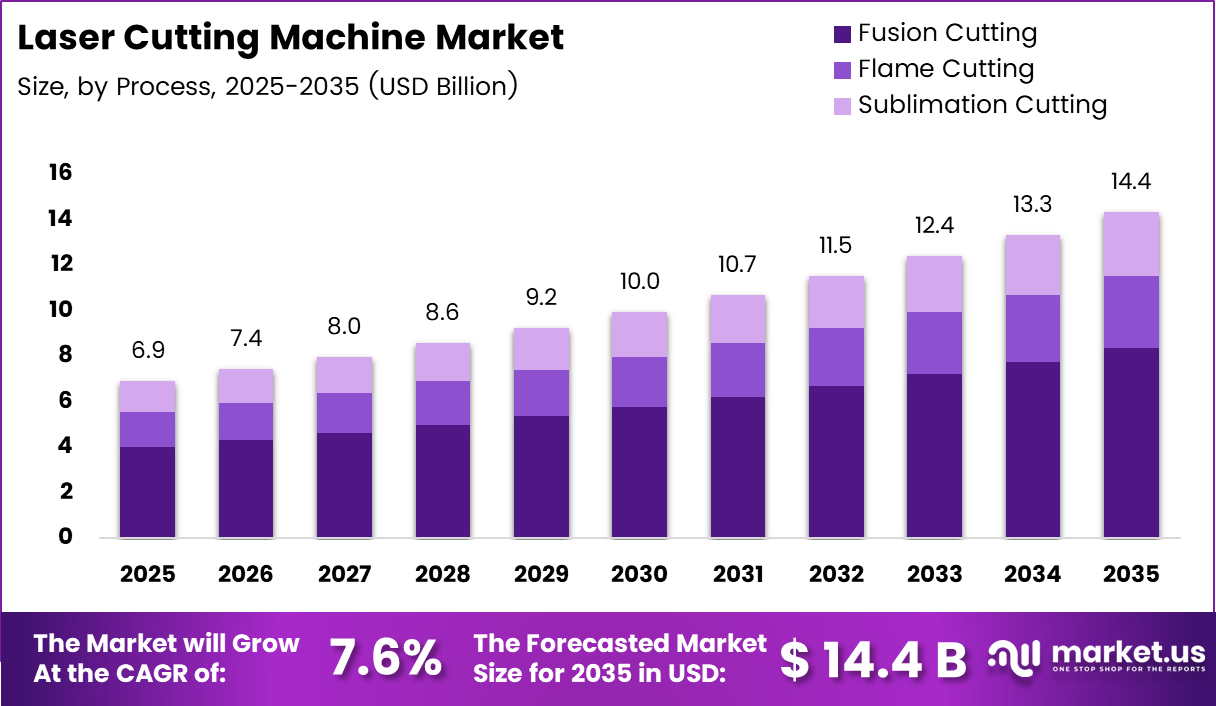
Global Laser Cutting Machine Market size is expected to be worth around USD 14.4 Billion by 2035 from USD 6.9 Billion in 2025, growing at a CAGR of 7.6% during the forecast period 2026 to 2035.
The laser cutting machine market refers to the global industry involved in the design, manufacturing, and deployment of machines that use focused laser beams to cut, engrave, or shape materials. These machines are widely used across metal fabrication, automotive, electronics, and aerospace sectors. They offer high precision, speed, and minimal material waste.
Laser cutting technology has evolved significantly over the past decade. Modern systems now include fiber lasers, CO₂ lasers, and solid-state laser platforms. Consequently, manufacturers are adopting these solutions to improve production efficiency and reduce operational costs across various industrial applications.
Growth in this market is driven by rising demand for precision manufacturing in automotive and electronics industries. Moreover, expanding infrastructure projects in developing economies are creating new demand for advanced cutting equipment. Governments in several regions are supporting smart manufacturing through policy incentives and industrial development programs.
Regulatory frameworks around workplace safety and environmental emissions are also influencing equipment design. Therefore, manufacturers are investing in low-emission, energy-efficient laser systems to meet compliance standards. This shift is further encouraging adoption of fiber laser technology over traditional gas laser systems globally.
According to SLTL Group, laser sheet cutting machines can handle material thicknesses from 0.5mm to 80mm, ensuring high-quality results for both thin and thick metals. Additionally, advanced fiber laser systems now offer cutting power of up to 30 kW for steel sheets up to 50mm thick.
According to Eagle Group, the iNspire series of fiber laser cutting machines offers powers ranging from 4kW to 40kW, acceleration of up to 6G, and cutting speeds up to 150 m/min. These capabilities make them suitable for continuous operation across both small and large batch manufacturing environments.
Key Takeaways
- The global Laser Cutting Machine Market was valued at USD 6.9 Billion in 2025 and is projected to reach USD 14.4 Billion by 2035.
- The market is expected to grow at a CAGR of 7.6% during the forecast period 2026 to 2035.
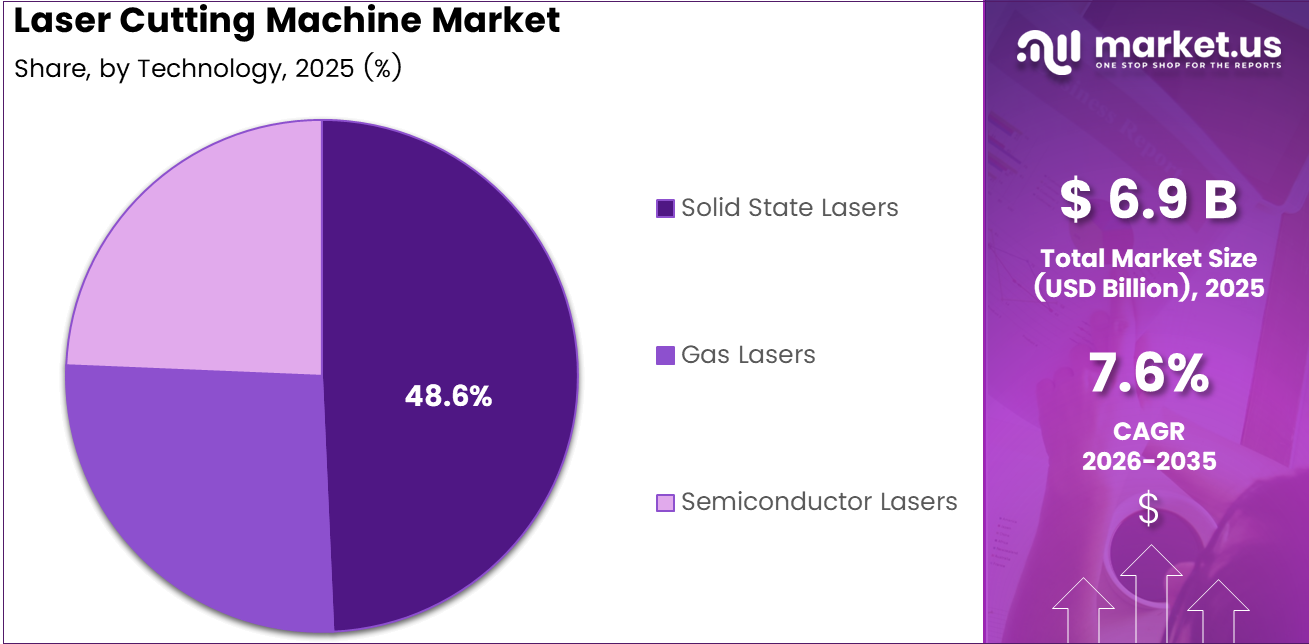
- By Technology, Solid State Lasers dominate with a market share of 48.6% in 2025.
- By Process, Fusion Cutting leads the segment with a share of 58.2% in 2025.
- By Application, Automotive holds the largest share at 41.7% in 2025.
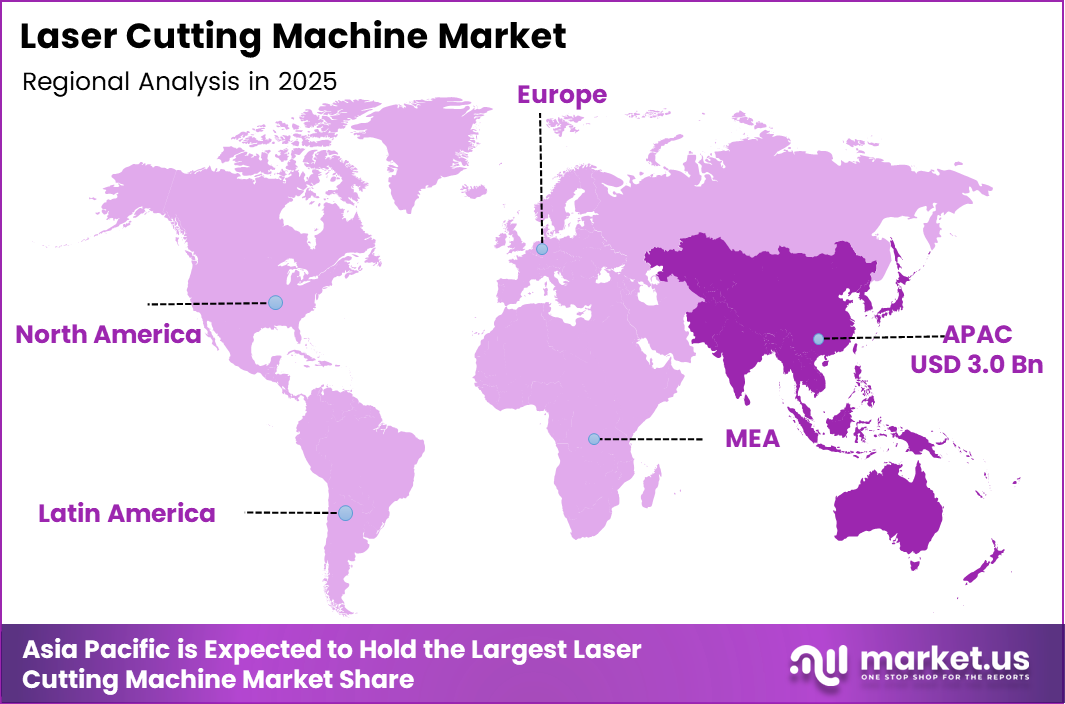
- Asia Pacific is the dominating region, holding a market share of 43.70%, valued at approximately USD 3 Billion in 2025.
Technology Analysis
Solid State Lasers dominate with 48.6% due to high efficiency and broad industrial applicability.
In 2025, Solid State Lasers held a dominant market position in the Technology segment of the Laser Cutting Machine Market, with a 48.6% share. These lasers offer superior beam quality, longer operational life, and lower maintenance requirements. Moreover, their compatibility with fiber delivery systems makes them highly preferred in automotive and metal fabrication industries.
Gas Lasers continue to hold a relevant position in the market, particularly for cutting non-metallic materials such as wood, acrylic, and plastics. However, their relatively higher energy consumption and larger footprint are gradually limiting their adoption. Additionally, many manufacturers are transitioning from CO₂-based gas lasers toward more efficient fiber-based alternatives.
Semiconductor Lasers represent a growing niche, especially in microfabrication and electronics applications. These compact laser sources are valued for their energy efficiency and precise control. Consequently, their adoption is rising in consumer electronics manufacturing and medical device production, where fine precision and minimal heat-affected zones are critical requirements.
Process Analysis
Fusion Cutting dominates with 58.2% due to its effectiveness in cutting thick metallic materials cleanly.
In 2025, Fusion Cutting held a dominant market position in the Process segment of the Laser Cutting Machine Market, with a 58.2% share. This process uses an inert gas such as nitrogen to blow molten material away from the cut zone, producing oxide-free edges. Therefore, it is widely preferred for stainless steel and aluminum applications in automotive and aerospace sectors.
Flame Cutting uses oxygen as the assist gas and is primarily used for cutting mild steel at high thicknesses. This process generates more heat, which can affect edge quality; however, it remains cost-effective for heavy industrial applications. Moreover, its lower gas cost compared to inert gas processes makes it attractive for large-scale structural fabrication operations.
Sublimation Cutting involves vaporizing material directly without melting, resulting in extremely clean cuts with no dross. This process is particularly suited for non-metallic materials, thin films, and precision parts in electronics manufacturing. Consequently, its adoption is growing in specialized industries that demand the highest levels of edge quality and minimal thermal distortion.
Application Analysis
Automotive dominates with 41.7% due to high-volume precision component manufacturing requirements.
In 2025, Automotive held a dominant market position in the Application segment of the Laser Cutting Machine Market, with a 41.7% share. The sector relies heavily on laser cutting for fabricating body panels, chassis components, and interior parts with consistent accuracy. Moreover, the shift toward electric vehicles is further increasing demand for precision-cut battery enclosures and structural parts.
Consumer Electronics is a fast-growing application segment driven by miniaturization trends and increasing device complexity. Laser cutting enables the production of fine components such as circuit board outlines, display frames, and enclosure parts. Additionally, the demand for compact smartphones and wearable devices continues to push manufacturers toward high-precision laser processing solutions.
Defense and Aerospace applications require the highest standards of precision and material integrity in every component. Laser cutting is used to process advanced alloys, composites, and heat-resistant materials for aircraft structures and defense systems. Consequently, this segment commands premium equipment specifications and drives adoption of high-power solid-state laser systems globally.
Others include sectors such as medical devices, construction, and general industrial manufacturing. These diverse end-use industries benefit from laser cutting’s flexibility in handling various materials and geometries. Therefore, the segment contributes meaningfully to overall market volume, particularly as laser technology becomes more accessible to smaller manufacturers.
Key Market Segments
By Technology
- Solid State Lasers
- Gas Lasers
- Semiconductor Lasers
By Process
- Fusion Cutting
- Flame Cutting
- Sublimation Cutting
By Application
- Automotive
- Consumer Electronics
- Defense and Aerospace
- Others
Drivers
Rising Demand for Precision Fabrication and High-Speed Manufacturing Drives Laser Cutting Machine Market Growth
The rising adoption of precision metal fabrication across automotive and industrial manufacturing is a primary driver for this market. Manufacturers require consistent, high-accuracy cutting to meet strict quality standards. Moreover, laser cutting machines deliver repeatable results at high volumes, making them essential tools in modern production facilities globally.
Accelerated demand for high-speed and high-accuracy cutting in mass production environments is further pushing market expansion. Laser systems reduce production cycle times significantly compared to mechanical cutting methods. Consequently, manufacturers are replacing conventional cutting equipment with advanced laser solutions to improve throughput and reduce material waste in competitive production settings.
Expanding use of laser cutting in electronics and microfabrication is also contributing to market growth. The growing preference for non-contact and low-waste manufacturing technologies aligns well with laser cutting’s strengths. Therefore, industries ranging from semiconductor packaging to medical device production are integrating laser systems into their core manufacturing workflows.
Restraints
High Capital Investment and Skilled Workforce Requirements Limit Broader Laser Cutting Machine Market Adoption
High initial capital investment remains one of the most significant restraints in the laser cutting machine market. Advanced laser systems, particularly high-power fiber lasers, require substantial upfront expenditure. Consequently, small and medium-sized enterprises often find it difficult to justify the cost without guaranteed long-term production volumes to recover the investment.
Beyond equipment costs, the total cost of ownership includes maintenance, consumables, and facility upgrades such as ventilation and cooling systems. Moreover, the ongoing expense of assist gases and optical components adds to operational budgets. Therefore, businesses in cost-sensitive markets may delay adoption or opt for lower-specification systems with limited capabilities.
Skilled workforce requirements for operating and maintaining laser cutting equipment present an additional challenge. These machines demand trained technicians who understand laser physics, CNC programming, and safety protocols. Additionally, the shortage of qualified personnel in certain regions increases labor costs and creates operational risks, slowing broader market penetration in developing economies.
Growth Factors
SME Expansion, Emerging Economy Infrastructure Growth, and Industry 4.0 Integration Drive Laser Cutting Market Opportunities
Increasing deployment of fiber laser cutting machines in small and medium enterprises is a significant growth factor. Declining equipment costs and flexible financing options are making fiber laser systems more accessible. Moreover, SMEs in metalworking and fabrication are recognizing the productivity and quality advantages these machines offer over traditional cutting methods.
Expanding infrastructure and construction activities in emerging economies are creating new demand for laser cutting equipment. Countries across Asia, Africa, and Latin America are investing in manufacturing capacity as part of industrial development strategies. Consequently, demand for structural metal components produced using laser cutting technology is rising steadily across these high-growth regions.
Integration of laser cutting systems with smart factory and Industry 4.0 platforms is unlocking new operational efficiencies. Connected machines enable real-time performance monitoring, predictive maintenance, and automated workflow optimization. Additionally, growing demand for customized and complex component manufacturing is driving adoption of flexible, software-driven laser cutting solutions across diverse industrial sectors.
Emerging Trends
Fiber Laser Adoption, Automation Integration, and Software-Driven Precision Reshape the Laser Cutting Machine Market
The shift from CO₂ lasers to fiber and disk laser cutting technologies is one of the most prominent trends reshaping this market. Fiber lasers offer higher energy efficiency, lower operating costs, and superior performance on reflective metals. Moreover, their compact design and reduced maintenance requirements make them the preferred choice for modern manufacturing facilities.
Adoption of automation and robotics in laser cutting workflows is accelerating across the industry. Automated loading, unloading, and material handling systems are reducing labor dependency and improving machine uptime. Consequently, manufacturers are investing in fully integrated laser cutting cells that operate continuously with minimal human intervention, boosting productivity and reducing per-unit production costs.
Rising popularity of compact and energy-efficient laser cutting machines is reflecting growing sustainability priorities among manufacturers. Additionally, advancements in software-driven precision control and real-time monitoring are enabling operators to achieve tighter tolerances and faster setup times. Therefore, next-generation laser cutting platforms are increasingly defined by their intelligence and connectivity as much as their raw power output.
Regional Analysis
Asia Pacific Dominates the Laser Cutting Machine Market with a Market Share of 43.70%, Valued at USD 3 Billion
Asia Pacific leads the global laser cutting machine market, holding a dominant share of 43.70% and valued at approximately USD 3 Billion in 2025. The region’s strong manufacturing base in China, Japan, South Korea, and India drives this leadership. Moreover, rapid industrialization, growing automotive production, and government-backed smart manufacturing initiatives continue to support robust regional demand.
North America Laser Cutting Machine Market Trends
North America represents a mature and technology-forward market for laser cutting machines. The United States leads regional demand, driven by aerospace, defense, and automotive manufacturing sectors. Additionally, strong investment in advanced manufacturing infrastructure and reshoring initiatives is supporting the continued adoption of high-performance fiber laser cutting systems across the region.
Europe Laser Cutting Machine Market Trends
Europe holds a significant share in the global laser cutting machine market, supported by its well-established precision engineering and automotive industries. Germany, Italy, and France are key contributors to regional demand. Furthermore, the European focus on sustainable manufacturing and energy-efficient production technologies is accelerating the replacement of older CO₂ laser systems with modern fiber alternatives.
Middle East and Africa Laser Cutting Machine Market Trends
The Middle East and Africa region is at an earlier stage of laser cutting adoption but shows strong growth potential. Expanding construction and infrastructure projects, particularly in GCC countries, are creating demand for precision metal fabrication. Consequently, investments in industrial diversification programs are beginning to drive uptake of advanced laser cutting equipment across the region.
Latin America Laser Cutting Machine Market Trends
Latin America presents a developing but promising market for laser cutting machines. Brazil and Mexico lead regional demand, supported by active automotive assembly and metal fabrication industries. However, economic volatility and currency fluctuations can constrain capital equipment investments. Therefore, affordable entry-level fiber laser systems and financing solutions are key to unlocking broader adoption in this region.
Key Regions and Countries
North America
- US
- Canada
Europe
- Germany
- France
- The UK
- Spain
- Italy
- Rest of Europe
Asia Pacific
- China
- Japan
- South Korea
- India
- Australia
- Rest of APAC
Latin America
- Brazil
- Mexico
- Rest of Latin America
Middle East & Africa
- GCC
- South Africa
- Rest of MEA
Key Company Insights
Trumpf is a global leader in laser cutting technology, recognized for its continuous innovation in high-power laser sources and machine automation. The company offers a comprehensive portfolio of 2D and 3D laser cutting systems serving automotive, aerospace, and sheet metal industries. Its focus on Industry 4.0 integration and smart factory solutions positions it at the forefront of the evolving market landscape.
Bystronic has established a strong global presence through its advanced fiber laser cutting platforms and integrated automation systems. The company emphasizes end-to-end production efficiency, combining cutting machines with bending and software solutions. Moreover, Bystronic’s investment in digitally connected manufacturing ecosystems aligns well with the growing industry trend toward fully automated laser fabrication workflows.
Mazak is widely recognized for its multi-tasking laser cutting and machining platforms that serve complex manufacturing requirements. The company integrates laser cutting with CNC turning and milling capabilities, offering manufacturers a versatile production solution. Additionally, Mazak’s global service network and strong presence in North America and Asia support consistent customer satisfaction and long-term equipment performance.
Amada holds a prominent position in the global laser cutting machine market with a broad range of fiber laser systems designed for varied sheet metal applications. The company is known for its strong engineering heritage and customer-focused approach to machine design. Consequently, Amada continues to expand its market reach through product innovation, regional partnerships, and tailored solutions for diverse manufacturing environments.
Key Players
- Trumpf
- Bystronic
- Mazak
- Amada
- Coherent
- IPG Photonics
- Prima Power
- Mitsubishi Electric
- Han’s Laser Technology
- Hypertherm
Recent Developments
- July 2025 – IDEX Corporation announced the acquisition of Micro-LAM, Inc., an advanced manufacturer of laser-assisted machining, ultra-precision diamond tools, and custom optics. Micro-LAM and its subsidiaries, 603 OPTX and M10 Edge, complement the optical technologies solutions within the IDEX Health and Science Technologies segment.
- October 2024 – A leading manufacturer announced the acquisition of Taiwan’s largest 6000W fiber laser five-axis tube cutting machine, featuring an automatic fiber laser cutting system paired with automatic loading and unloading devices. This investment significantly enhances production efficiency, enables continuous cutting without manual intervention, and improves overall automation across fabrication operations.
Report Scope
Report Features Description Market Value (2025) USD 6.9 Billion Forecast Revenue (2035) USD 14.4 Billion CAGR (2026-2035) 7.6% Base Year for Estimation 2025 Historic Period 2020-2024 Forecast Period 2026-2035 Report Coverage Revenue Forecast, Market Dynamics, Competitive Landscape, Recent Developments Segments Covered Technology (Solid State Lasers, Gas Lasers, Semiconductor Lasers), Process (Fusion Cutting, Flame Cutting, Sublimation Cutting), Application (Automotive, Consumer Electronics, Defense & Aerospace, Others) Regional Analysis North America (US and Canada), Europe (Germany, France, The UK, Spain, Italy, and Rest of Europe), Asia Pacific (China, Japan, South Korea, India, Australia, and Rest of APAC), Latin America (Brazil, Mexico, and Rest of Latin America), Middle East & Africa (GCC, South Africa, and Rest of MEA) Competitive Landscape Trumpf, Bystronic, Mazak, Amada, Coherent, IPG Photonics, Prima Power, Mitsubishi Electric, Han’s Laser Technology, Hypertherm Customization Scope Customization for segments, region/country-level will be provided. Moreover, additional customization can be done based on the requirements. Purchase Options We have three licenses to opt for: Single User License, Multi-User License (Up to 5 Users), Corporate Use License (Unlimited User and Printable PDF)  Laser Cutting Machine MarketPublished date: Feb 2026add_shopping_cartBuy Now get_appDownload Sample
 -
-
- Trumpf
- Bystronic
- Mazak
- Amada
- Coherent
- IPG Photonics
- Prima Power
- Mitsubishi Electric
- Han's Laser Technology
- Hypertherm
Our Clients

- 20861
- Feb 2026






