


Report Overview
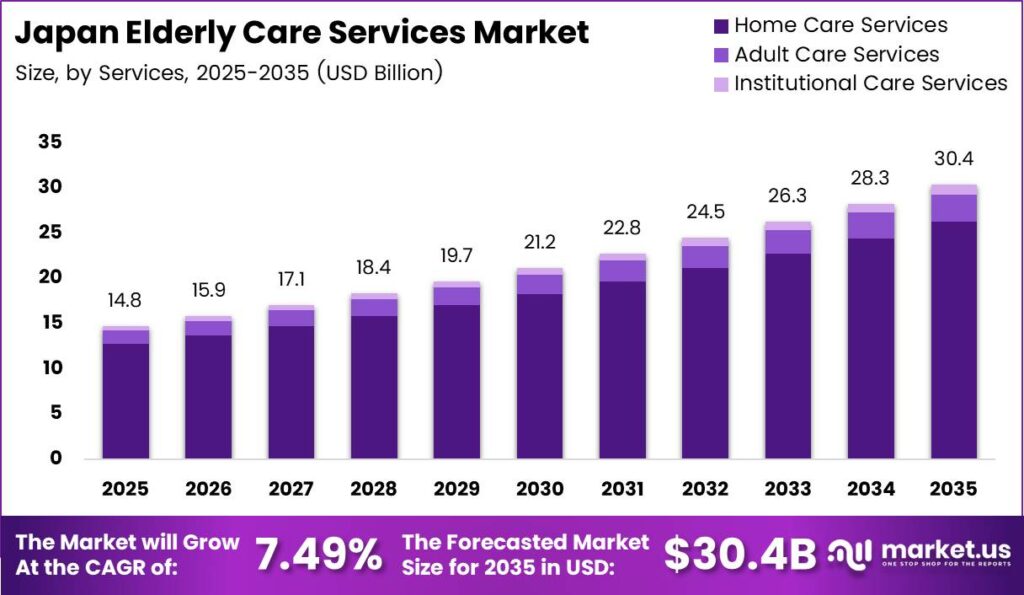
Japan Elderly Care Services Market size is expected to be worth around USD 30.43 Billion by 2035 from USD 14.8 Billion in 2025, growing at a CAGR of 7.49% during the forecast period 2026 to 2035. At the end of April 2025, 7.230 million people were certified as requiring long-term care or support under Japan’s long-term care insurance system. This certification base confirms demand is already present and enrolled, giving providers a measurable addressable population rather than a speculative one.
Japan’s elderly care services market encompasses a structured continuum of formal support delivered to older adults through home-based, community-based, and institutional channels. The market operates under Japan’s long-term care insurance system, which funds and regulates access across certified need levels. This structure creates a dual commercial environment where government-reimbursed services form the revenue base and privately funded services offer incremental growth.
Key Takeaways
- The Japan Elderly Care Services Market was valued at USD 14.8 Billion in 2025 and is forecast to reach USD 30.43 Billion by 2035, growing at a CAGR of 7.49% during 2026 to 2035.
- Home Care Services holds the dominant position in the By Services segment, driven by insurance coverage, lower delivery costs, and strong user preference for in-home support.
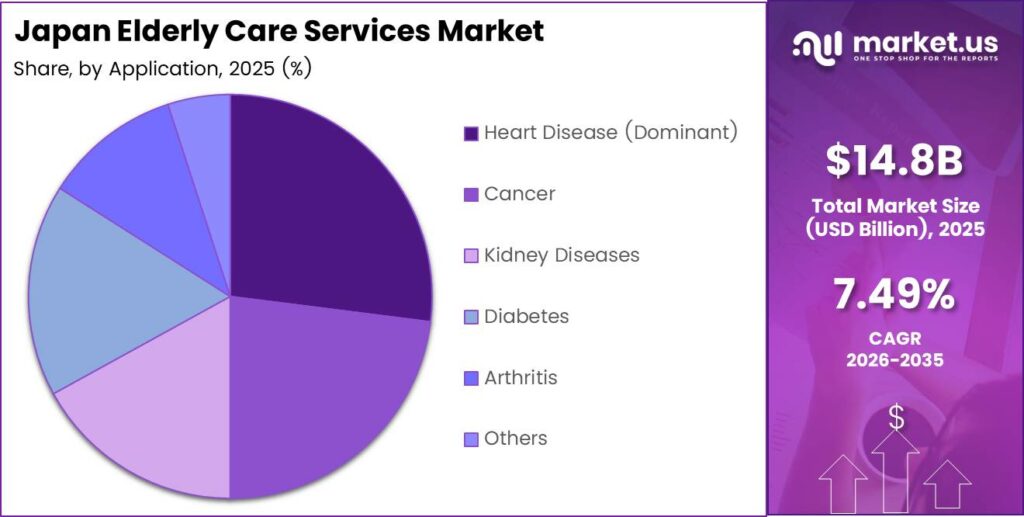
- Heart Disease leads the By Application segment, reflecting its prevalence as the primary chronic condition among Japan’s certified elderly population.
- Private providers dominate the By Service Provider segment, with operational flexibility and acquisition capacity giving them a structural advantage over public operators.
- Certified Seniors Needing Care holds the highest share in the By End-User segment, with 19.8% of Japan’s insured population aged 65 and older certified under the long-term care insurance system as of April 2025.
- Kanto is the dominant region within Japan, concentrating the largest certified care population and the highest density of private care operators in the country.
Japan’s government actively supports this market through regulated reimbursement and technology adoption subsidies. The OECD Health at a Glance 2025 data shows Japan had 6.8 long-term care workers per 100 people aged 65 and over, compared with the OECD average of 5.0. This staffing density reflects the system’s scale but also signals the wage and recruitment pressure that shapes operating costs across all provider types.
Energy cost inflation creates a measurable cost environment for care facility operators. The World Bank’s April 2026 forecast projected Brent crude oil to average USD 86 per barrel in 2026, compared with USD 69 per barrel in 2025. Operators running residential facilities with energy-intensive heating, bathing, and catering systems face direct margin pressure, reinforcing the commercial case for energy-efficient facility design and procurement consolidation.
Services Analysis
Home Care Services dominates with the highest share due to insurance coverage, lower cost, and user preference.
In 2025, Home Care Services held a dominant market position in the By Services segment of the Japan Elderly Care Services Market, with the leading revenue share. As per our research, 4.303 million people received home-based care or preventive care services under Japan’s long-term care insurance system in February 2025. This volume confirms home care as the system’s primary delivery channel, creating a durable commercial base for providers who build route density and staff retention at the local level.
Adult Care Services captures a structurally important share of the community-facing tier. As per our research, 916,000 people received community-based care or preventive care services in Japan in February 2025. This segment serves users who retain some independence but require structured daily support, producing recurring service visits with lower acuity costs than residential care. Providers who build efficient community networks in metropolitan catchments hold a cost advantage over fragmented local operators.
Institutional Care Services carries the highest per-client revenue of any delivery channel. As per our research, 959,000 people received institutional long-term care services in Japan in February 2025. Within this segment, 574,000 were in long-term care welfare facilities including special nursing homes, 338,000 were in geriatric health services facilities providing nursing care and rehabilitation, and 50,000 were in long-term care medical facilities known as kaigo iryoin. These sub-segments serve the highest-acuity certified users, supporting premium pricing and longer average stays. In June 2026, Advent International signed a definitive agreement to acquire Japan Wellbeing Corp., the parent group of Tsukui and Soyokaze, which operated more than 1,100 care locations and served approximately 110,000 users monthly. This transaction confirms institutional scale as a primary acquisition target for global capital.
Application Analysis
Heart Disease dominates with the highest share due to its prevalence as the leading chronic condition among certified elderly users.
In 2025, Heart Disease held a dominant market position in the By Application segment of the Japan Elderly Care Services Market, with the highest share. Heart disease is the leading chronic condition driving certified care needs among Japan’s older population. Providers serving this cohort require staff trained in cardiac monitoring, medication management, and mobility assistance. This clinical complexity commands higher service intensity per client and supports stronger revenue per case than lower-acuity application segments.
Cancer and Kidney Diseases represent the next two application categories in terms of care intensity and service duration. Both conditions require ongoing clinical support, frequent monitoring, and coordination with hospital discharge teams. Providers who build structured referral agreements with hospital oncology and nephrology departments gain a consistent pipeline of high-acuity clients. This integration creates a competitive barrier against operators without formal discharge linkages.
Diabetes and Arthritis serve a large volume of lower-acuity users who typically need preventive and mobility support services. These application categories are well-suited to home care and community care delivery, reducing facility overhead per client. Osteoporosis, Neurological Conditions, Respiratory Conditions, and Others collectively represent the remaining share, with neurological conditions such as dementia carrying the highest monitoring and staffing demands within this group.
Service Provider Analysis
Private providers dominate with the highest share due to operational flexibility, investment capacity, and service breadth.
In 2025, Private providers held a dominant market position in the By Service Provider segment of the Japan Elderly Care Services Market, with the highest share. Private operators build scale through acquisitions, brand recognition, and proprietary training systems that public bodies cannot replicate at comparable speed. The World Bank’s April 2026 forecast projected the energy-price index to increase by 23.6% in 2026 compared with 2025. This cost environment pressures smaller private operators more acutely than large chains with bulk procurement and energy contracts, accelerating consolidation toward larger private groups.
Public providers hold the second position in the By Service Provider segment and represent the fastest-growing category within this market. Public bodies expand capacity in response to policy mandates and municipal demographic pressure, particularly in regions where private operators have not yet entered. This public growth creates a partnership opportunity for private technology and staffing solution vendors who can supply capability without competing directly for client revenue.
End-User Analysis
Certified Seniors Needing Care dominates with the highest share due to their mandatory enrollment and full reimbursement entitlement under Japan’s long-term care insurance system.
In 2025, Certified Seniors Needing Care held a dominant market position in the By End-User segment of the Japan Elderly Care Services Market, with the highest share. As per our research, 19.8% of Japan’s insured population aged 65 and older was certified as requiring long-term care or support in April 2025. This certification rate confirms that a material share of the eligible population generates active, reimbursable demand, giving providers a quantified enrollment pipeline rather than an estimate.
Certified Seniors Needing Support represent users with lower-acuity needs who receive preventive and assistance-level services under the insurance system. This segment creates volume-based revenue for home care and community care providers, as visit frequency is high but per-visit complexity is lower. Operators who build efficient route scheduling and staff utilization for this tier achieve stronger margin per labor hour than those relying solely on high-acuity cases.
Active Seniors aged 55 to 75 represent a non-certified, self-pay population whose care needs are emerging rather than formally assessed. This group drives demand for wellness, preventive health, and lifestyle support services outside the insurance framework. Providers who develop private-pay offerings for this segment create a revenue stream that is not subject to administered tariff compression, improving overall business resilience.
Key Market Segments
By Services
- Home Care Services
- Health Care
- Non-Medical Home Care
- Adult Care Services
- Health Care
- Non-Medical Care
- Institutional Care Services
- Nursing Homes
- Hospital-Based Care
- Assisted Living
- Independent Senior Living
By Application
- Heart Disease
- Cancer
- Kidney Diseases
- Diabetes
- Arthritis
- Osteoporosis
- Neurological Conditions
- Respiratory Conditions
- Others
By Service Provider
- Private
- Public
By End-User
- Active Seniors (Ages 55–75)
- Certified Seniors Needing Support
- Certified Seniors Needing Care
Regional Analysis
Kanto Dominates the Japan Elderly Care Services Market with the Highest Regional Market Share
Kanto holds the dominant position in Japan’s elderly care services market. The region concentrates Japan’s largest urban elderly population, the highest density of certified care users, and the deepest network of private care operators. This combination of demand volume and supply infrastructure makes Kanto the primary revenue market for home care, community care, and institutional care providers. Operators who secure capacity here define the national competitive benchmark.
Kansai represents the fastest-growing region within Japan’s elderly care services market. The region’s large cities, including Osaka and Kyoto, combine an aging demographic base with active policy support for care infrastructure. In September 2025, Charm Care Corporation, Mitsubishi Estate Residence, and Mitsubishi UFJ Trust and Banking began construction of a 62-room elderly care home in Tokyo’s Setagaya Ward, with Charm Care as its operator. This reflects the broader investment confidence driving new facility development across Japan’s major urban corridors.
Regions including Tohoku, Chubu, Chugoku, Shikoku, and Kyushu represent earlier-stage markets with lower operator density relative to their aging populations. Hokkaido faces distinct service-delivery challenges linked to geographic dispersion and colder climate operating costs. These regions offer lower entry competition but require providers to invest in route efficiency and staff retention strategies before achieving viable margins. Operators with proven rural care models hold a structural first-mover position in these underserved prefectures.
By Region Within Japan
- Kanto
- Hokkaido
- Tohoku
- Chubu
- Kansai
- Chugoku
- Shikoku
- Kyushu
Drivers
Japan’s care demand mechanism is driven by the concentration of residents in higher-acuity age groups. In 2024, residents aged 75 and above numbered 20.78 million, exceeding the 15.47 million aged 65 to 74. This age-mix shift pushes providers toward recurring personal care visits, longer-duration support, and higher-acuity residential packages, making revenue per client more important than client-count growth alone.
Reimbursement reform and hospital discharge integration reinforce organic demand at the service level. The 2024 revision expanded reimbursement for rehabilitation, nutrition, and oral care, while hospital-to-community referral programs create a structured pipeline of newly discharged patients. Providers who align their intake processes with hospital discharge teams capture first-mover share in high-acuity home care before competitors establish equivalent referral relationships.
| Driver | (~) % Impact on CAGR Forecast | Geographic Relevance | Impact Timeline |
|---|---|---|---|
| Older-age concentration and care intensity | +0.65 percentage points | Nationwide; metropolitan aging corridors | Short term (≤ 2 years) |
| Single-person household care substitution | +0.35 percentage points | Tokyo, Osaka, regional cities | Medium term (2–4 years) |
| Rehabilitation, nutrition, and oral-care reimbursement | +0.25 percentage points | Nationwide; day-care and residential settings | Short term (≤ 2 years) |
| Hospital-to-community referral integration | +0.20 percentage points | Nationwide; hospital catchment areas | Short term (≤ 2 years) |
| Existing productivity-linked service incentives | +0.15 percentage points | Nationwide; qualifying residential facilities | Medium term (2–4 years) |
Restraints
Administered reimbursement directly limits providers’ ability to offset lower base fees through price increases. The April 2024 revision reduced the physical-care tariff for visits lasting 20 to less than 30 minutes from 250 to 244 units, a 2.4% reduction. Household assistance lasting 45 minutes or longer fell from 225 to 220 units, approximately 2.2%. These base-fee reductions discourage marginal branch openings and can reverse sales growth at low-volume sites even when certified demand remains present.
Household affordability constraints and service designation requirements slow market expansion at the operator and client level. Financial pressure on lower-income households defers non-urgent service uptake, while service-specific premises requirements raise the fixed cost of entering regulated care categories. These two forces together create a structural ceiling on addressable revenue for operators targeting affordability-sensitive or newly regulated service types.
| Restraint | (~) % Impact on CAGR Forecast | Geographic Relevance | Impact Timeline |
|---|---|---|---|
| Home-visit base-fee compression | -0.40 percentage points | Nationwide; home-help providers | Short term (≤ 2 years) |
| Household affordability and purchase deferral | -0.30 percentage points | Nationwide; financially vulnerable households | Short term (≤ 2 years) |
| Service-specific designation and premises requirements | -0.20 percentage points | Nationwide; new regulated-service sites | Medium term (2–4 years) |
| Unmet reimbursement eligibility conditions | -0.15 percentage points | Nationwide; nonqualifying service providers | Short term (≤ 2 years) |
| Excluded household-service billing boundaries | -0.10 percentage points | Nationwide; insured home-care services | Short term (≤ 2 years) |
Challenges
Japan’s care workforce replenishment gap is the primary structural constraint on expanding deliverable service hours. The Ministry of Health, Labour and Welfare’s July 2024 planning estimates identified a requirement for approximately 2.40 million care workers in fiscal 2026, compared with 2.15 million in fiscal 2022. This represents an expansion of approximately 250,000 workers, or 11.6%, requiring roughly 63,000 additional workers annually. Operators who build structured onboarding and retention programs capture billable capacity that competitors with high turnover cannot deliver.
Rural service-route inefficiency and disaster continuity obligations add operational cost burdens that suppress margin in geographically dispersed markets. Depopulating municipalities generate low route density, increasing travel time per billable visit. Care documentation interoperability friction and decision-support coordination complexity slow multisite operators from achieving the administrative efficiency that would otherwise offset workforce costs through technology investment.
| Challenge | (~) % CAGR Friction Drag | Geographic Relevance | Mitigation Horizon |
|---|---|---|---|
| Care workforce replenishment gap | -0.55 percentage points | Nationwide; strongest recruitment pressure locally | Long term (≥ 4 years) |
| Rural service-route inefficiency | -0.20 percentage points | Depopulating rural and mountainous municipalities | Long term (≥ 4 years) |
| Disaster continuity operating burden | -0.15 percentage points | Earthquake, flood, and coastal exposure zones | Medium term (2–4 years) |
| Care documentation interoperability friction | -0.10 percentage points | Nationwide; multisite and cross-provider networks | Medium term (2–4 years) |
| Decision-support coordination complexity | -0.10 percentage points | Nationwide; clients without nearby representatives | Medium term (2–4 years) |
Opportunities
Japan’s regulatory framework already permits clearly separated combinations of insured and uninsured services, subject to client explanation, distinct operating terms, separate billing, and segregated accounting. This creates an execution opportunity for subscription-based lifestyle support services, such as companionship, escorted errands, and household coordination, delivered alongside insured care. Operators who build this model first in affluent metropolitan catchments establish a recurring private-pay revenue stream not subject to administered tariff compression.
Employer-funded caregiver navigation contracts and insurer-funded prevention outcome contracts represent the next tier of untapped revenue. Large employers in Tokyo, Osaka, and Nagoya face productivity losses from employees managing parent care, creating willingness to fund structured navigation services. Accessible-housing care coordination partnerships and advance-care planning membership services extend this logic into urban redevelopment and independent senior households, where early engagement locks in long-term client relationships before competing operators arrive.
| Opportunity | (~) % Potential CAGR Upside | Geographic Relevance | Execution Window |
|---|---|---|---|
| Separately contracted lifestyle-support subscriptions | +0.35 percentage points | Affluent metropolitan and regional-city catchments | Short term (≤ 2 years) |
| Employer-funded caregiver navigation contracts | +0.25 percentage points | Tokyo, Osaka, Nagoya; large-employer networks | Medium term (2–4 years) |
| Insurer-funded prevention outcome contracts | +0.20 percentage points | Nationwide; private-insurance partnerships | Medium term (2–4 years) |
| Accessible-housing care coordination partnerships | +0.15 percentage points | Urban redevelopment and suburban housing clusters | Medium term (2–4 years) |
| Advance-care planning membership services | +0.10 percentage points | Nationwide; independent older households | Long term (≥ 4 years) |
Key Company Insights
SOMPO Care has built a multi-format platform spanning home care, residential facilities, and operational technology subsidiaries. As of June 25, 2025, SOMPO Care had deployed the FIKAIGO administrative-work automation service at 12 care facilities. In July 2026, the company launched SOMPO Care Solutions by merging Set Up and SOMPO Care Foods, consolidating workforce training, meal services, and procurement support under one subsidiary. This integration reduces per-facility overhead and strengthens margin resilience across its network.
Benesse Style Care pursues a portfolio expansion strategy targeting lower-priced care and geographic spread. In December 2025, Benesse Style Care Group acquired all outstanding shares of Japan Human Support, adding 22 care businesses across 15 facilities in Saitama, Ibaraki, and Chiba. The World Bank’s April 2026 forecast projected Japan’s liquefied natural gas benchmark to average USD 16 per million British thermal units in 2026, compared with USD 12 in 2025. This energy cost trajectory directly pressures residential operators like Benesse whose facilities carry significant heating and hot-water overhead.
Key Players
- SOMPO Care Inc.
- Benesse Style Care Co., Ltd.
- Charm Care Corporation
- Saint-Care Holdings Corporation
- Tsukui Corporation
- Soyokaze
- Japan Wellbeing Corp.
- Leopalace21 Corporation
- Mitsubishi Estate Residence Co., Ltd.
- donut robotics Inc.
Recent Developments
- September 7, 2026 – SOMPO Care announced pre-opening viewings for SOMPO Care Lavire Residence Kugayama in Tokyo’s Suginami ward, scheduled to open on October 1, 2026, with 72 private rooms accommodating 72 residents; room sizes ranged from 28.12 to 29.12 square metres.
- February 10, 2026 – Benesse Style Care announced Medical Home Granda Ayameike Ekimae in Nara, scheduled to open on March 16, 2026, comprising 73 private rooms with capacity for 87 residents and a total floor area of 4,367.11 square metres.
- January 29, 2026 – SOMPO Care announced SOMPO Care Lavire Residence Nijojo in Kyoto, scheduled to open on May 1, 2026, comprising 72 rooms accommodating 72 residents, with room sizes ranging from 28.12 to 29.25 square metres.
- September 2026 – Leopalace21 announced a memorandum of understanding to transfer its elderly care subsidiaries, Azu Life Care and Azu Residence, to a special-purpose company backed by funds managed by Japan Innovation Investment Company, with closing targeted for the end of October 2026.
Report Scope
| Report Features | Description |
|---|---|
| Market Value (2025) | USD 14.8 Billion |
| Forecast Revenue (2035) | USD 30.43 Billion |
| CAGR (2026-2035) | 7.49% |
| Base Year for Estimation | 2025 |
| Historic Period | 2020-2024 |
| Forecast Period | 2026-2035 |
| Report Coverage | Revenue Forecast, Market Dynamics, Market Opportunity Analysis, Technology and Innovation Landscape, Competitive Landscape, Recent Developments |
| Segments Covered | By Services (Home Care Services, Adult Care Services, Institutional Care Services), By Application (Heart Disease, Cancer, Kidney Diseases, Diabetes, Arthritis, Osteoporosis, Neurological Conditions, Respiratory Conditions, Others), By Service Provider (Private, Public), By End-User (Active Seniors Ages 55-75, Certified Seniors Needing Support, Certified Seniors Needing Care), By Region Within Japan (Kanto, Hokkaido, Tohoku, Chubu, Kansai, Chugoku, Shikoku, Kyushu) |
| Regional Analysis | Kanto, Hokkaido, Tohoku, Chubu, Kansai, Chugoku, Shikoku, Kyushu |
| Competitive Landscape | SOMPO Care Inc., Benesse Style Care Co. Ltd., Charm Care Corporation, Saint-Care Holdings Corporation, Tsukui Corporation, Soyokaze, Japan Wellbeing Corp., Leopalace21 Corporation, Mitsubishi Estate Residence Co. Ltd., donut robotics Inc. |
| Customization Scope | Customization for segments, region/country-level will be provided. Additional customization can be done based on requirements. |
| Purchase Options | We have three licenses to opt for: Single User License, Multi-User License (Up to 5 Users), Corporate Use License (Unlimited User and Printable PDF) |





































