


Global Intelligent Enterprise Data Capture Software Market Size, Share and Analysis By Deployment Model (Cloud/SaaS-based, On-Premises, Hybrid), By Business Function (Accounts Payable Automation, Customer Onboarding (KYC/AML), Human Resources & Payroll Processing, Logistics & Supply Chain Documentation, Others), By Technology & Capability (Template & Rules-Based Recognition, Artificial Intelligence & Machine Learning (AI/ML) Models, Others), By Data Source & Format (Structured Documents, Semi-Structured Documents, Unstructured Documents, Handwritten Documents & Forms, Others), By End-User Industry (Financial Services, Healthcare, Retail & Logistics, Government & Public Sector, Others), By Regional Analysis, Global Trends and Opportunity, Future Outlook By 2025-2035
- Published date: March 2026
- Report ID: 179948
- Number of Pages: 376
- Format:
-
keyboard_arrow_up
Quick Navigation
- Report Overview
- Key Takeaway
- Enterprise Adoption Rates Statistics
- By Deployment Model
- By Business Function
- By Technology and Capability
- By Data Source and Format
- By End User Industry
- By Region
- Key Market Segments
- Driver Analysis
- Restraint Analysis
- Opportunity Analysis
- Challenge Analysis
- Top Emerging Trends
- Customer Impact: Trends and Disruptors
- Key Players Analysis
- Recent Developments
- Report Scope
Report Overview
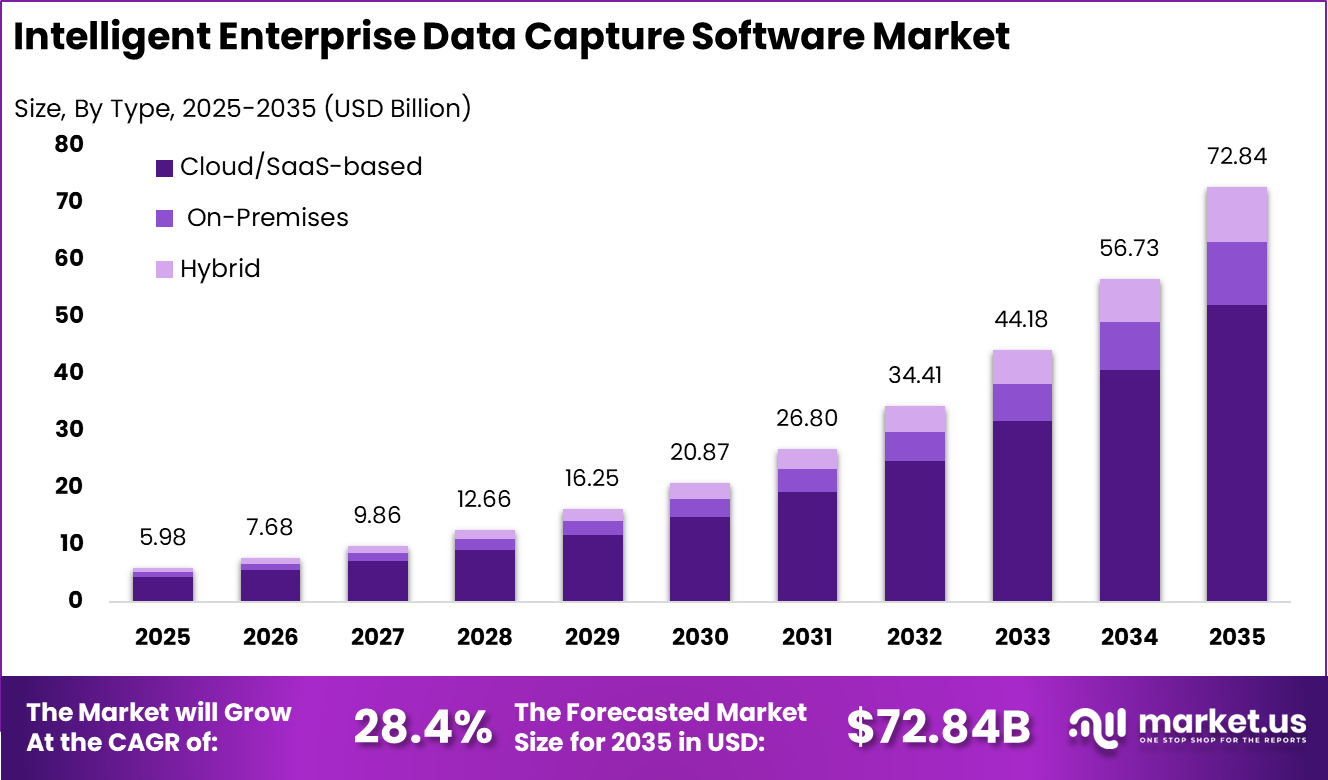
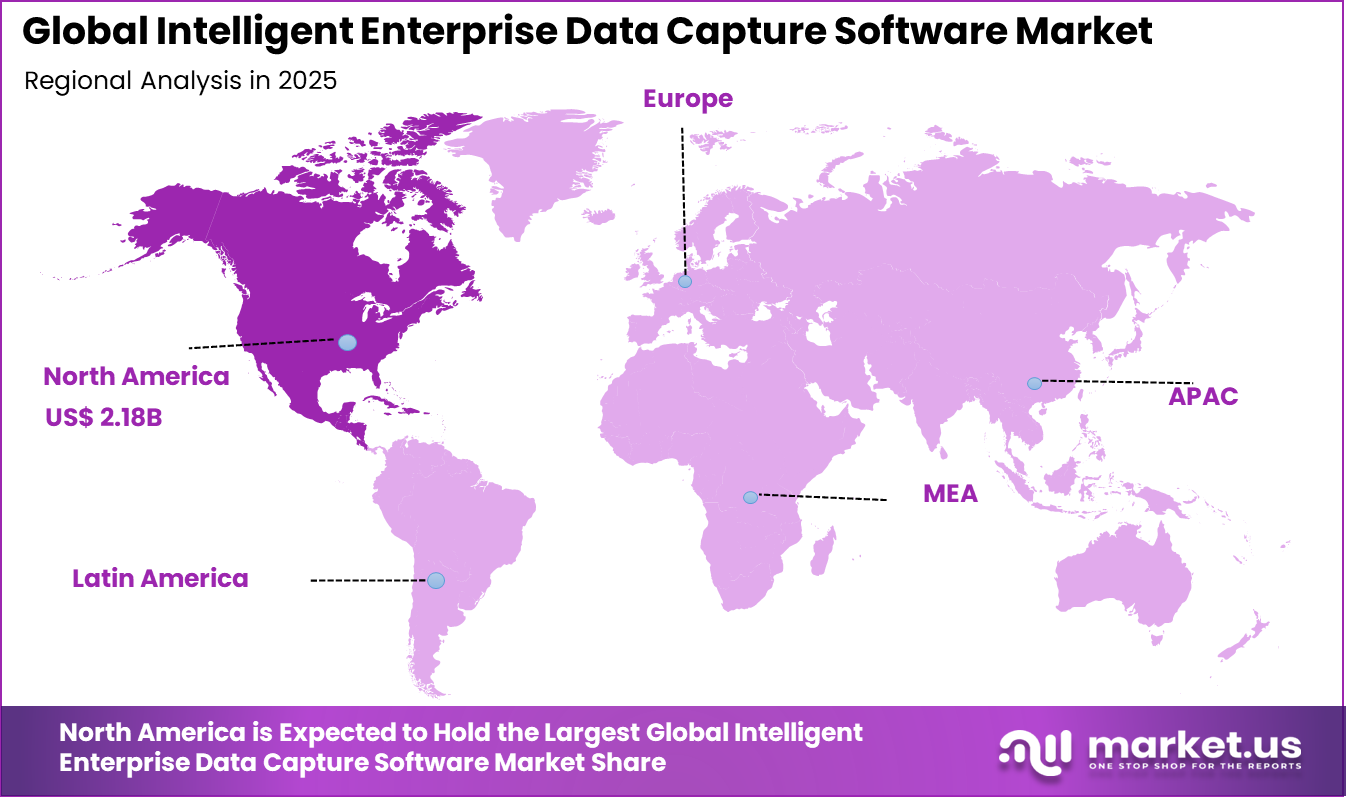
The Global Intelligent Enterprise Data Capture Software Market size is expected to be worth around USD 72.84 billion by 2035, from USD 5.98 billion in 2025, growing at a CAGR of 28.4% during the forecast period from 2025 to 2035. North America held a dominant market position, capturing more than a 36.5% share, holding USD 2.18 billion in revenue.
The intelligent enterprise data capture software market refers to solutions that automate the extraction, classification, and validation of data from diverse sources such as documents, forms, emails, and images using advanced technologies such as optical character recognition (OCR), artificial intelligence, and machine learning. These platforms convert unstructured and semi-structured content into structured data that can be processed by business systems. The goal is to reduce manual entry, improve data accuracy, and accelerate information flow across operations.
Enterprises face increasing volumes of information flowing through digital and physical channels. Traditional manual data capture is time consuming, error prone, and limits operational efficiency. Intelligent data capture software addresses these limitations by automating extraction, applying contextual understanding, and integrating captured data directly into enterprise workflows such as customer onboarding, invoice processing, claims management, and compliance reporting. This capability improves data reliability and supports faster decision making.
For instance, in February 2026, UiPath Inc. acquired WorkFusion, a specialist in AI agents for financial crime compliance, like AML and KYC. This bolsters UiPath’s agentic automation platform with pre-built libraries that handle complex document workflows, helping banks cut costs and boost compliance. Smart move as financial services demand secure data capture ramps up.
Key Takeaway
- In 2025, Cloud and SaaS based deployment led the Intelligent Enterprise Data Capture Software Market, accounting for 71.6% of total share.
- In 2025, Accounts Payable Automation emerged as the primary business function, capturing 41.3% of overall demand.
- In 2025, Artificial Intelligence and Machine Learning models dominated the technology segment with a 58.4% share.
- In 2025, Semi Structured Documents represented the leading data source category, contributing 48.7% of the market.
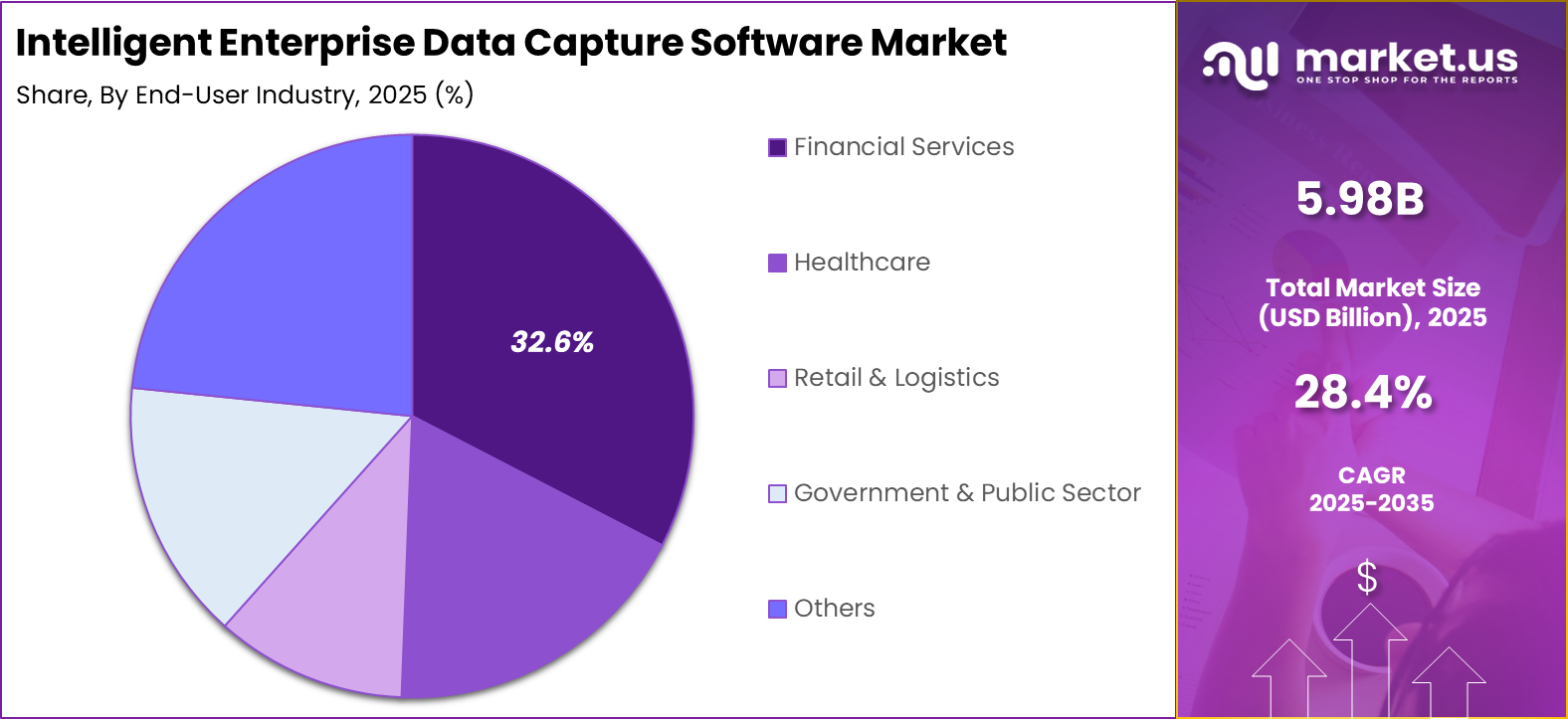
- In 2025, Financial Services held the largest end user share at 32.6%.
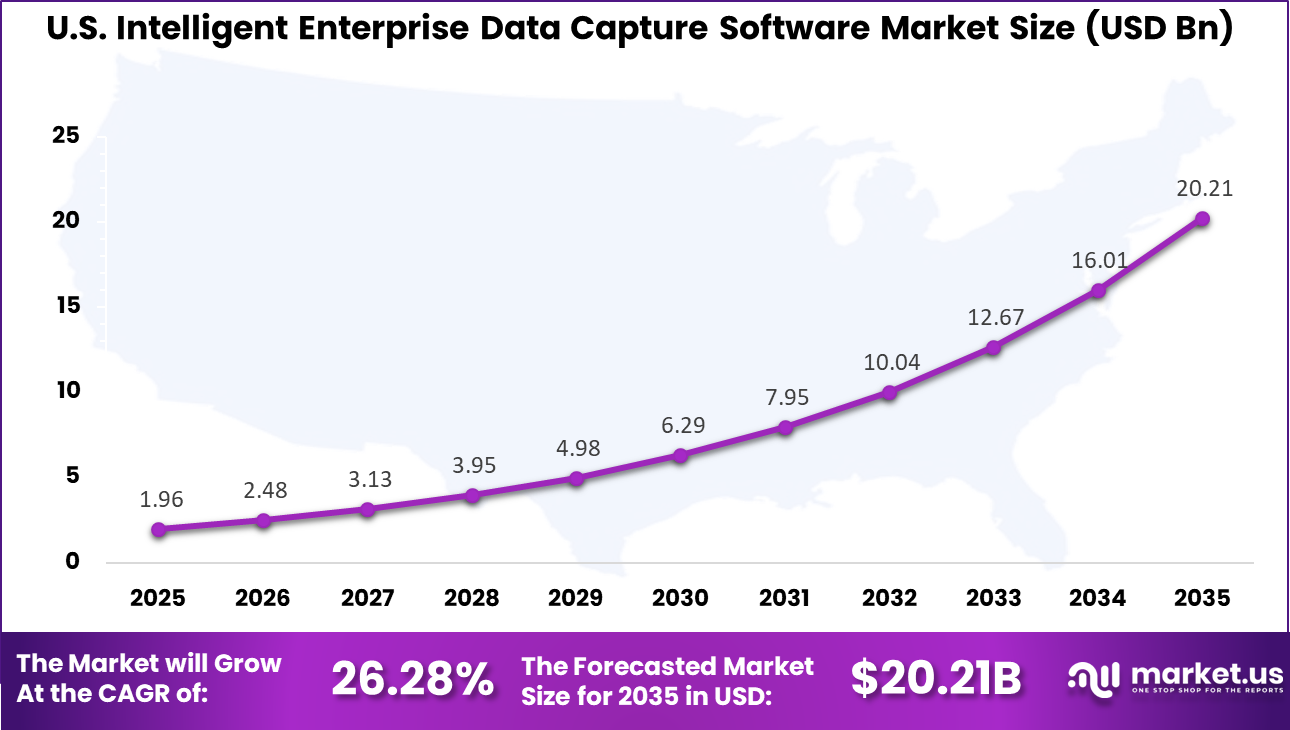
- In 2025, North America secured a 36.5% regional share, while the U.S. market reached USD 1.96 billion and recorded a strong growth rate of 26.28%.
Enterprise Adoption Rates Statistics
- Around 78% of companies worldwide use AI in at least one business function, reflecting a 55% increase since 2023.
- Between 63% and 80% of organizations plan to increase investment in intelligent document processing through 2025.
- Large enterprises account for 73.6% of current adoption, while SME adoption is projected to grow by 50% between 2025 and 2028.
- Approximately 66% of new initiatives focus on replacing legacy systems with advanced AI driven platforms.
- In banking and finance, 88% of institutions prioritize document automation within digital transformation strategies.
- In insurance, 67% of companies have implemented or are piloting automated claims and underwriting processes.
- More than 70% of logistics firms use automation for customs documentation and shipment tracking.
- Healthcare organizations show a 63% adoption rate, reducing patient record processing time by up to 50%.
- Retail companies report 68% adoption, lowering late payment penalties by as much as 25%.
- Automated data capture systems operate nearly 4x faster than manual entry methods.
- Automation reduces human error rates by up to 90%.
- Businesses save approximately USD 8 to USD 12 per document processed through intelligent automation.
- Deep learning models achieve up to 99% accuracy for structured documents and 85% to 90% for unstructured content.
- Although 80% to 90% of new enterprise data is unstructured, only 18% of organizations effectively utilize it.
- Cloud based deployment accounts for roughly 60% to 64% of market share due to scalability and remote accessibility.
- Despite digital transformation efforts, 61% of processes still involve physical paper, and 37% continue to rely on fax systems.
By Deployment Model
Cloud and SaaS based deployment accounts for 71.6% of the market, reflecting enterprise demand for scalability and rapid implementation. Organizations prefer cloud infrastructure to centralize document capture across distributed offices and remote teams. This model supports real time synchronization and reduces the need for heavy on site hardware investment.
Subscription based platforms also enable continuous software updates and integration with enterprise resource planning and accounting systems. Cloud deployment strengthens data accessibility while maintaining structured governance controls. As digital transformation initiatives accelerate, cloud based intelligent capture systems continue to dominate enterprise adoption.
For Instance, in December 2025, ABBYY was named a Leader in IDC MarketScape for IDP software, spotlighting cloud-ready AI models for data capture. Their FlexiCapture platform pushes cloud deployment with seamless scalability, letting enterprises process docs without hardware worries.
By Business Function
Accounts payable automation represents 41.3% of business function adoption, highlighting the importance of invoice processing efficiency. Intelligent capture systems extract invoice details, validate purchase orders, and reconcile payment data with minimal manual intervention. This reduces processing errors and shortens payment cycles.
Finance departments increasingly rely on automated validation to strengthen compliance and audit readiness. Structured data extraction improves transparency in vendor transactions and enhances financial reporting accuracy. As transaction volumes grow, intelligent accounts payable automation remains a primary use case for enterprise data capture platforms.
For instance, in November 2025, UiPath rolled out its 2025.10 release for intelligent document processing, featuring agentic extraction ideal for invoice handling in accounts payable. Autopilot generates schemas from samples, speeding AP workflows by cutting config time from days to minutes and boosting straight-through processing rates significantly.
By Technology and Capability
Artificial intelligence and machine learning models account for 58.4% of technological adoption within the market. These models enable advanced document classification, optical character recognition enhancement, and contextual data extraction. AI systems continuously learn from corrections, improving accuracy over time.
Machine learning driven analytics also detect anomalies and flag inconsistencies in captured data. This strengthens governance and reduces operational risk. As enterprises process increasing volumes of semi structured and unstructured documents, AI based capture capabilities provide measurable improvements in efficiency and reliability.
For Instance, in October 2025, Hyperscience launched its Winter 2025 Hypercell release, advancing agentic AI with enhanced vision models and continuous learning for superior data extraction. It targets complex docs via adaptability and contextual awareness, helping enterprises automate high-volume processes with high precision across industries.
By Data Source and Format
Semi structured documents represent 48.7% of data source focus, reflecting the widespread use of invoices, purchase orders, contracts, and forms. These documents contain both structured fields and variable text elements, requiring intelligent interpretation. Automated capture platforms are designed to extract key information while preserving contextual accuracy.
The growth of digital document exchange across supply chains has increased the volume of semi structured files. Intelligent systems reduce manual review and enhance processing speed across departments. As enterprises digitize operations, managing semi structured document flows remains a central requirement.
For Instance, in July 2025, OpenText released Capture 25.2 with NextGenOCR engine, improving handling of semi-structured items like color images, mobile captures, and handwritten content. The upgrade delivers better accuracy for mixed-format docs, supporting web client SnapMatch for faster field population in diverse sources.
By End User Industry
Financial services account for 32.6% of industry adoption due to strict compliance and reporting obligations. Institutions in this sector manage high volumes of transactional documents, statements, and regulatory filings. Intelligent capture platforms ensure accurate extraction and validation of critical financial data.
Data accuracy is essential in risk assessment, fraud monitoring, and regulatory reporting. Automated capture reduces human error and strengthens audit trails. As financial institutions continue to modernize back office operations, intelligent data capture systems remain integral to operational stability.
For Instance, in August 2025, Adobe introduced Acrobat Studio, an AI-driven PDF hub blending analysis and extraction tailored for financial docs like contracts in services. Features like PDF Spaces and custom AI assistants simplify reviews and data pulls, aiding compliance-heavy workflows in banking and insurance with secure, contextual insights.
By Region
North America holds 36.5% of the market, supported by advanced digital infrastructure and early adoption of enterprise automation technologies. Organizations across finance, healthcare, and public sectors have implemented structured document digitization frameworks. Strong regulatory standards further drive the need for accurate and auditable data processing systems.
For instance, in February 2026, Adobe launched AI-powered document capture features in Acrobat AI Assistant, dominating North American enterprise workflows. The solution extracts structured data from PDFs with 99% accuracy, integrated with Adobe Experience Cloud. This strengthens Adobe’s market leadership in intelligent content processing.
Within North America, the United States contributes USD 1.96 billion with a growth rate of 26.28%. High investment in artificial intelligence and enterprise automation has strengthened national leadership in intelligent data capture adoption. Continued modernization of finance and compliance workflows is expected to sustain regional growth.
For instance, in January 2026, IBM enhanced its WatsonX.data platform with advanced intelligent data capture capabilities, reinforcing U.S. leadership in enterprise automation. The upgrade automates document processing using AI-driven OCR and NLP, serving Fortune 500 clients across finance and healthcare.
Key Market Segments
By Deployment Model
- Cloud/SaaS-based
- On-Premises
- Hybrid
By Business Function
- Accounts Payable Automation
- Customer Onboarding (KYC/AML)
- Human Resources & Payroll Processing
- Logistics & Supply Chain Documentation
- Others
By Technology & Capability
- Template & Rules-Based Recognition
- Artificial Intelligence & Machine Learning (AI/ML) Models
- Natural Language Processing
- Computer Vision
- Others
By Data Source & Format
- Structured Documents
- Semi-Structured Documents
- Unstructured Documents
- Handwritten Documents & Forms
- Others
By End-User Industry
- Financial Services
- Loan Processing & Account Opening
- Claims Processing & Customer Onboarding
- Healthcare
- Patient Intake Forms & Insurance Claims
- Medical Record Digitization & Archiving
- Retail & Logistics
- Vendor Invoice Processing
- Proof of Delivery & Shipping Documents
- Government & Public Sector
- Tax Form Processing
- License & Permit Applications
- Others
Key Regions and Countries
North America
- US
- Canada
Europe
- Germany
- France
- The UK
- Spain
- Italy
- Russia
- Netherlands
- Rest of Europe
Asia Pacific
- China
- Japan
- South Korea
- India
- Australia
- Singapore
- Thailand
- Vietnam
- Rest of APAC
Latin America
- Brazil
- Mexico
- Rest of Latin America
Middle East & Africa
- South Africa
- Saudi Arabia
- UAE
- Rest of MEA
Driver Analysis
Need for Operational Efficiency and Error Reduction
A primary driver of this market is the demand to improve operational efficiency by reducing time spent on manual data entry and correction. Many business functions rely on accurate and timely information to serve customers, process transactions, and maintain records. Intelligent data capture software automates the extraction process and applies validation checks that reduce errors. As a result, organizations can reallocate staff from repetitive tasks to higher-value activities.
Another driver is the growing volume of unstructured and semi-structured data generated by digital business processes. Traditional database systems handle structured information well, but sources such as scanned documents, mobile images, and emails require intelligent interpretation. By applying AI and machine learning, data capture software can interpret varied content formats and contexts, increasing automation scope and data usability.
For instance, in November 2025, Kofax launched a new intelligent automation suite that captures data from invoices and forms right away, feeding it into core systems for immediate use. Companies can now spot patterns as they happen, streamlining approvals and workflows. This move supports the push toward automation by making data ready for action the moment it arrives, easing daily tasks across departments.
Restraint Analysis
Integration Challenges and Implementation Costs
One restraint emerges from the complexity of integrating intelligent data capture systems with existing enterprise applications and data repositories. Many organizations operate heterogeneous environments with legacy systems, cloud applications, and custom platforms. Establishing connectors, ensuring data compatibility, and maintaining synchronization across sources require careful planning and technical expertise.
Another restraint involves implementation costs and change management. Deploying intelligent capture solutions often requires process redesign, staff training, and infrastructure investment. Smaller organizations or functions with limited budgets may face slower adoption due to resource constraints, particularly when integrating new systems into established workflows.
For instance, in December 2025, IBM enhanced its data capture tools with stronger encryption layers to protect info during processing, but highlighted ongoing worries about breaches in shared environments. Firms still pause adoption due to fears over exposed customer records in transit. While updates aim to build trust, the focus on compliance shows security remains a hurdle for broader rollout.
Opportunity Analysis
Expansion into Vertical-Specific Use Cases
A significant opportunity exists in extending intelligent data capture into industry-specific workflows. Sectors such as healthcare, insurance, logistics, and legal services generate large volumes of forms, claims, and records that benefit from automated extraction and processing. Tailored solutions that understand domain-specific terminology and format conventions can deliver greater value and adoption.
Another opportunity lies in embedding capture capabilities into broader automation ecosystems. When combined with robotic process automation and enterprise workflows, intelligent data capture can trigger downstream processes automatically, such as initiating approvals, updating records, or notifying stakeholders. This integration increases end-to-end efficiency and enhances operational continuity.
For instance, in February 2026, UiPath integrated its capture tech with AI models for handling mixed data types like voice and scans, creating seamless links to cloud platforms. This opens ways to blend capture into larger automation chains, boosting efficiency in complex setups. Early adopters gain from smarter, connected flows that evolve with new tech.
Challenge Analysis
Data Quality Governance and Model Accuracy
A core challenge for the market involves maintaining data quality governance. Automated extraction systems must adhere to standards for accuracy, completeness, and consistency, particularly in regulated environments. Organizations must monitor performance, calibrate models, and implement validation checks to ensure captured data meets compliance and business requirements.
Another challenge relates to model accuracy in diverse content environments. Intelligent capture engines rely on trained algorithms to interpret varied document types and languages. Ensuring consistent performance across heterogeneous content requires ongoing refinement and training, which demands technical expertise and iterative tuning.
For instance, in February 2026, Automation Anywhere introduced training modules alongside its capture bots, tackling the lack of hands-on know-how for setup and tweaks. Many users still struggle with customization, sticking to basics. The effort highlights the need for better skills to unlock full potential in real operations.
Top Emerging Trends
One emerging trend is the integration of natural language processing capabilities that understand context and semantics beyond simple text recognition. By analyzing sentence structure, entity relationships, and content intent, systems can extract richer insights and reduce manual review effort.
Another trend involves real-time mobile capture where field personnel capture documents and information using mobile devices. On-device processing and cloud synchronization enable immediate extraction and validation, accelerating workflows such as customer onboarding and claims initiation.
Customer Impact: Trends and Disruptors
For enterprise users, intelligent data capture software reduces bottlenecks in information processing. Automated extraction and verification accelerate access to actionable data, which improves responsiveness in customer service, compliance reporting, and operational workflows.
Customers also benefit from improved data accuracy and consistency. When information is captured reliably the first time, downstream systems produce more trustworthy analytics and reduce errors in reporting and decision making. This reliability enhances confidence in digital operations and supports continuous improvement in business performance.
Key Players Analysis
The Intelligent Enterprise Data Capture Software Market is shaped by established document processing and automation providers with strong enterprise presence. ABBYY, Kofax Inc., and IBM Corporation offer advanced optical character recognition and AI based data extraction platforms. Their solutions are widely adopted across banking, insurance, and healthcare sectors where high document volumes require structured processing.
Enterprise software vendors are integrating intelligent capture into broader digital workflow ecosystems. Adobe Inc. and OpenText Corporation combine document management with automated data classification tools. Robotic process automation leaders such as UiPath Inc. and Automation Anywhere, Inc. embed data capture modules within end to end automation suites.
Emerging innovators focus on AI native platforms and deep learning based document understanding. WorkFusion, Rossum, Parascript, LLC, Ephesoft Inc., Hyperscience, AntWorks, Docsumo, and Infrrd compete through adaptive learning engines and cloud first deployment models. These vendors emphasize accuracy improvements above traditional rule based systems and faster implementation cycles.
Top Key Players in the Market
- ABBYY
- Kofax Inc.
- IBM Corporation
- Adobe Inc.
- OpenText Corporation
- UiPath Inc.
- Automation Anywhere, Inc.
- WorkFusion
- Rossum
- Parascript, LLC
- Ephesoft Inc.
- Hyperscience
- AntWorks
- Docsumo
- Infrrd
- Others
Recent Developments
- In December 2025, ABBYY partnered with IBM to integrate FlexiCapture document processing with IBM watsonx.ai, creating AI-driven process intelligence for healthcare. The combo delivers superior data extraction accuracy and workflow optimization for hospitals managing high-volume patient records.
- In November 2025, OpenText expanded its Google Cloud partnership, launching AI-powered Aviator Studio for no-code AI agents and Knowledge Discovery for automated metadata tagging. These tools target insurance and finance, enabling faster document classification and compliance-ready data capture.
Report Scope
Report Features Description Market Value (2025) USD 5.9 Bn Forecast Revenue (2035) USD 72.8 Bn CAGR (2026-2035) 28.4% Base Year for Estimation 2025 Historic Period 2020-2024 Forecast Period 2026-2035 Report Coverage Revenue forecast, AI impact on Market trends, Share Insights, Company ranking, competitive landscape, Recent Developments, Market Dynamics and Emerging Trends Segments Covered By Deployment Model (Cloud/SaaS-based, On-Premises, Hybrid), By Business Function (Accounts Payable Automation, Customer Onboarding (KYC/AML), Human Resources & Payroll Processing, Logistics & Supply Chain Documentation, Others), By Technology & Capability (Template & Rules-Based Recognition, Artificial Intelligence & Machine Learning (AI/ML) Models, Others), By Data Source & Format (Structured Documents, Semi-Structured Documents, Unstructured Documents, Handwritten Documents & Forms, Others), By End-User Industry (Financial Services, Healthcare, Retail & Logistics, Government & Public Sector, Others) Regional Analysis North America – US, Canada; Europe – Germany, France, The UK, Spain, Italy, Russia, Netherlands, Rest of Europe; Asia Pacific – China, Japan, South Korea, India, New Zealand, Singapore, Thailand, Vietnam, Rest of Latin America; Latin America – Brazil, Mexico, Rest of Latin America; Middle East & Africa – South Africa, Saudi Arabia, UAE, Rest of MEA Competitive Landscape ABBYY, Kofax Inc., IBM Corporation, Adobe Inc., OpenText Corporation, UiPath Inc., Automation Anywhere, Inc., WorkFusion, Rossum, Parascript, LLC, Ephesoft Inc., Hyperscience, AntWorks, Docsumo, Infrrd, Others Customization Scope Customization for segments, region/country-level will be provided. Moreover, additional customization can be done based on the requirements. Purchase Options We have three license to opt for: Single User License, Multi-User License (Up to 5 Users), Corporate Use License (Unlimited User and Printable PDF)  Intelligent Enterprise Data Capture Software MarketPublished date: March 2026add_shopping_cartBuy Now get_appDownload Sample
 -
-
- ABBYY
- Kofax Inc.
- IBM Corporation
- Adobe Inc.
- OpenText Corporation
- UiPath Inc.
- Automation Anywhere, Inc.
- WorkFusion
- Rossum
- Parascript, LLC
- Ephesoft Inc.
- Hyperscience
- AntWorks
- Docsumo
- Infrrd
- Others
Our Clients

- 179948
- March 2026









