Innovation Management Systems Market By Component (Solution, Services (Professional Services, Managed Services)), By Deployment (Cloud, On-premises), By Organization Size (SMEs, Large Enterprises), By Function (Product Development, Business Processes), By Application (Project Management Platforms, Marketing Platforms, Others), By Vertical (BFSI, Healthcare, Others),By Regional Analysis, Global Trends and Opportunity, Future Outlook By 2025-2035
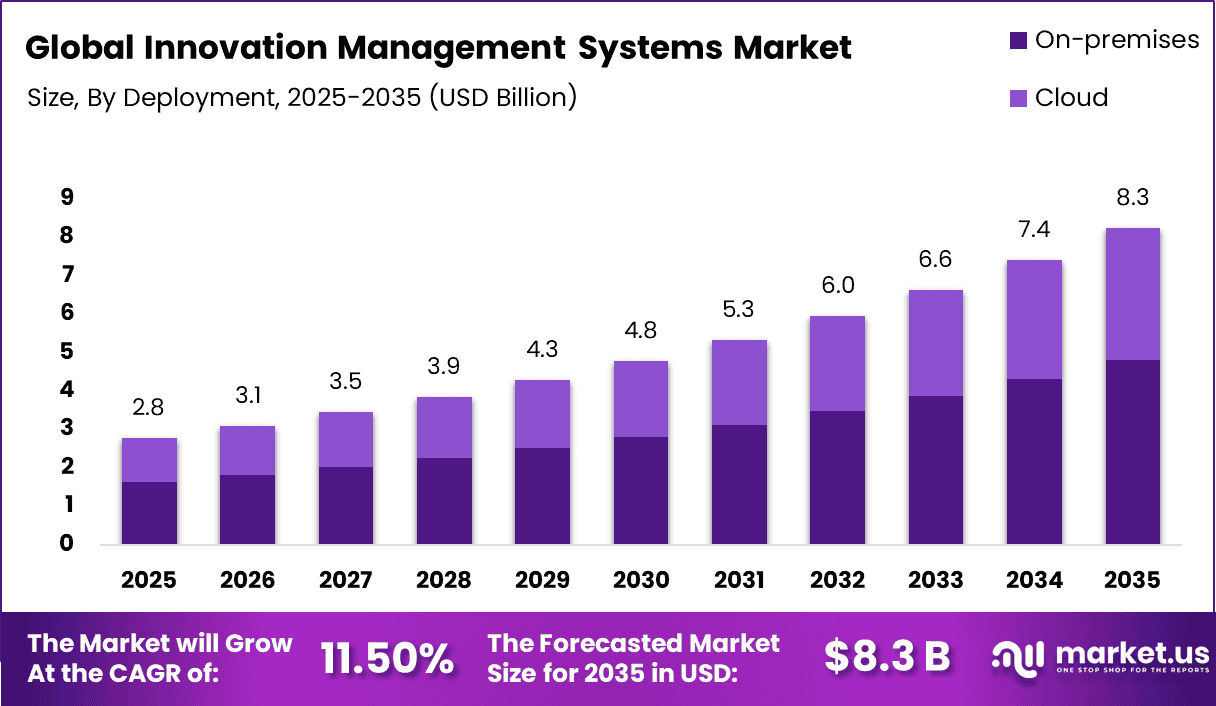
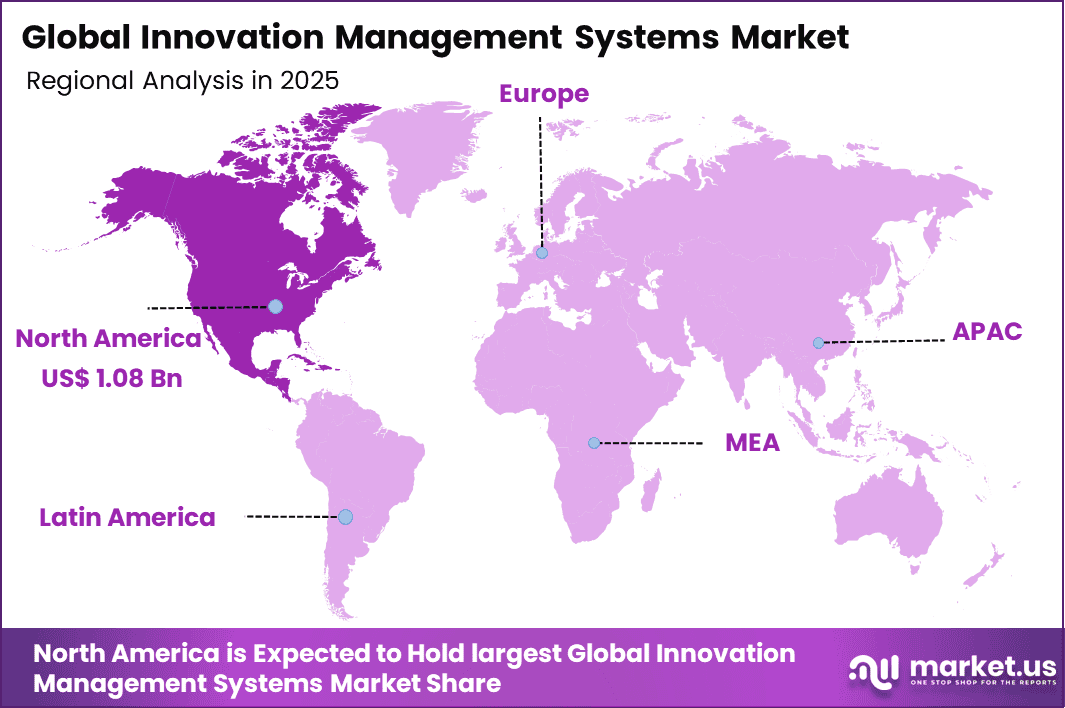
The Global Innovation Management Systems Market generated USD 2.8 billion in 2025 and is predicted to register growth from USD 3.1 billion in 2026 to about USD 8.3 billion by 2035, recording a CAGR of 11.50% throughout the forecast span. In 2025, North America held a dominant market position, capturing more than a 39.2% share, holding USD 1.08 Billion revenue.
Top Market Takeaways
Component Solution accounts for 78.2% of the Innovation Management Systems market, as most organizations prefer complete software platforms instead of separate tools or services.
Deployment On-premises holds 58.4% of the market, showing that many companies still choose to host innovation systems in-house for greater control and data security.
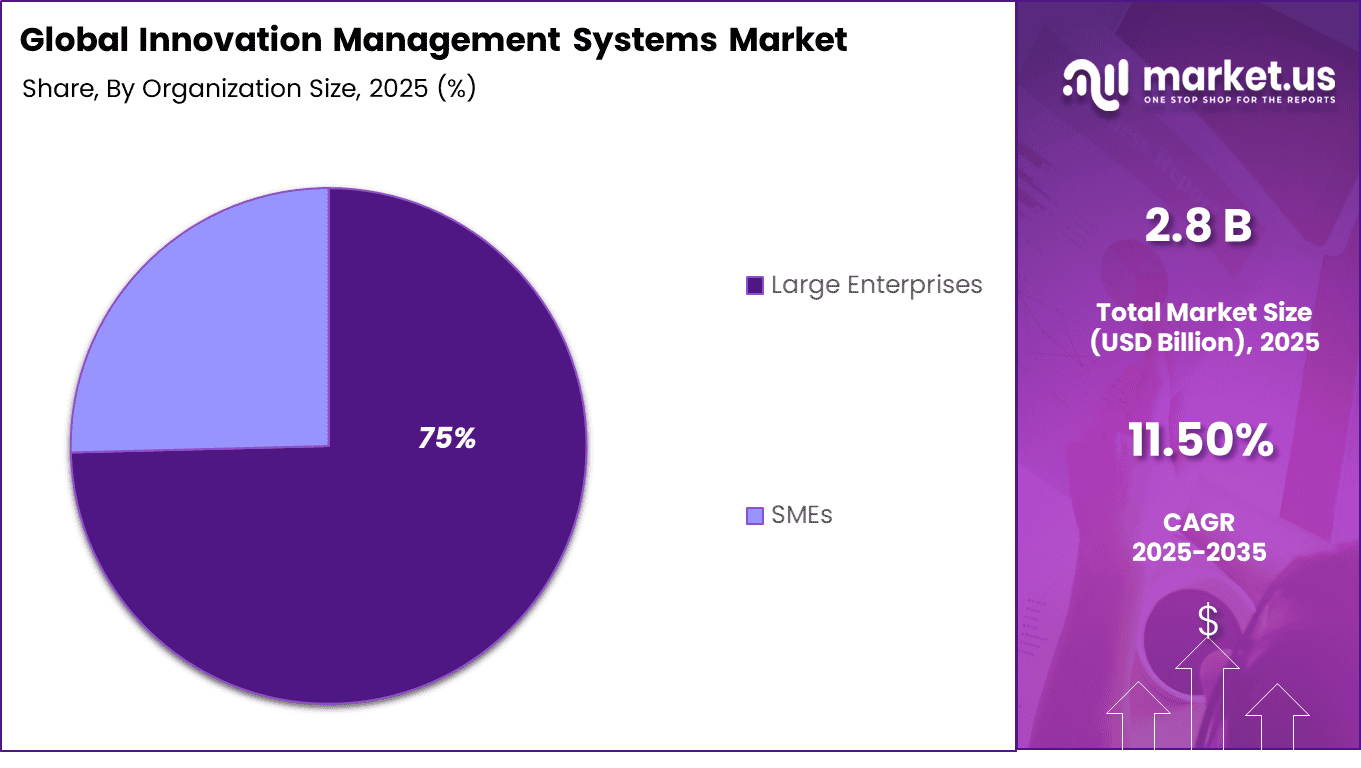
Organization Size Large enterprises make up 74.6%, because they run complex innovation programs and have higher budgets for structured innovation platforms.
Function Business processes account for 70.3%, indicating that these systems are mainly used to streamline, manage, and improve core business workflows and idea pipelines.
Application Project management platforms represent 37.4%, reflecting strong use of innovation tools to plan, track, and execute innovation-related projects and initiatives.
Vertical IT and telecommunication holds 35.4% of the market, as tech and telecom companies are early and heavy adopters of innovation management solutions.
Region North America represents 39.2% of the global market, driven by high digital adoption and a strong focus on formal innovation strategies.
Innovation management systems are digital platforms used by organizations to capture ideas, evaluate opportunities, manage development pipelines, and track innovation outcomes in a structured way. These systems help businesses move beyond informal brainstorming by creating repeatable processes for turning ideas into products, services, or internal improvements.
They are used across industries to coordinate collaboration between employees, partners, customers, and leadership teams. As markets change faster and competition increases, companies are relying more on structured innovation tools to stay relevant and improve decision making.
One of the main driving factors is the growing pressure on organizations to accelerate product development and respond quickly to shifting customer needs. Businesses are looking for ways to identify valuable ideas faster and reduce delays in evaluation and execution.
In addition, hybrid and global work models have increased the need for platforms that support collaboration across locations and departments. Leadership teams are also focusing more on measurable returns from innovation efforts, which is encouraging adoption of systems that provide workflow visibility and performance tracking. The broader push toward digital transformation is further supporting demand for organized innovation processes.
Demand for innovation management systems is rising as organizations seek scalable tools that improve idea flow and execution discipline. There is a strong preference for platforms that offer idea submission portals, scoring models, stage based project tracking, and analytics dashboards. Companies are also looking for systems that integrate with communication, project management, and enterprise software already in use.
The demand is particularly strong among large enterprises, research driven organizations, manufacturers, financial institutions, and technology firms that depend on continuous improvement. As long term growth increasingly depends on adaptability, the need for reliable and user friendly innovation systems is expected to grow steadily.
Drivers Impact Analysis
Key Driver
Impact on CAGR Forecast (~%)
Geographic Relevance
Impact Timeline
Additional Insight
Rising need for structured innovation processes
+3.2%
North America, Europe, Asia Pacific
Medium term
Firms need organized idea management
Growing adoption of digital transformation initiatives
+2.9%
Global
Medium to long term
Digital tools support innovation workflows
Increasing focus on product development and R&D efficiency
+2.6%
Developed markets
Medium term
Software improves project visibility
Expansion of open innovation and collaboration models
+2.4%
Global
Medium to long term
Collaboration improves idea generation
Demand for faster decision-making in competitive markets
+2.1%
Global
Short to medium term
Faster evaluation supports growth
Restraints Impact Analysis
Key Restraint
Impact on CAGR Forecast (~%)
Geographic Relevance
Impact Timeline
Additional Insight
High implementation and customization costs
-2.5%
Emerging markets
Short to medium term
Costs limit smaller firms
Resistance to organizational change
-2.1%
Global
Medium term
Cultural barriers slow adoption
Difficulty in measuring innovation ROI
-1.8%
Global
Medium to long term
ROI uncertainty affects spending
Integration challenges with existing enterprise systems
-1.6%
Global
Medium term
Compatibility issues delay deployment
Data security and intellectual property concerns
-1.4%
North America, Europe
Medium to long term
IP risks affect trust
By Component Analysis
The solution segment accounted for 78.2% of the market share, reflecting its dominant role in helping organizations capture ideas, manage innovation pipelines, and improve decision-making. This dominance is supported by the growing need for structured platforms that centralize collaboration, workflow tracking, analytics, and idea evaluation. Businesses are increasingly adopting dedicated solutions to streamline innovation activities and accelerate execution.
Another factor driving this segment is the demand for integrated tools that connect departments and improve visibility across innovation programs. Solution platforms help organizations reduce manual processes, prioritize initiatives, and measure outcomes effectively. These advantages continue to strengthen adoption across multiple industries.
By Deployment Analysis
The on-premises segment held 58.4% share, driven by the need for stronger control over internal data, workflows, and system customization. Many organizations prefer on-premises deployment to manage confidential business strategies, intellectual property, and innovation records within secure internal environments. This model also supports deeper integration with existing enterprise systems.
In addition, enterprises with complex compliance and governance requirements often choose local deployment for better oversight and operational stability. On-premises systems provide direct control over upgrades, access settings, and data management, reinforcing their continued market presence.
By Organization Size Analysis
The large enterprises segment captured 75% of the market, reflecting their strong need to manage large-scale innovation programs across multiple departments and regions. These organizations require advanced systems to coordinate ideas, evaluate investments, and track strategic initiatives efficiently. Innovation management platforms help improve structure and execution at scale.
Moreover, large enterprises have the financial and technical resources to invest in enterprise-grade systems with analytics, automation, and collaboration features. Their focus on long-term competitiveness and operational transformation continues to drive strong adoption in this segment.
By Function Analysis
The business processes segment accounted for 70.3% of the market share, driven by the increasing need to improve workflows, efficiency, and operational performance through innovation initiatives. Organizations are using management systems to redesign internal processes, remove bottlenecks, and encourage continuous improvement across departments.
Furthermore, companies are prioritizing innovation not only for products but also for process excellence. Structured platforms help evaluate process ideas, assign responsibilities, and monitor implementation progress. This has reinforced the leading position of the business processes function segment.
By Application Analysis
The project management platforms segment held 37.4% share, driven by the need to organize innovation projects from idea stage to execution. These platforms help teams manage timelines, resources, milestones, and collaboration in a structured manner. Organizations rely on them to improve accountability and execution speed.
In addition, growing demand for cross-functional coordination has increased the importance of project management tools within innovation programs. They provide visibility into progress and help reduce delays, supporting stronger adoption across enterprises.
By Vertical Analysis
The IT and telecommunication segment captured 35.4% of the market, reflecting its strong focus on rapid innovation, digital transformation, and competitive differentiation. Companies in this sector continuously develop new services, improve systems, and adapt to changing customer expectations, creating strong demand for innovation management tools.
Moreover, fast technology cycles and intense competition encourage IT and telecom organizations to manage ideas and projects more efficiently. These systems help accelerate product development, improve collaboration, and support strategic planning, reinforcing their leading position in the market.
Investor Type Impact Analysis
Investor Type
Growth Sensitivity
Risk Exposure
Geographic Focus
Investment Outlook
Venture capital firms
High
High
US, Europe
Investing in innovation SaaS startups
Private equity firms
Moderate to high
Moderate
North America and Europe
Scaling enterprise software providers
Corporate investors
High
Moderate
Global
Strategic investments in digital R&D tools
Institutional investors
Moderate
Low to moderate
Developed markets
Prefer stable enterprise SaaS firms
Government and public funding bodies
Moderate
Low
Global
Supporting innovation and R&D programs
Technology Enablement Analysis
Technology
Impact on CAGR Forecast (~%)
Geographic Relevance
Impact Timeline
Additional Insight
AI-based idea evaluation and scoring
+3.4%
US, Europe
Medium to long term
Improves idea prioritization
Cloud-based innovation management platforms
+3.0%
Global
Short to medium term
Enables scalable collaboration
Integration with project management and ERP tools
+2.7%
Global
Medium term
Connects innovation with execution
Data analytics and innovation performance dashboards
+2.4%
Developed markets
Medium to long term
Improves decision visibility
Workflow automation and collaboration tools
+2.1%
Global
Medium term
Speeds idea-to-project conversion
Key Challenges
High implementation cost makes adoption difficult for small businesses.
Resistance to change from employees used to traditional processes.
Low employee participation reduces idea generation and engagement.
Difficulty in measuring return on investment from innovation efforts.
Integration challenges with existing business systems and tools.
Lack of leadership support can slow program success.
Data security concerns for confidential ideas and projects.
Complex software features may require user training.
Poor idea evaluation processes can delay decisions.
Need for continuous updates to keep the system effective.
Emerging Trends
The innovation management systems market is evolving toward more collaborative and data driven platforms that help organizations turn ideas into measurable business outcomes. One of the key emerging trends is the use of AI powered idea discovery tools that can analyze employee suggestions, customer feedback, and market signals to identify high potential opportunities faster.
Another important trend is the shift toward open innovation models, where companies use digital platforms to engage employees, partners, startups, and academic institutions in a shared innovation process. There is also growing demand for workflow automation that manages idea submission, evaluation, approval, and implementation through a structured system. In addition, advanced analytics dashboards are becoming common, helping leadership track participation levels, project progress, and return from innovation initiatives. Mobile access and social collaboration features are also gaining traction, allowing teams to contribute ideas and collaborate from any location.
Growth Factors
The growth of this market is driven by the increasing pressure on organizations to launch new products, improve processes, and remain competitive in fast changing industries. Businesses are recognizing that informal idea management often leads to missed opportunities, which is encouraging adoption of dedicated systems. The rise of digital transformation programs is also supporting demand, as companies seek platforms that can align innovation efforts with strategic goals.
Another major factor is the need to improve employee engagement by giving staff a clear channel to contribute ideas and participate in change initiatives. Organizations are also focusing on faster decision making and better resource allocation, which strengthens the case for structured innovation platforms. Furthermore, expanding remote and global workforces are increasing the need for centralized systems that can connect distributed teams and maintain continuous innovation pipelines.
Key Market Segments
By Component
Solution
Services
Professional Services
Managed Services
By Deployment
Cloud
On-premises
By Organization Size
SMEs
Large Enterprises
By Function
Product Development
Business Processes
By Application
Project Management Platforms
Marketing Platforms
Design Platforms
Idea Management Platforms
Collective Intelligence & Prediction Platforms
Human Resources Platforms
Others
By Vertical
BFSI
Healthcare
Education
Media & Entertainment
IT & Telecommunication
Retail
Government
Others
Regional Analysis
North America accounted for 39.2% of the Innovation Management Systems market, supported by strong enterprise focus on digital transformation and structured idea development programs. Organizations across the region are increasingly using innovation platforms to capture employee ideas, evaluate new concepts, manage product pipelines, and improve collaboration across departments.
The mature corporate ecosystem and high adoption of cloud software have encouraged businesses to formalize innovation processes through dedicated systems. In addition, rising competition and the need for faster product development cycles are strengthening demand for innovation management solutions across industries.
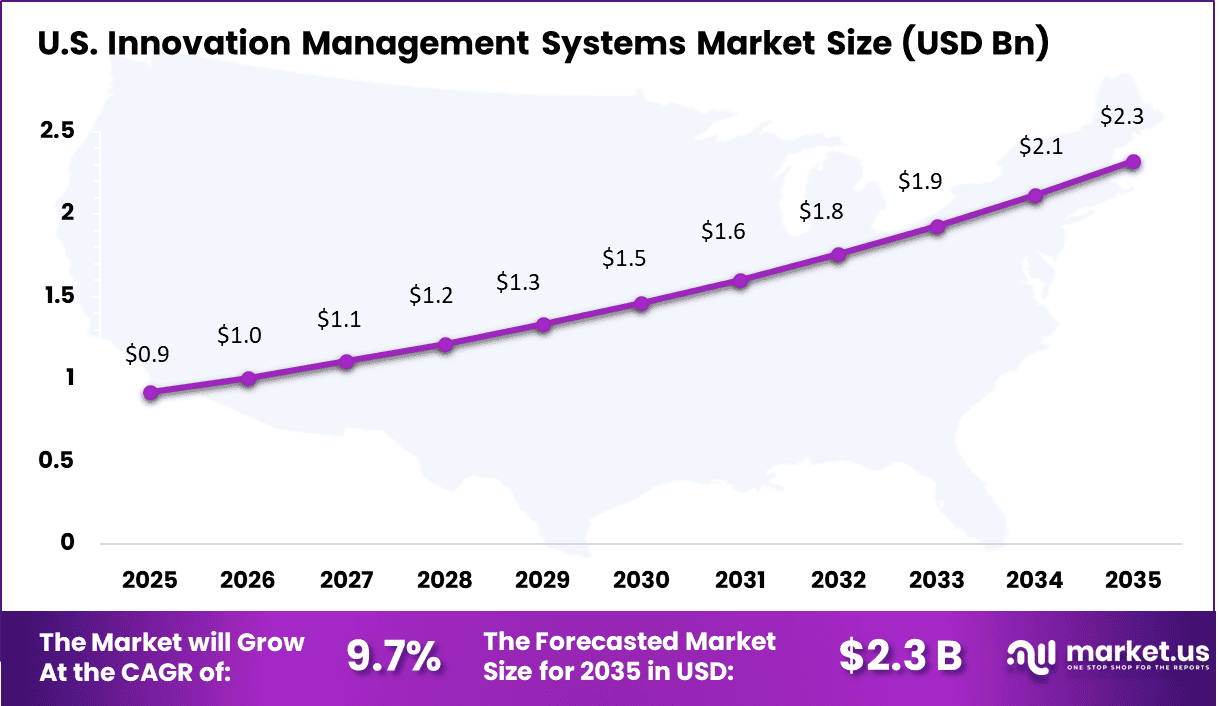
The U.S. market reached USD 0.92 Billion and is projected to grow at a CAGR of 9.7%, driven by growing investment in research-led business strategies and continuous improvement initiatives. Companies are adopting innovation management systems to streamline idea selection, track project outcomes, and align innovation goals with business performance.
The expansion of remote and hybrid work models has also increased the need for digital collaboration tools that support cross-functional innovation programs. In addition, strong startup activity and enterprise modernization efforts are expected to support steady growth of the market in the US over the coming years.
Key Regions and Countries
North America
US
Canada
Europe
Germany
France
The UK
Spain
Italy
Russia
Netherlands
Rest of Europe
Asia Pacific
China
Japan
South Korea
India
Australia
Singapore
Thailand
Vietnam
Rest of APAC
Latin America
Brazil
Mexico
Rest of Latin America
Middle East & Africa
South Africa
Saudi Arabia
UAE
Rest of MEA
Competitive Analysis
The competitive landscape of the Innovation Management Systems Market is shaped by a mix of global consulting firms and enterprise software providers. Companies such as Accenture, Boston Consulting Group, Deloitte Touche Tohmatsu Limited, and KPMG International Limited focus on helping organizations build innovation strategies, improve internal processes, and manage transformation programs. These firms combine advisory expertise with digital tools to support idea generation, portfolio planning, and execution. Their strong relationships with large enterprises and cross-industry experience help them maintain a leading position in the market.
At the same time, technology-focused players such as Miro, Qmarkets, Questel, Salesforce, Inc., SAP SE, and Sopheon Corporation compete by offering dedicated innovation management platforms. These companies focus on collaboration tools, idea tracking, workflow automation, and data-driven decision making to help businesses manage innovation pipelines efficiently. Competition in this market is driven by ease of use, integration with existing enterprise systems, scalability, and the ability to support both structured and open innovation programs.
The future outlook for the Innovation Management Systems Market looks strong as organizations continue to focus on faster product development, idea generation, and competitive growth. The market is expected to grow with increasing demand for digital platforms that help collect ideas, manage collaboration, and track innovation projects across teams. Companies are anticipated to use these systems to improve decision making and bring new products to market more efficiently. In the coming years, integration with AI, analytics, and cloud-based collaboration tools is expected to make innovation management systems smarter, more scalable, and widely adopted across industries.
Recent Developments
January, 2026 – Accenture continues to position itself as a top innovation partner through its global Innovation Hubs and analytics‑driven consulting offerings, which include setting up innovation management systems for large enterprises. It focuses on combining strategy, AI, and cloud platforms (often from partners like SAP, Salesforce, and Microsoft) to design end‑to‑end innovation operating models for clients.
January ,2026 – BCG is cited in innovation‑trends pieces as a leading strategy advisor helping firms build systematic innovation engines, often underpinned by software platforms for idea pipelines and venture building. BCG’s thought leadership around AI, sustainability, and new business models shapes how corporates design their innovation management frameworks and tool stacks.
Report Scope
Report Features
Description
Market Value (2025)
USD 2.8 Billion
Forecast Revenue (2035)
USD 8.3 Billion
CAGR(2025-2035)
11.50%
Base Year for Estimation
2024
Historic Period
2020-2024
Forecast Period
2025-2035
Report Coverage
Revenue forecast, AI impact on Market trends, Share Insights, Company ranking, competitive landscape, Recent Developments, Market Dynamics and Emerging Trends
Segments Covered
By Component (Solution, Services (Professional Services, Managed Services)), By Deployment (Cloud, On-premises), By Organization Size (SMEs, Large Enterprises), By Function (Product Development, Business Processes), By Application (Project Management Platforms, Marketing Platforms, Others), By Vertical (BFSI, Healthcare, Others)
Regional Analysis
North America – US, Canada; Europe – Germany, France, The UK, Spain, Italy, Russia, Netherlands, Rest of Europe; Asia Pacific – China, Japan, South Korea, India, New Zealand, Singapore, Thailand, Vietnam, Rest of Latin America; Latin America – Brazil, Mexico, Rest of Latin America; Middle East & Africa – South Africa, Saudi Arabia, UAE, Rest of MEA
Competitive Landscape
Accenture, Boston Consulting Group, Deloitte Touche Tohmatsu Limited, KPMG International Limited, Miro, Qmarkets, Questel, Salesforce, Inc., SAP SE, Sopheon Corporation, Others
Customization Scope
Customization for segments, region/country-level will be provided. Moreover, additional customization can be done based on the requirements.
Purchase Options
We have three license to opt for: Single User License, Multi-User License (Up to 5 Users), Corporate Use License (Unlimited User and Printable PDF)