


Report Overview
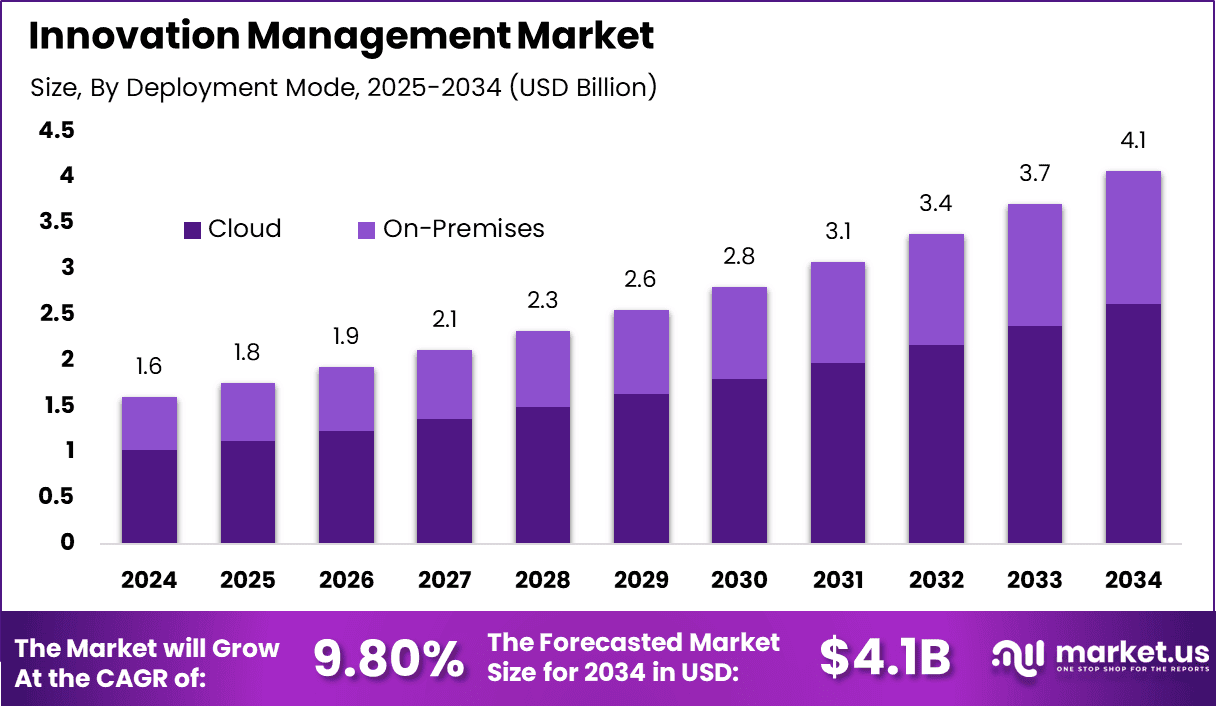
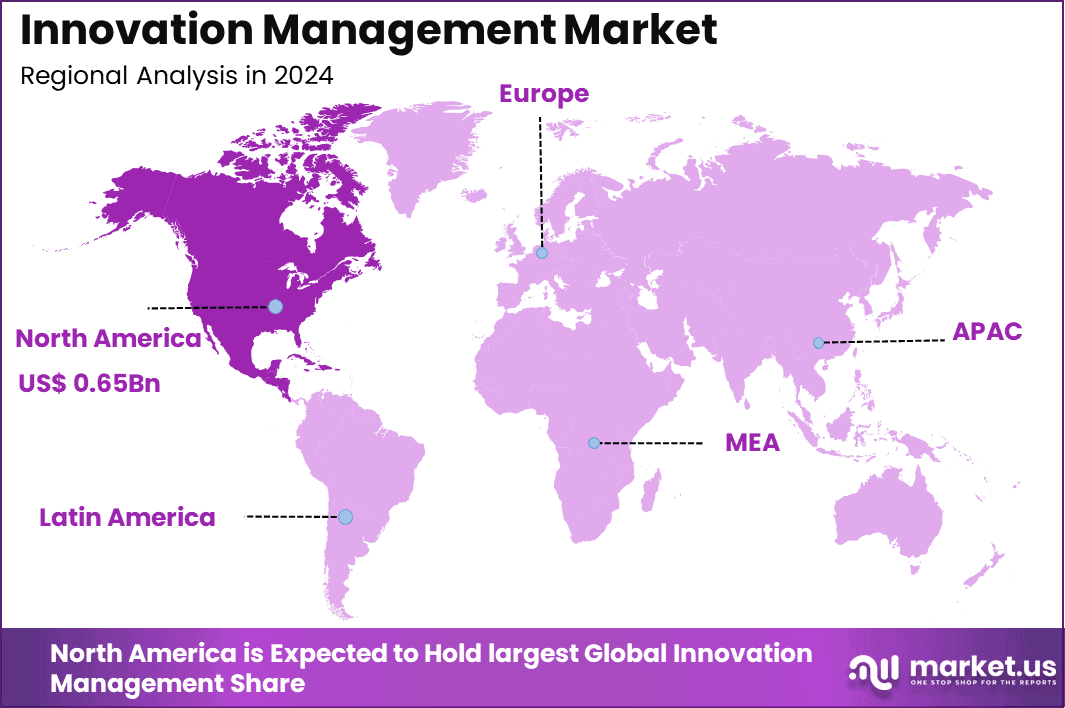
The Global Innovation Management Market generated USD 1.6 billion in 2024 and is predicted to register growth from USD 1.8 billion in 2025 to about USD 4.1 billion by 2034, recording a CAGR of 5.94% throughout the forecast span. In 2024, North America held a dominant market position, capturing more than a 9.8% share, holding USD 0.65 Billion revenue.
The innovation management market refers to structured platforms and processes that help organizations generate, evaluate, and implement new ideas across products, services, and operations. These solutions are designed to centralize innovation activities, improve collaboration, and align ideas with business strategy. As organizations operate in highly competitive and rapidly evolving environments, the ability to manage innovation systematically has become essential.
Top driving factors for the innovation management market are closely associated with increasing pressure on organizations to accelerate product development and maintain market relevance. Rapid technological advancements and shifting customer expectations require businesses to continuously innovate. Internal inefficiencies in idea management and lack of visibility across teams have historically limited innovation outcomes.
Demand analysis indicates strong adoption across industries such as information technology, healthcare, manufacturing, and consumer goods. These sectors rely on continuous innovation to remain competitive and respond to changing market dynamics. Large enterprises are leading adoption due to their need to manage complex innovation pipelines across multiple departments and geographies.
Increasing adoption technologies in this market are centered around artificial intelligence, cloud computing, and collaborative digital platforms. Artificial intelligence is being used to analyze large volumes of ideas, identify trends, and recommend high potential concepts. Cloud based platforms are widely adopted due to their scalability and ability to support real time collaboration across distributed teams.
Top Market Takeaways
- By component, the software segment dominates, holding approximately 64.2% of the market share, driven by the need for digital platforms to manage innovation workflows.
- By deployment, cloud solutions lead with 60% share, reflecting a strong shift toward flexible, scalable innovation management platforms.
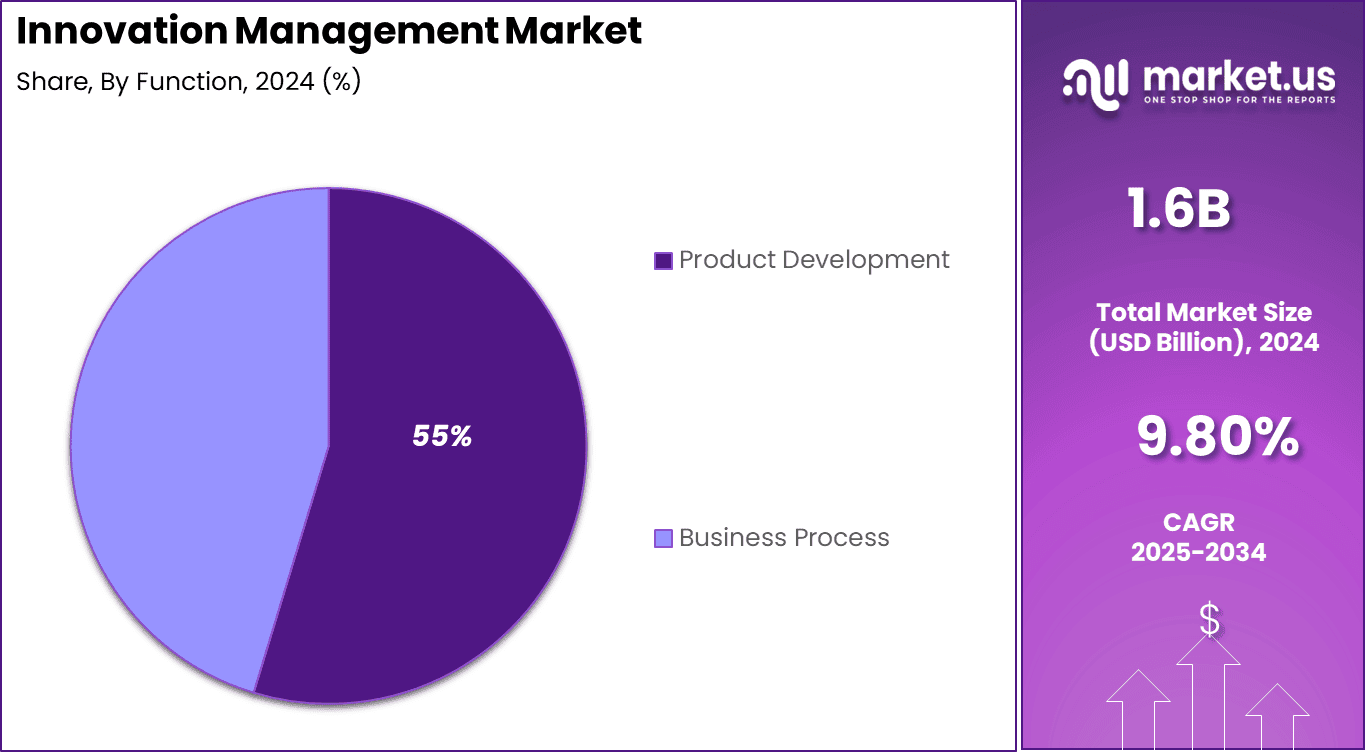
- By function, product development accounts for 54.7%, highlighting focus on accelerating new product ideation and launch.
- By application, product research & development platforms hold 31.2% share, supporting deeper innovation pipeline management.
- By end user, the BFSI segment represents 27%, driven by the sector’s focus on innovation for competitive advantage and regulatory compliance.
- Regionally, North America holds about 41% of the global innovation management market, led by technology adoption and innovation investments.
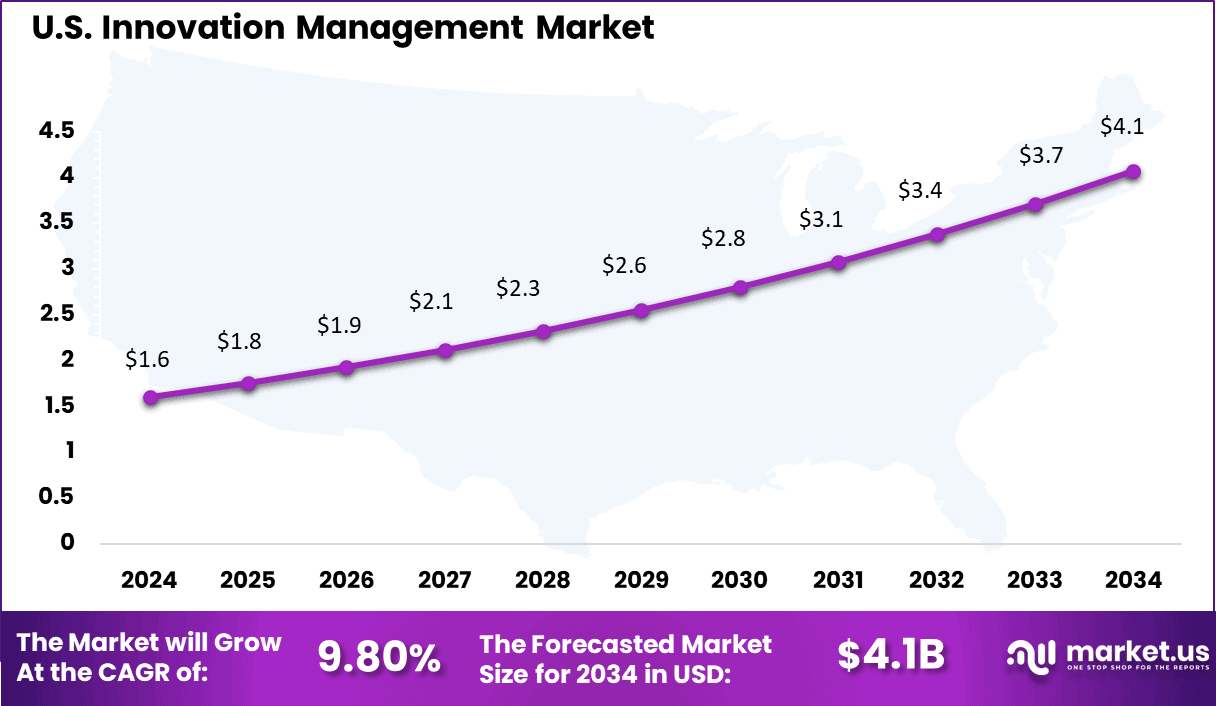
- The U.S. market size is estimated at around USD 0.70 billion in 2025.
Strategic Importance & Performance
- Around 84% of executives consider innovation essential for future business growth.
- Only 6% of executives are satisfied with their organization’s innovation performance.
- Just 21% of companies report that they achieve their stated innovation goals.
- Companies with a strong culture of innovation are 3.5 times more likely to outperform their peers.
- Innovative organizations report about 11% higher revenue growth and 22% higher EBITDA than less innovative firms.
- Many leading companies follow the 70-20-10 model for innovation resource allocation.
- Under this model, 70% of resources are directed toward core improvements, 20% toward adjacent opportunities, and 10% toward transformational innovation.
- About 54% of companies struggle to align innovation strategy with overall business strategy.
- High-performing innovators are 3 times more likely to collaborate with external partners on new product development.
- Around 57% of companies identify building an innovation culture as their top internal challenge.
- Nearly 86% of organizations report that legacy technology slows down innovation efforts.
- A lack of employee skills in data and innovation remains one of the most significant barriers to innovation progress.
By Component
In 2024, the software segment held a dominant share of 64.2% in the innovation management market, driven by the growing need for digital platforms that support idea generation, collaboration, and innovation tracking. Organizations are increasingly adopting software tools to manage innovation pipelines, evaluate concepts, and accelerate product development cycles.
These platforms enable structured workflows and improve visibility across innovation initiatives. As businesses focus on continuous improvement, software solutions remain central to innovation strategies. The segment’s growth is further supported by the integration of advanced technologies such as analytics and automation within innovation platforms.
Companies are leveraging these tools to identify trends, prioritize ideas, and enhance decision-making processes. Software-based systems also allow seamless collaboration across departments and geographies. This has strengthened the role of software as the core component in innovation management systems.
By Deployment
In 2024, the cloud segment accounted for 60% share, reflecting strong demand for scalable and flexible innovation management solutions. Cloud deployment enables organizations to access platforms remotely and collaborate in real time across distributed teams. This is particularly important for enterprises managing innovation processes across multiple locations. The ability to quickly deploy and scale solutions has made cloud adoption highly attractive.
The segment’s expansion is also driven by cost efficiency and ease of integration with existing enterprise systems. Cloud-based platforms reduce the need for heavy infrastructure investment and provide continuous updates. Organizations benefit from improved accessibility and faster implementation of innovation initiatives. As digital transformation continues, cloud deployment remains the preferred model for innovation management.
By Function
In 2024, the product development segment held a leading share of 54.7%, supported by the increasing focus on accelerating time-to-market and improving product quality. Innovation management tools are widely used to streamline product design, testing, and development processes. These solutions help organizations manage complex development cycles and ensure alignment with market demand. As competition intensifies, efficient product development has become a key priority.
The segment’s dominance is also linked to the need for continuous innovation in product offerings. Companies are investing in tools that enable faster prototyping, testing, and iteration. This improves responsiveness to changing customer preferences and market conditions. As a result, product development remains the primary function driving adoption of innovation management solutions.
By Application
In 2024, the product research and development platforms segment captured 31.2% share, reflecting strong demand for structured innovation environments. These platforms enable organizations to manage research activities, track development progress, and collaborate on new product ideas. They provide a centralized system for integrating research insights into product development strategies. This has made them essential for managing complex innovation workflows.
The segment’s growth is further supported by increasing investment in research-driven innovation. Organizations are focusing on developing new products that meet evolving customer needs and technological advancements. R&D platforms help streamline experimentation, testing, and validation processes. This has strengthened their role in driving innovation across industries.
By End User
In 2024, the BFSI segment held 27% share, driven by the sector’s need to continuously innovate in financial products and digital services. Financial institutions are adopting innovation management platforms to develop new offerings, improve customer experience, and enhance operational efficiency. The rise of digital banking and fintech solutions has increased the need for structured innovation processes. This has supported strong adoption within the BFSI sector.
The segment’s growth is also influenced by increasing competition and regulatory requirements. Institutions are focusing on innovation to remain competitive and meet evolving customer expectations. Innovation platforms help streamline idea generation, testing, and implementation within financial services. This has positioned BFSI as a key end-user segment in the market.
Emerging Trends Analysis
The innovation management market is increasingly moving toward digital platforms that support continuous and structured innovation processes. Organizations are adopting centralized systems to manage idea generation, evaluation, and execution, which improves visibility and decision-making. A key trend is the rise of open innovation, where businesses collaborate with external partners, startups, and customers to develop new solutions.
This approach is helping companies expand their innovation pipeline and reduce time required to bring new products to market.Another emerging trend is the growing use of artificial intelligence and analytics in innovation processes. AI tools are being used to analyze large volumes of ideas, identify high-potential opportunities, and forecast potential outcomes.
At the same time, cloud-based platforms are enabling global collaboration, allowing teams across different regions to contribute to innovation initiatives in real time. This shift is transforming innovation management into a more data-driven and scalable function across industries.
Key Market Segments
By Component
- Software
- Services
By Deployment
- Cloud
- On-premises
By Function
- Product Development
- Business Process
By Application
- Product Research & Development Platforms
- Marketing
- Design & Idea Platforms
- Collective Intelligence & Prediction Platforms
- Human Resources & Freelance Platforms
By End User
- BFSI
- Healthcare
- Education
- Media & Entertainment
- IT & Telecommunication
- Retail
- Government
- Others
Regional Analysis
In 2024, North America accounted for 41% of the innovation management market, supported by high adoption of digital technologies and strong focus on innovation across industries. Organizations in the region prioritize structured innovation processes to maintain competitive advantage.
The presence of advanced IT infrastructure and technology-driven enterprises has further strengthened market growth. This has positioned North America as a leading region in the global market. The region’s dominance is also driven by continuous investment in research, development, and digital transformation initiatives.
Companies are adopting innovation management platforms to improve efficiency and accelerate growth. Strong collaboration between enterprises, startups, and research institutions further supports innovation activities. These factors collectively contribute to sustained market expansion.
Country Analysis
In 2025, the United States innovation management market reached USD 0.70 billion and is growing at a CAGR of 12.3%, reflecting steady growth driven by increasing focus on digital innovation. The country has a strong ecosystem of technology companies and research institutions that support innovation activities. Organizations are investing in platforms that enable faster idea generation and product development. This has contributed to consistent market demand.
The growth in the U.S. is also supported by rising competition and the need for continuous improvement in products and services. Businesses are adopting advanced tools to enhance collaboration, streamline workflows, and improve decision-making. Increasing adoption of cloud-based solutions further accelerates market growth. As a result, the United States remains a key contributor to the global innovation management market.
Key Regions and Countries
- North America
- US
- Canada
- Europe
- Germany
- France
- The UK
- Spain
- Italy
- Russia
- Netherlands
- Rest of Europe
- Asia Pacific
- China
- Japan
- South Korea
- India
- Australia
- Singapore
- Thailand
- Vietnam
- Rest of APAC
- Latin America
- Brazil
- Mexico
- Rest of Latin America
- Middle East & Africa
- South Africa
- Saudi Arabia
- UAE
- Rest of MEA
Driver Analysis
The primary driver of the innovation management market is the increasing need for continuous innovation to remain competitive. Businesses are facing rapid technological changes and evolving customer expectations, which require constant development of new products and services. Innovation management systems help organizations streamline this process, ensuring that ideas are efficiently converted into actionable outcomes.
In addition, the growing adoption of digital transformation strategies is supporting market growth. A significant share of organizations are investing in digital tools to improve operational efficiency and customer engagement. Innovation management platforms play a critical role in aligning business strategies with execution by enabling better collaboration, faster decision-making, and improved tracking of innovation initiatives.
Restraint Analysis
One of the key restraints in the innovation management market is the complexity involved in managing innovation across large organizations. Innovation processes often involve multiple departments and stakeholders, which can lead to inefficiencies if not properly coordinated. Without a structured framework, organizations may struggle to prioritize ideas and allocate resources effectively.
Another restraint is resistance to change within organizations. Employees and management may be hesitant to adopt new systems or processes, especially if they are accustomed to traditional methods. This resistance can slow down implementation and reduce the overall effectiveness of innovation management initiatives.
Opportunity Analysis
Significant opportunities are emerging from the increasing focus on collaborative innovation and idea sharing. Organizations are using digital platforms to collect ideas from employees, customers, and external partners, creating a broader and more diverse innovation pipeline. This approach improves the chances of developing successful products and enhances overall business performance.
Additionally, the growing emphasis on sustainability is creating new opportunities for innovation management solutions. Companies are focusing on developing environmentally responsible products and processes, and innovation platforms are helping them align these initiatives with business goals. This trend is expected to drive further adoption across industries.
Challenge Analysis
A major challenge in the innovation management market is measuring the success of innovation initiatives. Innovation outcomes are often long-term and uncertain, making it difficult to evaluate their direct impact on business performance. Organizations need effective metrics and evaluation frameworks to assess the value of their innovation efforts.
Another challenge is balancing structure with creativity. While structured processes help manage innovation efficiently, excessive control can limit creative thinking. Organizations must create flexible systems that encourage experimentation while maintaining alignment with strategic objectives.
Competitive Analysis
The Innovation Management Market is led by global consulting firms offering strategic transformation and innovation advisory services. Accenture, Boston Consulting Group, Deloitte Touche Tohmatsu Limited, and KPMG International Limited support organizations in building innovation frameworks. These firms focus on digital transformation and process optimization. Their expertise helps enterprises improve decision-making. This supports structured innovation strategies. Increasing demand for business agility is driving their role in the market.
Technology providers contribute significantly through platforms that enable idea management and collaboration. Salesforce, Inc. and SAP SE offer integrated solutions for innovation tracking and execution. Miro enhances team collaboration through visual workspaces. These platforms support real-time idea sharing and workflow management. Their adoption is increasing across enterprises. This improves innovation efficiency and project execution outcomes.
Specialized innovation management firms focus on targeted solutions for idea generation and intellectual property management. Qmarkets, Questel, and Sopheon Corporation provide advanced tools for innovation lifecycle management. These companies enable organizations to capture, evaluate, and scale ideas effectively. Their solutions improve transparency and governance. This supports long-term innovation success. Continuous investment in digital platforms is strengthening market competitiveness.
Top Key Players in the Market
- Accenture
- Boston Consulting Group
- Deloitte Touche Tohmatsu Limited
- KPMG International Limited
- Miro
- Qmarkets
- Questel
- Salesforce, Inc.
- SAP SE
- Sopheon Corporation
Recent Developments
- January, 2026 – Salesforce IdeaExchange evolved into Agentforce for innovation workflows. AI agents triage 10,000 monthly submissions and predict commercial viability 85% accurately. B2B teams launched 300 products from crowdsourced ideas.
- February, 2026 – SAP Innovation Management within Signavio suite added generative AI for concept prototyping. ERP-integrated pipelines validate against supply chain constraints. Manufacturers accelerated NPD cycles 40%.
- March, 2026 – Miro AI whiteboarding expanded to collaborative innovation boards. Teams co-create 1,000 canvases daily with real-time clustering. Design firms cut ideation meetings 50%.
Report Scope
| Report Features | Description |
|---|---|
| Market Value (2024) | USD 1.6 Bn |
| Forecast Revenue (2034) | USD 4.1 Bn |
| CAGR(2025-2034) | 9.80% |
| Base Year for Estimation | 2024 |
| Historic Period | 2020-2023 |
| Forecast Period | 2025-2034 |
| Report Coverage | Revenue forecast, AI impact on Market trends, Share Insights, Company ranking, competitive landscape, Recent Developments, Market Dynamics and Emerging Trends |
| Segments Covered | Innovation Management Market By Component (Software, Services), By Deployment (Cloud, On-premises), By Function (Product Development, Business Process), By Application (Product Research & Development Platforms, Marketing, Design & Idea Platforms, Collective Intelligence & Prediction Platforms, Human Resources & Freelance Platforms), By End User (BFSI, Healthcare, Education, Media & Entertainment, IT & Telecommunication, Retail, Government, Others) |
| Regional Analysis | North America – US, Canada; Europe – Germany, France, The UK, Spain, Italy, Russia, Netherlands, Rest of Europe; Asia Pacific – China, Japan, South Korea, India, New Zealand, Singapore, Thailand, Vietnam, Rest of Latin America; Latin America – Brazil, Mexico, Rest of Latin America; Middle East & Africa – South Africa, Saudi Arabia, UAE, Rest of MEA |
| Competitive Landscape | Accenture, Boston Consulting Group, Deloitte Touche Tohmatsu Limited, KPMG International Limited, Miro, Qmarkets, Questel, Salesforce, Inc., SAP SE, Sopheon Corporation |
| Customization Scope | Customization for segments, region/country-level will be provided. Moreover, additional customization can be done based on the requirements. |
| Purchase Options | We have three license to opt for: Single User License, Multi-User License (Up to 5 Users), Corporate Use License (Unlimited User and Printable PDF) |





























