


Market Overview
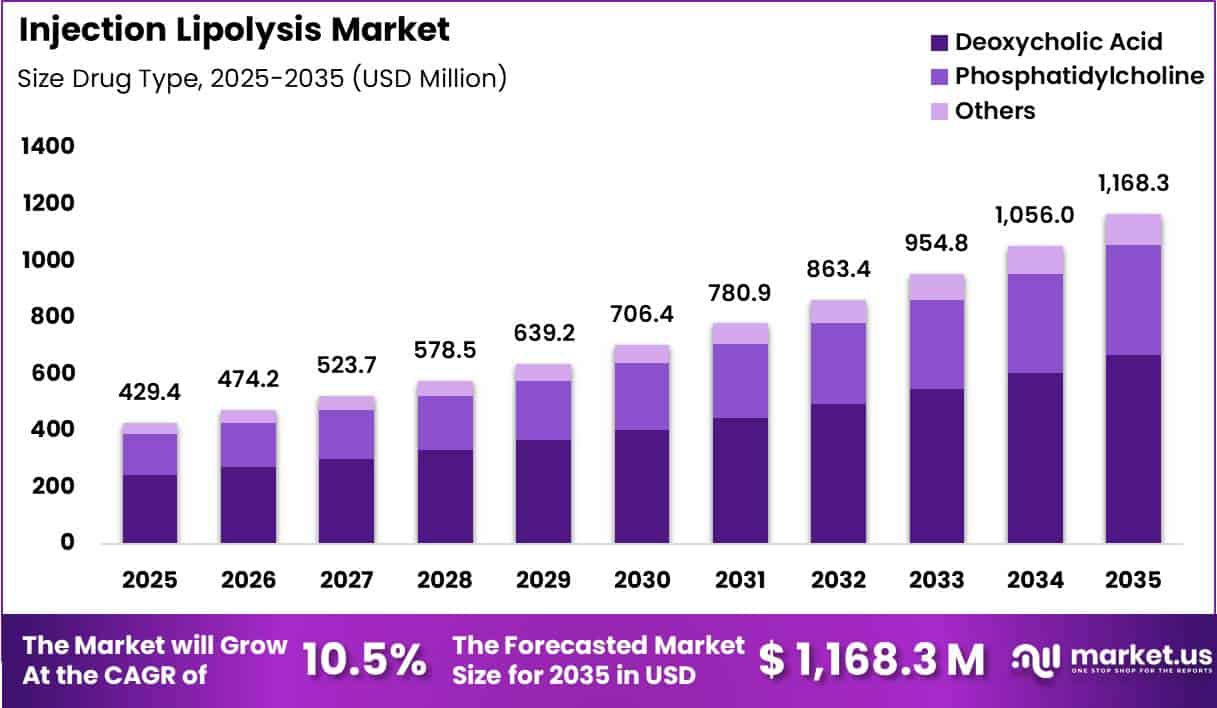
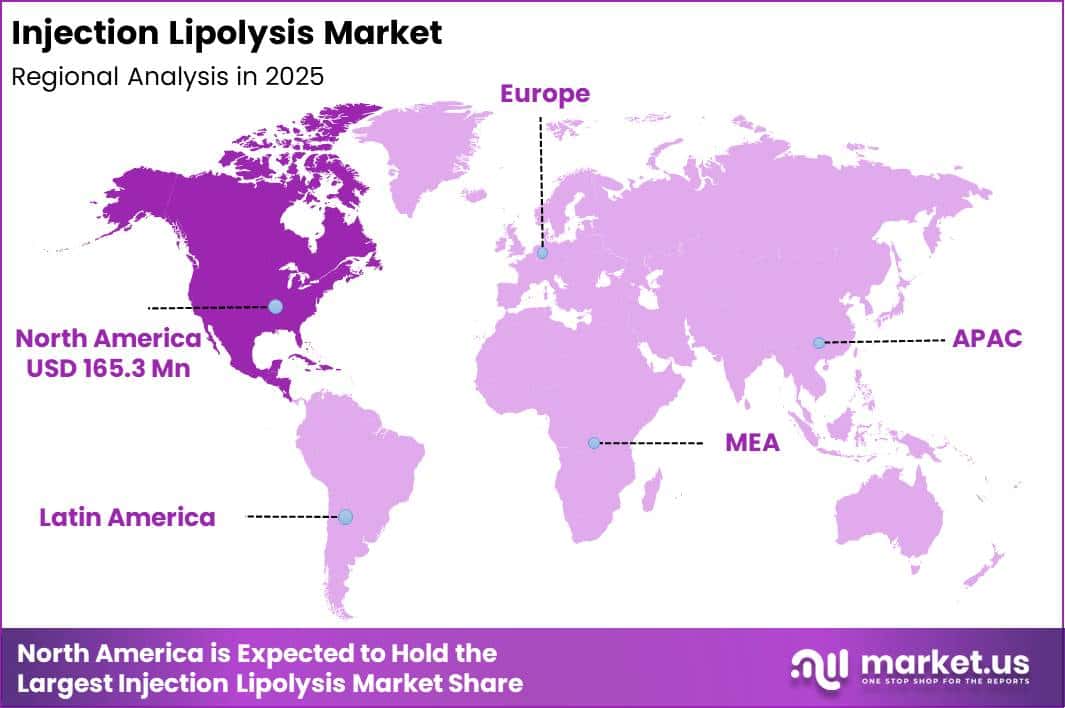
Global Injection Lipolysis Market size is expected to be worth around US$ 1,168.3 Million by 2035 from US$ 429.4 Million in 2025, growing at a CAGR of 10.5% during the forecast period from 2026 to 2035. In 2025, North America led the market, achieving over 38.5% share with a revenue of US$ 165.3 Million.
Injection lipolysis is a minimally invasive aesthetic procedure that uses injectable agents to break down localized fat deposits through the destruction of fat cells. The treatment is primarily used for body contouring applications, including reduction of submental fat, commonly known as a double chin. The procedure involves injecting lipolytic compounds into targeted areas, where active ingredients such as deoxycholic acid help disrupt fat cell membranes and support gradual fat reduction.
The U.S. Food and Drug Administration (FDA) approved KYBELLA (deoxycholic acid injection) in 2015 as the first injectable treatment specifically indicated for improving moderate to severe fullness associated with submental fat in adults. The approved formulation contains deoxycholic acid and is administered through multiple small-volume injections under professional supervision.
Growing consumer interest in non-surgical aesthetic procedures, shorter recovery periods, and demand for targeted fat reduction solutions are supporting adoption of injection-based lipolysis treatments. FDA labeling indicates that Kybella treatment may involve up to 50 injection sites or 10 mL per single treatment session, with repeat treatments performed at intervals of at least one month when clinically appropriate.
The market is witnessing increased focus on product safety, clinical validation, and improved injection techniques as aesthetic healthcare providers expand minimally invasive treatment offerings. Regulatory authorities continue to emphasize the importance of using approved products and trained healthcare professionals, as unapproved fat-dissolving injections have been associated with serious adverse reactions and complications.
Key Takeaways
- Market Size: Global Injection Lipolysis Market size is expected to be worth around US$ 1,168.3 Million by 2035 from US$ 429.4 Million in 2025.
- Market Share: The market is growing at a CAGR of 10.5% during the forecast period from 2026 to 2035.
- Drug Type: Deoxycholic Acid segments dominate the market with a 57.4% share in 2025.
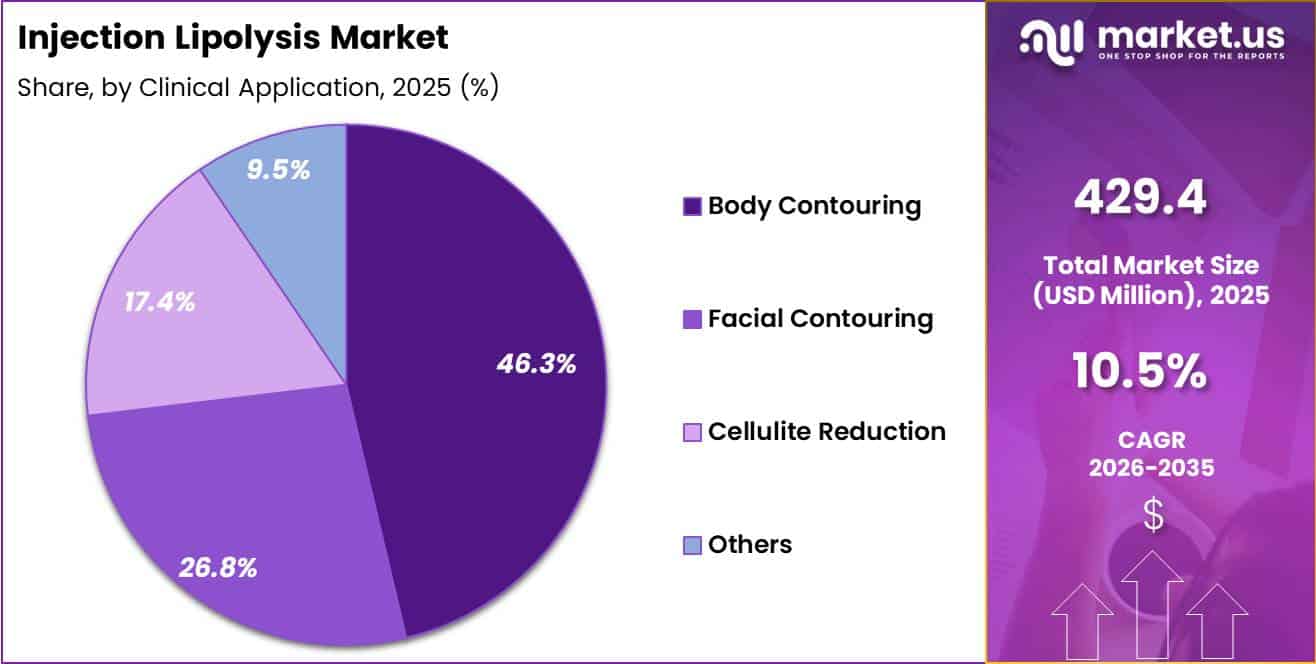
- Clinical Application: Body Contouring segments dominate the market with a 46.3% share in 2025.
- Procedure: Non-surgical segments dominate the market with a 61.4% share in 2025.
- Service Providers: Dermatology & Skin Clinics segments dominate the market with a 32.7% share in 2025.
- Regional Analysis: In 2025, North America led the market, achieving over 38.5% share with a revenue of US$ 165.3 Million.
Drug Type Analysis
Deoxycholic Acid segments dominate the market.
The Injection Lipolysis Market is segmented by drug type into Deoxycholic Acid, Phosphatidylcholine, and Others. Deoxycholic Acid segments dominate the market with a 57.4% share in 2025, supported by its strong clinical adoption, established mechanism for targeted fat reduction, and increasing use in aesthetic procedures such as submental fat reduction. The segment benefits from growing demand for minimally invasive treatments that provide visible contouring results with limited recovery time.
Phosphatidylcholine accounts for 33.2% market share in 2025, driven by its continued utilization in localized fat reduction procedures and combination injectable formulations. The compound has gained attention among aesthetic practitioners due to its historical application in body contouring treatments.
Others contribute 9.4% share in 2025, representing alternative formulations and emerging injectable solutions used in cosmetic fat reduction procedures. Increasing innovation in injectable therapies, rising adoption of non-surgical aesthetic treatments, and expanding availability of specialized cosmetic services are expected to influence future drug type demand.
Clinical Application Analysis
Body Contouring segments dominate the market.
The Injection Lipolysis Market is segmented by clinical application into Body Contouring, Facial Contouring, Cellulite Reduction, and Others. Body Contouring segments dominate the market with a 46.3% share in 2025, driven by increasing demand for targeted fat reduction across areas such as the abdomen, thighs, arms, and flanks. Growing consumer preference for minimally invasive body shaping procedures has accelerated the adoption of injection lipolysis as an alternative to traditional surgical methods.
Facial Contouring holds 26.8% market share in 2025, supported by rising demand for aesthetic enhancement procedures focused on jawline definition, chin fat reduction, and facial profile improvement. Cellulite Reduction accounts for 17.4% share, benefiting from increasing interest in treatments that improve skin appearance and texture.
Others represent 9.5% share in 2025, covering additional cosmetic applications. Expansion of aesthetic clinics, increasing awareness of injectable treatments, and advancements in formulation technologies continue to support growth across clinical applications.
Procedure Analysis
Non-surgical segments dominate the market.
The Injection Lipolysis Market is segmented by procedure into Non-surgical, Surgical, Abdominoplasty, and Liposuction. Non-surgical segments dominate the market with a 61.4% share in 2025, driven by rising patient preference for procedures with minimal downtime, lower invasiveness, and faster recovery compared with surgical alternatives. Injection lipolysis enables targeted fat reduction without incisions, making it increasingly popular among individuals seeking gradual aesthetic improvements.
Surgical procedures continue to maintain demand due to their effectiveness in removing larger fat volumes and achieving more significant body transformation outcomes. Abdominoplasty remains an important procedure segment, particularly among patients requiring removal of excess skin and abdominal fat after major weight changes.
Liposuction continues to be widely adopted because of its established clinical outcomes and ability to treat multiple body areas, although it involves greater procedural complexity. Increasing focus on personalized aesthetic treatments and growing acceptance of minimally invasive solutions are expected to strengthen the role of non-surgical procedures in the Injection Lipolysis Market.
Service Providers Analysis
Dermatology & Skin Clinics segments dominate the market.
The Injection Lipolysis Market is segmented by service providers into Dermatology & Skin Clinics, Hospitals, Plastic Surgery Clinics, Aesthetic Specialty Clinics, and Others. Dermatology & Skin Clinics segments dominate the market with a 32.7% share in 2025, supported by their specialized expertise in injectable aesthetic treatments, patient-focused care, and increasing demand for outpatient cosmetic procedures. These clinics are preferred for personalized treatment plans and advanced skin and body contouring services.
Hospitals contribute to market growth through established medical infrastructure, trained healthcare professionals, and integration of aesthetic services within specialized departments. Plastic Surgery Clinics hold a significant position due to their experience in combining surgical and non-surgical cosmetic procedures, including injection lipolysis treatments.
Aesthetic Specialty Clinics are expanding rapidly as consumers increasingly seek dedicated centers offering advanced cosmetic solutions. Others include wellness centers and emerging aesthetic providers offering injectable fat reduction services. Growing consumer awareness, expansion of cosmetic service networks, and increasing availability of trained practitioners are expected to support service provider growth in the coming years.
Key Market Segments
By Drug Type
- Deoxycholic Acid
- Phosphatidylcholine
- Others
By Clinical Application
- Body Contouring
- Facial Contouring
- Cellulite Reduction
- Others
By Procedure
- Surgical
- Abdominoplasty
- Liposuction
- Non-surgical
By Service Providers
- Hospitals
- Dermatology & Skin Clinics
- Plastic Surgery Clinics
- Aesthetic Specialty Clinics
- Others
Driver
Premium cash-pay economics and repeat-session revenue model.
The category is commercially attractive because it is usually paid out of pocket and often requires multiple sessions, allowing clinics to generate revenue not only from the drug but from consultation, injection time, follow-up, photography, and complementary facial aesthetic services.
Healthline cites average per-treatment costs of about $1,200 to $1,800, while CareCredit cites a national average treatment cost around $1,640 with a range of roughly $1,267 to $3,215, indicating a premium ticket size relative to many routine injectable services.
Because most patients receive 2 to 4 treatments and some require up to 6, total revenue per patient can compound materially, supporting market expansion even if unit patient volumes remain niche versus mainstream neuromodulators. This business model also favors high-income urban clusters where financing tools, subscription-style aesthetic retention programs, and cross-sell into skin tightening or contour maintenance improve lifetime value.
| Driver | (~) % Impact on CAGR Forecast | Geographic Relevance | Impact Timeline |
|---|---|---|---|
| Obesity-led candidate pool expansion | +2.1% | North America core, EU5 urban centers, GCC, China tier-1, India metros | Medium term |
| Minimally invasive chin-contouring shift | +1.8% | U.S., Canada, UK, Germany, France, South Korea, Japan | Short term |
| Deoxycholic acid protocol standardization in med-aesthetic clinics | +1.4% | North America core, Western Europe, Australia, selective APAC private clinics | Short term |
| Social-media-driven facial profile optimization demand | +1.2% | U.S., UK, South Korea, Japan, UAE, Southeast Asia private-pay hubs | Short term |
| Premium cash-pay economics and repeat-session revenue model | +1.0% | U.S. core, Canada, EU private aesthetics, GCC | Medium term |
| Regulatory filtering against unapproved fat-dissolving injectables | +0.9% | U.S. core, EU, developed APAC; spill-over to online cross-border channels | Medium term |
Challenge
Cross border regulatory fragmentation in injection lipolysis product approvals.
Regulatory fragmentation stems from the difference between tightly defined approvals for deoxycholic acid in markets such as the United States, where it is restricted to submental fat, and more variable enforcement environments where PC DC mixtures and mesotherapy type injections are used more broadly. This creates a compliance patchwork that increases operating complexity and slows cross border scaling.
In the United States, regulators restrict use to licensed professionals and highlight risks such as scarring, cyst formation, and painful nodules, which narrows usage to regulated clinics and raises liability related costs.
In Europe, Latin America, and parts of the Middle East, more flexible or uneven enforcement allows broader off label use, creating divergent standards for labeling, pharmacovigilance, and marketing across regions.
This lack of harmonization increases regulatory burden, raises compliance staffing needs, and delays multi country launches, contributing an estimated 0.9% point drag on CAGR. Over time, convergence may improve through clearer indications, real world evidence, and standardized training, but near term fragmentation remains a structural constraint on global scaling.
| Challenge | (~) % CAGR Friction Drag | Geographic Relevance | Mitigation Horizon |
|---|---|---|---|
| Safety signal volatility | -1.3% | US, EU, LatAm urban | Medium term (2-4 years) |
| Regulatory fragmentation | -0.9% | US, EU, Middle East | Long term (≥ 4 years) |
| Skilled injector scarcity | -1.1% | North America, APAC metros | Medium term (2-4 years) |
| Adverse-event data opacity | -0.7% | Global private clinics | Long term (≥ 4 years) |
| Input and device cost drift | -0.8% | EU, APAC import-reliant | Medium term (2-4 years) |
| Non-surgical alternative crowding | -1.0% | Global tier-1 cities | Long term (≥ 4 years) |
Restraints
Competing non surgical fat reduction technologies eroding injectable demand.
The injection lipolysis market is structurally constrained by competition from expanding non surgical fat reduction technologies such as cryolipolysis, radiofrequency, high intensity focused ultrasound, and laser based lipolysis.
These device based platforms have scaled significantly over the past decade and are increasingly positioned as multi area treatment systems covering the abdomen, flanks, thighs, and arms, while injectables remain more limited to small focal areas such as submental fat.Industry data from ISAPS indicates continued growth in body contouring procedures, with a large share driven by energy based devices rather than injectables.
For clinics that have already invested in capital equipment, the marginal cost of device based treatments is often lower than injectable procedures, which rely on recurring consumable and drug costs. This creates a strong incentive to prioritize device utilization.
As a result, injection lipolysis is increasingly positioned as an adjunct or niche option, particularly for small refinements or patients not suited for devices. Consumer preference also favors fewer session, device based protocols with visible outcomes over multi session injectable regimens. Overall, this competitive substitution effect is a structural headwind to injectable demand growth.
| Restraint | (~) % Impact on CAGR Forecast | Geographic Relevance | Impact Timeline |
|---|---|---|---|
| Safety signals and adverse events | -2.2% | North America, EU, East Asia | Short–Medium term |
| Regulatory and labeling constraints | -1.8% | North America, EU/UK, GCC | Medium–Long term |
| Limited indications and procedure economics | -1.5% | North America core, EU-5, affluent APAC | Medium term |
| Competition from alternative fat-reduction modalities | -1.3% | North America, EU, East Asia, LatAm Tier-1 | Medium–Long term |
| Practitioner skill gaps and medico-legal risk | -1.1% | Emerging APAC, LatAm, MEA urban | Short–Medium term |
| Consumer trust, obesity dynamics, and demand volatility | -0.9% | Global obesity hotspots | Long term |
Opportunity
Multi zone injection lipolysis expansion into broader body contouring demand.
Expanding injection lipolysis beyond the current chin focused indication into multi zone micro contouring of arms, bra rolls, peri axillary fat, small abdominal areas, and lipomas represents a meaningful white space. Current guidelines and pivotal trials largely restrict deoxycholic acid to submental fat, limiting billable volume per patient to a small number of low volume sessions.
However, small clinical series already show feasibility in areas such as the upper arms at diluted concentrations, though these uses remain off label and fragmented.Given the large global pool of overweight and obese adults, even very low penetration of off face contouring could translate into substantial incremental procedure volume over the next decade.
As manufacturers generate targeted clinical and post marketing data on safety and technique, regulators and professional societies could gradually broaden labels and formalize treatment grids for additional body areas. This would legitimize higher per patient usage and increase treatment intensity versus a chin only model.
Because this pathway depends on clinical evidence and regulatory evolution, it is not reflected in baseline forecasts. If multi zone use reaches a modest share of total cases by the mid 2030s, it could add roughly 2% points to long term growth, particularly in urban, high income markets where non surgical body contouring demand is already strong.
| Opportunity | (~) % Potential CAGR Upside | Geographic Relevance | Execution Window |
|---|---|---|---|
| Multi-zone body indications beyond submental | +2.0% | North America, EU, APAC urban | Medium term (2-4 years) |
| Protocol standardization and franchise models | +1.5% | North America core, GCC, Latin America | Short term (≤ 2 years) |
| Metabolic-aesthetic combo pathways | +1.8% | US, EU5, East Asia | Medium term (2-4 years) |
| AI-guided dosing and outcome analytics | +1.2% | Tech-mature markets (US, EU, Korea) | Long term (≥ 4 years) |
| Emerging-market tiered pricing and task-shifting | +2.3% | APAC emerging, LatAm, Middle East, Africa | Medium–Long (2-6 years) |
| New formulations and at-home adjuncts | +1.0% | Global premium segments | Long term (≥ 4 years) |
Regional Analysis
North America leads the Injection Lipolysis Market.
North America dominated the Injection Lipolysis Market in 2025, accounting for over 38.5% of the global market share, with revenue reaching approximately US$ 165.3 million. The region’s leading position is supported by the rising demand for minimally invasive aesthetic procedures, increasing consumer preference for non-surgical body contouring solutions, and the growing adoption of injectable fat reduction treatments among dermatology and cosmetic clinics.
The presence of advanced healthcare infrastructure, a high number of aesthetic practitioners, and strong awareness regarding cosmetic enhancement procedures further contribute to market expansion. Increasing investments in aesthetic medicine technologies and the availability of approved injectable treatments have strengthened clinical adoption across the United States and Canada.
Europe represents another significant market, driven by growing demand for facial rejuvenation and body sculpting procedures, favorable reimbursement-independent private aesthetic practices, and increasing acceptance of cosmetic treatments among aging populations. Countries such as Germany, the United Kingdom, France, and Italy continue to witness higher procedure volumes due to established cosmetic healthcare networks.
The Asia-Pacific region is expected to experience substantial growth due to rising disposable incomes, expanding medical tourism, increasing awareness of aesthetic treatments, and rapid development of cosmetic healthcare facilities. Emerging economies are witnessing greater adoption of injectable lipolysis as consumers seek affordable alternatives to surgical fat reduction procedures.
Latin America and the Middle East & Africa are also showing steady growth, supported by increasing cosmetic procedure demand, improving healthcare access, and expanding aesthetic service providers. These regions are expected to provide new growth opportunities as awareness and availability of injection lipolysis treatments continue to increase.
Key Regions and Countries
North America
- The US
- Canada
Europe
- Germany
- France
- The U.K.
- Italy
- Spain
- Russia & CIS
- Rest of Europe
Asia Pacific
- China
- India
- Japan
- South Korea
- ASEAN
- Australia & New Zealand
- Rest of Asia Pacific
Middle East & Africa
- GCC
- South Africa
- Rest of Middle East & Africa
Latin America
- Brazil
- Mexico
- Rest of Latin America
Key Player Analysis
The Injection Lipolysis Market is moderately consolidated, with leading aesthetic medicine companies competing through product innovation, clinical advancements, and expansion of minimally invasive treatment solutions.
Competitive dynamics are influenced by investments in research and development, strategic collaborations with aesthetic clinics, practitioner-focused training programs, and integration of injectable treatments with broader cosmetic care ecosystems. Companies are focusing on improving treatment safety, enhancing patient outcomes, and developing complementary aesthetic portfolios to strengthen their market position.
Among the key players, Merz Pharma GmbH & Co. KGaA, Galderma S.A., Bausch Health Companies Inc., Allergan plc, and Cutera, Inc. represent major participants driving market growth. Merz Pharma GmbH & Co. KGaA focuses on innovation in aesthetic medicine through advanced treatment solutions and global clinical networks.
Galderma S.A. emphasizes R&D investment, aesthetic product expansion, and partnerships with healthcare professionals to enhance adoption. Bausch Health Companies Inc. strengthens its presence through diversified aesthetic offerings and integrated treatment solutions.
Allergan plc leverages its established aesthetics ecosystem, product innovation capabilities, and practitioner engagement strategies to support market growth. Cutera, Inc. focuses on energy-based aesthetic technologies and integrated solutions that complement minimally invasive procedures.
These companies compete through continuous product development, ecosystem-based strategies, and workflow integration with clinics and aesthetic providers. Future competition is expected to center on advanced formulations, improved treatment protocols, and expanded global access to aesthetic procedures.
Top Key Players
- Merz Pharma GmbH & Co. KGaA
- Thrive Bioscience
- Syneron Medical Ltd.
- Bausch Health Companies Inc.
- Galderma S.A.
- Cutera, Inc.
- Lumenis Ltd.
- Cynosure, Inc.
- Venus Concept Ltd.
- Solta Medical, Inc.
- Prollenium Medical Technologies
- Allergan plc
- Huons Co., Ltd.
- Revitacare SAS
Recent Developments
- In April 2026, Galderma S.A. launched ALASTIN Signature Practices in partnership with leading aesthetic clinics to strengthen its regenerative aesthetics ecosystem. The initiative focuses on integrating ALASTIN’s skincare portfolio into dermatology and medical aesthetics practices, supporting personalized patient treatment pathways. This development highlights Galderma’s strategy of expanding beyond injectable products by building stronger clinic relationships and improving end-to-end aesthetic care solutions.
- In April 2026, Venus Concept Ltd. completed a short-form merger transaction following a common stock sale led by affiliates of Madryn Asset Management. The restructuring reflects the company’s focus on financial repositioning and strengthening its operational foundation in the medical aesthetics technology segment.
- In December 2025, Bausch Health Companies Inc.’s aesthetic business, Solta Medical, acquired Wuhan Shibo Zhenmei Technology Co., Ltd. (Shibo Group) to strengthen its China market presence. The acquisition converted a long-term distribution relationship into direct operational ownership, allowing Solta Medical to improve customer access, local support, and commercialization of aesthetic technologies in one of the fastest-growing aesthetics markets.
- In November 2025, Merz Pharma GmbH & Co. KGaA expanded its medical aesthetics portfolio with a new Ultherapy PRIME indication for arms and abdomen. The expansion increased the treatment application range for its non-invasive body contouring technology, supporting broader adoption among aesthetic practitioners seeking minimally invasive alternatives.
Report Scope
| Report Features | Description |
|---|---|
| Market Value (2025) | US$ 429.4 Million |
| Forecast Revenue (2035) | US$ 1,168.3 Million |
| CAGR (2026-2035) | 10.5% |
| Base Year for Estimation | 2025 |
| Historic Period | 2020-2024 |
| Forecast Period | 2026-2035 |
| Report Coverage | Revenue Forecast, Market Dynamics, Competitive Landscape, Recent Developments |
| Segments Covered | By Drug Type (Deoxycholic Acid, Phosphatidylcholine, Others), By Clinical Application (Body Contouring, Facial Contouring, Cellulite Reduction, Others), By Procedure (Surgical (Abdominoplasty, Liposuction), Non-surgical), By Service Providers (Hospitals, Dermatology & Skin Clinics, Plastic Surgery Clinics, Aesthetic Specialty Clinics, Others) |
| Regional Analysis | North America – The US, Canada; Europe – Germany, France, U.K., Italy, Spain, Russia & CIS, Rest of Europe; Asia Pacific – China, India, Japan, South Korea, ASEAN, Australia & New Zealand, Rest of Asia Pacific; Middle East & Africa – GCC, South Africa, Rest of Middle East & Africa; Latin America – Brazil, Mexico, Rest of Latin America |
| Competitive Landscape | Merz Pharma GmbH & Co. KGaA, Thrive Bioscience, Syneron Medical Ltd., Bausch Health Companies Inc., Galderma S.A., Cutera, Inc., Lumenis Ltd., Cynosure, Inc., Venus Concept Ltd., Solta Medical, Inc., Prollenium Medical Technologies, Allergan plc, Huons Co., Ltd., Revitacare SAS |
| Customization Scope | Customization for segments, region/country-level will be provided. Moreover, additional customization can be done based on the requirements. |
| Purchase Options | We have three licenses to opt for: Single User License, Multi-User License (Up to 5 Users), Corporate Use License (Unlimited User and Printable PDF) |





































