


Report Overview
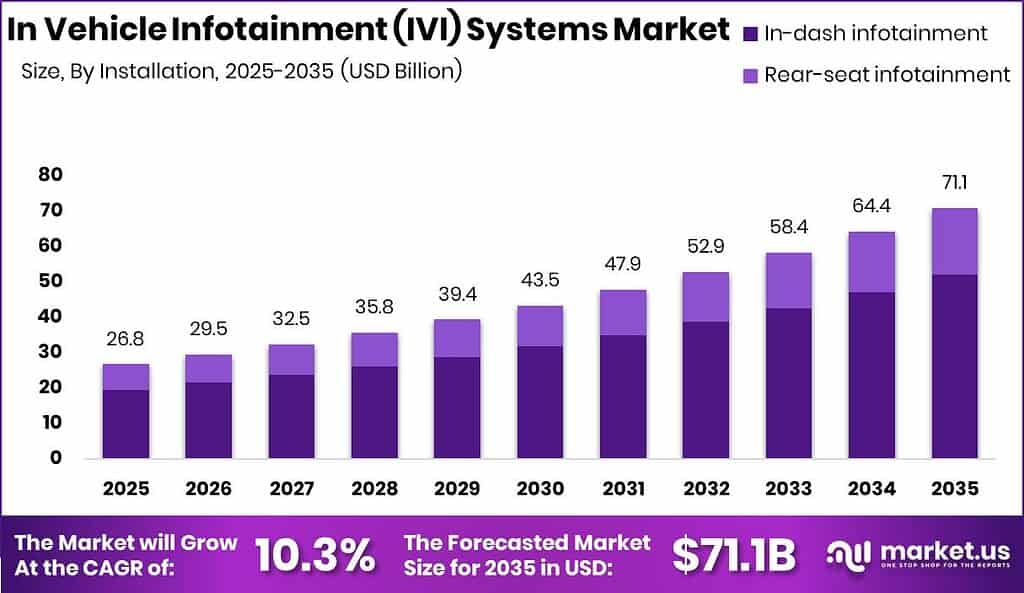
Global In Vehicle Infotainment (IVI) Systems Market size is expected to be worth around USD 71.10 Billion by 2035 from USD 26.80 Billion in 2025, growing at a CAGR of 10.3% during the forecast period 2026 to 2035.
Therefore, the market covers hardware, software, and connectivity layers that deliver media, navigation, communication, and vehicle data inside the cabin. Structure splits across components, operating systems, installation positions, and vehicle classes. Buyers range from passenger OEMs to commercial fleets that treat the cockpit as a software-defined product surface.
Key Takeaways
- The In Vehicle Infotainment (IVI) Systems market is valued at USD 26.80 Billion in 2025 and is projected to reach USD 71.10 Billion by 2035.
- The market expands at a CAGR of 10.3% during 2026 to 2035.
- Display units lead the By Component segment with a 41.1% share.
- Android-based IVI platforms lead growth in the By Operating System segment with a 38.4% share.
- In-dash infotainment leads the By Installation segment with a 73.2% share.
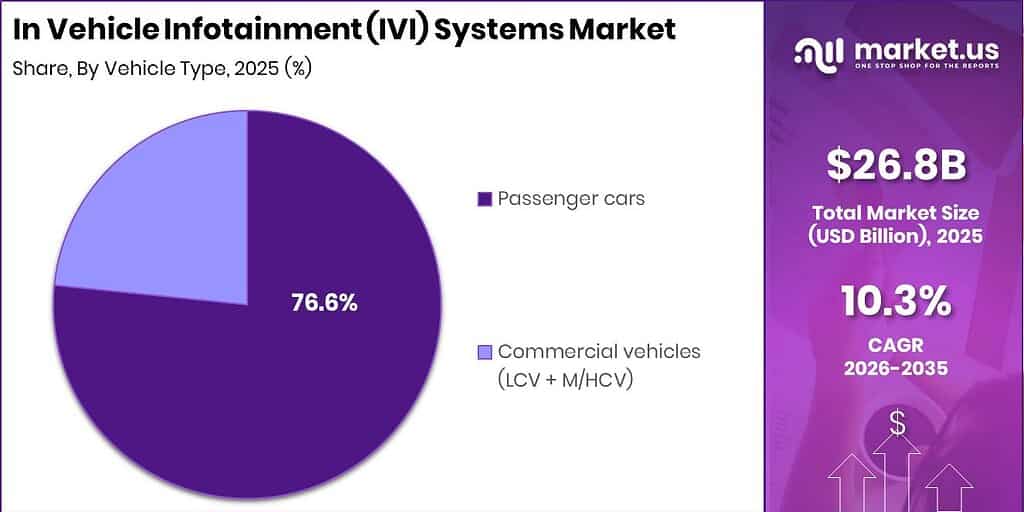
- Passenger cars lead the By Vehicle Type segment with a 76.6% share.
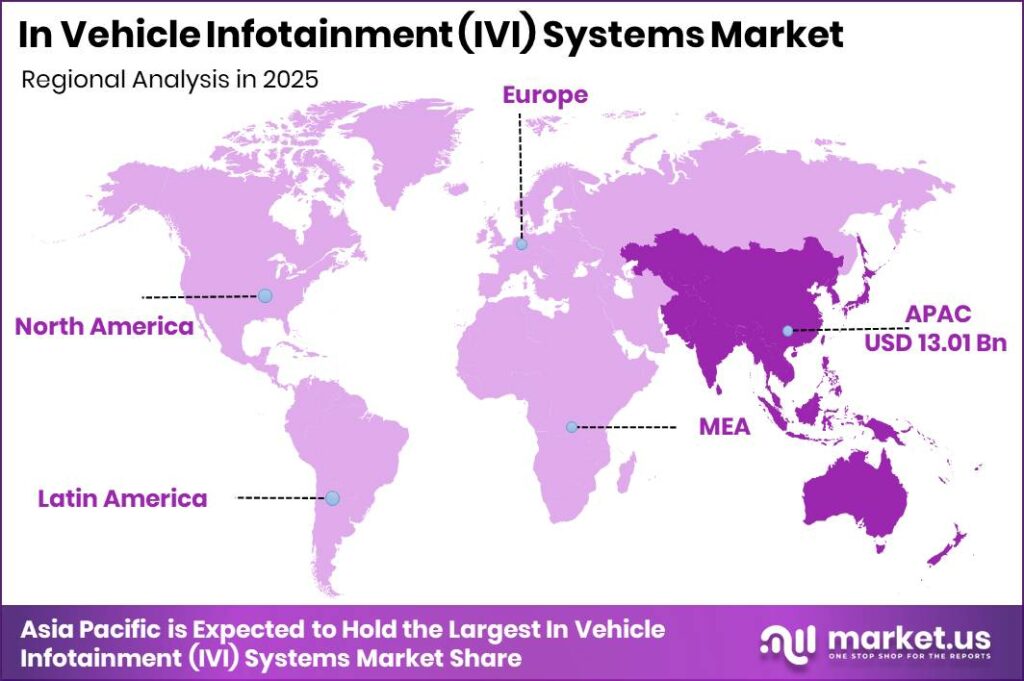
- Asia Pacific anchors regional demand through the largest share of global vehicle production.
As per our research, multimedia system problems fell to 42.3 problems per 100 vehicles in 2025 from 44.1 PP100 in 2024. This improvement lowers warranty risk for OEMs that standardize mature IVI stacks. Consequently, suppliers that prove lower field failure rates win longer platform contracts across multi-year vehicle programs.
Based on J.D. Power data, 46% of drivers who reported distraction-related problems named the infotainment system or touchscreen as the source. This finding raises regulatory and brand risk for complex HMI designs. OEMs that simplify control layouts and pair touch with physical backups protect residual values and reduce early ownership complaints.
This means end-use growth in connected passenger and commercial fleets lifts demand for multi-screen cockpits and always-on connectivity modules. Higher vehicle electronics content per unit converts directly into larger IVI bill-of-materials spend. Investors should track software attach rates, not only display unit shipments, when sizing addressable revenue.
Component Analysis
Display units dominates with 41.1% due to multi-screen cockpit specification growth.
In 2025, Display units held a dominant market position in the By Component segment of In Vehicle Infotainment (IVI) Systems Market, with a 41.1% share. OICA data show global vehicle production reached 96.4 million units in 2025, up from 92.7 million in 2024. Each incremental unit adds cockpit display content. Suppliers that scale automotive-grade panels capture the largest hardware wallet share as OEMs widen center and passenger screens.
Communication modules link smartphones, cloud services, and vehicle networks inside the cabin stack. Asia-Pacific produced about 59.2 million vehicles in 2025, more than 61% of world output. This concentration pulls high volumes of telematics and connectivity silicon into regional assembly lines. Vendors with certified modem and antenna platforms lock multi-year OEM design wins.
Navigation is the fastest-growing component line as embedded maps and real-time routing replace phone-only guidance. China alone produced 34.53 million vehicles in 2025, creating dense demand for localized map engines. This creates recurring map-update and services revenue beyond one-time hardware sales. Map and GNSS partners that secure native OS slots gain durable aftermarket cash flow.
Operating System Analysis
Android-based IVI platforms dominates with 38.4% due to OEM shift to licensed stacks.
In 2025, Android-based IVI platforms held a dominant market position in the By Operating System segment of In Vehicle Infotainment (IVI) Systems Market, with a 38.4% share. Google stated Android Auto compatibility exceeded 250 million vehicles worldwide. This installed base pulls app developers toward Android-first cabin targets. Platform owners that monetize app stores convert OS share into recurring services margin.
QNX-based systems remain the safety-certified choice for mixed-criticality cockpit controllers. Global vehicle sales reached 99.8 million units in 2025. Premium and regulated programs still specify certified RTOS layers beside consumer UI shells. This reflects continued dual-OS architectures where QNX guards safety domains while Android hosts apps.
Linux-based systems serve cost-sensitive and custom OEM builds that avoid full commercial OS fees. Europe produced 17.2 million vehicles in 2025 while sales held near 18.63 million. Regional OEMs with heavy legacy code often retain Linux middleware. Suppliers offering long-term support contracts win where total cost of ownership beats brand-name OS licenses.
Google also reported more than 100 vehicle models from 16 automotive brands with Google Built-in. This signals embedded Android Automotive scale beyond phone projection alone. Chip and middleware vendors aligned to that stack gain preferred-supplier status on new EV platforms.
Installation Analysis
In-dash infotainment dominates with 73.2% due to primary driver interface placement.
In 2025, In-dash infotainment held a dominant market position in the By Installation segment of In Vehicle Infotainment (IVI) Systems Market, with a 73.2% share. Android Automotive OS with Google built-in was available in more than 50 vehicle models in 2025. Most of those deployments center on the main dash cluster and center stack. Tier-1s that own dash domain controllers control the highest-value integration seat.
Rear-seat infotainment is the fastest-growing installation as families and ride-hail fleets demand passenger screens. India produced 6.49 million vehicles in 2025 with record domestic passenger sales above 4.6 million. Rising multi-occupant use cases expand second-row media demand. Content and seat-back display suppliers gain a second attach point per vehicle.
In-dash systems still absorb the bulk of navigation, voice, and vehicle settings traffic. The United States produced 10.24 million vehicles and sold 16.7 million in 2025. High sales relative to production keep premium dash features central to retail mix. OEMs that refresh dash UX faster than model cycles protect brand perception in quality surveys.
Vehicle Type Analysis
Passenger cars dominates with 76.6% due to high retail volume and feature density.
In 2025, Passenger cars held a dominant market position in the By Vehicle Type segment of In Vehicle Infotainment (IVI) Systems Market, with a 76.6% share. OICA figures place world motor vehicle output at 96.4 million units in 2025. Passenger programs absorb most multi-display and AI cockpit spend. Suppliers that prioritize car platforms secure scale before commercial niches mature.
Commercial vehicles spanning LCV and M/HCV form the fastest-growing vehicle class for IVI. Americas production stood near 18.74 million vehicles in 2025 while regional sales reached 24.86 million. Fleet buyers now specify connected cabins for routing, compliance, and driver welfare. This signals rising telematics-plus-cabin packages on trucks and vans.
Passenger car IVI roadmaps emphasize app ecosystems and large glass. China new-energy vehicle production hit 16.626 million units in 2025, up 29%. EV makers use digital cockpits as a core differentiator. Component vendors tied to EV platforms ride faster content growth than ICE-only lines.
Key Market Segments
By Component
- Display units
- Communication
- Navigation
By Operating System
- Android-based IVI platforms
- QNX-based systems
- Linux-based systems
By Installation
- In-dash infotainment
- Rear-seat infotainment
By Vehicle Type
- Passenger cars
- Commercial vehicles (LCV + M/HCV)
Regional Analysis
Asia Pacific Dominates the In Vehicle Infotainment (IVI) Systems Market, Supported by Over 61% of Global Vehicle Production and Output Near 59.2 Million Units
Asia Pacific leads IVI demand because vehicle assembly and electronics supply chains concentrate there. OICA reports Asia-Pacific production rose 7.6% to about 59.2 million vehicles in 2025. China added roughly 3.25 million units to reach 34.53 million produced. This scale pulls display, SoC, and OS design wins into the region first.
North America and Europe remain high-value feature markets even where unit growth is softer. US sales reached 16.7 million vehicles in 2025 against 10.24 million produced. Europe production slipped 0.8% to 17.2 million while sales eased 0.4% to 18.63 million. Premium software, AI voice, and cybersecurity spend stay elevated in these fleets.
As a result, Latin America and Middle East and Africa add volume from rising motorization rather than peak feature density. Brazil output reached 2.64 million vehicles, and Africa sales jumped 22% to 1.29 million. Entry IVI and smartphone-mirroring packages fit budget trims in these markets. Global suppliers that tier feature packs by price band expand coverage without over-engineering low-ASP vehicles.
Key Regions and Countries
North America
- US
- Canada
Europe
- Germany
- France
- The UK
- Spain
- Italy
- Rest of Europe
Asia Pacific
- China
- Japan
- South Korea
- India
- Australia
- Rest of APAC
Latin America
- Brazil
- Mexico
- Rest of Latin America
Middle East and Africa
- GCC
- South Africa
- Rest of MEA
Market Dynamics
Market Opportunity Analysis - Rear-seat, commercial, and services layers still lag core dash hardware penetration.
Rear-seat infotainment remains the fastest-growing installation while in-dash still holds 73.2% share. Most OEM spend still prioritizes the driver stack. This leaves second-row media and controls under-specified on volume trims. New entrants that ship modular rear-seat kits for family and ride-hail fleets can win attach without displacing dash incumbents.
Commercial vehicles are the fastest-growing vehicle type against passenger cars at 76.6% share. Fleet cabins still trail cars on multi-screen and app depth. Routing, compliance logging, and driver wellness create distinct software needs. Suppliers that package rugged IVI with fleet telematics open a channel cars-focused rivals undervalue.
By contrast, navigation is the fastest-growing component while display units already hold 41.1%. Map and services revenue compounds after the screen is sold. Many programs still ship thin embedded navigation. Vendors that bundle live traffic, EV routing, and paid map updates convert hardware wins into multi-year subscriptions.
Android-based platforms at 38.4% share still leave large QNX and Linux fleets outside full app-store economics. Those vehicles rarely activate paid cabin services. Middleware firms that bridge app catalogs onto mixed OS cockpits unlock monetization without forcing a full OS rip-and-replace. Early movers set revenue-share terms before OEMs standardize.
Technology and Innovation Landscape - High-compute cockpits, privacy gaps, and audio efficiency redefine IVI value.
As per our research, Mahindra Snapdragon Cockpit systems delivered computing capability above 230,000 DMIPS for infotainment and vehicle-management loads. That headroom enables AI voice, multi-display graphics, and concurrent vehicle services on one domain controller. Tier-1s that design around this class of silicon reduce ECU count and wiring cost. Investors should favor platforms that publish clear DMIPS and thermal budgets for multi-screen EVs.
Data from a 2025 embedded audio case study show system optimization cut audio processing time by more than 64%. Faster packet handling stabilizes media and voice under load. This signals that software tuning now moves quality metrics as much as new speakers do. Suppliers selling optimized audio stacks can raise ASP without adding heavy mechanical content.
A peer-reviewed Android Automotive study found vehicle speed sampled near 25 Hz on evaluated systems. High-frequency vehicle data feeds richer apps but widens the privacy surface. OEMs that expose clean, documented signals attract developers while retaining control. Platform owners that hide data behind unclear policies slow third-party innovation.
The same study found one OEM disclosed only 110 vehicle properties, or 13.02% of properties found in static analysis. Thin disclosure limits app capability and raises trust concerns with regulators. Transparent property catalogs become a competitive feature for developer ecosystems. Brands that publish broader, audited APIs pull more cabin software investment.
Drivers
Automakers are moving from closed proprietary IVI stacks to licensed Android Automotive OS builds. Google built-in expansions across Acura, Buick, Honda, and BYD lines through 2025 and into 2026 accelerate that shift. The business model changes from a one-time software fee toward app-store and subscription revenue per vehicle. This means OEMs can capture recurring income after the car leaves the factory.
Android Automotive penetration is tracked from about 1% of new vehicles in 2022 toward nearly 20% of new production by 2027. That unit shift underpins the estimated +2.1% CAGR contribution from OS adoption. Reference designs cut integration lead times from roughly 18 months to under 12 months and trim supplier licensing cost by about 15% to 20%. Large-display cockpits, smartphone mirroring, EV differentiation, and generative AI voice add further short-term uplift.
| Driver | (~) % Impact on CAGR Forecast | Geographic Relevance | Impact Timeline |
|---|---|---|---|
| Android Automotive OS adoption by OEMs | +2.1% | Global (North America, Europe, China) | Short term (2 years or less) |
| Rising large-display and multi-screen cockpit specs | +1.6% | China, Europe | Short term (2 years or less) |
| Smartphone mirroring and connectivity standardization | +1.2% | Global | Short term (2 years or less) |
| EV cockpit differentiation strategy | +1.0% | China, North America | Short term (2 years or less) |
| Generative AI voice assistant integration | +0.8% | North America, Europe | Short term (2 years or less) |
Restraints
Automotive-grade system-on-chip capacity remains tight in Taiwan and South Korea foundries. Higher-margin data-center and consumer orders still crowd out auto nodes even after AEC-Q100 cycles of 12 to 24 months. Smart-cockpit SoC lead times stretched to 26 to 52 weeks through 2025 and into 2026. Tier-1s delay multi-display launches and freeze some budget infotainment SKUs as a direct result.
Margin pressure follows the chip shortage. Suppliers report gross margin erosion of about 200 to 350 basis points on infotainment hardware from spot premiums. OEMs also redirect scarce silicon toward ADAS and powertrain modules ahead of cabin electronics. High vehicle financing rates, data localization rules, budget segment cost caps, and tariffs on imported automotive electronics add further short-term drag on IVI attach rates.
| Restraint | (~) % Impact on CAGR Forecast | Geographic Relevance | Impact Timeline |
|---|---|---|---|
| Automotive-grade SoC supply constraints | -1.8% | Global (Taiwan, South Korea dependency) | Short term (2 years or less) |
| High interest rate financing on vehicle purchases | -1.1% | North America, Europe | Short term (2 years or less) |
| Regional data localization and cybersecurity mandates | -0.9% | China, European Union | Short term (2 years or less) |
| Entry-level and budget vehicle segment cost caps | -0.7% | India, Southeast Asia, Latin America | Short term (2 years or less) |
| Tariff escalation on imported automotive electronics | -0.6% | United States | Short term (2 years or less) |
Challenges
Software-defined vehicle roadmaps outpace the supply of engineers skilled in automotive middleware, AUTOSAR adaptive stacks, and Android Automotive layers. Industry bodies estimate a global shortfall above 60,000 qualified embedded and automotive software engineers as of 2026. Senior cockpit software roles take 4 to 6 months to fill. Loaded engineering pay has risen about 12% to 18% year over year in hubs such as Bengaluru, Munich, and Detroit.
This talent gap raises operating expense even as firms offshore work and expand university pipelines. Low-code toolchains from chipset vendors become a partial bridge over a 2 to 4 year horizon. Cybersecurity surface growth, legacy OEM software debt, weak OTA coverage in low-connectivity regions, and driver distraction rules add medium-term friction. Firms that productize secure update pipelines and simplified HMI can turn compliance spend into a paid service line.
| Challenge | (~) % CAGR Friction Drag | Geographic Relevance | Mitigation Horizon |
|---|---|---|---|
| Embedded automotive software talent shortage | -0.9% | Global (North America, Europe, India) | Medium term (2 to 4 years) |
| Cybersecurity vulnerability surface expansion | -0.7% | Global | Medium term (2 to 4 years) |
| Fragmented OEM software architecture legacy debt | -0.6% | Europe, Japan | Medium term (2 to 4 years) |
| OTA update infrastructure reliability gaps | -0.5% | Global (rural/low-connectivity regions) | Medium term (2 to 4 years) |
| Driver distraction regulatory scrutiny | -0.4% | European Union, United States | Medium term (2 to 4 years) |
Opportunities
In-car app stores and paid subscriptions remain largely unexploited even where Android Automotive is already shipping. Fewer than an estimated 15% of equipped vehicles activate paid in-car app subscriptions as of 2026. Smartphone app-store take rates of 15% to 30% show the economic model that automotive could copy. Capturing even part of that structure could lift infotainment gross margins by about 400 to 600 basis points versus hardware-only markup.
This creates a clear early-mover race to build payment rails, third-party app catalogs, and revenue-share deals. Cost per vehicle software amortization could fall roughly 8% to 12% as recurring fees offset licenses. Budget-segment upgrades in India, Southeast Asia, and Latin America, plus fleet retrofit, in-vehicle commerce, and cockpit software M&A, widen the same monetization path. Players that execute subscriptions first lock user data and switching costs before rivals catch up.
| Opportunity | (~) % Potential CAGR Upside | Geographic Relevance | Execution Window |
|---|---|---|---|
| In-car app store and subscription monetization | +2.0% | Global | Medium term (2 to 4 years) |
| Emerging market budget-segment infotainment upgrade cycle | +1.4% | India, Southeast Asia, Latin America | Medium term (2 to 4 years) |
| Aftermarket and fleet retrofit infotainment integration | +0.9% | Global | Long term (4 years or more) |
| In-vehicle commerce and advertising monetization | +0.8% | North America, China | Long term (4 years or more) |
| Cross-brand M&A consolidation of cockpit software vendors | +0.6% | Global | Long term (4 years or more) |
Key Company Insights
Harman International positions around software-defined cabin stacks and ready-to-integrate automotive platforms for global OEMs. In September 2025 the firm deepened silicon partnership work aimed at generative AI in-cabin experiences and contextual voice. This approach ties content and personalization layers to high-performance cockpit compute. Rivals without equal software depth risk losing software margin even if they still win display hardware.
Panasonic Corporation advances cockpit domain controllers and full IVI platforms for volume OEMs. In January 2025 Panasonic Automotive Systems expanded work with Qualcomm Technologies on Snapdragon Cockpit Elite for AI multi-display cockpits. Figures from J.D. Power show touchscreen and digital display issues at 4.2 PP100 in 2025, up from 4.0. Suppliers that pair faster silicon with proven display reliability reduce OEM quality exposure on large-glass programs.
Key Players
- Harman International
- Panasonic Corporation
- Continental AG
- Robert Bosch GmbH
- Denso Corporation
- Visteon Corporation
- LG Electronics Inc.
- Alpine Electronics
- Pioneer Corporation
- JVCKENWOOD Corporation
- Sony Corporation
- Aptiv PLC
- Hyundai Mobis Co., Ltd.
- Clarion / FORVIA Faurecia
- Garmin Ltd.
Recent Developments
- September 2025: HARMAN and Qualcomm announced a strategic collaboration to integrate HARMAN Ready automotive software with the Snapdragon Cockpit Elite platform, delivering generative AI powered in-cabin experiences, contextual voice interaction, and personalized infotainment capabilities.
- March 2026: Panasonic Automotive Systems announced that its new in-vehicle infotainment platform debuted in the 2026 Toyota RAV4, providing faster processing, personalized user interfaces, cloud connectivity, and future-ready software architecture.
Geopolitical Impact Analysis
According to the WTO, world merchandise trade volume growth of about 2.4% in 2025 is set to slow toward roughly 0.5% in 2026 as tariff front-loading fades. Automotive electronics and display modules sit inside that trade slowdown. This means IVI bill-of-materials costs rise when US and regional tariffs hit imported cockpit semiconductors and panels. OEMs that dual-source SoCs outside single-country foundry corridors protect launch timing.
Figures from OICA show Americas production down 2.1% to 18.74 million vehicles in 2025 while sales rose 2.9% to 24.86 million. That gap increases cross-border vehicle and parts flows under tariff risk. Consequently, cockpit domain controllers and displays face longer customs cycles and higher landed cost. Regional localization of IVI final assembly becomes a hedge for North American programs.
Report Scope
| Report Features | Description |
|---|---|
| Market Value (2025) | USD 26.80 Billion |
| Forecast Revenue (2035) | USD 71.10 Billion |
| CAGR (2026-2035) | 10.3% |
| Base Year for Estimation | 2025 |
| Historic Period | 2020-2024 |
| Forecast Period | 2026-2035 |
| Report Coverage | Revenue Forecast, Market Dynamics, Market Opportunity Analysis, Technology and Innovation Landscape, Competitive Landscape, Recent Developments |
| Segments Covered | By Component (Display units, Communication, Navigation), By Operating System (Android-based IVI platforms, QNX-based systems, Linux-based systems), By Installation (In-dash infotainment, Rear-seat infotainment), By Vehicle Type (Passenger cars, Commercial vehicles (LCV + M/HCV)) |
| Regional Analysis | North America (US and Canada), Europe (Germany, France, The UK, Spain, Italy, and Rest of Europe), Asia Pacific (China, Japan, South Korea, India, Australia, and Rest of APAC), Latin America (Brazil, Mexico, and Rest of Latin America), Middle East and Africa (GCC, South Africa, and Rest of MEA) |
| Competitive Landscape | Harman International, Panasonic Corporation, Continental AG, Robert Bosch GmbH, Denso Corporation, Visteon Corporation, LG Electronics Inc., Alpine Electronics, Pioneer Corporation, JVCKENWOOD Corporation, Sony Corporation, Aptiv PLC, Hyundai Mobis Co., Ltd., Clarion / FORVIA Faurecia, Garmin Ltd. |
| Customization Scope | Customization for segments, region / country-level will be provided. Additional customization can be done based on requirements. |
| Purchase Options | We have three licenses to opt for: Single User License | Multi-User License (Up to 5 Users) | Corporate Use License (Unlimited User and Printable PDF) |





































