


Global Humanized Mouse Model Market By Model Type (Humanized Immune System (HIS) Models, Cell-Line Derived Xenograft (CDX) Models, Genetically Humanized Models (Gene Knock-In/Knock-Out), Humanized Liver Models and Patient-Derived Xenograft (PDX) Models), By Application (Oncology, Gene Therapy & Regenerative Medicine, Infectious Diseases, Inflammatory & Autoimmune Diseases, Metabolic Diseases and Neuroscience), By Species (Mice and Rats), By End User (Pharmaceutical & Biotechnology Companies, Contract Research Organizations (CROs), Academic & Research Institutes and Government & Regulatory Bodies), Region and Companies – Industry Segment Outlook, Market Assessment, Competition Scenario, Trends and Forecast 2026-2035
- Published date: Feb 2026
- Report ID: 179207
- Number of Pages: 359
- Format:
-
keyboard_arrow_up
Quick Navigation
Report Overview
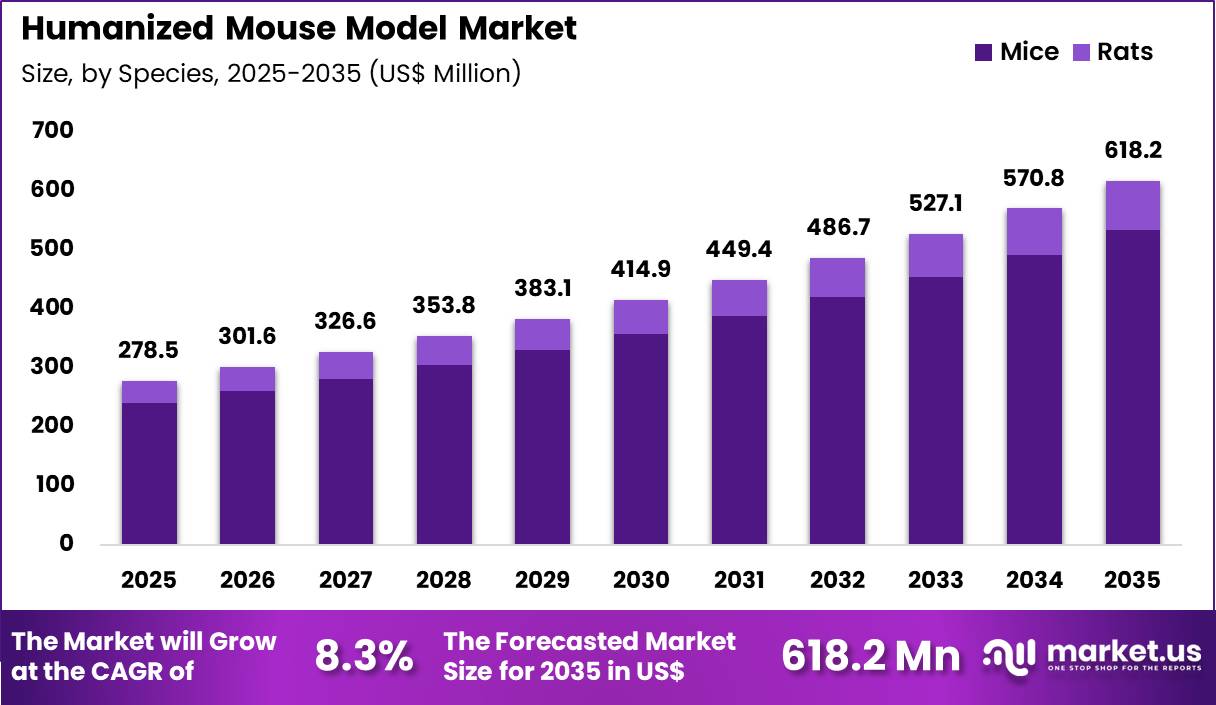
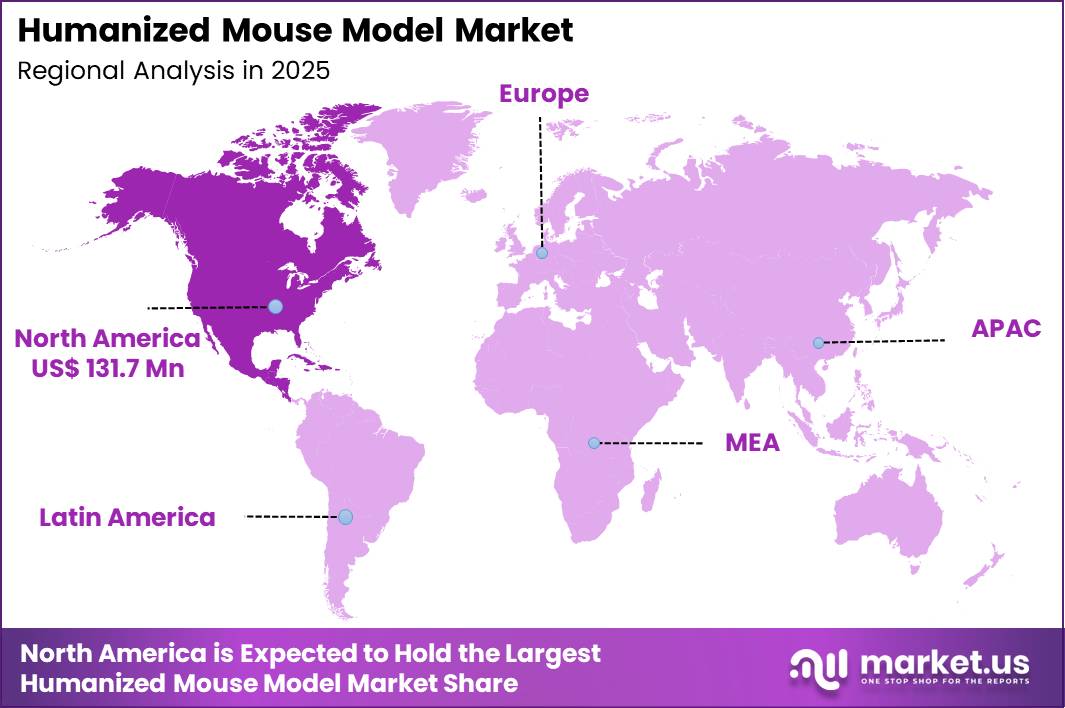
The Global Humanized Mouse Model Market size is expected to be worth around US$ 618.2 Million by 2035 from US$ 278.5 Million in 2025, growing at a CAGR of 8.3% during the forecast period 2026-2035. In 2025, North America led the market, achieving over 47.3% share with a revenue of US$ 131.7 Million.
Increasing demand for accurate preclinical models in drug discovery propels the humanized mouse model market as researchers require platforms that closely mimic human immune responses and disease pathologies. Scientists increasingly utilize these models in oncology research to engraft human tumors and evaluate immunotherapy efficacy, such as checkpoint inhibitors that target PD-1 pathways in melanoma and lung cancer xenografts.
These systems support infectious disease studies by reconstituting human hematopoietic cells, enabling investigations into HIV pathogenesis and antiviral compound testing within a human-like immune environment. Pharmaceutical developers apply humanized mice in autoimmune disorder modeling, assessing biologic therapies that modulate cytokine production in rheumatoid arthritis and multiple sclerosis simulations.
Toxicologists employ these models for safety evaluations of novel compounds, monitoring human-specific adverse effects like cytokine release syndrome in chimeric antigen receptor T-cell therapy development. Regenerative medicine teams leverage humanized mice to test stem cell engraftment and tissue regeneration, advancing treatments for hematopoietic disorders and organ repair.
Biotechnology firms pursue opportunities to engineer advanced humanized strains with multi-lineage human immune reconstitution, expanding applications in vaccine development where models replicate human antibody responses to pathogens like SARS-CoV-2 variants.
Developers advance CRISPR-edited models that incorporate specific human genetic mutations, broadening utility in precision oncology for patient-derived xenografts and targeted therapy validation. These innovations facilitate hybrid models combining humanized immunity with organ-on-chip technologies, optimizing drug metabolism studies.
Opportunities emerge in collaborative platforms that standardize model validation, accelerating adoption in regulatory toxicology. Companies invest in scalable production methods to reduce costs and variability. Recent trends emphasize AI-driven phenotype analysis and ethical sourcing of human cells, positioning the market for growth in personalized medicine and immunotherapy advancements.
Key Takeaways
- In 2025, the market generated a revenue of US$ 278.5 Million, with a CAGR of 8.3%, and is expected to reach US$ 618.2 Million by the year 2035.
- The model type segment is divided into humanized immune system (HIS) models, cell-line derived xenograft (CDX) models, genetically humanized models (gene knock-in/knock-out), humanized liver models and patient-derived xenograft (PDX) models, with humanized immune system (HIS) models taking the lead with a market share of 32.8%.
- Considering application, the market is divided into oncology, gene therapy & regenerative medicine, infectious diseases, inflammatory & autoimmune diseases, metabolic diseases and neuroscience. Among these, oncology held a significant share of 44.9%.
- Furthermore, concerning the species segment, the market is segregated into mice and rats. The mice sector stands out as the dominant player, holding the largest revenue share of 86.3% in the market.
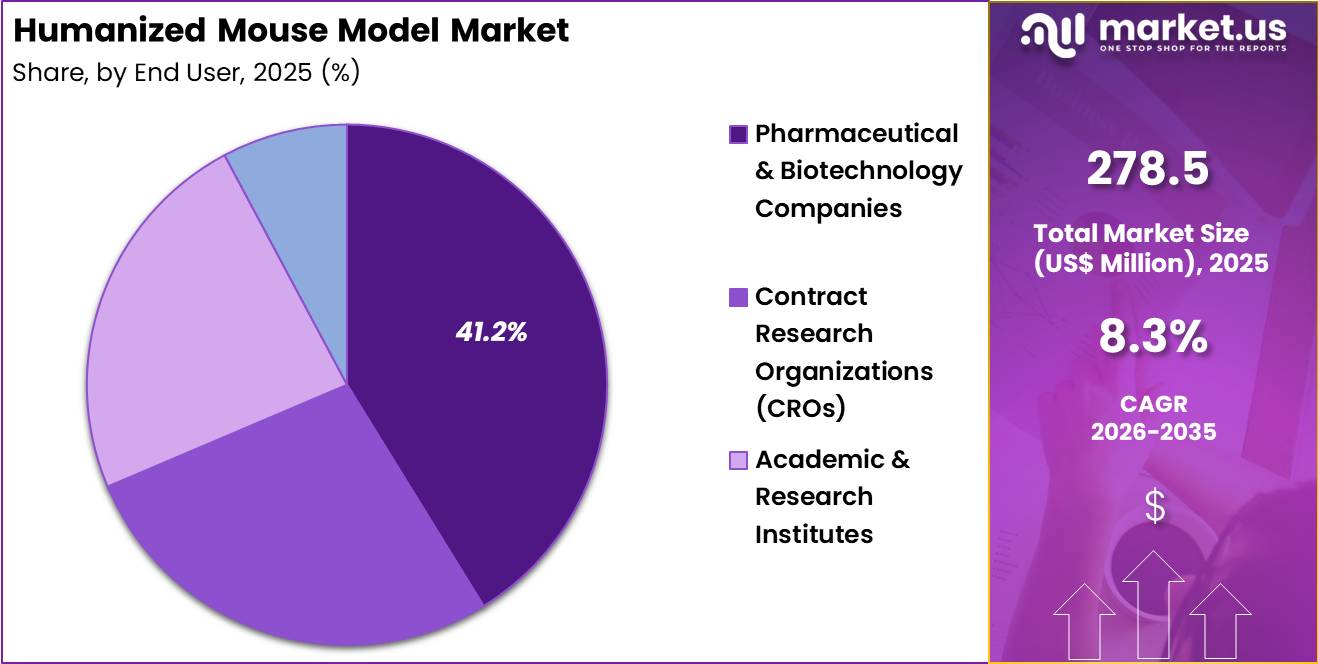
- The end user segment is segregated into pharmaceutical & biotechnology companies, contract research organizations (CROs), academic & research institutes and government & regulatory bodies, with the pharmaceutical & biotechnology companies segment leading the market, holding a revenue share of 41.2%.
- North America led the market by securing a market share of 47.3%.
Model Type Analysis
Humanized immune system models accounted for 32.8% of growth within model type and led the humanized mouse model market due to their ability to replicate human immune responses in vivo. Researchers rely on HIS models to evaluate immunotherapies, vaccine candidates, and immune-oncology agents.
These models provide functional human T cells, B cells, and myeloid components, which improves translational relevance. Rising development of checkpoint inhibitors and cell-based therapies strengthens demand for immune-competent platforms.
Growth accelerates as precision medicine strategies require reliable immune interaction data. Pharmaceutical pipelines increasingly include biologics that target immune pathways, which elevates preclinical testing volumes.
Technological refinements improve engraftment efficiency and immune stability. Collaborative research initiatives further expand adoption. The segment is expected to remain dominant as immunotherapy and vaccine research continue to drive demand for advanced immune modeling systems.
Application Analysis
Oncology generated 44.9% of growth within application and emerged as the leading segment due to intensive cancer drug development activity. Humanized models enable evaluation of tumor-immune interactions and therapeutic response in a controlled environment.
Researchers use these systems to test monoclonal antibodies, CAR-T therapies, and combination regimens. Rising global cancer incidence reinforces sustained investment in oncology research.
Growth strengthens as biomarker-driven trials require accurate preclinical validation. Expansion of personalized oncology approaches increases demand for translational models. Regulatory agencies emphasize robust preclinical evidence for immunotherapies, which supports utilization.
Pharmaceutical collaborations with academic labs further boost study volume. The segment is projected to maintain leadership as oncology remains the most active and innovation-driven therapeutic field.
Species Analysis
Mice accounted for 86.3% of growth within species and dominated the humanized mouse model market due to their genetic compatibility and well-established laboratory use. Researchers prefer mice because of extensive genomic knowledge and availability of immunodeficient strains suitable for human cell engraftment.
Short reproductive cycles and manageable housing requirements support scalable studies. Cost efficiency compared to larger species strengthens adoption across research institutions.
Growth continues as genome-editing technologies enable precise human gene insertion in murine models. Established ethical and regulatory frameworks further support mouse-based research. High reproducibility and standardized protocols enhance data consistency.
Infrastructure and expertise for murine handling remain widely available. The segment is anticipated to sustain dominance as mice continue to represent the primary species for translational biomedical research.
End-User Analysis
Pharmaceutical and biotechnology companies contributed 41.2% of growth within end user and led the humanized mouse model market due to expanding preclinical pipelines. These companies require robust in vivo platforms to evaluate safety, efficacy, and pharmacodynamics of novel therapies. Competitive pressure to accelerate drug development timelines increases outsourcing and internal model utilization. Investment in immuno-oncology and gene therapy programs further elevates demand.
Growth strengthens as biotech startups focus on niche and rare disease therapeutics that require precise validation models. Strategic partnerships with CROs enhance study throughput. Regulatory expectations for comprehensive preclinical evidence increase testing requirements.
Funding allocation toward advanced biologics reinforces adoption. The segment is expected to remain dominant as pharmaceutical innovation continues to rely heavily on predictive and human-relevant animal models.
Key Market Segments
By Model Type
- Humanized Immune System (HIS) Models
- Cell-Line Derived Xenograft (CDX) Models
- Genetically Humanized Models (Gene Knock-In/Knock-Out)
- Humanized Liver Models
- Patient-Derived Xenograft (PDX) Models
By Application
- Oncology
- Gene Therapy & Regenerative Medicine
- Infectious Diseases
- Inflammatory & Autoimmune Diseases
- Metabolic Diseases
- Neuroscience
By Species
- Mice
- Rats
By End User
- Pharmaceutical & Biotechnology Companies
- Contract Research Organizations (CROs)
- Academic & Research Institutes
- Government & Regulatory Bodies
Drivers
Increasing demand for personalized medicine is driving the market.
The rising emphasis on personalized medicine has significantly boosted the humanized mouse model market by enabling more accurate testing of individual-specific therapies in preclinical stages. Pharmaceutical companies are increasingly utilizing humanized models to simulate human immune responses for tailored drug development.
Healthcare research institutions prioritize these models to bridge the gap between animal studies and human trials. The correlation between genetic variability and treatment efficacy underscores the need for humanized systems in precision oncology.
Government-funded programs in genomics support the adoption of these models for customized therapeutic evaluation. Humanized mouse models provide engrafted human tissues that closely mimic patient-specific disease progression.
National biotechnology initiatives emphasize innovation in model engineering for better translational outcomes. Key players are expanding model portfolios to meet this growing research requirement. This driver fosters collaboration between academia and industry for advanced model applications.
Restraints
High cost of custom humanized models is restraining the market.
The elevated pricing of custom-engineered humanized mouse models poses a significant barrier to widespread adoption in research facilities with limited budgets. Complex genetic modification and engraftment processes contribute to substantial development expenses for these specialized models.
Smaller biotechnology firms often face financial challenges in procuring custom models for early-stage studies. Regulatory demands for ethical sourcing and validation add to the overall cost structure. In academic settings, grant restrictions favor standard models over premium custom variants.
Researchers may opt for less sophisticated alternatives to control experimental costs. This restraint impacts scalability, particularly in resource-constrained environments. Industry efforts to standardize model production aim to mitigate pricing pressures partially. Despite superior human relevance, economic factors hinder universal implementation. The high cost of custom humanized models is a key market restraint.
Opportunities
Government-funded initiatives for cancer research is creating growth opportunities.
The allocation of public funds to oncology research presents avenues for humanized mouse models in studying tumor microenvironments and immunotherapy responses. Governmental grants support the development of advanced models for preclinical testing in cancer drug discovery.
Increasing focus on precision oncology amplifies potential for model applications in biomarker validation. Partnerships with national institutes facilitate customized model creation for specific cancer types. The large pipeline of immuno-oncology therapies magnifies prospects for model utilization in efficacy studies.
Educational programs for researchers promote standardized use in funded projects. This opportunity enables suppliers to collaborate on grant-supported initiatives. Key organizations are establishing dedicated facilities for model generation in research hubs.
Overall, cancer research funding aligns with efforts to accelerate therapeutic advancements. Government-funded initiatives for cancer research are a major growth opportunity.
Impact of Macroeconomic / Geopolitical Factors
Macroeconomic conditions influence the humanized mouse model market through research funding cycles, pharmaceutical R&D budgets, and venture capital availability. Inflation increases costs for specialized breeding, housing facilities, feed, and laboratory infrastructure, which raises overall program expenses.
Higher interest rates reduce access to expansion capital for biotech firms, which slows large scale preclinical study planning. Geopolitical tensions affect international collaboration, biological material exchange, and supply of genetic engineering reagents, creating operational complexity.
Current US tariffs on imported laboratory equipment, genetic editing tools, and specialty reagents increase procurement costs and tighten margins for research providers. These pressures can delay model development timelines and constrain smaller research institutions.
At the same time, organizations invest in domestic breeding capacity and strengthen local supplier networks to reduce external dependency. Strong demand for translational research in oncology, immunology, and gene therapy continues to anchor long term market growth.
Latest Trends
Introduction of FDA Modernization Act 2.0 is a recent trend in the market.
In 2023, the enactment of the FDA Modernization Act 2.0 has influenced the humanized mouse model market by promoting alternatives to traditional animal testing in drug development. This legislation encourages the use of advanced humanized models as non-animal methods for safety and efficacy evaluation.
Manufacturers have focused on regulatory alignment to position models as compliant alternatives under the new framework. Clinical research has demonstrated model utility in reducing reliance on conventional testing paradigms. The introduction of FDA Modernization Act 2.0 is a key market trend. This development addresses ethical concerns while maintaining rigorous standards for drug approval.
The trend emphasizes validation protocols for model-based data in regulatory submissions. Regulatory adaptations have supported broader acceptance of humanized systems in preclinical assessments. Industry collaborations refine model designs for enhanced human relevance. These changes aim to streamline development timelines while improving translational accuracy in pharmaceutical research.
Regional Analysis
North America is leading the Humanized Mouse Model Market
North America accounted for 47.3% of the Humanized Mouse Model market, reflecting the region’s strong biomedical research ecosystem and high preclinical spending in 2024. Growth accelerated as pharmaceutical and biotechnology companies intensified work in immuno-oncology, cell and gene therapy, and infectious disease research, all of which require translational in vivo systems that closely mimic human immunity.
The National Institutes of Health reported total funding of approximately USD 47.7 billion in fiscal year 2023, underscoring sustained federal investment in life sciences research that supports advanced animal model development and utilization.
Academic medical centers and contract research organizations expanded collaborations to evaluate checkpoint inhibitors, CAR T therapies, and monoclonal antibodies in immune-reconstituted models. Regulatory emphasis on predictive preclinical data further encouraged adoption of advanced murine platforms.
Venture capital inflows into early-stage biotech firms strengthened demand for customized and patient-derived systems. Established infrastructure, skilled researchers, and access to federal grants reinforced North America’s leadership position in 2024.
The Asia Pacific region is expected to experience the highest CAGR during the forecast period
Asia Pacific is projected to experience notable expansion during the forecast period as governments increase biomedical research funding and local biotech innovation gains momentum. China’s National Bureau of Statistics reported that national expenditure on research and development reached 3.33 trillion yuan in 2023, demonstrating substantial commitment to scientific advancement and translational medicine.
Research institutes across China, Japan, South Korea, and Singapore are investing in immunology and oncology programs that require sophisticated immune-reconstituted animal platforms. Regional biotechnology startups are accelerating antibody discovery and cell therapy pipelines, driving demand for advanced in vivo validation systems.
Governments are strengthening domestic laboratory infrastructure and encouraging public private partnerships to reduce reliance on imported models. Pharmaceutical manufacturers are expanding preclinical testing capacity to shorten drug development timelines.
Academic collaborations with global partners are improving technical expertise in immune system reconstitution and genetic engineering. Strong funding growth, policy backing, and rising clinical research ambitions are expected to sustain steady regional expansion in the coming years.
Key Regions and Countries
North America
- US
- Canada
Europe
- Germany
- France
- The UK
- Spain
- Italy
- Russia
- Netherland
- Rest of Europe
Asia Pacific
- China
- Japan
- South Korea
- India
- Australia
- New Zealand
- Singapore
- Thailand
- Vietnam
- Rest of APAC
Latin America
- Brazil
- Mexico
- Rest of Latin America
Middle East & Africa
- South Africa
- Saudi Arabia
- UAE
- Rest of MEA
Key Players Analysis
Key participants in the humanized mouse model market accelerate growth by refining CRISPR-based genome editing, expanding immune-reconstituted strains, and enhancing engraftment consistency to improve translational reliability in oncology and immunology research. They also differentiate through integrated service models that combine model supply, in vivo pharmacology, and biomarker analysis under unified project management frameworks.
Companies secure long-term demand by forming co-development agreements with biopharma sponsors and embedding customized strains into early drug discovery pipelines. Expansion into emerging biotech clusters in Asia and Europe strengthens global footprint and diversifies client concentration risk.
The Jackson Laboratory, a US-based nonprofit biomedical research institution, maintains a comprehensive repository of genetically engineered and humanized strains supported by robust breeding infrastructure and scientific advisory capabilities.
The organization advances its market position through continuous strain innovation, collaborative research initiatives, and a commercialization approach that aligns scientific rigor with evolving therapeutic development priorities.
Top Key Players
- The Jackson Laboratory
- Charles River Laboratories
- Taconic Biosciences
- Horizon Discovery
- GenOway
- Crown Bioscience
- Shanghai Model Organisms Center
- Ingenious Targeting Laboratory
- Cyagen Biosciences
- Pharmaron
Recent Developments
- In August 2025, Taconic Biosciences entered into a strategic alliance with Cyagen Biosciences to broaden availability of Cyagen’s genetically engineered mouse models. Under the agreement, Taconic will serve as the exclusive distributor across North America and Europe. The collaboration combines Cyagen’s gene-editing expertise with Taconic’s global distribution network and established quality and health standards, strengthening access to advanced preclinical research models.
- In July 2024, researchers at the University of Texas Health Science Center at San Antonio introduced the TruHuX mouse model, engineered to incorporate a functional human immune system alongside a humanized gut microbiome. The model is designed to support studies of immune development, vaccine research, and therapeutic testing by facilitating human stem cell differentiation and antibody response mechanisms within a controlled in vivo platform.
Report Scope
Report Features Description Market Value (2025) US$ 278.5 Million Forecast Revenue (2035) US$ 618.2 Million CAGR (2026-2035) 8.3% Base Year for Estimation 2025 Historic Period 2020-2024 Forecast Period 2026-2035 Report Coverage Revenue Forecast, Market Dynamics, COVID-19 Impact, Competitive Landscape, Recent Developments Segments Covered By Model Type (Humanized Immune System (HIS) Models, Cell-Line Derived Xenograft (CDX) Models, Genetically Humanized Models (Gene Knock-In/Knock-Out), Humanized Liver Models and Patient-Derived Xenograft (PDX) Models), By Application (Oncology, Gene Therapy & Regenerative Medicine, Infectious Diseases, Inflammatory & Autoimmune Diseases, Metabolic Diseases and Neuroscience), By Species (Mice and Rats), By End User (Pharmaceutical & Biotechnology Companies, Contract Research Organizations (CROs), Academic & Research Institutes and Government & Regulatory Bodies) Regional Analysis North America – US, Canada; Europe – Germany, France, The UK, Spain, Italy, Russia, Netherlands, Rest of Europe; Asia Pacific – China, Japan, South Korea, India, Australia, New Zealand, Singapore, Thailand, Vietnam, Rest of APAC; Latin America – Brazil, Mexico, Rest of Latin America; Middle East & Africa – South Africa, Saudi Arabia, UAE, Rest of MEA Competitive Landscape The Jackson Laboratory, Charles River Laboratories, Taconic Biosciences, Horizon Discovery, GenOway, Crown Bioscience, Shanghai Model Organisms Center, Ingenious Targeting Laboratory, Cyagen Biosciences, Pharmaron Customization Scope Customization for segments, region/country-level will be provided. Moreover, additional customization can be done based on the requirements. Purchase Options We have three licenses to opt for: Single User License, Multi-User License (Up to 5 Users), Corporate Use License (Unlimited User and Printable PDF)  Humanized Mouse Model MarketPublished date: Feb 2026add_shopping_cartBuy Now get_appDownload Sample
 -
-
- The Jackson Laboratory
- Charles River Laboratories
- Taconic Biosciences
- Horizon Discovery
- GenOway
- Crown Bioscience
- Shanghai Model Organisms Center
- Ingenious Targeting Laboratory
- Cyagen Biosciences
- Pharmaron
Our Clients

- 179207
- Feb 2026






