


Global Hot Food Processing Equipment Market Size, Share, And Enhanced Productivity By Type (Baking Equipment, Evaporation Equipment, Pasteurization Equipment, Dehydration Equipment, Roasting and Grilling Equipment, Frying Equipment, Sterilization Equipment, Blanching Equipment, Others), By End-User (Food Processing Industries, Food Service Industry (Fast Food Solutions, Restaurant, Cafes & Bars, Caterers, Cloud kitchens, Vending Machine, Others), Household), By Mode of Operation (Automatic, Semi-automatic, Manual), By Region and Companies - Industry Segment Outlook, Market Assessment, Competition Scenario, Trends, and Forecast 2026-2035
- Published date: March 2026
- Report ID: 182269
- Number of Pages: 207
- Format:
-
keyboard_arrow_up
Quick Navigation
Report Overview
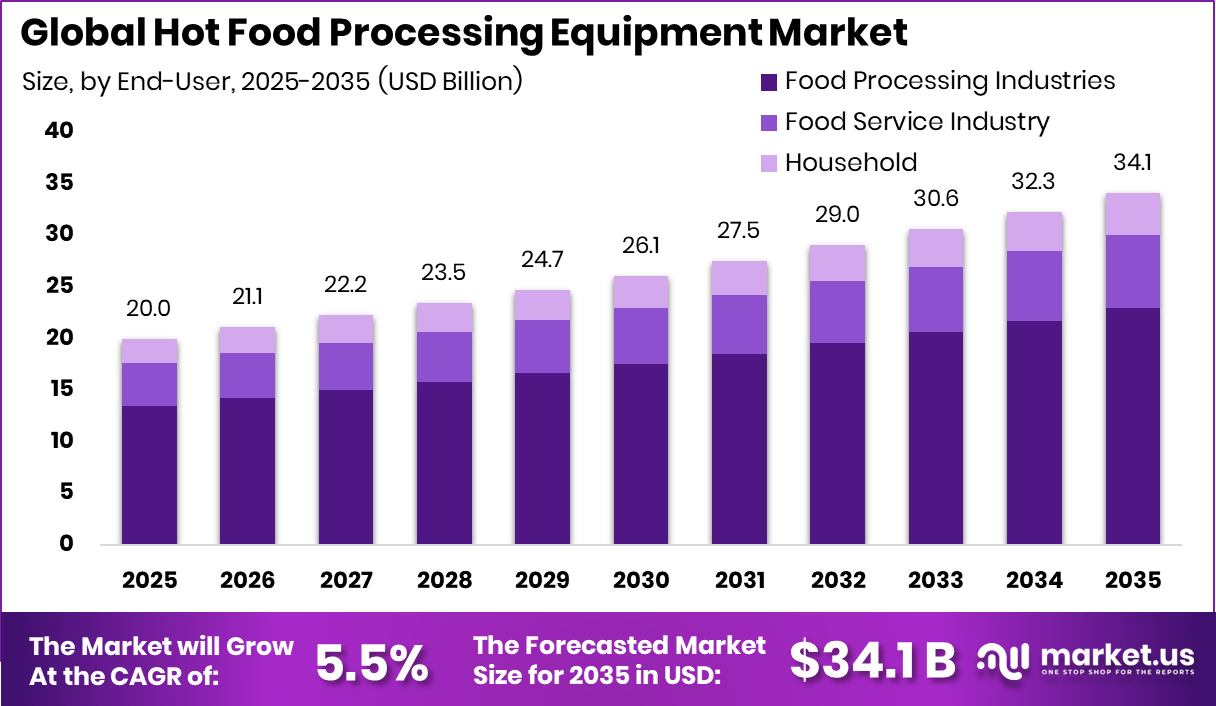
The Global Hot Food Processing Equipment Market is expected to be worth around USD 34.1 billion by 2035, up from USD 20.0 billion in 2025. It is projected to grow at a CAGR of 5.5% from 2026 to 2035. With a USD 8.7 Bn valuation, Asia Pacific holds 43.7% of the hot food processing equipment market.
Hot food processing equipment refers to machines used to apply heat during food production, including baking, frying, roasting, pasteurizing, sterilizing, and drying. These systems help improve food safety, extend shelf life, and enhance taste and texture. The taxonomy of this market includes equipment such as baking, evaporation, pasteurization, dehydration, roasting and grilling, frying, sterilization, blanching, and others, serving different processing needs across industries.
The Hot Food Processing Equipment Market represents the ecosystem of manufacturing, supplying, and adopting these machines across food processing industries, food service businesses, and households. It is shaped by the need for efficiency, hygiene, and consistent quality in food preparation. The market is segmented by type, end-user, and mode of operation, including automatic, semi-automatic, and manual systems, allowing flexibility across different scales of use.
Growth in this market is supported by continuous investment and funding activities. For instance, Arabelle’s Bakery of Chilliwack secured a $10K grant from DoorDash Canada, while Restaurant365 raised $135M to enhance food service software capabilities. Additionally, Goals raised ¥1.33B in Pre-Series B funding, reflecting broader innovation in food systems. Product affordability trends, such as a £130 air fryer discounted to £60, also indicate rising accessibility of processing equipment.
Demand is driven by increasing consumption of processed and ready-to-eat foods, especially in urban areas where convenience is essential. Food processing industries require reliable equipment to maintain quality and meet large-scale production needs, while food service businesses depend on efficient systems to ensure speed and consistency. Household adoption is also rising as consumers seek better cooking solutions at home.
Opportunities lie in the development of energy-efficient, cost-effective, and easy-to-operate equipment across all segments. The growing focus on sustainability and operational efficiency encourages innovation in processing technologies. As businesses expand and consumers seek convenience, the market continues to offer strong potential for advanced solutions tailored to diverse food processing requirements.
- In April 2024, Marel entered into a merger agreement with JBT Corporation, with a deal value of around USD 3.9 billion. Marel, which develops food processing equipment, aimed to combine its technology with JBT’s systems to expand global reach and improve processing solutions. This development supports better automation, efficiency, and innovation in food processing equipment, including hot food processing systems.
Key Takeaways
- The Global Hot Food Processing Equipment Market is expected to be worth around USD 34.1 billion by 2035, up from USD 20.0 billion in 2025. It is projected to grow at a CAGR of 5.5% from 2026 to 2035.
- Baking equipment dominates the Hot Food Processing Equipment Market with a significant 32.6% share globally.
- Food processing industries lead end-user demand in the Hot Food Processing Equipment Market at 67.3% share.
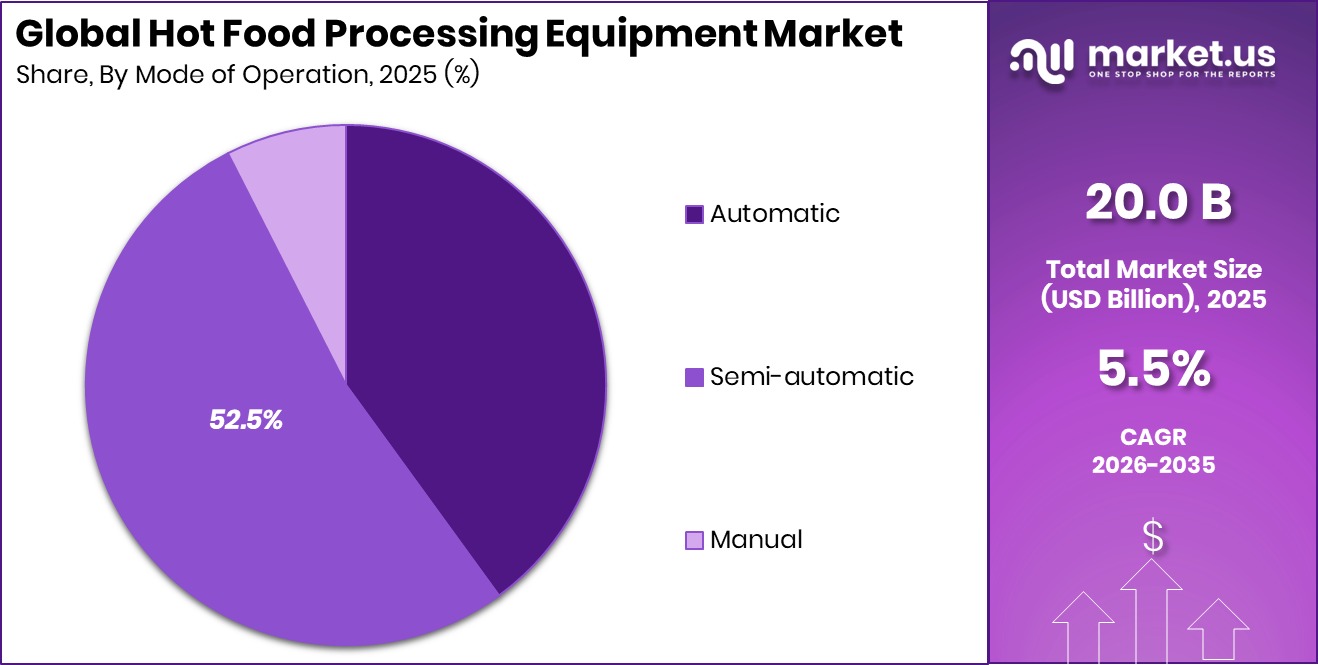
- Semi-automatic systems hold 52.5% share in the Hot Food Processing Equipment Market by operation mode.
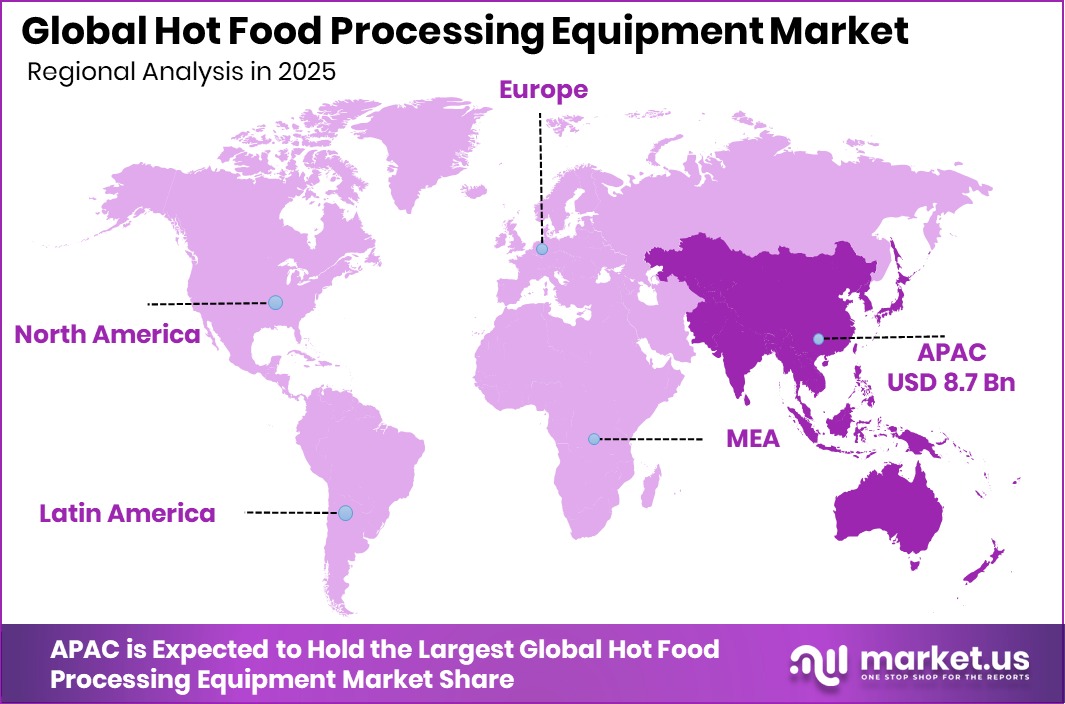
- Asia Pacific region leads Hot Food Processing Equipment Market, accounting 43.7% share and reaching USD 8.7 Bn.
By Type Analysis
Hot Food Processing Equipment Market by Type shows baking equipment at 32.6%
In 2025, the Hot Food Processing Equipment Market shows a strong tilt toward baking equipment, accounting for 32.6% of the overall share. This dominance reflects the rising global demand for baked goods such as bread, pastries, and ready-to-eat snacks, especially in urban areas. Manufacturers are increasingly investing in advanced ovens, mixers, and proofing systems to improve efficiency and product consistency.
Additionally, the expansion of commercial bakeries and quick-service restaurants is fueling the need for reliable and high-capacity baking solutions. Technological innovations, including energy-efficient systems and automated controls, are further enhancing productivity, making baking equipment a critical segment within the broader market landscape.
By End-User Analysis
Hot Food Processing Equipment Market by End-User led food processing industries, 67.3%
In 2025, food processing industries will emerge as the leading end-users in the Hot Food Processing Equipment Market, contributing 67.3% of total demand. This significant share is driven by the growing need for large-scale food production to meet increasing consumer demand worldwide. These industries rely heavily on advanced processing equipment to maintain quality, safety, and consistency across high volumes of output.
The shift toward packaged and convenience foods has further accelerated equipment adoption. Moreover, stringent food safety regulations are pushing companies to upgrade to modern systems with better hygiene standards. As a result, food processing industries continue to dominate, shaping market trends and driving continuous technological advancements.
By Mode of Operation Analysis
Hot Food Processing Equipment Market by Mode of Operation: Semi-automatic holds 52.5%
In 2025, semi-automatic equipment leads the Hot Food Processing Equipment Market by mode of operation, holding a 52.5% share. This preference highlights the balance businesses seek between automation and cost-effectiveness. Semi-automatic systems offer improved efficiency compared to manual operations while remaining more affordable and flexible than fully automated solutions.
Small and medium-sized enterprises particularly favor these systems due to lower initial investment and easier maintenance. Additionally, semi-automatic equipment allows for better control over processing, which is essential for maintaining product quality in diverse food applications. As businesses scale gradually, this mode of operation provides a practical and adaptable solution within an evolving market environment.
Key Market Segments
By Type
- Baking Equipment
- Evaporation Equipment
- Pasteurization Equipment
- Dehydration Equipment
- Roasting & Grilling Equipment
- Frying Equipment
- Sterilization Equipment
- Blanching Equipment
- Others
By End-User
- Food Processing Industries
- Food Service Industry
- Fast Food Solutions
- Restaurant
- Cafes & Bars
- Caterers
- Cloud kitchens
- Vending Machine
- Others
- Household
By Mode of Operation
- Automatic
- Semi-automatic
- Manual
Driving Factors
Rising demand for processed convenience foods
The Hot Food Processing Equipment Market is strongly driven by the growing demand for processed and convenience foods across urban populations. Consumers increasingly prefer ready-to-eat and easy-to-prepare meals, encouraging food manufacturers to expand production capacity and invest in advanced equipment such as baking, frying, and sterilization systems. This shift is further supported by financial backing within the food sector, such as Carmistin The Food Company, securing approximately EUR 500 million in financing to accelerate investments in agriculture and food production.
Such funding reflects a broader push toward scaling operations, which directly increases the need for efficient hot food processing equipment to maintain quality, consistency, and output in large-scale food production environments.
Increasing industrial automation in food processing
Automation is becoming a key driver in the Hot Food Processing Equipment Market as industries aim to improve efficiency, reduce labor dependency, and maintain consistent product quality. Automated and semi-automatic systems enable faster processing, better temperature control, and reduced human error, making them essential for modern food production facilities. This trend is reinforced by initiatives like the Food Processing Hub and Warren County Community College receiving a $980,000 grant for a new center focused on advancing food processing technologies.
Such developments highlight the growing emphasis on automation and innovation, encouraging manufacturers to adopt advanced equipment that supports streamlined operations and meets increasing production demands effectively.
Restraining Factors
High initial investment cost for equipment
The high upfront cost of hot food processing equipment remains a significant restraint, particularly for small and medium-sized enterprises. Advanced systems such as automated ovens, pasteurizers, and sterilization units require substantial capital investment, which can limit adoption despite long-term efficiency benefits. While innovation continues to attract funding, such as BRAINR securing $13 million in seed funding to digitize food manufacturing, the cost barrier still affects many businesses.
Companies often hesitate to invest heavily in new equipment due to uncertain returns and financial risks. This challenge slows down market penetration in cost-sensitive regions, where businesses prefer lower-cost or manual alternatives instead of upgrading to modern processing technologies.
Maintenance complexity limits small business adoption
Maintenance and operational complexity present another barrier in the Hot Food Processing Equipment Market, especially for smaller businesses with limited technical expertise. Advanced systems often require regular servicing, skilled operators, and access to specialized components, increasing operational costs over time.
While innovation continues in the broader food ecosystem, as seen with a fresh insect-based dog food startup securing $1.46 million in funding, many small-scale operators still struggle with maintaining sophisticated equipment. This complexity discourages adoption and leads businesses to rely on simpler, manual systems. As a result, despite technological advancements, maintenance challenges continue to limit widespread use among smaller food producers.
Growth Opportunity
Expansion of energy-efficient processing solutions
The increasing focus on sustainability and cost savings is creating strong opportunities for energy-efficient solutions in the Hot Food Processing Equipment Market. Businesses are actively seeking equipment that reduces energy consumption while maintaining high performance, particularly in heating-intensive processes like frying and baking.
Government support is also encouraging this shift, such as Governor Mills announcing nearly $20 million in Maine Jobs & Recovery Plan grants to support farmers and food processors. These initiatives promote the adoption of modern, efficient systems that lower operational costs and environmental impact. As energy prices fluctuate, the demand for such solutions is expected to grow, opening new avenues for manufacturers to innovate.
Growing adoption in emerging regional markets
Emerging markets present significant growth opportunities as food processing industries expand to meet rising consumption needs. Increasing urbanization and changing dietary habits are driving demand for processed foods, encouraging investment in modern equipment.
Supportive initiatives, such as Michigan State University receiving a $500,000 USDA-NIFA grant to strengthen food processing programs, highlight the focus on building capacity and technical expertise. These developments create a favorable environment for equipment adoption in new regions. As infrastructure improves and awareness increases, businesses in these markets are more likely to invest in hot food processing technologies, contributing to overall market expansion.
Latest Trends
Smart connected equipment is improving processing efficiency
A key trend in the Hot Food Processing Equipment Market is the integration of smart and connected technologies that enhance efficiency and control. Equipment with digital monitoring, automation, and data-driven insights allows manufacturers to optimize processes, reduce waste, and improve product consistency. This trend is supported by initiatives like the California Energy Commission, which is awarding $23 million to help food processors adopt advanced technologies.
Such funding encourages the implementation of smart systems that improve operational performance. As industries increasingly focus on precision and efficiency, connected equipment is becoming a standard feature, transforming how food processing operations are managed and monitored.
Compact multifunctional machines are gaining market popularity
Compact and multifunctional equipment is gaining traction as businesses seek flexible and space-saving solutions. These machines combine multiple processing functions, such as frying, roasting, and baking, into a single unit, making them ideal for both commercial and small-scale operations. This trend is supported by investments like Ontario allocating $25 million to increase food processing capacity, encouraging modernization and efficiency.
The demand for versatile equipment is particularly strong among small and medium enterprises looking to maximize productivity with limited space and budget. As a result, multifunctional systems are becoming an important trend, offering convenience, cost savings, and operational flexibility.
Regional Analysis
In 2025, Asia Pacific dominates the Hot Food Processing Equipment Market with 43.7% share, USD 8.7 Bn value.
The Hot Food Processing Equipment Market demonstrates varied regional dynamics across North America, Europe, Asia Pacific, the Middle East & Africa, and Latin America, reflecting differences in industrial development and consumption patterns. Asia Pacific emerges as the dominating region, accounting for 43.7% of the market with a valuation of USD 8.7 Bn, driven by strong demand from expanding food processing industries and rapid urbanization.
North America and Europe maintain steady growth, supported by established food manufacturing sectors and consistent demand for processed and convenience foods. Meanwhile, the Middle East & Africa region is gradually advancing, supported by increasing investments in food infrastructure and rising consumption needs.
Latin America also shows moderate progress, with growing adoption of food processing technologies in response to shifting consumer preferences. Overall, while all regions contribute to market expansion, Asia Pacific clearly leads in both share and value, positioning itself as the central hub for growth in the global Hot Food Processing Equipment Market.
Key Regions and Countries
- North America
- US
- Canada
- Europe
- Germany
- France
- The UK
- Spain
- Italy
- Rest of Europe
- Asia Pacific
- China
- Japan
- South Korea
- India
- Australia
- Rest of APAC
- Latin America
- Brazil
- Mexico
- Rest of Latin America
- Middle East & Africa
- GCC
- South Africa
- Rest of MEA
Key Players Analysis
In 2025, GEA Group Aktiengesellschaft continues to demonstrate a strong strategic focus within the global Hot Food Processing Equipment Market. The company’s strength lies in its diversified equipment portfolio and engineering expertise, enabling it to cater to a wide range of food processing requirements. Its emphasis on process optimization and efficiency positions it as a reliable partner for manufacturers seeking consistent output and operational stability. GEA’s structured approach to product development and system integration supports scalable solutions, making it well-aligned with evolving production needs.
Bühler AG maintains a competitive stance through its deep-rooted specialization in food processing technologies. The company’s ability to deliver precision-driven equipment supports high-quality production outcomes, particularly in thermal and processing applications. Bühler’s focus on technological refinement and application-specific solutions enhances its relevance across diverse food segments. Its strong engineering capabilities and consistent product innovation contribute to its positioning as a dependable provider in the global market landscape.
Marel stands out for its integrated approach to food processing equipment and systems. The company emphasizes streamlined processing solutions that improve productivity and operational flow. Marel’s capability to offer end-to-end systems supports efficiency across multiple processing stages. Its focus on reliability and performance enables it to address the practical needs of food manufacturers, reinforcing its role as a key participant in the Hot Food Processing Equipment Market.
Top Key Players in the Market
- GEA Group Aktiengesellschaft
- Bühler AG
- Marel
- The Middle by Corporation
- JBT
- Heat & Control, Inc
- SPX Flow
- Tetra Laval International S.A
- Alfa Laval
- TNA Australia Pty Limited
Recent Developments
- In July 2025, GEA opened a new Food Application and Technology Center in Wisconsin, USA. The company, known for manufacturing food processing equipment, developed this facility to support advanced food production technologies such as thermal processing, fermentation, and alternative protein manufacturing. This development strengthens GEA’s capability in hot food processing by enabling large-scale testing and production optimization.
- In January 2025, Bühler acquired advanced puffing technology from CEREX. The company, which develops food processing equipment, made this move to expand its product portfolio for snacks, cereals, bakery, and dairy applications. This technology uses heat and pressure to process food, making it highly relevant for hot food processing equipment. It improves product texture, shelf life, and production efficiency while reducing energy consumption.
Report Scope
Report Features Description Market Value (2025) USD 20.0 Billion Forecast Revenue (2035) USD 34.1 Billion CAGR (2026-2035) 5.5% Base Year for Estimation 2025 Historic Period 2020-2024 Forecast Period 2026-2035 Report Coverage Revenue Forecast, Market Dynamics, Competitive Landscape, Recent Developments Segments Covered By Type (Baking Equipment, Evaporation Equipment, Pasteurization Equipment, Dehydration Equipment, Roasting & Grilling Equipment, Frying Equipment, Sterilization Equipment, Blanching Equipment, Others), By End-User (Food Processing Industries, Food Service Industry (Fast Food Solutions, Restaurant, Cafes & Bars, Caterers, Cloud kitchens, Vending Machine, Others), Household), By Mode of Operation (Automatic, Semi-automatic, Manual) Regional Analysis North America – US, Canada; Europe – Germany, France, The UK, Spain, Italy, Rest of Europe; Asia Pacific – China, Japan, South Korea, India, Australia, Singapore, Rest of APAC; Latin America – Brazil, Mexico, Rest of Latin America; Middle East & Africa – GCC, South Africa, Rest of MEA Competitive Landscape GEA Group Aktiengesellschaft, Bühler AG, Marel, The Middle by Corporation, JBT, Heat & Control, Inc, SPX Flow, Tetra Laval International S.A, Alfa Laval, TNA Australia Pty Limited Customization Scope Customization for segments, region/country-level will be provided. Moreover, additional customization can be done based on the requirements. Purchase Options We have three licenses to opt for: Single User License, Multi-User License (Up to 5 Users), Corporate Use License (Unlimited User and Printable PDF)  Hot Food Processing Equipment MarketPublished date: March 2026add_shopping_cartBuy Now get_appDownload Sample
 -
-
- GEA Group Aktiengesellschaft
- Bühler AG
- Marel
- The Middle by Corporation
- JBT
- Heat & Control, Inc
- SPX Flow
- Tetra Laval International S.A
- Alfa Laval
- TNA Australia Pty Limited
Our Clients

- 182269
- March 2026






