


Market Overview
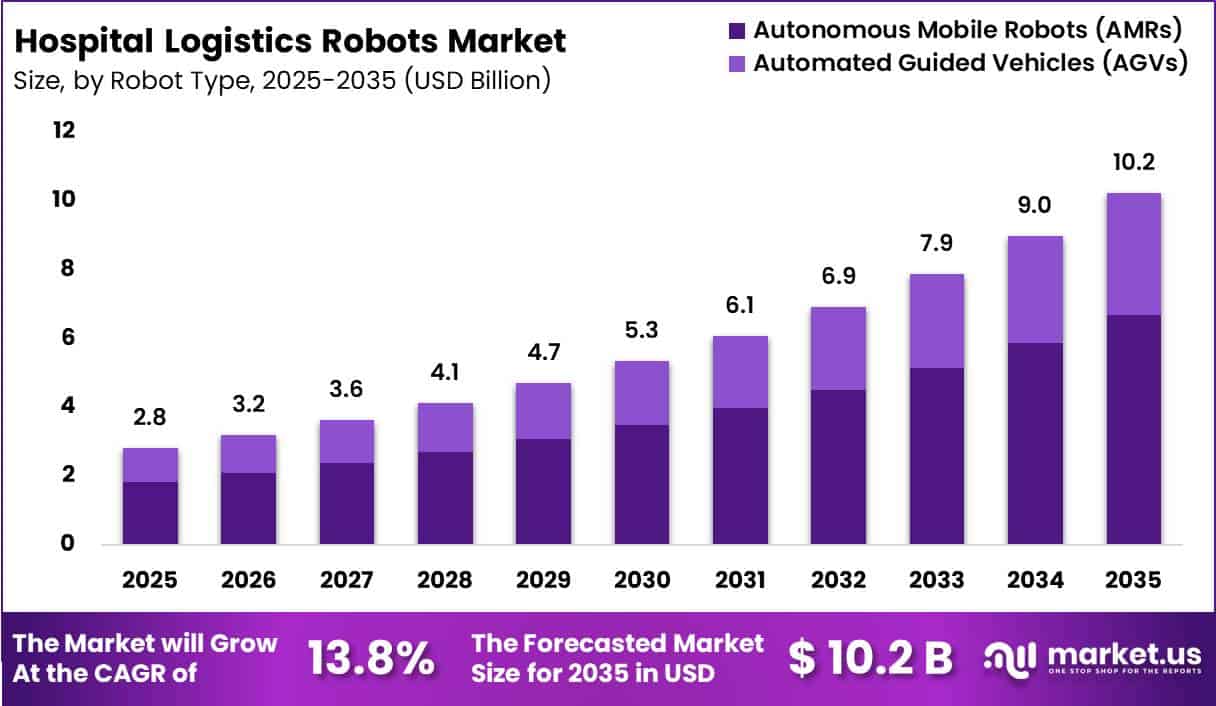
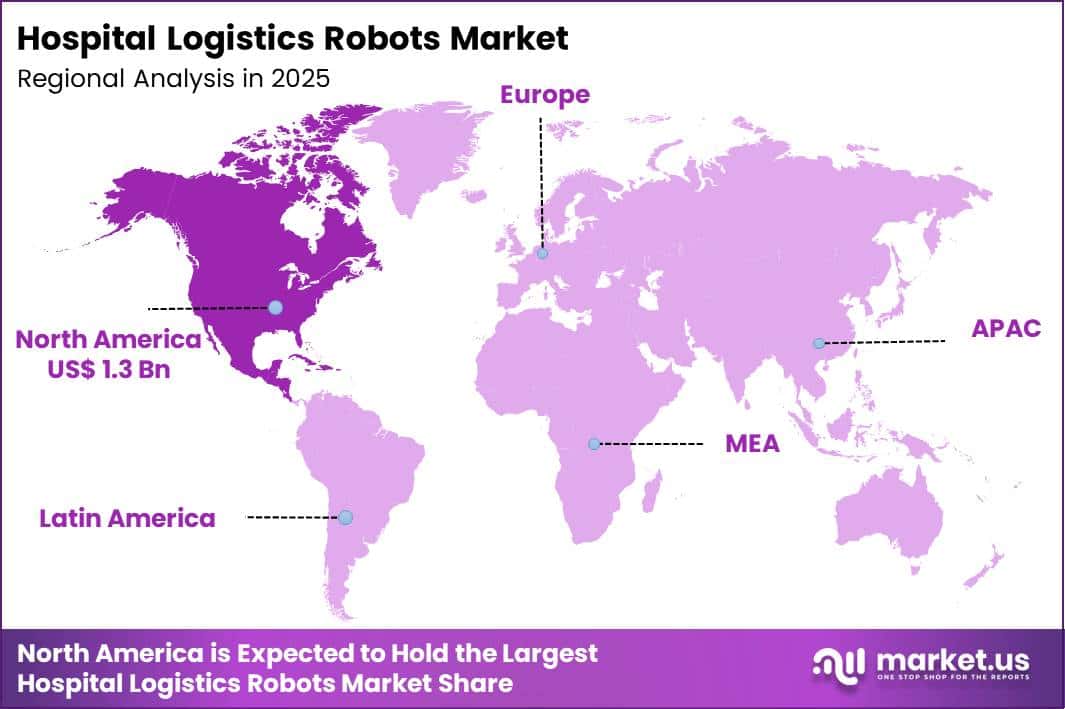
Global Hospital Logistics Robots Market size is expected to be worth around US$ 10.2 Billion by 2035 from US$ 2.8 Billion in 2025, growing at a CAGR of 13.8% during the forecast period from 2026 to 2035. In 2025, North America led the market, achieving over 45.2% share with a revenue of US$ 1.3 Billion.
Hospital logistics robots are becoming an important part of modern healthcare by automating the transport of medicines, laboratory samples, sterile supplies, meals, linens, and medical waste throughout hospitals.
These autonomous mobile robots (AMRs) help reduce the physical workload of healthcare staff, improve operational efficiency, and support timely delivery of essential supplies. By handling routine transportation tasks, hospitals can allow nurses and other clinical professionals to spend more time on direct patient care.
The growing adoption of hospital logistics robots is closely linked to the increasing focus on patient safety and infection prevention. According to the World Health Organization (WHO), 7 out of every 100 patients in acute-care hospitals in high-income countries and 15 out of every 100 patients in low- and middle-income countries acquire at least one healthcare-associated infection (HAI) during their hospital stay.
WHO also reports that effective infection prevention and control (IPC) programmes can reduce healthcare-associated infections by up to 70%, encouraging hospitals to adopt technologies that reduce unnecessary contact and improve workflow efficiency.
Hospital logistics robots operate continuously, navigating hospital corridors using advanced sensors, cameras, and autonomous navigation systems to deliver supplies safely and efficiently. Their deployment supports digital transformation initiatives by improving inventory movement, reducing manual transport errors, and strengthening hospital resilience.
According to the World Health Organization, more than 300 million surgical procedures are performed globally each year, creating substantial demand for efficient internal logistics systems that ensure critical medical supplies are available when needed while supporting high standards of patient care.
Key Takeaways
- Market Size: Global Hospital Logistics Robots Market size is expected to be worth around US$ 10.2 Billion by 2035 from US$ 2.8 Billion in 2025.
- Market Share: The market is growing at a CAGR of 13.8% during the forecast period from 2026 to 2035.
- Robot Type: In 2025,Autonomous Mobile Robots (AMRs) emerged as the leading robot type in the Hospital Logistics Robots Market, accounting for 65.2% of the total market share.
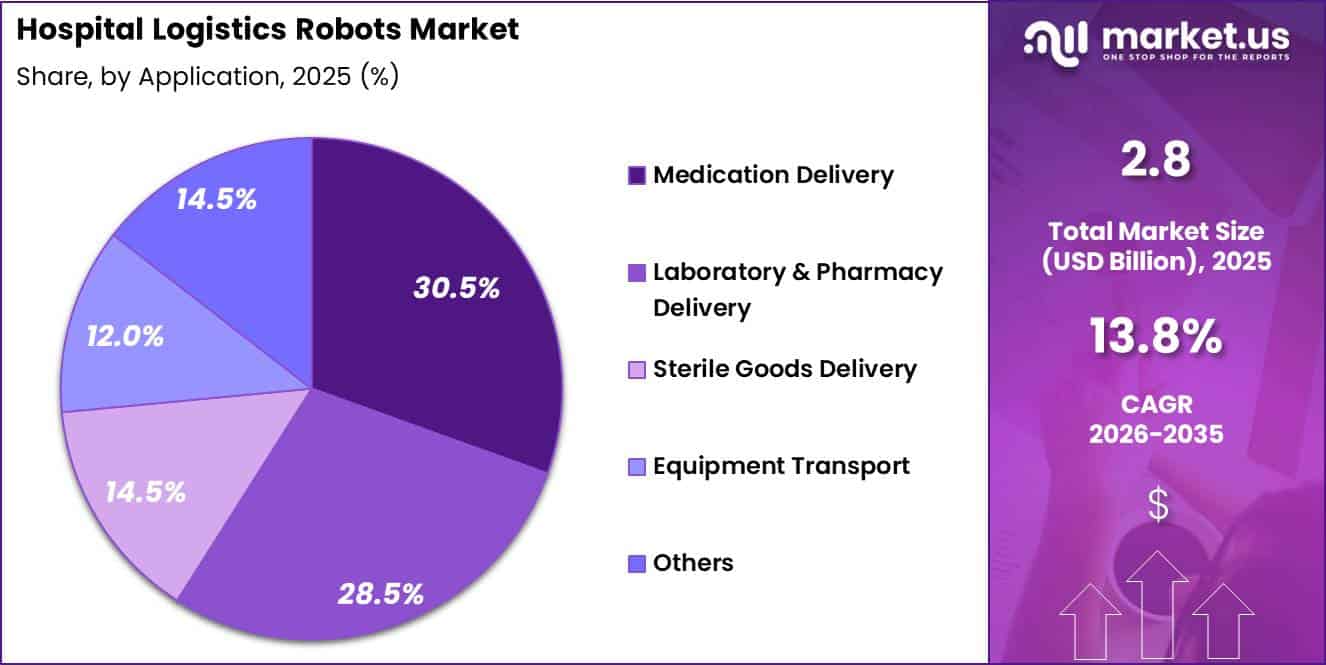
- Application: In 2025,Medication Delivery held the largest share of the Hospital Logistics Robots Market, capturing 30.5% of total revenue.
- Component: In 2025,Sensors dominated the Hospital Logistics Robots Market with a 28.4% market share.
- End User: In 2025,Hospitals accounted for the largest share of the Hospital Logistics Robots Market, representing 72.5% of total revenue.
- Regional Analysis: In 2025, North America led the market, achieving over 45.2% share with a revenue of US$ 1.3 Billion.
Robot Type Analysis
Autonomous Mobile Robots (AMRs) emerged as the leading robot type in the Hospital Logistics Robots Market.
In 2025, Autonomous Mobile Robots (AMRs) emerged as the leading robot type in the Hospital Logistics Robots Market, accounting for 65.2% of the total market share. Their dominance is driven by their ability to move independently using advanced navigation technologies such as LiDAR, cameras, and artificial intelligence.
Unlike fixed-path systems, AMRs can adapt to changing hospital environments, avoid obstacles, and safely transport medications, medical supplies, laboratory samples, and linens across multiple departments. Hospitals increasingly prefer AMRs because they reduce manual workload, improve delivery accuracy, and support continuous operations around the clock.
Their flexibility also allows easy deployment without major infrastructure modifications, making them suitable for both new and existing healthcare facilities. Growing investments in hospital automation and digital healthcare transformation further strengthen demand for AMRs.
Meanwhile,Automated Guided Vehicles (AGVs) represented 34.8% of the market in 2025. AGVs continue to play an important role in facilities with predictable transportation routes and repetitive logistics tasks. They operate efficiently on predefined paths using magnetic strips, lasers, or guide wires, making them reliable for routine movement of heavy equipment, waste, and bulk supplies.
Although less flexible than AMRs, AGVs remain a cost-effective solution for standardized hospital logistics operations.
Application Analysis
Medication Delivery held the largest share of the Hospital Logistics Robots Market.
In 2025,Medication Delivery held the largest share of the Hospital Logistics Robots Market, capturing 30.5% of total revenue. Hospitals increasingly deploy logistics robots to transport medicines from central pharmacies to patient wards, reducing delivery delays and minimizing medication handling errors.
Automated medication transport improves workflow efficiency, enhances patient safety, and enables healthcare professionals to spend more time on direct patient care. Growing demand for timely medication distribution, particularly in large hospitals and emergency departments, continues to support the widespread adoption of robotic delivery systems.
Laboratory & Pharmacy Delivery accounted for 28.5% of the market, reflecting strong demand for rapid movement of laboratory samples, blood products, diagnostic materials, and pharmaceutical supplies between departments.
Faster transportation improves laboratory turnaround times and operational efficiency.Sterile Goods Delivery represented 14.5%, driven by the need for contamination-free transport of surgical instruments and sterilized equipment. Equipment Transport contributed 12.0%, as hospitals increasingly automate the movement of wheelchairs, infusion pumps, monitoring devices, and other medical equipment.
The remaining 14.5% was classified under Others, including waste transportation, linen delivery, food services, and internal supply distribution. Together, these applications demonstrate the expanding role of logistics robots in improving hospital productivity and supporting efficient healthcare operations.
Component Analysis
Sensors dominated the Hospital Logistics Robots Market with a 28.4% market share.
In 2025,Sensors dominated the Hospital Logistics Robots Market with a 28.4% market share. Sensors serve as the foundation of autonomous hospital robots by enabling real-time obstacle detection, environmental mapping, navigation, and safe interaction with patients and healthcare staff.
Technologies such as LiDAR, ultrasonic sensors, infrared sensors, cameras, and proximity sensors help robots move accurately through busy hospital corridors while avoiding collisions. As hospitals demand higher levels of automation and safety, manufacturers continue integrating advanced sensor technologies that improve navigation precision, operational reliability, and autonomous decision-making capabilities.
Controllers form another essential component by managing robot movement, coordinating hardware functions, and ensuring smooth communication between subsystems.Software & AI Platforms continue gaining importance as hospitals adopt intelligent fleet management, route optimization, predictive maintenance, and workflow automation solutions.
Artificial intelligence also enables robots to learn from operational data and improve efficiency over time.Navigation Systems support precise indoor positioning through simultaneous localization and mapping (SLAM), enabling robots to navigate complex healthcare environments without human intervention.
The Others segment includes batteries, communication modules, drive systems, charging stations, actuators, and mechanical components that ensure reliable and uninterrupted robot performance. Continuous technological advancements across these components are improving operational efficiency, safety, and scalability of hospital logistics robots worldwide.
End User Analysis
Hospitals accounted for the largest share of the Hospital Logistics Robots Market.
In 2025,Hospitals accounted for the largest share of the Hospital Logistics Robots Market, representing 72.5% of total revenue. Large hospitals generate significant internal transportation requirements for medications, laboratory specimens, sterile supplies, medical equipment, food services, and waste management.
The growing emphasis on workflow automation, staff productivity, infection prevention, and operational efficiency has accelerated the deployment of logistics robots across hospitals. Increasing patient admissions, expanding healthcare infrastructure, and rising investments in smart hospital technologies further support this segment’s leadership. Hospitals also benefit from reduced labor costs, faster delivery times, and improved inventory management through autonomous robotic systems.
Ambulatory Surgical Centers (ASCs) represent another important end-user segment as these facilities increasingly automate logistics to support high patient turnover and efficient surgical workflows. Robotics helps ASCs improve supply distribution, instrument transport, and medication delivery while maintaining operational efficiency within compact healthcare environments.
The Others segment includes specialty clinics, rehabilitation centers, diagnostic laboratories, research institutes, and long-term care facilities. These healthcare organizations are gradually adopting logistics robots to streamline internal transportation processes, reduce manual handling, improve service quality, and enhance staff productivity. Growing digital transformation across healthcare continues to expand robot adoption beyond traditional hospital settings.
Key Market Segments
By Robot Type
- Autonomous Mobile Robots (AMRs)
- Automated Guided Vehicles (AGVs)
By Application
- Medication Delivery
- Laboratory & Pharmacy Delivery
- Sterile Goods Delivery
- Equipment Transport
- Others
By Component
- Sensors
- Controllers
- Software & AI Platforms
- Navigation Systems
- Others
By End User
- Hospitals
- Ambulatory Surgical Centers
- Others
Drivers
Patient Safety Automation in Medication and Transport Workflows.
Patient safety remains a major global healthcare challenge, with WHO estimating that about 1 in 10 hospitalized patients experience harm, and over half of these events are considered preventable. This elevates internal hospital logistics such as medication delivery, specimen transport, and patient movement to critical safety infrastructure rather than purely operational support functions.
The Joint Commission’s 2026 shift toward National Performance Goals reinforces this focus, emphasizing patient identification, communication accuracy, medication safety, and reduction of preventable harm. These requirements increasingly favor automated systems that integrate robotics with barcode scanning, smart medication cabinets, elevator systems, and centralized dispatch platforms.
Unlike traditional porter based workflows, automated transport systems improve traceability, reduce handoff errors, and standardize delivery times, which helps minimize variability in high risk environments like medication administration and lab specimen handling.
From a market perspective, the value proposition extends beyond labor efficiency to include reduced medical errors, improved compliance, and stronger audit readiness. This positions automation vendors to benefit most in North America and Europe, where safety regulations and performance reporting requirements are more stringent and consistently enforced.
| Driver | (~) % Impact on CAGR Forecast | Geographic Relevance | Impact Timeline |
|---|---|---|---|
| Patient-safety automation in medication and transport workflows | +2.4% | North America core, EU, Japan, South Korea, GCC tertiary hubs | Short term (≤ 2 years) |
| Hospital labor scarcity and task-shifting economics | +2.1% | North America core, EU, APAC metros, Australia | Short term (≤ 2 years) |
| Connected-device regulation and cyber-compliant procurement | +1.5% | U.S. core, EU, UK, advanced APAC | Medium term (2-4 years) |
| Reimbursement and margin pressure driving nonclinical productivity | +1.7% | U.S. core, Western Europe, developed APAC | Medium term (2-4 years) |
| Supply-chain resilience and inventory visibility digitization | +1.3% | U.S., EU, Japan, Singapore, Middle East flagship hospitals | Medium term (2-4 years) |
| AI-enabled hospital operations and fleet orchestration maturity | +1.9% | U.S., China, EU, South Korea, Singapore | Long term (≥ 4 years) |
Challenges
Complex Intra Hospital Integration in Logistics Robotics.
Hospital logistics robots must operate across 20–40 distinct workflows, including medication delivery, lab sample transport, linen handling, meal distribution, and sterile supply movement. Each workflow has unique timing, access control, and safety requirements, requiring deep integration with elevator systems, door controls, pharmacy automation, and EHR linked inventory platforms.
In early deployments, integration timelines often extend 6–12 months beyond initial expectations. Around 15–25% of robot missions face exceptions such as blocked corridors, access errors in automated dispensing systems, or conflicting priority rules, reducing effective utilization from a target of 18–20 hours per day to about 11–14 hours. This limits fleet scalability within a single hospital to roughly 30–40 units in many cases.
These challenges add 3–5% to total project costs and require significant ongoing supervision, often 50–80 additional staff hours per week. As a result, expected cost savings per robot can be reduced by 8–12% in early years, delaying broader rollout decisions.
Overall, integration complexity remains a key barrier to scale, slowing adoption until systems achieve consistently high mission success rates and standardized interoperability across hospital infrastructure.
| Challenge | (~) % CAGR Friction Drag | Geographic Relevance | Mitigation Horizon |
|---|---|---|---|
| Complex intra-hospital integration | -1.4% | North America core, EU hospital hubs, advanced APAC | Medium term (2-4 years) |
| Elevator and corridor congestion | -0.8% | Dense urban hospitals globally | Medium term (2-4 years) |
| Robust cybersecurity & data compliance | -1.1% | US, EU, high-digitization Asia | Long term (≥ 4 years) |
| Workforce adoption & process redesign | -1.3% | Global tertiary hospitals | Medium term (2-4 years) |
| Capital efficiency under reimbursement uncertainty | -1.6% | US, EU, selected emerging markets | Long term (≥ 4 years) |
| Multi-vendor interoperability & uptime | -1.0% | Large multi-site health systems | Medium term (2-4 years) |
Restraints
High Upfront CapEx and Slow ROI in Hospital Logistics Robotics.
Hospital logistics robotics adoption is constrained by high initial capital requirements and slower than expected payback periods. Typical deployments of 10–20 autonomous mobile robots require upfront investments of around USD 1.5–3.0 million, plus ongoing annual service and software costs of 15–20%, along with additional IT integration expenses.These projects compete directly with other high priority hospital investments such as imaging systems, ICU expansion, and EHR upgrades.
As a result, capital committees often require payback within 24–36 months, while real world productivity gains such as 12–18% improvements in materials handling and 10–15% nursing time reallocation tend to translate into ROI timelines of 4–6 years once full workflow redesign and maintenance are included.
To address this mismatch, vendors are increasingly offering robotics as a service models with monthly fees per site, but hospitals still view these as semi fixed operational costs, especially when efficiency gains are partially offset by new coordination and IT oversight roles.
Overall, this cost and payback gap slows adoption decisions, extends sales cycles, and defers some deployments, reducing near term market growth momentum in hospital logistics robotics.
| Restraint | (~) % Impact on CAGR Forecast | Geographic Relevance | Impact Timeline |
|---|---|---|---|
| High upfront CapEx & slow ROI | -2.5% | North America core, EU, APAC tier-1 | Medium term (2-4 years) |
| Regulatory and classification friction for medical robots | -1.8% | North America, EU, China, India | Medium term (2-4 years) |
| Cybersecurity, data protection & interoperability gaps | -1.5% | North America core, EU, APAC corridors | Long term (≥ 4 years) |
| Skilled workforce and change-management bottlenecks | -1.4% | Global, stronger in LATAM, MEA, APAC tier-2 | Medium term (2-4 years) |
| Supply chain volatility for robotic components | -1.7% | EU, North America, APAC manufacturing hubs | Short–Medium term (≤ 4 years) |
| Hospital infrastructure & reimbursement misalignment | -2.1% | North America, EU, emerging Asia | Long term (≥ 4 years) |
Opportunity
Integrated Medication–Lab–Supply AMR Platforms in Hospitals.
This opportunity centers on unified autonomous mobile robot (AMR) platforms that combine medication delivery, lab specimen transport, and general supply logistics into a single orchestration layer integrated with hospital IT systems.
Today’s deployments are typically siloed by function pharmacy, lab, or supplies delivering 15–22% logistics cost reduction and 20–30% improvements in delivery efficiency, but still leaving 30–40% of material movement dependent on manual processes.
An integrated platform could significantly expand value by coordinating all intra hospital logistics through a single system, improving utilization and reducing duplication. For a typical 500 bed hospital, this could generate an additional USD 1.5–2.0 million annually through software licensing, fleet management, and performance based contracts, driven by incremental labor savings equivalent to several full time staff positions.
At broader scale, if 15–20% of hospitals in North America and Europe adopt integrated AMR systems by 2030, the segment could add USD 3–4 billion in incremental market value. This shift also moves vendors from hardware centric models toward higher margin software and orchestration platforms.
Overall, this represents a next phase evolution of hospital robotics, but remains an emerging opportunity because most systems today still operate in isolated workflows with limited interoperability and shallow integration into hospital wide data systems.
| Opportunity | (~) % Potential CAGR Upside | Geographic Relevance | Execution Window |
|---|---|---|---|
| Integrated meds–lab–supply AMR platforms | +2.0% | North America core, EU | Medium term (2-4 years) |
| Outsourced “Robotics-as-a-Service” hospital logistics | +1.5% | North America, EU, APAC emerging markets | Short term (≤ 2 years) |
| AI-optimized clinical logistics tied to LOS & adverse events KPIs | +1.3% | North America, EU, GCC | Medium term (2-4 years) |
| Pharmacy & therapeutics cold-chain automation inside hospitals | +1.0% | North America, EU, East Asia | Long term (≥ 4 years) |
| Multi-hospital robotic logistics networks & M&A roll-ups | +1.2% | North America, EU | Long term (≥ 4 years) |
| Infection-control & biohazard waste robotics for regulatory compliance | +0.8% | North America, EU, APAC | Medium term (2-4 years) |
Regional Analysis
In 2025, North America dominated the Hospital Logistics Robots Market.
North America dominated the Hospital Logistics Robots Market in 2025, accounting for more than 45.2% of the global market and generating approximately US$ 1.3 billion in revenue. The region’s leadership is supported by the rapid adoption of healthcare automation, advanced hospital infrastructure, and increasing investments in digital health technologies.
Hospitals across the United States and Canada are deploying autonomous mobile robots (AMRs) and automated guided vehicles (AGVs) to transport medications, laboratory samples, sterile supplies, and medical equipment. These robotic systems help improve operational efficiency, reduce human errors, and address ongoing healthcare workforce shortages.
The region also benefits from strong healthcare spending, widespread implementation of electronic health records (EHRs), and continuous investments in smart hospital projects. Healthcare providers are increasingly adopting robotic logistics solutions to enhance patient safety, streamline internal supply chains, and minimize infection risks through contactless delivery.
The presence of leading robotics manufacturers, favorable regulatory support for healthcare innovation, and growing demand for automated hospital operations continue to strengthen North America’s market position. These factors are expected to help the region maintain its leadership in the Hospital Logistics Robots Market throughout the forecast period.
Key Regions and Countries
North America
- The US
- Canada
Europe
- Germany
- France
- The U.K.
- Italy
- Spain
- Russia & CIS
- Rest of Europe
Asia Pacific
- China
- India
- Japan
- South Korea
- ASEAN
- Australia & New Zealand
- Rest of Asia Pacific
Middle East & Africa
- GCC
- South Africa
- Rest of Middle East & Africa
Latin America
- Brazil
- Mexico
- Rest of Latin America
Key Player Analysis
The Hospital Logistics Robots Market is moderately consolidated, with competition centered on technological innovation, intelligent automation, and workflow optimization. Companies are investing in autonomous navigation, artificial intelligence, fleet management software, and seamless integration with hospital information systems to strengthen their market position.
Aethon, Inc., Swisslog Holding AG (a KUKA Group company), Omnicell, Inc., Mobile Industrial Robots (MiR), and Diligent Robotics, Inc. are among the leading participants driving innovation in hospital logistics automation.
Other prominent companies operating in the market include Locus Robotics Corporation, Pudu Robotics Technology Co., Ltd., Vecna Robotics LLC, Relay Robotics Inc., Yujin Robot Co., Ltd., Keenon Robotics Co., Ltd., Panasonic Holdings Corporation, Toshiba Corporation, Yaskawa Electric Corporation, KUKA AG, ABB Ltd., BlueBotics SA, PAL Robotics SL, Richtech Robotics Co., Ltd., Robotnik Automation S.L.L., and Others.
Competitive strategies are primarily focused on research and development, strategic partnerships, and continuous product innovation. Leading companies are introducing robots with enhanced autonomous navigation, obstacle avoidance, and intelligent fleet coordination to improve medication delivery, laboratory transport, and sterile goods handling.
Collaboration with hospitals, healthcare technology providers, and software companies enables better workflow integration and operational efficiency. Vendors are also expanding ecosystem-based solutions by combining robotics with AI, cloud-based fleet management, IoT connectivity, and hospital information systems.
This integrated approach helps healthcare facilities optimize logistics operations, reduce labor dependency, improve supply chain visibility, and support the broader transition toward smart hospitals and digital healthcare infrastructure.
Top Key Players
- Aethon, Inc.
- Diligent Robotics, Inc.
- Locus Robotics Corporation
- Pudu Robotics Technology Co., Ltd.
- Omnicell, Inc.
- Vecna Robotics LLC
- Swisslog Holding AG (a KUKA Group company)
- Mobile Industrial Robots (MiR)
- Relay Robotics Inc.
- Yujin Robot Co., Ltd.
- Keenon Robotics Co., Ltd.
- Panasonic Holdings Corporation
- Toshiba Corporation
- Yaskawa Electric Corporation
- KUKA AG
- ABB Ltd.
- BlueBotics SA
- PAL Robotics SL
- Richtech Robotics Co., Ltd.
- Robotnik Automation S.L.L.
- Others
Recent Developments
- In January 2026, Serve Robotics announced the acquisition of Diligent Robotics. The acquisition expands Serve Robotics into the healthcare automation market while strengthening its AI-powered robotics portfolio. The combined platform is expected to accelerate innovation and large-scale deployment of autonomous hospital robots.
- In September 2025, Swisslog Healthcare and Diligent Robotics entered a strategic partnership to deploy autonomous last-mile delivery robots in U.S. hospitals. The agreement combines Swisslog’s hospital automation solutions with Diligent’s Moxi robots to improve medication transport, workflow efficiency, and traceability across healthcare facilities
- In September 2025, ST Engineering Aethon (Aethon, Inc.) partnered with Oracle to integrate Aethon’s autonomous mobile robots with Oracle Fusion Cloud Advanced Inventory Management. The partnership enables automated inventory transport, real-time stock visibility, and seamless workflow integration, helping hospitals improve supply chain efficiency and reduce manual handling.
Report Scope
| Report Features | Description |
|---|---|
| Market Value (2025) | US$2.8 Billion |
| Forecast Revenue (2035) | US$10.2 Billion |
| CAGR (2026-2035) | 13.8% |
| Base Year for Estimation | 2025 |
| Historic Period | 2020-2024 |
| Forecast Period | 2026-2035 |
| Report Coverage | Revenue Forecast, Market Dynamics, Competitive Landscape, Recent Developments |
| Segments Covered | By Robot Type (Autonomous Mobile Robots (AMRs), Automated Guided Vehicles (AGVs)), By Application (Medication Delivery, Laboratory & Pharmacy Delivery, Sterile Goods Delivery, Equipment Transport, Others), By Component (Sensors, Controllers, Software & AI Platforms, Navigation Systems, Others), By End User (Hospitals, Ambulatory Surgical Centers, Others) |
| Regional Analysis | North America – The US, Canada; Europe – Germany, France, U.K., Italy, Spain, Russia & CIS, Rest of Europe; Asia Pacific – China, India, Japan, South Korea, ASEAN, Australia & New Zealand, Rest of Asia Pacific; Middle East & Africa – GCC, South Africa, Rest of Middle East & Africa; Latin America – Brazil, Mexico, Rest of Latin America |
| Competitive Landscape | Aethon, Inc., Diligent Robotics, Inc., Locus Robotics Corporation, Pudu Robotics Technology Co., Ltd., Omnicell, Inc., Vecna Robotics LLC, Swisslog Holding AG (a KUKA Group company), Mobile Industrial Robots (MiR), Relay Robotics Inc., Yujin Robot Co., Ltd., Keenon Robotics Co., Ltd., Panasonic Holdings Corporation, Toshiba Corporation, Yaskawa Electric Corporation, KUKA AG, ABB Ltd., BlueBotics SA, PAL Robotics SL, Richtech Robotics Co., Ltd., Robotnik Automation S.L.L., Others |
| Customization Scope | Customization for segments, region/country-level will be provided. Moreover, additional customization can be done based on the requirements. |
| Purchase Options | We have three licenses to opt for: Single User License, Multi-User License (Up to 5 Users), Corporate Use License (Unlimited User and Printable PDF) |





































