Report Overview
Global Hermetic Storage Bags Market size is expected to be worth around USD 4.3 Billion by 2035 from USD 2.4 Billion in 2025, growing at a CAGR of 5.8% during the forecast period 2026 to 2035.
The hermetic storage bags market covers flexible, airtight packaging solutions designed to preserve grain, seed, pulses, coffee, and other agricultural commodities through oxygen exclusion rather than chemical treatment. Products range from small household bags under 25 kg to large-format FIBC bulk containers above 500 kg, serving smallholder farmers, commercial cooperatives, seed enterprises, and specialty commodity exporters across global agricultural supply chains.
Key Takeaways
- The Hermetic Storage Bags Market is valued at USD 2.4 Billion in 2025 and is expected to reach USD 4.3 Billion by 2035, growing at a CAGR of 5.8%.
- Triple-Layer Hermetic Storage Bags leads the By Product Type segment with a 34.00% market share in 2025.
- Polyethylene (PE) holds a dominant 42.00% share in the By Material segment in 2025.
- The 51–100 kg capacity range holds a dominant 47.00% share in the By Capacity segment in 2025.
- Grain Storage leads the By Application segment with a 45.00% market share in 2025.
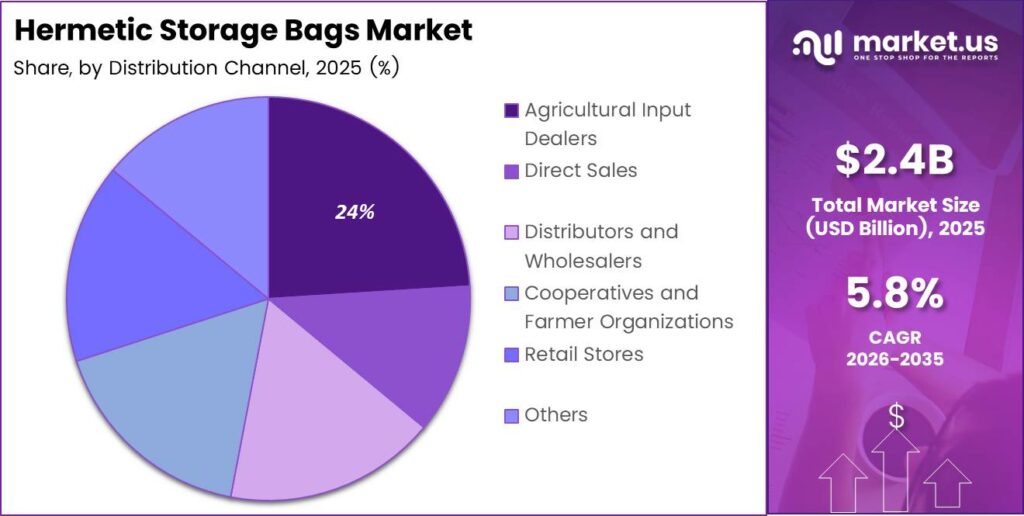
- Agricultural Input Dealers leads the By Distribution Channel segment with a 24.00% market share in 2025.
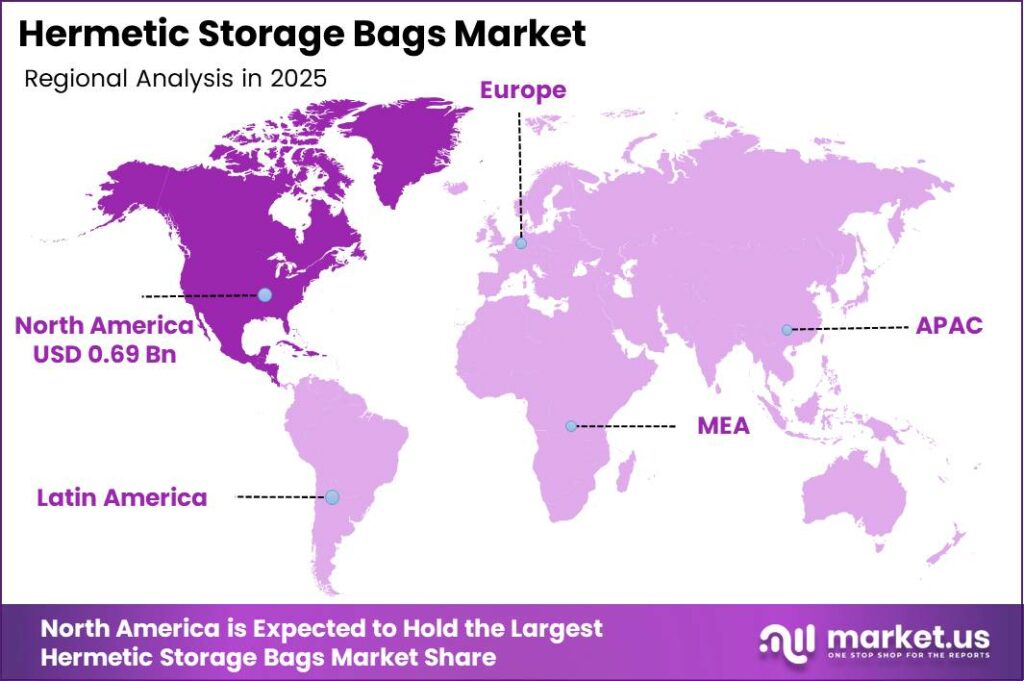
- North America dominates the global market with a 29.00% share, valued at USD 0.69 Billion in 2025.
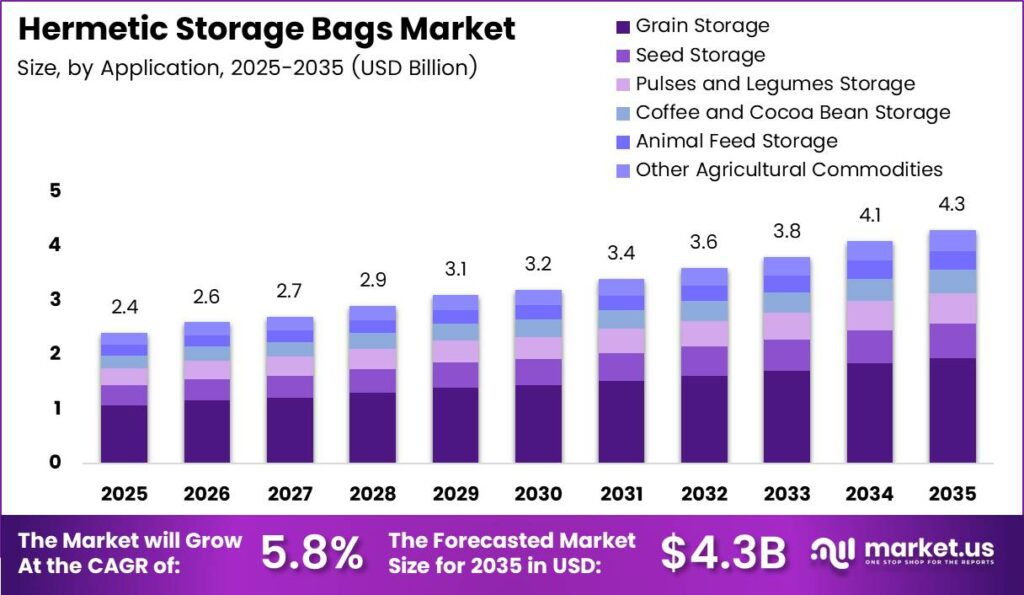
As per our research, hermetic storage bags cost between USD 1.20 and USD 2.50 per 50 kg unit, placing them within reach of commercially active smallholders while still requiring upfront financing at harvest time. This pricing structure creates a clear entry point for agricultural input dealers and microfinance-linked distribution programs to drive volume adoption at the farm level.
According to FAO, global cereal production in 2026 is forecast at 2,979 million tonnes, representing a 2.1% decline from the previous year’s record output. Lower production volumes increase the economic value of every harvested tonne stored, making post-harvest loss prevention a direct commercial priority for grain-producing households and commodity traders alike.
This reflects a structural demand signal for storage solutions that protect against loss without chemical inputs. Governments across Sub-Saharan Africa and South Asia have channeled investment into post-harvest infrastructure, accelerating hermetic bag adoption through procurement programs and farmer demonstration networks. Institutional buyers and NGO procurement channels now represent a parallel distribution route alongside private agricultural input dealers.
Product Type Analysis
Triple-Layer Hermetic Storage Bags dominates with 34.00% due to superior multi-barrier oxygen exclusion performance.
In 2025, Triple-Layer Hermetic Storage Bags held a dominant market position in the By Product Type segment of the Hermetic Storage Bags Market, with a 34.00% share. FAO technical guidance confirms that multi-layer barrier structures reduce oxygen transmission more effectively than single-layer alternatives, protecting grain quality across extended storage cycles. Ecotact’s commercially deployed hermetic packaging uses 9 high-barrier layers, demonstrating that barrier count directly correlates with performance claims for premium buyers in commercial markets. In July 2026, GrainPro conducted a live demonstration of its GrainSafe Bag at the 24th Agri Intex exhibition in Coimbatore, India, attended by seed companies, agribusinesses, and distributors, confirming active commercial interest in technically differentiated bag formats.
Single-Layer Hermetic Storage Bags serve cost-sensitive smallholder buyers who prioritize upfront affordability over extended multi-season performance. FAO data shows that hermetic bags remain the most accessible post-harvest loss reduction tool in low-income farming regions where cold storage and metal silos are unavailable. The World Bank estimates that 470 million smallholder farms operate globally, representing the primary addressable market for entry-level single-layer formats. Vendors targeting this segment compete on per-unit price and dealer availability rather than technical specification.
Multi-Layer Hermetic Storage Bags occupy the mid-tier between single-layer and triple-layer formats, serving cooperative buyers and commercial grain aggregators who require extended storage without investing in premium barrier technology. USDA reports that grain stored at moisture levels below 13% can maintain marketable quality for up to 12 months with effective hermetic sealing, validating the commercial case for mid-tier bag adoption at the cooperative level. Buyers at this tier typically purchase in bulk quantities, creating predictable reorder cycles for distributors and manufacturers.
Material Analysis
Polyethylene (PE) dominates with 42.00% due to cost-effective flexible barrier film availability.
In 2025, Polyethylene (PE) held a dominant market position in the By Material segment of the Hermetic Storage Bags Market, with a 42.00% share. IRRI’s February 2026 article reported that the Super Grain Bag uses a 60 µm-thick polyethylene liner coated with a gas barrier, confirming PE’s structural role in commercially deployed hermetic storage products. IRRI further reported that Super Grain Bags can be reused for up to 3 years, giving PE-based products a lifecycle cost advantage over single-use alternatives. This reuse profile reduces per-season cost and supports farmer uptake in markets where first-purchase price is the primary adoption barrier.
Polypropylene (PP) serves higher-load applications where structural rigidity and resistance to physical stress during transport are critical. The IFC estimates that post-harvest losses in Sub-Saharan Africa reduce farmer income by 15% to 20% annually, creating commercial demand for durable bag materials that withstand repeated handling. PP-based formats capture buyers in commercial aggregation and cooperative storage settings where bags are loaded, relocated, and stacked at scale. This structural performance premium supports a higher price point than PE equivalents.
Polyamide (PA/Nylon) targets specialty applications requiring high oxygen and moisture barrier performance for sensitive commodities including certified seeds, specialty coffee, and processed agricultural products. The OECD reports that certified seed trade represents a growing share of agricultural input spending in emerging markets, with seed sector investment rising across South Asia and East Africa. PA-based bags command a margin premium over PE and PP formats due to material cost and technical specification requirements. This positions PA as a volume-limited but margin-rich segment for manufacturers investing in specialty crop product lines.
Capacity Analysis
51–100 kg capacity dominates with 47.00% due to direct alignment with smallholder harvest volumes.
In 2025, the 51–100 kg capacity range held a dominant market position in the By Capacity segment of the Hermetic Storage Bags Market, with a 47.00% share. FAO data shows that smallholder farms in Sub-Saharan Africa and South Asia typically harvest between 50 kg and 200 kg per crop cycle, placing the 51–100 kg bag directly within standard household storage volumes. PICS Global presents a modeled calculation in which 50 million bags of 100 kg capacity store 5 million tonnes per season, equivalent to 15 million tonnes across three seasons of reuse, illustrating the aggregate food security impact this capacity tier can deliver at scale.
The 101–500 kg capacity range serves commercial grain aggregators, rural cooperatives, and mid-scale producers who consolidate grain from multiple farms before sale or processing. The World Bank estimates that grain aggregation by cooperatives increases smallholder selling prices by 10% to 25% by reducing individual transaction costs and improving bargaining power. Buyers in this capacity tier prioritize structural durability and consistent sealing integrity across repeated loading cycles. This creates a higher-value per-unit sale for manufacturers relative to the sub-100 kg tier.
The Above 500 kg FIBC and bulk liner segment targets large-scale commercial storage operations, port-side grain handling, and commodity export logistics. UNCTAD reports that global bulk agricultural commodity trade exceeded 1.7 billion tonnes in recent years, with a significant share transiting through containerized and bulk shipping channels. Bulk hermetic liners protect grain during international transit by maintaining atmospheric control inside standard shipping containers. This segment commands the highest per-unit revenue and serves a more concentrated buyer base than smallholder-focused capacity tiers.
Application Analysis
Grain Storage dominates with 45.00% due to staple crop volume scale and post-harvest loss urgency.
In 2025, Grain Storage held a dominant market position in the By Application segment of the Hermetic Storage Bags Market, with a 45.00% share. FAO estimates that post-harvest losses in developing countries reduce available food supply by 14% annually, with grain accounting for the largest share of lost value. IRRI’s February 2026 article reported that in a field trial, the Super Grain Bag, priced at approximately ₹100 per unit, enabled smallholder rice farmers to reduce storage losses and increase income by storing grain beyond immediate harvest-season price lows. This direct income linkage makes grain storage the most commercially motivated application category across smallholder and commercial buyer segments alike.
Seed Storage represents a technically demanding sub-category where hermetic bags must maintain germination rates rather than simply prevent visible pest damage. FAO guidance specifies that hermetic conditions are suitable for appropriately dried seed, with high-value varieties requiring moisture levels near 8% for safe long-term viability. The International Seed Federation reports that certified seed demand in developing markets grows at roughly 6% annually, creating a commercially expanding base for seed-grade hermetic storage products. Vendors serving this segment must supply documented performance data to seed enterprises and government certification bodies.
Coffee and Cocoa Bean Storage has attracted commercially differentiated product development as specialty coffee roasters and exporters require oxygen-controlled storage to protect flavor profiles. Ecotact’s Mini 20 high-barrier, resealable coffee bag holds 50 g of green coffee, 20 g of roasted coffee, or 20 g of ground coffee, targeting specialty sample packaging where quality preservation during transit directly affects buyer evaluation outcomes. The Specialty Coffee Association estimates that the specialty coffee segment represents over 50% of total US coffee value, reinforcing commercial demand for precision storage formats at the premium end of the market.
Distribution Channel Analysis
Agricultural Input Dealers dominate with 24.00% due to embedded trust within existing farmer purchase cycles.
In 2025, Agricultural Input Dealers held a dominant market position in the By Distribution Channel segment of the Hermetic Storage Bags Market, with a 24.00% share. The World Bank reports that over 80% of smallholder farmers in Sub-Saharan Africa purchase agricultural inputs from local dealers rather than formal retail chains, confirming the structural importance of this channel for hermetic bag penetration. Input dealers stock seed, fertilizer, and crop protection products alongside storage solutions, creating a bundled purchase environment that reduces consumer education costs for hermetic bag manufacturers. Vendors that establish dealer stocking agreements gain a distribution advantage that is difficult for direct-to-farmer online competitors to replicate quickly.
Government and NGO Procurement Programs function as a parallel demand channel that operates independently of commercial pricing dynamics and often serves markets where private retail infrastructure is absent. USAID procurement data shows that donor-funded agricultural programs in Sub-Saharan Africa disbursed over USD 2 billion in post-harvest support investments between 2010 and 2024, with hermetic storage equipment included as a standard component in many country programs. This channel creates bulk, predictable purchase volumes but concentrates revenue risk around grant cycles and policy changes. Manufacturers that rely on procurement programs without building commercial dealer networks face revenue volatility when institutional funding shifts.
Online Retail and E-Commerce is an emerging distribution channel in markets with growing smartphone penetration and mobile payment infrastructure. The ITU reports that mobile internet subscriptions in Sub-Saharan Africa reached 615 million by the end of 2023, creating a technically reachable digital buyer base across key hermetic storage markets. Direct-to-farmer digital sales reduce dealer margin leakage and enable manufacturers to collect end-user purchase data for product development decisions. However, last-mile delivery costs and limited cold-chain logistics infrastructure constrain online channel growth in remote agricultural regions.
Key Market Segments
By Product Type
- Triple-Layer Hermetic Storage Bags
- Single-Layer Hermetic Storage Bags
- Multi-Layer Hermetic Storage Bags
- Hermetic FIBC / Bulk Storage Bags
- Hermetic Liners and Inner Bags
By Material
- Polyethylene (PE)
- Polypropylene (PP)
- Polyamide (PA / Nylon)
- Others
By Capacity
- Below 25 kg
- 25–50 kg
- 51–100 kg
- 101–500 kg
- Above 500 kg
By Application
- Grain Storage
- Seed Storage
- Pulses and Legumes Storage
- Coffee and Cocoa Bean Storage
- Animal Feed Storage
- Other Agricultural Commodities
By Distribution Channel
- Agricultural Input Dealers
- Direct Sales
- Distributors and Wholesalers
- Cooperatives and Farmer Organizations
- Retail Stores
- Online Retail / E-Commerce
- Government and NGO Procurement Programs
Regional Analysis
North America Dominates the Hermetic Storage Bags Market with a Market Share of 29.00%, Valued at USD 0.69 Billion
North America holds a 29.00% share of the global hermetic storage bags market, valued at USD 0.69 Billion in 2025. The region’s dominance reflects its large commercial grain production base, well-developed agricultural input dealer networks, and active institutional buyer community including USAID-funded post-harvest programs operating across international supply chains. US-based manufacturers and distributors supply hermetic bag products to both domestic large-scale grain operations and export-oriented procurement programs targeting Sub-Saharan Africa and South Asia.
Asia Pacific represents the fastest-growing regional market, driven by the concentration of smallholder rice and grain producers across India, Bangladesh, Vietnam, and the Philippines. The region accounts for the majority of global smallholder farm units, and government-backed post-harvest programs in India and Southeast Asia have accelerated hermetic bag adoption through subsidized distribution and farmer training. This creates a compounding demand base as commercially successful first-season adopters drive peer-to-peer awareness in agricultural communities. Investors entering this region benefit from both institutional procurement volumes and an emerging private retail channel.
Sub-Saharan Africa and Latin America represent high-potential growth regions where post-harvest loss rates remain above the global average and institutional infrastructure investment continues to build commercial demand. FAO data identifies Sub-Saharan Africa as one of the highest post-harvest loss regions globally, with cereal losses exceeding 10% of production value in several countries. Latin America’s specialty coffee and cocoa sectors generate demand for premium hermetic packaging at the cooperative and export processing level. These two regions collectively represent the largest addressable expansion opportunity for manufacturers scaling beyond North America and Asia Pacific.
Key Regions and Countries
North America
- US
- Canada
Europe
- Germany
- France
- The UK
- Spain
- Italy
- Rest of Europe
Asia Pacific
- China
- Japan
- South Korea
- India
- Australia
- Rest of APAC
Latin America
- Brazil
- Mexico
- Rest of Latin America
Middle East and Africa
- GCC
- South Africa
- Rest of MEA
Market Dynamics
Market Opportunity Analysis - Underserved capacity tiers and specialty crop segments offer entry points for focused manufacturers
The Below 25 kg and 25–50 kg capacity tiers remain underserved relative to the dominant 51–100 kg segment, which holds 47.00% of the market. Urban and peri-urban smallholders who store smaller grain quantities per cycle represent a distinct buyer profile not addressed by current bag formats optimized for rural harvest volumes. Manufacturers that develop purpose-sized products for sub-25 kg storage gain access to an urban agricultural buyer segment with higher price tolerance and greater proximity to modern retail channels.
Pulses and Legumes Storage and Animal Feed Storage together occupy sub-segments within the By Application category that receive limited product development attention compared to grain and coffee. FAO reports that pulse production in South Asia and East Africa has grown consistently, driven by protein-demand increases and government diversification programs. However, this segment generates only marginal evidence of dedicated hermetic bag product lines optimized for pulse density, shape, and outgassing characteristics. New entrants that develop pulse-specific hermetic formats and market them through existing grain dealer networks gain differentiated shelf positioning without requiring new distribution infrastructure.
Ecotact’s cumulative sales exceeding 30 million bags confirm that commercial-scale demand exists across Sub-Saharan Africa, yet distribution penetration in rural secondary markets remains thin relative to total smallholder population. Cooperative and Farmer Organization channels hold an underdeveloped share of the By Distribution Channel segment, despite representing consolidated buyer units that reduce per-unit sales cost significantly. Manufacturers that invest in cooperative channel development now establish volume relationships before competing brands reach these aggregated buyer groups. This is particularly relevant in East Africa, where coffee and grain cooperative networks represent structured purchasing entities with reliable seasonal procurement budgets.
The Government and NGO Procurement Programs channel creates a replicable template for commercial market entry across geographies where institutional demand has already validated product performance. Regions where WFP, USAID, or national government post-harvest programs have established hermetic bag supply chains represent pre-qualified markets for commercial distribution expansion. Dealers operating in these regions already understand the product category, reducing buyer education cost for new entrants. Manufacturers that enter these markets immediately after institutional program cycles end capture commercially motivated repeat buyers before competitors identify the market transition.
Technology and Innovation Landscape - Material science advances and barrier engineering are redefining storage performance thresholds
The Super Grain Bag developed by IRRI uses a 60 µm-thick polyethylene liner with a gas-barrier coating, delivering a water-vapor transmission rate below 5 g/m²/day as reported in IRRI’s February 2026 article. This specification sets a measurable technical benchmark for moisture control performance in polyethylene-based hermetic bags deployed across humid tropical rice-producing regions. Manufacturers that publish equivalent transmission rate data differentiate on verifiable engineering criteria rather than unverifiable field claims, creating a technical sales argument that resonates with seed enterprises and commercial grain buyers who require documented storage performance.
Ecotact’s nine-layer high-barrier construction, as stated on its official website, represents a commercial application of multi-layer co-extrusion technology that maximizes oxygen exclusion beyond what single or triple-layer structures can achieve. This barrier architecture requires more complex manufacturing investment but commands premium pricing in specialty crop, seed, and coffee storage applications where oxygen sensitivity directly affects commodity value. As per our research, hermetic bag manufacturers that invest in multi-layer barrier engineering now establish a product tier that low-cost single-layer competitors cannot match on performance, protecting margin in premium segments as overall market pricing faces downward pressure from volume-driven commodity producers.
GrainPro’s GrainSafe Bag, demonstrated live at the 24th Agri Intex exhibition in Coimbatore in July 2026, showcases the commercial application of hermetic storage technology for dry agricultural commodities without chemical fumigants. Demonstration-based technology transfer at trade events directly addresses farmer and agribusiness skepticism by providing visible, real-time evidence of hermetic sealing performance. This approach accelerates adoption in new markets faster than printed materials alone, creating a replicable innovation diffusion model for manufacturers entering South Asian and Southeast Asian markets where visual product validation holds stronger commercial weight than written technical specification sheets.
Drivers
Institutional programs across Sub-Saharan Africa and South Asia are converting demonstrated hermetic storage benefits into commercial demand by pairing farmer training with private-sector distribution rather than treating bags as relief supplies. WFP’s Mozambique activities in 2024 trained 68,668 smallholders, including 33,492 women, while adoption of post-harvest equipment, including hermetic bags, prevented 1,416 metric tons of crop losses. This demonstration-led retail conversion reduces manufacturer dependence on independently establishing demand and supports aggregated replenishment orders through established dealer networks.
Hermetic bags eliminate insecticide application during grain storage, directly addressing farmer health risks and chemical input costs while meeting growing buyer requirements for residue-free commodities. Farmers in Africa, South Asia, and Latin America operating without access to cold storage or metal silos gain a practical chemical-free alternative that preserves grain quality without recurring fumigation expenditures. Buyers sourcing grain for export or premium food processing markets increasingly require verifiable insecticide-free storage documentation, creating a commercial specification pull that supports hermetic bag adoption beyond subsistence-level demand.
| Driver | (~) % Impact on CAGR Forecast | Geographic Relevance | Impact Timeline |
|---|---|---|---|
| Institution-backed post-harvest commercialization | +0.65% | Sub-Saharan Africa; selected Asian markets | Short term (≤ 2 years) |
| Insecticide-free grain protection | +0.45% | Africa; South Asia; Latin America | Short term (≤ 2 years) |
| Seasonal crop-sale optimization | +0.35% | Seasonal cereal and pulse markets | Short term (≤ 2 years) |
| Established licensed manufacturing networks | +0.30% | Africa; Asia; Central America; Caribbean | Medium term (2–4 years) |
| Multi-crop household applicability | +0.25% | Global smallholder farming regions | Medium term (2–4 years) |
Restraints
The primary commercial barrier for hermetic bag adoption is the mismatch between upfront cash expenditure at harvest and economic benefits realized during storage. WFP’s Sudan documentation recorded a hermetic bag price approximately 67% above the traditional storage alternative, with a useful economic period of 3 years for a 90 kg bag. WFP’s 2025 post-harvest venture update continued to identify microfinancing as an adoption requirement despite demonstrated farmer interest, confirming that product awareness alone does not resolve purchase timing constraints for low-income buyers.
Households with existing storage containers such as metal drums, sealed silos, or repurposed food-grade vessels often defer hermetic bag purchases, viewing them as redundant rather than superior. In established reusable-bag markets, multi-season replacement deferral further extends repurchase intervals, reducing annual sales volume below what adoption rates alone would suggest. Subsistence farming regions where crop deficits eliminate surplus grain also generate no commercial storage demand regardless of product price. These structural demand gaps limit total addressable market size in regions where storage infrastructure and income levels already provide partial substitutes.
| Restraint | (~) % Impact on CAGR Forecast | Geographic Relevance | Impact Timeline |
|---|---|---|---|
| Harvest-time purchasing-power constraints | −0.35% | Low-income African and South Asian smallholders | Short term (≤ 2 years) |
| Multi-season replacement deferral | −0.25% | Established reusable-bag markets | Medium term (2–4 years) |
| Substitution by existing storage containers | −0.18% | Households with drums, silos, or sealable containers | Short term (≤ 2 years) |
| Insufficient retained harvest surplus | −0.12% | Subsistence and crop-deficit farming regions | Short term (≤ 2 years) |
| Installed bulk-storage infrastructure | −0.10% | Mechanized grain-producing regions | Long term (≥ 4 years) |
Challenges
Hermetic bags preserve properly prepared grain but do not replace pre-storage drying, creating a persistent operational dependency that manufacturers must address through product education and support infrastructure. Purdue guidance recommends drying grain below 13% moisture to maintain seed viability, while FAO warns that insufficiently dried seed sealed under warm conditions risks fungal development and deterioration. This verification burden is not a universal sales barrier, but moisture heterogeneity between lots can produce inconsistent outcomes that become product complaints when farmers lack access to calibrated moisture-testing equipment.
Puncture and sealing integrity failures in decentralized storage environments undermine buyer confidence and create repeat-purchase hesitancy when root-cause attribution is unclear. Seasonal rural inventory positioning challenges in remote African and Asian territories mean that bags arrive after planting season or during periods when farmer liquidity is lowest, misaligning product availability with purchase intent. Frequent household bag opening for subsistence grain withdrawal breaks hermetic seals and reduces effective storage duration below manufacturer-stated performance benchmarks. Each of these operational gaps creates a product-performance risk that distributors and manufacturers must address through training, packaging design, and after-sales support rather than marketing spend alone.
| Challenge | (~) % CAGR Friction Drag | Geographic Relevance | Mitigation Horizon |
|---|---|---|---|
| Drying and moisture verification | −0.25% | Humid tropical and monsoon regions | Medium term (2–4 years) |
| Puncture and sealing integrity | −0.17% | Global decentralized storage markets | Short term (≤ 2 years) |
| Seasonal rural inventory positioning | −0.12% | Remote African and Asian distribution territories | Medium term (2–4 years) |
| Frequent household bag opening | −0.09% | Subsistence household storage markets | Short term (≤ 2 years) |
| Field performance attribution complexity | −0.07% | Global multi-crop deployment markets | Medium term (2–4 years) |
Opportunities
Crop-qualified seed-preservation product lines represent conditional upside for manufacturers willing to invest in germination-retention validation and lot identification systems. FAO confirms hermetic storage as technically suitable for appropriately dried seed, with high-value varieties requiring moisture levels near 8%. Suppliers that establish crop-specific performance evidence and secure commercial contracts with certified seed enterprises gain a margin-premium product tier above standard grain bags. This opportunity is execution-dependent and requires independent performance validation before seed buyers treat hermetic bags as a qualified input rather than an unverified substitute.
Specialty coffee micro-lot expansion and non-invasive monitoring service bundles create revenue stream diversification opportunities beyond the smallholder grain segment. Latin America, East Africa, and Southeast Asia represent geographically concentrated coffee-producing regions where cooperative exporters require consistent oxygen-controlled storage across harvest-to-shipment cycles. Food-contact-qualified circular liner systems and regional distributor consolidation platforms represent long-horizon opportunities that reward early entrants with first-mover relationships in fragmented dealer markets. Manufacturers that invest in these adjacent product and service lines before competitors establish distribution lock-in will capture a disproportionate share of incremental market growth in the 2028 to 2035 window.
| Opportunity | (~) % Potential CAGR Upside | Geographic Relevance | Execution Window |
|---|---|---|---|
| Qualified seed-preservation product lines | +0.30% | South Asia; Africa; Latin America | Medium term (2–4 years) |
| Specialty coffee micro-lot expansion | +0.25% | Latin America; East Africa; Southeast Asia | Medium term (2–4 years) |
| Non-invasive monitoring service bundles | +0.20% | Commercial cooperatives and premium crop exporters | Long term (≥ 4 years) |
| Food-contact-qualified circular liner systems | +0.15% | Organized agricultural packaging markets | Long term (≥ 4 years) |
| Regional distributor consolidation platforms | +0.10% | Fragmented African and Asian dealer markets | Medium term (2–4 years) |
Key Company Insights
GrainPro Inc. prices its hermetic bags between USD 2.00 and USD 3.00 per 90–100 kg unit and offers a reuse period of 3 to 5 storage seasons, creating a low annualized cost argument for commercial-scale buyers. The company supported 144,786 farmers and 868,719 beneficiaries across Asia, Africa, and Latin America in 2025, and prevented 917 kg of phosphine use through its hermetic solutions. In January 2025, GrainPro and Neumann Gruppe USA’s Rothfos, InterAmerican Coffee, and Atlas Coffee Importers operated a live recycling program through Continental Terminals, allowing US customers to return used GrainPro hermetic bags and TranSafeliners via warehouse collection, mail-in, or delivery routes.
Vestergaard operates across humanitarian and commercial agricultural markets with a company-wide workforce exceeding 110 employees reported in its 2025 Sustainability and Impact Report. This lean operational scale signals a focused product portfolio strategy rather than broad-line manufacturing, which concentrates Vestergaard’s competitive exposure on high-value specialty segments where margin justifies limited volume. The company’s sustainability reporting practice differentiates it from competitors that publish no comparable impact documentation, creating a potential procurement advantage with institutional buyers and donor-funded programs that require verifiable social and environmental performance from supply partners.
Key Players
- GrainPro Inc.
- PICS Global Inc.
- Vestergaard
- Ecotact
- AgroZ
- Elite Innovations LLC
- Storezo
- Sesi Technologies
- Supreme Industries Ltd.
- Rishi FIBC Solutions Pvt. Ltd.
- Silo Bag India Pvt. Ltd.
- Cropsto
- PackFreshUSA
- IMPAK Corporation
- ShieldPro Flexible Packaging
Recent Developments
- June 2026: Shayashone PLC announced a production-capacity expansion through a new manufacturing facility under construction in Gelan, Ethiopia, extending its hermetic grain-storage business into advanced packaging solutions for coffee and seeds, serving domestic and international agricultural markets.
- 2025: GrainPro reported recycling 93,867 hermetic bags and 3,052 TranSafeliners through its established collection and return programs across operating regions, as documented in its 2025 impact report.
Geopolitical Impact Analysis
As reported by UNCTAD, trade volume passing through the Suez Canal decreased by 42% over a two-month period in early 2024, while Panama Canal total transits over the same period ran 36% below the prior year. These simultaneous disruptions to two of the world’s three primary shipping chokepoints increased freight lead times and container availability costs for agricultural packaging manufacturers sourcing polyethylene and polypropylene resin, pushing up input costs precisely when smallholder-focused buyers require stable price points to maintain adoption rates.
According to UNCTAD data, the Suez Canal handled approximately 12% to 15% of global trade in 2023, and its sustained disruption forced container rerouting through the Cape of Good Hope, adding up to 10 to 14 days of transit time per voyage. UNCTAD’s Review of Maritime Transport 2025 forecast global maritime trade volume growth of just 0.5% for 2025, with containerized trade growing only 1.4%. These constrained trade flows reduce the reliability of just-in-time hermetic bag inventory replenishment for dealers in Sub-Saharan Africa and South Asia, where rural stocking cycles depend on predictable international shipment schedules.
Report Scope
| Report Features | Description |
|---|---|
| Market Value (2025) | USD 2.4 Billion |
| Forecast Revenue (2035) | USD 4.3 Billion |
| CAGR (2026-2035) | 5.8% |
| Base Year for Estimation | 2025 |
| Historic Period | 2020-2024 |
| Forecast Period | 2026-2035 |
| Report Coverage | Revenue Forecast, Market Dynamics, Market Opportunity Analysis, Technology and Innovation Landscape, Competitive Landscape, Recent Developments |
| Segments Covered | By Product Type (Triple-Layer Hermetic Storage Bags, Single-Layer Hermetic Storage Bags, Multi-Layer Hermetic Storage Bags, Hermetic FIBC / Bulk Storage Bags, Hermetic Liners and Inner Bags), By Material (Polyethylene (PE), Polypropylene (PP), Polyamide (PA / Nylon), Others), By Capacity (Below 25 kg, 25–50 kg, 51–100 kg, 101–500 kg, Above 500 kg), By Application (Grain Storage, Seed Storage, Pulses and Legumes Storage, Coffee and Cocoa Bean Storage, Animal Feed Storage, Other Agricultural Commodities), By Distribution Channel (Agricultural Input Dealers, Direct Sales, Distributors and Wholesalers, Cooperatives and Farmer Organizations, Retail Stores, Online Retail / E-Commerce, Government and NGO Procurement Programs) |
| Regional Analysis | North America (US and Canada), Europe (Germany, France, The UK, Spain, Italy, and Rest of Europe), Asia Pacific (China, Japan, South Korea, India, Australia, and Rest of APAC), Latin America (Brazil, Mexico, and Rest of Latin America), Middle East and Africa (GCC, South Africa, and Rest of MEA) |
| Competitive Landscape | GrainPro Inc., PICS Global Inc., Vestergaard, Ecotact, AgroZ, Elite Innovations LLC, Storezo, Sesi Technologies, Supreme Industries Ltd., Rishi FIBC Solutions Pvt. Ltd., Silo Bag India Pvt. Ltd., Cropsto, PackFreshUSA, IMPAK Corporation, ShieldPro Flexible Packaging |
| Customization Scope | Customization for segments, region / country-level will be provided. Additional customization can be done based on requirements. |
| Purchase Options | We have three licenses to opt for: Single User License | Multi-User License (Up to 5 Users) | Corporate Use License (Unlimited User and Printable PDF) |