


Global Hand Cream Market Size, Share, Growth Analysis By Product (Moisturizing Hand Creams, Anti-Aging Hand Creams, Repairing Hand Creams, Whitening/Brightening Hand Creams, Others), By End Use (Women, Men), By Distribution Channel (Supermarkets & Hypermarkets, Specialty Beauty Stores, Pharmacies & Drugstores, E-commerce, Others), By Region and Companies - Industry Segment Outlook, Market Assessment, Competition Scenario, Statistics, Trends and Forecast 2026-2035
- Published date: March 2026
- Report ID: 182594
- Number of Pages: 394
- Format:
-
keyboard_arrow_up
Quick Navigation
Report Overview
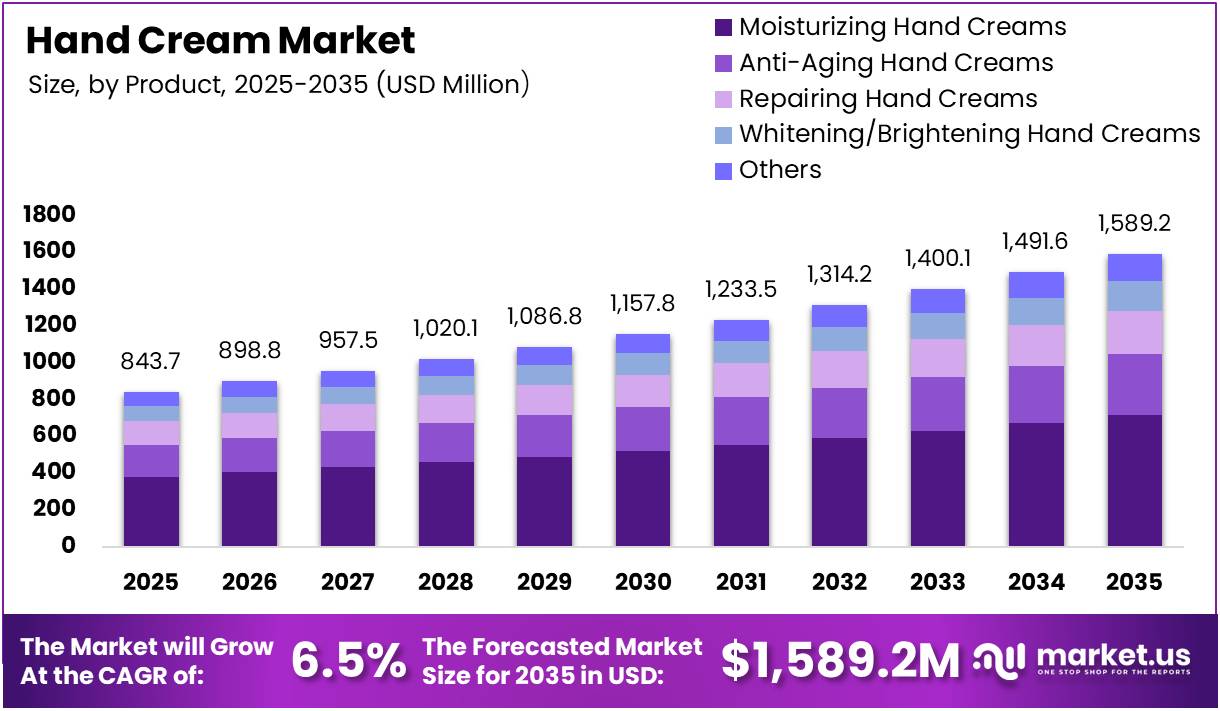
The Global Hand Cream Market size is expected to be worth around USD 1,589.2 Million by 2035 from USD 843.7 Million in 2025, growing at a CAGR of 6.5% during the forecast period 2026 to 2035.
The hand cream market refers to the global industry engaged in the formulation, production, and distribution of topical skin care products designed specifically for hand hydration, protection, and repair. These products address daily skin concerns such as dryness, aging, and damage caused by environmental exposure and frequent handwashing.
Hand creams are available across a wide range of categories including moisturizing, anti-aging, repairing, and whitening formulations. Moreover, they are sold through diverse channels such as pharmacies, supermarkets, specialty beauty stores, and e-commerce platforms, making them widely accessible to consumers globally.
Growth in this market is closely linked to rising consumer awareness about skin health and personal grooming. Additionally, the shift toward premium and natural formulations is encouraging brands to innovate continuously. Increasing disposable incomes across emerging economies are further supporting demand for quality hand care products.
Government regulations around cosmetic safety and ingredient transparency are shaping product development across key markets. Consequently, brands are investing in compliant, sustainable formulations. Regulatory bodies in North America and Europe are particularly influencing labeling standards and ingredient disclosures in the hand cream segment.
Opportunities in the market are expanding with growing interest in multifunctional and eco-conscious products. Furthermore, wellness trends and subscription-based beauty models are opening new distribution avenues for hand cream brands targeting both mass and premium consumer segments.
According to Jarsking, 49% of adolescents and 73% of adults aged 25 and above use hand cream regularly. Additionally, females applied hand cream approximately 2.3 times per day on average in 2025, compared to 1.1 times for males, reflecting strong gender-based usage patterns across the global hand care market.
Key Takeaways
- The global Hand Cream Market was valued at USD 843.7 Million in 2025 and is projected to reach USD 1,589.2 Million by 2035.
- The market is growing at a CAGR of 6.5% during the forecast period 2026 to 2035.
- By Product, Moisturizing Hand Creams dominated the market with a share of 44.8% in 2025.
- By End Use, Women led the market with a dominant share of 75.2% in 2025.
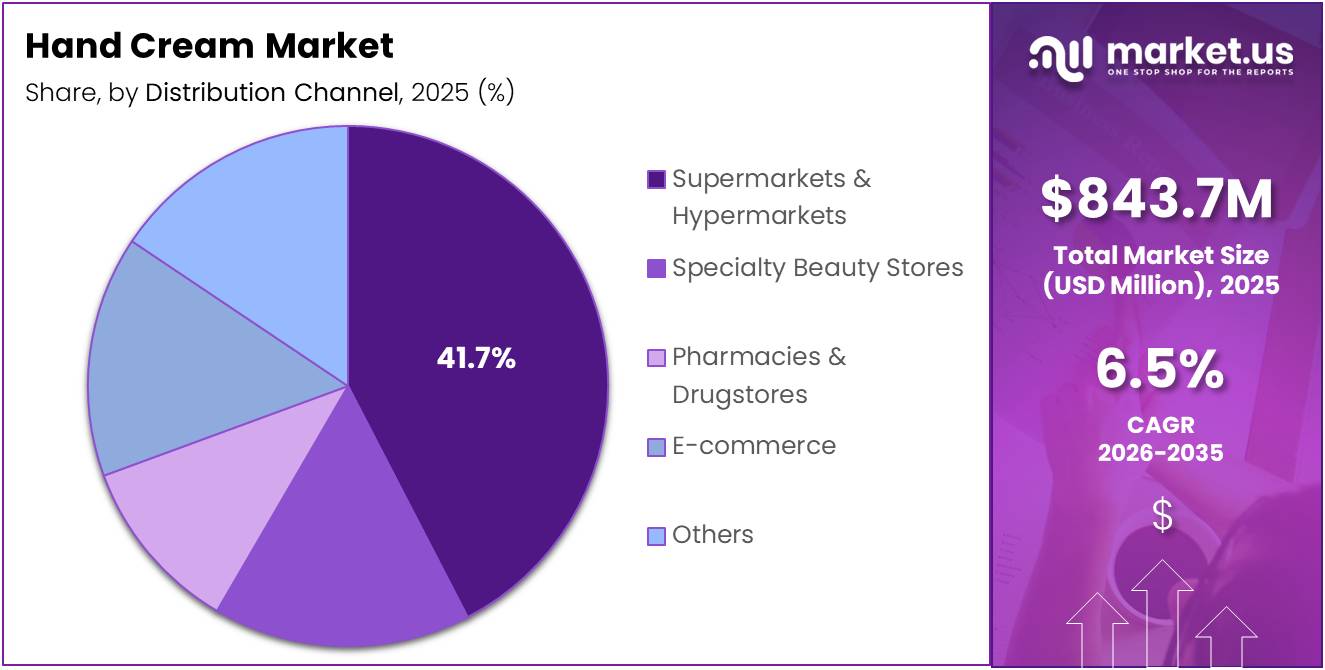
- By Distribution Channel, Supermarkets & Hypermarkets held the largest share of 41.7% in 2025.
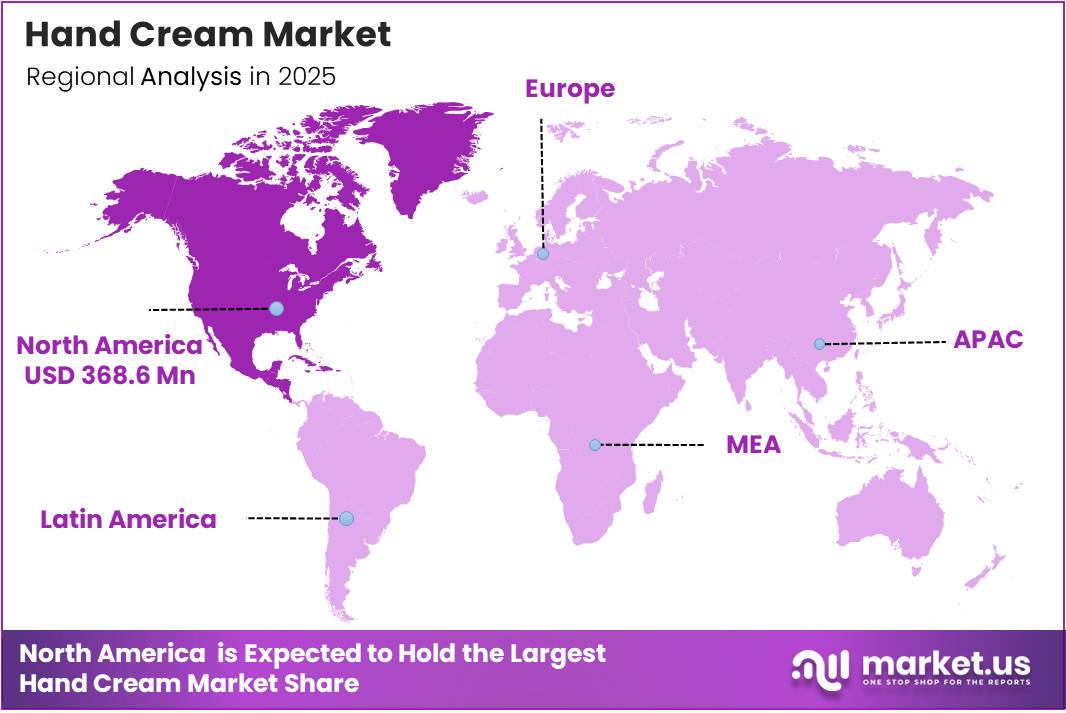
- North America dominated the regional market with a share of 43.70%, valued at USD 368.6 Million in 2025.
By Product Analysis
Moisturizing Hand Creams dominate with 44.8% due to high daily consumer demand for hydration and skin protection.
In 2025, Moisturizing Hand Creams held a dominant market position in the By Product segment of the Hand Cream Market, with a 44.8% share. These products remain the most widely purchased due to their broad consumer appeal across age groups. Moreover, frequent handwashing habits and environmental exposure continue to drive steady demand for basic moisturizing solutions.
Anti-Aging Hand Creams represent a growing sub-segment driven by older consumer demographics seeking targeted skin treatment. These formulations address concerns such as fine lines, dark spots, and loss of firmness. Consequently, premium brands are expanding their anti-aging hand care lines to meet rising demand from consumers who prioritize long-term visible skin health results.
Repairing Hand Creams are gaining traction among consumers dealing with occupational skin damage or persistent conditions such as eczema and dryness. These products are formulated with intensive healing agents including ceramides and urea. Therefore, they appeal strongly to healthcare workers, manual laborers, and individuals with clinically sensitive or compromised skin barriers.
Whitening/Brightening Hand Creams are especially popular across Asia Pacific markets where even skin tone is a key consumer priority. These formulations typically contain ingredients such as niacinamide and vitamin C. Additionally, growing beauty awareness and influence of regional skincare culture continue to support steady demand for this sub-segment across multiple countries.
Others within the product segment include specialty formulations catering to niche consumer needs such as cooling, fragrance-free, or medically oriented hand care products. These products serve specific skin concerns not addressed by mainstream lines. Moreover, they often target professional or clinical end users, adding further diversity to the overall hand cream product landscape.
By End Use Analysis
Women dominate with 75.2% due to higher frequency of hand cream usage and stronger personal care routines.
In 2025, Women held a dominant market position in the By End Use segment of the Hand Cream Market, with a 75.2% share. Female consumers consistently demonstrate higher purchase frequency and brand loyalty in personal care categories. Moreover, usage data confirms that women apply hand cream approximately 2.3 times per day, reflecting deeply embedded daily skincare habits.
Men represent a smaller but steadily growing sub-segment within the hand cream market. Male grooming awareness has risen significantly in recent years, supported by targeted product launches and evolving social norms around personal care. Consequently, brands are developing gender-specific hand care formulations designed to address male skin texture and preferences for lighter, non-greasy products.
By Distribution Channel Analysis
Supermarkets & Hypermarkets dominate with 41.7% due to high product visibility, accessibility, and consumer convenience.
In 2025, Supermarkets & Hypermarkets held a dominant market position in the By Distribution Channel segment of the Hand Cream Market, with a 41.7% share. These retail formats offer consumers the ability to compare products directly and benefit from in-store promotions. Moreover, high foot traffic and broad geographic presence make this channel the most efficient for mass-market hand cream brands.
Specialty Beauty Stores attract premium-oriented consumers seeking expert guidance and curated hand care selections. These outlets often carry professional and niche brands not readily available in mainstream retail environments. Consequently, they serve as important discovery channels for consumers willing to spend more on targeted, high-quality hand cream formulations.
Pharmacies & Drugstores remain a trusted channel for medicated and dermatologist-recommended hand cream formulations. Consumers with sensitive or condition-prone skin frequently rely on this channel for clinically backed products. Additionally, the presence of trained pharmacy staff adds a layer of credibility that encourages purchase decisions among health-conscious shoppers.
E-commerce is a rapidly growing distribution channel supported by consumer demand for convenience, competitive pricing, and broader product discovery. Online platforms allow brands to reach geographically dispersed audiences efficiently. Moreover, customer reviews, influencer recommendations, and targeted digital advertising continue to accelerate online hand cream sales across global markets.
Others within this segment include direct sales, beauty subscription boxes, and specialty wellness retail formats. These channels offer brands alternative routes to engage niche and loyal consumer groups. Therefore, they play a supporting role in expanding overall market reach, particularly for emerging and independent hand cream brands seeking visibility beyond traditional retail.
Key Market Segments
By Product
- Moisturizing Hand Creams
- Anti-Aging Hand Creams
- Repairing Hand Creams
- Whitening/Brightening Hand Creams
- Others
By End Use
- Women
- Men
By Distribution Channel
- Supermarkets & Hypermarkets
- Specialty Beauty Stores
- Pharmacies & Drugstores
- E-commerce
- Others
Drivers
Rising Consumer Awareness and Natural Product Preference Drive Hand Cream Market Growth
Growing awareness about skin hydration and protection is a key driver in the hand cream market. Consumers are increasingly recognizing the importance of daily hand care as part of their broader skincare routines. Consequently, this shift is encouraging higher purchase frequency and greater willingness to invest in quality formulations.
The preference for natural and organic ingredients is reshaping product development across the industry. Consumers are actively seeking formulations free from harmful chemicals. Moreover, this demand is pushing brands to reformulate existing products and launch cleaner alternatives that align with health-conscious consumer values and clean beauty expectations.
Expansion of personal care routines across all age groups is broadening the consumer base significantly. Younger demographics are adopting hand cream habits earlier, while older consumers seek targeted solutions. Therefore, this generational shift is creating sustained demand across multiple product categories and price points within the hand cream segment.
Restraints
Intense DIY Competition and Low Product Differentiation Restrain Hand Cream Market Growth
High competition from DIY and homemade hand care solutions presents a notable challenge for commercial hand cream brands. Many consumers are turning to kitchen ingredients such as shea butter and coconut oil as low-cost alternatives. Consequently, this trend reduces purchase conversion among price-sensitive segments, particularly in emerging and developing markets.
Limited product differentiation is another significant restraint affecting market dynamics. When consumers perceive minimal variation across competing brands, they tend to switch easily based on price or promotion. Moreover, this lack of perceived uniqueness weakens brand loyalty and makes it difficult for mid-tier players to retain their customer base effectively.
Together, these factors create downward pricing pressure across the hand cream category. Brands must continuously invest in innovation and marketing to justify product positioning. Therefore, smaller players with limited research and development budgets face increasing difficulty in sustaining competitive relevance against larger, more resourceful market participants.
Growth Factors
Multifunctional Formulations and Sustainable Packaging Solutions Accelerate Hand Cream Market Expansion
Development of multifunctional hand creams combining anti-aging and SPF properties presents a strong growth opportunity. Consumers increasingly prefer products that deliver multiple benefits in a single application. Moreover, this trend supports premium pricing strategies and helps brands differentiate themselves in an otherwise crowded and competitive personal care marketplace.
Introduction of eco-friendly and sustainable packaging is gaining momentum as environmental consciousness grows among consumers. Brands adopting refillable, biodegradable, or recycled packaging solutions are seeing stronger appeal among younger demographics. Consequently, sustainability-driven packaging is becoming a key differentiator and a measurable driver of brand preference in the hand cream segment.
Collaboration with wellness and beauty subscription boxes is creating new reach for hand cream brands. These partnerships offer direct access to engaged, beauty-forward consumers who regularly discover and trial new products. Therefore, subscription-based distribution channels are proving effective in accelerating trial rates and building long-term consumer loyalty across various market segments.
Emerging Trends
Vegan Formulations and Social Media Influence Are Reshaping the Hand Cream Market Landscape
The popularity of vegan and cruelty-free hand cream formulations is rising rapidly across global markets. Consumers are increasingly scrutinizing ingredient lists and brand ethics before making purchasing decisions. Moreover, certifications such as Leaping Bunny and PETA approval are becoming important trust signals that influence product selection among ethically conscious buyers.
Social media platforms and beauty influencers are playing a decisive role in shaping consumer preferences. Product reviews, tutorials, and unboxing content on platforms like Instagram and TikTok significantly affect purchase intent. Consequently, brands are increasing their influencer marketing investments to gain visibility and credibility among younger, digitally engaged consumer audiences.
Demand for travel-sized and on-the-go hand care solutions is growing alongside busier consumer lifestyles. Compact packaging formats are appealing to commuters, travelers, and office-going professionals. Additionally, these smaller SKUs offer an accessible entry point for new consumers to trial premium formulations, thereby supporting both brand discovery and incremental revenue growth.
Regional Analysis
North America Dominates the Hand Cream Market with a Market Share of 43.70%, Valued at USD 368.6 Million
North America leads the global hand cream market with a share of 43.70%, valued at USD 368.6 Million in 2025. The region benefits from high consumer spending on personal care, strong retail infrastructure, and widespread awareness of skin health. Moreover, a well-established distribution network across supermarkets, pharmacies, and e-commerce platforms supports consistent market growth.
Europe Hand Cream Market Trends
Europe represents a significant market driven by consumer preference for premium, dermatologist-tested, and natural hand care products. Countries like Germany, France, and the UK are key contributors to regional revenue. Additionally, strict EU cosmetic regulations encourage high product quality standards, which further strengthens consumer trust in European hand cream brands.
Asia Pacific Hand Cream Market Trends
Asia Pacific is the fastest-growing regional market, supported by a large and expanding middle-class population. Whitening and brightening hand cream formulations are particularly popular in countries like China, Japan, and South Korea. Consequently, rising disposable incomes and growing beauty consciousness are accelerating adoption of both mass-market and premium hand care products.
Latin America Hand Cream Market Trends
Latin America is an emerging market showing steady growth driven by increasing urbanization and personal care awareness. Brazil and Mexico are the primary contributors to regional demand. Moreover, the growing influence of social media beauty trends is encouraging younger consumers in the region to incorporate hand cream into their daily skincare routines.
Middle East and Africa Hand Cream Market Trends
The Middle East and Africa market is expanding gradually, supported by rising beauty spending in GCC countries. Consumers in this region favor moisturizing and repairing formulations due to harsh climatic conditions. Therefore, both international brands and regional players are actively investing in product availability and targeted marketing efforts across this developing market.
Key Regions and Countries
North America
- US
- Canada
Europe
- Germany
- France
- The UK
- Spain
- Italy
- Rest of Europe
Asia Pacific
- China
- Japan
- South Korea
- India
- Australia
- Rest of APAC
Latin America
- Brazil
- Mexico
- Rest of Latin America
Middle East & Africa
- GCC
- South Africa
- Rest of MEA
Key Company Insights
L’Occitane Groupe S.A. is a globally recognized premium personal care brand with a strong presence in the hand cream segment. The company is widely known for its iconic Shea Butter Hand Cream, which commands significant loyalty among consumers. Moreover, L’Occitane’s focus on natural ingredients and sustainable sourcing continues to strengthen its competitive positioning in premium retail channels worldwide.
Natura & Co is a leading sustainable beauty group operating across multiple markets with a strong commitment to ethical sourcing and biodiversity. The company integrates environmental responsibility into its product development strategy. Consequently, its hand care portfolio appeals to a growing segment of eco-conscious consumers who prioritize clean formulations and transparent brand values in their purchasing decisions.
Johnson & Johnson is a well-established player in the consumer health and skincare space with broad distribution reach globally. Its hand care products are available across pharmacies, supermarkets, and online platforms. Additionally, the company’s trusted brand equity and dermatological credibility make it a preferred choice among consumers seeking reliable and clinically backed hand moisturizing solutions.
Nécessaire Inc. is a modern wellness brand recognized for its minimalist, science-driven approach to personal care. The company focuses on clean formulations using clinically active ingredients. Therefore, Nécessaire has built a loyal following among health-conscious millennial and Gen Z consumers, positioning itself as a premium yet purposeful player in the growing clean beauty hand care segment.
Key Players
- L’Occitane Groupe S.A.
- Natura & Co
- Johnson & Johnson
- Nécessaire Inc.
- The Clorox Company
- Beiersdorf AG
- L’Oréal S.A.
- Kao Corporation
- Unilever PLC
- Pierre Fabre S.A.
Recent Developments
- January 2026 – Beiersdorf launched NIVEA Creme Natural Touch, expanding its hand care portfolio with a nature-inspired formulation. The product is designed to appeal to consumers seeking clean and skin-friendly moisturizing solutions within the growing natural personal care segment.
- April 2025 – Unilever acquired Wild Cosmetics, strengthening its position in the sustainable and eco-friendly personal care market. This strategic acquisition enables Unilever to expand its clean beauty offerings and reach a broader base of environmentally conscious consumers across key global markets.
Report Scope
Report Features Description Market Value (2025) USD 843.7 Million Forecast Revenue (2035) USD 1,589.2 Million CAGR (2026-2035) 6.5% Base Year for Estimation 2025 Historic Period 2020-2024 Forecast Period 2026-2035 Report Coverage Revenue Forecast, Market Dynamics, Competitive Landscape, Recent Developments Segments Covered By Product (Moisturizing Hand Creams, Anti-Aging Hand Creams, Repairing Hand Creams, Whitening/Brightening Hand Creams, Others), By End Use (Women, Men), By Distribution Channel (Supermarkets & Hypermarkets, Specialty Beauty Stores, Pharmacies & Drugstores, E-commerce, Others) Regional Analysis North America (US and Canada), Europe (Germany, France, The UK, Spain, Italy, and Rest of Europe), Asia Pacific (China, Japan, South Korea, India, Australia, and Rest of APAC), Latin America (Brazil, Mexico, and Rest of Latin America), Middle East & Africa (GCC, South Africa, and Rest of MEA) Competitive Landscape L’Occitane Groupe S.A., Natura & Co, Johnson & Johnson, Nécessaire Inc., The Clorox Company, Beiersdorf AG, L’Oréal S.A., Kao Corporation, Unilever PLC, Pierre Fabre S.A. Customization Scope Customization for segments, region/country-level will be provided. Moreover, additional customization can be done based on the requirements. Purchase Options We have three licenses to opt for: Single User License, Multi-User License (Up to 5 Users), Corporate Use License (Unlimited User and Printable PDF) 
-
-
- L'Occitane Groupe S.A.
- Natura & Co
- Johnson & Johnson
- Nécessaire Inc.
- The Clorox Company
- Beiersdorf AG
- L'Oréal S.A.
- Kao Corporation
- Unilever PLC
- Pierre Fabre S.A.
Our Clients

- 182594
- March 2026






