


Global Toilet Seat Market Size, Share, Growth Analysis By Product Type (Ordinary Toilet Seat, Smart Toilet Seat), By Bowl Shape (Elongated, Round, Square, Others), By Material (Plastic, Wood, Ceramic, Others), By End-Use (Residential, Commercial), By Distribution Channel (Specialty Stores, Online Channels, Mega Retail Stores, Others), By Region and Companies - Industry Segment Outlook, Market Assessment, Competition Scenario, Statistics, Trends and Forecast 2026-2035
- Published date: Feb 2026
- Report ID: 178606
- Number of Pages: 254
- Format:
-
keyboard_arrow_up
Quick Navigation
Report Overview
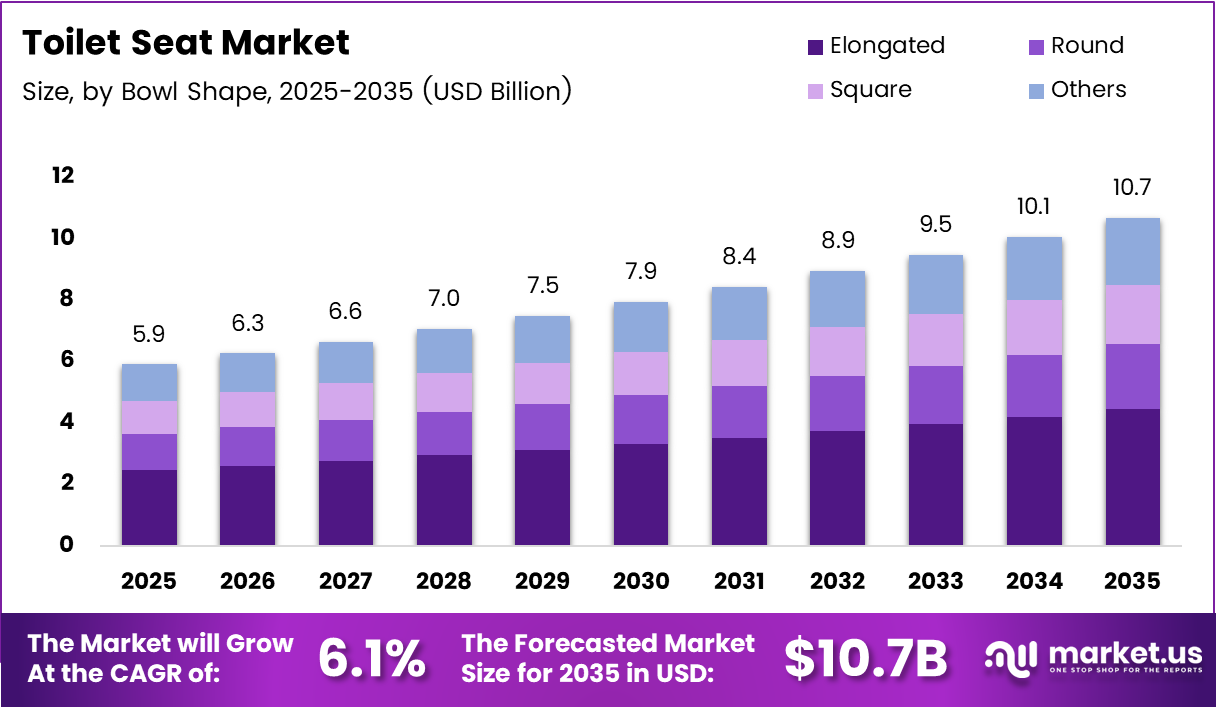
Global Toilet Seat Market size is expected to be worth around USD 10.7 Billion by 2035 from USD 5.9 Billion in 2025, growing at a CAGR of 6.1% during the forecast period 2026 to 2035.
The toilet seat market covers a broad set of products ranging from standard plastic seats to sensor-activated smart toilet seats with bidet functions, heated surfaces, and self-cleaning technology. Residential bathroom renovation, new housing construction, and public restroom upgrades across commercial buildings drive consistent purchase volumes across all price tiers.
Urban sanitation programs across emerging economies actively push toilet seat installations into previously underserved households. Governments in South Asia, Southeast Asia, and Sub-Saharan Africa allocate public hygiene budgets that include basic sanitation fixtures. This policy-driven demand creates a floor for the market even when consumer discretionary spending slows.
Smart bathroom integration reshapes buyer expectations at the premium end. Bidet-enabled toilet seats, IoT-connected controls, and antimicrobial surface coatings now attract specification by architects and interior designers — not just individual homeowners. This shift moves toilet seats from a commodity replacement item into a planned renovation investment with higher average selling prices.
Hygiene awareness among consumers adds measurable pressure on product design. According to the Ukiyo Journal, 63.7% of respondents worry about multi-user hygiene and 58.2% express concern about bacterial contamination on shared toilet seats. These figures directly influence purchasing decisions toward antibacterial materials, quick-release designs, and touchless features — accelerating the trade-up from ordinary to premium segments.
Japan’s adoption pattern signals where other markets are headed. According to the Cabinet Office of Japan, more than 80% of multi-person households own electronic bidet toilet seats — a penetration rate sustained since approximately 2016. This normalization shows that once smart toilet seats reach a critical threshold of consumer familiarity, replacement and upgrade cycles become self-sustaining revenue drivers for manufacturers.
Key Takeaways
- The global toilet seat market is valued at USD 5.9 Billion in 2025 and is forecast to reach USD 10.7 Billion by 2035 at a CAGR of 6.1%.
- Ordinary Toilet Seats hold the largest product share at 68.3%, reflecting dominant volume-driven demand in residential and standard commercial segments.
- Elongated bowl shape leads the By Bowl Shape segment with a 49.7% share, driven by ergonomic preference in North American and European markets.
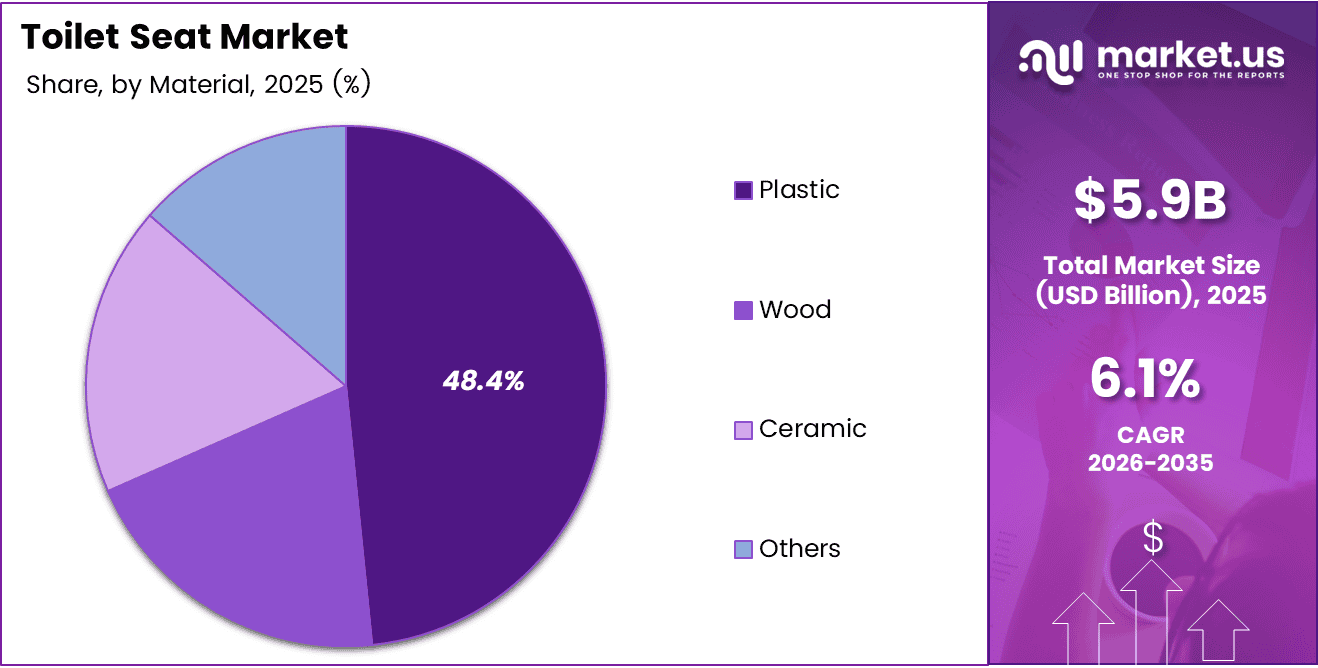
- Plastic material leads the By Material segment with 48.4% share due to low cost, durability, and ease of manufacturing.
- Residential end-use accounts for 68.2% of market demand, reflecting the dominance of household installations and bathroom renovation activity.
- Specialty Stores lead distribution with 32.6% share, though online channels are expanding their footprint as consumer confidence in purchasing fixtures digitally increases.
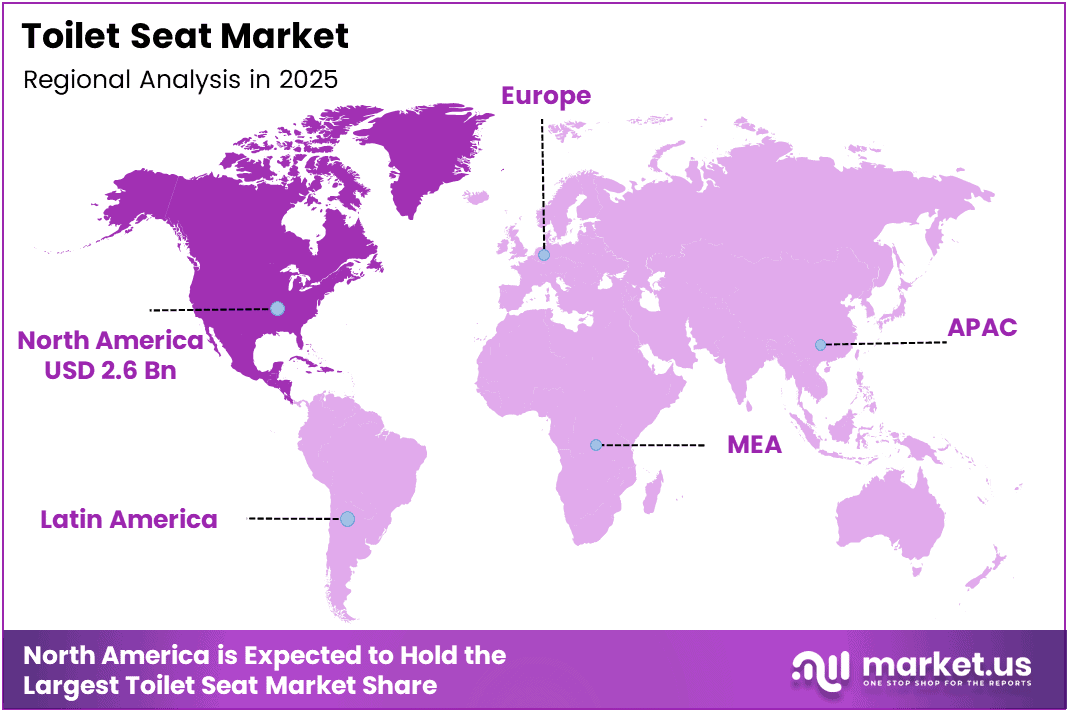
- North America dominates regional share at 45.70%, valued at USD 2.6 Billion, supported by mature real estate renovation cycles and premium product adoption.
Product Type Analysis
Ordinary Toilet Seat dominates with 68.3% due to high residential volume and low replacement cost.
In 2025, Ordinary Toilet Seat held a dominant market position in the By Product Type segment of the Toilet Seat Market, with a 68.3% share. This dominance reflects the sheer scale of standard residential and commercial installations globally. However, the margin profile on ordinary seats is thin, which means volume leadership does not translate directly into revenue leadership — creating a structural incentive for manufacturers to push consumers up the value chain.
Smart Toilet Seat carries the highest margin within the product type segment and represents the fastest-moving revenue opportunity. Sensor-based functions, bidet integration, and app-controlled personalization drive a premium price point that standard seats cannot match. In January 2024, Bemis introduced the Bio Bidet BB-1200 app-controlled smart toilet seat at CES, featuring smartphone control, heated seat, unlimited warm water, and user profile personalization — signaling that product innovation continues to raise the bar for what buyers expect at the smart tier.
Bowl Shape Analysis
Elongated dominates with 49.7% due to ergonomic preference in mature Western markets.
In 2025, Elongated bowl shape held a dominant market position in the By Bowl Shape segment of the Toilet Seat Market, with a 49.7% share. Elongated designs align with ergonomic standards widely adopted in North American and European residential and commercial bathrooms. Their share advantage reflects decades of specification habit embedded in building codes and renovation guides — a structural preference that competitors in other shape categories must work against.
Round bowl shape serves as the practical choice in space-constrained environments such as small urban apartments, compact hotel bathrooms, and older housing stock. Its smaller footprint gives it a structural advantage in high-density urban markets across Asia and parts of Latin America, where bathroom dimensions are tighter than Western standards.
Square bowl shape differentiates through design appeal, targeting the premium renovation segment where architectural aesthetics take priority. Square-profile seats command a price premium and attract specification from luxury residential developers and boutique hospitality projects. Consequently, this sub-segment punches above its volume share in terms of revenue contribution.
Others — including D-shaped and custom configurations — serve niche commercial and accessible design applications. These variants address accessibility compliance requirements in public and institutional restrooms, where standard shapes may not satisfy regulatory specifications for assisted use environments.
Material Analysis
Plastic dominates with 48.4% due to cost efficiency and ease of mass production.
In 2025, Plastic held a dominant market position in the By Material segment of the Toilet Seat Market, with a 48.4% share. Polypropylene and thermoset variants offer manufacturers a cost-effective substrate that supports antibacterial additive integration, color customization, and lightweight installation. Moreover, plastic seats align with the price expectations of the mass residential segment, which represents the market’s highest-volume purchase tier.
Wood material carries a positioning advantage in mid-to-premium residential segments where warmth of feel and traditional aesthetics matter to buyers. Solid and MDF-core wooden seats command a price premium over plastic while remaining accessible to a broad consumer base. However, wood faces durability challenges in high-humidity environments, limiting its penetration in tropical and high-moisture-use settings.
Ceramic material targets the luxury and design-led bathroom segment, where seamless integration with ceramic bowl units creates a unified aesthetic. Ceramic seats carry a significant price premium and typically enter through architect specification rather than retail purchase. Therefore, their adoption tracks closely with high-value residential construction and luxury hotel development pipelines.
Others — including stainless steel and composite materials — serve specialized commercial and healthcare environments requiring extreme hygiene standards, impact resistance, or chemical cleaning tolerance. These materials address institutional procurement criteria that standard plastic or wood cannot satisfy, positioning them as a stable niche rather than a volume category.
End-Use Analysis
Residential dominates with 68.2% due to household installation volume and bathroom renovation cycles.
In 2025, Residential end-use held a dominant market position in the By End-Use segment of the Toilet Seat Market, with a 68.2% share. New housing construction in emerging economies and replacement-driven renovation activity in developed markets together sustain this share. The residential segment also drives the transition from ordinary to premium seat categories, as homeowners treat bathroom upgrades as a directly visible quality-of-life investment.
Commercial end-use covers hotels, offices, hospitals, educational institutions, and public transit facilities — settings where durability, hygiene compliance, and ease of maintenance override aesthetic preference. Commercial buyers specify products through procurement frameworks with volume discount structures, which pressures margins but guarantees predictable order flow. Additionally, hygiene regulation in public facilities increasingly specifies antimicrobial surfaces and touchless features, pulling commercial demand toward higher-specification product tiers.
Distribution Channel Analysis
Specialty Stores dominate with 32.6% due to expert-guided purchase decisions in renovation contexts.
In 2025, Specialty Stores held a dominant market position in the By Distribution Channel segment of the Toilet Seat Market, with a 32.6% share. Specialty bathroom and sanitary ware retailers provide the tactile evaluation and installation consultation that toilet seat buyers — particularly in the mid-to-premium range — depend on. This channel advantage reflects a category where product touch, finish comparison, and size verification remain important to purchase confidence.
Online Channels expand their footprint as consumer confidence in purchasing bathroom fixtures digitally rises, driven by detailed product imagery, installation video content, and no-hassle return policies. E-commerce narrows the specialty store advantage by replicating product education digitally. Consequently, brands that invest in online content and direct-to-consumer fulfillment gain distribution reach without the overhead of physical retail.
Mega Retail Stores — large home improvement chains and mass merchandise retailers — capture volume-driven purchases at the standard and entry-level price points. Their advantage lies in footfall, immediate availability, and bundled promotion with other bathroom fixture categories. However, their assortment depth in premium and smart toilet seat categories remains limited compared to specialty channels.
Others — including trade and contractor supply networks, wholesale distributors, and institutional procurement channels — fulfill bulk orders for construction projects, hotel refurbishments, and public infrastructure programs. This sub-channel operates on negotiated contract pricing and product specification, making it structurally distinct from retail-led purchase behavior.
Key Market Segments
By Product Type
- Ordinary Toilet Seat
- Smart Toilet Seat
By Bowl Shape
- Elongated
- Round
- Square
- Others
By Material
- Plastic
- Wood
- Ceramic
- Others
By End-Use
- Residential
- Commercial
By Distribution Channel
- Specialty Stores
- Online Channels
- Mega Retail Stores
- Others
Drivers
Government-Led Sanitation Programs and Urban Hygiene Mandates Push Household Toilet Seat Upgrades at Scale
National sanitation campaigns in South Asia, Southeast Asia, and Sub-Saharan Africa directly fund toilet installation in under-served households. These programs do not just deliver basic fixtures — they create first-time buyers who subsequently upgrade to better-quality seats as incomes rise. For manufacturers, this government-funded entry point builds a long-term replacement pipeline that commercial demand alone cannot generate.
Hygiene awareness campaigns in public settings create measurable consumer behavior shifts. According to the Ukiyo Journal, 46.8% of respondents report using public bidet-equipped toilet seats — evidence that public restroom exposure normalizes smart seat features and accelerates residential upgrade consideration. When consumers experience advanced toilet seat functions outside the home, they become more likely to specify them in their next bathroom renovation.
Smart bathroom integration elevates toilet seats from a utility purchase into a technology category. In January 2024, Kohler unveiled the PureWash E930 smart bidet toilet seat at CES 2024, featuring voice control via Alexa and Google Assistant, UV self-cleaning, and personalized cleansing settings. Product launches of this caliber redefine consumer expectations and compress the timeline between innovation introduction and mainstream adoption.
Residential Real Estate Expansion in Emerging Economies Creates Sustained New-Installation Demand
New housing construction across India, Vietnam, Indonesia, and parts of Latin America generates first-time toilet seat installations at a scale that mature markets cannot replicate. Each new dwelling unit represents a guaranteed product placement, independent of renovation cycles or consumer discretionary spending. This structural link between housing starts and toilet seat volumes gives the market a degree of demand predictability that is unique compared to pure consumer goods categories.
Antibacterial and ergonomic material preferences shift product mix toward higher-value units even within the residential segment. Builders and developers increasingly specify antimicrobial plastic or composite seats as standard fittings — not upgrades — in response to buyer expectations set by hygiene awareness campaigns. Consequently, the average selling price per unit in new residential installations rises without requiring a separate consumer upsell effort.
Consumer preference for easy-clean and quick-release toilet seat designs reflects a broader shift toward low-maintenance bathroom fixtures. Buyers across income tiers now evaluate cleaning convenience alongside price when selecting toilet seats. Manufacturers that embed tool-free removal and antibacterial surface treatments into standard product lines capture share without requiring buyers to trade up to full smart seat pricing.
Restraints
High Price Sensitivity in Low- and Middle-Income Markets Limits Adoption of Premium and Smart Toilet Seat Categories
In markets where household income constrains bathroom renovation budgets, the purchase decision defaults to the lowest-cost functional option. Smart toilet seats — which carry price premiums multiples above standard plastic units — remain aspirational rather than accessible for a large share of potential buyers in emerging economies. This price ceiling caps the addressable market for premium product tiers in the geographies that generate the highest installation volumes.
Volatility in polypropylene and thermoset plastic raw material costs directly compresses manufacturing margins on the standard seat category. When input costs rise, manufacturers face a choice between absorbing the margin hit or passing price increases to price-sensitive retail channels — both of which damage profitability. This cost pressure is particularly acute for producers reliant on a single material input and operating in markets where retail price increases trigger immediate demand suppression.
The combination of price sensitivity at the consumer level and input cost volatility at the manufacturing level creates a margin squeeze that constrains the pace of product investment. Manufacturers with limited R&D budgets cannot simultaneously absorb cost volatility and fund the innovation pipeline needed to compete in smart seat categories. Therefore, smaller producers risk falling behind as larger players use scale to weather input cost swings and continue product development.
Growth Factors
E-Commerce Expansion and Elderly-Care Demographics Open High-Value Toilet Seat Market Segments
Direct-to-consumer online channels remove the geographic constraint that limits specialty store reach in smaller cities and rural markets. Brands that build strong digital product presentation — detailed specifications, installation videos, and verified buyer reviews — can now sell mid-to-premium toilet seats in markets where physical retail representation is thin. This distribution shift materially expands the addressable consumer base for non-standard product categories.
Aging population demographics create a structural demand pool for medical-assist and elderly-friendly toilet seats. Raised-height seats, armrest-integrated designs, and soft-close mechanisms address mobility limitations that standard products ignore. According to 2026 market data, Toto has surpassed 70 million washlets sold globally — a milestone that confirms long-term consumer willingness to invest in bathroom comfort technology, and signals the scale at which elderly-focused features can be mainstreamed rather than niche-positioned.
Green building certification programs create a procurement pull for sustainable and recyclable toilet seat materials. Construction developers targeting LEED, BREEAM, or equivalent green ratings specify low-emission and recyclable fixtures across bathroom categories. Manufacturers that certify their product materials against recognized sustainability standards gain access to an institutional buyer segment that prioritizes compliance over cost — a structurally different and higher-margin buyer profile than standard retail.
Emerging Trends
IoT Connectivity and Touchless Technology Redefine Buyer Expectations in the Premium Toilet Seat Segment
IoT-connected toilet seats — with app-based controls, usage analytics, and automated self-cleaning — shift the product category from a passive fixture into an active bathroom technology node. Early adopters in premium residential and hospitality segments set a new baseline for what “standard” looks like in renovation specifications. According to the Ukiyo Journal, usage of bidet-equipped seats among people in their 20s stands at 23.8% — a cohort that will drive premium seat specification as their household purchasing power increases over the next decade.
Quick-release and tool-free installation designs address a practical barrier that slows the replacement cycle for toilet seats. When consumers can swap a seat without tools or professional help, the friction cost of upgrading drops significantly. Manufacturers that embed intuitive installation into product design convert more browsing consumers into active buyers — particularly in the online channel where the absence of in-store assistance makes self-installation confidence a prerequisite for purchase completion.
Slim-profile and minimalist toilet seat aesthetics align with a broader design movement in bathroom interiors that prioritizes visual simplicity. Architects and interior designers increasingly specify low-profile fixtures to complement frameless glass, wall-hung sanitary ware, and neutral material palettes. Toilet seat manufacturers that develop aesthetically integrated product lines — not just functionally improved ones — access the design specification channel, which operates on professional recommendation rather than consumer price comparison.
Regional Analysis
North America Dominates the Toilet Seat Market with a Market Share of 45.70%, Valued at USD 2.6 Billion
North America commands 45.70% of the global toilet seat market, valued at USD 2.6 Billion in 2025. Mature residential renovation cycles, a large existing housing stock requiring fixture replacement, and strong consumer appetite for premium bathroom upgrades underpin this share. Moreover, the region’s established retail infrastructure — both specialty bathroom showrooms and large home improvement chains — sustains high purchase frequency across all product tiers.
Europe Toilet Seat Market Trends
Europe holds a significant share driven by strong design culture in bathroom fixtures, especially across Germany, France, Italy, and the UK. Regulatory standards for water efficiency and antimicrobial surfaces in commercial restrooms create specification pull for compliant products. Additionally, aging housing stock across Western Europe generates a steady pipeline of bathroom renovation projects, sustaining demand for both standard and premium seat categories.
Asia Pacific Toilet Seat Market Trends
Asia Pacific represents the highest-growth geographic opportunity for toilet seat manufacturers. Rapid urbanization in China, India, Indonesia, and Vietnam creates first-time installation demand at scale, while Japan sustains a premium smart seat market with over 80% household penetration of electronic bidet units. This dual dynamic — volume growth in emerging markets alongside premium upgrades in mature markets — makes Asia Pacific the region with the most complex but rewarding competitive landscape.
Latin America Toilet Seat Market Trends
Latin America generates incremental demand through urban expansion in Brazil and Mexico, where new housing construction programs include basic sanitation fixtures as standard government deliverables. Consumer purchasing in this region remains price-sensitive, concentrating demand in standard plastic seat categories. However, an emerging upper-middle-class segment in major cities creates early-stage demand for mid-tier and antimicrobial product variants.
Middle East and Africa Toilet Seat Market Trends
The Middle East, particularly GCC countries, drives demand through large-scale hospitality and luxury residential construction where premium bathroom specifications are the norm rather than the exception. Africa presents a long-term volume opportunity tied to sanitation infrastructure programs funded by international development agencies. Currently, demand concentrates at the entry-level product tier, but urban infrastructure investment progressively moves this region up the value chain.
Key Regions and Countries
North America
- US
- Canada
Europe
- Germany
- France
- The UK
- Spain
- Italy
- Rest of Europe
Asia Pacific
- China
- Japan
- South Korea
- India
- Australia
- Rest of APAC
Latin America
- Brazil
- Mexico
- Rest of Latin America
Middle East & Africa
- GCC
- South Africa
- Rest of MEA
Key Company Insights
American Standard anchors its competitive position in the North American market through broad distribution across both specialty retail and mass home improvement channels. Its product range spans entry-level to mid-premium toilet seats, giving it volume coverage that smaller players cannot replicate. This channel breadth protects market share during downturns while providing a platform to upsell consumers into higher-specification products as renovation budgets recover.
Cera Sanitaryware leverages its deep distribution network across India to capitalize on the country’s large-scale residential construction and government sanitation program demand. Its positioning in the mid-market price tier aligns directly with the purchasing profile of India’s expanding urban middle class. Consequently, Cera benefits structurally from both new housing installation demand and the aspirational upgrade cycle that follows as household incomes rise.
Centoco Manufacturing differentiates through focused production of residential-grade plastic toilet seats with an emphasis on quick-ship availability and consistent quality at competitive price points. This operational focus makes Centoco a preferred supply partner for large retail chains seeking reliable private-label and branded inventory. However, its narrower product scope limits exposure to the premium smart seat category, which is the segment generating the highest margin expansion opportunity.
Duravit targets the premium and luxury bathroom specification market across Europe and international hospitality projects. Its design-led product philosophy attracts specification from architects, interior designers, and luxury hotel developers — a buyer profile that evaluates aesthetic integration over price. This positions Duravit in the highest-margin segment of the toilet seat market, but also makes its revenue sensitive to luxury construction cycles and design trend shifts.
Key Players
- American Standard
- Cera Sanitaryware
- Centoco Manufacturing
- Duravit
- Geberit
- Hindware Sanitaryware
- Jaquar
- Kohler
- Lixil Group
- Masco Corporation
Recent Developments
- January 2026 — Kohler launched the PureWash E860 dual-wand bidet toilet seat, featuring dedicated front and rear wands designed for improved hygiene and women’s health use cases. This product advancement signals Kohler’s strategy to deepen its smart seat portfolio with gender-specific health functionality, raising the competitive bar in the premium bidet segment.
- 2026 — Investor activity highlighted technology diversification at major toilet manufacturer Toto, noting over 70 million washlets sold globally and growing strategic investment interest linked to advanced ceramic technology. This milestone confirms Toto’s dominant position in the electronic bidet seat category and underscores the commercial viability of premium smart toilet seat investment at scale.
Report Scope
Report Features Description Market Value (2025) USD 5.9 Billion Forecast Revenue (2035) USD 10.7 Billion CAGR (2026-2035) 6.1% Base Year for Estimation 2025 Historic Period 2020-2024 Forecast Period 2026-2035 Report Coverage Revenue Forecast, Market Dynamics, Competitive Landscape, Recent Developments Segments Covered By Product Type (Ordinary Toilet Seat, Smart Toilet Seat), By Bowl Shape (Elongated, Round, Square, Others), By Material (Plastic, Wood, Ceramic, Others), By End-Use (Residential, Commercial), By Distribution Channel (Specialty Stores, Online Channels, Mega Retail Stores, Others) Regional Analysis North America (US and Canada), Europe (Germany, France, The UK, Spain, Italy, and Rest of Europe), Asia Pacific (China, Japan, South Korea, India, Australia, and Rest of APAC), Latin America (Brazil, Mexico, and Rest of Latin America), Middle East & Africa (GCC, South Africa, and Rest of MEA) Competitive Landscape American Standard, Cera Sanitaryware, Centoco Manufacturing, Duravit, Geberit, Hindware Sanitaryware, Jaquar, Kohler, Lixil Group, Masco Corporation Customization Scope Customization for segments, region/country-level will be provided. Moreover, additional customization can be done based on the requirements. Purchase Options We have three licenses to opt for: Single User License, Multi-User License (Up to 5 Users), Corporate Use License (Unlimited User and Printable PDF) 
-
-
- American Standard
- Cera Sanitaryware
- Centoco Manufacturing
- Duravit
- Geberit
- Hindware Sanitaryware
- Jaquar
- Kohler
- Lixil Group
- Masco Corporation
Our Clients

- 178606
- Feb 2026






