


Global Solar Powered Irrigation System Market Size, Share, And Enhanced Productivity By Product Type (Submersible Pumps, Surface Pumps, Floating Pumps), By Irrigation System (Drip Irrigation, Sprinkler Irrigation, Center Pivot and Lateral-Move), By Power Rating (HP) (Up to 3 HP, 3.1 to 10 HP, Above 10 HP), By Component (Solar Panels, Pumps, Controllers, Inverters, Balance of System), By End-user (Smallholder Farms, Commercial Farms, Greenhouses, Livestock), By Region and Companies - Industry Segment Outlook, Market Assessment, Competition Scenario, Trends, and Forecast 2026-2035
- Published date: March 2026
- Report ID: 180609
- Number of Pages: 345
- Format:
-
keyboard_arrow_up
Quick Navigation
- Report Overview
- Key Takeaways
- By Product Type Analysis
- By Irrigation System Analysis
- By Power Rating (HP) Analysis
- By Component Analysis
- By End-user Analysis
- Key Market Segments
- Driving Factors
- Restraining Factors
- Growth Opportunity
- Latest Trends
- Regional Analysis
- Key Players Analysis
- Recent Developments
- Report Scope
Report Overview
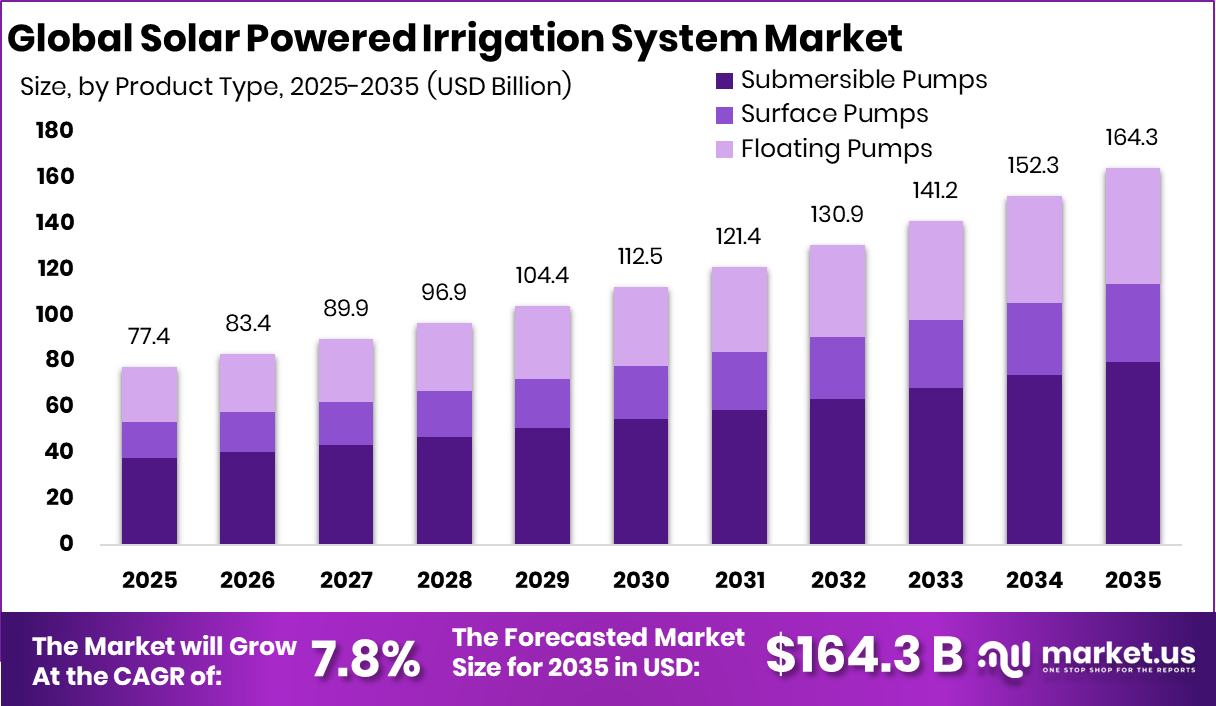
The global solar-powered irrigation system market is expected to be worth around USD 164.3 billion by 2035, up from USD 77.4 billion in 2025. It is projected to grow at a CAGR of 7.8% from 2026 to 2035. Solar Powered Irrigation System Market in Asia Pacific accounted for 43.7%, totaling USD 33.8 Bn.
A solar-powered irrigation system is an agricultural irrigation solution that uses solar energy to operate water pumps and distribute water to crops. Solar panels convert sunlight into electricity, which powers pumps that draw water from wells, rivers, or storage tanks and deliver it through irrigation systems such as drip or sprinkler networks. These systems help farmers irrigate fields without relying on grid electricity or diesel pumps, making them suitable for rural and off-grid agricultural areas. Solar irrigation systems are designed to support a reliable water supply while reducing energy costs and environmental impact.
The Solar Powered Irrigation System Market refers to the global ecosystem involved in the production, deployment, and use of solar-based irrigation technologies across agriculture. It includes equipment such as solar panels, pumps, controllers, inverters, and supporting infrastructure used for irrigation across farms, greenhouses, and livestock watering operations. The market is expanding as farmers adopt renewable energy technologies to improve irrigation efficiency and reduce operational expenses. Systems are increasingly used with irrigation methods such as drip, sprinkler, and center pivot irrigation to improve water distribution and crop productivity.
Market growth is strongly influenced by the rising need for energy-efficient irrigation and sustainable farming practices. Many agricultural regions face increasing energy costs and unreliable electricity supply, encouraging farmers to adopt solar irrigation technologies. Financial support and development initiatives are also supporting adoption. For example, US $350,000 was granted for water-saving drip irrigation in Nigeria, while Nigeria and FAO signed a US $350,000 irrigation funding pact to support irrigation infrastructure development.
Demand for solar irrigation solutions continues to increase as farmers seek reliable water management systems that support consistent crop production. Agricultural development programs and funding initiatives are accelerating adoption in several regions. SNV received a €39.5 million grant for smart agriculture projects in Kenya, Tanzania, and Uganda, and the Danish government funded an irrigation project expected to benefit more than 12,000 farmers in Uganda, highlighting the growing focus on sustainable irrigation.
The market also presents strong opportunities driven by technological innovation and agricultural investment. Funding for advanced irrigation technologies and agri-technology companies is expanding system accessibility and efficiency. An Israeli agritech company developing irrigation systems raised $44 million in a Series C funding round, while Kenya’s FarmWorks secured $4 million in pre-Series A funding, reflecting increasing investment in technologies that improve water use and agricultural productivity.
Key Takeaways
- The global solar-powered irrigation system market is expected to be worth around USD 164.3 billion by 2035, up from USD 77.4 billion in 2025. It is projected to grow at a CAGR of 7.8% from 2026 to 2035.
- In the Solar Powered Irrigation System Market, submersible pumps dominate product type with a 48.6% share.
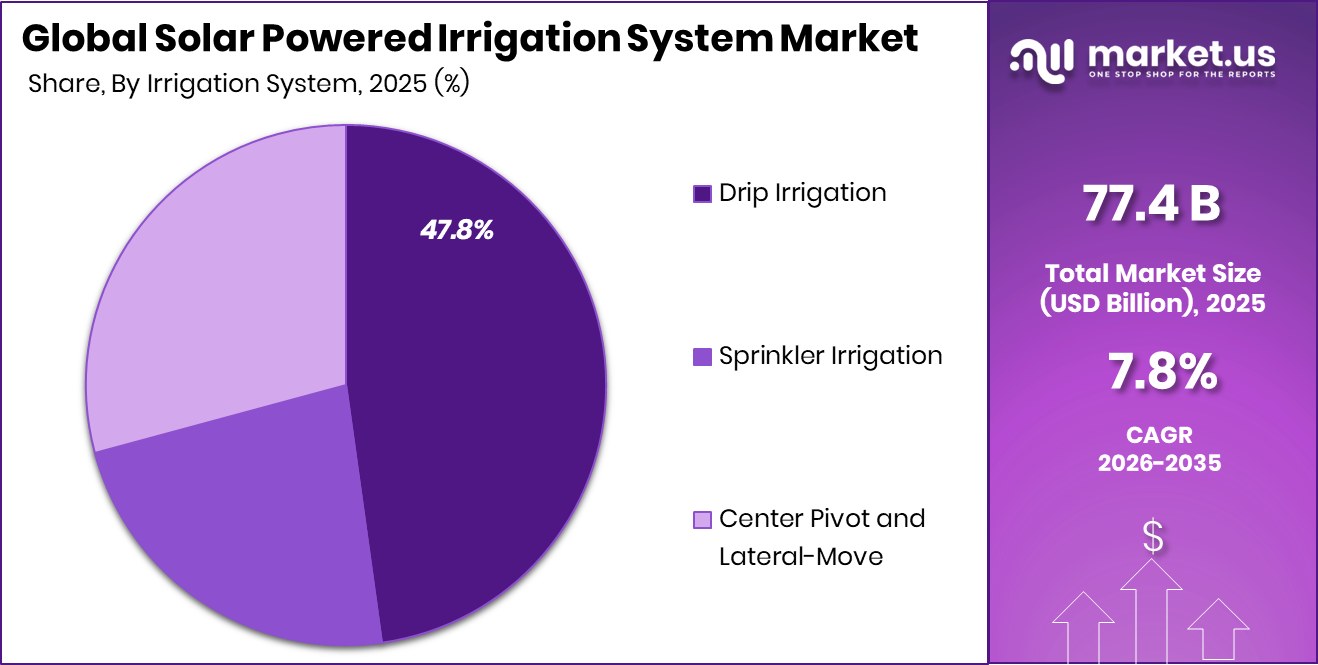
- Drip irrigation leads irrigation systems in the Solar Powered Irrigation System Market, accounting for 47.8% share.
- In the Solar Powered Irrigation System Market, the 3.1 to 10 HP power rating segment holds 44.6% share.
- Solar panels represent a major component segment, contributing 38.2% within the Solar Powered Irrigation System Market.
- Smallholder farms dominate end-users in the Solar Powered Irrigation System Market, accounting for a 49.9% share.
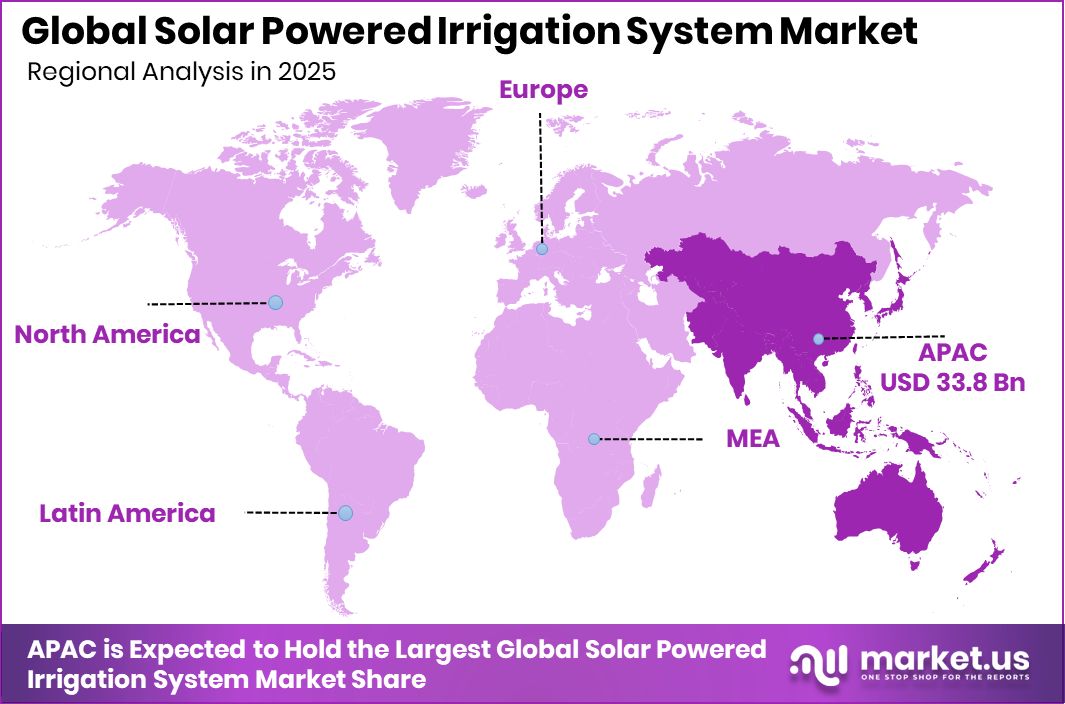
- Asia Pacific held 43.7% share in the Solar Powered Irrigation System Market, valued at USD 33.8 Bn.
By Product Type Analysis
Submersible pumps dominated Solar Powered Irrigation System Market with a significant 48.6% share globally.
In 2025, submersible pumps dominated the Solar Powered Irrigation System Market, accounting for a significant 48.6% share. Their dominance is attributed to their efficiency in pumping water from deep wells and boreholes, which are widely used in agricultural irrigation across regions facing groundwater dependency. Submersible pumps are preferred because they operate underwater, reducing energy loss and improving pumping efficiency compared to surface pumps. Their compatibility with solar-powered systems allows farmers to access reliable irrigation without relying on grid electricity or diesel generators.
The increasing adoption of solar irrigation solutions in rural farming communities further strengthens demand for submersible pumps. Additionally, government subsidies and initiatives promoting solar irrigation technologies have encouraged farmers to install solar-powered submersible pumping systems. As water scarcity and energy costs continue to rise, submersible pumps remain a critical component supporting sustainable and cost-effective irrigation practices.
By Irrigation System Analysis
Drip irrigation dominated Solar Powered Irrigation System Market with a strong 47.8% share.
In 2025, drip irrigation dominated the Solar Powered Irrigation System Market with a 47.8% share, reflecting its strong adoption in water-efficient agricultural practices. Drip irrigation systems deliver water directly to plant roots through a network of pipes and emitters, significantly reducing water wastage and evaporation losses. When integrated with solar-powered pumping systems, drip irrigation enables farmers to maintain consistent irrigation while minimizing energy consumption and operational costs. This combination is particularly beneficial in regions experiencing water scarcity and limited access to electricity.
Farmers increasingly prefer drip irrigation due to its ability to enhance crop yield, optimize fertilizer use, and reduce labor requirements. Government programs encouraging micro-irrigation adoption and sustainable farming practices have further accelerated the growth of solar-powered drip irrigation systems, making it the dominant irrigation method in the market during 2025.
By Power Rating (HP) Analysis
3.1 to 10 HP category dominated Solar Powered Irrigation System Market with 44.6% share.
In 2025, solar irrigation systems with a power rating of 3.1 to 10 HP dominated the Solar Powered Irrigation System Market, capturing a 44.6% share. This power range is widely adopted because it effectively meets the irrigation needs of medium-sized farms and diverse agricultural applications. Pumps within this range provide sufficient water flow and pressure to support various irrigation systems such as drip, sprinkler, and surface irrigation.
Farmers favor 3.1 to 10 HP solar pumps due to their balanced combination of efficiency, affordability, and operational capability. These systems can efficiently draw water from moderate depths while maintaining stable performance under solar power conditions. Additionally, government incentives promoting solar pump installations for agricultural irrigation have increased the adoption of this power category, as it aligns well with the irrigation requirements of many small and mid-scale farming operations.
By Component Analysis
Solar panels dominated Solar Powered Irrigation System Market components with a notable 38.2% share.
In 2025, solar panels dominated the component segment of the Solar Powered Irrigation System Market with a 38.2% share. Solar panels serve as the primary energy generation component, converting sunlight into electricity to power irrigation pumps and related equipment. Their central role in energy production makes them a critical part of solar irrigation systems. Advances in photovoltaic technology have improved panel efficiency, durability, and cost-effectiveness, encouraging broader adoption among farmers and agricultural operators.
The increasing focus on renewable energy solutions in agriculture has further strengthened demand for high-performance solar panels in irrigation systems. Government policies supporting clean energy adoption and financial incentives for solar installations have also contributed to the growth of this component segment. As solar-powered irrigation continues expanding globally, solar panels remain the most essential and dominant component within these systems.
By End-user Analysis
Smallholder farms dominated the Solar Powered Irrigation System Market end-users with a leading 49.9% share.
In 2025, smallholder farms dominated the solar-powered irrigation system market, accounting for a 49.9% share. Smallholder farmers increasingly adopt solar-powered irrigation systems to overcome challenges related to unreliable electricity supply and rising fuel costs associated with diesel pumps. Solar irrigation solutions provide an affordable and sustainable method for accessing water, particularly in rural and off-grid agricultural regions. These systems enable farmers to irrigate crops consistently, improving agricultural productivity and crop quality. Additionally, solar irrigation reduces operational costs over time, making it economically attractive for small-scale farming operations.
Many governments and development organizations have introduced subsidy programs, financing options, and rural electrification initiatives aimed at supporting solar pump installations for smallholder farmers. As a result, smallholder farms continue to represent the largest end-user segment, driving demand in the solar-powered irrigation system market.
Key Market Segments
By Product Type
- Submersible Pumps
- Surface Pumps
- Floating Pumps
By Irrigation System
- Drip Irrigation
- Sprinkler Irrigation
- Center Pivot and Lateral-Move
By Power Rating (HP)
- Up to 3 HP
- 3.1 to 10 HP
- Above 10 HP
By Component
- Solar Panels
- Pumps
- Controllers
- Inverters
- Balance of System
By End-user
- Smallholder Farms
- Commercial Farms
- Greenhouses
- Livestock Watering
Driving Factors
Rising adoption of renewable agricultural irrigation
The rising adoption of renewable agricultural irrigation is becoming an important driving factor for both the Paraffin Wax and Solar Powered Irrigation System Market as industries and agriculture increasingly rely on energy-efficient and sustainable technologies.
Farmers are gradually shifting from conventional fuel-based irrigation systems toward solar-powered alternatives that reduce operating costs and support long-term energy independence. Renewable irrigation solutions also support water conservation and stable agricultural productivity in remote farming areas where electricity access remains limited.
At the same time, developments in energy funding policies continue influencing the renewable energy landscape. For instance, Virginia lost $156 million in Solar for All funding following a clawback, highlighting how policy and funding changes can impact renewable project expansion while still encouraging stakeholders to explore diversified solar deployment strategies.
Restraining Factors
High initial installation cost for farmers
High initial installation costs remain a major restraining factor affecting the Paraffin Wax And Solar Powered Irrigation System Market and solar irrigation adoption among farmers. Although solar irrigation systems reduce long-term operational expenses, the upfront investment required for solar panels, pumping equipment, and installation can create financial challenges for small and medium-scale farmers.
Many agricultural communities still rely on traditional irrigation systems due to the cost barrier associated with transitioning to solar technology. Additionally, the renewable energy sector often requires large-scale manufacturing and infrastructure investment to lower equipment prices. For example, $45.5 million was allocated to support Australian solar manufacturing, aiming to strengthen domestic solar supply chains and reduce costs over time, which could indirectly improve the affordability of solar irrigation technologies.
Growth Opportunity
Expansion of solar irrigation in emerging regions
The expansion of solar irrigation across emerging agricultural regions presents strong growth opportunities for the Paraffin Wax and Solar-Powered Irrigation System Market. Many developing economies are actively seeking sustainable irrigation solutions to improve food security, increase crop productivity, and reduce dependency on fossil fuel-powered pumps.
Solar irrigation systems provide reliable water access for farming communities operating in off-grid or electricity-constrained areas. As rural electrification and renewable energy initiatives expand, solar-powered irrigation infrastructure is expected to become more accessible to farmers.
Government-backed clean energy initiatives are also supporting the growth of solar technologies in local communities. For instance, the U.S. Department of Commerce awarded $41.1 million through the Clean Energy Community Grant program, supporting energy projects that encourage renewable infrastructure development and broader adoption of clean energy technologies.
Latest Trends
Integration of smart controllers with solar pumps
One of the latest trends shaping the Paraffin Wax and Solar-Powered Irrigation System Market is the integration of smart controllers with solar pumping systems. Smart controllers allow farmers to manage irrigation schedules, water flow, and pump performance more efficiently, improving water management and crop productivity. These systems can optimize energy usage by adjusting pumping operations according to solar power availability and irrigation needs. The adoption of digital monitoring tools also enables remote management of irrigation systems, which is particularly beneficial for large agricultural fields.
At the same time, policy developments continue influencing the solar energy sector globally. For example, the U.S. Environmental Protection Agency cancelled a $7 billion solar energy grant program introduced during the Biden era, reflecting how policy adjustments can reshape renewable energy program priorities while technology adoption continues evolving.
Regional Analysis
In 2025, Asia Pacific dominated the Solar Powered Irrigation System Market with 43.7% share, reaching USD 33.8 Bn.
The Solar Powered Irrigation System Market demonstrates varied regional dynamics across North America, Europe, Asia Pacific, the Middle East & Africa, and Latin America, reflecting differences in agricultural practices, renewable energy adoption, and water resource management.
Asia Pacific dominated the market with a 43.7% share, reaching a value of USD 33.8 Bn, supported by strong agricultural dependence and increasing adoption of solar-based irrigation technologies across rural farming areas. Countries in this region continue to integrate solar pumps to improve irrigation efficiency and reduce reliance on conventional energy sources.
North America represents a technologically advanced market where solar irrigation solutions are increasingly used to support sustainable farming practices and reduce operational energy costs. Europe also shows steady adoption due to a strong emphasis on renewable energy and efficient water management in agriculture. The Middle East & Africa region is witnessing increasing use of solar-powered irrigation systems to address water scarcity and support agricultural productivity in off-grid farming areas.
Meanwhile, Latin America is gradually expanding its adoption of solar irrigation technologies as farmers seek cost-effective and environmentally sustainable irrigation solutions to enhance crop production and improve water resource utilization.
Key Regions and Countries
- North America
- US
- Canada
- Europe
- Germany
- France
- The UK
- Spain
- Italy
- Rest of Europe
- Asia Pacific
- China
- Japan
- South Korea
- India
- Australia
- Rest of APAC
- Latin America
- Brazil
- Mexico
- Rest of Latin America
- Middle East & Africa
- GCC
- South Africa
- Rest of MEA
Key Players Analysis
In 2025, Grundfos Holding A/S continues to demonstrate a strong strategic position in the solar-powered irrigation system space through its focus on high-efficiency pumping technologies and advanced water management solutions. The company’s expertise in energy-efficient pump design allows it to support solar-based irrigation applications that require reliable water delivery under varying solar power conditions. Grundfos emphasizes innovation, durability, and system integration, enabling farmers and agricultural operators to deploy solar pumping solutions suitable for remote and off-grid farming environments. Its technological capabilities, global engineering experience, and consistent focus on sustainable water solutions reinforce its relevance in supporting solar irrigation infrastructure development.
Bernt Lorentz GmbH maintains a specialized presence in solar pumping technology, focusing exclusively on solar water pumping systems designed for agriculture and water supply. The company is recognized for engineering solar-powered pumping solutions that operate efficiently without dependence on conventional electricity. Its product development approach emphasizes durability, modular design, and ease of installation, allowing solar irrigation systems to be implemented in diverse agricultural environments. Bernt Lorentz GmbH prioritizes long-term reliability and system performance, which is particularly important for farms operating in remote regions. Its dedicated focus on solar pumping innovation supports the broader expansion of solar-powered irrigation adoption globally.
Shakti Pumps (India) Limited plays a significant role in advancing solar irrigation technology through its specialization in stainless steel pumps and solar pumping solutions. The company integrates solar energy systems with agricultural water pumping equipment, enabling farmers to access dependable irrigation while reducing reliance on grid electricity or fuel-based pumps. Its engineering approach combines durability, corrosion-resistant materials, and efficient motor technology to support long-term agricultural use. Shakti Pumps has built a strong reputation for developing solar pumping systems tailored to agricultural requirements, helping farmers improve irrigation efficiency and water management while supporting sustainable and energy-independent farming operations.
Top Key Players in the Market
- Grundfos Holding A/S
- Bernt Lorentz GmbH
- Shakti Pumps (India) Limited
- Tata Power Solar Systems Limited
- C.R.I.Pumps Private Limited
- Franklin Electric Co., Inc.
- Jntech Renewable Energy Co., Ltd.
- Bright Solar Limited
- Solar Power & Pump Company LLC.
- American West Windmill and Solar Company
Recent Developments
- In July 2025, Grundfos supported a large solar-powered irrigation project at Mont Rouge Olive Estate in South Africa, supplying pumps for a system powered by 750 kWp solar panels to irrigate 200 hectares of olive farms, improving off-grid irrigation reliability.
- In August 2024, Shakti Pumps (India) Limited, a company that manufactures solar water pumps and energy-efficient pumping systems, secured a Letter of Intent to supply 12,537 solar water pumps in Uttar Pradesh under the PM-KUSUM scheme to support solar irrigation for farmers.
Report Scope
Report Features Description Market Value (2025) USD 77.4 Billion Forecast Revenue (2035) USD 164.3 Billion CAGR (2026-2035) 7.8% Base Year for Estimation 2025 Historic Period 2020-2024 Forecast Period 2026-2035 Report Coverage Revenue Forecast, Market Dynamics, Competitive Landscape, Recent Developments Segments Covered By Product Type (Submersible Pumps, Surface Pumps, Floating Pumps), By Irrigation System (Drip Irrigation, Sprinkler Irrigation, Center Pivot and Lateral-Move), By Power Rating (HP) (Up to 3 HP, 3.1 to 10 HP, Above 10 HP), By Component (Solar Panels, Pumps, Controllers, Inverters, Balance of System), By End-user (Smallholder Farms, Commercial Farms, Greenhouses, Livestock) Regional Analysis North America – US, Canada; Europe – Germany, France, The UK, Spain, Italy, Rest of Europe; Asia Pacific – China, Japan, South Korea, India, Australia, Singapore, Rest of APAC; Latin America – Brazil, Mexico, Rest of Latin America; Middle East & Africa – GCC, South Africa, Rest of MEA Competitive Landscape Grundfos Holding A/S, Bernt Lorentz GmbH, Shakti Pumps (India) Limited, Tata Power Solar Systems Limited, C.R.I.Pumps Private Limited, Franklin Electric Co., Inc., Jntech Renewable Energy Co., Ltd., Bright Solar Limited, Solar Power & Pump Company LLC., American West Windmill and Solar Company Customization Scope Customization for segments, region/country-level will be provided. Moreover, additional customization can be done based on the requirements. Purchase Options We have three licenses to opt for: Single User License, Multi-User License (Up to 5 Users), Corporate Use License (Unlimited User and Printable PDF)  Solar Powered Irrigation System MarketPublished date: March 2026add_shopping_cartBuy Now get_appDownload Sample
 -
-
- Grundfos Holding A/S
- Bernt Lorentz GmbH
- Shakti Pumps (India) Limited
- Tata Power Solar Systems Limited
- C.R.I.Pumps Private Limited
- Franklin Electric Co., Inc.
- Jntech Renewable Energy Co., Ltd.
- Bright Solar Limited
- Solar Power & Pump Company LLC.
- American West Windmill and Solar Company
Our Clients

- 180609
- March 2026






