


Report Overview
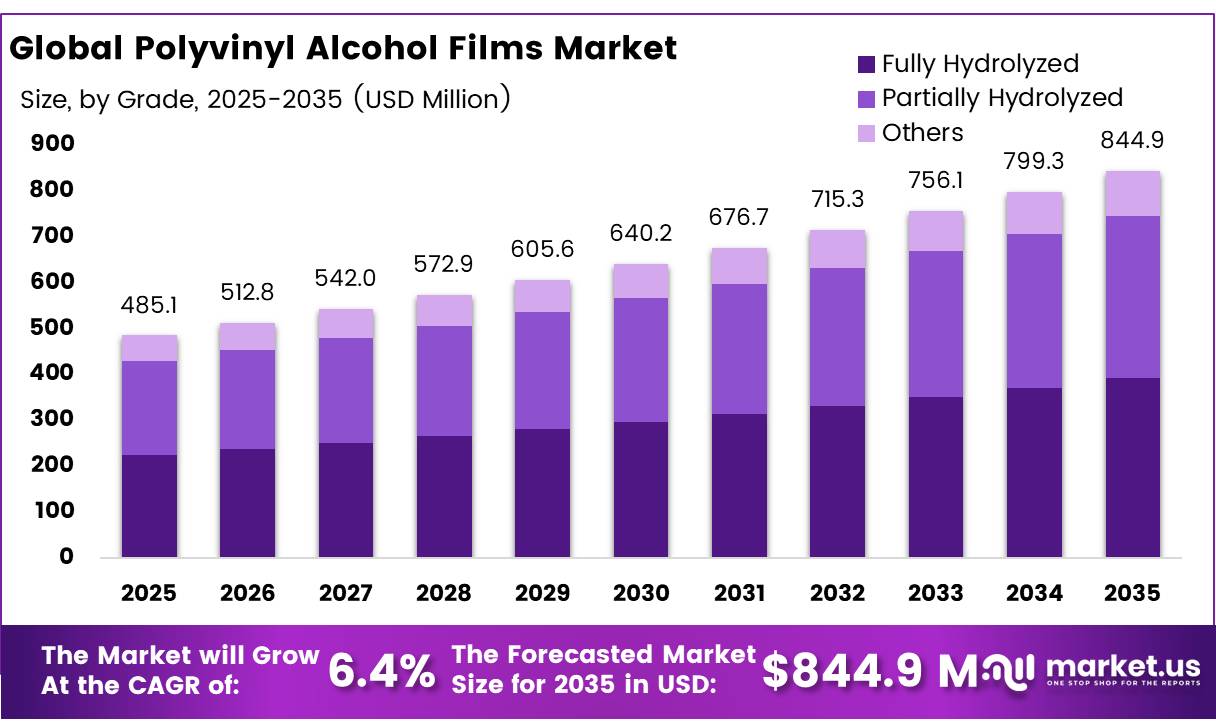
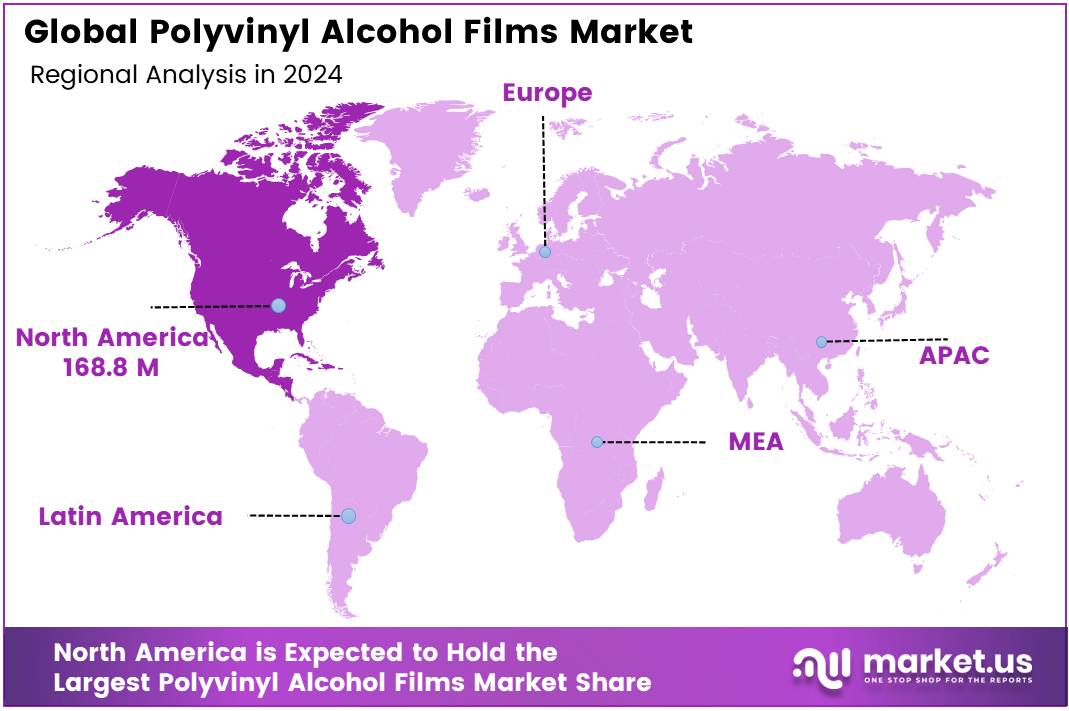
In 2025, the Global Polyvinly Alcohol Films Market was valued at USD 485.1 million, and between 2026 and 2035, this market is estimated to register a CAGR of 6.4%, reaching about USD 844.9 million by 2035. In 2025, North America led the market, achieving over 34.8% share with a revenue of US$168.8 Million.
Polyvinyl Alcohol (PVA) films have emerged as a critical water-soluble, biodegradable packaging solution addressing mounting environmental waste concerns across detergent, agrochemical, pharmaceutical, and food sectors. The industrial scenario for PVA films is shaped directly by international plastic-waste policy momentum.
- In February 2025, according to the United Nations Environment Programme, global plastic waste generation stood near 400 million tonnes annually, with volumes projected to almost triple to around 1.2 billion tonnes by 2060 under current trends. This escalating waste burden is a principal driving factor pushing manufacturers and regulators toward compostable, water-dispersible film alternatives such as PVA.
Key Takeaways
- Global polyvinyl alcohol films market was worth USD 485.1 million in 2025.
- It is expected that the growth of global polyvinyl alcohol films market will be at CAGR of 6.4%, reaching USD 844.9 million by 2035.
- Fully hydrolyzed PVA films were dominant segment in 2025 with its market share of around 46.3% of the total market.
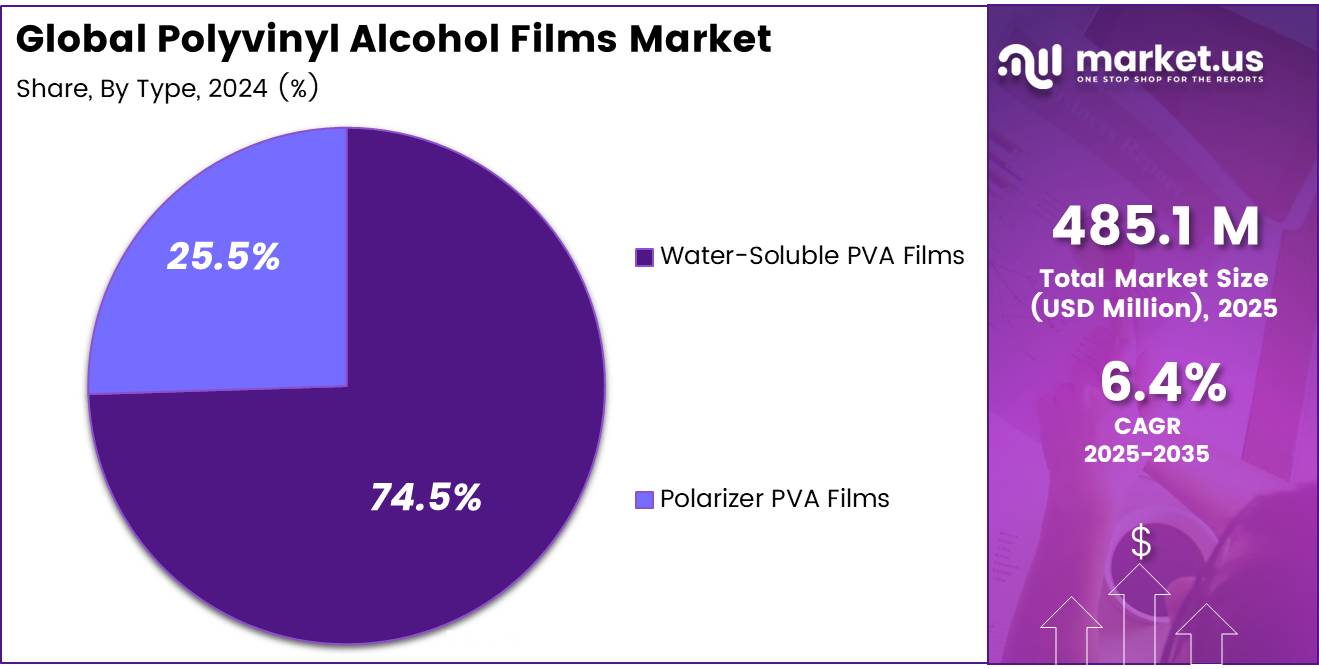
- Water-soluble PVA films were leading in the market with its share of 74.5% in 2025.
- 30–60 μm was leading in the market with its market share of around 48.1% of the total market.
- Detergent packaging was leading the market in 2025 with its market share of about 37.2%.
- In 2025, North America was largest was the largest segment with its market share of about 34.8%.
Future growth opportunities for PVA films lie in expanding applications within unit-dose detergent pods, pharmaceutical delivery systems, and sustainable agrochemical packaging, as governments worldwide tighten single-use plastic restrictions and extended producer responsibility frameworks, positioning PVA films as a compliance-driven, environmentally aligned material choice across regulated global packaging value chains.
- Reinforcing this shift, in February 2025, according to the European Commission, the Packaging and Packaging Waste Regulation (EU) 2025/40 mandated a 65% recycling rate for all packaging waste by 2025, rising to 70% by 2030, alongside recyclability requirements for all packaging by 2030.
Grade Analysis
The market’s top segment was made up of fully hydrolyzed polyvinyl alcohol films.
The fully hydrolyzed segment dominates the global polyvinyl alcohol market, accounting for nearly 46.3% of the total market share. Based on grade, the market is categorized into fully hydrolyzed, partially hydrolyzed, and other variants. The strong market position of fully hydrolyzed PVA films is primarily attributed to their superior functional properties compared to partially hydrolyzed grades.
- According to the European Commission, Member States must ensure annual consumption of lightweight plastic carrier bags does not exceed 40 bags per capita by 2025, reinforcing the broader policy push toward compostable, water-dispersible alternatives
Polarizer PVA Films stand out as the fastest-growing segment, gaining ground through their use in optical-grade films for LCD and OLED display manufacturing. According to the Ministry of Trade, Industry and Resources of the Republic of Korea, display exports rose 9.4% year-on-year in May 2026, supported by the launch of new mobile products, contributing to record overall export performance
Type Analysis
Water-Soluble Polyvinyl Alcohol (PVA) Films dominated the global Polyvinyl Alcohol Films Market
In 2025, Water-Soluble Polyvinyl Alcohol (PVA) Films accounting for approximately 74.5% of the total market share. The strong market dominance of this segment is attributed to the extensive use of water-soluble PVA films across multiple high-volume industries, particularly in detergent packaging, agrochemical packaging, laundry bags, and medical applications. These films are highly valued for their excellent water solubility, biodegradability, non-toxic composition, and ease of disposal, making them an ideal sustainable packaging solution.
Among the various categories, normal temperature soluble films hold a significant share due to their widespread application in household detergent pods and cleaning products. Medium and high-temperature soluble films are increasingly utilized in industrial and specialized applications where controlled dissolution is required. The rising global demand for eco-friendly and convenient packaging solutions has further accelerated the adoption of water-soluble PVA films, especially as governments and consumers push for reduced plastic waste and improved environmental sustainability.
Thickness Analysis
Polyvinyl alcohol films with a thickness of 30–60 μm accounted for the largest market share.
30–60 μm films lead the polyvinyl alcohol films market by thickness, commanding a strong 48.1% share, favored for their balanced strength, dissolution speed, and durability across detergent pods, agrochemical sachets, and pharmaceutical unit-dose packaging.
In February 2025, according to the European Commission, Member States must establish deposit-return systems and collect at least 90% of single-use plastic and metal beverage containers by 2029, reinforcing sustained demand for standardized, mid-thickness soluble films. This blend of functional reliability and regulatory backing secures the segment’s core market position.
- According to the U.S. Environmental Protection Agency, the National Recycling Goal targets raising the U.S. recycling rate to 50% by 2030 , a benchmark encouraging manufacturers to adopt thinner, more resource-efficient film structures. As sustainability targets tighten, thinner PVA films are expected to see accelerated adoption.
Application Analysis
Detergent packaging represents dominant Segment in the Market
Detergent Packaging stands as the clear leader among PVA film applications, commanding a substantial 37.2% share, driven by the widespread use of water-soluble films in single-load laundry pods and dishwasher capsules. In June 2025, according to the European Parliament, the Council and Parliament reached a provisional agreement on the revised EU Detergents Regulation, empowering the European Commission to set stricter biodegradability requirements for the water-soluble polymeric films used to encapsulate detergents.
Agrochemical Packaging, meanwhile, is emerging as the fastest-growing application, gaining momentum as farmers increasingly turn to pre-measured, water-soluble sachets for safer pesticide handling. In July 2025, according to the Food and Agriculture Organization of the United Nations, global pesticide consumption reached 3.73 million tonnes of active ingredients in 2023, nearly double the level recorded in 1990
Key Market Segments
By Grade
- Fully Hydrolyzed
- Partially Hydrolyzed
- Others
By Type
- Water-Soluble PVA Films
-
- Normal Temperature Soluble
- Medium Temperature Soluble
- High Temperature Soluble
- Polarizer PVA Films
By Thickness
- Up to 30 μm
- 30–60 μm
- Above 60 μm
By Application
- Detergent packaging
- Agrochemical packaging
- Laundry bags
- Embroidery
- Polarizing Panels
- Medical & Pharmaceutical
- Others
Driver Analysis
Product innovation in composite and bio‑filled PVA films
As global packaging, food, and consumer‑goods companies seek to meet plastic-reduction targets, PVA composite films can be engineered to match specific application needs—e.g., moisture barrier for dry foods, oxygen barrier for snacks, antimicrobial surface for fresh products—allowing PVA to occupy niches where pure PVA or traditional plastics would underperform.
If innovation pipelines over 2026–2030 yield even a handful of commercially successful composite film families, each capturing low‑single‑digit shares of relevant packaging or industrial segments, the aggregate effect could be high‑single‑digit incremental demand for these higher‑margin grades, with suppliers able to charge 10–20% price premiums while offering improved sustainability profiles.
This driver reconfigures business models from bulk film production toward more diversified portfolios of engineered materials, supported by application labs, co‑development agreements with major brands, and IP‑protected formulations; over a ≥4 year horizon, such innovation can reasonably add around 1–1.5 percentage points to CAGR by opening new addressable markets and strengthening PVA’s strategic position within the broader transition to sustainable and biodegradable packaging solutions.
Drivers Impact Analysis
| Driver | (~) % Impact on CAGR | Geographic Relevance | Impact Timeline |
|---|---|---|---|
| Cold-water detergent pods and household unit-dose cleaning | +2.3% | North America core, EU, developed APAC | Short term (≤ 2 years) |
| Water-soluble agrochemical and industrial packaging under plastics regulation | +1.9% | Asia-Pacific corridors, EU regulatory hubs, Latin America spill-over | Medium term (2-4 years) |
| Biodegradable medical, healthcare, and hygiene film adoption | +1.6% | North America, EU core, Japan, South Korea | Medium term (2-4 years) |
| Optical PVA films in LCD/OLED polarizers and electronics | +1.8% | East Asia electronics hubs, North America design centers | Long term (≥ 4 years) |
| Product innovation in composite and bio-filled PVA films | +1.4% | Global innovation clusters, EU, U.S., Japan | Long term (≥ 4 years) |
Restraint Analysis
Moisture sensitivity and barrier performance limits in PVA films
As a result, PVA films cannot easily replace all conventional plastics in barrier-intensive packaging such as snacks, certain foods, or high‑humidity logistics, and must often be restricted to specific niches or used in combination with other materials, limiting volumetric expansion opportunities and keeping PVA as a specialty rather than dominant substrate.
Strategically, this acts as a hard restraint because it caps the total practical TAM for single‑layer PVA films and forces significant R&D and capex to unlock new applications via composites; until moisture-management and barrier properties see step-change improvements, this constraint likely shaves around 1.5 percentage points off potential CAGR over a ≥4 year horizon, particularly in humid APAC and tropical Latin American regions where environmental conditions are most challenging.
Restraint Impact Analysis
| Restraint | (~) % Impact on CAGR | Geographic Relevance | Impact Timeline |
|---|---|---|---|
| High energy-intensive PVA film processing cost | -2.2% | Asia-Pacific production hubs, EU, North America | Medium term (2-4 years) |
| Volatile vinyl acetate monomer and PVA raw-material prices | -1.8% | North America core, EU importers, Asia petrochemical corridors | Medium term (2-4 years) |
| Moisture sensitivity and barrier performance limits in PVA films | -1.5% | Global, esp. humid APAC and tropical Latin America | Long term (≥ 4 years) |
| Concentrated supply base and regional production dependence | -1.7% | Asia-Pacific core, EU, North America downstream users | Long term (≥ 4 years) |
| Regulatory constraints on LDPE content and competing eco-materials | -1.6% | EU regulatory hubs, North America, developed APAC | Medium term (2-4 years) |
Opportunity Analysis
Regulated EU e-commerce & transport packaging formats
The EU Packaging and Packaging Waste Regulation entered into force in 2025 and begins general application from August 2026, with major reuse and packaging reduction provisions phasing toward 2030, including 40% reusable transport-packaging targets in key cases and a 50% empty-space cap for grouped, transport, and e-commerce packaging, which increases the value of lightweight specialty formats that remove secondary material layers outright.
In commercial terms, if PVA film suppliers capture even 2% to 3% of the addressable high-compliance packaging redesign spend in regulated EU logistics-intensive categories, that can create an adjacent serviceable market equivalent to roughly 10% to 15% of the 2026 global PVA films baseline, supporting about +1.4 percentage points of incremental CAGR through premium pricing, qualification-led stickiness, and 300 to 600 basis points of gross-margin expansion versus standard water-soluble film grades.
Opportunity Impact Analysis
| Opportunity | (~) % Potential CAGR Upside | Geographic Relevance | Execution Window |
|---|---|---|---|
| Regulated EU e-commerce & transport packaging formats | +1.4% | EU core, UK, CEE | Short term (≤ 2 years) |
| Pharma unit-dose & hospital-ready dissolvable films | +1.1% | North America, EU, Japan | Medium term (2-4 years) |
| Agrochemical soluble sachet conversion | +1.7% | India, China, LATAM, Southeast Asia | Medium term (2-4 years) |
| Premium personal care & beauty pods | +0.9% | North America, EU, South Korea, Japan | Short term (≤ 2 years) |
| Optical-film adjacent value capture | +1.3% | Japan, South Korea, China, Taiwan | Medium term (2-4 years) |
| Regional M&A roll-up in fragmented specialty converters | +1.6% | India, China, EU niche markets | Long term (≥ 4 years) |
Challenges Analysis
Volatile feedstock and energy costs
Root friction stems from the PVA value chain’s exposure to upstream vinyl acetate monomer (VAM) and power costs, which in turn are tied to naphtha and natural-gas pricing, emissions compliance, and regional energy mix volatility, creating recurring unit-cost variability without fully blocking production; in practice, PVA film producers see raw-material cost swings of 10% to 25% year-on-year and electricity and steam expenses varying by 15% or more across regions, with EU plants particularly sensitive to carbon pricing and fuel-switching policies, and Asian facilities exposed to local power-grid constraints.
This volatility translates into a 150 to 350 basis point spread in gross margins between plants and quarters, as well as price-adjustment cycles that lag cost changes by 3 to 6 months, effectively creating a growth drag of about 1.4 percentage points on the market’s potential CAGR by forcing producers to prioritize margin defense over aggressive volume expansion and by increasing the standard deviation of contract prices relative to fully integrated resin producers.
Strategic mitigation requires multi-year hedging programs for key inputs, diversified sourcing across at least two VAM suppliers per region, onsite energy-efficiency investments that can cut kWh per square meter by 10% to 15%, and contract structures that allow price-indexing to major energy benchmarks on a quarterly basis, but these take 2 to 4 years to normalize cost curves and adoption remains partial, which is why this drag persists as a medium-term challenge rather than a short-term restraint.
Challenges Impact Analysis
| Challenge | (~) % CAGR Friction | Geographic Relevance | Mitigation Horizon |
|---|---|---|---|
| Volatile feedstock and energy costs | -1.4% | Global, EU, China | Medium term (2-4 years) |
| Complex, shifting packaging regulation | -1.2% | EU regulatory hubs | Long term (≥ 4 years) |
| Multi-node logistics and transit unreliability | -1.0% | APAC–EU–NA trade lanes | Medium term (2-4 years) |
| High-spec optical film process complexity | -1.1% | Japan, China, Korea | Long term (≥ 4 years) |
| Limited specialized formulation and application talent | -0.9% | Global, esp. Asia and EU | Long term (≥ 4 years) |
| Capital allocation and scale-up timing risk | -1.3% | Global, new capacity nodes | Medium term (2-4 years) |
Geopolitical Impact Analysis
Geopolitical Unrest that Disrupts the Polyvinyl Alcohol Films Market’s Supply Chain The market for polyvinyl alcohol films is greatly impacted by geopolitical tension since it disrupts the supply chain, raises the price of raw materials, and makes trade challenging. In this instance, raw materials, such as vinyl acetate monomer, are necessary for the creation of PVA films. A few countries, such as China, the United States, and Japan, provide the majority of these resources. The supply of VAM may be disrupted by any kind of political unrest or interruption in international trade, which would have an impact on PVA film producers worldwide.
For instance, Chemical shortages, for instance, are a result of trade disputes between the US and other countries. Furthermore, delays in the transportation of raw materials needed in production result from any interruptions in the shipping process across oceans like South China and the Strait of Hormuz. PVA films are also the result of energy-intensive procedures. Geopolitical friction between nations raises energy prices, which raises manufacturing costs and, ultimately, the price of the product. For example, oil prices have doubled due to geopolitical conflict between Russia and Ukraine.
Regional Analysis
North America Dominates the World Polyvinyl Alcohol Films Market
The biggest market for polyvinyl alcohol films is North America, which makes up about 34.8% of global revenue, estimated at approximately US$168.8 million. The dominance of this region is attributable to the high demand for PVA films in different industries such as packaging, agriculture, healthcare, and textile. The advanced manufacturing facilities along with sustainable technologies have led to increased use of PVA films especially in the United States where green technology is highly regarded.
Water-soluble polyvinyl alcohol films have been largely used in packaging of unit-dose detergents that provide convenience to customers while cutting down the use of plastics. They are also used in packaging pesticides and fertilizers that dissolve in the agricultural fields without posing health risks or packaging problems. The strict environmental regulations in the region along with the increased awareness of consumers regarding sustainable products has boosted the adoption of the film.
North America has benefitted from the existence of key companies in the sector as well as constant investments in research and development activities. All these factors ensure that the region continues dominating the world market for polyvinyl alcohol films.
Key Regions and Countries Covered
- North America
- The US
- Canada
- Europe
- Germany
- France
- The UK
- Spain
- Italy
- Russia & CIS
- Rest of Europe
- APAC
- China
- Japan
- South Korea
- India
- ASEAN
- Rest of APAC
- Latin America
- Brazil
- Mexico
- Rest of Latin America
- Middle East & Africa
- GCC
- South Africa
- Rest of MEA
Key Players Analysis
The global polyvinyl alcohol (PVA) films market is characterized by the presence of several established manufacturers and specialty chemical companies, including Kuraray, Mitsubishi Chemical Group, Aicello Corporation, Sekisui Chemical, Chang Chun Group, Jiangmen Proudly Water-soluble Plastic, Foshan Polyva Materials, Amtrex Nature Care, Arrow GreenTech, Cortec Corporation, Ecopol S.p.A., Noble Industries, ElephChem Holding, and Medanos Claros HK.
A key focus area for these companies is research and development, aimed at enhancing product performance and expanding application scope. Continuous innovation is particularly directed toward improving water solubility, mechanical strength, and environmental sustainability of PVA films, enabling their use in packaging, agriculture, healthcare, and specialty applications.
Kuraray is a leading global specialty chemical company recognized for its high-performance PVA resins and films, widely used across industrial and consumer applications. The company emphasizes sustainable material development and compliance with evolving environmental regulations.
Aicello Corporation, a Japanese manufacturer, supplies water-soluble PVA films under its Solublon brand and has strategically transitioned its portfolio toward environmentally responsible materials, reinforcing its commitment to sustainability.
The Major Players In The Industry
- Kuraray Co., Ltd
- Mitsubishi Chemical Group Corporation
- Aicello Corporation
- Sekisui Chemical Co., Ltd.
- Chang Chun Group
- Jiangmen Proudly Water-soluble Plastic Co., Ltd.
- Foshan Polyva Materials Co., Ltd.
- Amtrex Nature Care Pvt. Ltd.
- Arrow GreenTech Ltd
- Cortec Corporation
- Ecopol SpA
- Noble Industries
- ElephChem Holding Limited
- Medanos Claros HK Limited
- Other Key Players
Key Developments
- In October 2024, Mitsubishi Chemical Group Corporation announced expansion of OPL Film, adding 27 million m²/year and lifting total capacity to 154 million m²/year by FY2027. In April 2025, its Okayama Plant PVA products received ISCC PLUS certification. In August 2025, it decided to transfer J-Film, which had JPY 33.6 billion sales and 827 employees.
- In June 2025, Kuraray Co., Ltd announced expansion at its Saijo Plant, Japan, adding 38 million m²/year capacity. Total annual capacity will rise from 296 million m² to 334 million m², with operations planned for December 2027. The new line supports 3-meter-wide polarizing films, showing strong new product and expansion focus.
- In May 2025, Sekisui Specialty Chemicals raised prices for Selvol and related products by up to USD 200/mt in North America, Latin America, and Asia, and EUR 200/mt in EMEA.
Report Scope
| Report Features | Description |
|---|---|
| Market Value (2025) | USD 485.1 Mn |
| Forecast Revenue (2035) | USD 844.9 Mn |
| CAGR (2025-2035) | 6.4% |
| Base Year for Estimation | 2025 |
| Historic Period | 2020-2025 |
| Forecast Period | 2026-2035 |
| Report Coverage | Revenue Forecast, Market Dynamics, Competitive Landscape, Recent Developments |
| Segments Covered | By Grade (Fully Hydrolyzed, Partially Hydrolyzed and Others), By Type (Water-Soluble PVA Films and Polarizer PVA Films), By Thickness (Up to 30 μm, 30–60 μm and Above 60 μm), By Application (Detergent Packaging, Agrochemical Packaging, Laundry Bags, Embroidery, Polarizing Panels, Medical & Pharmaceutical and Others) |
| Regional Analysis | North America – The US & Canada; Europe – Germany, France, The UK, Spain, Italy, Russia & CIS, Rest of Europe; APAC– China, Japan, South Korea, India, ASEAN & Rest of APAC; Latin America– Brazil, Mexico & Rest of Latin America; Middle East & Africa– GCC, South Africa, & Rest of MEA |
| Competitive Landscape | Kuraray, Mitsubishi Chemical, Aicello Corporation, Sekisui Chemical, Chang Chun Group, Jiangmen Proudly Water-soluble Plastic, Foshan Polyva Materials, Amtrex Nature Care, Arrow GreenTech, Cortec Corporation, Ecopol SpA, Noble Industries, ElephChem Holding, Medanos Claros HK, Other Players. |
| Customization Scope | Customization for segments, region/country-level will be provided. Moreover, additional customization can be done based on the requirements. |
| Purchase Options | We have three licenses to opt for: Single User License, Multi-User License (Up to 5 Users), Corporate Use License (Unlimited Users and Printable PDF) |





































