


Global Nickel-Metal Hydride Battery Market Size, Share, And Enhanced Productivity By Product Type (Small Sized, Large Sized, Others), By Application (HEV, Retail Market, Cordless Phone, Dust Collector, Personal Care, Lighting Tools, Others), By End-user (Consumer Electronics, Hybrid and Electric Vehicles, Others), By Region and Companies - Industry Segment Outlook, Market Assessment, Competition Scenario, Trends, and Forecast 2025-2034
- Published date: December 2025
- Report ID: 168663
- Number of Pages: 222
- Format:
-
keyboard_arrow_up
Quick Navigation
Report Overview
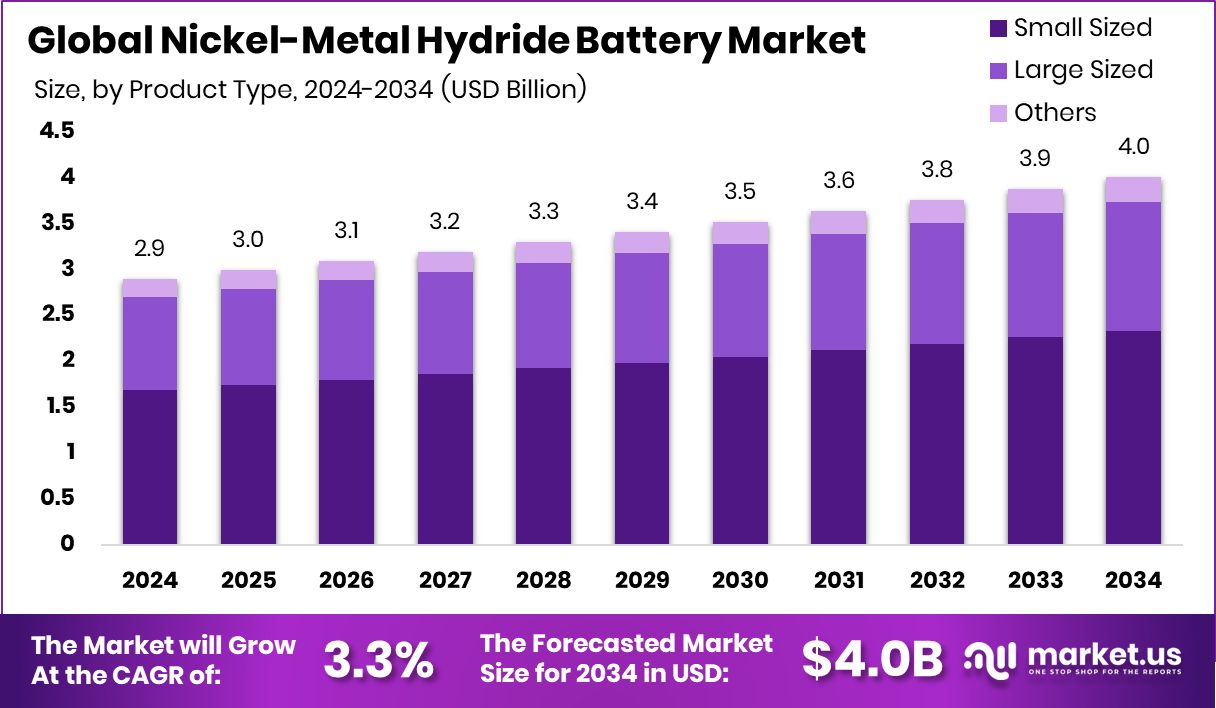
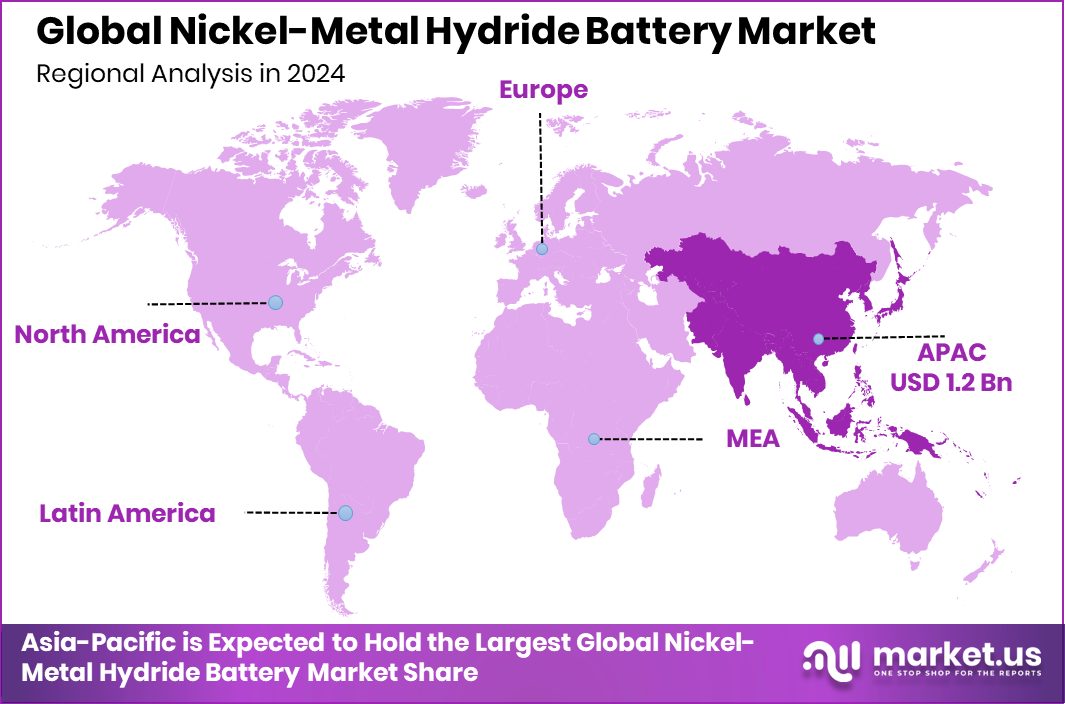
The Global Nickel- Metal Hydride Battery Market is expected to be worth around USD 4.0 billion by 2034, up from USD 2.9 billion in 2024, and is projected to grow at a CAGR of 3.3% from 2025 to 2034. Asia-Pacific accounts for 43.80% of Nickel-Metal Hydride Battery Market totaling USD 1.2 Bn.
A Nickel-Metal Hydride (NiMH) battery is a rechargeable battery that stores energy using nickel oxide hydroxide and a hydrogen-absorbing metal alloy. It is known for stable performance, safety, and long cycle life. NiMH batteries are widely used in hybrid vehicles, consumer electronics, medical devices, and backup power systems, especially where reliability matters more than compact size.
The Nickel-Metal Hydride Battery Market refers to the production, use, and trade of these batteries across transportation, electronics, and industrial sectors. In simple terms, this market supports energy storage needs where cost control, durability, and proven technology are important, particularly in hybrid electric vehicles and grid-support applications.
Growth factors include government-backed electrification efforts and consumer incentives that keep electric mobility moving forward. Policy support such as an EV grant scheme boost worth £1.3bn, £3,750 discounts on electric cars, and discussions around reallocating a £950m motorway charger fund continue to strengthen interest in electrified power systems.
Demand is rising as drivers respond to running-cost savings. Motorists are expected to save about £850 per year by choosing electric cars, supporting steady battery demand despite policy measures like a proposed $250 annual EV fee.
Key Takeaways
- The Global Nickel- Metal Hydride Battery Market is expected to be worth around USD 4.0 billion by 2034, up from USD 2.9 billion in 2024, and is projected to grow at a CAGR of 3.3% from 2025 to 2034.
- Small sized products dominate the Nickel-Metal Hydride Battery Market with 58.2% share due to designs.
- HEV applications lead the Nickel-Metal Hydride Battery Market holding 46.8% as hybrids balance efficiency sustainability.
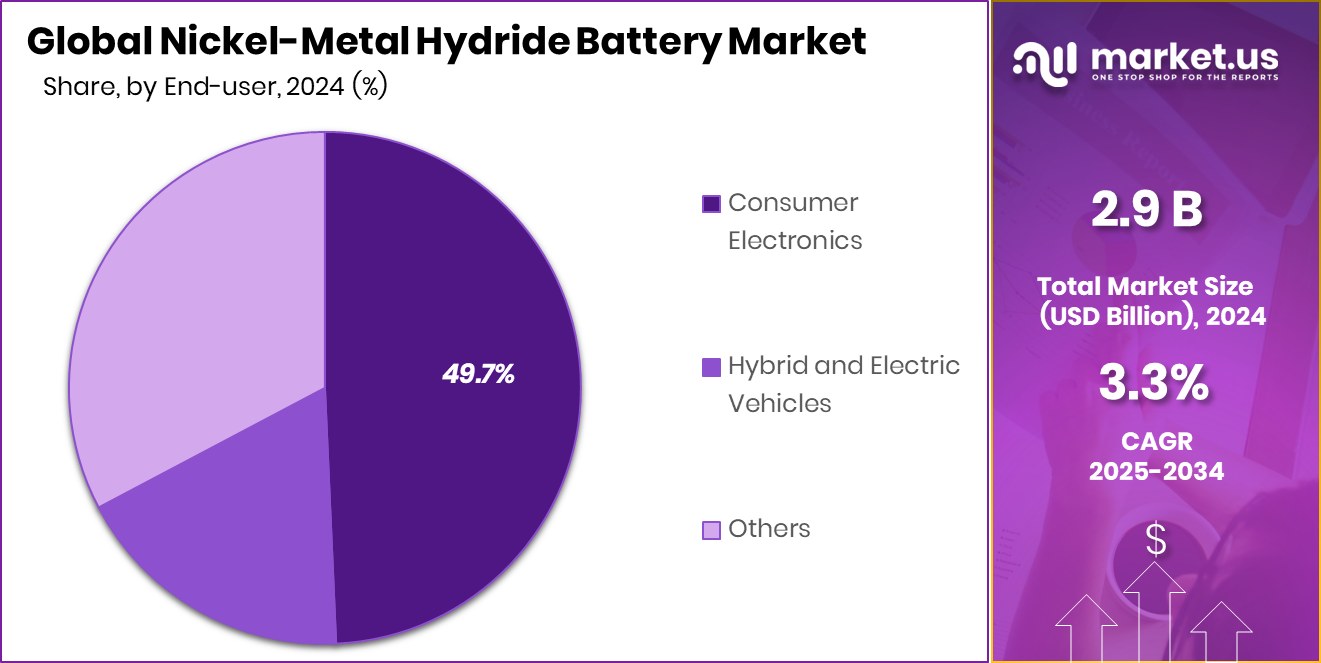
- Consumer electronics drive the Nickel-Metal Hydride Battery Market with 49.7% demand from everyday portable devices.
- Nickel-Metal Hydride Battery Market in Asia-Pacific reached USD 1.2 Bn representing 43.80% share.
By Product Type Analysis
Small sized batteries dominate the Nickel-Metal Hydride Battery Market with 58.2% share.
In 2024, Small Sized held a dominant market position in the By Product Type segment of the Nickel-Metal Hydride Battery Market, with a 58.2% share. This dominance reflects strong usage across applications that require compact, reliable, and cost-effective power solutions.
Small sized NiMH batteries are widely preferred where space efficiency and stable energy output are critical. Their ability to operate safely under repeated charge and discharge cycles supports long-term use across established systems.
Manufacturers continue to focus on this format due to its proven performance, predictable manufacturing processes, and compatibility with existing product designs. The segment benefits from steady replacement demand, as many devices are engineered specifically around small sized NiMH configurations.
By Application Analysis
HEV applications lead the Nickel-Metal Hydride Battery Market, accounting for 46.8% demand.
In 2024, HEV held a dominant market position in the By Application segment of the Nickel-Metal Hydride Battery Market, with a 46.8% share. This strong position is linked to the long-standing use of NiMH batteries in hybrid electric vehicles, where dependable power delivery and safety are key requirements.
HEV platforms continue to rely on this battery chemistry for consistent performance across varied driving conditions. The 46.8% share reflects sustained adoption in hybrid powertrains that balance electric assistance with conventional engines.
Automakers value the proven operating stability and predictable lifecycle of NiMH batteries in HEV systems. As a result, this segment maintains leadership within the application landscape, supported by established vehicle designs and ongoing demand for practical hybrid mobility solutions.
By End-user Analysis
Consumer electronics dominate usage in the Nickel-Metal Hydride Battery Market at 49.7%.
In 2024, Consumer Electronics held a dominant market position in the By End-user segment of the Nickel-Metal Hydride Battery Market, with a 49.7% share. This dominance highlights the continued reliance on NiMH batteries across everyday electronic devices that require safe, rechargeable, and stable power sources.
The 49.7% share reflects steady replacement demand, as many consumer products are designed around this battery chemistry. NiMH batteries are favored in electronics for their consistency, ease of use, and dependable performance over long periods.
Manufacturers serving consumer electronics maintain production focus on NiMH to meet recurring usage needs. As a result, this end-user segment remains a key contributor to overall market volume, supported by widespread adoption and sustained consumer demand.
Key Market Segments
By Product Type
- Small Sized
- Large Sized
- Others
By Application
- HEV
- Retail Market
- Cordless Phone
- Dust Collector
- Personal Care
- Lighting Tools
- Others
By End-user
- Consumer Electronics
- Hybrid and Electric Vehicles
- Others
Driving Factors
Growing Hybrid Vehicle Adoption Sustains NiMH Demand
One major driving factor of the Nickel-Metal Hydride Battery Market is the steady growth of hybrid electric vehicles. NiMH batteries are widely used in hybrids because they are reliable, safe, and well tested over many years. Vehicle makers prefer this technology as it performs consistently under different temperatures and driving conditions.
NiMH batteries also support frequent charging and discharging without sudden performance drops, which is important for hybrid driving patterns. From a buyer’s point of view, hybrids offer smoother operation and lower maintenance risks, which indirectly supports battery demand.
The familiarity of this battery type across existing vehicle platforms further strengthens adoption. As long as hybrid vehicles remain a practical transition option between fuel-driven and fully electric mobility, NiMH batteries continue to see stable and dependable market growth.
Restraining Factors
Lower Energy Density Limits Advanced Application Expansion
A key restraining factor in the Nickel-Metal Hydride Battery Market is its lower energy density compared to newer battery technologies. NiMH batteries store less energy for the same size and weight, which limits their use in compact and high-power applications.
As products become smaller and demand longer operating times, this constraint becomes more visible. In vehicles, lower energy density means heavier battery packs for similar performance levels. This can reduce efficiency and design flexibility. Some manufacturers also face challenges meeting modern performance expectations using this chemistry alone.
As a result, NiMH batteries remain less suitable for applications where lightweight design and long-range performance are critical. This limitation slows adoption in advanced use cases, even though the technology remains reliable and well established.
Growth Opportunity
Affordable Electric Mobility Expands NiMH Adoption Scope
One strong growth opportunity for the Nickel-Metal Hydride Battery Market lies in the push for affordable electric mobility. Support measures such as an electric car grant worth up to £3,750 help reduce upfront costs for buyers, making electric and hybrid vehicles more accessible. This encourages broader adoption of cost-effective battery technologies that balance price, safety, and durability.
At the same time, ongoing warnings of risk to used values make buyers more cautious about expensive vehicle components. NiMH batteries benefit in such conditions because they are proven, stable, and easier to value in the resale market. As affordability becomes a priority over cutting-edge performance, NiMH batteries gain opportunities in practical, value-driven electric mobility solutions across daily transport needs.
Latest Trends
Rising Demand for Reliable Rechargeable Power Solutions
One of the latest trends in the Nickel-Metal Hydride Battery Market is the growing demand for reliable and safe rechargeable power in everyday devices. Consumers increasingly prefer well-known battery technologies that offer stable performance and simple handling. This trend is visible in new product launches that favor dependable energy storage.
For example, Makera Z1 smashes its funding goal and soared past $4M on Kickstarter, showing strong interest in advanced consumer hardware that depends on trusted power sources.
Such successful projects highlight the need for batteries that can support frequent use without safety concerns. NiMH batteries fit these expectations due to their long service life and predictable performance, making them attractive for innovative, consumer-focused products entering the market.
Regional Analysis
Asia-Pacific dominates Nickel-Metal Hydride Battery Market with 43.80% share at USD 1.2 Bn.
The Asia-Pacific region dominates the Nickel-Metal Hydride Battery Market, holding a 43.80% share valued at USD 1.2 Bn. This leadership reflects strong manufacturing depth, mature battery supply chains, and wide adoption of rechargeable technologies across multiple industries. The region’s scale of production and consumption supports consistent demand, allowing Asia-Pacific to retain its leading position in both volume and value terms.
North America represents a stable and well-established regional market, supported by ongoing use of reliable battery technologies across transportation, industrial applications, and consumer devices. The region benefits from technological maturity and steady replacement demand rather than rapid volume expansion.
Europe shows balanced market participation driven by structured energy policies and long-term adoption of rechargeable battery systems. Demand here is supported by regulated standards and a preference for proven battery chemistries with predictable performance.
The Middle East & Africa market remains developing, with adoption largely linked to targeted industrial usage, backup power needs, and gradual electrification initiatives. Growth is measured and application-specific.
Latin America reflects emerging demand, supported by gradual uptake of rechargeable batteries across consumer and mobility applications. While market size is smaller compared to leading regions, consistent adoption patterns support steady regional presence.
Key Regions and Countries
- North America
- US
- Canada
- Europe
- Germany
- France
- The UK
- Spain
- Italy
- Rest of Europe
- Asia Pacific
- China
- Japan
- South Korea
- India
- Australia
- Rest of APAC
- Latin America
- Brazil
- Mexico
- Rest of Latin America
- Middle East & Africa
- GCC
- South Africa
- Rest of MEA
Key Players Analysis
In 2024, Axiss Technology continues to maintain a focused presence in the Nickel-Metal Hydride Battery Market by serving niche and application-specific requirements. The company’s strength lies in its ability to supply reliable battery solutions tailored for consistent performance and long operational life. Axiss Technology emphasizes stability, safety, and dependable output, which supports its positioning in segments where proven battery behavior is more important than rapid innovation. Its measured approach helps the company remain relevant in a market that values reliability.
BYD Company plays a significant role in the Nickel-Metal Hydride Battery Market through its broad experience in rechargeable battery systems. The company leverages large-scale manufacturing capability and deep technical know-how to support stable battery supply. BYD’s approach reflects long-term confidence in NiMH technology, particularly for applications where durability and safety records matter. Its integrated operations allow better control over quality and cost consistency across deployments.
Camelion Batterien GmbH remains well recognized for its consumer-focused battery solutions. The company emphasizes dependable performance and ease of use, aligning closely with end-user expectations. Camelion’s continued focus on NiMH batteries supports steady demand from established applications that rely on trusted and familiar power solutions.
Top Key Players in the Market
- Axiss Technology
- BYD Company
- Camelion Batterien GmbH
- Duracell
- DYNAMIS Batterien GmbH
- EPT Battery
- FDK CORPORATION
- GP Batteries
- Grepow Battery
- GS Yuasa
Recent Developments
- In July 2025, GS Yuasa announced a renewed sales launch of its high-performance battery series “ECO.R Revolution” for vehicles with stop/start systems — though this appears aimed at automotive battery applications rather than consumer-grade NiMH packs.
- In October 2024, Grepow announced its participation in the Hong Kong Electronics Fair 2024, stating it would showcase its “newest rechargeable batteries and power solutions,” where NiMH remains part of its broader custom battery portfolio.
Report Scope
Report Features Description Market Value (2024) USD 2.9 Billion Forecast Revenue (2034) USD 4.0 Billion CAGR (2025-2034) 3.3% Base Year for Estimation 2024 Historic Period 2020-2023 Forecast Period 2025-2034 Report Coverage Revenue Forecast, Market Dynamics, Competitive Landscape, Recent Developments Segments Covered By Product Type (Small Sized, Large Sized, Others), By Application (HEV, Retail Market, Cordless Phone, Dust Collector, Personal Care, Lighting Tools, Others), By End-user (Consumer Electronics, Hybrid and Electric Vehicles, Others) Regional Analysis North America – US, Canada; Europe – Germany, France, The UK, Spain, Italy, Rest of Europe; Asia Pacific – China, Japan, South Korea, India, Australia, Singapore, Rest of APAC; Latin America – Brazil, Mexico, Rest of Latin America; Middle East & Africa – GCC, South Africa, Rest of MEA Competitive Landscape Axiss Technology, BYD Company, Camelion Batterien GmbH, Duracell, DYNAMIS Batterien GmbH, EPT Battery, FDK CORPORATION, GP Batteries, Grepow Battery, GS Yuasa Customization Scope Customization for segments, region/country-level will be provided. Moreover, additional customization can be done based on the requirements. Purchase Options We have three licenses to opt for: Single User License, Multi-User License (Up to 5 Users), Corporate Use License (Unlimited User and Printable PDF)  Nickel-Metal Hydride Battery MarketPublished date: December 2025add_shopping_cartBuy Now get_appDownload Sample
 -
-
- Axiss Technology
- BYD Company
- Camelion Batterien GmbH
- Duracell
- DYNAMIS Batterien GmbH
- EPT Battery
- FDK CORPORATION
- GP Batteries
- Grepow Battery
- GS Yuasa
Our Clients

- 168663
- December 2025






