


Report Overview
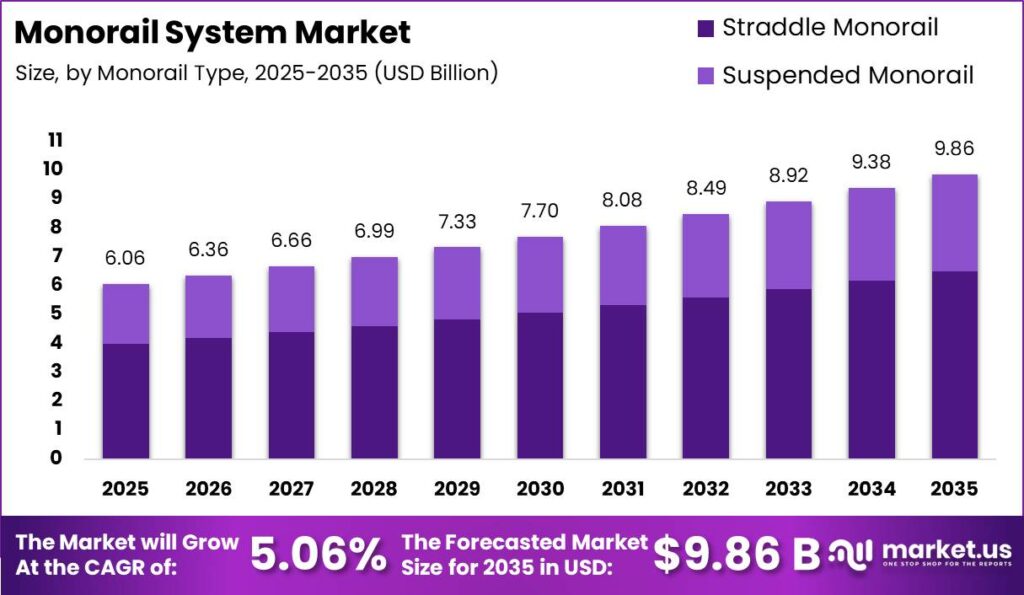
Global Monorail System Market size is expected to be worth around USD 9.86 Billion by 2035 from USD 6.06 Billion in 2025, growing at a CAGR of 5.06% during the forecast period 2026 to 2035. This expansion reflects city agencies choosing elevated single-beam corridors when surface right of way is scarce. Investors gain a multi-year civil and rolling stock pipeline tied to mid capacity urban routes rather than one off vehicle sales.
Therefore, the monorail system market covers straddle and suspended guideways, electric and maglev propulsion, and graded automation from manual cab control to unattended GoA4 fleets. Structure spans design, civil beams, trainsets, signaling, and multi year operations contracts. Buyers treat the product as a complete corridor package, so suppliers who bundle civil works with lifecycle service lock longer cash flows than pure rolling stock vendors.
Key Takeaways
- The market is valued at USD 6.06 Billion in 2025 and is projected to reach USD 9.86 Billion by 2035.
- The market is expanding at a CAGR of 5.06% over the forecast period 2026 to 2035.
- Straddle Monorail leads By Monorail Type with a 66.00% share.
- Electric propulsion leads By Propulsion Type with a 72.00% share.
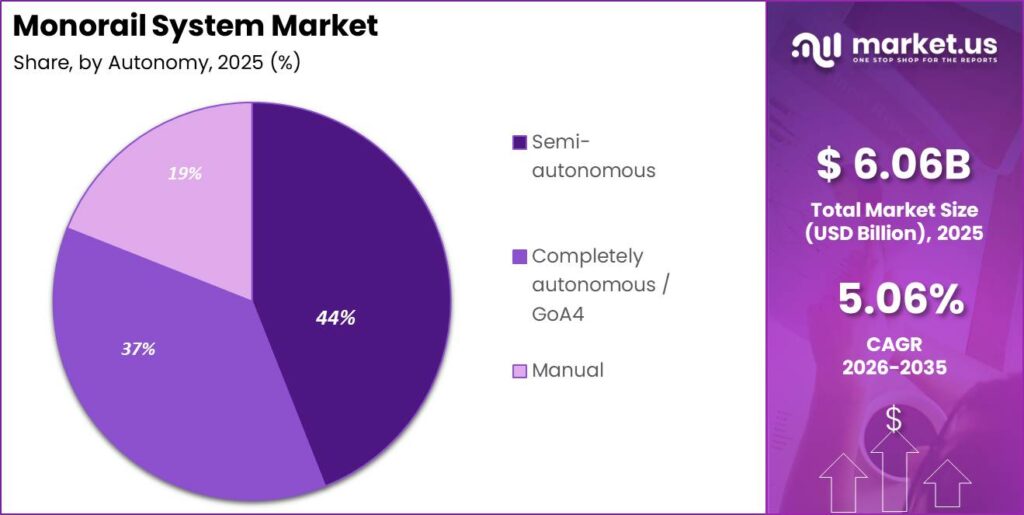
- Semi-autonomous systems lead By Autonomy with a 44.00% share.
- GoA4 is the fastest growing grade within By Autonomous.
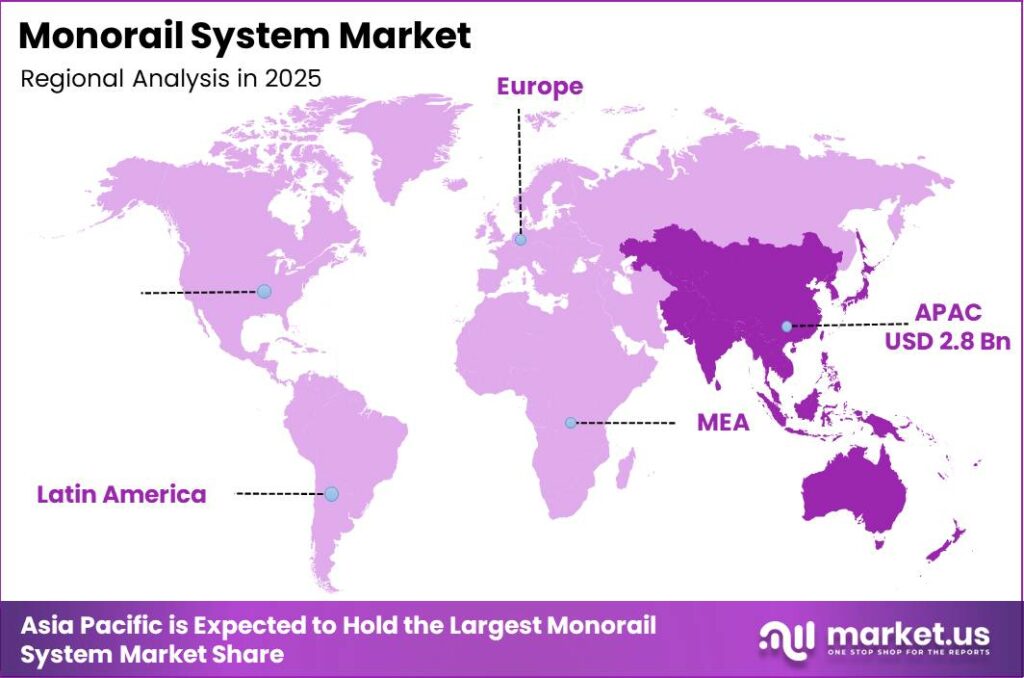
- Asia Pacific dominates with a 46.20% share, valued at USD 2.8 Billion.
Government investment shapes award timing as national infrastructure pipelines fund elevated links that cut land take versus underground metro. As per our research, monorail systems can move from a few thousand to more than 40,000 passengers per hour per direction, which lets cities match capacity to corridor demand without overbuilding heavy rail. This means contractors who bid full system packages capture both CapEx and multi year O and M revenue once ridership ramps.
Consequently, end use growth in dense urban corridors raises product demand for shorter elevated lines. The International Monorail Association identifies 10 to 30 kilometres as the typical public transport operating length, which fits airport links and city spines that heavy metro overshoots on cost. As a result, vendors who standardize beam and train modules for that length band shorten bid cycles and improve margin visibility for investors.
In May 2026, Alstom, Orascom Construction, and Arab Contractors opened commercial service on Cairo’s East Nile Monorail with 16 of 22 stations live, about 72.7% of the line. This phased opening shows agencies can monetize partial networks before full completion. Suppliers who design for staged station activation reduce revenue lag and strengthen bid competitiveness on similar multi station projects.
Monorail Type Analysis
Straddle Monorail dominates with 66.00% due to stable elevated beam load paths.
In 2025, Straddle Monorail held a dominant market position in the By Monorail Type segment of Monorail System Market, with a 66.00% share. International Monorail Association capacity bands show large public systems often near 12,500 pphpd and up to about 22,500 pphpd with four car trains at tight headways. This capacity fit lets cities replace mid density metro plans with lighter elevated structures. Suppliers who own straddle beam IP and depot layouts win more multi corridor framework awards.
Suspended Monorail is the fastest growing type because under hung cars free ground space for roads and utilities. Typical public monorail lines still cluster in the 10 to 30 kilometre band cited by the association for urban applications. This length suits river crossings and constrained downtown spines where pier footprints must stay small. Early movers who certify suspended switch gear and evacuation paths can take share where straddle clearances fail local codes.
Both types compete on civil simplicity versus heavy metro. World Steel Association data shows India produced 164.9 million tonnes of crude steel in 2025, up 10.4% year on year, supporting regional beam fabrication for elevated spans. This supply depth lowers logistics risk for Asian straddle builds. Contractors who lock multi year steel offtake and standardized span designs protect bid margins when guideway tonnage dominates CapEx.
Propulsion Type Analysis
Electric dominates with 72.00% due to grid aligned zero exhaust operation.
In 2025, Electric held a dominant market position in the By Propulsion Type segment of Monorail System Market, with a 72.00% share. Electrified fleets align with city air quality rules and avoid depot fuel logistics that diesel hybrids still require. UN DESA linked urbanization paths keep roughly 68% of people in cities by 2050, which raises demand for clean elevated capacity. OEMs who pair traction packages with regenerative braking cut operator energy bills and win O and M weighted tenders.
Maglev is the fastest growing propulsion path because contact free guidance cuts wear on wheels and rails. High speed maglev concepts remain capital heavy, yet urban low speed magnetic guidance appears in niche people mover briefs. China still produced over 1,005 million tonnes of crude steel in 2024 per worldsteel rankings, anchoring guideway steel supply for experimental magnetic beams. Vendors who pilot maglev on short airport hops can price premium availability against higher first cost.
Electric traction also simplifies GoA4 unattended packages because power and control share the same continuous guideway interface. Operators then standardize substations and SCADA rather than mixed fuel sites. This creates spare parts scale for global fleets. Suppliers who certify dual voltage traction across regions reduce custom engineering hours per bid and improve win rates on multi city frameworks.
Autonomy Analysis
Semi-autonomous dominates with 44.00% due to driver supervised automatic running.
In 2025, Semi-autonomous held a dominant market position in the By Autonomy segment of Monorail System Market, with a 44.00% share. Semi automatic grades keep a trained attendant for door and exception handling while computers manage speed profiles. UITP style GoA ladders place this tier between manual cab drive and full unattended operation. Cities adopt it first when unions or regulators still require onboard staff, so vendors who ship hybrid cab consoles protect near term order books.
Completely autonomous GoA4 is the fastest growing autonomy class because segregated beams support unattended train operation without onboard crew. International Monorail Association specifications state segregated monorail infrastructure can support Grade of Automation 4 without operating staff onboard. This cuts long run labor cost per train kilometre. Operators who redesign depots for remote wake up and stabling capture opex savings that justify higher signaling CapEx.
Manual systems remain for tourist loops and low frequency heritage lines where full automation fails cost tests. They still need proven brakes and wayside signals that meet local inspector rules. This keeps a small aftermarket for conventional cabs. Suppliers who modularize manual to semi automatic upgrade kits can harvest retrofit revenue without waiting for greenfield GoA4 awards.
Autonomous Analysis
GoA4 dominates growth within grades due to unattended full automation capability.
GoA0 and GoA1 keep the driver responsible for observation and starting, which fits low complexity shuttles. These grades need fewer platform screen doors and less wayside detection hardware than higher tiers. A 2026 peer reviewed trial of connected monorail collision avoidance ran at 20 to 80 km/h with communication delays from 0.02 to 0.30 seconds. That latency band shows even lower grades benefit from digital safety overlays. Suppliers who sell add on obstacle detection can upgrade brownfield fleets without full GoA4 rebuilds.
GoA2 and GoA3 shift more starting, stopping, and door logic to the computer while staff remain onboard or on platforms. These steps are common bridges for cities that want headway cuts before removing crew entirely. Platform screen doors and CBTC style continuous control become baseline. This raises software and integration share of contract value. Firms with certified interlocking libraries reduce commissioning risk and penalty exposure on multi year builds.
GoA4 is the fastest growing autonomous grade because trains run without onboard operating staff when guideways stay fully segregated. Association guidance ties this level to unattended operation on protected beams. Labor and energy scheduling then move to control centers. Investors favor OEMs who already run GoA4 references because lenders price lower operating variance into project finance models.
Key Market Segments
By Monorail Type
- Straddle Monorail
- Suspended Monorail
By Propulsion Type
- Electric
- Maglev
By Autonomy
- Semi-autonomous
- Completely autonomous / GoA4
- Manual
By Autonomous
- GoA0
- GoA1
- GoA2
- GoA3
- GoA4
Regional Analysis
Asia Pacific Dominates the Monorail System Market with a Market Share of 46.20%, Valued at USD 2.8 Billion
Asia Pacific leads because dense coastal megacities fund elevated corridors that avoid costly tunneling. The region’s share near half of global value concentrates OEM factories, civil consortia, and repeat orders. Cairo’s network context still sits outside the region, yet Asian suppliers feed many export kits. This means global capacity planning must track Asian bid calendars first when allocating scarce engineering talent and beam plant slots.
Middle East and North Africa projects set a high visibility growth pace through large single city awards. Egypt’s East of Nile Monorail initial 2026 section carries a full capacity rating of 600,000 passenger journeys per day. The broader Cairo program documented 96 kilometres of elevated track, 35 stations, and two depots in 2025 materials, with East and West lines near 57 and 42 kilometres for about 99 kilometres combined. This scale creates multi package civil and systems work. Contractors with desert climate and sand mitigation credentials gain a durable reference edge on Gulf and North African tenders.
Latin America advances through metro expansion cities that pick monorail for mid capacity elevated links. Monterrey Lines 4 and 6 illustrate fleet sizing with CRRC supply of 13 six car trainsets rated around 720 passengers each. North America and Europe remain selective, focusing on airport people movers and automation upgrades. This split pushes global OEMs to run dual playbooks: high volume Asian and MENA corridors versus niche Western automation and airport bids.
Key Regions and Countries
North America
- US
- Canada
Europe
- Germany
- France
- The UK
- Spain
- Italy
- Rest of Europe
Asia Pacific
- China
- Japan
- South Korea
- India
- Australia
- Rest of APAC
Latin America
- Brazil
- Mexico
- Rest of Latin America
Middle East and Africa
- GCC
- South Africa
- Rest of MEA
Market Dynamics
Market Opportunity Analysis - Airport links, secondary cities, and lighter suspended corridors remain open entry points
Airport people mover corridors remain under worked relative to municipal metro tenders. The propulsion and autonomy stacks already proven on urban straddle lines transfer directly to terminal connectors. New entrants who specialize in short electric automated shuttles avoid multi billion city politics. This creates faster sales cycles and clearer O and M annuity streams for investors who accept smaller average contract size.
Suspended monorail still holds a minority share behind straddle leadership near 66.00%, so product gaps remain in switch design and evacuation certification. Cities with narrow street canyons need under hung options that straddle piers cannot fit. Specialists who certify suspended packages can win sole source technical scores. This means a focused engineering firm can out flank full line OEMs on constrained downtown RFPs.
Semi autonomous fleets near 44.00% share leave a large base that will later buy GoA4 upgrades rather than new civil works. Software and signaling houses can sell unattended overlays on existing beams. That path needs less capital than greenfield guideways. Investors gain exposure to high margin digital scope without full construction risk.
Latin American and African mid capacity corridors sit outside Asia Pacific’s 46.20% concentration and still default to bus or deferred metro plans. Standardized electric straddle kits sized for 10 to 30 kilometre spines match their budgets better than heavy rail. Regional fabricators paired with global systems partners can own this white space. Early framework wins here compound as second and third lines reuse the same train and beam standards.
Technology and Innovation Landscape - GoA4 automation, collision avoidance software, and high speed design envelopes redefine bids
Grade of Automation 4 unattended operation on segregated monorail beams removes onboard operating staff and shifts value to control centers. International Monorail Association specifications explicitly support this path on protected infrastructure. Operators cut labor per train kilometre while raising night time service density. Suppliers who own certified unattended packages win technical scores that pure mechanical builders cannot match.
Intelligent connected collision avoidance tested in 2026 across 20 to 80 km/h with link delays of 0.02 to 0.30 seconds shows how onboard and wayside software harden safety cases. Shorter reaction windows support tighter headways on single beam lines. This raises throughput without wider civil structures. Investors should favor OEMs who treat perception and comms stacks as core IP rather than optional extras.
Cairo program design speed of 90 km/h on elevated alignments proves monorail can serve longer urban spines, not only slow people movers. Higher design speed expands addressable corridor length and farebox potential. Rolling stock must then manage thermal, braking, and switch loads at those speeds. Vendors with proven high speed straddle dynamics capture premium packages on city to satellite links.
Electric traction at 72.00% segment leadership pairs with regenerative braking and depot charging analytics. Digital twins for predictive maintenance turn sensor streams into spare parts forecasts. This lifts aftermarket margin above one time vehicle sale margin. Companies that bundle twins inside O and M bids lock multi year data advantages competitors cannot easily displace.
Drivers
Asia Pacific absorbs more than 40% of global system procurement as cities face congestion that fiscal planners can no longer defer. UN DESA paths place about 68% of people in urban areas by 2050, so elevated mid capacity lines become budget tools rather than optional showpieces. World Bank style cost bands place straddle elevated CapEx roughly 30% to 50% below equivalent underground heavy metro per kilometre. This re baselining shifts tenders toward monorail on medium density corridors and lengthens O and M concession pipelines for suppliers.
National infrastructure pipelines in India and Southeast Asia, plus GoA4 driverless programs in China and Western Europe, add further uplift. Decarbonization policy favors electric fleets globally over multi decade horizons. Elevated right of way also saves scarce urban land in Tier 1 cores. Buyers who lock operate and maintain renewals, such as large multi year O and M packages, convert one time builds into recurring margin. Investors should weight vendors with proven automation and concession delivery over pure civil generalists.
| Driver | (~) % Impact on CAGR Forecast | Geographic Relevance | Impact Timeline |
|---|---|---|---|
| Accelerating Urbanization & Congestion Relief Mandates | +1.8% | Asia Pacific, Middle East | Short term (2 years or less) |
| National Infrastructure Investment Pipelines | +1.4% | India, Southeast Asia | Medium term (2 to 4 years) |
| GoA4 Driverless Automation Deployment | +1.1% | China, Western Europe | Medium term (2 to 4 years) |
| Decarbonization & Electrified Transit Policy | +0.9% | Global | Long term (4 years or more) |
| Elevated Right-of-Way Land Efficiency | +0.7% | High-density Tier-1 cities | Short term (2 years or less) |
| Mid-Capacity Corridor Fit vs. Heavy Metro | +0.6% | Latin America, Africa | Medium term (2 to 4 years) |
Restraints
Elevated CapEx collides with high sovereign borrowing costs across emerging markets. Documented delivery has ranged near USD 27 million per kilometre on some Asian systems to above USD 150 million per kilometre on premium alignments. IMF linked policy rate pressure through 2025 keeps municipal debt service heavy. Project IRRs then fall below hurdles and tenders stall before award. OEMs face vendor financing demands and stretched milestones that freeze sales that would close in a lower rate world.
Switch and interchange hardware stays costly, while municipal budget freezes in Latin America and South Asia delay awards. Proprietary lock in raises lifecycle risk for buyers who fear single vendor spares. Land acquisition fights in India and Southeast Asia extend schedules on otherwise shovel ready corridors. This means suppliers must offer open interface options and staged payment designs. Investors should discount order backlogs that still lack closed financing and clear right of way.
| Restraint | (~) % Impact on CAGR Forecast | Geographic Relevance | Impact Timeline |
|---|---|---|---|
| Elevated CapEx & Restrictive Financing Rates | -1.6% | Emerging Markets, Africa | Short term (2 years or less) |
| Prohibitive Switch & Interchange Costs | -1.0% | Global | Medium term (2 to 4 years) |
| Municipal Fiscal Constraint & Budget Freezes | -0.9% | Latin America, South Asia | Short term (2 years or less) |
| Proprietary Vendor Lock-In Barriers | -0.7% | Global | Long term (4 years or more) |
| Land Acquisition & Right-of-Way Litigation | -0.6% | India, Southeast Asia | Medium term (2 to 4 years) |
Challenges
Steel and prefabricated guideway inputs create the heaviest ongoing friction because beam and column steel is a core cost line. Indian hot rolled coil sat near a five year low around Rs 47,150 per tonne in late 2025 with a possible 4% to 6% upside if safeguard duties land, while demand growth of 8% to 9% in India meets soft global prices. Build cycles of 36 to 48 months make fixed price bids fragile. Firms need index linked EPC terms and design cuts in steel per span to defend gross margin.
Signaling and automation talent shortages slow software heavy GoA programs worldwide. Cross border supplier qualification adds friction in India and the EU. Guideway retrofit limits interoperability in legacy transit cities. Extended commissioning and certification cycles push revenue recognition later than civil completion. This opens a services revenue stream for training, digital twins, and independent safety assessors. Early movers who productize certification playbooks can monetize delays that pure hardware rivals only absorb as cost.
| Challenge | (~) % CAGR Friction Drag | Geographic Relevance | Mitigation Horizon |
|---|---|---|---|
| Steel & Guideway Input Volatility | -0.9% | Global, India | Medium term (2 to 4 years) |
| Signaling & Automation Talent Deficit | -0.8% | Global | Long term (4 years or more) |
| Cross-Border Supplier Qualification Friction | -0.6% | India, EU | Medium term (2 to 4 years) |
| Guideway Retrofit & Interoperability Drag | -0.5% | Legacy transit cities | Long term (4 years or more) |
| Extended Commissioning & Certification Cycles | -0.4% | Global | Medium term (2 to 4 years) |
Opportunities
Airport people mover work sits in a separate procurement channel that many monorail OEMs still under serve. Delhi International Airport Limited tendered an automated people mover of about 7.7 kilometres linking major terminals and cargo zones, a pattern other large hubs can copy. Captive airport ridership supports premium O and M margins. Lifecycle margin uplifts of 15% to 20% versus standard urban corridor deals appear when fare inelastic traffic meets long concessions. Vendors who build dedicated airport bid teams can lift blended portfolio returns above the baseline forecast.
Predictive maintenance digital twins, tourism circuits in Southeast Asia and the GCC, and supply chain localization in India and ASEAN add further upside. Tier 2 and Tier 3 city corridors remain open white space where heavy metro fails cost tests. Early movers who package lighter trainsets with local beam fabrication can lock framework roles before global peers arrive. This shifts competition from pure CapEx price to lifecycle software and regional industrial policy alignment.
| Opportunity | (~) % Potential CAGR Upside | Geographic Relevance | Execution Window |
|---|---|---|---|
| Airport People-Mover Adjacent Vertical | +1.7% | India, Middle East, Asia Pacific | Short term (2 years or less) |
| Predictive-Maintenance Digital-Twin Monetization | +1.2% | Global | Medium term (2 to 4 years) |
| Tourism & Leisure Circuit Deployments | +0.9% | Southeast Asia, GCC | Medium term (2 to 4 years) |
| Regional Supply-Chain Localization & M&A Roll-Ups | +0.8% | India, ASEAN | Long term (4 years or more) |
| Tier-2 & Tier-3 City White-Space Corridors | +0.7% | Emerging Markets | Long term (4 years or more) |
Key Company Insights
Bombardier Inc. built deep monorail product heritage through Innovia style platforms that many cities still specify by performance class. That installed base supports spare parts, signaling upgrades, and attendant to higher automation paths on existing beams. The advantage is reference density that shortens technical scoring in bids. The risk is ownership and brand transitions that can confuse buyers unless delivery continuity stays visible in every tender package.
Siemens AG competes through signaling, electrification, and automation stacks that sit at the core of GoA migrations. Cities buying semi autonomous or fully unattended fleets need proven interlocking and power integration more than cosmetic train styling. This creates stickiness once wayside software is certified. The risk is pure civil heavy packages where local contractors own the beam and Siemens must partner to avoid scope loss.
Key Players
- Bombardier Inc.
- Siemens AG
- CRRC Corporation Limited
- Hitachi, Ltd.
- Intamin Transportation
- Ansaldo STS
- BYD Company Ltd.
- General Electric
- Alstom S.A.
- Thales Group
- Mitsubishi Electric
- ABB
Recent Developments
- April 2025: Hitachi Ltd. and Mitsubishi Electric supported Panama Metro Line 3 secured a USD 1 billion JICA loan for the monorail project, which will use Hitachi manufactured trains and rail systems.
- July 2025: Alstom supported East Nile Monorail in Cairo began trial operations without passengers as part of commissioning the Innovia Monorail 300 system.
Geopolitical Impact Analysis
According to UNCTAD, maritime trade growth is set to slow to 0.5% in 2025 after 2.2% growth in 2024, which raises cost risk for imported monorail cars and long steel beams. Container freight stayed elevated and volatile, with the Shanghai Containerized Freight Index averaging 2,496 points in 2024, up 149% from 2023. This means project budgets that assume stable ocean rates face CapEx overruns on cross regional rolling stock moves. Buyers shift toward regional final assembly to cut exposure to Red Sea and tariff driven reroutes.
Data from the World Steel Association shows India produced 164.9 million tonnes of crude steel in 2025, up 10.4%, while EU plans would cut tariff free steel import quotas by about 47% and lift above quota duties toward 50% from mid 2026. Guideway beams depend on flat and long steel, so quota and duty shocks move monorail civil unit costs. Therefore, EPC teams hedge steel and localize fabrication inside protected markets. Investors should stress test bids against dual shocks of freight volatility and steel trade barriers.
Report Scope
| Report Features | Description |
|---|---|
| Market Value (2025) | USD 6.06 Billion |
| Forecast Revenue (2035) | USD 9.86 Billion |
| CAGR (2026-2035) | 5.06% |
| Base Year for Estimation | 2025 |
| Historic Period | 2020-2024 |
| Forecast Period | 2026-2035 |
| Report Coverage | Revenue Forecast, Market Dynamics, Market Opportunity Analysis, Technology and Innovation Landscape, Competitive Landscape, Recent Developments |
| Segments Covered | By Monorail Type (Straddle Monorail, Suspended Monorail), By Propulsion Type (Electric, Maglev), By Autonomy (Semi-autonomous, Completely autonomous / GoA4, Manual), By Autonomous (GoA0, GoA1, GoA2, GoA3, GoA4) |
| Regional Analysis | North America (US and Canada), Europe (Germany, France, The UK, Spain, Italy, and Rest of Europe), Asia Pacific (China, Japan, South Korea, India, Australia, and Rest of APAC), Latin America (Brazil, Mexico, and Rest of Latin America), Middle East and Africa (GCC, South Africa, and Rest of MEA) |
| Competitive Landscape | Bombardier Inc., Siemens AG, CRRC Corporation Limited, Hitachi, Ltd., Intamin Transportation, Ansaldo STS, BYD Company Ltd., General Electric, Alstom S.A., Thales Group, Mitsubishi Electric, ABB |
| Customization Scope | Customization for segments, region / country-level will be provided. Additional customization can be done based on requirements. |
| Purchase Options | We have three licenses to opt for: Single User License | Multi-User License (Up to 5 Users) | Corporate Use License (Unlimited User and Printable PDF) |





































