


Global Grain Processing Equipment Market Size, Share, And Enhanced Productivity By Mode of Operation (Automatic, Semi-Automatic), By Machine (Pre Processing, Processing), By Type (Grain Mills, Grain Dryers, Grain Cleaners, Grain Sorters, Grain Storage Systems), By Capacity (Small Scale (up to 10 tons per hour), Medium Scale (10-50 tons per hour), Large Scale (above 500 tons per hour)), By Application (Food Processing, Animal Feed, Biofuel Production, Pharmaceutical, Others), By Region and Companies - Industry Segment Outlook, Market Assessment, Competition Scenario, Trends, and Forecast 2026-2035
- Published date: March 2026
- Report ID: 180414
- Number of Pages: 228
- Format:
-
keyboard_arrow_up
Quick Navigation
Report Overview
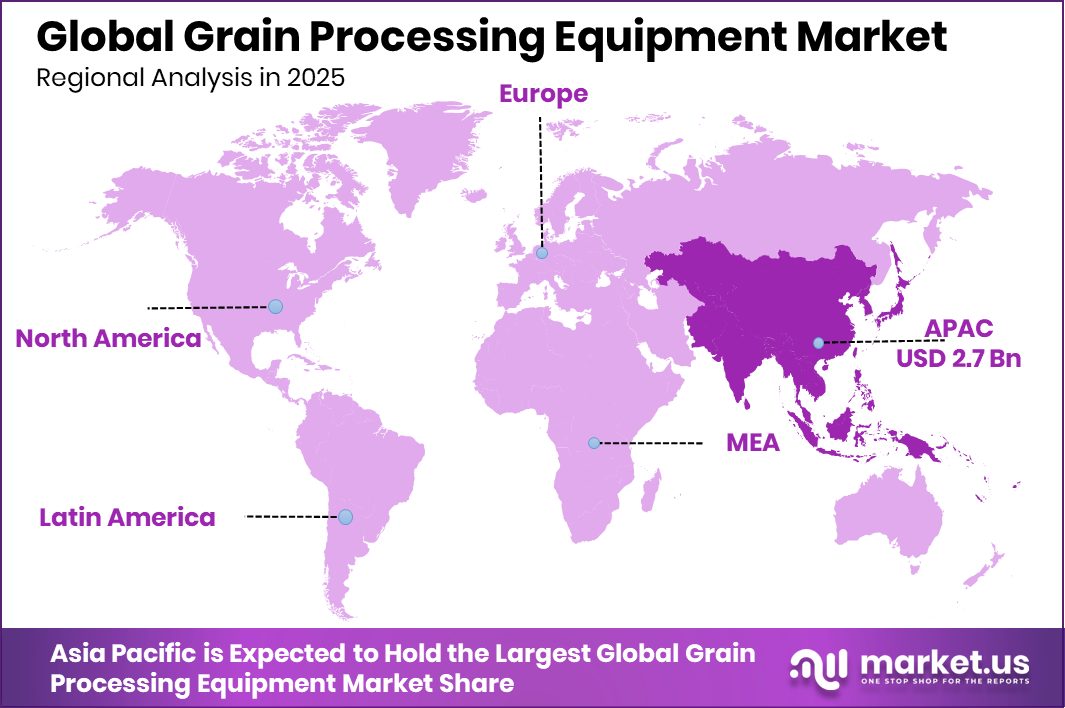
The Global Grain Processing Equipment Market is expected to be worth around USD 10.0 billion by 2035, up from USD 6.1 billion in 2025, and is projected to grow at a CAGR of 5.1% from 2026 to 2035. With 44.9% share, the Asia Pacific Grain Processing Equipment Market reached USD 2.7 Bn.
Grain processing equipment refers to machines used to handle, clean, dry, mill, sort, and store grains before they are used for food or other industrial purposes. These machines help transform raw grains such as wheat, corn, rice, and barley into usable products by removing impurities, reducing moisture, and converting grains into flour, meal, or other processed forms. Equipment such as grain mills, dryers, cleaners, sorters, and storage systems is commonly used in processing facilities to maintain grain quality and improve operational efficiency.
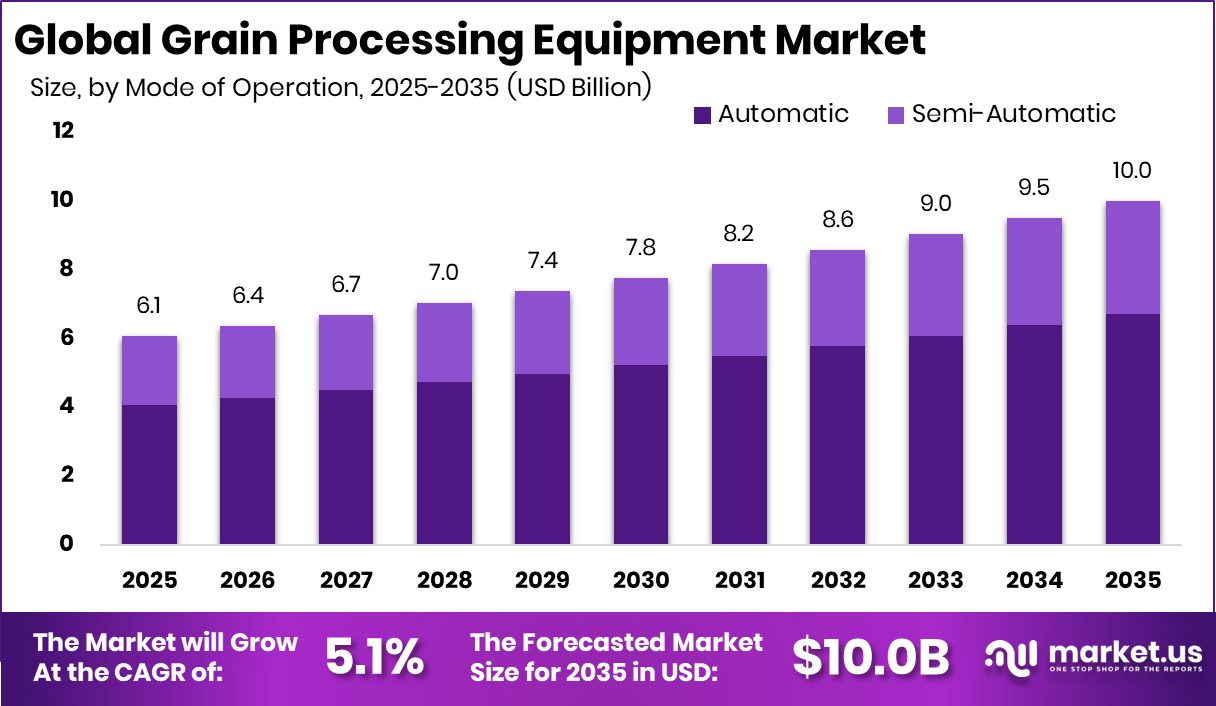
The Grain Processing Equipment Market represents the industry involved in manufacturing and supplying machinery designed for grain handling and processing across multiple applications. These machines are widely used in food processing, animal feed production, biofuel manufacturing, and pharmaceutical applications. The market includes equipment operating in automatic and semi-automatic modes, with systems designed for small, medium, and large-scale processing capacities to support different production requirements.
Growth in the market is largely influenced by the expansion of food manufacturing infrastructure and investment in processing technologies. Several initiatives and funding programs are supporting improvements in food production and processing capabilities. For instance, the USDA awarded more than $212 million to expand U.S. agricultural exports, while USDA-NIFA allocated $9.6 million through the Food Safety Outreach Program to strengthen food safety systems. In addition, federal funding proposals supporting a $50 million food science center highlight ongoing investment in advanced food processing development.
Demand for grain processing equipment continues to rise as food producers focus on improving production efficiency and maintaining quality standards. Investments in food technology and processing facilities are encouraging the modernization of grain handling operations. Programs such as the $980,000 grant awarded to the Food Processing Hub and Warren County Community College to develop a new center for food innovation reflect the increasing attention on strengthening processing infrastructure and training within the food sector.
Opportunities in the market are expanding with increased funding and technological development in food innovation. Emerging technology companies and food system initiatives are investing heavily in digital and advanced processing solutions. For example, BRAINR secured $13 million in seed funding to support digital transformation in food manufacturing, while AKA Foods raised $17.2 million to develop secure AI-driven food innovation systems. Similarly, KatKin attracted $50 million in investment, reflecting broader interest in modern food production technologies that can influence future grain processing systems and operational improvements.
Key Takeaways
- The Global Grain Processing Equipment Market is expected to be worth around USD 10.0 billion by 2035, up from USD 6.1 billion in 2025, and is projected to grow at a CAGR of 5.1% from 2026 to 2035.
- The Grain Processing Equipment Market is dominated by automatic systems, accounting for 67.2% of total operations.
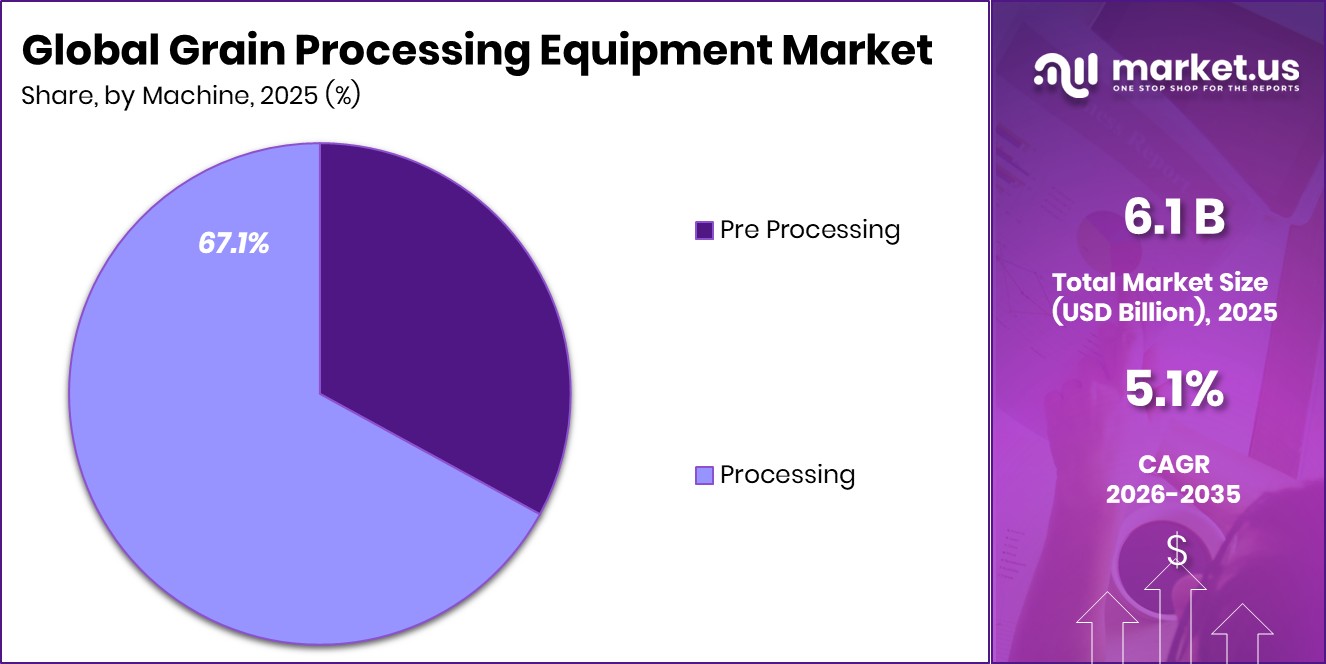
- In the Grain Processing Equipment Market, processing machines represent 67.1% of the machinery used across facilities.
- Grain mills lead the Grain Processing Equipment Market by type, contributing approximately 34.7% share globally.
- Medium scale capacity equipment, producing 10–50 tons per hour, holds 48.5% in the Grain Processing Equipment Market.
- Food processing applications account for 45.8% demand within the Grain Processing Equipment Market worldwide.
- Asia Pacific Grain Processing Equipment Market is valued at USD 2.7 Bn, holding a 44.9% share.
By Mode of Operation Analysis
Grain Processing Equipment Market is dominated by automatic mode operations with 67.2% share.
In 2025, the Grain Processing Equipment Market showed a strong preference for automatic systems, which accounted for 67.2% of the total share by mode of operation. Automatic equipment has become increasingly popular among grain processors because it improves production efficiency, reduces labor dependency, and ensures consistent output quality. These systems allow operators to monitor and control processes such as cleaning, grinding, and separation with minimal manual intervention.
The adoption of automation is also driven by the growing need to handle larger processing volumes while maintaining strict food safety and quality standards. Additionally, automatic systems help minimize operational errors and energy consumption, making them a practical choice for modern processing facilities looking to optimize performance and profitability.
By Machine Analysis
Grain Processing Equipment Market is led by processing machines, accounting for 67.1% share.
In 2025, the Grain Processing Equipment Market was largely dominated by processing machines, which held 67.1% of the share by machine type. Processing equipment plays a central role in converting raw grains into consumable or industrial products through steps such as milling, grinding, and refining. The high share of this segment reflects the increasing demand for processed grain products across the food and feed industries.
Modern processing machines are designed to deliver higher output, improved precision, and reduced wastage during operations. Manufacturers are also focusing on advanced technologies that enhance durability and operational efficiency. As global demand for wheat, rice, corn, and other grains continues to rise, processing equipment remains essential for ensuring smooth and large-scale grain transformation.
By Type Analysis
Grain Processing Equipment Market sees grain mills holding a significant 34.7% market share.
In 2025, grain mills represented 34.7% of the total share in the Grain Processing Equipment Market by type. Grain mills are essential for grinding and crushing grains into flour or meal, making them a key component of grain processing operations. The growing demand for wheat flour, cornmeal, and other grain-based products has significantly increased the need for efficient milling solutions. Grain mills are widely used in both large industrial facilities and smaller regional processing units.
Manufacturers are focusing on improving milling technologies to enhance grinding precision, reduce energy consumption, and maintain product quality. The steady expansion of the food processing sector, along with rising consumption of grain-based foods, continues to support the demand for advanced grain milling equipment.
By Capacity Analysis
Grain Processing Equipment The market’s medium-scale capacity dominates with 48.5% market share.
In 2025, medium-scale equipment with a capacity of 10–50 tons per hour held the largest share of 48.5% in the Grain Processing Equipment Market. This capacity range is widely adopted by processors because it provides a balance between production efficiency and manageable operational costs. Medium-scale facilities are suitable for regional grain processors that require consistent output without the high investment associated with large-scale plants. Such equipment offers flexibility in handling different types of grains while maintaining steady processing speeds.
Additionally, medium-capacity systems are easier to maintain and operate, making them an attractive option for businesses looking to expand gradually. As demand for processed grain products grows, medium-scale processing facilities continue to play a vital role in meeting regional supply needs.
By Application Analysis
Grain Processing Equipment Market: Food processing applications account for a notable 45.8% share.
In 2025, the food processing segment accounted for 45.8% of the Grain Processing Equipment Market by application. Grain processing equipment is widely used to produce flour, cereals, starch, and other ingredients that form the foundation of numerous food products. The strong demand from the food industry is driven by rising global consumption of bakery products, packaged foods, and ready-to-eat meals. Food manufacturers require reliable and efficient equipment to maintain consistent quality and large-scale production.
As consumer preferences shift toward processed and convenience foods, food processing companies continue to invest in advanced grain processing technologies. This growing demand ensures that the food processing sector remains one of the most important application areas for grain processing equipment worldwide.
Key Market Segments
By Mode of Operation
- Automatic
- Semi-Automatic
By Machine
- Pre Processing
- Processing
By Type
- Grain Mills
- Grain Dryers
- Grain Cleaners
- Grain Sorters
- Grain Storage Systems
By Capacity
- Small Scale (up to 10 tons per hour)
- Medium Scale (10-50 tons per hour)
- Large Scale (above 500 tons per hour)
By Application
- Food Processing
- Animal Feed
- Biofuel Production
- Pharmaceutical
- Others
Driving Factors
Rising demand for processed grain products
The Grain Processing Equipment Market is experiencing strong momentum due to the rising demand for processed grain products across the food and feed industries. Consumers increasingly prefer ready-to-use flour, cereals, and processed grain ingredients that require efficient milling, drying, and cleaning processes. This shift encourages processors to invest in modern equipment capable of maintaining consistent output and quality. At the same time, financial support and technology investments within the broader food production ecosystem are strengthening processing infrastructure.
For instance, MGA Thermal secured AU$3.25 million in ARENA funding to support thermal energy storage FEED studies, supporting energy innovations in industrial processing. In addition, BinSentry raised CAD $68.8 million in Series C funding to expand its remote animal feed monitoring platform into Brazil, reflecting growing technological integration within grain-related processing and feed supply chains.
Restraining Factors
High initial investment for processing equipment
One of the major challenges affecting the Grain Processing Equipment Market is the high initial investment required to install advanced grain cleaning, drying, and milling systems. Modern processing lines often involve complex machinery, integrated control systems, and infrastructure upgrades, which can create financial pressure for smaller processors and regional milling facilities. In many cases, businesses must carefully evaluate long-term operational benefits before committing to such investments.
Meanwhile, funding across related agricultural and food technology sectors continues to evolve, shaping innovation but also highlighting the cost intensity of advanced solutions. For example, French animal nutrition company Aviwell raised EUR 11 million to support microbiota-based technologies using artificial intelligence. Additionally, the Michigan Craft Beverage Council awarded nearly $450,000 in research and education grants, demonstrating continued investment in agricultural processing research and development.
Growth Opportunity
Expansion of medium-scale processing facilities
The expansion of medium-scale processing facilities is creating new opportunities in the Grain Processing Equipment Market. Processing units operating within moderate capacity ranges are becoming increasingly attractive because they offer a balance between production efficiency and manageable capital investment. These facilities support regional grain supply chains by enabling local processors to convert raw grains into flour, feed ingredients, or other processed products without relying solely on large industrial plants.
Government initiatives and agricultural development programs are also encouraging improvements in food and agricultural processing capacity. For instance, the Michigan Department of Agriculture and Rural Development (MDARD) has surpassed $250 million in grants awarded during the Whitmer administration, supporting agricultural development projects and infrastructure expansion. Such initiatives contribute to improving processing capabilities and strengthening regional food production systems.
Latest Trends
Integration of automation in milling operations
Automation is becoming a key trend shaping the Grain Processing Equipment Market, particularly within milling and grain handling operations. Processing facilities are increasingly integrating automated control systems, digital monitoring, and advanced machinery to improve consistency, reduce manual intervention, and enhance operational efficiency. Automated equipment allows processors to maintain precise control over cleaning, grinding, and sorting processes, helping maintain product quality while increasing throughput.
In addition, government programs and agricultural business initiatives are supporting modernization across food processing infrastructure. The Michigan Department of Agriculture and Rural Development (MDARD) awarded over $1.8 million for projects that create jobs and strengthen local agriculture businesses, reflecting efforts to improve agricultural processing capabilities. Such developments encourage greater adoption of advanced grain processing technologies and automated milling solutions across the industry.
Regional Analysis
In the Asia Pacific, the Grain Processing Equipment Market accounted for 44.9% share, reaching USD 2.7 Bn.
The Grain Processing Equipment Market demonstrates varied growth patterns across key regions, including North America, Europe, Asia Pacific, the Middle East & Africa, and Latin America. Asia Pacific emerged as the dominating region, accounting for 44.9% of the global market and reaching a value of USD 2.7 Bn. The region’s leadership is supported by strong grain production, large-scale food processing industries, and rising demand for processed grain products across major agricultural economies.
Rapid industrialization in food processing and increasing consumption of wheat, rice, and corn-based products continue to strengthen the demand for modern grain processing equipment across the region. North America represents a mature market with established grain milling and food processing infrastructure, where equipment upgrades and technological advancements contribute to steady demand.
Europe also holds a significant share due to its well-developed food manufacturing sector and consistent consumption of processed grain products. Meanwhile, the Middle East & Africa and Latin America are gradually expanding markets where rising investments in food processing capacity and improving agricultural processing infrastructure are supporting the adoption of grain processing equipment across local and regional supply chains.
Key Regions and Countries
- North America
- US
- Canada
- Europe
- Germany
- France
- The UK
- Spain
- Italy
- Rest of Europe
- Asia Pacific
- China
- Japan
- South Korea
- India
- Australia
- Rest of APAC
- Latin America
- Brazil
- Mexico
- Rest of Latin America
- Middle East & Africa
- GCC
- South Africa
- Rest of MEA
Key Players Analysis
In 2025, Bühler Group continues to demonstrate strong positioning in the global Grain Processing Equipment Market through its extensive experience in grain milling and processing technologies. The company is recognized for its comprehensive portfolio of equipment designed to support efficient grain cleaning, milling, and processing operations. Bühler Group focuses on engineering precision, reliability, and operational efficiency in its equipment offerings, enabling processors to maintain consistent product quality and optimize production performance. Its solutions are widely used in large and medium-scale processing facilities where advanced milling and automation capabilities are essential.
Alvan Blanch Development Company Limited maintains a specialized approach within the grain processing equipment landscape by focusing on practical and adaptable processing solutions. The company is known for offering equipment that supports grain drying, cleaning, storage, and processing applications across different operational scales. Its equipment is designed to meet the needs of grain processors seeking reliable machinery that can operate efficiently in varying agricultural and industrial environments. Alvan Blanch emphasizes durable engineering and flexible system configurations, allowing processors to handle different grain types while maintaining stable processing operations.
Osaw Agro Industries Private Limited plays an active role in providing grain processing and agricultural equipment solutions designed for operational efficiency and practical application. The company offers machinery that supports grain cleaning, grading, milling, and related processing activities. Its equipment portfolio is structured to assist processors in improving grain quality and maintaining consistent production output. Osaw Agro Industries Private Limited focuses on manufacturing dependable machinery suited for regional processing facilities and agricultural processing units.
Top Key Players in the Market
- Bühler Group
- Alvan Blanch Development Company Limited
- Osaw Agro Industries Private Limited
- WESTRUP A/S
- Golfetto Sangati S.r.l.
- PETKUS Technologie GmbH
- Lewis M. Carter Manufacturing, LLC
- Satake USA, Inc.
- Lianyungang Huantai Machinery Co., Ltd.
Recent Developments
- In June 2024, Osaw Agro Industries Private Limited, a manufacturer of grain cleaning, grading, and seed processing equipment, installed a 4 TPH paddy seed processing plant in Maharashtra, India. The plant includes advanced cleaning and grading machinery designed to improve post-harvest grain processing efficiency and product quality for seed processors and agricultural businesses.
- In January 2024, Alvan Blanch Development Company Limited, a manufacturer of grain drying and processing equipment, presented new systems at the LAMMA 2024 agricultural exhibition in the UK. The company introduced equipment, including the DF6000 Grain Dryer (up to 6 tonnes/hour) and the 3-Screen RCG Rotary Cleaner & Aspirator (5–20 tonnes/hour), to support grain cleaning and drying operations.
Report Scope
Report Features Description Market Value (2025) USD 6.1 Billion Forecast Revenue (2035) USD 10.0 Billion CAGR (2026-2035) 5.1% Base Year for Estimation 2025 Historic Period 2020-2024 Forecast Period 2026-2035 Report Coverage Revenue Forecast, Market Dynamics, Competitive Landscape, Recent Developments Segments Covered By Mode of Operation (Automatic, Semi-Automatic), By Machine (Pre Processing, Processing), By Type (Grain Mills, Grain Dryers, Grain Cleaners, Grain Sorters, Grain Storage Systems), By Capacity (Small Scale (up to 10 tons per hour), Medium Scale (10-50 tons per hour), Large Scale (above 500 tons per hour)), By Application (Food Processing, Animal Feed, Biofuel Production, Pharmaceutical, Others) Regional Analysis North America – US, Canada; Europe – Germany, France, The UK, Spain, Italy, Rest of Europe; Asia Pacific – China, Japan, South Korea, India, Australia, Singapore, Rest of APAC; Latin America – Brazil, Mexico, Rest of Latin America; Middle East & Africa – GCC, South Africa, Rest of MEA Competitive Landscape Bühler Group, Alvan Blanch Development Company Limited, Osaw Agro Industries Private Limited, WESTRUP A/S, Golfetto Sangati S.r.l., PETKUS Technologie GmbH, Lewis M. Carter Manufacturing, LLC, Satake USA, Inc., Lianyungang Huantai Machinery Co., Ltd. Customization Scope Customization for segments, region/country-level will be provided. Moreover, additional customization can be done based on the requirements. Purchase Options We have three licenses to opt for: Single User License, Multi-User License (Up to 5 Users), Corporate Use License (Unlimited User and Printable PDF)  Grain Processing Equipment MarketPublished date: March 2026add_shopping_cartBuy Now get_appDownload Sample
 -
-
- Bühler Group
- Alvan Blanch Development Company Limited
- Osaw Agro Industries Private Limited
- WESTRUP A/S
- Golfetto Sangati S.r.l.
- PETKUS Technologie GmbH
- Lewis M. Carter Manufacturing, LLC
- Satake USA, Inc.
- Lianyungang Huantai Machinery Co., Ltd.
Our Clients

- 180414
- March 2026






