


Global Dry Shampoo Market Size, Share, Growth Analysis By Form (Spray, Powder, Others), By End Use (Men, Women, Children), By Distribution Channel (Offline, Online), By Region and Companies - Industry Segment Outlook, Market Assessment, Competition Scenario, Statistics, Trends and Forecast 2026-2035
- Published date: March 2026
- Report ID: 182279
- Number of Pages: 367
- Format:
-
keyboard_arrow_up
Quick Navigation
Report Overview
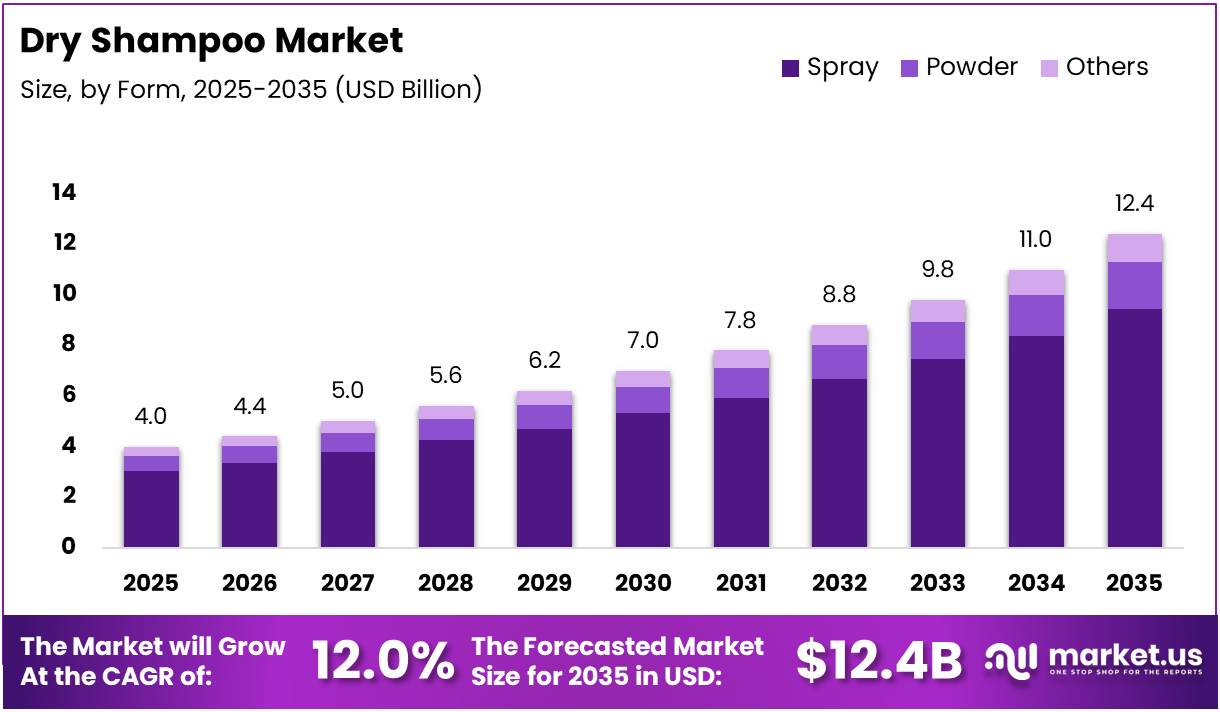
The Global Dry Shampoo Market size is expected to be worth around USD 12.4 Billion by 2035 from USD 4.0 Billion in 2025, growing at a CAGR of 12.0% during the forecast period 2026 to 2035.
Dry shampoo is a hair care product designed to cleanse and refresh hair without the use of water. It typically comes in spray or powder form and works by absorbing excess oil, sweat, and odor from the scalp. Consequently, it gives hair a cleaner and fresher appearance between traditional washes.
This product has evolved from a niche convenience item into a mainstream hair care essential. Modern dry shampoos offer additional benefits such as volumizing, texture building, and even color-refreshing. Therefore, they appeal to a wide range of consumers across different age groups and hair types.
The market is experiencing strong growth driven by shifting consumer lifestyles. Busy schedules, increased travel, and greater awareness of sustainable beauty practices are pushing consumers toward waterless hair care. Moreover, the rising influence of social media beauty trends has significantly accelerated product discovery and adoption globally.
Government awareness campaigns promoting water conservation have further supported the waterless beauty movement. Additionally, regulatory attention on clean-label and chemical-free formulations is encouraging manufacturers to reformulate products using safer, more natural ingredients. This regulatory environment is opening new product development pathways for brands worldwide.
Opportunities in this market are expanding rapidly, particularly in the organic and gender-neutral product segments. Brands are also investing in sustainable packaging solutions, including refillable and recyclable cans. These initiatives align well with growing consumer expectations around environmental responsibility and ingredient transparency.
Supporting data underscores the effectiveness and growing credibility of dry shampoo products. According to a research paper published on the SARSEF Virtual Fair platform, expensive dry shampoo reduced hair oiliness by approximately 80–90% in trials, whereas a cheaper dry shampoo showed around 50–70% oil reduction under identical conditions. These performance differences are helping consumers make more informed purchasing decisions.
Overall, the dry shampoo market presents a compelling investment landscape. With innovations in formulation, packaging, and distribution, brands are well-positioned to capture growing consumer demand. The forecast period from 2026 to 2035 is expected to witness consistent expansion across all key regions and product segments.
Key Takeaways
- The global Dry Shampoo Market is valued at USD 4.0 Billion in 2025 and is projected to reach USD 12.4 Billion by 2035.
- The market is growing at a CAGR of 12.0% during the forecast period 2026 to 2035.
- By Form, the Spray segment dominates with a market share of 76.1% in 2025.
- By End Use, the Men segment holds the leading position with a share of 81.3% in 2025.
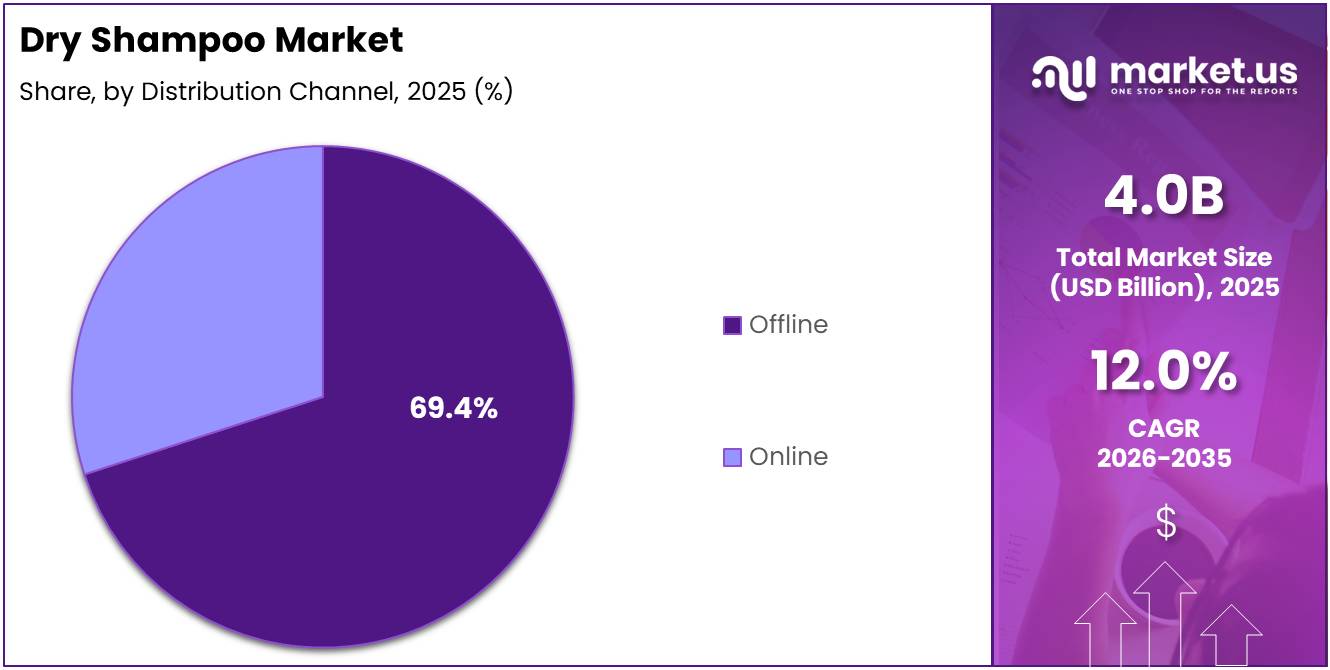
- By Distribution Channel, the Offline segment leads with a share of 69.4% in 2025.
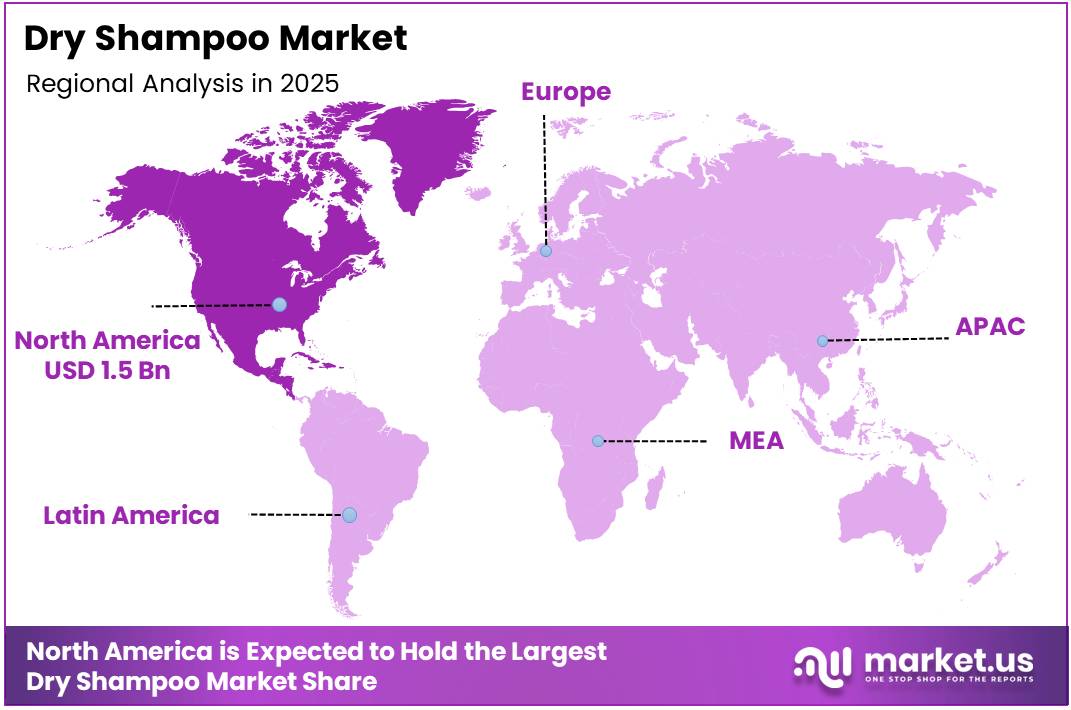
- North America dominates the regional landscape with a share of 39.10%, valued at USD 1.5 Billion.
By Form Analysis
Spray dominates with 76.1% due to its ease of use and wide consumer preference.
In 2025, Spray held a dominant market position in the By Form segment of the Dry Shampoo Market, with a 76.1% share. Spray-based dry shampoos are widely preferred for their quick application, even distribution, and immediate results. Moreover, their availability across mass-market and premium retail channels contributes to consistently high consumer demand.
Powder dry shampoos represent a growing sub-segment driven by demand for chemical-free and aerosol-free alternatives. Consumers with sensitive scalps particularly favor powder formats for their gentle formulation. Additionally, powder variants are gaining traction in sustainable beauty circles due to their minimal packaging requirements and longer shelf life.
Others in this segment include foam-based and dry shampoo bar formats, which are emerging as niche but promising options. These formats cater to eco-conscious and travel-focused consumers. Consequently, ongoing product innovation in this sub-segment is expected to attract a new generation of buyers seeking functional yet sustainable hair care solutions.
By End Use Analysis
Men dominates with 81.3% due to growing male grooming awareness and product adoption.
In 2025, Men held a dominant market position in the By End Use segment of the Dry Shampoo Market, with an 81.3% share. Male consumers are increasingly incorporating dry shampoo into daily grooming routines for its speed and convenience. Moreover, targeted marketing campaigns and gender-specific product launches have significantly expanded adoption among men globally.
Women represent a well-established and loyal consumer base in the dry shampoo market. Female consumers continue to drive innovation demand, particularly for multifunctional products offering volume, fragrance, and oil absorption. Additionally, social media influencer marketing plays a major role in shaping purchasing behavior within this end-use segment.
Children form a smaller but steadily growing sub-segment as parents seek gentle, water-free hair care options for kids. Products in this category are typically formulated without harsh chemicals and allergens. Therefore, safety certification and dermatologically tested claims are becoming key purchase drivers for this end-use group.
By Distribution Channel Analysis
Offline dominates with 69.4% due to strong retail presence and in-store consumer experience.
In 2025, Offline held a dominant market position in the By Distribution Channel segment of the Dry Shampoo Market, with a 69.4% share. Supermarkets, pharmacies, and specialty beauty stores remain primary purchase points for dry shampoo consumers. Moreover, the ability to physically test products and access in-store promotions continues to drive offline channel preference.
Online distribution is experiencing rapid growth, supported by the expansion of e-commerce platforms and direct-to-consumer brand strategies. Subscription models, bundled offers, and influencer-driven online promotions are attracting digital-first shoppers. Consequently, brands are increasingly investing in digital storefronts and social commerce to capitalize on growing online beauty purchasing trends.
Key Market Segments
By Form
- Spray
- Powder
- Others
By End Use
- Men
- Women
- Children
By Distribution Channel
- Offline
- Online
Drivers
Rising Demand for Time-Saving and Eco-Friendly Hair Care Solutions Drives Dry Shampoo Market Growth
Modern consumers increasingly prioritize convenience in their daily routines. Dry shampoo addresses the need for fast, effective hair care without water or heat styling. Consequently, busy professionals, students, and travelers are turning to dry shampoos as a practical alternative to traditional washing routines.
The growing popularity of waterless and eco-friendly beauty products is further supporting market expansion. Consumers are becoming more conscious of water consumption and environmental impact. Moreover, brands positioning dry shampoo as a sustainable hair care solution are gaining strong traction among environmentally aware buyers worldwide.
Social media and beauty influencer culture have dramatically reshaped how consumers discover hair care products. Platforms such as Instagram and TikTok have amplified dry shampoo visibility through tutorials and product reviews. Therefore, influencer endorsements continue to be a powerful driver of first-time purchases and repeat consumer engagement globally.
Restraints
Scalp Health Concerns and Limited Market Awareness Restrain Dry Shampoo Adoption
One of the primary challenges facing the dry shampoo market is consumer concern over scalp irritation and allergic reactions. Chemical ingredients such as alcohol and synthetic fragrances in certain formulations can cause sensitivity issues. Consequently, some consumers remain hesitant to use dry shampoos regularly, limiting repeat purchase rates.
Negative perceptions around ingredient safety are prompting cautious buying behavior, particularly among health-conscious demographics. Dermatologist advisories about product buildup and scalp blockage have received significant media attention. Moreover, these concerns have slowed adoption in certain consumer segments despite strong product innovation efforts by manufacturers.
Limited awareness and low adoption rates in emerging markets also act as significant restraints. In regions with strong cultural preferences for traditional hair washing routines, dry shampoo remains largely unfamiliar. Therefore, educating consumers about product benefits and safety in these markets requires considerable investment in marketing and distribution infrastructure.
Growth Factors
Organic Formulations and Multifunctional Product Innovation Accelerate Dry Shampoo Market Expansion
The expansion into organic and natural dry shampoo formulations represents one of the most significant growth opportunities in the market. Consumers are actively seeking clean-label products free from parabens, sulfates, and synthetic additives. Consequently, brands investing in certified natural ingredients are gaining a competitive advantage and attracting health-conscious buyer segments.
Development of gender-neutral and multi-hair-type products is broadening the addressable consumer base considerably. Inclusive formulations designed for various textures, colors, and scalp conditions are resonating with diverse audiences. Moreover, removing gendered product positioning allows brands to capture a wider market share without fragmenting their core messaging.
Multifunctional product innovation is also driving growth by delivering additional value beyond basic oil absorption. Products combining dry shampoo with volumizing, color-refreshing, or scalp-nourishing benefits are gaining strong consumer interest. Therefore, this trend is increasing average purchase value and encouraging more frequent product use among existing customers.
Emerging Trends
Sustainable Packaging, Hybrid Formulations, and At-Home Beauty Routines Reshape the Dry Shampoo Market
Sustainable packaging is rapidly becoming a key differentiator in the dry shampoo market. Brands are transitioning toward refillable cans, recyclable materials, and reduced-plastic designs. Moreover, consumers are actively rewarding brands that demonstrate environmental commitment, making sustainable packaging a critical factor in purchasing decisions rather than just a marketing claim.
The rise of at-home beauty routines and DIY hairstyling has created a consistent demand for convenient, professional-grade products. Post-pandemic lifestyle shifts have normalized self-care at home. Consequently, dry shampoo has become a staple in home styling kits, driving increased frequency of use and stronger brand loyalty among everyday consumers.
Hybrid products combining dry shampoo with styling sprays, texturizers, or scalp treatments represent a growing and exciting product innovation trend. These all-in-one solutions appeal to consumers seeking simplified beauty routines without sacrificing results. Therefore, product development teams are increasingly prioritizing multifunctional formulations to meet evolving consumer expectations and capture premium pricing opportunities.
Regional Analysis
North America Dominates the Dry Shampoo Market with a Market Share of 39.10%, Valued at USD 1.5 Billion
North America holds the leading position in the global dry shampoo market, accounting for 39.10% of total market share and valued at USD 1.5 Billion in 2025. The region benefits from high consumer spending on personal care, strong retail infrastructure, and a mature beauty market. Moreover, the rapid growth of e-commerce and influencer-driven marketing continues to sustain robust demand across the United States and Canada.
Europe Dry Shampoo Market Trends
Europe represents the second-largest market for dry shampoo, supported by a well-established premium beauty culture and strong consumer preference for sustainable products. Countries such as the UK, Germany, and France lead regional demand. Additionally, stringent EU regulations on cosmetic ingredients are pushing manufacturers toward cleaner and safer formulations, which aligns closely with European consumer expectations.
Asia Pacific Dry Shampoo Market Trends
Asia Pacific is the fastest-growing region in the dry shampoo market, driven by rising disposable incomes, expanding urban populations, and growing beauty consciousness. Markets such as China, India, and South Korea are seeing accelerated product adoption. Consequently, international brands are increasing their presence through localized product offerings and digital marketing strategies tailored to regional consumer preferences.
Middle East and Africa Dry Shampoo Market Trends
The Middle East and Africa market is at a nascent but promising stage of dry shampoo adoption. Urbanization, a young population, and growing interest in international beauty trends are key demand enablers. Moreover, increasing availability of personal care products through modern retail and online channels is helping raise product awareness across Gulf and African markets.
Latin America Dry Shampoo Market Trends
Latin America presents moderate but steady growth potential for the dry shampoo market. Brazil and Mexico are the primary demand centers, driven by growing middle-class spending on personal care and beauty. Therefore, brands entering this region with competitively priced and locally relevant product offerings are expected to gain meaningful traction over the forecast period.
Key Regions and Countries
North America
- US
- Canada
Europe
- Germany
- France
- The UK
- Spain
- Italy
- Rest of Europe
Asia Pacific
- China
- Japan
- South Korea
- India
- Australia
- Rest of APAC
Latin America
- Brazil
- Mexico
- Rest of Latin America
Middle East & Africa
- GCC
- South Africa
- Rest of MEA
Key Company Insights
Procter & Gamble is a global consumer goods leader with a strong foothold in the hair care segment. The company leverages its extensive distribution network and significant R&D investment to continuously innovate its dry shampoo portfolio. Moreover, its data-driven marketing approach and brand trust give it a consistent edge in both developed and emerging markets globally.
Unilever maintains a competitive position in the dry shampoo market through its diverse brand portfolio and commitment to sustainability. The company has made significant progress in reducing the environmental impact of its hair care product lines. Additionally, Unilever’s strong retail partnerships and global supply chain allow it to reach a broad consumer base across all major regions efficiently.
L’Oréal S.A. stands out in the dry shampoo segment for its strong investment in scientific research and premium product positioning. The company consistently introduces innovative formulations that address specific consumer needs such as scalp sensitivity and color protection. Consequently, L’Oréal’s ability to blend science with luxury branding makes it a highly influential player in this growing market.
Church & Dwight Co., Inc. is a notable player through its well-known Batiste brand, which holds strong recognition in the affordable dry shampoo segment. The company focuses on accessible pricing combined with effective formulation to drive mass-market adoption. Therefore, Church & Dwight continues to expand its reach through strategic product launches and targeted retail distribution across multiple global markets.
Key Players
- Procter & Gamble
- Unilever
- L’Oréal S.A.
- Church & Dwight Co., Inc.
- Henkel AG & Co. KGaA
- Klorane
- Revlon
- Estée Lauder Companies Inc.
- Living Proof
- Amika
Recent Developments
- March 2026 – Henkel announced its acquisition of the ‘Not Your Mother’s’ haircare brand to strengthen its North America product portfolio. This strategic move is expected to significantly expand Henkel’s presence in the mass-market hair care and dry shampoo segment across the region.
- June 2025 – Jennifer Aniston’s brand LolaVie launched its Powder Perfect Dry Shampoo, a non-aerosol, talc-free formula designed to instantly absorb oil and odor while providing root lift. The product marked a notable entry into the clean and aerosol-free dry shampoo category.
- April 2025 – COLAB introduced its latest dry shampoo innovation, Supreme Clean, which delivers maximum oil absorption for light, fresh hair. This launch reinforced COLAB’s positioning as a performance-driven dry shampoo brand with strong consumer appeal.
- January 2025 – Church & Dwight, under its Batiste brand, launched the “Sensitive Scalp Gentle Dry Shampoo,” specifically formulated for consumers with scalp sensitivity. This product directly addresses one of the most cited consumer concerns in the dry shampoo category, expanding Batiste’s inclusive product range.
Report Scope
Report Features Description Market Value (2025) USD 4.0 Billion Forecast Revenue (2035) USD 12.4 Billion CAGR (2026-2035) 12.0% Base Year for Estimation 2025 Historic Period 2020-2024 Forecast Period 2026-2035 Report Coverage Revenue Forecast, Market Dynamics, Competitive Landscape, Recent Developments Segments Covered By Form (Spray, Powder, Others), By End Use (Men, Women, Children), By Distribution Channel (Offline, Online) Regional Analysis North America (US and Canada), Europe (Germany, France, The UK, Spain, Italy, and Rest of Europe), Asia Pacific (China, Japan, South Korea, India, Australia, and Rest of APAC), Latin America (Brazil, Mexico, and Rest of Latin America), Middle East & Africa (GCC, South Africa, and Rest of MEA) Competitive Landscape Procter & Gamble, Unilever, L’Oréal S.A., Church & Dwight Co., Inc., Henkel AG & Co. KGaA, Klorane, Revlon, Estée Lauder Companies Inc., Living Proof, Amika Customization Scope Customization for segments, region/country-level will be provided. Moreover, additional customization can be done based on the requirements. Purchase Options We have three licenses to opt for: Single User License, Multi-User License (Up to 5 Users), Corporate Use License (Unlimited User and Printable PDF) 
-
-
- Procter & Gamble
- Unilever
- L'Oréal S.A.
- Church & Dwight Co., Inc.
- Henkel AG & Co. KGaA
- Klorane
- Revlon
- Estée Lauder Companies Inc.
- Living Proof
- Amika
Our Clients

- 182279
- March 2026






