


Report Overview
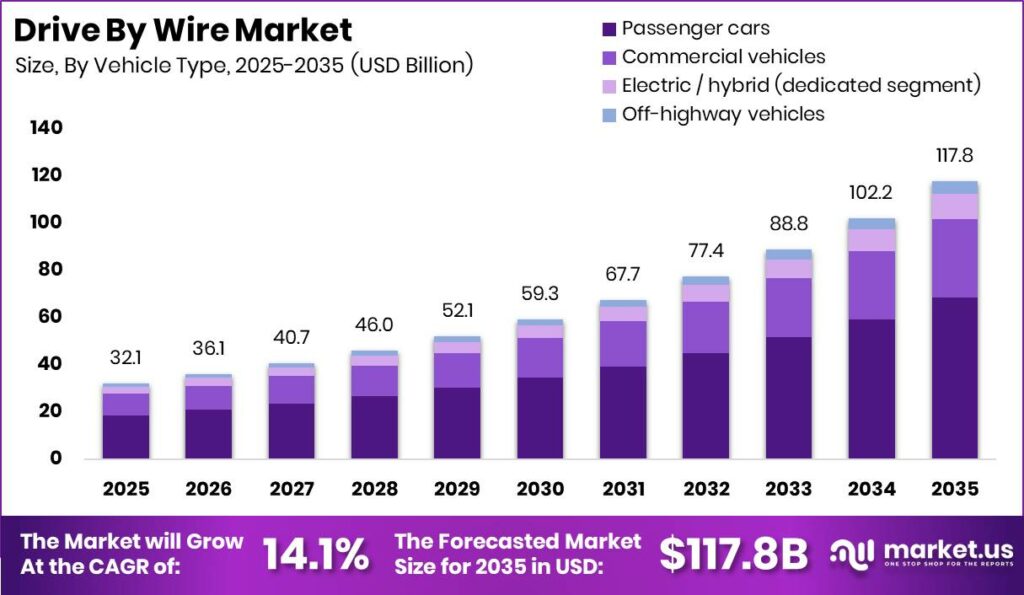
Global Drive By Wire Market size is expected to be worth around USD 117.80 Billion by 2035 from USD 32.10 Billion in 2025, growing at a CAGR of 14.1% during the forecast period 2026 to 2035. Electronic control of throttle, brake, steer, shift, and park functions replaces mechanical linkages with sensors, actuators, and software. This architecture raises content per vehicle and supports software-defined chassis strategies for OEMs and tier-one suppliers.
Therefore, the market covers complete by-wire subsystems sold into passenger cars, commercial vehicles, electric and hybrid platforms, and off-highway machines. Buyers pay for actuators, ECUs, sensors, wiring, and middleware that meet functional-safety rules. Suppliers who qualify redundant electronic paths early lock multi-year platform contracts before mechanical steering and braking fade from new designs.
Key Takeaways
- The global Drive By Wire Market is valued at USD 32.10 Billion in 2025 and is set to reach USD 117.80 Billion by 2035 at a CAGR of 14.1%.
- Passenger cars lead the By Vehicle Type segment with a 58.1% share and rank as the fastest-growing vehicle class.
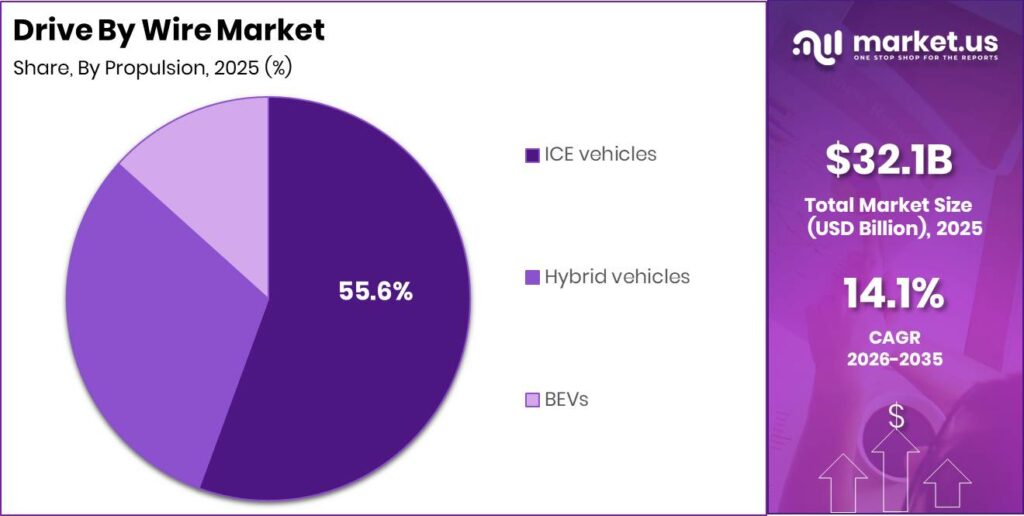
- ICE vehicles hold the largest By Propulsion position at 55.6%, while BEVs rank as the fastest-growing propulsion class.
- Actuators including throttle units lead By Component with a 30.0% share; ECUs and control modules grow fastest.
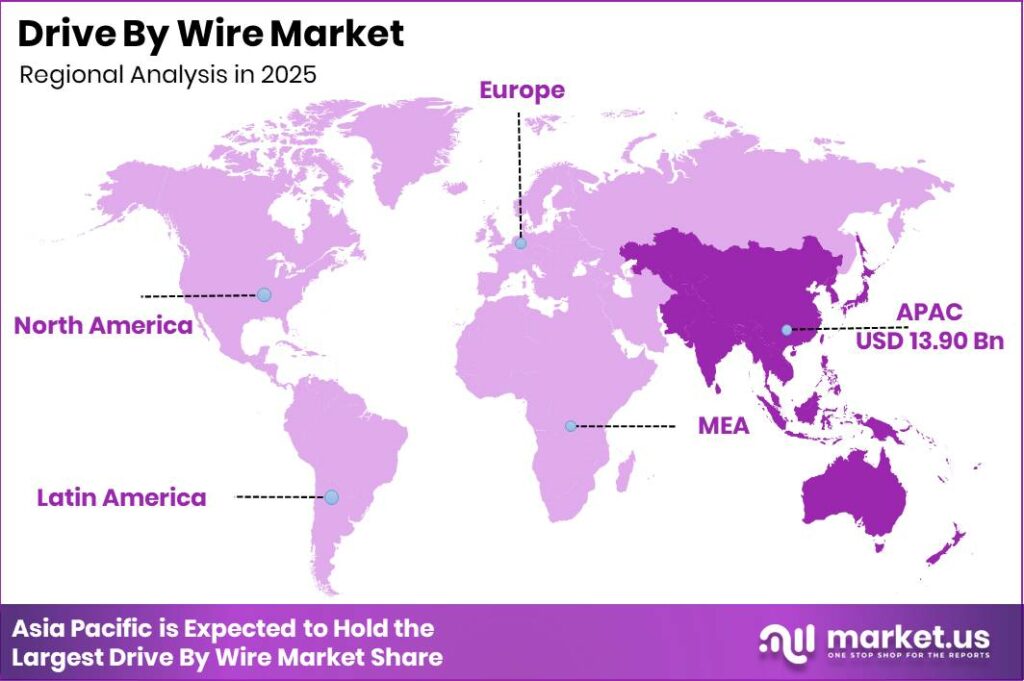
- Asia Pacific dominates the regional landscape with a 43.3% share valued at USD 13.90 Billion.
Governments in Europe, North America, and China tighten emissions and fuel-efficiency rules that reward lighter electronic chassis hardware. OEMs drop heavy mechanical columns and hydraulic lines to cut mass and improve packaging on EV skateboards. This cause-and-effect chain lifts unit demand for steer-by-wire and brake-by-wire modules on every new platform that must meet the next regulatory cycle.
As a result, series validation programs move from lab to road at scale. As reported by Bosch Mobility, one brake-by-wire validation drive covered more than 3,300 km across multiple climate zones toward the Arctic Circle. Long-distance multi-climate proof points shorten OEM sign-off timelines and pull forward series awards for suppliers who finish durability work first.
This signals rising content depth across chassis electronics. Figures from ZF show production of more than 3 billion brake components across its history, giving a deep manufacturing base for hydraulic, electric, and hybrid brake-by-wire lines. In May 2026, Brembo started series production of its Sensify brake-by-wire system for a global automaker, converting software-defined braking from pilot status into shipped volume.
Function Analysis
Throttle-by-wire dominates due to universal electronic throttle baseline fitment.
In 2025, Throttle-by-wire held a dominant market position in the By Function segment of Drive By Wire Market through near-universal electronic throttle control on modern powertrains. Data from OICA shows global vehicle production reached 96.4 million units in 2025. High build volume keeps throttle-by-wire as the default electronic entry point. Suppliers who bundle throttle actuators with shared ECUs capture early wallet share before full chassis-by-wire packages land.
Brake-by-wire converts pedal input into electronic commands that coordinate friction and regenerative force. Under 2026 Formula 1 technical rules, front brakes typically supply approximately 70–75% of total braking force while brake-by-wire manages rear hydraulic force with energy recovery. This force-split logic migrates into road EV platforms. Vendors who master blended brake control win OEM safety-case approvals faster than pure hydraulic incumbents.
Steer-by-wire removes the mechanical column and uses dual actuators with torque feedback. Hirain reported in March 2026 that its steer-by-wire product supports 12-V and 48-V platforms and a maximum rack force of 18 kN. Dual-voltage coverage lets the same stack serve ICE and high-voltage EVs. In January 2025, Nexteer demonstrated Steer-by-Wire and Motion-by-Wire at CES 2025 for next-generation electric and autonomous vehicles, accelerating software-defined steering interest among Asian and global OEMs.
Shift-by-wire replaces mechanical gear linkages with electronic range selection for automatics and multi-speed EVs. Park- and suspend-by-wire complete electronic chassis control for parking pawls and active suspension interfaces. Together these functions hold the remaining share collectively. Suppliers who offer a full function stack reduce OEM integration risk and raise switching costs once a platform freezes its electrical architecture.
Vehicle Type Analysis
Passenger cars dominates with 58.1% due to high global car production volume.
In 2025, Passenger cars held a dominant market position in the By Vehicle Type segment of Drive By Wire Market, with a 58.1% share. OICA data show China alone produced around 30.3 million passenger cars in 2025, with Japan at 7.2 million and India at 5.4 million. Mass car output multiplies by-wire attach rates quickly. Tier-ones that secure high-volume passenger platforms amortize ISO 26262 costs across millions of units.
Commercial vehicles adopt by-wire for fleet telematics, driver-assist braking, and remote operation pilots. Fleet buyers prioritize uptime and predictive maintenance over luxury steering feel. This creates demand for rugged ECUs and actuators with long service intervals. Suppliers who certify commercial-duty cycles open a second revenue stream less tied to passenger fashion cycles.
Electric and hybrid dedicated platforms treat by-wire as native architecture rather than a mid-cycle upgrade. IEA figures show electric car sales topped 20 million globally in 2025, equal to one in four new cars sold. Skateboard layouts remove traditional tunnel packaging, so steer-by-wire and brake-by-wire fit naturally. Early EV platform wins lock multi-year electronic content before late ICE programs convert.
Off-highway vehicles use by-wire for precision control in construction and agriculture. Operators need repeatable implement response and remote or semi-autonomous modes. This segment values durability and high rack force over cabin luxury. Vendors who ruggedize passenger-grade stacks for dust, vibration, and voltage spikes capture niche margin with lower volume competition.
Propulsion Analysis
ICE vehicles dominates with 55.6% due to large installed powertrain base.
In 2025, ICE vehicles held a dominant market position in the By Propulsion segment of Drive By Wire Market, with a 55.6% share. Global sales reached about 99.8 million vehicles in 2025 per OICA-linked industry tallies, and ICE still fills most of that base. Throttle-by-wire and selective brake-by-wire upgrades keep revenue flowing on combustion platforms. Suppliers who serve ICE and EV with shared modules protect volume during the transition decade.
Hybrid vehicles blend combustion and electric drive, so by-wire must coordinate engine load, motor torque, and friction brakes smoothly. Calibration complexity rises because two power sources share one chassis control layer. This raises software and middleware value per vehicle. Firms with strong hybrid calibration tools win programs that pure ICE or pure BEV specialists miss.
BEVs rank as the fastest-growing propulsion class and pull full by-wire suites into series design. IEA analysis confirms electric cars accounted for over a quarter of global car sales in 2025. Regenerative braking needs electronic brake blending that mechanical systems cannot match. OEMs that standardize brake-by-wire and steer-by-wire on BEV skateboards raise electronic content per unit and create recurring software update paths.
Component Analysis
Actuators dominates with 30.0% due to multi-actuator content per vehicle.
In 2025, Actuators including throttle held a dominant market position in the By Component segment of Drive By Wire Market, with a 30.0% share. Each by-wire channel needs at least one primary actuator and often a redundant unit for safety. High actuator count per vehicle keeps this line the largest revenue pool. Manufacturers who scale precision motors and hydraulic-electric hybrids cut unit cost and win multi-function packages.
ECUs and control modules form the fastest-growing component line as domain controllers absorb throttle, brake, and steer logic. Functional-safety rules demand redundant processing and secure boot. This lifts silicon and software content faster than mechanical parts. Suppliers who certify ASIL-D capable modules early become default partners on autonomous-ready platforms.
Sensors feed position, torque, pressure, and pedal data into the control loop. Wiring and connectors carry power and signals under harsh under-hood and chassis conditions. Software and middleware define steering feel and brake blend after hardware freezes. Hirain’s 2026 steer-by-wire platform offers a variable steering-input range of 150–500 degrees for software-defined response. Vendors who own the middleware layer monetize feel profiles long after the actuator ships.
Key Market Segments
By Function
- Throttle-by-wire
- Brake-by-wire
- Steer-by-wire
- Shift-by-wire
- Park-/suspend-by-wire
By Vehicle Type
- Passenger cars
- Commercial vehicles
- Electric / hybrid (dedicated segment)
- Off-highway vehicles
By Propulsion
- ICE vehicles
- Hybrid vehicles
- BEVs
By Component
- Actuators (incl. throttle)
- ECUs / control modules
- Sensors
- Wiring & connectors
- Software & middleware
Regional Analysis
Asia Pacific Dominates the Drive By Wire Market with a Market Share of 43.3%, Valued at USD 13.90 Billion
Asia Pacific leads with a 43.3% share worth USD 13.90 Billion on the back of high vehicle output in China, Japan, South Korea, and India. Local EV platform proliferation and commercial fleet electrification pull steer-by-wire and brake-by-wire into series programs. Suppliers with regional manufacturing and dual-voltage products secure volume before Western plants finish retooling.
Europe ranks among the fastest-moving regions for series steer-by-wire rollout, led by German OEM validation and Japanese co-development patterns cited in driver tables. Strict emissions rules and ADAS penetration raise electronic chassis content quickly. This means European platform wins set global safety and software benchmarks that Asian and North American programs later copy.
North America follows with strong passenger and commercial demand plus liability-sensitive design rules. Latin America and Middle East and Africa add smaller but rising volumes as global platforms localize. Cross-region homologation still fragments timelines, so multi-region certified stacks win preferred-supplier status.
Key Regions and Countries
North America
- US
- Canada
Europe
- Germany
- France
- The UK
- Spain
- Italy
- Rest of Europe
Asia Pacific
- China
- Japan
- South Korea
- India
- Australia
- Rest of APAC
Latin America
- Brazil
- Mexico
- Rest of Latin America
Middle East and Africa
- GCC
- South Africa
- Rest of MEA
Market Dynamics
Market Opportunity Analysis - Off-highway, BEV software layers, and commercial retrofit paths remain under-penetrated relative to passenger ICE volume.
Off-highway vehicles still sit behind passenger cars in by-wire attach rates even though precision control and remote operation create clear value. Ruggedized actuators and high rack-force designs remain specialized. New entrants who harden passenger-grade stacks for dust and vibration can win agricultural and construction programs with less direct competition from volume chassis giants.
BEVs grow fastest in propulsion yet full software-defined steering and brake feel monetization trails hardware attach. Many platforms ship capable ECUs without mature subscription catalogs. This means investors who fund middleware and customer-facing feature stores capture recurring margin after the first hardware sale.
Commercial vehicle retrofit and aftermarket kits remain early relative to OEM factory fit. Fleets want electronic braking and steering upgrades without full vehicle replacement. Therefore, modular kits certified for major truck platforms open a medium-term channel in North America and Europe that pure OEM-tied suppliers under-serve.
By contrast, shift-by-wire and park-by-wire trail throttle and brake in visibility inside multi-function bids. Bundling these lower-share functions into a single chassis electronics package raises average selling price. Suppliers who present a full function suite reduce OEM integration risk and lock share before standalone specialists catch up.
Technology and Innovation Landscape - Weight cut, fluid elimination, and software-defined steering ranges redefine chassis electronics value.
Bosch and peer hydraulic brake-by-wire designs target major weight reduction versus older redundant mechanical layouts. Lighter modules improve EV range and free packaging space near the corners. Manufacturers who hit double-digit mass cuts without losing redundancy win platform nominations on efficiency-critical skateboards.
Continental’s 2025 electro-mechanical brake architecture eliminates 100% of the brake fluid requirement. Fluid-free designs cut maintenance and leak risk over vehicle life. Buyers in fleet and premium EV segments gain lower service cost. This shifts competition from hydraulic expertise toward electromechanical and software control quality.
According to MotorTrend’s 2025 technical assessment, the Tesla Cybertruck steer-by-wire yoke needed only 340 degrees of movement across full range, less than one full rotation. The linked rear-steering system turns rear wheels by as much as 10 degrees. Tighter steering ratios and rear-steer improve low-speed agility and high-speed stability. Competitors must match software-defined ratio maps or lose premium EV benchmark status.
Under 2026 Formula 1 rules, brake-by-wire cars use 18-inch wheels that constrain disc size while electronic rear control blends with energy recovery. Race-derived control algorithms migrate into road EV brake blending. Suppliers who translate motorsport control software into ASIL-rated road stacks differentiate on pedal feel and regen efficiency.
Drivers
Steer-by-wire moves from prototype validation into series production, led by Mercedes-Benz commercial rollout plans for 2026 after heavy 2024 and 2025 testing. Dual-actuator electronic architectures replace single mechanical columns and raise content per vehicle. Each new OEM platform win compounds volume on a still-small base. Early movers absorb ISO 26262 costs now and later collect software-defined licensing once volumes clear breakeven.
Consequently, emissions mandates, EV skateboard growth, ADAS penetration, and OEM weight targets reinforce the same electronic shift. Mechanical linkage removal cuts mass and frees packaging space. Commercial EV fleets in Asia Pacific add another volume leg. Buyers gain finer control and over-the-air feel updates while suppliers expand bill-of-materials share on every committed platform.
| Driver | (~) % Impact on CAGR Forecast | Geographic Relevance | Impact Timeline |
|---|---|---|---|
| Steer-by-wire series production ramp-up | +3.2% | Global (Europe, Japan lead) | Short term (2 years or less) |
| Stricter vehicle emissions and fuel-efficiency mandates | +2.6% | Europe, North America, China | Short term (2 years or less) |
| Electric vehicle platform proliferation | +2.4% | Global | Medium term (2 to 4 years) |
| ADAS and electronic stability control penetration | +2.1% | Global | Short term (2 years or less) |
| OEM weight-reduction targets via mechanical linkage removal | +1.5% | North America, Asia Pacific | Medium term (2 to 4 years) |
| Rising commercial EV fleet electrification in Asia Pacific | +1.2% | Asia Pacific | Medium term (2 to 4 years) |
Restraints
Automotive-grade legacy-node chips still make up about 95% of vehicle semiconductors, and by-wire needs multiple redundant microcontrollers per channel. New fab capacity takes at least 2 years from plan to full output. Lead times stretch past normal planning cycles. OEMs stock more parts and absorb working-capital drag while chassis electronics makers face spot premiums or delayed launches.
As a result, high capital cost of redundant safety hardware, elevated interest rates that delay OEM CapEx, missing global steer-by-wire approval harmony, and North American liability exposure further slow adoption. Programs freeze incremental unit sales until chip supply and regulatory clarity improve. Participants who secure long-term chip contracts and multi-region homologation packages protect launch dates better than pure spot buyers.
| Restraint | (~) % Impact on CAGR Forecast | Geographic Relevance | Impact Timeline |
|---|---|---|---|
| Automotive-grade legacy chip supply constraints | -1.8% | Global | Short term (2 years or less) |
| High capital cost of functional-safety redundancy hardware | -1.4% | North America, Europe | Short term (2 years or less) |
| Elevated interest rate environment delaying OEM CapEx | -1.1% | North America, Europe | Short term (2 years or less) |
| Absence of harmonized global steer-by-wire regulatory approval | -0.9% | Global | Short term (2 years or less) |
| Consumer liability and product-recall exposure on electronic-only control | -0.7% | North America | Medium term (2 to 4 years) |
Challenges
By-wire systems remove mechanical fallback, so intrusion into steering or braking ECUs creates direct safety risk. Each domain controller needs intrusion detection, secure boot, and repeated penetration tests that can add multiple development quarters per program. Already-qualified platforms keep shipping while new nameplates absorb the extra cybersecurity load. This friction caps how fast content can spread across the fleet.
This creates demand for reusable cybersecurity stacks and shared threat models that cut duplicated certification spend. Talent shortages in automotive software safety, multi-tier integration complexity, long redundant-actuator test cycles, and fragmented homologation in Asia Pacific and Latin America add further drag. Firms that productize secure middleware and pre-certified actuator pairs open a services and software revenue stream beyond one-time hardware sales.
| Challenge | (~) % CAGR Friction Drag | Geographic Relevance | Mitigation Horizon |
|---|---|---|---|
| Cybersecurity hardening for by-wire ECUs | -1.3% | Global | Medium term (2 to 4 years) |
| Automotive software-safety talent shortage | -1.0% | North America, Europe | Long term (4 years or more) |
| Multi-tier supplier integration complexity | -0.8% | Global | Medium term (2 to 4 years) |
| Redundant actuator validation testing cycles | -0.6% | Global | Medium term (2 to 4 years) |
| Fragmented regional homologation standards | -0.5% | Asia Pacific, Latin America | Long term (4 years or more) |
Opportunities
Today most by-wire revenue lands at vehicle sale through hardware pricing. The larger white space is post-sale software subscriptions on the same actuators, still in early pilot stages at tier-one investor days. Adjustable steering feel and performance brake maps need no extra steel once the ECU ships. Software-tier gross margins exceed hardware once integration costs amortize.
However, full upside needs fleet penetration of software-capable hardware, subscription infrastructure, and clarity on which functions may be feature-gated, none fully ready as of 2026. This sits above the baseline 14.1% CAGR. Retrofit kits for commercial fleets, domestic legacy-chip foundries, off-highway adoption, and Asia Pacific two-wheeler throttle-by-wire add further entry points for early movers who build reusable software and regional supply now.
| Opportunity | (~) % Potential CAGR Upside | Geographic Relevance | Execution Window |
|---|---|---|---|
| Retrofit and aftermarket by-wire kits for commercial fleets | +1.8% | North America, Europe | Medium term (2 to 4 years) |
| Software-defined vehicle licensing and over-the-air feature monetization | +1.6% | Global | Long term (4 years or more) |
| Domestic legacy-chip foundry roll-up and localization | +1.3% | North America, India | Long term (4 years or more) |
| Off-highway and agricultural machinery by-wire adoption | +1.1% | Asia Pacific, Europe | Medium term (2 to 4 years) |
| Two-wheeler and micro-mobility throttle-by-wire expansion | +0.9% | Asia Pacific | Medium term (2 to 4 years) |
Key Company Insights
Robert Bosch GmbH advances brake-by-wire and steer-by-wire toward series production with Asian OEMs from 2026 through its Vehicle Motion unit. Bosch reported in April 2025 that its hydraulic brake-by-wire system can be up to 25% lighter than conventional redundant braking while keeping redundancy. Weight cuts help EV range and packaging. This positions Bosch to convert validation mileage into multi-year volume contracts ahead of slower peers.
Continental AG showcased a next-generation integrated brake-by-wire system at Auto Shanghai in April 2025 that combines master cylinder, booster, and controls in one module and cuts system weight by nearly 30%. Integration lowers assembly time and vehicle mass for EV platforms. Continental’s electro-mechanical path also removes fluid maintenance burden. OEMs seeking simpler bill-of-materials and lower service cost gain a clear reason to dual-source or switch.
Key Players
- Robert Bosch GmbH
- Continental AG
- ZF Friedrichshafen AG
- Nexteer Automotive
- JTEKT Corporation
- Denso Corporation
- Hitachi Astemo (Hitachi, Ltd.)
- Aptiv PLC
- Nidec Corporation
- Schaeffler Group
- Brembo S.p.A
- CTS Corporation
- Ficosa Internacional SA
- Kongsberg Automotive
- Curtiss-Wright Corporation
Recent Developments
- September 2025: Bosch announced that its Brake-by-Wire and Steer-by-Wire systems will enter series production from 2026 with two Asian vehicle manufacturers through its Vehicle Motion division.
- September 2025: ZF Friedrichshafen showcased its Steer-by-Wire and digital brake technologies at IAA Mobility 2025, highlighting production deployment in the NIO ET9 and confirming additional customer programs with Mercedes and Cadillac.
Geopolitical Impact Analysis
According to WTO monitoring of trade measures, average applied tariffs on automotive parts in several major corridors remain in the mid-single to low-double digits, with selected bilateral hikes above 20% on certain electronics and steel categories. UNCTAD shipping reviews note port congestion and rerouting that can add 10 to 14 days on Asia-Europe lanes during peak disruption. Actuators, ECUs, and wiring for by-wire systems face higher landed cost and buffer-stock needs when routes lengthen.
Consequently, World Bank logistics indicators show manufacturing lead-time variance rising by more than 15% for complex auto electronics in stressed corridors, while IMF commodity trackers recorded multi-quarter swings above 25% in key metal inputs used in motors and connectors. Chassis electronics makers dual-source legacy chips and localize final assembly near OEM plants. This protects series-production dates when geopolitical shocks hit single-region supply chains.
Report Scope
| Report Features | Description |
|---|---|
| Market Value (2025) | USD 32.10 Billion |
| Forecast Revenue (2035) | USD 117.80 Billion |
| CAGR (2026-2035) | 14.1% |
| Base Year for Estimation | 2025 |
| Historic Period | 2020-2024 |
| Forecast Period | 2026-2035 |
| Report Coverage | Revenue Forecast, Market Dynamics, Market Opportunity Analysis, Technology and Innovation Landscape, Competitive Landscape, Recent Developments |
| Segments Covered | By Function (Throttle-by-wire, Brake-by-wire, Steer-by-wire, Shift-by-wire, Park-/suspend-by-wire), By Vehicle Type (Passenger cars, Commercial vehicles, Electric / hybrid, Off-highway vehicles), By Propulsion (ICE vehicles, Hybrid vehicles, BEVs), By Component (Actuators incl. throttle, ECUs / control modules, Sensors, Wiring & connectors, Software & middleware) |
| Regional Analysis | North America (US and Canada), Europe (Germany, France, The UK, Spain, Italy, and Rest of Europe), Asia Pacific (China, Japan, South Korea, India, Australia, and Rest of APAC), Latin America (Brazil, Mexico, and Rest of Latin America), Middle East and Africa (GCC, South Africa, and Rest of MEA) |
| Competitive Landscape | Robert Bosch GmbH, Continental AG, ZF Friedrichshafen AG, Nexteer Automotive, JTEKT Corporation, Denso Corporation, Hitachi Astemo (Hitachi, Ltd.), Aptiv PLC, Nidec Corporation, Schaeffler Group, Brembo S.p.A, CTS Corporation, Ficosa Internacional SA, Kongsberg Automotive, Curtiss-Wright Corporation |
| Customization Scope | Customization for segments, region / country-level will be provided. Additional customization can be done based on requirements. |
| Purchase Options | We have three licenses to opt for: Single User License | Multi-User License (Up to 5 Users) | Corporate Use License (Unlimited User and Printable PDF) |





































